BlogDatenräumeHonest Data Room Review in June 2026: I Tested 10 Data Rooms For You
Honest Data Room Review in June 2026: I Tested 10 Data Rooms For You
·12 Min. Lesezeit
Marc Seitz
I'm Marc, co-founder of Papermark. I started building Papermark to bring a better solution for document sharing to a market where most data room providers have existed for at least 20 years.
The problem with the VDR industry is that they're too focused on enterprise clients and often forget that, at the end of the day, the world has changed. Nobody wants to be sold something they don't need or that won't work. Incumbents like iDeals, Datasite, Intralinks, and even DocSend, founded in the early 2000s, just don't innovate anymore. They prioritize selling contracts for $1,000-$30,000+ per month. Otherwise, how do you explain they need thousands of employees? I founded multiple startups and worked at a Fund of Funds before, so I felt the pain of getting data room software and the pain of sitting through enterprise sales pitches.
So, if you're like me, here is my honest review of virtual data rooms, originally written in January 2025 and fully refreshed in June 2026 with current pricing, ratings, and product changes.
I want to start by first reviewing the reasons why you might be looking for virtual data room alternatives and why we bring to market and give you my take. Of all the founders and operators we've spoken to who are looking for better data room solutions, here are their top reasons:
Traditional VDRs are ridiculously expensive
Open Source VDR just does not exists
Legacy interfaces feel like they're from 2000
No real-time analytics
Limited developer tools
Price
The pricing reality in the VDR space is brutal and not transparent at all, majority of VDRS dont have any pricing page. Traditional providers like Intralinks and iDeals charge $3,000+ monthly.
Price by pages, or storage-based pricing maybe made sense 20 years ago, but it's ridiculous now, as storage is no longer expensive. Taking into account that the majority of VDR providers use AWS under the hood, which is cheap, compared to charging $0.40 to $0.80 per page or $60 to $77 per gigabyte (GB) per month.
Alternatively you can use free Google Drive or Dropbox, but they provide limited to none document protection features and tracking activity features.
After evaluating dozens of data room providers in the market landscape, the reality is this: genuine alternatives that deliver both functionality and affordability are surprisingly rare.
The big thing in VDR market is no transparent pricing, or no pricing on page, which mostly tells us about pricing being not very affordable. Couple of solutions I would mention who have pricing on their pages: DealRoom from $1000/month for 1 data room, Ansarada starting from $479/month for 250 MB and Papermark from $99/month for unlimited data rooms.
We want to bring something in the middle to find the perfect balance between a secure solution and a modern, affordable price.
We saved 70% by transitioning to Papermark. And managed to scale our sales. Our team loves this modern data rooms.
Alonso Benavides Panizo
SVP of Finance at Yuno | Founding team
Security = Open Source
I am a big open-source believer and built Papermark from the start as an open-source software. The open-source model means hundreds of developers can review our security implementation, as code is open and available on GitHub. Vulnerabilities are spotted faster, fixes are implemented quicker, and there's complete transparency about what's happening inside the codebase.
But at the same time, majority of users use Papermark as a familiar SaaS solution hosted on us. The open source thought is a transparency we bring.
Something impossible with closed-source alternatives. At the end of the day, you can not verify what is happening inside the codebase of other VDR providers, and you can not verify the security of the solution. When was the last time you heard about a community-driven security improvement to DocSend or Intralinks?
Design Actually Matters
Look, if you've ever used Intralinks or Ideals, you know what I'm talking about. These interfaces look like they were designed in 2005 and never updated. Everything takes forever to load, menus are buried three clicks deep, and uploading files feels like a chore.
The good news? Almost any modern VDR will feel like a breath of fresh air. But here's the thing - not all "modern" solutions are created equal.
From what I've tested, modern providers like Ansarada and Firmroom are decent choices if you want something clean and updated.
Papermark takes a different approach - we built it like a developer tool. Everything loads instantly, the interface is minimal but powerful, and there's no fluff. If you've ever used Linear or Vercel, you'll feel right at home.
Bottom line: Choose Papermark for speed and simplicity. While legacy providers like iDeals have updated their design somewhat, and Firmroom offers a clean interface for deals, we focus on instant loading and developer-friendly workflows.
Analytics - Where Everyone Fails
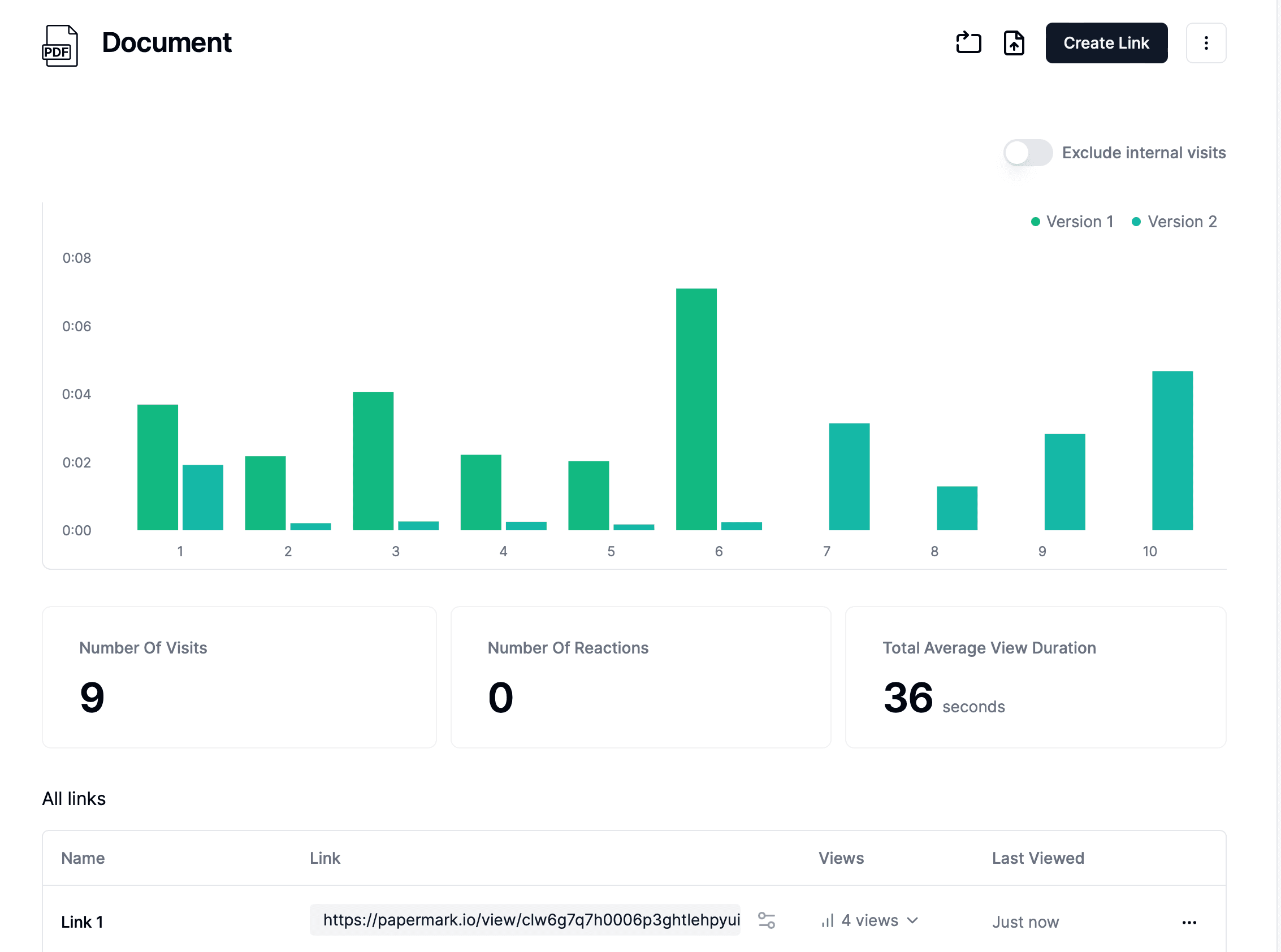
Here's where most VDRs completely drop the ball. You share your most important documents and get basically no deep dive into user behavior.
Traditional VDRs give you too basic analytics: "John Smith viewed Document A on Tuesday." That's it. No details about which pages they spent time on, where they dropped off, or what sections grabbed their attention. For something you're paying $300+ per month for, this is embarrassing.
The page-by-page problem is real. When you're sharing a 50-page pitch deck or financial report, knowing someone "viewed" the document tells you nothing. Did they skim the first few pages and bounce? Did they deep-dive into your financials?
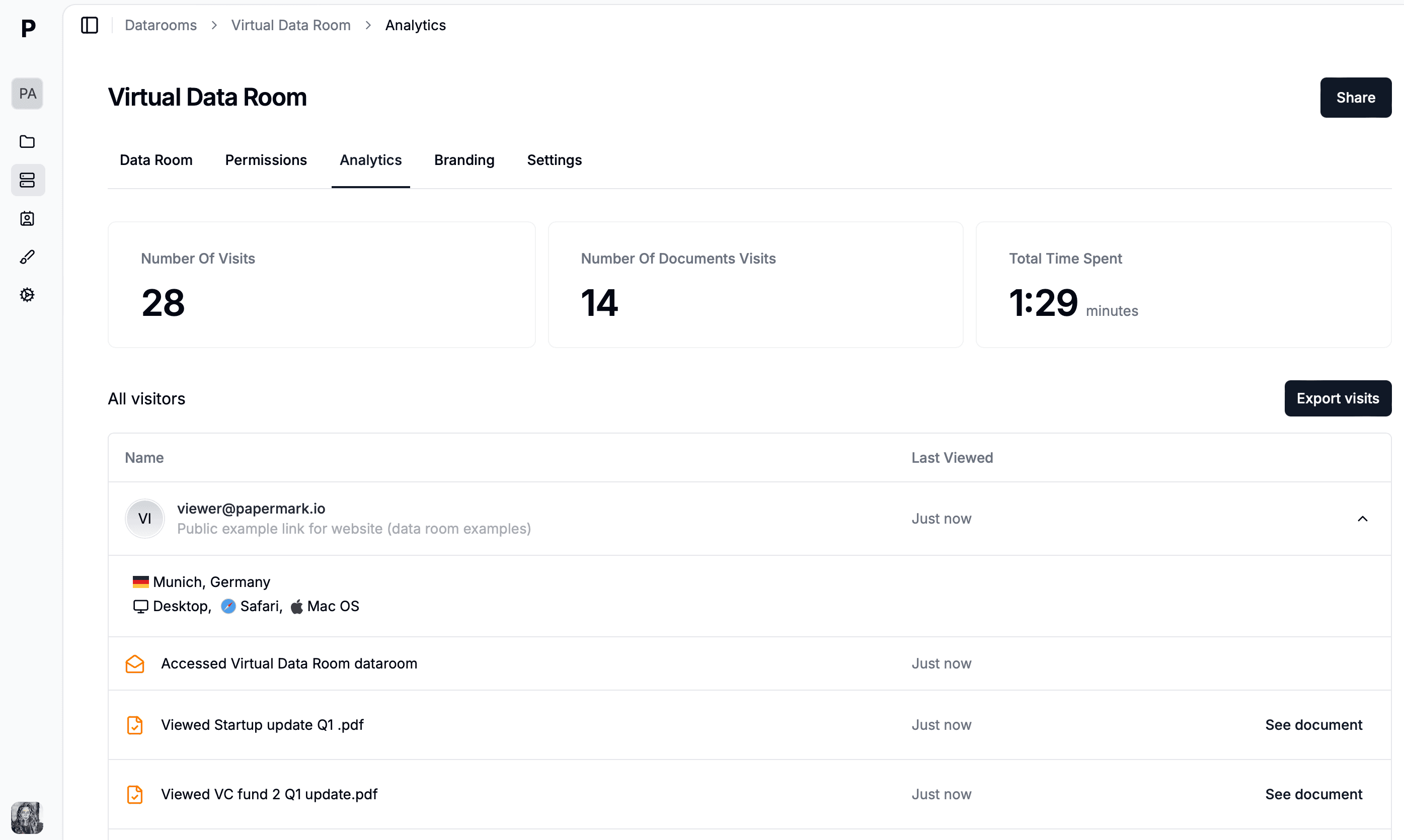
Papermark changes this completely. We track every page view, scroll depth, time spent per section, and even cursor movements. You can see exactly which slides in your pitch deck are working and which ones are losing people. When an investor spends 5 minutes on your financial projections versus 10 seconds on your team slide - that's actionable intelligence.
Real-time analytics mean you know the moment someone opens your document. You can literally watch engagement happen live and follow up while your content is still fresh in their mind.
This isn't just nice-to-have data - it's competitive intelligence that can make or break your fundraising, sales process, or M&A deal.
The Reality of the VDR Market
The data room market is divided into three categories at the moment:
3. Modern Alternatives: Papermark, Digify, DocSend
Pricing: $99-$500/month
Target: Startups, Funds, founders, small teams
Reality: Transparent pricing, modern UX, but varies widely in features
Let me break down what I found when I actually used these platforms.
The Honest Comparison of Data Rooms
Provider
Pricing
Transparent Pricing
Sign-up
Real-time Analytics
Data Rooms
Best For
Papermark
€99/mo
Yes
Instant
Yes - page-by-page
Unlimited
Startups, modern teams
Digify
$500/mo
Yes
Instant
Basic
Limited (3)
Security-focused sharing
SecureDocs
$400/mo
Yes
Instant
Basic
Limited
Simple document sharing
DocSend
$300/mo
Yes
Instant
Basic
Limited
Basic document sharing
Ansarada
$479–$8,579/mo
Partial
Instant
Yes - AI-powered
Included
AI-powered deals
iDeals
$499+/mo
No - quote required
Demo only
Basic
Enterprise
Mid-market M&A
FirmRoom
$995/mo
Yes
Instant
Basic
Included
Mid-market deals
DealRoom
$1,495+/mo
No - quote required
Demo only
Basic
Enterprise
Mid-large M&A
Intralinks
$7,500+/mo
No - quote required
Demo only
Basic
Enterprise
Enterprise M&A
Datasite
$10,000+/mo
No - quote required
Demo only
Yes - AI-powered
Enterprise
Large enterprise
Data rooms Comparison
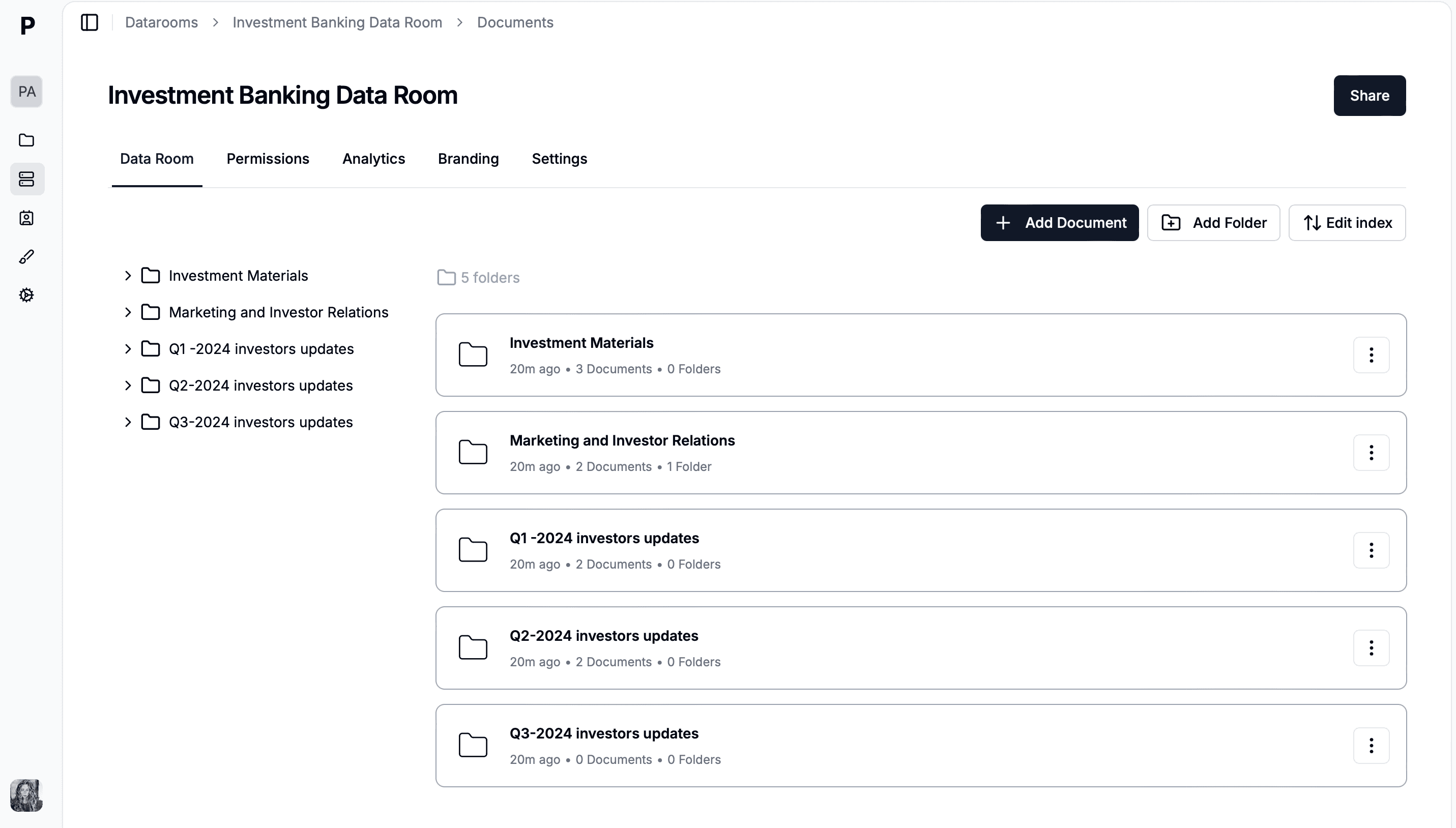
1. Papermark - The Open-Source Option
Price: €99/month (unlimited data rooms)
Best for: Fundraising, M&A deals for companies seeking modern, cost-effective data rooms
I'll be upfront-I'm the co-founder. But here's why we built it:
We started Papermark because the alternatives were either too expensive or too basic. The enterprise players wanted $10,000+ for features we could build better. The budget options lacked security. So we built something in the middle.
What works:
Unlimited data rooms and storage with predictable pricing
Page-by-page analytics that actually show you where viewers spend time
Open source-you can self-host if you need complete data control
Custom domains and white-labeling included (not a $500 add-on)
SOC 2, ISO 27001 certified
What doesn't:
No dedicated mobile app (though mobile web works)
Self-hosting requires DevOps resources
My take: We built this for founders tired of enterprise pricing and dated interfaces. If that's you, try it free.
2. Intralinks - The Enterprise Workhorse
Price: $7,500+/month (custom quotes only)
Best for: Large enterprise M&A, investment banks with deep pockets
Intralinks has been around since 1996. They've powered thousands of deals worth trillions. But that legacy comes with baggage.
What works:
Battle-tested platform with decades of experience
Global compliance certifications
24/7 multilingual support
Handles enormous document volumes
What doesn't:
Interface feels like it was designed in 2005
Pricing is completely opaque-prepare for a sales process
Steep learning curve requiring extensive training
Overkill for anything under $100M deal value
My take: If you're Goldman Sachs doing a $5 billion acquisition, Intralinks makes sense. For everyone else, you're paying for features you'll never use.
Best for: Large-scale M&A, particularly sell-side transactions
Datasite (formerly Merrill Datasite) has invested heavily in AI. Their document categorization and analytics are impressive. But that power comes at a price.
What works:
AI-powered document organization saves hours
Excellent analytics dashboard
Strong global support infrastructure
Purpose-built for complex M&A
What doesn't:
Pricing is a black box
Setup and configuration is time-consuming
Interface has a steep learning curve
Way overbuilt for straightforward deals
My take:Datasite is betting big on AI-they recently acquired MergerLinks to enhance deal intelligence. If you're running complex transactions and have budget, it's solid. But most companies don't need this level of complexity.
My take: DocSend rode the startup fundraising wave but hasn't kept up. The UI feels dated, support got worse after acquisition, and pricing went up. We built Papermark specifically for people frustrated with DocSend.
After all this research, here's what I've learned matters most:
1. Transparent Pricing
If a provider hides their pricing, they're probably going to charge you too much. The best providers-SecureDocs, FirmRoom, Papermark-tell you what it costs upfront.
2. Security That Fits Your Needs
Don't pay for SOC 2 Type II, HIPAA, and ISO 27001 if you're just sharing a pitch deck. But if you're handling M&A materials, those certifications matter.
3. Actually Good Analytics
"Someone viewed your document" is useless. Page-by-page analytics that show where viewers spend time? That's actionable intelligence.
4. Reasonable Support
When you're in the middle of a deal and something breaks, you need help in hours, not weeks. Test support responsiveness before you commit.
5. Modern Interface
Life's too short for interfaces designed in 2005. Your team will actually use tools that don't feel like punishment.
Dealflow mit einem virtuellen Datenraum verwalten
Keine Kreditkarte erforderlich
Seitenweise Analyse
Unbegrenzte Dokumente & Ordner
Berechtigungsverwaltung
Dynamische Wasserzeichen
NDA-Erfassung
Echtzeit-Warnungen
Individuelles Branding
Prüfprotokoll
My Recommendation in June 2026
For most companies in June 2026, you don't need a $10,000/month enterprise VDR.
If you're a startup or growing company: Look at Papermark, FirmRoom, or SecureDocs. Transparent pricing, modern interfaces, and the features you actually need.
If you're running mid-market M&A: iDeals, Ansarada, or DealRoom offer the balance between features and cost.
If you're a large enterprise: Datasite and Intralinks exist for a reason. But make sure you actually need that level of complexity before signing.
Whatever you choose, demand transparent pricing. The VDR industry has gotten away with opacity for too long.
Our Bigger Vision
A developer-friendly document sharing platform doesn't exist yet! We believe that document analytics should be available to anyone creating and sharing documents.
Rich observability: Don't get left in the dark when sharing a document. Papermark provides full transparency by exposing all document-related events through webhooks.
Fast performance: We're built on top of Vercel to serve your documents fast wherever your recipients are located, with real-time engagement data powered by ClickHouse.
Developer-friendly: We're expanding the platform with a clean API, so you can create, share, connect and expand documents both externally and internally.
Final Thoughts
Virtual data rooms haven't evolved much since 2010, but the way founders build and share has. In June 2026, you deserve lightning-fast document viewers, real-time engagement insights, and predictable pricing that won't bankrupt your startup.
If you're tired of per-page billing, clunky enterprise UIs, and black-box analytics, give Papermark Data Rooms a try. We'd love your feedback as we continue building the future of document sharing.
Ready to experience modern document sharing? Start your free trial today and see why founders choose Papermark for their most important documents.
Thanks for reading - and let us know what you want to see next!
I hope you find this article helpful, and I genuinely hope you find the best product that fits your needs!
If there's any other product you want us to review or if there are reasons we haven't covered, just let us know :)