



datarooms
Virtual Data Room Toronto: 7 Best Providers and Pricing for 2026
Compare the 7 best virtual data room providers in Toronto for 2026: pricing, PIPEDA compliance, Canadian data residency, and the right VDR for your M&A deal.
Hi, it's Marc, founder of Papermark. I went through the pricing of each major virtual data room provider so you don't have to. What I discovered is that most VDR pricing is not transparent - you often need to contact sales or request a quote to get real numbers. I've compiled everything I found here to save you time.
Virtual data rooms in 2026 cost from €99/month flat on annual billing (Papermark Data Rooms) to $25,000+/year for custom enterprise quotes (Datasite, Intralinks). The four pricing models in the market are flat-rate (Papermark, SecureDocs, Firmex), per-user (DocSend, ShareVault), per-page (legacy M&A VDRs like Intralinks), and per-GB storage (Ansarada). Flat-rate pricing is the most predictable for most real deals; per-page can balloon fast on document-heavy transactions. This guide breaks down every model, hidden fees, and the real total cost for startups, fundraising, M&A, and IPO workflows.
Pricing below was collected directly from vendor pricing pages, public G2 and TrustRadius reviews, and anonymized customer quotes from teams moving between VDRs in 2026. Where a vendor does not publish pricing (Datasite, Intralinks, Merrill), the ranges reflect representative customer contracts verified in September 2026. Where pricing is public and flat-rate (Papermark, SecureDocs, CapLinked), the numbers are taken from the vendor's own published tiers. This guide is intentionally cautious with "starts at" anchors - most buyers end up on higher tiers once storage, admin seats, and overage clauses are added.
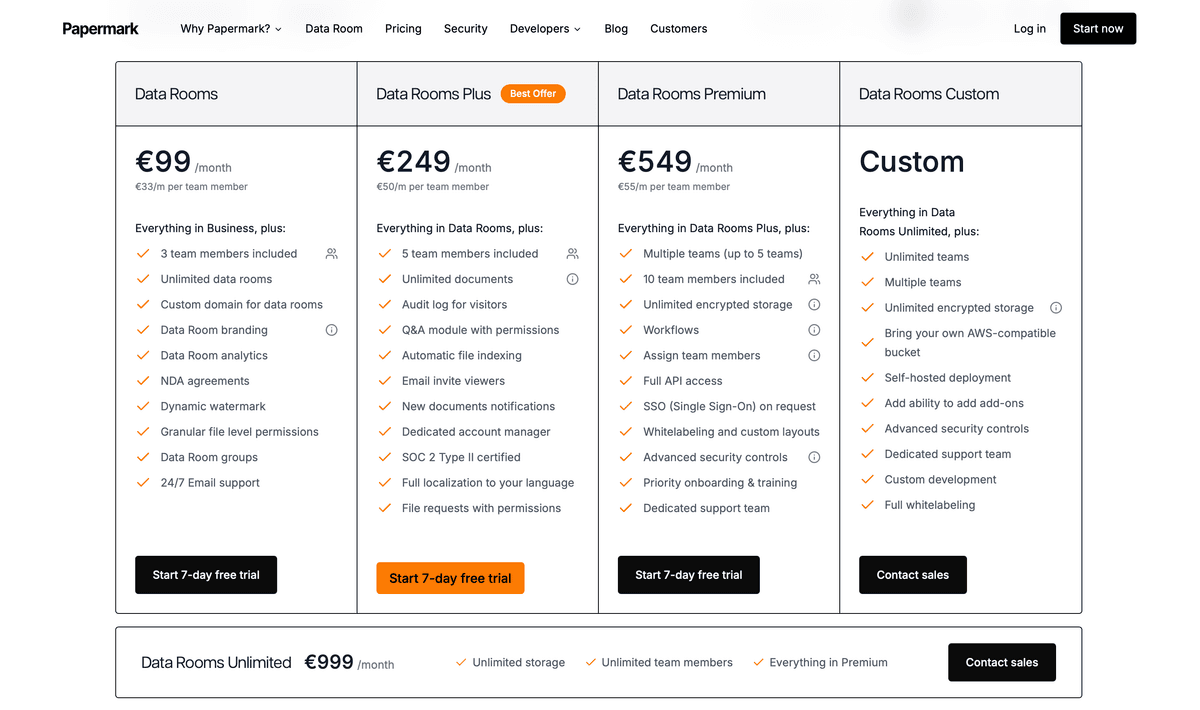
Virtual data room costs vary by pricing model and deal size, but the 2026 market breaks into four tiers. Modern flat-rate VDRs like Papermark sit at €99/month on annual billing for the Data Rooms plan (€149/month billed monthly), with unlimited documents, 3 team members included, and +€33/month per additional team member. Mid-market flat-rate providers (SecureDocs, CapLinked, Firmex) sit at $450-$625/month. Per-user VDRs (DocSend) sit at $15/user/month for basic plans and $50+/user for analytics tiers. Enterprise VDRs charging per-page or per-GB (Datasite, Intralinks, Merrill, iDeals Business+) commonly land at $10,000-$50,000/year on custom quotes.
The cheapest-to-budget model is flat-rate. A fundraising data room with 500 documents and 10 active viewers costs the same on a flat-rate plan whether it runs for one month or six. On a per-page plan, the same room at $0.60/page runs ~$30,000 against only the pages, before user fees. On a per-user plan with 20 LPs invited, the same setup costs 20 × $25 = $500/month before analytics upcharges.
For any deal that involves more than ~200 documents or more than ~5 external viewers, flat-rate is almost always cheaper than per-page or per-user. For pitch-deck-only workflows (a founder sharing a single deck with 15 investors), per-user DocSend-style pricing can be cheaper at the margin. For enterprise M&A with 2,000+ documents and 50+ reviewers, flat-rate still wins if the provider offers unlimited documents at the price point.
There are four pricing models used across every VDR in the market. The table below summarizes what each one costs, who it favors, and where it breaks down.
| Pricing model | Typical range | Best for | Where it breaks |
|---|---|---|---|
| Flat-rate subscription | €99-€1,000/month | Most fundraising, M&A, and diligence workflows | Very small pitch-deck workflows (where per-user is cheaper) |
| Per-user subscription | $15-$250/user/month | Small teams sharing pitch decks or sales collateral | Processes with 10+ external reviewers (LPs, bidders, counsel) |
| Per-page pricing | $0.40-$0.85/page | Very short, small-document deals | Any M&A or diligence workflow with 500+ pages - scales badly |
| Per-GB storage | $60-$77/GB/month | Projects with strict file-size caps | Video, audio, or technical-document heavy deals |
| Custom enterprise quote | $10,000-$50,000+/year | Enterprise M&A, IPO, large PE fundraising | Buyers who need predictable pricing or flexibility |
Per-page pricing is a legacy model inherited from physical data rooms. Providers charge between $0.40 and $0.85 per page for storing and managing documents in the VDR. It sounds cheap until you realize a 200-page CIM, plus 50 legal contracts averaging 30 pages each, plus an HR binder of 400 pages, clears 2,000 pages on its own. At $0.60/page that single room costs $1,200, before any user fees. Intralinks, iDeals in certain tiers, and Ansarada use this model.
One CEO of a capital-markets platform described the real-world problem in a sales call: "Intralinks is just too expensive, we can't really afford to pay by page like that." That is the structural issue with per-page pricing - it penalizes thorough diligence rather than rewarding it.
In the per-user model, the provider charges $15 to $25 per regular user per month, with admin seats often costing significantly more ($100 to $250/month). DocSend, ShareVault, and a handful of smaller VDRs use this structure. It is attractive for tiny deals (a founder sharing a pitch deck with 3 partners) and punishing at scale. A Series B raise with 40 investors invited becomes a $600-$1,000/month line item before any analytics upcharge.
Some providers charge $60 to $77 per GB per month. This works if your files are PDFs and Word documents. It breaks the moment you add technical diagrams, audio transcripts, or video walkthroughs. Ansarada no longer publishes public pricing and now quotes per deal; historically its tiered storage pricing (250 MB at $479/month, 1 GB at $1,479/month, 5 GB at $3,069/month, scaling up to 20 GB at $8,579/month) meant per-GB pricing disguised as flat-rate.
In the flat-rate model, providers charge a fixed monthly or annual fee regardless of document count or external viewer count. Papermark's Data Rooms plan is €99/month on annual billing (€149/month billed monthly), with unlimited documents, 3 team members included, and all advanced VDR features bundled. Additional team members above the included quota cost +€33/month on annual billing. SecureDocs charges a subscription from $450/month (billed annually), CapLinked starts at $399/month (Team plan), and Firmex is quote-based with reported entry rates around $625/month. For any real M&A or fundraising workflow, flat-rate is the cheapest model to budget and the one least likely to create renewal-time surprises.

The table below compares the top 10 virtual data room providers on pricing, free trial availability, and included admin seats. Starting prices reflect each provider's published entry tier as of September 2026; actual quotes frequently land higher once storage, seats, and enterprise features are added.
| Provider | Starting price | Pricing model | Free trial | G2 / Capterra rating |
|---|---|---|---|---|
| Papermark | €99/month (annual billing) | Flat-rate | 7 days | 4.9 / 5 (171 reviews) |
| SecureDocs | From $450/month | Subscription | Yes | 4.6 / 5 |
| CapLinked | $399/month | Flat-rate | 14 days | 4.4 / 5 |
| Firmex | ~$625/month reported (custom quote) | Flat-rate | No | 4.7 / 5 |
| Ansarada | Quote-based (was $479–$8,579/mo) | Tiered / per-GB | Limited | 4.5 / 5 |
| iDeals | ~$500+/month (quote) | Custom / per-page | No (demo) | 4.7 / 5 |
| DealRoom | $1,250/month | Flat-rate + tiers | Demo | 4.7 / 5 |
| Intralinks | $7,500+/deal or $4,000-$25,000+/yr | Per-page / custom | No | 4.3 / 5 |
| Datasite | $25,000+/year | Custom enterprise | No | 4.6 / 5 |
Papermark is the most affordable feature-rich virtual data room in 2026, priced at €99/month flat-rate on annual billing with no per-page, per-GB, or activation fees. External viewers (investors, bidders, counsel) are unlimited on every paid plan. Team member seats above the included quota are billed at a published per-seat rate, not hidden in a sales quote. All advanced VDR features (dynamic watermarking, granular permissions, NDA enforcement, page-by-page analytics, custom domains, white-label branding) are bundled at every paid Data Rooms tier. Papermark is the only virtual data room with transparent published pricing across every plan, a 7-day free trial without a sales call, and an optional self-hostable open-source version on GitHub for teams that need on-prem deployment.
How Papermark pricing works:
Full Papermark pricing table (September 2026):
| Plan | Monthly billing | Annual billing (per month) | USD (annual billing) | Team members included | Additional team member (annual) |
|---|---|---|---|---|---|
| Free | €0 | €0 | $0 | 1 | +€10/mo ($12 USD) |
| Pro | €29 | €24 | $29 | 1 | +€24/mo ($29 USD) |
| Business | €79 | €59 | $69 | 3 | +€19/mo ($23 USD) |
| Data Rooms | €149 | €99 | $119 | 3 | +€33/mo ($39 USD) |
| Data Rooms Plus | €349 | €249 | $299 | 5 | +€49/mo ($59 USD) |
| Data Rooms Premium | €699 | €549 | $649 | 10 | +€55/mo ($64 USD) |
| Data Rooms Unlimited | €1,499 | €999 | $1,199 | Unlimited | Included |
| Data Rooms Custom | Custom | Custom | Custom | Custom | Custom |
Document sharing tiers (pitch decks, sales collateral, light sharing):
Data Rooms tiers (full virtual data room features):
Example: what a 6-person Data Rooms team actually pays
A startup on the Data Rooms plan with 6 admin seats on annual billing pays €99 base + 3 extra seats × €33 = €198/month total. The same team on iDeals or Intralinks would typically pay $100-$250 per admin seat on top of a custom base quote. External investor viewers remain free regardless of count.
See Papermark Data Rooms pricing for the live plan comparison and VDR cost calculator to model your team size.
Papermark is a secure virtual data room with a flat-rate pricing model and a 7-day free trial on all paid plans. For teams with strict data residency or on-prem requirements, Papermark also offers an optional self-hostable open-source deployment with the full codebase on GitHub.
Two, a fintech startup that raised €13M in Series A funding, ran its investor data room on Papermark's flat-rate plan to keep costs predictable across a multi-month raise.
Datasite specializes in large-scale enterprise M&A and IPOs. Pricing is custom and typically starts at $25,000+/year, with project-based quotes for specific deals.
Best for: enterprise M&A, IPOs, and cross-border diligence with dedicated PM support. Not cost-effective for startup fundraising or mid-market M&A. See Papermark vs Datasite for the head-to-head.
Intralinks (now SS&C) is an enterprise VDR priced primarily per-page or via custom quote. Third-party benchmarks place starting costs at $7,500 for ~10,000 pages, with annual contracts commonly $4,000-$25,000+/year.
Best for: banking, capital markets, and enterprise M&A. Heavy ongoing cost for document-dense deals. A first-time French PE partner summarized the buyer frustration in an onboarding call: "Intralinks is everywhere but I don't think they're good solutions - people just don't question it." See Intralinks alternatives.
iDeals offers a mid-market VDR with non-transparent, quote-based pricing. Plans start at approximately $500/month for the Pro tier, with most real deals landing at $5,000+/month and Business/Enterprise running into five figures per year on custom quotes.
Best for: mid-market M&A with moderate document volumes. Strong Q&A module. See Papermark vs iDeals.
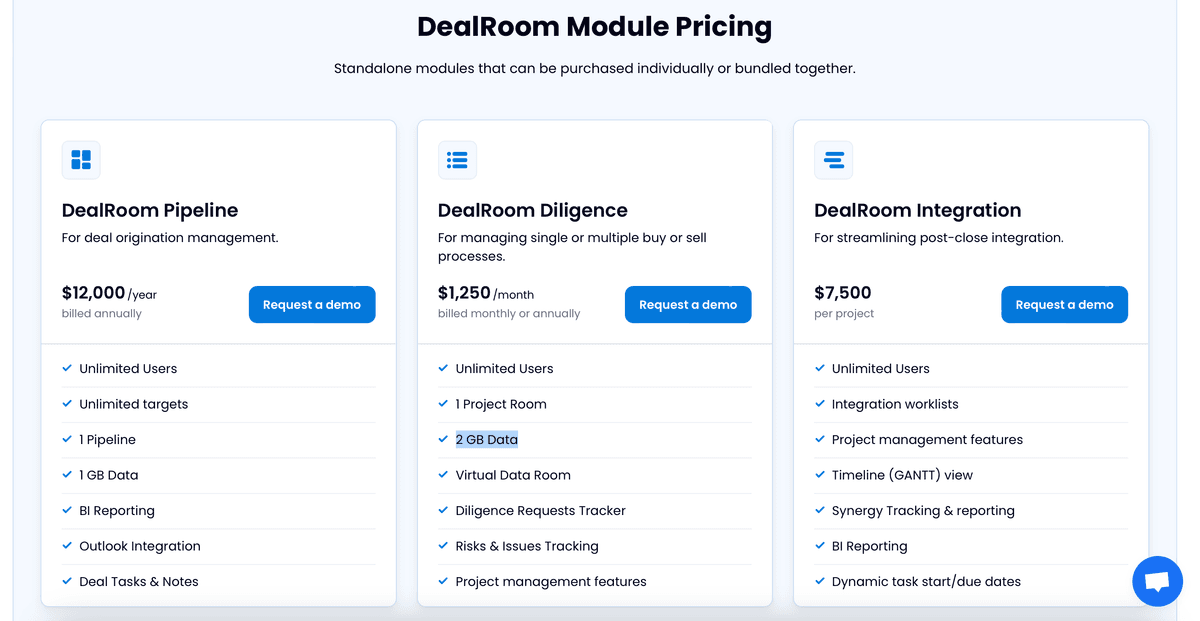
DealRoom focuses on M&A pipeline management in addition to VDR. Pricing starts at $1,250/month (billed annually) for the Diligence plan.
Best for: corporate M&A teams that want pipeline + VDR bundled. Not cost-effective for simple fundraising. Starting tier billed annually only.
Firmex runs flat-rate subscriptions on custom quotes, with reported entry rates around $625/month, unlimited users, and a focus on legal, compliance, and life sciences workflows.
Best for: regulated industries (legal, compliance, life sciences) where SOC 2 and HIPAA are hard requirements.
Ansarada uses tiered storage-based pricing with AI features bundled into higher tiers.
Ansarada no longer publishes public pricing and now quotes per deal; the tiers below are historical/indicative only.
Best for: bid management with AI insights. Storage tiers escalate quickly for document-heavy deals.
FirmRoom offers flat, storage-based pricing with unlimited users on every tier and a 14-day free trial. As of September 2026 published rates are:
All plans include unlimited users, 1 data room, watermarking, granular permissions, NDA workflow, redaction, and audit trail & analytics.
Best for: small-to-mid M&A teams that want unlimited users at a predictable flat rate.
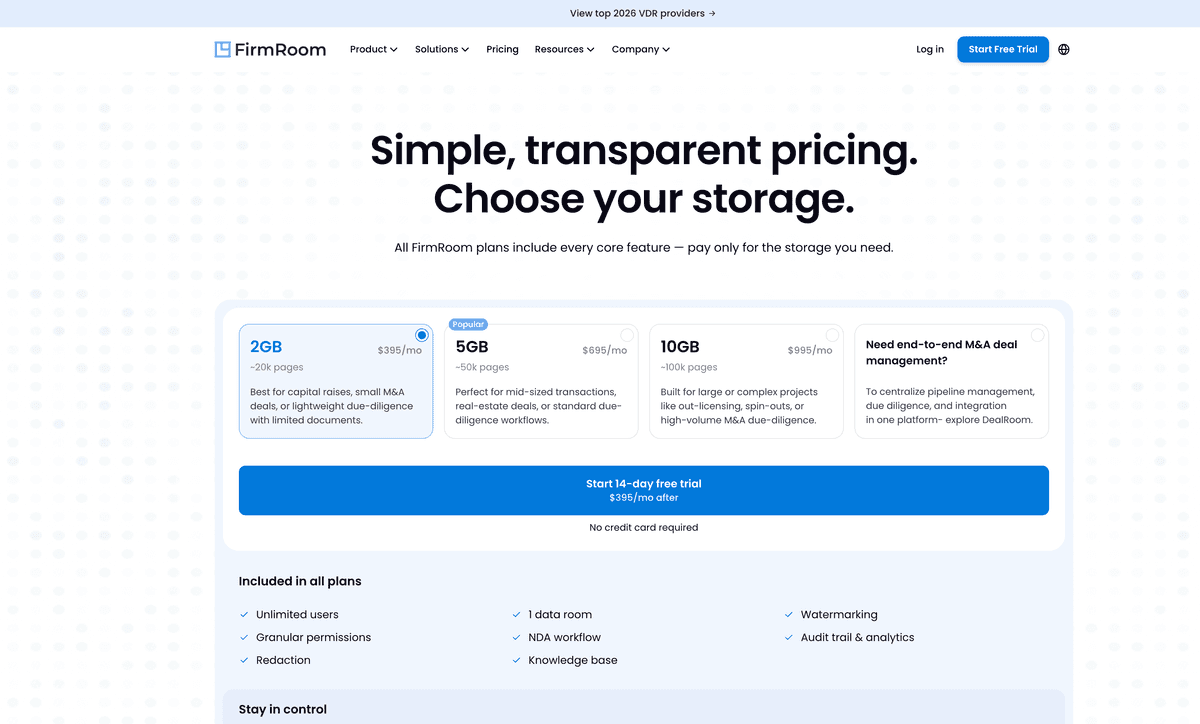
Quick overview of prices for 30+ data room providers
The sticker price on a VDR rarely matches the final invoice. Five hidden fees routinely push buyers over budget, especially on legacy enterprise VDRs. Papermark charges none of these. The table below names which providers charge each hidden fee.
| Hidden fee | Typical range | Providers known to charge | Papermark |
|---|---|---|---|
| Storage overage fee | $50-$150/GB/month | Ansarada, FirmRoom, iDeals | None - unlimited on every paid tier |
| Per-page overage | $0.40-$0.85/page | Intralinks, Ansarada, iDeals Pro | None - flat-rate, no page cap |
| Extra admin seat | $100-$250/seat/month | iDeals, DealRoom, Datasite | €19-€70/mo per seat above included quota (Unlimited: included) |
| One-time activation/setup | $1,500-$10,000 | Datasite, Intralinks, Merrill | None |
| 12-month annual minimum | Locks 9+ unused months | Intralinks, DealRoom, iDeals | Month-to-month on all plans |
1. Storage overage fees. Per-GB pricing tiers often charge 2-3x the base rate once you exceed the included allowance. A 5 GB Ansarada plan at $3,069/month jumps to the next 10 GB tier at $4,348/month, or higher with overage fees, the moment a video walkthrough or high-resolution CAD file pushes storage past the cap.
2. Admin seat upcharges. Base plans commonly include 1-3 admin seats. Each additional admin can cost $100-$250/month on enterprise VDRs. Papermark publishes add-on rates directly on the pricing page: from +€10/month on Free up to +€55/month on Premium (annual billing). Unlimited tier includes all team members.
3. Activation and setup fees. Enterprise VDRs (Datasite, Intralinks, Merrill) often charge one-time activation or setup fees of $1,500-$10,000 depending on deal size. This is rarely disclosed until the contract.
4. Per-project / per-deal fees. Some providers (Datasite, DealRoom Integration) charge per project in addition to the subscription. A firm running five concurrent deals can pay five subscription fees on what looks like a single contract.
5. Annual-only billing and minimum contracts. Intralinks, DealRoom, and iDeals commonly require 12-month minimums billed annually. If a deal closes in month 4, you keep paying through month 12. Flat-rate month-to-month providers (Papermark, SecureDocs) avoid this entirely.
To see how pricing models compare on a real deal, consider an investment banking firm preparing a 10-month M&A transaction with 50 GB of storage and 15 user licenses (~10,000 pages).
The flat-rate model is typically 3x-10x cheaper than per-page or per-user models on any serious transaction. The savings get larger as document count and reviewer count grow.
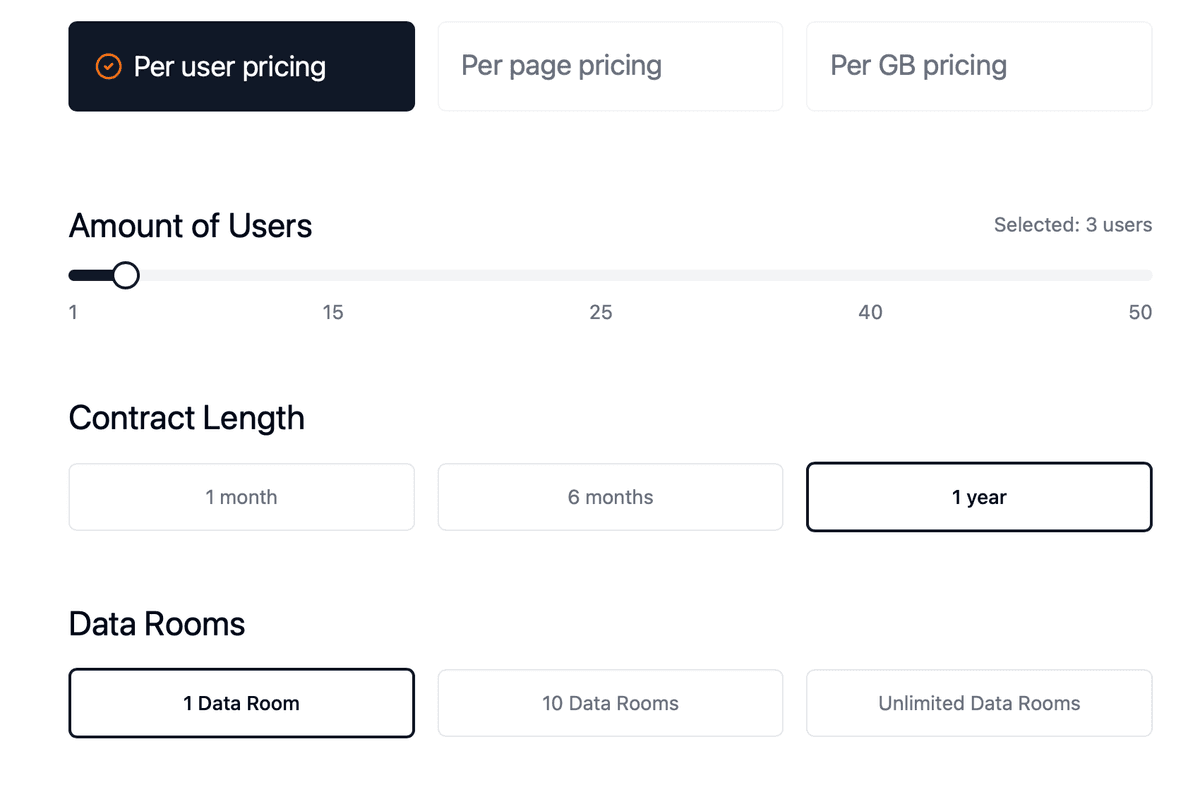
Calculate VDR price with the Papermark calculator →
The right budget depends on the deal you are running. The table below maps typical VDR spend to the four most common workflows.
| Deal type | Typical VDR budget | Recommended pricing model | Notes |
|---|---|---|---|
| Pre-seed / seed pitch | €0-€50/month | Free or per-user | DocSend or Papermark Free works for a single deck and 10-20 investors. |
| Series A/B fundraise | €99-€300/month | Flat-rate | Papermark at €99/month covers full investor diligence with unlimited LPs. |
| PE Fund I LP fundraise | €99-€999/month | Flat-rate | Plus tier €249/month adds Q&A; Premium €549/month adds multi-team; Unlimited €999/month includes all team members. |
| Mid-market M&A ($50M-$500M) | €99-€2,000/month | Flat-rate | Per-page becomes punitive once document count exceeds 1,000. |
| Enterprise M&A ($500M+) | $5,000-$25,000+/year | Flat-rate or custom | Datasite, Intralinks expected by enterprise counsel; Papermark Custom plan is the modern alternative. |
| IPO preparation | $10,000-$50,000+/year | Custom enterprise | Includes 6-12 month engagement, audit trail retention, and SEC disclosure tracking. |
| Audit and tax | €99-€249/month | Flat-rate | Plus tier €249/month adds Q&A for auditor interaction. |
| Clinical trial / biotech | €549-Custom/month | Flat-rate + BAA | HIPAA, FDA 21 CFR Part 11 compliance push toward higher tiers or self-hosted. |
For deal-specific guides, see data room for raising Fund I, virtual data room for biotech, data room for IPO, and virtual data room for M&A.
Free trials matter because most VDRs are sold through demo + sales cycles that delay decision-making by 1-3 weeks. The table maps trial availability across the top 12 providers.
| Provider | Free trial | Trial length | What's included |
|---|---|---|---|
| Papermark | Yes | 7 days | Full feature set, no credit card |
| Papermark Free tier | Yes (free forever) | n/a | Basic document sharing, view tracking |
| SecureDocs | Yes | 14 days | Full feature set |
| CapLinked | Yes | 14 days | Full feature set |
| iDeals | Yes | 14 days | Standard tier features |
| Firmex | No | n/a | Demo only |
| Datasite | No | n/a | Demo only, sales-led |
| Intralinks | No | n/a | Demo only, sales-led |
| Merrill | No | n/a | Demo only, sales-led |
| Ansarada | Yes | 14 days | Standard tier |
| DealRoom | Yes | 14 days | Limited tier |
| FirmRoom | Yes | 7 days | Standard tier |
| ShareVault | No | n/a | Demo only |
Trial-blocking providers (Datasite, Intralinks, Merrill, Firmex) typically operate at the enterprise end of the market where 12-month contracts are the norm. For diligence workflows under 6 months, trial-friendly flat-rate providers are easier to budget and faster to onboard.
Sticker price is misleading. Total cost of ownership (TCO) accounts for all the line items that come at the end of year one. The framework below pulls the actual cost out of the pricing page.
Direct costs
Indirect costs
Hidden multipliers
Example TCO comparison (hypothetical Series B fundraise, 6 months, 800 documents, 25 investor viewers):
| Provider | Subscription | Activation | Admin seats | Overages | Total 6-month TCO |
|---|---|---|---|---|---|
| Papermark Plus | €1,494 | €0 | Included (5) | €0 | €1,494 |
| Firmex | €3,750 | €0 | €0 | €0 | €3,750 |
| iDeals (per-page) | €0 base | €1,500 | €0 | ~€8,000 | ~€9,500 |
| Datasite (custom) | €15,000+ annual | €5,000 | €1,200 | ~€2,000 | ~€20,000+ pro-rated |
Papermark's flat-rate model wins on TCO for any deal lasting more than 2 months or generating more than 200 documents.
Enterprise VDR pricing is anchored, not fixed. The five tactics below routinely unlock 15-30% discounts on Datasite, Intralinks, iDeals Business+, and DealRoom Enterprise.
1. Quote from a flat-rate competitor. Walk into the negotiation with a Papermark Custom or Firmex Annual quote. Enterprise sales teams know flat-rate is the modern alternative and will price closer to it under competitive pressure.
2. Commit to a longer term. A 24-month commit typically unlocks a 10-15% discount versus 12-month. A 36-month commit unlocks 15-25%. Only do this if you are confident in the multi-deal pipeline.
3. Negotiate the activation fee separately. Activation fees are pure margin. Push for them to be waived or rolled into the subscription. Most reps have authority to waive a $1,500-$5,000 activation on a closing deal.
4. Bundle multiple projects. If your firm runs 3-5 deals per year, negotiate a corporate or enterprise-wide license rather than per-deal pricing. The per-deal multiplier is often where the markup hides.
5. Push back on overage clauses. Storage overage at 2-3x base rate is the single most common surprise on year-end invoices. Negotiate a published per-GB overage that does not exceed 1.5x base rate, or push for unlimited storage in writing.
Pricing varies by region, currency, and local sales presence. The table below summarizes typical entry-tier pricing in three major markets.
| Provider | EU (EUR) | US (USD) | UK (GBP) | Notes |
|---|---|---|---|---|
| Papermark | €99/month (annual) | $119/month (annual) | £95/month (approx.) | Flat-rate; USD prices are explicit Stripe tiers, £ is an approximate FX conversion |
| SecureDocs | €420/month | $450/month | £360/month | Localized |
| CapLinked | €370/month | $399/month | £320/month | Localized |
| Firmex | €575/month | $625/month | £500/month | Localized |
| iDeals | Custom | Custom | Custom | Sales-led, varies by market |
| Datasite | Custom | Custom | Custom | Custom enterprise quote |
EU customers should verify the contracting entity (Ireland, Germany, Netherlands) for VAT and data residency. UK customers post-Brexit need separate Standard Contractual Clauses (SCCs) for cross-border transfers if the contracting entity is outside the UK.
Switching costs are the silent reason teams stay on overpriced VDRs. The 5 components below sum to the total cost of leaving.
1. Export and migration time. Exporting 1,000+ documents with their folder structure and permissions is rarely a one-click operation. Budget 1-3 days of admin time.
2. Re-indexing on the new platform. Folder restructuring, permission re-mapping, and link regeneration commonly take 2-5 days for a mid-sized deal.
3. External counsel and counterparty re-onboarding. Bidders, LPs, and external counsel must be re-invited with new links. Allow 1-2 weeks for full re-engagement.
4. Data export fees on the legacy platform. Some legacy VDRs charge per-GB for export of customer data on contract termination. Budget €500-€5,000 depending on volume.
5. Audit log preservation. If the legacy VDR's audit log is required for compliance retention (SOC 2 Type II, GDPR Article 30), exporting and archiving it independently is mandatory. Some VDRs charge for audit log export.
Modern VDRs that support easy migration (Papermark, Firmex, SecureDocs) publish standard export options. Legacy enterprise VDRs (Intralinks, Merrill) historically have not, although this is improving.
The naive question is "how much does the VDR cost?" The better question is "how much money and time does a good VDR save?" The five categories below typically dominate the ROI calculation.
Deal velocity. A clean data room with self-serve coverage compresses diligence timelines by 25-40% on document-heavy deals. On a $100M deal, every week of compressed timeline is meaningful interest savings or option-cost reduction.
Reduced admin time. Per-page or per-user pricing models force ongoing optimization (deleting docs to manage page count, juggling user invitations). Flat-rate models free up that admin time entirely.
Faster Q&A turnaround. Structured Q&A with logged answers in the data room replaces an email chain. Counsel and counterparty time saved adds up across the diligence period.
Reduced legal disputes. A complete audit trail tied to specific documents makes post-close disputes easier to resolve. Hard to put a number on, but it shows up in lower legal-reserve calculations.
Procurement velocity. A modern VDR with public DPA, public sub-processor list, and SOC 2 Type II report under NDA passes vendor security reviews in days, not weeks. Faster onboarding into enterprise customers.
For real customer cases, see Backtrace Capital, GP Loree Family Office, and TBD VC.
Five pitfalls show up consistently in customer interviews about overpaying for a VDR.
1. Anchoring on the entry-tier price. The published entry tier is a marketing anchor. Most buyers end up at the second or third tier because the first tier excludes admin seats or essential features. Always price the tier you will actually use.
2. Underestimating page or storage growth. A diligence room often doubles in size from the initial upload as Q&A drives additional document requests. Per-page or per-GB pricing creates surprise overages.
3. Skipping the activation fee question. A $1,500-$10,000 one-time activation fee can flip the cost-effectiveness ranking versus flat-rate. Always ask explicitly.
4. Ignoring the user invitation count. A pricing tier that includes 5 admin users but charges $100/month for each external counterparty becomes expensive at scale. Verify external viewer pricing. On Papermark, external viewers are always free; only internal team member seats above the included quota are billed.
5. Locking into a multi-year contract for a single deal. A 12-month contract for a 3-month diligence is 9 months of dead spend. Month-to-month flat-rate plans avoid this entirely.
Price is necessary but not sufficient. The decision framework below covers the four dimensions that matter once the budget question is answered.
For the 15 features that actually matter in 2026, see the virtual data room features guide. For the full buying comparison, see best virtual data rooms in 2026.
Compare the 7 best virtual data room providers in Toronto for 2026: pricing, PIPEDA compliance, Canadian data residency, and the right VDR for your M&A deal.
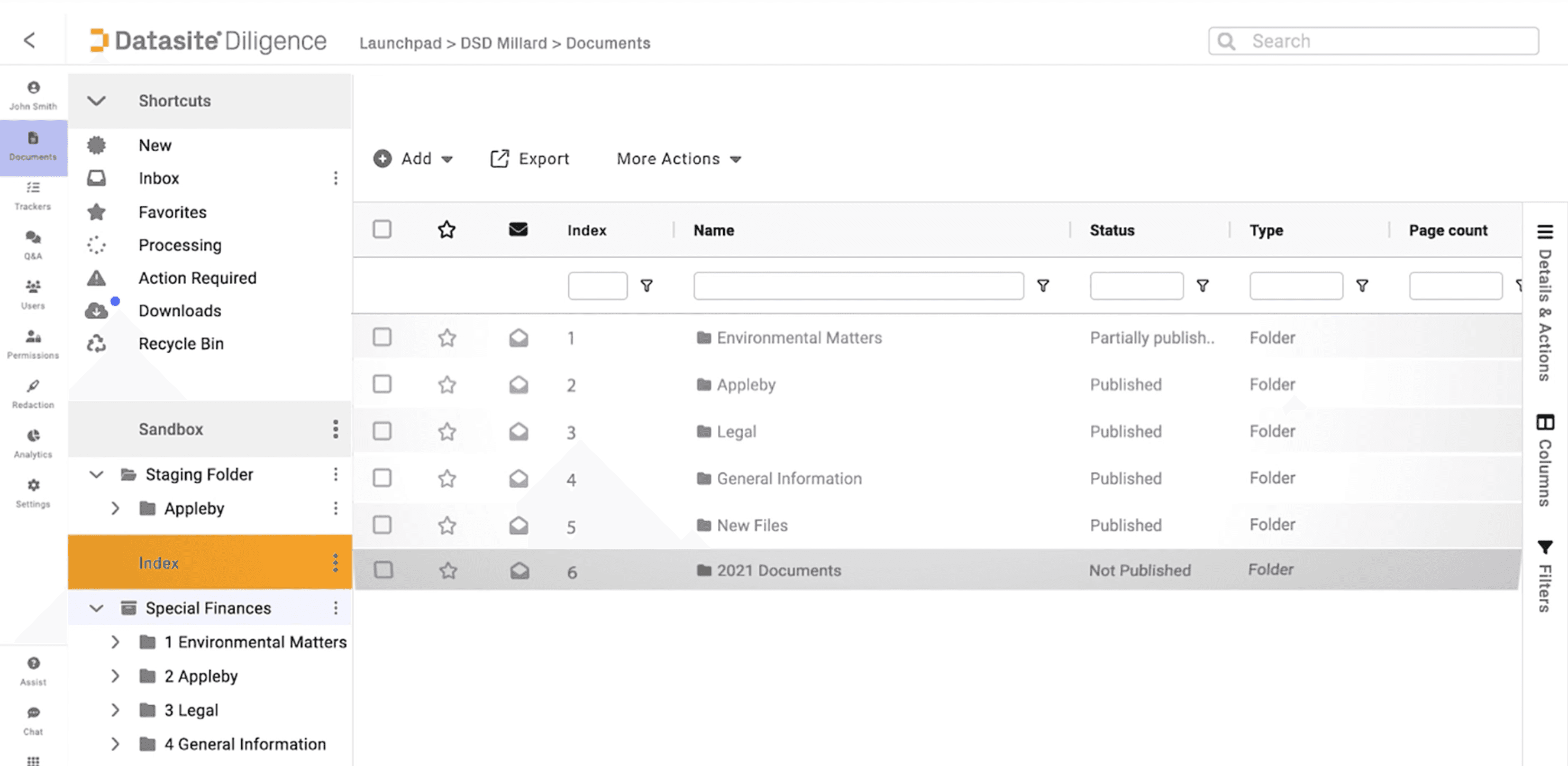
Datasite (formerly Merrill DataSite) 2026 overview and review: $0.40-$0.85/page pricing, G2 4.5/5 from 399 reviews, and how it compares to Papermark at €99/month.
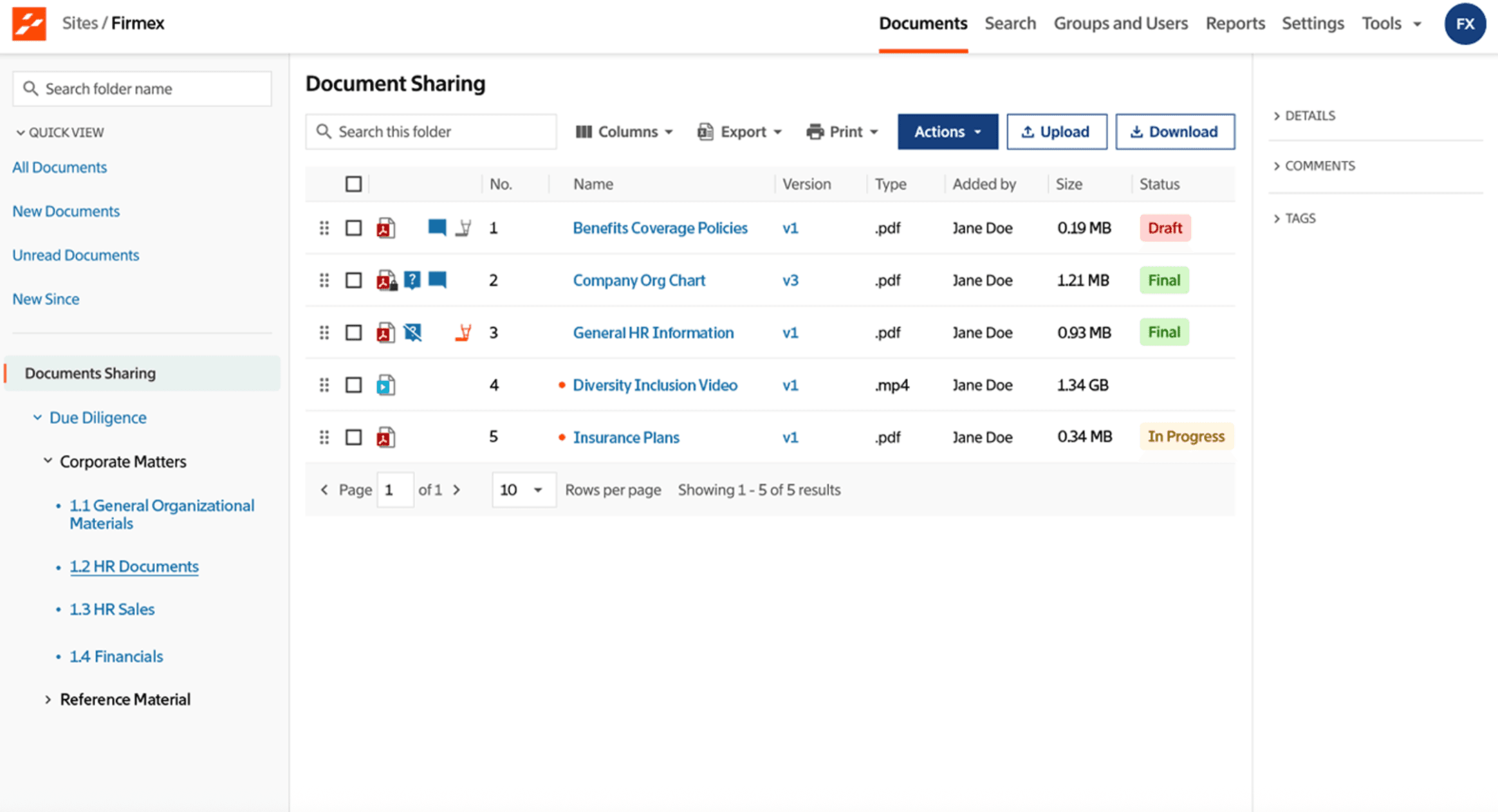
Complete Firmex VDR overview in 2026 - features, current pricing, the Datasite acquisition story, what it means for customers, and a step-by-step guide to transitioning from Firmex to Papermark.