



datarooms
Virtual Data Room Toronto: 7 Best Providers and Pricing for 2026
Compare the 7 best virtual data room providers in Toronto for 2026: pricing, PIPEDA compliance, Canadian data residency, and the right VDR for your M&A deal.
The virtual data room (VDR) market is in the middle of the most consequential shift since cloud-based VDRs replaced physical data rooms in the early 2000s. AI is moving from gimmick to backbone, the market is consolidating fast, pricing models are flipping from opaque per-page to transparent flat-rate, and the buyer mix is widening from bulge-bracket M&A bankers to first-time fund managers, founders, and corporate development teams. This guide compiles the 2026 market data, the major deals reshaping the industry, the AI workflows that actually matter, sector-specific trends, the pricing model shift, and what we expect in 2027.
The global virtual data room market is growing at a strong pace, driven by increasing M&A activity, regulatory compliance needs, rising cybersecurity concerns, and rapid AI adoption. Four research firms have published their 2026 estimates, with valuations clustering between $3.58 billion and $4.37 billion.
| Source | 2026 valuation | Long-range projection | CAGR |
|---|---|---|---|
| Fortune Business Insights | $4.11 billion | $17.46 billion (2034) | 19.8% |
| Research and Markets | $4.37 billion | $14.54 billion (2032) | 22% |
| IMARC Group | $3.58 billion | $8.0 billion (2034) | 10.79% |
| KBV Research | $3.2 billion | - | 15.6% |
The market was valued at approximately $3.4 billion in 2025 and is projected to exceed $14 billion by the early 2030s. The spread between research firms (10.79% CAGR low to 22% CAGR high) reflects different methodologies for counting adjacent categories: Fortune and Research and Markets include AI-powered diligence tools and broader deal-management software, while IMARC takes a tighter view focused on core VDR functionality.
The single most visible business-model trend in 2026 is the shift from opaque per-page billing to transparent flat-rate pricing. This affects which VDR vendors win mid-market and emerging-manager deals, and it changes the total cost of ownership materially.
Source: vendor pricing pages and G2 / TrustRadius / VDR Compare data verified September 2026. Each provider is mapped to its primary pricing model.
A BCG analysis on enterprise software costs highlighted that opaque pricing models are systematically eroding buyer trust. The data above confirms it: 12 of 17 providers (70%) now publish pricing on their website, and the three providers that still require sales calls for any quote (Datasite, Intralinks, iDeals at higher tiers) are increasingly skewed toward enterprise M&A where the legacy procurement cycle is tolerated.
For a fuller pricing breakdown across all models, see virtual data room cost in 2026 and the best virtual data rooms in 2026.
The VDR industry is consolidating rapidly. The 12 deals below cover M&A activity, strategic partnerships, and major product launches between mid-2023 and February 2026. The pattern is clear: VDR vendors are buying or building deal-intelligence layers, AI integrations, and fund-administration adjacencies to expand from "data room" into "deal platform."
| # | Date | Deal | Type | Strategic angle |
|---|---|---|---|---|
| 1 | Aug 2023 | Datasite acquires MergerLinks | M&A | Deal-intelligence layer for sell-side analytics |
| 2 | Jan 2026 | Intralinks launches DealVault | Product | Long-term archival on top of VDR |
| 3 | Jan 2026 | Blueflame integrates with Datasite | Partnership | AI analysis directly on VDR contents |
| 4 | Jan 2026 | Permira/Warburg take Clearwater private | M&A | PE bets on financial-data infrastructure |
| 5 | Feb 2026 | iCapital acquires Passthrough | M&A | Fund onboarding meets VDR workflows |
| 6 | Feb 2026 | Arcesium acquires Limina | M&A | Centralized investment platform |
| 7 | Feb 2026 | ToltIQ x Deal Engine partnership | Partnership | Deal sourcing connects to diligence |
| 8 | Feb 2026 | Keye launches Odin | Product | AI-native due diligence tool |
| 9 | 2026 | Papermark launches AI data rooms | Product | AI document assistant + smart organization |
| 10 | 2026 | Firmex expands flat-rate plans | Pricing | Mid-market pricing transparency |
| 11 | 2026 | Ansarada AI bidder prediction | Product | 97% accuracy claim on bidder behavior |
| 12 | 2026 | Imprima AI Q&A multilingual | Product | Generative AI on foreign-language docs |
Date: August 2023
Datasite, the leading SaaS-based M&A technology provider, completed its acquisition of London-based MergerLinks. MergerLinks is a financial data platform used by finance professionals to find deals and track dealmaker activity.
This acquisition enhanced Datasite's deal intelligence capabilities, giving users access to comprehensive data on M&A advisors, league tables, and investor engagement metrics. The strategic angle: Datasite is shifting from being "where the deal documents live" to being "the platform that finds the deal, runs it, and benchmarks it." MergerLinks gives Datasite a sell-side intelligence layer that competitors like Intralinks and iDeals do not natively offer. Source: Datasite News.
Date: January 2026
Intralinks introduced DealVault, a cloud-based archive solution that enables secure access to deal documents and reduces reliance on physical storage devices. DealVault integrates with existing Intralinks VDR workflows for seamless archival once a deal closes.
The strategic angle: post-close document retention is a multi-year compliance and litigation requirement that has historically lived outside the VDR. Intralinks is closing that gap, making the platform sticky beyond deal close. Source: Intralinks.
Date: February 2026
iCapital acquired Passthrough, a fund subscription and onboarding platform. The acquisition aims to support GPs with streamlined onboarding, financial compliance, and scaling operations to tap into wealth management allocations.
The strategic angle: this is the second-largest sign that "data room" is no longer a discrete category. Fund onboarding (subscription documents, KYC, AML) and the LP data room sit on the same workflow surface for any modern fund manager. iCapital + Passthrough creates a vertical stack that competes with bolt-together solutions of VDR + e-signature + fund admin. Source: The Drawdown.
Date: January 2026
Blueflame AI announced a strategic integration with Datasite, allowing Datasite's virtual data rooms to be accessed and analyzed through Blueflame's AI platform. Deal teams can now query data rooms in natural language and get answers grounded in the underlying documents.
The strategic angle: this is the first major VDR x third-party AI integration to ship at production scale. It signals that the AI layer of dealmaking will be horizontal (shared across multiple VDRs) rather than locked into a single vendor. Source: The Drawdown.
Date: February 2026
Arcesium, the financial services technology company, acquired Limina to build a centralized investment platform. The combined company aims to provide integrated solutions across investment operations, data management, and document workflows.
The strategic angle: PE and asset-management technology is consolidating around a smaller number of full-stack platforms. Arcesium is building toward "the operating system for institutional investment," which puts pressure on point-solution VDRs to either integrate or be absorbed. Source: The Drawdown.
Date: January 2026
Private equity firms Permira and Warburg Pincus, with participation from Temasek and Francisco Partners, took Clearwater Analytics private in a major fintech transaction. The deal valued the financial-data infrastructure provider at multiple billions.
The strategic angle: PE money is consolidating financial-data and document infrastructure as a category bet. The thesis is that diligence, fund admin, LP reporting, and post-trade workflows are all moving onto integrated platforms, and the winners will look more like enterprise software than discrete tools. Source: The Drawdown.
Date: February 2026
ToltIQ and Deal Engine announced a partnership to connect deal sourcing and due diligence platforms. The integration ingests deal documents typically found in virtual data rooms, then rapidly analyzes and categorizes them to extract critical insights.
This represents the early horizontal AI layer connecting deal pipeline tools (sourcing, CRM) with diligence tools (VDR, document review). Source: Scott Coop.
Date: February 2026
Keye launched Odin, an AI-powered due diligence tool that turns plain-English questions into deterministic financial analysis for deal professionals. Odin runs on top of source documents in a VDR and produces consistent, auditable outputs rather than the "creative" answers typical of consumer AI tools.
The strategic angle: AI-native diligence tools are now optimized for deterministic output, which is what regulated buyers (banks, PE firms, insurance) need. The era of "AI assistant" giving different answers each time is ending in the deal-professional segment. Source: The Drawdown.
In response to the AI transformation sweeping the VDR industry, Papermark introduced AI-powered features to its data room platform.
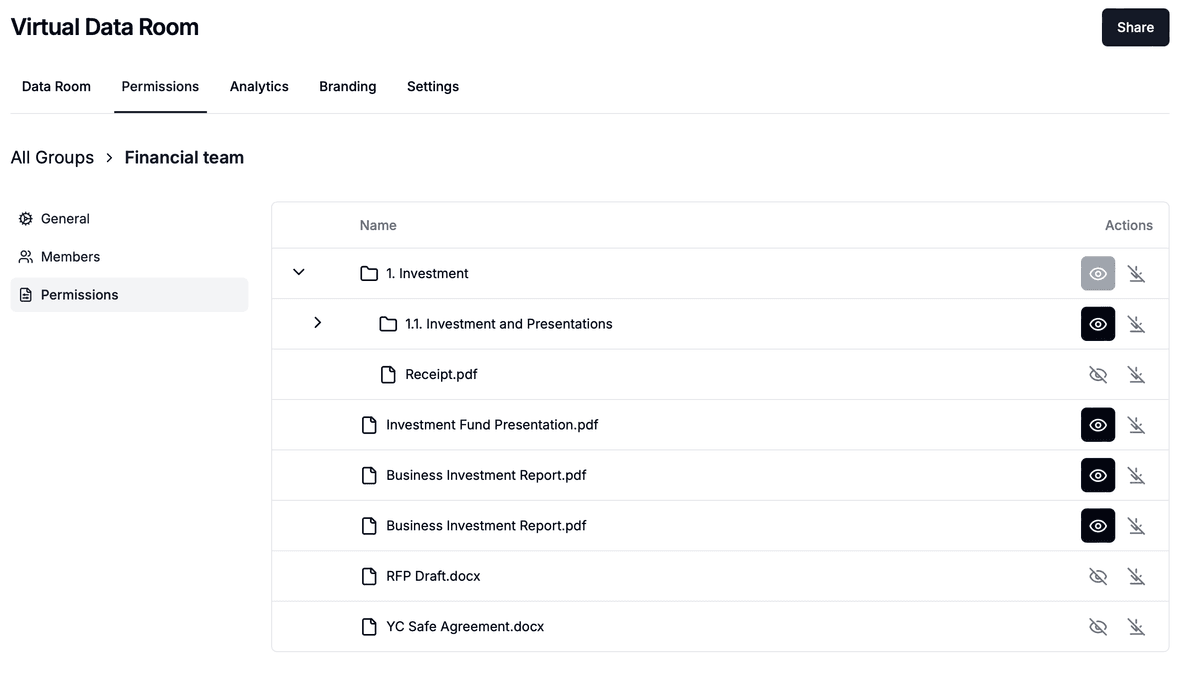
AI document assistant. Papermark's AI assistant helps users navigate complex data rooms by answering questions about document contents, summarizing key sections, and identifying relevant files across large document sets. The assistant is grounded in the data room's actual contents (not generic web data) and respects per-folder permissions, so users only see answers from documents they are authorized to view.
Smart document organization. AI-powered automatic categorization helps organize uploaded documents into logical folder structures (Corporate, Financial, Legal, IP, etc.), reducing setup time for new data rooms from hours to minutes for first-time users.
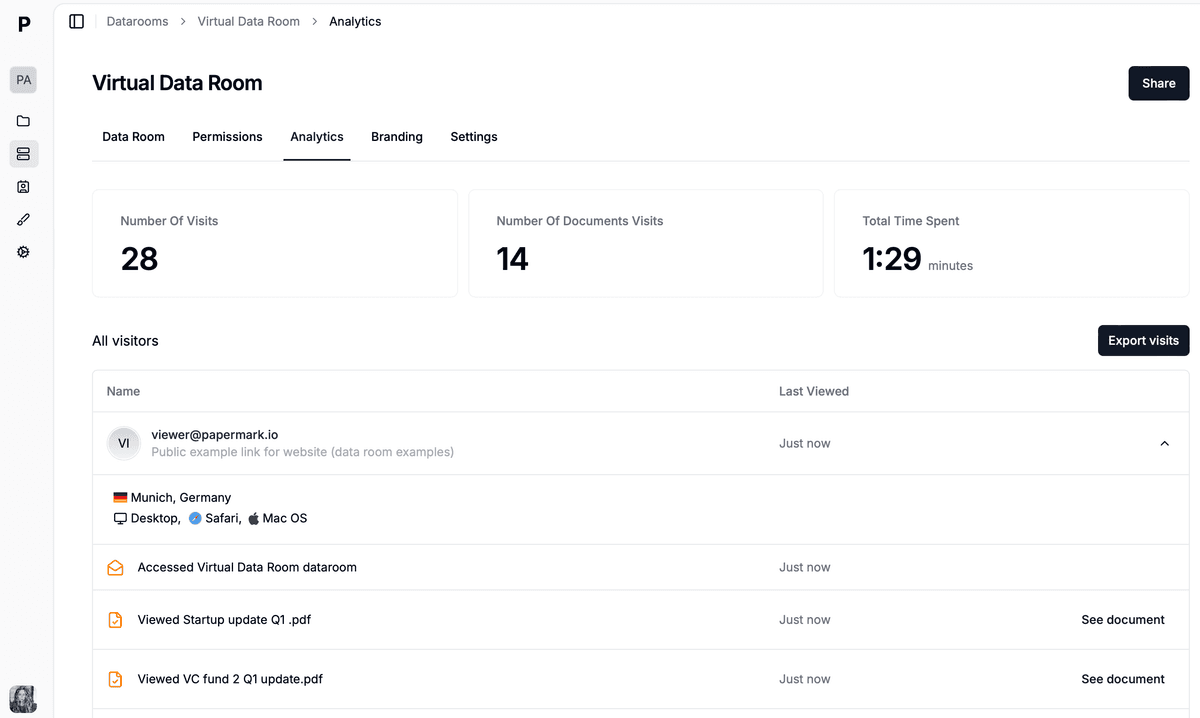
Intelligent analytics. Beyond page-by-page tracking, Papermark's AI analyzes viewer behavior patterns to provide insights on which documents drive the most engagement, which pages need attention, and which viewers signal serious deal intent.
Several smaller but meaningful product moves rounded out the year. Firmex expanded flat-rate plans to compete with Papermark and SecureDocs in the mid-market. Ansarada publicly claimed 97% accuracy in predicting bidder behavior using its AI scoring engine, the first VDR vendor to publish a quantitative AI accuracy benchmark. Imprima added generative-AI Q&A on foreign-language documents, enabling cross-border M&A teams to ask questions in English about Japanese, German, or Mandarin source files and get cited answers.
According to Datasite's CRO Mark Williams, AI has become "the backbone of dealmaking in 2026." The shift is not theoretical. AI features that were experimental in 2024 are now standard in 2026.
| Capability | What it does | Vendors shipping it (2026) |
|---|---|---|
| Automated document classification | AI sorts and indexes documents by category instantly on upload | Papermark, Datasite, Ansarada, Intralinks, iDeals |
| Contract analysis | Key clauses, risks, and red flags surfaced automatically | Datasite (via Blueflame), iDeals, Keye Odin |
| Smart redaction | PII automatically detected and masked using LLMs | Datasite, Intralinks, Papermark |
| Bidder behavior prediction | AI predicts which bidders are most likely to advance based on engagement signals | Ansarada (97% accuracy claim), Datasite |
| Multilingual Q&A | Generative AI answers questions about foreign-language documents | Imprima, Datasite via Blueflame |
| AI document assistant | Natural-language Q&A grounded in data room contents | Papermark, Blueflame, Keye, Datasite |
| Auto-summarization | AI generates folder and document summaries for fast reviewer onboarding | Papermark, iDeals, Intralinks |
| Engagement scoring | AI ranks viewers by deal intent based on engagement patterns | Papermark, Ansarada, Datasite |
Imprima reports that AI-enabled VDR tools can reduce document review time by up to 40%. The biggest gains show up in four workflows:
The 40% reduction is most visible on document-heavy deals (M&A above $100M, IPO readiness, large licensing engagements). For small fundraising rounds and pitch-deck-only workflows, the gains are smaller because the underlying document set is already small.
The headline AI capabilities matter less than the day-to-day workflows. Three patterns dominate in 2026:
1. The "first-pass review" pattern. Bankers and law firms use AI to triage a 2,000-document data room into a "high priority" subset of 100-200 documents that humans review first. The AI does not replace human review - it sequences it, so the deal team gets to substance faster.
2. The "ask the data room" pattern. Deal teams query the data room in natural language ("What was the working capital adjustment on the FY24 audited financials?") and get a cited answer with the source document linked. This replaces the keyword search and folder hunt that used to take hours.
3. The "smart Q&A routing" pattern. Buyers' Q&A questions are auto-routed to the right responder (legal, financial, operational) based on AI classification. Saves 1-2 days per Q&A cycle in mid-market M&A.
For a deeper view of how features map to deal workflows, see 15 virtual data room features that matter and the M&A due diligence software comparison.
The 2026 VDR market is increasingly segmented by industry, with sector-specific feature requirements driving vendor differentiation.
Private equity sponsors are expected to lead deal volume growth at 5% in 2026 (vs. 3% for M&A overall). PE firms need to return capital to LPs, and the gap between seller expectations and buyer offers is finally closing. The PE-specific trends:
VC fundraising in 2026 is increasingly digital and signal-rich. First-time fund managers (Fund I) are using flat-rate VDRs for the entire LP raise. The VC-specific trends:
For the full Fund I playbook, see Fund I Data Room in 2026.
Biotech M&A and licensing deals require deeper compliance than other industries. Key 2026 trends:
Real estate VDRs have the most distinctive folder structure (organized by property rather than document category). Key 2026 trends:
Government contractors, defense, and regulated banks face the strictest data residency and procurement requirements. Trends:
Opaque pricing and unpredictable usage fees are no longer acceptable for buyers running mid-market and emerging-manager deals. A BCG analysis highlights how unclear pricing models undermine trust. Modern VDRs offer:
For the full pricing breakdown, see virtual data room cost breakdown.
Organizations are implementing stricter security frameworks including:
Providers are developing customized solutions for:
Mobile-first solutions and hybrid deployment models are improving accessibility while maintaining strong security protocols. Executives can review deals from anywhere without compromising document protection. Native mobile viewers, watermarking that survives mobile screenshots, and offline-secure modes are now table stakes.
The fastest-growing buyer segment in 2026 is teams that want a secure, modern VDR with the option to self-host. Open-source solutions like Papermark are gaining share among:
Icebreaker.vc, a leading early-stage VC across Finland, Sweden, and Estonia, chose Papermark for the LP communications layer of their Fund III raise. The decisive features were page-by-page engagement analytics and a custom-domain LP portal that scaled across hundreds of prospective LPs without per-user pricing penalties.
For more case studies, see TBD VC raises $35M Fund II using Papermark and Backtrace Capital raises €50M+ Fund I.
Whether you are running a fundraise, managing M&A due diligence, or sharing sensitive documents with investors, the 2026 VDR landscape offers different opportunities by buyer type.
Based on the deal flow and product launches observed in 2026, four predictions for the year ahead:
1. Per-page pricing will lose another 5-10 points of market share. Intralinks and iDeals will face increasing pressure to publish flat-rate alternatives or risk losing the mid-market segment entirely.
2. AI-native VDRs will hit production scale. Tools like Keye Odin and Blueflame will move from "AI integration with traditional VDR" to "AI-first deal platform." Expect at least one major acquisition in this category by Q3 2027.
3. Self-hosted will become a hard requirement for regulated buyers. Government, defense, regulated banks, and biotech with strict data residency will increasingly disqualify cloud-only VDRs from procurement.
4. The lines between VDR, fund admin, and LP communications will fully blur. Following iCapital/Passthrough, expect more consolidation between deal-document workflows and adjacent fund-operations tools.
Sources: Fortune Business Insights, IMARC Group, Datasite, The Drawdown, EY-Parthenon, KPMG, BCG, Imprima, Research and Markets.
Compare the 7 best virtual data room providers in Toronto for 2026: pricing, PIPEDA compliance, Canadian data residency, and the right VDR for your M&A deal.

Virtual data room pricing in 2026 explained. Compare per-page, per-user, storage, and flat-rate models across Papermark, Datasite, iDeals, Intralinks, and 30+ providers.
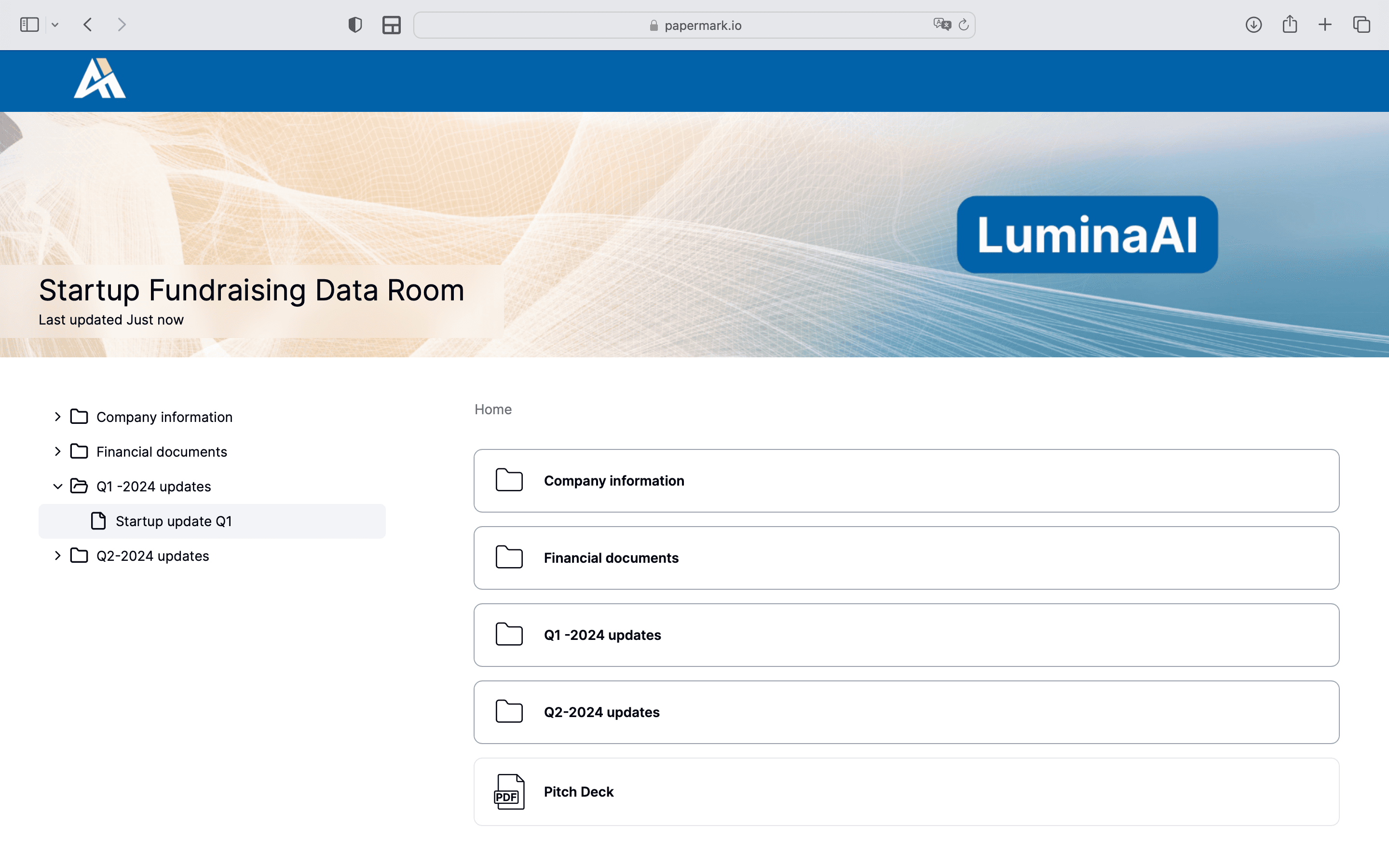
Set up a virtual data room for M&A in 2026. Covers sell-side vs buy-side workflows, the 15-document checklist, folder structure, and top provider comparison.