BlogData RoomsData Room for IPO 2026: S-1 Checklist, Setup, and How to Choose a VDR
Data Room for IPO 2026: S-1 Checklist, Setup, and How to Choose a VDR
·9 min read
Marc Seitz
A data room for IPO is a secure virtual workspace where companies share confidential documents with underwriters, auditors, legal counsel, and institutional investors during the initial public offering process. IPO data rooms house the S-1 (or F-1) drafts, audited financials, corporate governance documents, and material contracts required to complete SEC registration in the US or an ESMA-approved prospectus in the EU. Papermark is the data room trusted by 70,000+ dealmakers worldwide, including firms behind billions in deals, and this IPO data room guide covers the S-1 checklist, the two-phase setup, and how to pick the right provider in 2026.
Quick recap
An IPO data room is a secure online repository for documents shared with underwriters, auditors, legal counsel, and regulators during an initial public offering.
Pre-IPO readiness runs 6-18 months before filing; IPO execution runs 4-6 months from S-1 filing to pricing and ringing the bell.
US IPOs require an S-1 registration (F-1 for foreign private issuers), audited financials for 3 years, and SEC review cycles that add ~3-4 months.
EU IPOs require an ESMA-approved prospectus under the Prospectus Regulation, with jurisdiction-specific listing rules in London, Paris, Frankfurt, or Amsterdam.
Core IPO document categories: corporate governance, audited financials, material contracts, IP portfolio, HR and compensation, litigation, regulatory, and risk factors. The full list is in the IPO data room checklist.
Essential VDR features for IPO: dynamic watermarking, granular permissions per workstream (legal, financial, operational), Q&A module, append-only audit log, and SOC 2 Type II compliance.
Typical IPO data room size: 500-5,000+ documents across 10-15 top-level folders; active reviewer group of 20-80 people (underwriters, counsel, auditors, company team).
Papermark covers the full IPO feature set (watermarking, granular permissions, Q&A, audit log, SOC 2 Type II) with the same platform 70,000+ dealmakers already use for M&A, fundraising, and due diligence.
Trust matters at this stage: Papermark data rooms run deals for Lincoln Property ($50B AUM), Tesi (~€2B AUM), Thesis ($1.4B portfolio), and firms like TBD VC, which raised a $35M fund on Papermark.
What is a data room for IPO?
A data room for IPO is a secure virtual workspace where companies store and share confidential documents during the initial public offering process with underwriters, auditors, legal counsel, and institutional investors. It produces the document trail and audit history that SEC (or ESMA) review cycles require, and it is the operational backbone of the 6-18 month IPO readiness workflow.
Unlike generic cloud storage, an IPO data room provides granular per-workstream permissions, dynamic watermarking, mandatory NDA enforcement, Q&A workflows, and a tamper-proof audit trail. Every document published, every viewer who opened it, and every version change is logged immutably. That trail is what underwriter counsel relies on during review, and what the company's own counsel relies on in the event of post-IPO litigation.
Why you need a data room for your IPO
Going public without a properly set up data room extends the timeline, risks missed disclosures, and weakens the audit trail that underwriters and regulators rely on. Four practical reasons drive every IPO-bound company to a purpose-built VDR.
Underwriter due diligence. Investment banks are legally obligated to conduct thorough due diligence before they can price the offering. They need to verify financials, contracts, IP, litigation history, and governance. Without a VDR, the diligence workflow becomes email requests and shared-drive chaos, which fails the audit trail that underwriter counsel requires.
Speed to market. IPO windows can close fast when market conditions shift. A well-organized data room compresses diligence by weeks compared to disorganized document management. For a company targeting a Q3 IPO, shaving two weeks off diligence is the difference between pricing in a good window and waiting for the next one.
Institutional investor confidence. Mutual funds, sovereign wealth funds, and pension funds evaluate operational maturity in part through how the company runs its diligence process. A clean, professional data room signals a company ready to be public.
Regulatory compliance. SEC regulations (and ESMA equivalents in Europe) require extensive documentation of what was disclosed, when, and to whom. The data room's audit trail is the evidentiary backbone of that compliance record.
Why IPO teams run their data room on Papermark
The world's most ambitious dealmakers, founders, and finance teams trust Papermark data rooms to host confidential documents through the highest-stakes transactions of their lives. Over 70,000 companies worldwide run on Papermark, from pre-IPO startups to institutions managing billions in assets.
Firm
Scale
Why it matters for IPO
Lincoln Property
$50B AUM, ~400M sq ft managed
Real estate and infrastructure IPOs need the same bank-grade controls as a $50B institution expects
Tesi
~€2B AUM (Finnish state investment company)
Sovereign and state-backed investors evaluate operational maturity through how you run diligence
Thesis
$1.4B portfolio (tBTC and venture studio)
Crypto and tech IPOs need granular permissions without a six-week enterprise procurement cycle
Play Ventures
$300M+ gaming VC
High-velocity deal teams need a room they can stand up the same day counsel asks
Three things make Papermark a strong fit for the IPO workflow specifically:
Bank-grade security without the enterprise sales cycle. SOC 2 Type II, GDPR alignment, dynamic watermarking, mandatory NDA gating, and an exportable audit log are all standard. You can open an IPO-ready room the same afternoon your counsel asks for one, instead of waiting weeks for an enterprise VDR procurement cycle.
Permissions built for multi-bank diligence. Granular folder- and file-level permissions with viewer groups keep each bookrunner's counsel scoped to their own workstream, with no visibility into a competing bank's activity. Page-by-page analytics show you exactly which documents each workstream is reading, so you can see where the next comment letter is coming from before it lands.
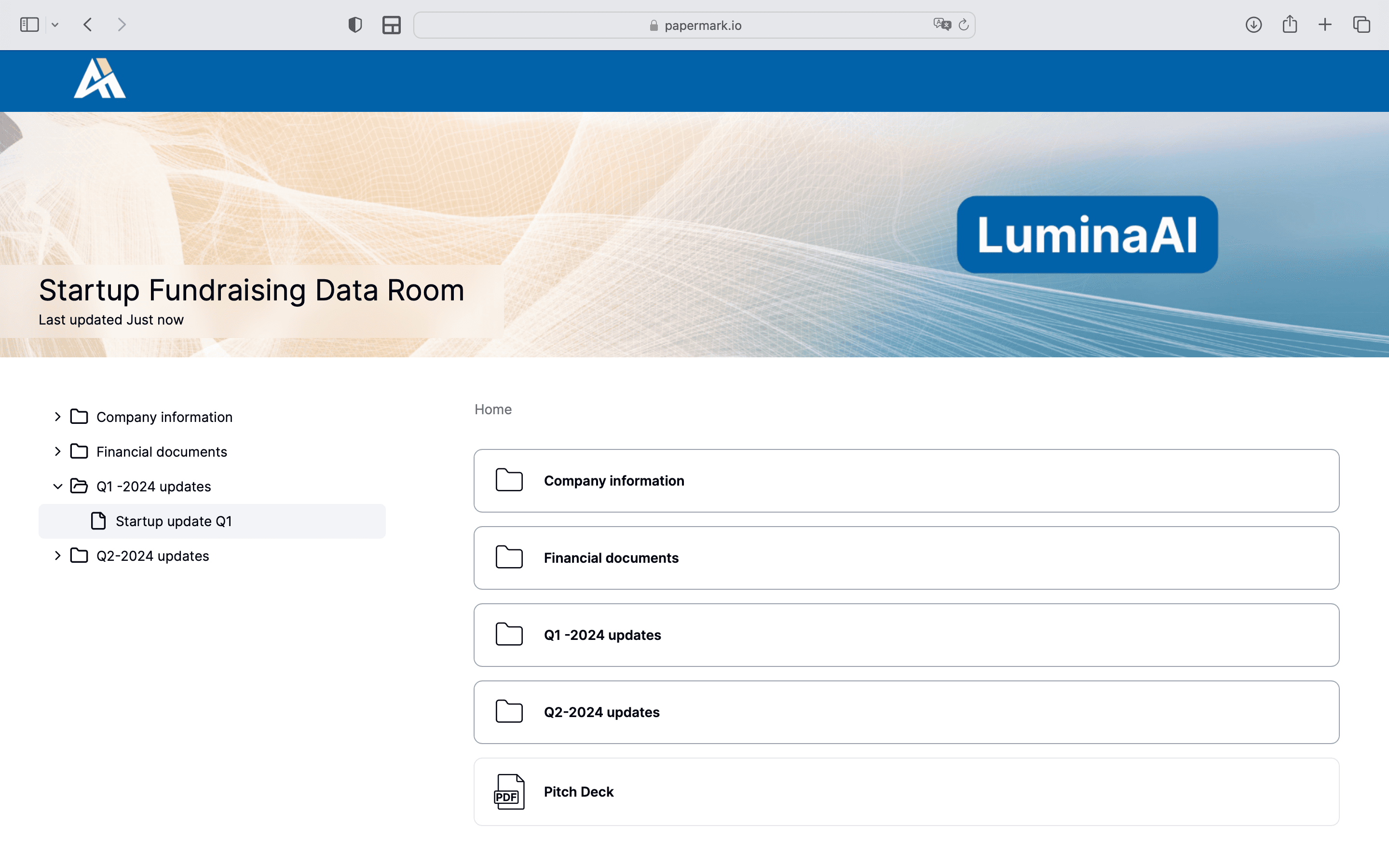
White-labelling that looks like you. Custom domains and full branding mean underwriters and institutional investors see your company's data room, not a vendor's. Tab ran its acquisition by Kivra through a Papermark data room for exactly this combination of control and polish.
"We closed €50M Fund I using Papermark Data Rooms. Level of customization and how secure it is, is unmatched." (Michael Münnix, Co-Founder, Backtrace Capital)
No credit card required.
Pre-IPO readiness vs IPO execution
Most companies underestimate how much IPO data room work happens before the S-1 filing. The full IPO lifecycle has two distinct phases with different data room needs.
Pre-IPO readiness (months -18 to -4). This is when the company cleans up financial reporting, upgrades internal controls (SOX readiness), restructures the cap table, resolves litigation overhangs, and refreshes board composition. The data room at this stage is an internal working room shared with the CFO team, audit firm, legal counsel, and board. It is typically smaller (100-500 documents) but iteratively updated. Feature requirements are moderate: folder organization, granular permissions, version control, and basic audit log.
IPO execution (months -4 to 0). This is when the S-1 (or F-1) is drafted, filed, and iterated through SEC review. The data room expands significantly (commonly 2,000-5,000+ documents), the reviewer group grows to 20-80 people across underwriters, counsel (company, underwriter, and selling-shareholder), auditors, and compliance staff. Feature requirements are full: dynamic watermarking, mandatory NDA, scoped-link access per workstream, Q&A module, audit log export, SOC 2 Type II.
Treating these as one phase is the most common source of data room failures. The readiness room should not have 30 external underwriter reviewers rummaging through draft board minutes six months before filing. The execution room should not be missing the pre-readiness work that demonstrates the company is actually ready to be public.
IPO data room checklist: S-1 documents and more
The list below is a summary of the core document categories for a US IPO. The full S-1 review reaches into sub-categories (contract-by-contract reviews, tax jurisdiction breakdowns, IP by patent family). For the complete folder-by-folder breakdown with priorities, preparation steps, VDR feature requirements, and Papermark setup guidance, see the dedicated IPO data room checklist: what to include and how to prepare.
For the full checklist with categories and sub-folders, see the data room folder structure guide and the due diligence data room complete guide.
IPO in the US: SEC and S-1 readiness
US IPOs require S-1 registration (or F-1 for foreign private issuers) filed with the Securities and Exchange Commission. The data room supports three concurrent workstreams during this filing phase.
SEC review. The SEC reviews the S-1 and issues comment letters in cycles, typically 2-4 rounds over 3-4 months. The company's legal and financial teams respond via supplemental filings, each of which pulls documents from the data room for citation and reference. The data room audit log supports the record of what was shared with counsel and external parties during the drafting.
Underwriter diligence. Bookrunning banks (typically 2-4 joint bookrunners) run their own due diligence in parallel. Their counsel pulls from the data room for diligence memos, comfort letter support, and legal opinions. The data room's per-workstream permissions prevent one underwriter's legal team from seeing another bank's work product.
Auditor validation. The audit firm (one of the Big Four or a comparable firm) validates 3 years of financial statements, reviews internal controls (for SOX readiness), and issues the comfort letter. The data room hosts draft audit reports, management representation letters, and supporting schedules.
IPO in Europe: prospectus and ESMA-approved listings
EU IPOs operate under the Prospectus Regulation (EU Regulation 2017/1129), with the prospectus approved by the competent authority of the company's home member state. Large EU listings are most common on the London Stock Exchange (pre-Brexit precedent still shapes prospectus practice), Euronext Paris and Amsterdam, Deutsche Börse in Frankfurt, and Nasdaq Stockholm or Helsinki.
The data room supports the prospectus drafting and regulator review workflow much like an S-1 data room supports SEC review. Key differences:
Prospectus structure follows the ESMA Annexes (Annex 1 for equity securities) rather than the S-1 item format.
Financial statements must be prepared under IFRS (or reconciled to IFRS for non-EU issuers).
Local listing rules add jurisdiction-specific disclosures (LSE Listing Rules, Euronext Market Rules, Prime Standard rules in Frankfurt).
Language requirements vary by market: English is typically accepted on LSE and Euronext's international segments; local language is required for Frankfurt Prime Standard and Stockholm.
For cross-listed IPOs (dual-listed or Level 3 ADR), the data room must maintain both S-1 and prospectus drafts with coordinated versioning. This is exactly where granular folder-level permissions and per-workstream scoped links become critical.
How to set up a data room for IPO in 6 steps
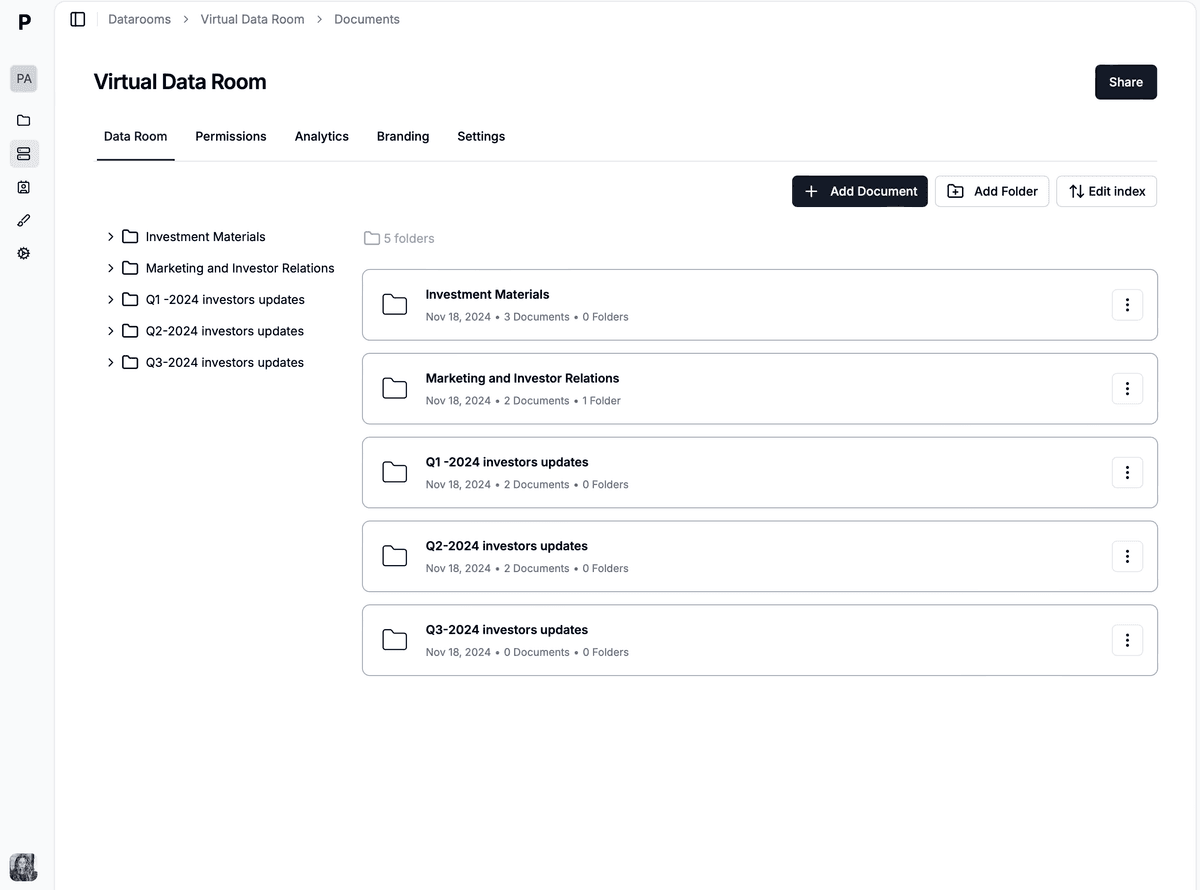
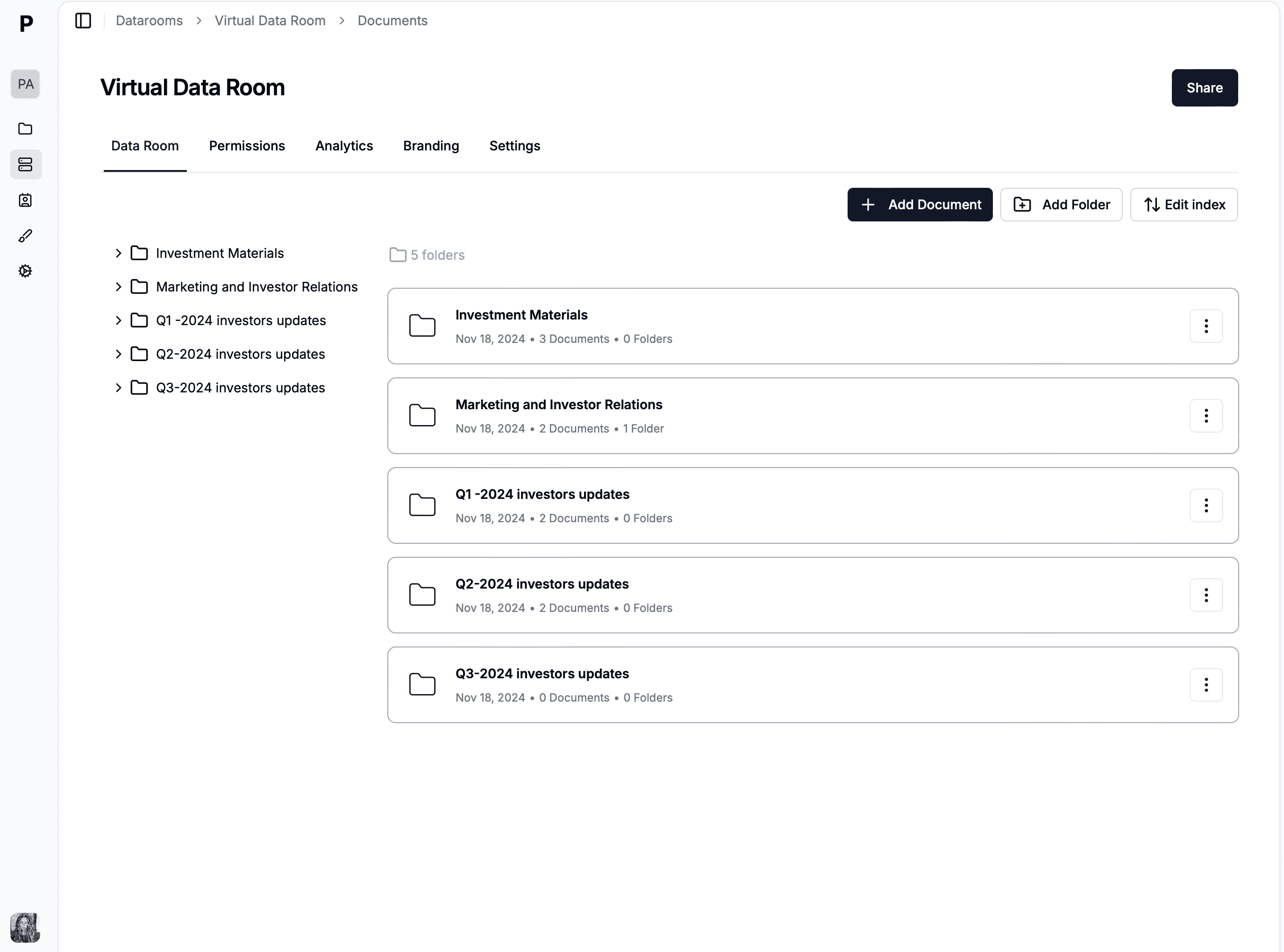
IPO data room setup differs from a generic M&A or fundraising room in three ways: (1) more rigorous permission scoping per workstream, (2) longer active period (often 12+ months), and (3) higher compliance requirements (SOC 2 Type II minimum). Watch the short walkthrough below for how to create a data room in Papermark, then follow the written steps.
1. Choose the right VDR
For IPO, require enterprise-grade features: granular per-workstream permissions, dynamic watermarking, mandatory NDA gating, Q&A module, append-only audit log with export, SOC 2 Type II, GDPR alignment, and (for biotech or regulated industries) HIPAA or 21 CFR Part 11 as applicable. Papermark covers all of these out of the box; legacy enterprise competitors (Datasite, Intralinks) commonly require custom enterprise contracts and multi-week onboarding for IPO-grade deployments.
2. Build the folder structure
Organize by the 10 top-level categories above (1.0 Corporate, 2.0 Audited Financials, 3.0 Material Contracts, 4.0 IP, 5.0 HR, 6.0 Legal, 7.0 Regulatory, 8.0 Underwriter Materials, 9.0 Marketing, 10.0 Strategic). Number folders for consistent sort order and unambiguous Q&A referencing.
1. Corporate Governance
2. Audited Financials
3. Material Contracts
4. Intellectual Property
5. HR and Compensation
6. Legal and Litigation
7. Regulatory and Compliance
8. Underwriter Materials
9. Marketing and Investor Materials
10. Strategic and Operational
3. Upload and organize documents
Use consistent file naming (YYYY-MM-DD_DocumentType_Subject.pdf). Bulk-upload to preserve folder hierarchy. Redact sensitive information (customer names in revenue schedules, employee SSNs, unfiled patent applications) before upload.
4. Set up access permissions
Scope access per workstream:
Company management: full access
Company counsel: full access excluding board executive session minutes
Underwriter counsel (per bank): scoped access to the documents relevant to that bank's diligence, with no visibility into competing banks' activity
Auditors: financial, tax, and internal-controls folders
Board: full access to governance and strategic folders
Marketing and IR: marketing materials and teaser deck only
5. Enable tracking, analytics, and Q&A
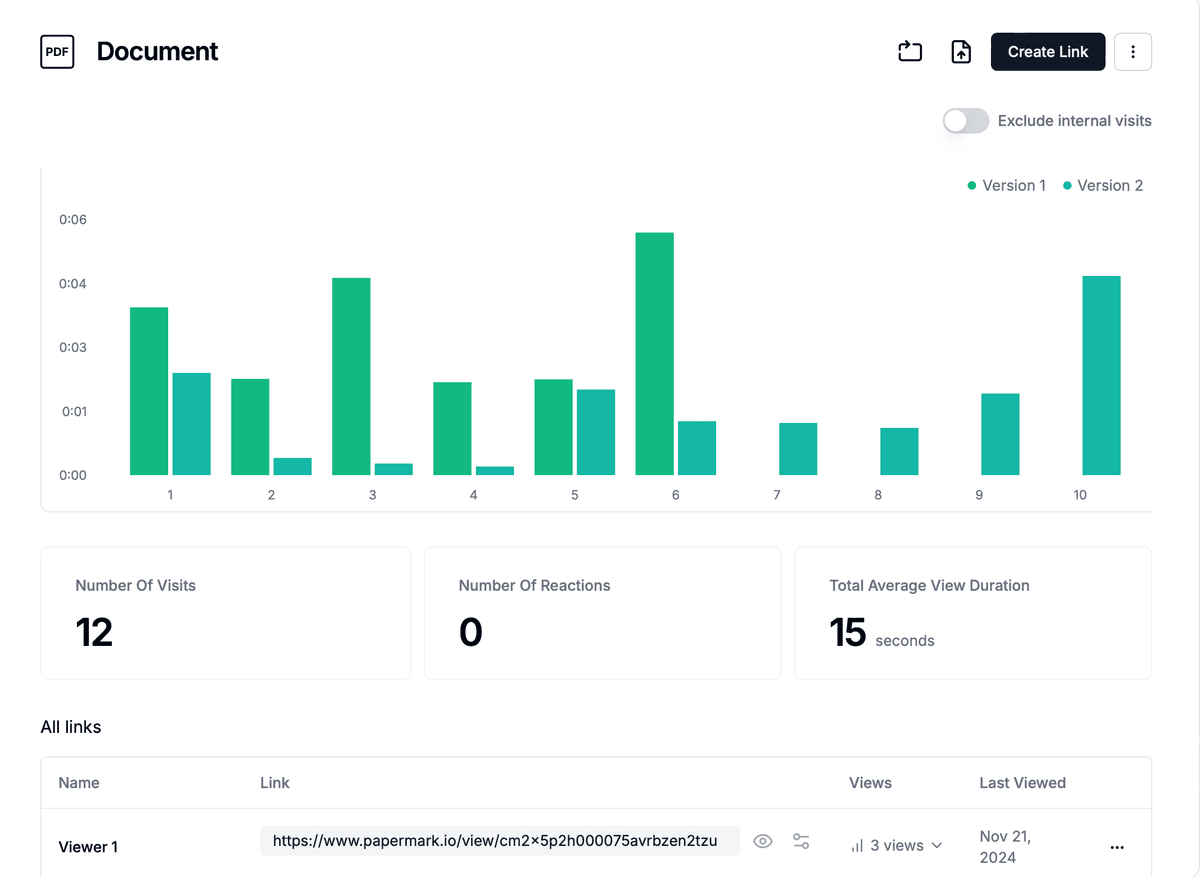
Activate page-by-page analytics to read which documents each workstream is engaging with. Enable the Q&A module with threaded questions tied to specific documents and per-workstream scoping (underwriter counsel questions should not be visible to the other bank's team).
6. Monitor activity and respond to Q&A
Assign a data room manager (commonly someone in legal or finance) who maintains organization, manages access, coordinates Q&A responses, and owns the audit log export for the offering record.
Best practices for managing your IPO data room
Start early. Open a pre-IPO readiness room 6-18 months before filing. Missing documents found in month -12 can be fixed; missing documents found in month -2 delay the offering.
Watermark everything. Every document viewed in the IPO data room should carry a per-session dynamic watermark with viewer email, IP, and timestamp. This is non-negotiable for material non-public information disclosure.
Monitor activity closely. Page-by-page analytics surface patterns: which documents each workstream opens most, which bank's counsel is asking the hardest questions, where comment-letter responses need preemptive support. Use those patterns to prioritize revision cycles.
Plan for post-IPO continuity. The data room should transition cleanly to an investor relations and post-IPO compliance portal. Do not delete content after pricing; the company will need it for 10-K filings, investor outreach, and any subsequent 10b-5 or shareholder litigation.
IPO data room provider comparison
IPO data room selection should be driven by feature fit, compliance posture, and speed to deploy, not sticker price alone. The table below compares how leading providers stack up for IPO workflows in 2026.
#
Provider
Pricing model
Compliance
Best for IPO
1
Papermark
Flat-rate subscription, 7-day trial
SOC 2 Type II, GDPR, HIPAA
Fast setup, multi-bank permissions, white-label branding
2
Datasite
Custom enterprise
SOC 2 Type II, ISO 27001
Large US IPOs, cross-border
3
Intralinks
Per-page / custom
SOC 2 Type II
Banking-heavy IPOs, capital markets
4
iDeals
Custom quote
SOC 2 Type II
Mid-market European IPOs
5
Firmex
Custom quote (reported ~$625/month)
SOC 2 Type II
Regulated industries (life sciences)
6
DealRoom
Flat-rate + tiers
SOC 2 Type II
Corporate dev teams running multiple deals
7
Ansarada
Tiered storage
SOC 2 Type II
AI-assisted IPO readiness
The practical difference is not just features on a checklist. Per-page and custom-quote models mean the cost of an IPO data room grows with the offering itself, commonly reaching $25,000-$100,000+ per deal on legacy enterprise platforms. Papermark gives IPO teams the same watermarking, permissions, Q&A, and audit trail without a procurement cycle that delays filing prep.
Poor folder organization. Dumping everything into one folder or using inconsistent naming forces reviewers to file Q&A requests for documents that should be self-serve. Use the standard numbered index.
Incomplete documents. Missing pages, unsigned contract versions, and drafts without signatures are red flags for underwriter counsel. Validate completeness before upload.
Overly restrictive access. Creating unnecessary friction (every document requires approval, every viewer needs individual invitation) slows diligence without improving security. Use group-based permissions instead.
Ignoring analytics. Not using the tracking data means missing signals about which workstreams are behind and where comment-letter revisions should focus.
Waiting too long. Starting data room setup two weeks before roadshow launch is a recipe for missed disclosures. Start 6-12 months before filing.
Getting started with Papermark for IPO
Setting up an IPO-ready data room in Papermark takes under an hour once documents are organized locally. Enterprise-grade security, granular permissions, dynamic watermarking, Q&A module, SOC 2 Type II, audit log export, unlimited documents, and custom domains are all included, joining the 70,000+ companies that already run their deals on Papermark. Start with the IPO data room checklist to map your S-1 documents, then open your room and invite counsel the same day.