


fundraising
What you need to know about startup fundraising rounds in 2026
The complete guide to startup fundraising rounds in 2026, from discovering which rounds you are and exist and what you need to know to fundraise
Raising money for your startup is one of the hardest parts of building a company. You're not just selling your product - you're selling a vision, a team, and a future that doesn't exist yet.
After helping hundreds of founders through fundraising at Papermark, I've seen what works and what doesn't. This guide covers everything from your first angel check to closing a Series A, with practical advice you won't find in VC blog posts.
Here's the fundraising journey in numbered steps:
Startup fundraising happens in stages, each with different expectations and investor types.
This is where most founders start. You've got an idea, maybe a prototype, but no real traction yet.
Typical raise: €100K - €500K
Investors: Friends, family, angel investors, micro VCs
What they want: A strong team and a big market opportunity
At this stage, investors are betting on you, not your metrics. They want to see that you deeply understand the problem you're solving and have the skills to build something people want.
Your pitch should focus on the problem, your unique insight, and why you're the right team to solve it. Don't worry if you don't have revenue yet - but you should have some evidence that people care about this problem.
You've built an MVP and have some early users or customers. Now you need capital to scale.
Typical raise: €500K - €2M
Investors: Angel investors, seed VCs, accelerators
What they want: Product-market fit signals and early traction
Seed investors want to see momentum. That could be:
You don't need to be profitable, but you need to prove people actually want what you're building. The best seed decks show a clear path from where you are now to Series A metrics.
This is where things get serious. You've proven product-market fit and now you're ready to scale aggressively.
Typical raise: €2M - €15M
Investors: VC firms (Tier 1 and Tier 2)
What they want: Repeatable growth and unit economics that work
Series A investors want to see:
At this stage, your pitch shifts from vision to execution. Investors want to see that you can efficiently acquire customers and that those customers stick around.
Your pitch deck is your most important fundraising tool. Here's what to include:
1. Problem - What painful problem are you solving?
Make it concrete. Don't say "communication is hard." Say "sales teams waste 10 hours per week on manual data entry."
2. Solution - How does your product solve it?
Show, don't tell. Screenshots, demos, or user testimonials work better than feature lists.
3. Market Size - How big is the opportunity?
Use a bottom-up approach. If you say "we're going after a $50B market," investors will tune out. Instead, calculate: "There are 100K companies in our target segment, each spending €10K/year on this problem = €1B addressable market."
4. Product - What have you built?
This is where your screenshots go. Show the actual product, not mockups. Walk through the core user flow.
5. Traction - What momentum do you have?
Charts going up and to the right. Monthly active users, revenue, key partnerships - whatever your strongest metric is, lead with that.
6. Business Model - How do you make money?
Keep it simple. "We charge €99/month per team" is better than a complex pricing matrix.
7. Go-to-Market - How do you acquire customers?
Show your current channels and their efficiency. "We acquire customers at €200 CAC with a €2,400 LTV" tells investors you've figured out sustainable growth.
8. Competition - Who else is in this space?
Don't say you have no competitors. Instead, show why you're different and better.
9. Team - Why are you the right people to build this?
Relevant experience matters. Highlight domain expertise, previous exits, or technical credentials.
10. Financials - What are your projections?
3-year projections showing revenue, expenses, and key metrics. Be ambitious but realistic.
11. The Ask - How much are you raising and what will you use it for?
"We're raising €2M to hire 5 engineers and scale our sales team from 2 to 10 reps." Specific is better than vague.
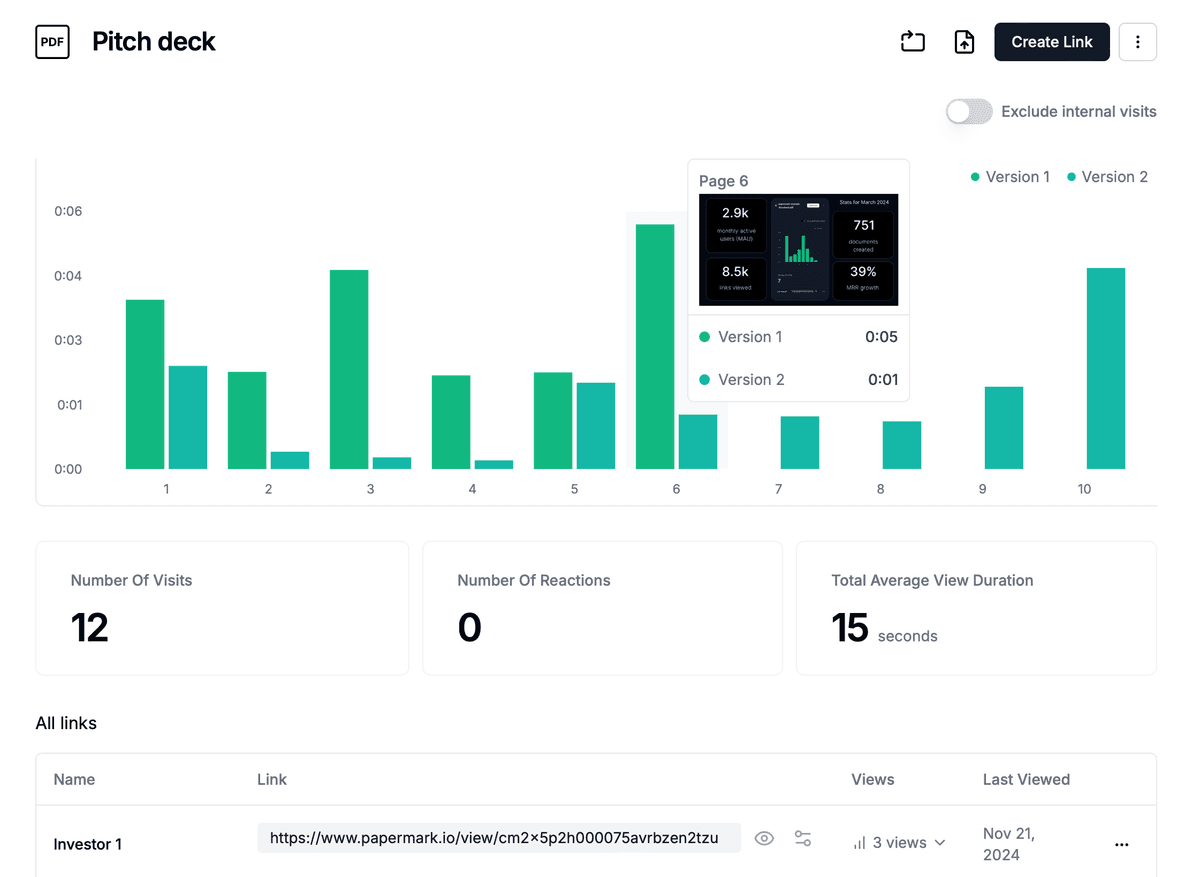
Instead of emailing your deck or using DocSend, use Papermark to share it securely.
Why it matters:
When you send your pitch deck through Papermark, you can see:
This data helps you follow up more effectively. If an investor spent 10 minutes on your traction slide, you know what interested them most.
Not all money is equal. The right investor brings more than capital - they bring network, expertise, and credibility.
Start by looking at who invested in companies similar to yours. Use platforms like Crunchbase, PitchBook, or AngelList to find:
Make a spreadsheet with:
Cold emails rarely work. Investors get hundreds of pitches every week.
The best paths to investors:
When asking for an intro, make it easy. Send a short blurb about your company that the person can forward:
"Hey [Investor], meet [Founder] who's building [Company]. They're [one-line description of what you do] and just hit [impressive metric]. Raised [amount] from [notable investors] and growing [X%] month-over-month. Worth a conversation."
Fundraising is a numbers game. You'll pitch 50 investors to get 10 meetings, 5 second meetings, and 2 term sheets.
Don't try to raise from everyone at once. Start with 10-15 "practice" investors you're less excited about. Refine your pitch based on their feedback, then approach your top targets when you've got it down.
Once an investor is interested, they'll want to dig deeper. This is due diligence.
They'll ask for:
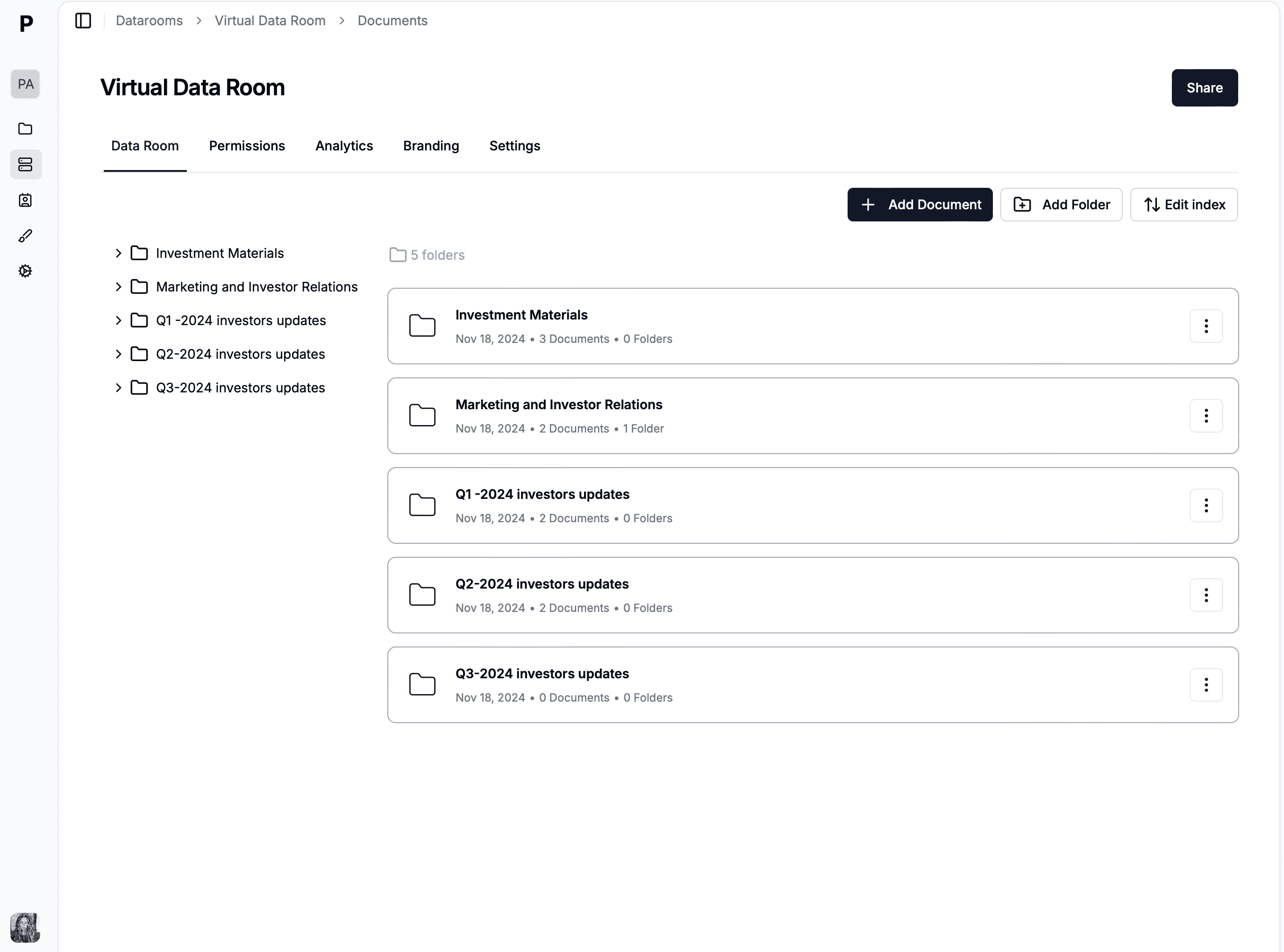
Don't send this stuff over email. Use a data room.
A data room is a secure place to share sensitive documents with investors. It lets you:
How to organize your fundraising data room:
Papermark is purpose-built for fundraising data rooms. You can create a professional data room in minutes, control exactly who sees what, and track engagement.
Investors appreciate organized data rooms because it shows you're serious and prepared. It's also a signal that you understand how to work with VCs.
You've got an offer. Now comes the hard part: understanding the terms.
Valuation: What your company is worth pre-money (before the new investment). If you're raising €2M at a €8M pre-money valuation, your post-money valuation is €10M and investors own 20%.
Liquidation Preference: Who gets paid first if the company is sold. Standard is 1x non-participating, meaning investors get their money back first, then everyone shares the remaining proceeds. Watch out for 2x or participating preferred - these heavily favor investors.
Board Seats: Who controls the board. For Series A, it's typical for investors to get 1-2 board seats. Make sure founders retain enough control.
Pro Rata Rights: The right for investors to invest in future rounds to maintain their ownership percentage. This is standard and usually favorable for founders.
Anti-Dilution Protection: Protects investors if you raise money at a lower valuation later. "Broad-based weighted average" is standard and fair. Avoid "full ratchet" anti-dilution.
Vesting: Your shares as a founder will likely have a 4-year vest with a 1-year cliff. This is standard - don't push back on it.
Never sign a term sheet without a lawyer who understands venture deals. The upfront cost (€5-10K) is worth it to avoid giving away too much equity or control.
Good lawyers will:
After watching hundreds of fundraises, here are the most common mistakes I've seen:
Raising too early - You pitch before you have any traction. Raise when you have momentum, not when you're out of money.
Raising too much - Taking €5M when you only need €2M means more dilution and higher expectations. Raise what you need to hit your next milestone.
Bad investor fit - Taking money from anyone who'll give it. A bad investor can hurt more than they help.
Complicated terms - Accepting multiple liquidation preferences, ratchets, or board control provisions that'll haunt you later.
No competitive tension - Only talking to one investor. You want at least 2-3 interested parties to create urgency and better terms.
Ignoring existing investors - Not giving your current investors a chance to participate. They already believe in you - they're your easiest money.
Over-optimizing the process - Spending months trying to get the perfect valuation. Speed matters more than an extra 10% valuation bump.
Congratulations, the money is in the bank. Now the real work begins.
Most founders underestimate how fast they'll burn through their raise. Create a detailed budget and track it monthly.
Your runway should be:
Build in buffer for things going wrong (they will). Don't plan to raise your next round right when you run out of money - start fundraising 6 months before that.
Send monthly or quarterly updates to all your investors. Include:
Good investors want to help, but they won't unless you ask. Be specific about what you need:
Start building relationships with Series A or Series B investors 6-12 months before you need to raise. Have coffee, send updates, ask for advice.
When you're ready to raise, you'll already have warm relationships instead of starting cold.
Startup fundraising is hard, but it's learnable. Here's what to remember:
The fundraising process gets easier the more you do it. Learn from each conversation, refine your pitch, and keep building.
The complete guide to startup fundraising rounds in 2026, from discovering which rounds you are and exist and what you need to know to fundraise
The 10 best data rooms for fundraising in 2026 compared on pricing, security, and best-fit round. Real customer stories from Backtrace Capital, TBD VC, and Two Inc.
Discover the 15 best startup fundraising tools in 2026 to streamline investor outreach, manage pitch decks, and close funding rounds faster with powerful analytics and automation.