BlogData RoomsBest 15 Virtual Data Rooms for Due Diligence in 2026 (From $99/month to $10,000/month)
Best 15 Virtual Data Rooms for Due Diligence in 2026 (From $99/month to $10,000/month)
·23 min read
Marc Seitz
The best virtual data room for due diligence depends on deal size, document volume, pricing model tolerance, and compliance requirements. For most fundraising and mid-market M&A, flat-rate providers (Papermark at €99/month, Firmex at ~$625/month reported, SecureDocs from $450/month) win on predictability. For enterprise M&A and IPOs, Datasite and Intralinks are still dominant but expensive. This guide compares the 15 most-used VDRs in 2026 on the dimensions that actually matter during a live deal.
Quick recap
Papermark: secure VDR with flat €99/month pricing, page-level analytics, dynamic watermarking, and an optional self-hosted open-source deployment - best overall for modern mid-market diligence.
Intralinks (SS&C): enterprise-grade VDR common in banking and capital markets; per-page pricing; strong compliance posture.
Ideals: mid-market M&A VDR with a strong Q&A module; quote-based pricing, commonly from ~$500/month into five-figure annual contracts.
Firmex: flat-rate VDR (custom quote, reported from ~$625/month) with strong legal and life-sciences compliance.
Ansarada: AI-powered VDR with per-GB pricing; strong bid management workflow.
Datasite: enterprise bulge-bracket M&A VDR; custom pricing from $25,000+/year.
Box: cloud content management platform with VDR tier; unsuitable for regulated diligence.
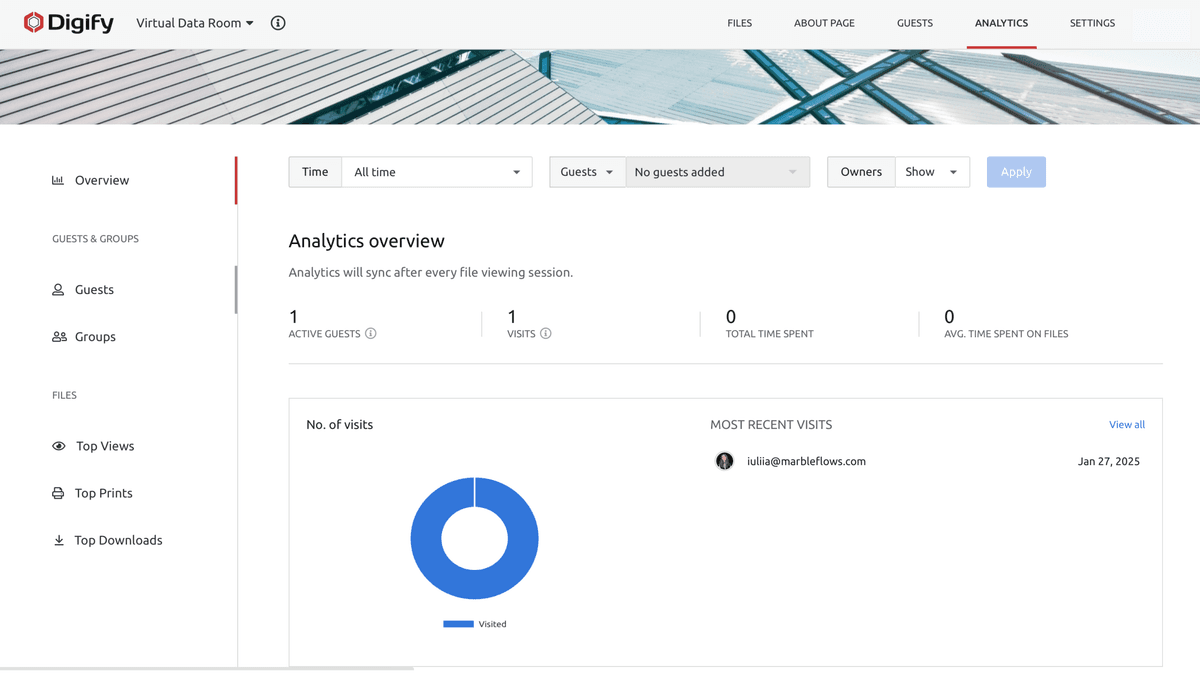
Digify: secure document sharing with watermarking; lightweight alternative.
DocSend (Dropbox): per-user pitch deck tool; works for pre-seed fundraising, limited for full diligence.
What is a virtual data room for due diligence?
A virtual data room for due diligence is a secure online platform where companies store, organize, and share critical business documents (financials, contracts, IP, legal) with potential investors, buyers, or auditors during a transaction. It provides granular permissions, dynamic watermarking, NDA enforcement, and a tamper-proof audit trail that underwriter counsel and post-close litigation both rely on.
How a due diligence data room is structured and run
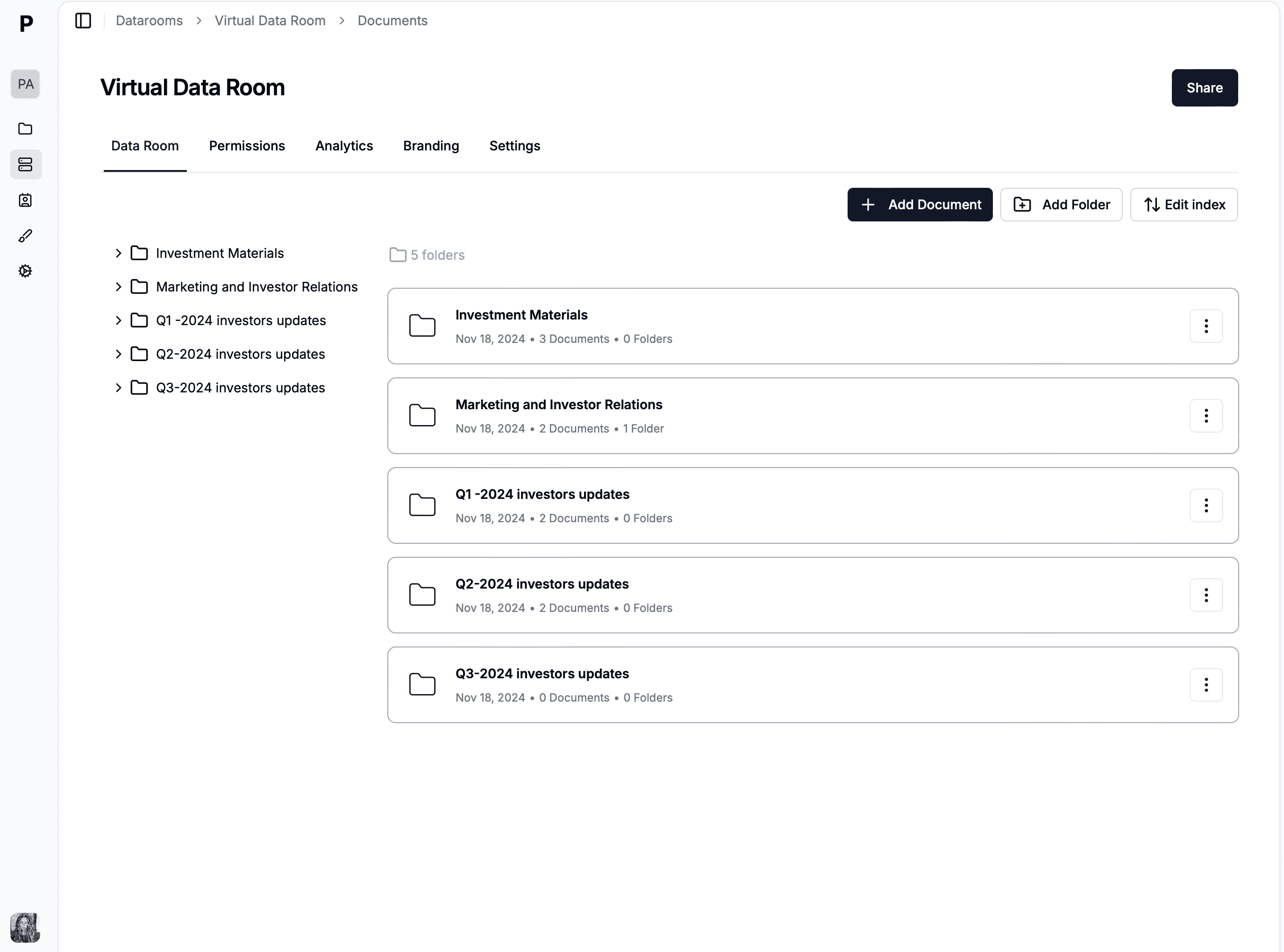
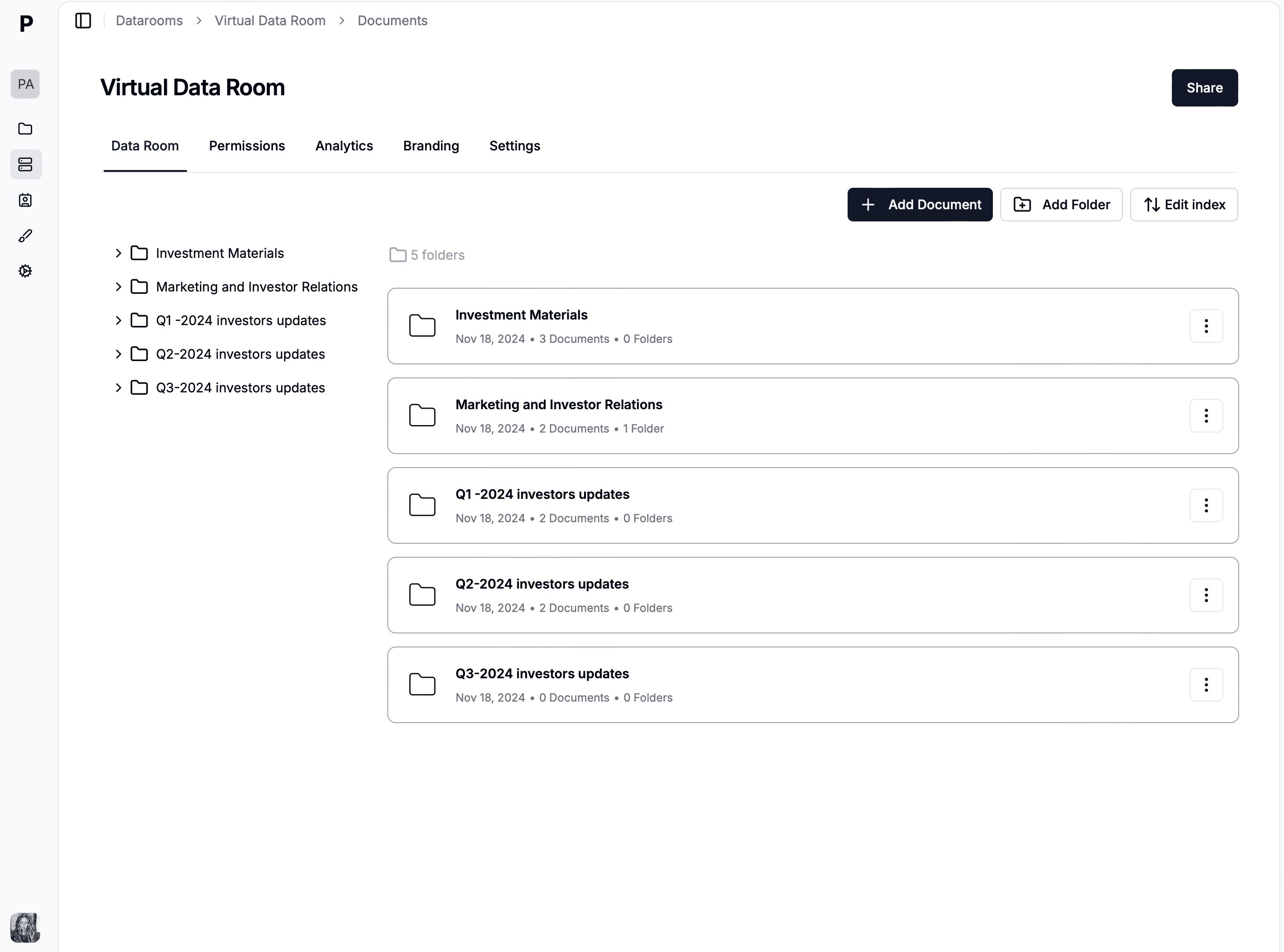
A due diligence data room is built around the buyer's workstreams, not around the seller's internal file drive. The top level is almost always the same eight folders: corporate and governance, financial, legal and contracts, intellectual property, human resources, commercial, tax and regulatory, and technology and data protection. Inside each, documents are numbered so a buyer's request list can reference "3.2.4" rather than a filename, and versions stack so the current file is always the one on top. Getting this structure right before the first buyer arrives is the single biggest time saver in a process, because every later request is answered by pointing at an index number.
The second half of a diligence room is staging. Not every party should see everything at once. A first-round buyer sees the teaser, the management presentation and summary financials; a party that has signed a letter of intent sees customer contracts, employment agreements and the detailed model; the buyer's lawyers get the litigation and IP folders in confirmatory diligence. In practice this means one permission group per stage, each with its own link, so moving a bidder forward is a matter of adding them to the next group rather than re-sharing files.
Take a hypothetical: Norrland Components, a 60-person industrial supplier, is sold by its founders to a strategic buyer. The CFO builds the room in Papermark in an afternoon by bulk-uploading the eight folders and letting the index number itself. Three groups are created: Round 1 for the five parties that signed the NDA, Round 2 for the two that submitted indicative offers, and Confirmatory for the winning buyer's counsel. Every page a buyer opens is watermarked with their email and timestamp and logged, so when one party claims it never saw the change-of-control clause, the audit trail shows the page view, the date and the time spent. Buyer questions come in through the Q&A workflow rather than email, and the answers are published to the group that asked. When the deal closes, the room is frozen and archived as the disclosure record.
Papermark supports this workflow on its Data Rooms plan from €99/month, with Q&A and room freezing on Data Rooms Plus; enterprise VDRs such as Datasite, Intralinks and Ideals run the same structure on custom per-project quotes.
How we evaluated the best VDRs for due diligence
The 15 providers below are ranked against four criteria that matter in a real deal.
Security and compliance posture. Every production-grade VDR should ship AES-256 encryption at rest, TLS 1.2+ in transit, dynamic watermarking per session, granular permissions at folder and file level, mandatory NDA enforcement, append-only audit logs, and SOC 2 Type II compliance. Providers that miss any of these baseline controls are not ready for regulated diligence.
Pricing model and predictability. Flat-rate subscriptions (Papermark, SecureDocs, Firmex) beat per-page pricing (Intralinks, Ansarada tiers) for almost every deal with more than 200 documents. Custom enterprise quotes (Datasite) can make sense for very large deals but weaken budget predictability. Per-user pricing (DocSend) only works for pitch-deck-only workflows.
Feature fit for due diligence workflows. Page-by-page analytics, Q&A module with per-bidder scoping, version control with audit history, and folder-level permissions are the features that show up repeatedly in real diligence. Decorative features (branding themes, AI document summaries) matter less when a buyer's counsel is asking a pointed question about a 2022 tax return.
Total cost of ownership. Setup fees, per-seat upcharges, 12-month annual minimums, and overage clauses can 2-3x the sticker price on enterprise VDRs. Flat-rate providers rarely have these clauses.
Why you need a virtual data room for due diligence
Running due diligence on email and shared drives is the anti-pattern that a dedicated VDR exists to replace. Six problems get solved by moving to a purpose-built data room.
Confidentiality at scale. Scoped access per bidder group prevents cross-contamination of competitive information. Multiple bidders reviewing the same room without seeing each other's activity.
Audit trail. Every view, download, and interaction is logged immutably. Underwriter counsel relies on this during review; post-close litigation relies on this for dispute resolution.
Dynamic watermarking. Per-session viewer identity on every page deters leaks and traces them when they happen.
Version control. Automatic version history shows what was published, when, and who viewed each version. Critical for buyers claiming they never saw the updated financials.
Q&A workflow. Structured, threaded Q&A tied to specific documents replaces the "diligence tracker" spreadsheet every deal team otherwise maintains by hand.
Global access. Buyers, counsel, and auditors across time zones all access the same room on the same audit log.
Real-world example: family office due diligence
See how G.P. Loree & Co., a New York-based family office, uses Papermark to streamline institutional investment due diligence:
Comparison of virtual data room providers for due diligence
The table below maps the 15 most-used VDRs in 2026 on the features that matter most for diligence. Starting prices reflect each provider's entry tier as of September 2026; enterprise quotes commonly land higher.
When you sell a startup, the buyer's diligence team will request financials, cap table, contracts, IP assignments, and employee agreements within days of signing an LOI. A due diligence data room lets you stage all of this in one secure, branded room, scope access per bidder, and watch page-by-page analytics to see which acquirer is actually working the financial model.
For a founder-led sale, the room needs to go live fast and cost little. Papermark fits this well: flat €99/month pricing, unlimited documents, dynamic watermarking, NDA gating, and granular folder permissions so legal, financial, and commercial reviewers each see only their own files. Real founders run acquisitions this way - Tab closed its acquisition by Kivra in 3 weeks using a Papermark data room.
The video below walks through setting up a deal-ready data room from scratch before you compare the detailed provider list.
Whichever provider you choose, buyers expect the same categories in a due diligence room:
Corporate and governance: incorporation, articles, shareholder agreements, board minutes, cap table
Financial: audited statements, management accounts, forecast, debt and lease schedules
Legal and contracts: material customer and supplier agreements, litigation summary, licences, insurance
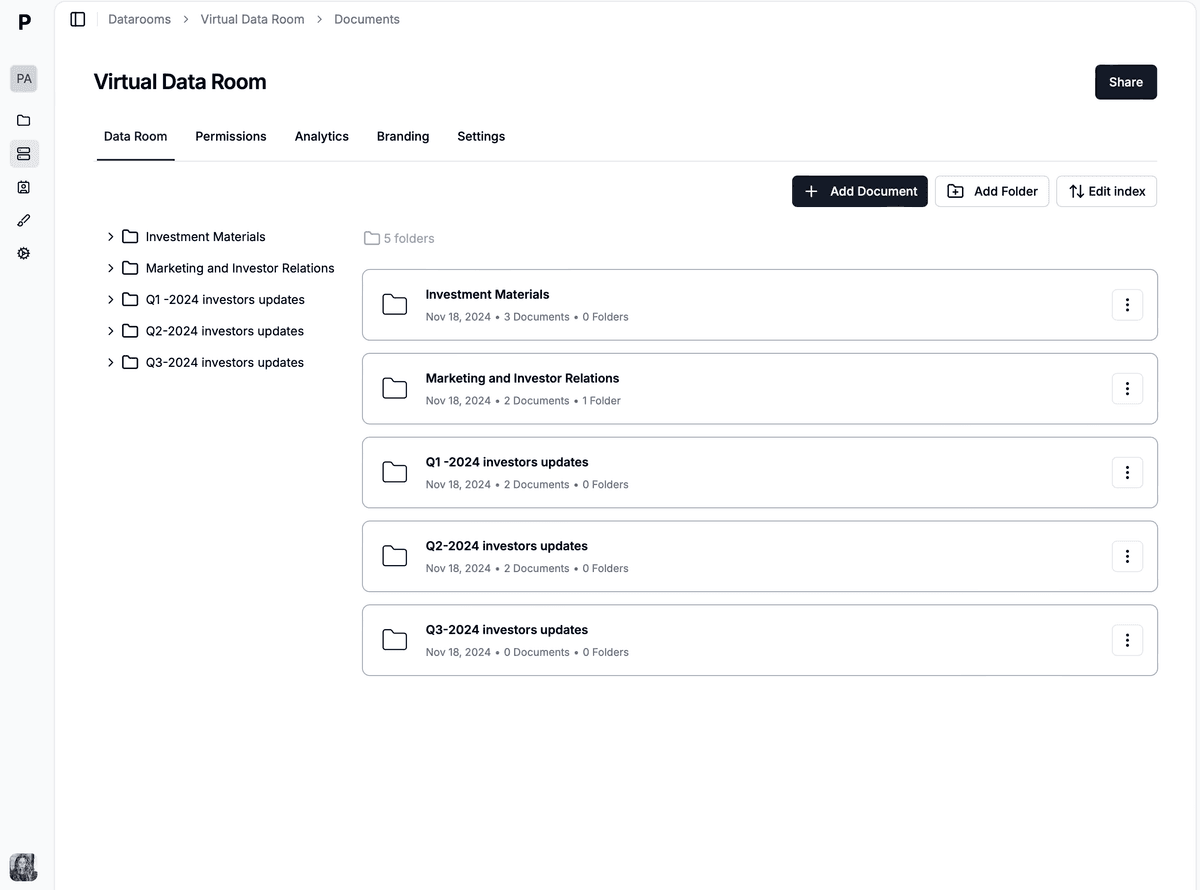
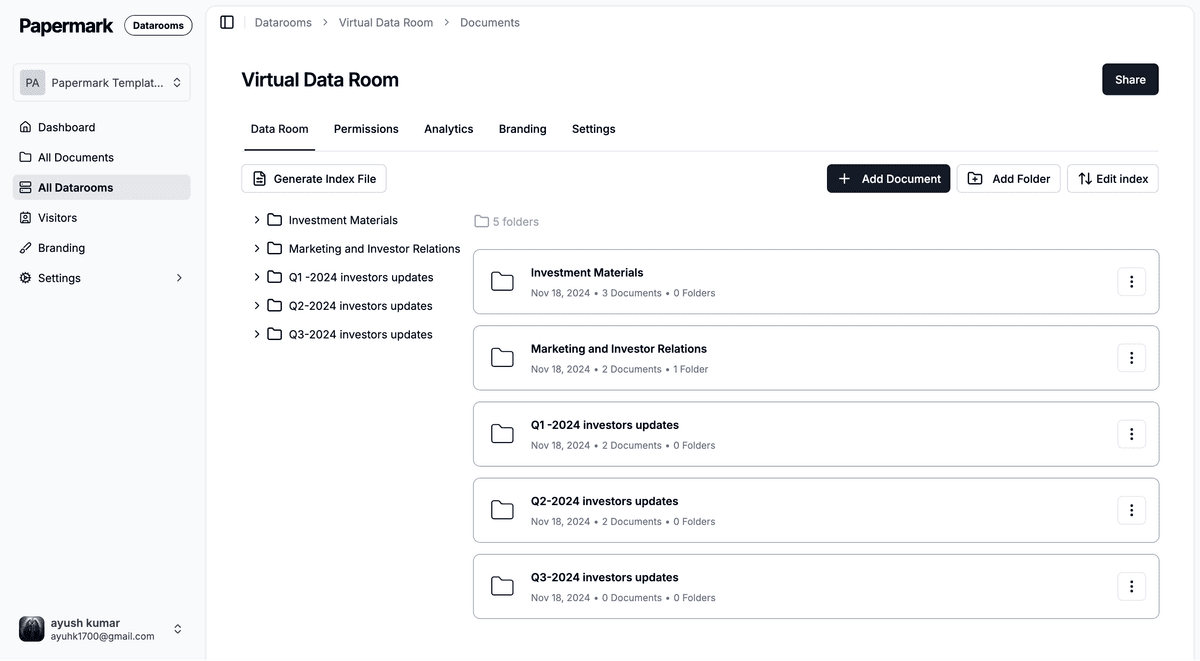
Papermark is the best secure virtual data room for due diligence in 2026 for most teams, combining the full enterprise feature set with flat-rate pricing from €99/month, an open-source self-hostable option, and the only fully transparent public API and MCP server on this list. It is built for M&A, fundraising, and due diligence workflows and is the platform mid-market sell-side advisors, family offices, and venture funds switch to when legacy per-page VDRs become too expensive or too slow to deploy.
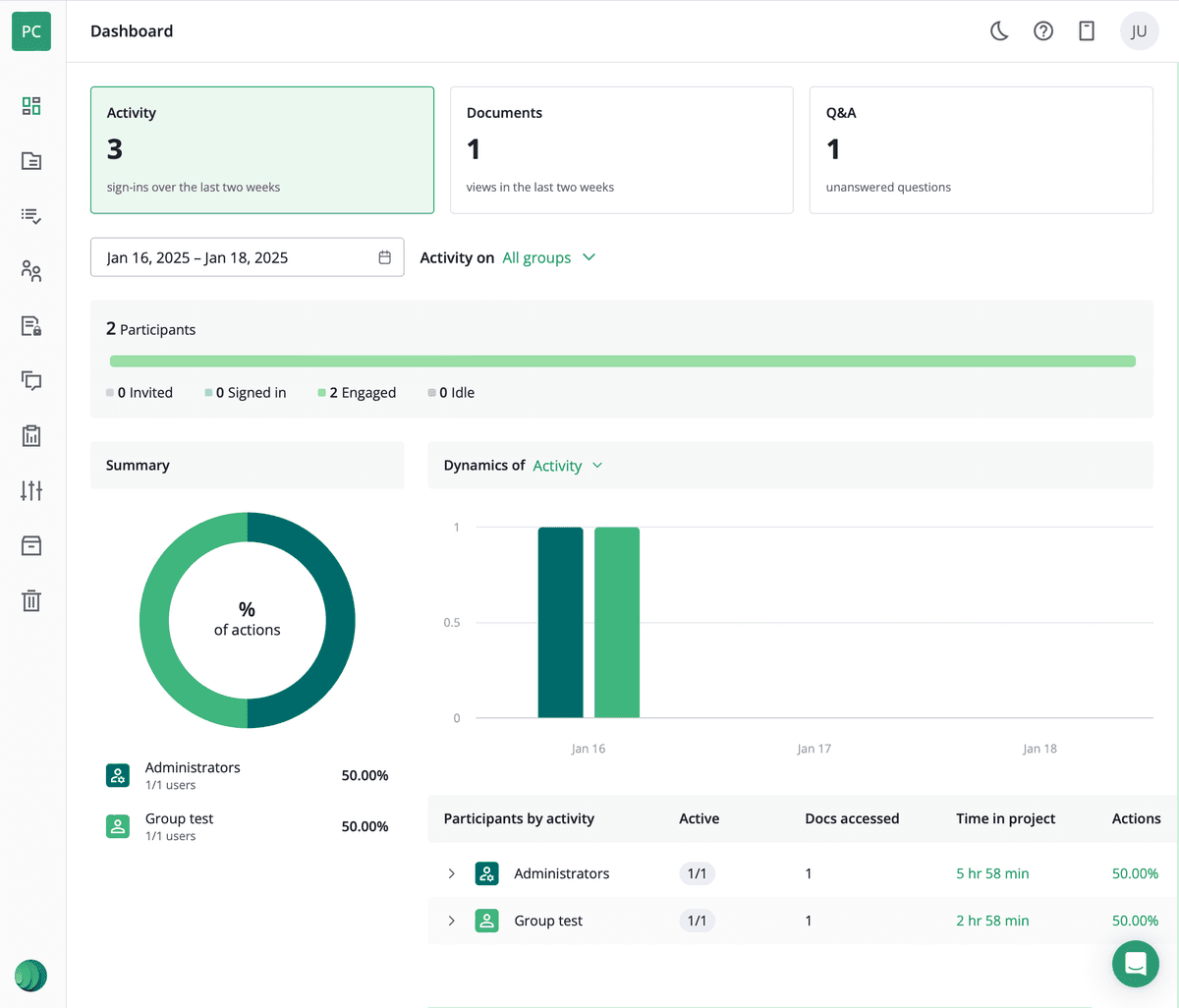
For a real diligence process, Papermark ships every control buyers and counsel expect: granular folder and file permissions with bidder groups, dynamic watermarking with per-session viewer email, IP, and timestamp on every page, mandatory NDA gating before any document loads, email verification, download restrictions and link expiration per group, and IP allow-listing. The Q&A module (Data Rooms Plus, €249/month) is threaded and scoped per bidder so legal, tax, and business diligence teams never see each other's questions, with document-linked answers and Excel export for the close binder. Every view and download writes to an append-only audit log with page-by-page analytics per viewer and per session, and at signing you can freeze the room into an immutable, exportable archive for the SPA disclosure schedule, M&A insurance, and 7-year retention.
Papermark is also the only secure due diligence data room with a fully transparent, public API and MCP server, so deal teams and AI agents can create rooms, set permissions, and pull engagement data programmatically. It is SOC 2 Type II certified and GDPR compliant with EU data hosting, and the only platform here that is open-source and self-hostable for full data sovereignty. See data room security for the full compliance posture.
Proof: Papermark holds a 4.9/5 rating across 171 reviews on G2, Product Hunt, and Reddit (verified September 2026) and is used in live diligence and fundraising by Backtrace Capital (€50M+ Fund I), GP Loree family office (direct M&A diligence), and Tab (acquisition by Kivra closed in 3 weeks). It is the only data room on this list that is open-source, with 8,000+ GitHub stars.
Key features:
Page-by-page engagement analytics per viewer and per session
Dynamic watermarking with customizable variables
Granular folder and file permissions with group management
Mandatory NDA gating, email verification, and allow-list access
Fully branded, white-label data rooms: custom domain, logo, colors, and layouts
Enterprise security and compliance: SOC 2 Type II, GDPR, ISO 27001, EU hosting (see security)
Open-source, self-hostable deployment (AGPL)
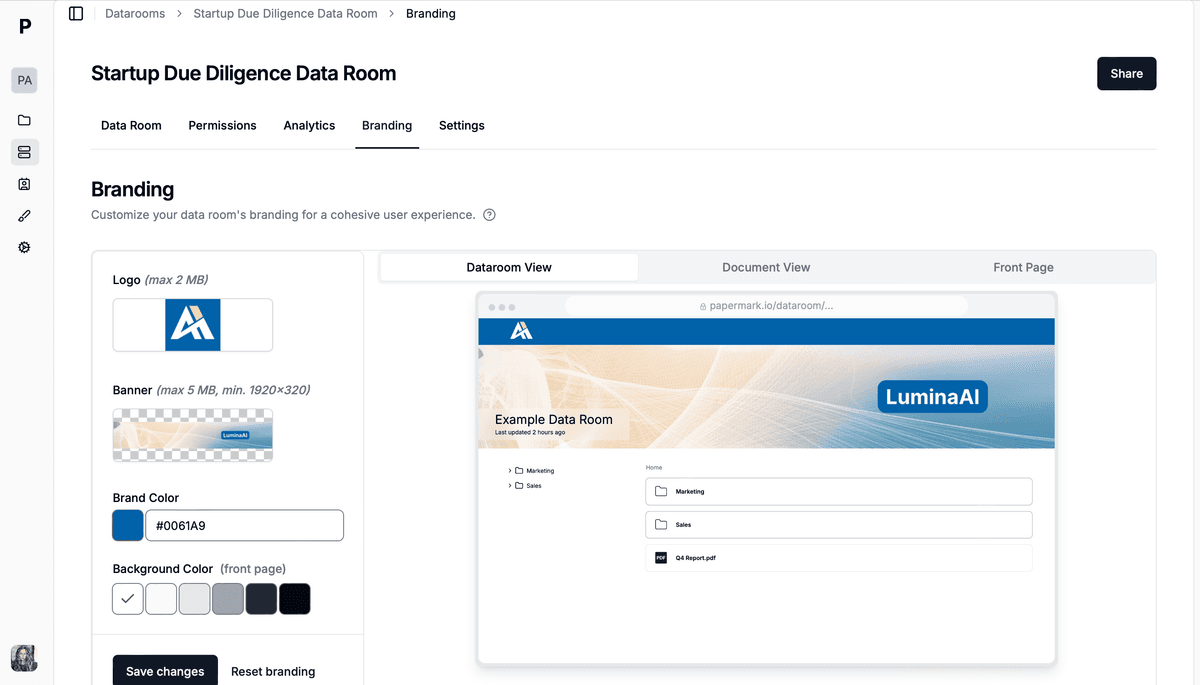
Papermark runs every diligence room on a fully branded experience, so buyers and counsel see your firm's domain, logo, colors, and layout instead of a generic vendor portal. Branding is included from the Data Rooms plan, not gated behind an enterprise tier.
Pro: €24/month, 1 member (unlimited links, custom branding, folders, video analytics)
Business: €59/month, 3 members (unlimited light data rooms, multi-file sharing, screenshot protection, custom domain for docs, webhooks)
Data Rooms plans:
Data Rooms: €99/month, 3 team members (unlimited data room visitors, unlimited data rooms, custom domain for data rooms, advanced branding, data room analytics, NDA agreements, dynamic watermark, granular file-level permissions, Data Room groups)
Data Rooms Plus: €249/month, 5 team members (unlimited data room visitors, everything in Data Rooms plus audit log, Q&A module with permissions, automatic file indexing, email invite viewers, dedicated account manager, SOC 2 Type II)
Data Rooms Premium: €549/month, 10 team members and multiple teams (unlimited data room visitors, everything in Plus plus AI redaction, unlimited encrypted storage, workflows, full API, SSO, whitelabeling)
Data Rooms Unlimited (€999/month): unlimited data room visitors, unlimited team members with no per-seat charge, plus every Premium capability including AI redaction
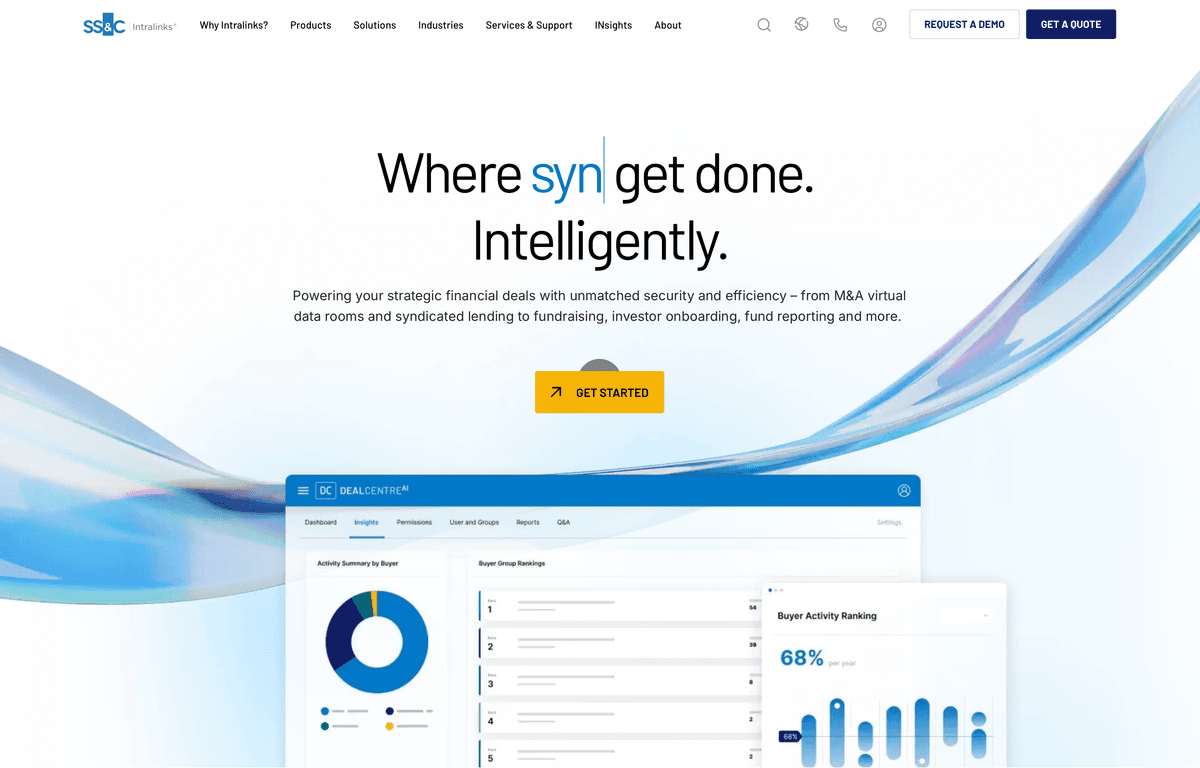
Intralinks, now owned by SS&C, is the dominant enterprise VDR in banking, capital markets, and large M&A. Its feature set is deep (granular permissions, detailed activity tracking, advanced document control, compliance posture covering SOC 2 Type II and ISO 27001), but pricing is per-page or custom enterprise quote and commonly runs $4,000-$25,000+/year on annual contracts. A frequent friction point raised by customers is the SMS verification step that "disincentivizes anyone from ever looking at a data room." For bulge-bracket banking workflows, Intralinks remains a default; for mid-market diligence, the pricing model rarely pencils out.
Key features:
Enterprise-grade encryption and SOC 2 Type II compliance
Detailed activity tracking and reporting
Advanced permissions and secure document sharing
Integration with major enterprise software
Pricing: Custom, commonly $7,500 for ~10,000 pages; annual contracts $4,000-$25,000+.
Ideals is a Europe-headquartered VDR commonly used in mid-market M&A and European deal flow. The feature set is deep: 256-bit encryption, an intuitive interface, comprehensive audit trails, 24/7 support with dedicated project managers, and a strong Q&A module. Pricing is not publicly transparent; the Pro tier starts around $500/month, most live deals land closer to $5,000/month, and enterprise pricing for large cross-border transactions can quickly reach five figures per year. Ideals has particularly strong European market presence (often used by M&A advisors on LSE and Euronext listings), but custom quote pricing weakens budget predictability for mid-market diligence.
Key features:
256-bit encryption and advanced security controls
Intuitive interface with minimal training overhead
Comprehensive audit trails
24/7 customer support with dedicated project managers
Integrated Q&A module for due diligence
Pricing: Custom quote; commonly from ~$500/month on Pro, often $5,000/month and above on larger transactions.
Firmex runs on a flat-rate subscription model, though pricing is quote-based: reported entry-tier rates cluster around $625-$995/month. Its feature set emphasizes dynamic watermarking, two-factor authentication, document control, and audit trails, and the platform has particularly strong traction in legal, life sciences, and regulated financial workflows. For compliance-sensitive industries that need predictable pricing without Intralinks-level cost, Firmex is a common choice. The tradeoff is a somewhat less modern UX than Papermark.
Key features:
Flat-rate pricing without per-page billing
Dynamic watermarks and two-factor authentication
SOC 2 Type II and HIPAA compliance
24/7 customer support
Strong Q&A module
Pricing: Custom quote; reported entry rates from ~$625/month.
Ansarada pairs VDR functionality with AI-powered bid management and is common in Asia-Pacific M&A. The platform emphasizes AI document organization, real-time collaboration, and comprehensive audit trails. Ansarada no longer publishes public pricing and now quotes per deal; the following tiers are historical/indicative only: tiered per-GB storage (250 MB at $479/month, 1 GB at $1,479/month, 5 GB at $3,069/month, scaling up to 20 GB at $8,579/month), which escalates quickly on media-heavy deals. For deals that genuinely benefit from AI-assisted diligence and bid scoring, Ansarada has differentiated features; for smaller deals, the per-GB pricing is rarely the cheapest option.
Key features:
AI-powered document organization and Q&A insights
Real-time collaboration tools
Comprehensive audit trails
Drag-and-drop upload interface
Pricing: Quote-based — Ansarada no longer publishes public pricing (historical/indicative: $479–$8,579/month per tiered GB storage, 250 MB to 20 GB).
Datasite (formerly Merrill Corporation) specializes in large-scale, complex M&A deals and IPOs. It is the dominant VDR for bulge-bracket investment banks and is commonly seen on deals above $500M. Pricing is always custom, typically starting at $25,000+/year with per-deal quotes. The tradeoff: Datasite offers the deepest enterprise feature set and dedicated project management support, but at a cost that is rarely justifiable for mid-market diligence or fundraising.
Box is a cloud content management platform with a VDR-adjacent tier used for lightweight document sharing. It is not a purpose-built VDR: it lacks mandatory NDA enforcement, dynamic per-session watermarking, and the per-bidder scoping that real M&A requires. Box works for internal team collaboration and basic client file sharing, but is unsuitable for regulated M&A, IPO readiness, or institutional LP fundraising. A tax advisor at a boutique wealth management firm described the problem directly: Box "forced account creation frustrated wealthy clients."
Key features:
Cloud content management with real-time collaboration
Integration with Office 365 and Google Workspace
Advanced file management
Pricing: Box does not publish a dedicated VDR tier, and all business plans require a 3-user minimum. Realistic minimum monthly spend: Business Starter from $15/month; Business from $45/month - the lowest tier with security controls approaching VDR territory; Business Plus from $99/month; Enterprise from $141/month. External collaborators may incur additional cost on entry-tier plans.
ShareFile is Citrix's secure document sharing product, sometimes pitched for VDR use cases. It offers SSL/TLS encryption, customizable document controls, Microsoft Office integration, and activity logs. For due diligence specifically, feature depth is limited: no dynamic per-session watermarking, limited folder-level permissioning, no structured Q&A. ShareFile is best suited for secure document sharing outside deal contexts rather than for M&A or fundraising diligence.
Key features:
Secure file sharing with SSL/TLS encryption
Customizable document controls
Microsoft Office integration
Activity logs
Pricing: All ShareFile business plans require a 3-user minimum, and the dedicated VDR plan requires a 5-user minimum. Realistic minimum monthly spend: Advanced from $54/month; Premium from $86/month; dedicated Virtual Data Room plan from $385/month - the only tier with VDR-grade features such as Q&A, dynamic watermarking and click trails.
Digify is a mid-tier document security platform with file-level tracking and rights management. It offers dynamic watermarking, document tracking, and basic audit logs at more accessible pricing than enterprise VDRs. For smaller deals that do not need the full IB-grade feature set (no multi-bidder staging, no enterprise compliance posture), Digify is a reasonable alternative. It does not match Papermark's feature depth, but it costs less than Intralinks or Datasite.
Key features:
File-level tracking and rights management
Dynamic watermarking
Basic audit logs and reporting
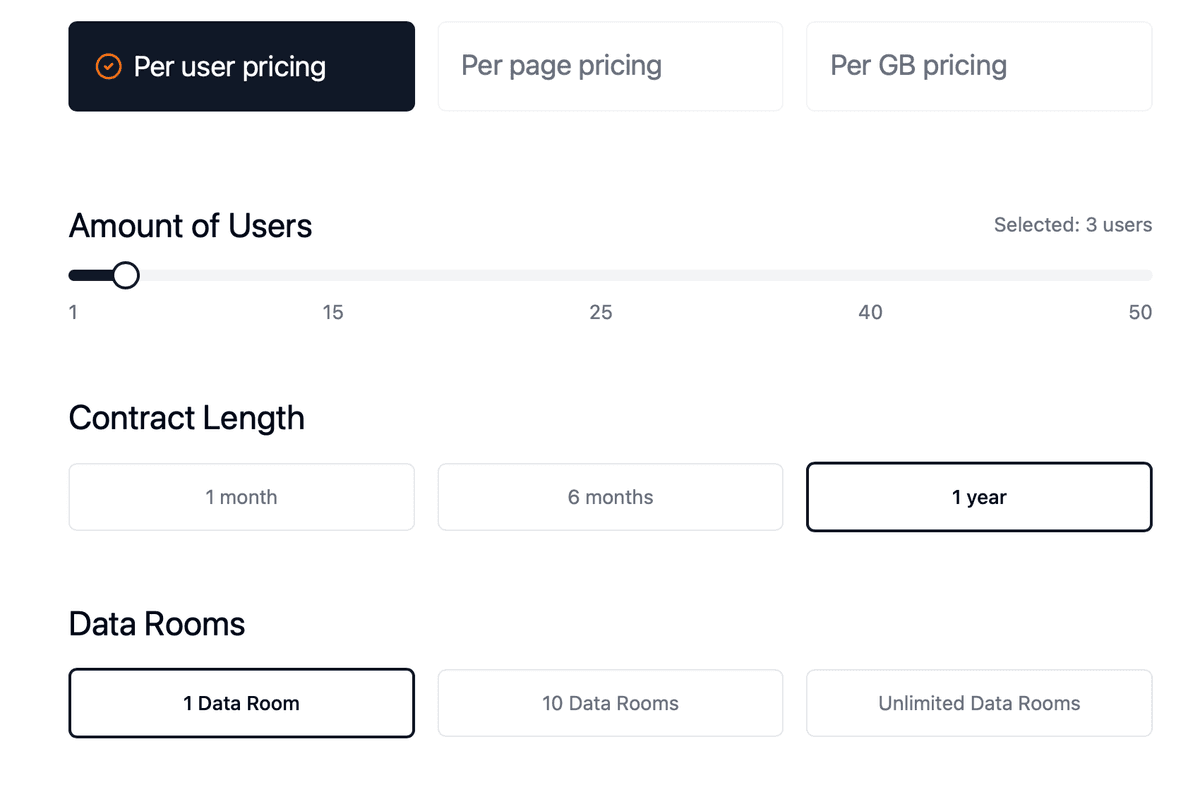
Pricing: Pro $190/month (1 user, 3 data rooms, 50 guests - no dynamic watermarking or Q&A); Team $500/month (3 users, 10 data rooms, 200 guests, dynamic watermarking, Q&A); Enterprise custom. Annual billing reduces each tier by ~30% (Pro $140/mo, Team $350/mo billed yearly). Only the Team tier carries the VDR feature set described above.
DocSend (now owned by Dropbox) is optimized for pitch-deck sharing and pre-seed fundraising analytics. It has a VDR tier, but the platform is not designed for full diligence workflows: limited granular permissioning, no mandatory NDA gating with per-session watermarks, and per-user pricing that becomes expensive once 10+ investors are invited. For a pre-seed founder sharing a pitch deck with 3-5 angels, DocSend is often cheaper than a full VDR. For Series A+ due diligence, it is a downgrade.
Key features:
Real-time document tracking and analytics
Document permissions
Email and communication tool integration
Simple user interface
Pricing: Personal $10/user/month (1 user); Standard $45/user/month (1 user); Advanced $150/month (3 users included, lightweight Spaces/data rooms); Advanced Data Rooms $180/month (3 users included, full VDR features including audit log, automatic indexing, Q&A permissions, dynamic watermarking). Only the Advanced Data Rooms tier is relevant for real due-diligence workflows.
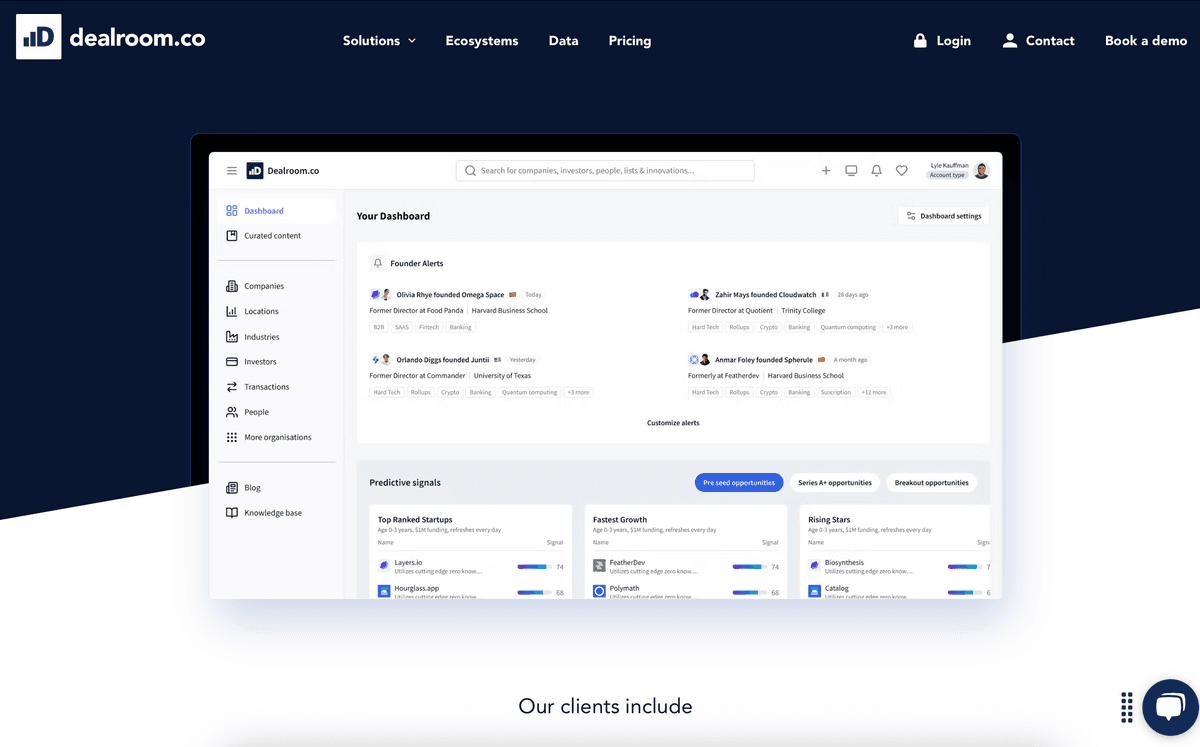
DealRoom is an M&A-focused platform that blends a VDR with pipeline, diligence-tracker, and integration workflows. Its standout is deal-level AI chat across all contracts at once and a playbook builder that generates a tailored diligence tracker by deal type, which saves setup time for buy-side teams running structured processes. The tradeoff is an opinionated, buyer-led workflow that is most valuable when a team fully adopts the platform, and subscription pricing that starts around $1,250/month, higher than flat-rate mid-market VDRs. For acquirers running many deals through one repeatable process, DealRoom is differentiated; for a single sell-side raise, it is more platform than most teams need.
Key features:
Deal-level AI chat across all contracts with citations
Diligence playbook and tracker generation
Granular permissions and audit trails
Pipeline and integration (PMI) workflows
Pricing: Subscription, commonly from $1,250/month.
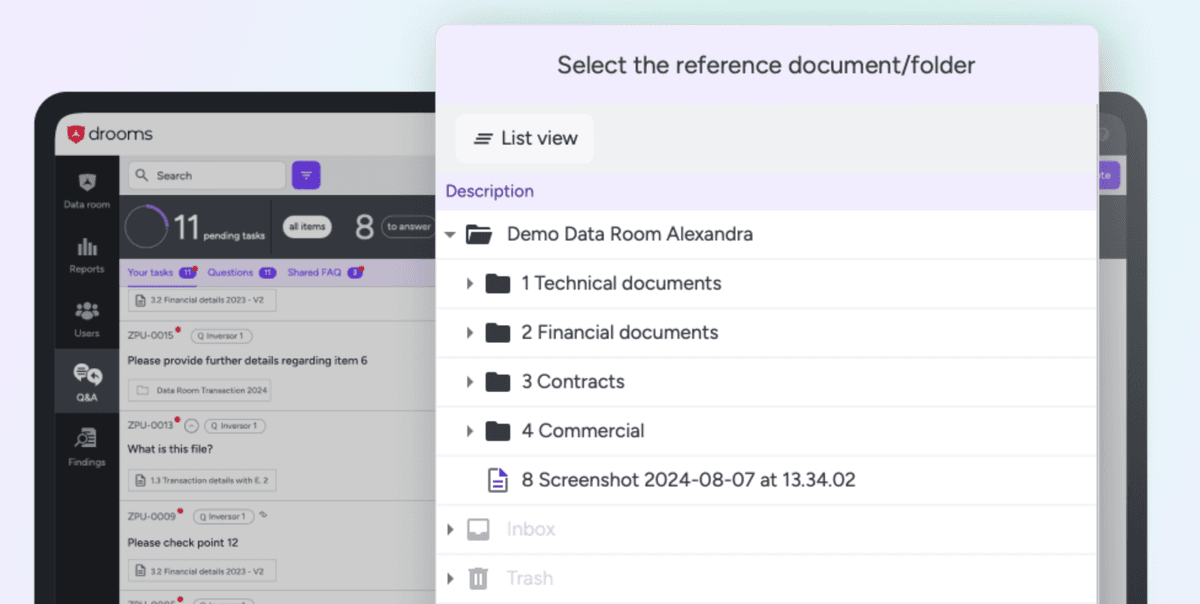
Drooms is a European VDR with a strong security and compliance posture, trusted by Fortune 500 companies and common in EU real estate, M&A, and legal transactions. It holds GDPR, ISO 27001:2022, and ISO 27018:2020 certifications with georedundant European infrastructure, and its AI Assistant adds multilingual Q&A and document breakdown that work across language barriers, an advantage for cross-border diligence. Pricing is quote-based, and the platform can carry a steeper learning curve for teams new to enterprise VDRs. For regulated European deals where data residency and multilingual review are non-negotiable, Drooms is a strong fit; for budget-sensitive mid-market diligence, the custom pricing is less predictable than flat-rate alternatives.
Key features:
GDPR, ISO 27001 and ISO 27018 certified, EU georedundant hosting
Multilingual AI Assistant with semantic search and Q&A
Comprehensive audit trails and document control
Strong fit for real estate and regulated EU transactions
Pricing: Custom enterprise quote.
13. SecureDocs - flat-rate VDR for life sciences and SMB
SecureDocs is a subscription VDR aimed at small and mid-market companies, with particular traction in life sciences and corporate transactions. It publishes transparent pricing (from $450/month) with unlimited users, fast setup, and the core diligence controls: watermarking, granular permissions, audit logs, and built-in e-signature. It is deliberately simpler than enterprise platforms, which makes it quick to launch but lighter on advanced bidder-management and analytics. For a straightforward sell-side or fundraising room where predictable pricing and speed matter more than deep enterprise tooling, SecureDocs is a solid, budget-friendly option.
Key features:
Flat-rate pricing with unlimited users
Watermarking, granular permissions, and audit logs
Built-in electronic signature
Fast setup with minimal training
Pricing: From $450/month.
14. CapLinked - flat-rate VDR for finance and real estate
CapLinked is a US-based VDR used in M&A, asset sales, and real estate, with flat-rate plans that start around $399/month on the Team tier. It covers the standard diligence controls (dynamic watermarking, granular permissions, activity tracking, and an API for programmatic workflows) and is known for a relatively quick learning curve. Higher tiers add custom branding and advanced reporting. CapLinked sits between lightweight tools and enterprise VDRs: more capable than DocSend for real diligence, more affordable than Datasite or Intralinks, but with a smaller European footprint than Drooms.
Key features:
Flat-rate plans with dynamic watermarking
Granular permissions and activity tracking
API access for workflow automation
Custom branding on higher tiers
Pricing: From $399/month (Team tier).
15. ShareVault - secure VDR for life sciences and IP-heavy deals
ShareVault is an enterprise VDR with deep roots in life sciences, biotech, and pharma diligence, where IP protection and regulatory document control are paramount. It offers strong document security (remote shredding of downloaded files, granular rights management, dynamic watermarking) and AI-assisted document handling, and is commonly seen in licensing deals and clinical-asset transactions. Pricing is custom and oriented to enterprise buyers, so it is rarely the cheapest choice for a small raise. For IP-sensitive life-sciences diligence that needs post-download control, ShareVault is purpose-built; for general mid-market M&A, flat-rate VDRs are usually more economical.
Key features:
Remote shred and rights management on downloaded files
Dynamic watermarking and granular permissions
AI-assisted document organization
Strong fit for life sciences, biotech, and IP licensing
Create the room and apply your branding. Name it by deal (e.g. Project Atlas - Due Diligence), then set your custom domain, logo, and colors so the room is fully branded from the first link.
Build the folder structure. Use the standard numbered index (1.0 Corporate, 2.0 Financial, 3.0 Legal, 4.0 HR, 5.0 IP, 6.0 Operations) so counsel can navigate without asking.
Upload and organize documents. Bulk-upload the diligence set, preserve the folder hierarchy, and check for anything that needs redaction before buyers see it.
Set permissions per group. Scope separate links for each diligence team (legal, tax, business) so each sees only its own files and activity.
Turn on security. Enable dynamic watermarking, NDA gating, email verification, and download controls. Papermark is SOC 2 Type II and GDPR compliant - see data room security for the full posture.
Invite reviewers and track engagement. Share scoped links, then use page-by-page analytics to see which buyer is working the financial model and which has stalled.
How to choose a due diligence data room
Choosing a VDR for due diligence comes down to three decisions. The decision framework below captures how most buyers actually make the call.
1. Match the provider to deal size and document volume. Small to mid-market deals (under $100M) with flat-rate providers (Papermark, Firmex, SecureDocs) almost always win on total cost. Enterprise M&A above $500M and IPOs commonly run on Datasite or Intralinks despite the cost, because of deep enterprise integrations and project management support. Pre-seed or seed fundraising with only a pitch deck and 5-10 investors can run on DocSend, though it still costs more per month once the investor list expands.
2. Prioritize the features that match your workflow. Sell-side M&A with multiple bidders needs granular permissions, per-bidder Q&A scoping, and dynamic watermarking. LP fundraising needs page-by-page analytics and per-LP scoped access. IPO readiness needs SOC 2 Type II, version control, and long-lived rooms. Identify the 4-5 features your workflow actually uses and score providers on those.
3. Verify the pricing model and total cost of ownership. Sticker price is a starting point. Per-page billing (Intralinks, Ansarada), admin seat upcharges, one-time activation fees, and 12-month annual-only minimums can 2-3x the sticker cost. Flat-rate providers (Papermark, SecureDocs, Firmex) rarely have these clauses. Ask any provider you are evaluating for a sample invoice from a deal similar to yours before signing.
A law firm's requirements differ from a corporate seller's in two ways. The firm runs many matters at once, so it needs one sandboxed room per client with separate permissions, analytics and branding, under a single subscription rather than a contract per deal. And the firm's audit trail has to be good enough to hand to a client or a court: which party opened which document, when, from where, and for how long, exportable as a record. Privilege adds a third: material that must never leave the room needs view-only links, dynamic watermarks and instant revocation.
When a bank leads the transaction, the firm is usually told which platform to use, and that is most often Datasite, Intralinks or Ideals, each on a per-project quote arranged by the deal team. When the firm chooses for its own clients, which is the norm for mid-market M&A, private company sales, financing and real estate matters, Papermark gives it unlimited separate data rooms, an exportable per-visitor audit log, view-only links with dynamic watermarking and instant revocation, NDA gating for each room, and AI redaction for documents that must be shared with names removed, from €99/month with the firm's own logo and domain on every room.
Virtual data room costs for due diligence
Papermark flat-rate pricing starts at €99/month for the Data Rooms plan (3 team members, unlimited data room visitors, unlimited data rooms, dynamic watermark, NDA, granular permissions, custom domain). Data Rooms Plus is €249/month (5 members, unlimited data room visitors, Q&A, audit log, SOC 2 Type II), Premium is €549/month (10 members, unlimited data room visitors, AI redaction, multi-team, SSO, white-label), and Data Rooms Unlimited is €999/month with unlimited team members. Legacy VDR providers commonly charge €750+/month with per-page billing pushing enterprise quotes to $25,000-$100,000+ per deal. See Papermark Data Rooms pricing.