

mergers-and-acquisitions
Operational Due Diligence in 2026: Process, Scope, and Checklist
Learn how to conduct operational due diligence to assess processes, systems, capabilities, and scalability before acquisitions or investments.
Financial due diligence tells you what happened; commercial due diligence tells you what will happen. It validates a target's market position, competitive advantages, customer loyalty, and growth potential before you commit capital to an acquisition or investment. This guide walks through the full commercial due diligence process, its scope, and a practical checklist for 2026.
Commercial due diligence, often shortened to CDD, is the independent assessment of whether a target company operates a good business in an attractive market. Where financial diligence tests the reliability of the numbers already on the page, commercial diligence tests the durability of the demand behind them. It examines the size and direction of the market, the strength of the target's competitive position, the loyalty and economics of its customers, and the realism of the growth story that justifies the price. In short, it answers a single question that valuation models cannot answer on their own: will customers keep buying, and will the market keep rewarding this company?
The discipline matters most in deals where the buyer is paying for growth rather than for current cash flow. A strategic acquirer or a private equity sponsor underwriting a five-year hold is buying a forecast, and that forecast is only as good as the market and customer dynamics that support it. Commercial diligence is where those dynamics get stress-tested by someone who does not benefit from an optimistic answer. It draws on industry reports, analyst research, CRM data, and primary interviews, then reconciles them against management's projections.
A thorough commercial due diligence process examines six connected areas. Each one feeds the valuation and the integration plan, and weakness in any single area can change the price or kill the deal.
The core purpose of commercial due diligence is to protect the buyer from paying for a future that will not arrive. Historical financials can be clean while the business underneath is quietly eroding: a market in structural decline, a handful of unhappy anchor customers, or a competitor closing the product gap. Commercial diligence surfaces those issues before the purchase agreement is signed, when the buyer still has leverage to renegotiate price, restructure the deal, or walk away. Investors who skip it tend to learn the same lesson late, discovering after close that revenue was less sustainable, or growth forecasts more imaginative, than the data room suggested.
Beyond risk avoidance, commercial diligence sharpens nearly every downstream decision. It validates the investment thesis by confirming or challenging the strategic rationale and the growth assumptions baked into the model. It exposes customer concentration, churn drivers, and satisfaction problems that a spreadsheet alone will not reveal. It weighs whether the target's competitive advantages are genuinely defensible or merely a head start that rivals are already closing. And it grounds valuation in realistic forecasts rather than seller projections, so the price reflects the business as it is rather than as the seller hopes it will become.
Commercial diligence also does double duty as an integration roadmap. The same customer interviews and segment analysis that identify risk also identify quick wins: cross-sell opportunities, under-served segments, accounts ready to expand, and pricing that has been left on the table. A buyer who runs CDD well walks into day one already knowing which accounts are fragile, which are ready to grow, and where the first hundred days of value creation should focus.
Commercial due diligence is one of four diligence workstreams that run in parallel on most transactions, and it is easy to blur the boundaries between them. The cleanest way to keep them distinct is to remember what question each one answers. Commercial diligence asks whether this is a good business in an attractive market. Financial diligence asks whether the reported numbers are real and sustainable. Operational diligence asks whether the company can actually execute and scale. Legal diligence asks whether hidden liabilities or contractual traps could undermine the deal.
These workstreams overlap and reinforce one another. A commercial finding that net retention is deteriorating, for example, should prompt the financial team to revisit revenue quality and the legal team to check renewal terms in the largest contracts. Commercial diligence is especially critical for strategic acquirers and growth investors, because they are paying a premium for future growth rather than for current earnings, and that premium is precisely what CDD validates.
| Type | Focus | Key question |
|---|---|---|
| Commercial DD | Market, customers, competition | Is this a good business in an attractive market? |
| Financial DD | Historical financials, quality of earnings | Are the numbers real and sustainable? |
| Operational DD | Processes, systems, capabilities | Can they execute and scale? |
| Legal DD | Contracts, compliance, IP | Are there legal risks or liabilities? |
Timing depends on the deal type, but the underlying logic is the same: run a light preliminary pass early to decide whether the opportunity is worth pursuing, then a deeper full pass once the parties are committed enough to open the data room. For acquisitions, preliminary commercial diligence typically happens before an offer is made, so the buyer can confirm strategic fit without spending heavily. Full commercial diligence follows the letter of intent and runs alongside financial and legal work, feeding the final purchase agreement.
For venture and private equity investments, the sequencing mirrors the fund's stage discipline. Commercial diligence begins after initial screening but before the term sheet or final investment decision, so partners can size the market and pressure-test product-market fit before committing. Earlier-stage deals lean more heavily on market analysis and evidence of product-market fit, because there is limited operating history; later-stage deals dig into customer economics, cohort behavior, and competitive positioning, where several years of data make the analysis far richer.
Typical timelines look like this in practice, though complex deals in fragmented markets or with large customer bases can run considerably longer.
The six components below form the analytical core of any commercial due diligence engagement. Each is a distinct workstream with its own data requirements and its own set of questions, but they are deeply interdependent: market attractiveness shapes growth potential, customer economics drive revenue quality, and competitive position colors every forecast. Work through them in sequence, then reconcile the findings into a single view of the business.
Market analysis establishes the backdrop against which everything else is judged. A mediocre company in a fast-growing market often outperforms an excellent company in a shrinking one, so the first task is to size the market and understand where it is heading. That means quantifying the total addressable market, the serviceable addressable market, and the serviceable obtainable market, then reconciling those figures against three to five years of historical growth and credible forward projections from analyst research. Industry reports from firms such as Gartner, Forrester, and IDC are useful reference points, but they should be triangulated against what customers and the target's own data actually show.
Structure and trend analysis complete the picture. Market structure covers how concentrated the market is, how high the barriers to entry are, and how much power suppliers and buyers hold, all of which shape long-run profitability. Trend analysis looks at the forces reshaping demand, from automation and AI to regulatory change, shifting customer behavior, and macroeconomic pressures like interest rates and inflation. The guiding questions are whether the market is growing, stable, or declining, what is driving that direction, and whether the target sits in an attractive segment of it.
Competitive positioning determines whether the target's revenue is defensible. The analysis begins by mapping the landscape: identifying direct and indirect competitors, segmenting them by product, geography, and customer type, and estimating each one's market share and growth trajectory. The point is not to produce a tidy chart but to understand momentum, whether the target is gaining ground, holding, or quietly losing share to a rival that is investing faster.
From there, the work turns to differentiation and durability. Differentiation spans product quality, pricing and value proposition, service, brand, technology, and go-to-market motion. The harder and more important question is whether any advantage is sustainable. An advantage rooted in proprietary assets such as intellectual property or unique data is far more defensible than one rooted in a temporary feature lead that competitors can replicate. The questions to answer are why customers choose this company over the alternatives, how strong the moat really is, and whether competitors are closing the gap. Because management is rarely objective about its own moat, the most reliable evidence comes from interviewing customers, lost customers, and independent industry experts.
Customer analysis is often where commercial diligence earns its keep, because customer behavior predicts future revenue more reliably than any forecast slide. The work starts with segmentation: understanding who the customers are by industry, size, and geography, which segments are most profitable, and where growth is actually coming from. It then examines concentration, since a business that draws half its revenue from three accounts carries a very different risk profile from one with a broad, diversified base. Contract duration and renewal rates round out the concentration picture.
The economics come next. Acquisition efficiency is measured through customer acquisition cost by channel, CAC payback period, sales-cycle length, and conversion rates down the funnel. Retention is measured through gross and net retention, churn rate and its drivers, and satisfaction scores such as NPS and CSAT. Lifetime value ties it together: the LTV:CAC ratio should sit at 3:1 or higher for acquisition to be healthy, alongside a realistic view of expansion revenue. Numbers alone, however, cannot explain why customers stay or leave, which is why reference calls with 5 to 10 current customers and 3 to 5 lost customers are indispensable.
Revenue quality asks whether the top line is built to last. Two companies with identical revenue can be worth wildly different multiples depending on how that revenue is composed. Recurring, contracted revenue from a diversified base is worth far more than one-time or heavily concentrated revenue, so the analysis begins by breaking revenue down by type, product, geography, and customer segment, and by identifying any concentration that creates fragility. Historical trends, seasonality, and cohort retention curves reveal whether the base is compounding or leaking.
The forward-looking half of this workstream is pipeline and forecast validation. Analysts examine pipeline size and velocity, conversion rates by stage, average deal size, and pipeline coverage relative to quota, then compare management's forecast against historical performance. The most reliable check is a bottoms-up rebuild of the forecast, customer by customer or cohort by cohort, with key assumptions such as win rates, average selling price, and churn stress-tested independently. Reviewing the raw CRM data in Salesforce or HubSpot rather than a cleaned-up summary is what separates a real validation from a rubber stamp.
Growth potential translates the market and customer findings into a defensible forecast. The goal is to separate growth the company can realistically achieve from growth the seller has simply asserted. Organic levers include expanding into new customer segments, launching new products or features, entering new geographies, optimizing pricing, and improving retention and expansion within the existing base. Inorganic levers add bolt-on acquisitions, partnerships, and channel expansion. Each lever should be evaluated for evidence that it can work, not just for its theoretical upside.
Barriers matter as much as levers. Capital requirements, talent constraints, technology scalability, and competitive response can all cap growth that looks achievable on paper. The disciplined approach is to model base, upside, and downside scenarios with explicit sensitivity analysis on the drivers that move the answer most, so the deal team understands not just the expected outcome but the range around it and the investments each scenario demands. The questions to answer are whether current growth rates are sustainable, what realistic scenarios look like, and what capital is required to get there.
The final component consolidates everything into a prioritized view of what could go wrong and what could go better than planned. Commercial risks cluster around a familiar set of themes: customer concentration, market decline or disruption, intensifying competition and price wars, product obsolescence driven by technology shifts, and regulatory change that raises costs or restricts market access. Each risk should be rated by likelihood and impact rather than simply listed, so the deal team knows which ones deserve mitigation in the purchase agreement and which are minor.
Opportunities deserve equal rigor, because they often justify part of the price. Under-served segments, product gaps relative to competitors, geographic white space, pricing optimization, and partnership potential can all support a growth case, but only when they are evidenced rather than assumed. The output is a risk-and-opportunity register that flows directly into valuation and into the reps, warranties, and indemnities that allocate risk between buyer and seller.
With the components defined, the practical process is a sequence of six steps that move from gathering evidence to synthesizing a decision. The early steps are about assembling the raw material; the middle steps are about interrogating it from both quantitative and qualitative angles; and the final steps are about pressure-testing the growth story and packaging the conclusions for the deal team. The workflow below assumes a secure data room as the backbone for requesting, organizing, and reviewing everything the target provides.
The first step is to define exactly what you need and request it through a structured document list so nothing gets lost and access stays controlled. The request spans three buckets: market and competitive materials, customer and revenue data, and sales and marketing metrics. Organizing these into clearly labeled folders in a secure data room lets you track what has been provided, what is outstanding, and who on the deal team has reviewed each file.
Once the data is in hand, the analytical work begins with the numbers. This step validates growth, retention, and customer economics by digging into revenue trends by segment, revenue concentration, cohort retention curves, and seasonality. It calculates lifetime value, acquisition cost, and payback period, benchmarks them against industry norms, and separates the profitable segments from the ones quietly losing money. Pipeline analysis, covering size, velocity, conversion, and coverage, sets up the forecast that later steps will stress-test. The output is a financial model that can project revenue under several scenarios.
Numbers explain what is happening; interviews explain why. This step gathers the context that spreadsheets cannot, through structured conversations with several groups. Current customers reveal why they bought, how satisfied they are, and what would make them switch. Lost customers explain what drove them away and what a competitor offered instead. Industry experts describe how the market is evolving and where disruption might come from. Where the target allows it, conversations with the sales, product, and customer-success teams add an internal view of pipeline quality and churn drivers.
This step benchmarks the target against its rivals using both primary and secondary evidence. Requesting competitor demos, sometimes called mystery shopping, reveals how the target's product, pricing, and sales experience actually compare in the field. Public sources add depth: feature comparisons, pricing pages, and review platforms such as G2, Capterra, and TrustRadius, alongside signals like LinkedIn headcount growth as a proxy for momentum. Pulling it together in a structured SWOT analysis clarifies where the target genuinely leads, where competitors have an edge, and which market trends help or threaten the business.
Step five is where seller optimism meets independent scrutiny. Rather than accept management's forecast, the analyst rebuilds it from the bottom up, modeling revenue customer by customer for smaller bases or cohort by cohort for larger ones, and converting pipeline to revenue using historical win rates. Scenario analysis frames a realistic base case, an achievable upside, and a conservative downside that assumes market slowdown or higher churn. Sensitivity analysis then quantifies how much the forecast moves if churn rises five points, if new-customer acquisition slows twenty percent, or if pricing pressure cuts average selling price ten percent. Large gaps between this forecast and management's signal projections that will not hold.
The final step turns weeks of analysis into a decision-ready commercial due diligence report. A typical structure opens with a two-to-three-page executive summary, then works through market analysis, competitive positioning, customer analysis, revenue quality, growth potential, and risks with mitigations, before closing on valuation implications such as price adjustments or earn-out structures. The report is presented to the deal team and stakeholders, and its conclusions flow directly into final pricing, deal terms, and integration planning.
To see the process end to end, consider Northwind Capital, a growth-equity firm evaluating a €40 million investment in Vergo, a hypothetical mid-market SaaS company that automates procurement workflows. Vergo's financials look strong: 45 percent revenue growth and clean books. Management projects the same growth for three more years, and the ask is priced accordingly.
Northwind's deal team opens a secure data room and requests Vergo's customer list, CRM export, cohort data, and competitive materials, organized into labeled folders. The quantitative pass reveals two tensions the pitch deck glossed over. First, the top four customers account for 48 percent of revenue, and two of them are on month-to-month terms. Second, net retention has slipped from 118 percent to 103 percent over six quarters as a better-funded competitor has entered the mid-market.
The qualitative pass sharpens the picture. Of ten customer interviews, three describe an active evaluation of the rival, and both lost-customer calls cite a missing analytics module. Two industry experts confirm the competitor is investing aggressively. Northwind rebuilds the forecast from the bottom up and models a downside case in which one anchor account churns and net retention holds at 100 percent, cutting three-year revenue by 22 percent against management's plan.
Northwind still likes the market and the product, but not at the asking price. It renegotiates a 15 percent reduction, structures part of the consideration as an earn-out tied to net retention, and builds a first-hundred-days plan to ship the analytics module and diversify the customer base. Commercial diligence did not kill the deal; it made the deal survivable.
Certain findings recur often enough across deals to serve as an early-warning system. None is automatically fatal, but each should trigger deeper investigation and, frequently, a price adjustment. The most common is customer concentration, where the top three customers supply half or more of revenue and any single departure would be material. Deteriorating retention is nearly as telling: when net retention slips below 100 percent and keeps falling, the base is leaking faster than expansion can refill it, and every growth forecast built on that base is suspect.
The remaining flags cluster around economics, competition, and credibility. Weak pipeline coverage, poor unit economics, eroding competitive position, structural market decline, and low customer satisfaction all point to a business whose forward story is weaker than its historical numbers imply. Unrealistic management forecasts, growth targets far above any credible plan, are less a risk in themselves than a signal that the seller's model needs to be rebuilt independently before it can inform the price.
| Red flag | Warning threshold | Why it matters |
|---|---|---|
| Customer concentration | Top 3 customers = 50%+ of revenue | A single departure would be material |
| Declining retention | Net retention below 100% and falling | Revenue base is leaking |
| Weak pipeline | Coverage under 3x quota | Growth forecast is unrealistic |
| Poor unit economics | LTV:CAC under 2:1 | Acquisition is unprofitable |
| Competitive pressure | Lost deals, pricing erosion, feature parity | Moat is eroding |
| Market decline | TAM shrinking from tech, regulation, or substitutes | Structural headwind |
| Low satisfaction | NPS under 20, rising support tickets | Elevated churn risk |
| Unrealistic forecasts | 50%+ growth with no credible plan | Seller projections inflate price |
Commercial due diligence is document-heavy and time-boxed. The deal team is sharing sensitive customer lists, CRM exports, market research, and competitive analyses with internal analysts and outside consultants, often across several weeks and under a tight LOI clock. Doing that over email or consumer file-sharing tools is both risky and slow, because you lose control of who sees what and you have no reliable record of engagement. A purpose-built virtual data room solves both problems, and Papermark is built for exactly this workflow.
Papermark lets you organize the entire diligence request into clearly labeled folders, separating customer data, CRM exports, market research, and competitive analyses so reviewers find what they need without seeing what they should not. Granular permissions grant each commercial DD consultant access to only the folders relevant to their scope, while dynamic watermarking stamps viewer identity, email, and timestamp across sensitive customer lists to deter leaks. Every action is captured in a complete audit trail, and page-by-page analytics show which documents each reviewer opened and how long they spent on each page, so you can see whether an advisor actually read the customer contracts or skimmed them.
Because commercial diligence generates constant questions, the built-in Q&A module keeps buyer questions and seller answers threaded against the relevant documents instead of scattered across inboxes, and version control ensures everyone works from the current file with a defensible history of updates. Security is handled at the platform level with SOC 2 Type II compliance, password protection, email verification, and expiring links. Pricing is transparent rather than metered: unlike legacy VDRs that bill per page or per gigabyte, Papermark's Data Rooms plan is €99 per month with unlimited documents and viewers, so a long diligence process does not turn into a surprise invoice.
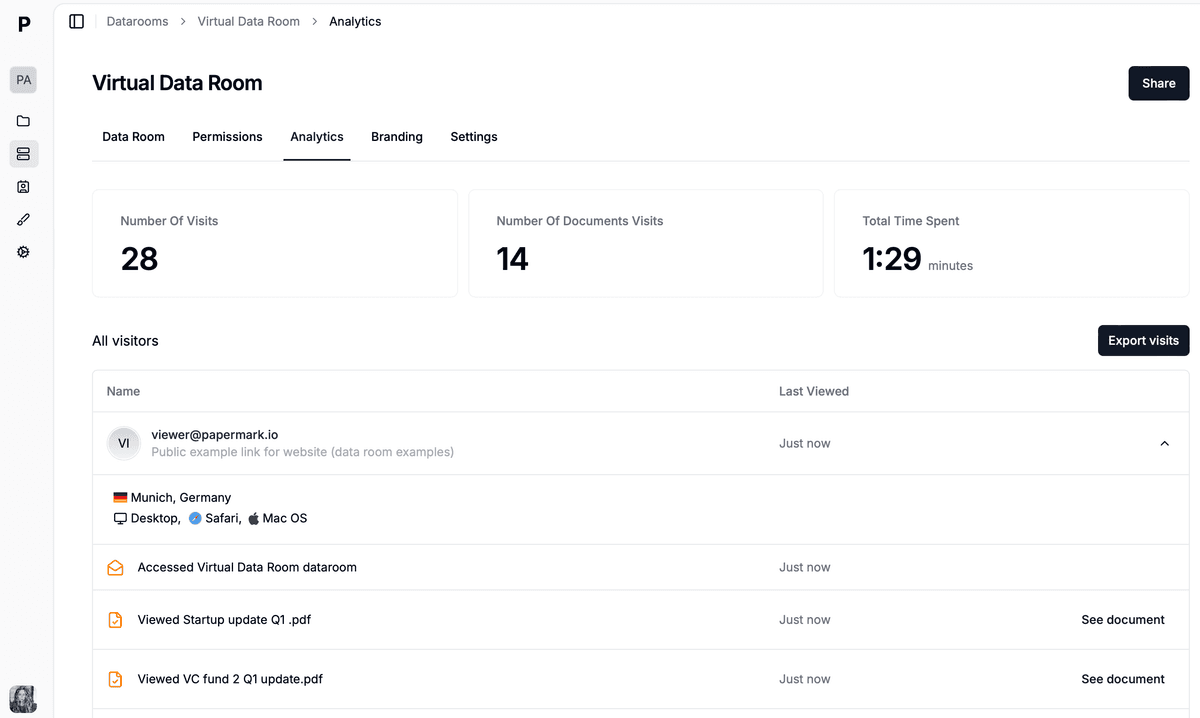
Page-by-page data room analytics show which consultants reviewed each commercial due diligence document and for how long.
Commercial due diligence exists to validate whether a target is a good business in an attractive market, and to make sure the price reflects the business as it truly is. The strongest engagements combine quantitative analysis of revenue, retention, pipeline, and unit economics with qualitative research drawn from customer, lost-customer, and expert interviews, rather than leaning on seller-provided materials alone. Independent forecasting, built from the bottom up and stress-tested across scenarios, is what separates a defensible investment case from an optimistic one.
The practical discipline comes down to a few habits. Interview 5 to 10 customers and 3 to 5 lost customers to validate sentiment, benchmark the target against competitors through demos and review platforms, and watch for the early red flags of concentration, declining retention, and weak pipeline. Feed every finding into valuation, deal terms, and the integration plan. Good commercial due diligence reduces deal risk and produces smarter decisions, and a secure data room keeps the whole process organized, controlled, and auditable from first request to final report.
Learn how to conduct operational due diligence to assess processes, systems, capabilities, and scalability before acquisitions or investments.
How the M&A due diligence process works in 2026. Seven phases, a citable checklist, red flags, document categories, and the data room setup buyers expect.

The 7 workstreams of commercial real estate due diligence, the estoppel delay that stalls closings, real report costs, and the data room setup that fits.