BlogData RoomsVirtual Data Room Toronto: 7 Best Providers and Pricing for 2026
Virtual Data Room Toronto: 7 Best Providers and Pricing for 2026
·18 min read
Marc Seitz
A virtual data room in Toronto is a secure online repository that Bay Street firms, tech founders, and real estate teams use to share confidential documents during M&A, fundraising, and due diligence. The right VDR balances Canadian privacy compliance, data residency, and price. This guide compares 7 options for 2026.
Quick recap
A virtual data room (VDR) is a secure online repository for sharing confidential documents during M&A, fundraising, real estate, and legal due diligence.
Toronto is Canada's financial hub, home to the TSX, Bay Street law firms, major banks, and one of North America's fastest-growing venture ecosystems.
The 7 providers compared here: Papermark, Firmex, Intralinks, CapLinked, ShareVault, iDeals, and RR Donnelley Venue.
Pricing ranges from a free plan and €99/month flat (Papermark) to $500 to $1,500/month (Firmex, ShareVault) up to $10,000 to $100,000+ per deal (Intralinks, Venue).
Firmex is the notable Toronto-headquartered VDR and offers Canadian data residency.
Canadian buyers should check PIPEDA compliance, data-residency options, and cross-border transfer safeguards before sharing personal information.
Most reputable VDRs meet PIPEDA through encryption, granular access controls, and audit trails; Canadian hosting is only mandatory for specific sectors.
Why Toronto businesses need virtual data rooms
Toronto is the financial engine of Canada. The Toronto Stock Exchange is one of the largest in the world by listed companies, Bay Street concentrates the country's biggest law firms and investment banks, and the region has become a magnet for venture capital across fintech, health tech, and AI. Every one of those activities produces confidential documents that cannot safely travel by email attachment or a shared consumer drive. A virtual data room is the purpose-built alternative: a controlled environment where a seller, founder, or advisor decides exactly who sees what, and can prove it later.
The practical driver is due diligence. When a Toronto company raises a round or sells itself, the other side wants to inspect financials, contracts, cap tables, employment agreements, and IP filings. A VDR lets you publish those documents once, invite dozens of counterparties, and watch engagement at the page level instead of losing track of forwarded PDFs. For law firms and private equity funds running several deals at once, that structure is not a luxury; it is the difference between a defensible process and a leak.
There is also a distinctly Canadian layer. Personal information in these documents falls under PIPEDA, and some Toronto organizations in government, healthcare, and regulated finance carry contractual or policy requirements for Canadian data residency. Choosing a VDR is therefore partly a compliance decision, not only a features decision. Virtual data rooms serve Toronto teams across several recurring scenarios:
M&A transactions handled by Bay Street law firms and investment banks, where buy-side teams need controlled, auditable access to a seller's records.
Venture fundraising for Toronto's startup scene, where founders share a data room with investors and want to see which sections get read.
Commercial and residential real estate deals, where property, financing, and title documents move between brokers, lenders, and counsel.
Legal matters and litigation, where firms manage privileged documents and discovery under strict access rules.
Private equity and family offices, where Canadian funds run diligence on portfolio companies and acquisitions.
If you want the underlying concept first, our explainer on what a virtual data room is covers the fundamentals before you compare vendors.
How these Toronto VDR providers were evaluated
Before ranking anything, it helps to know the lens. This list weighs the criteria that actually matter to a Toronto buyer rather than a generic global feature checklist. The first factor is Canadian fit: whether the provider is headquartered in Canada, offers Canadian data residency, and documents PIPEDA-aligned safeguards. The second is deal fit, because a seed-stage founder and a Bay Street restructuring team have almost nothing in common in budget or complexity.
Price transparency is the third factor. Some providers publish plans you can start today; others require a sales call, a scoped quote, and a per-deal contract. Neither model is wrong, but they suit very different timelines. The fourth factor is security and compliance depth, including encryption, granular permissions, watermarking, audit trails, and recognized certifications such as SOC 2 and ISO 27001. Finally, setup speed matters more than most vendors admit: a data room you can open in minutes changes how quickly a Toronto founder can respond to an interested investor.
The seven providers below are ordered to move from the most accessible, self-serve option to the most enterprise-heavy. Each entry explains what the tool is, who in Toronto it suits, and where it falls short, so the comparison stays honest rather than promotional.
Top 7 virtual data room providers for Toronto
1. Papermark - best for startups and modern businesses
Papermark is an open-source virtual data room built for Toronto startups, scale-ups, and modern teams that want secure document sharing without enterprise overhead. Instead of a multi-week onboarding, you create a data room, upload documents, and share a link the same afternoon. That speed is why it fits founders who need to respond to an investor's interest while the momentum is still there, and small M&A or advisory teams that do not want to pay per-deal enterprise pricing.
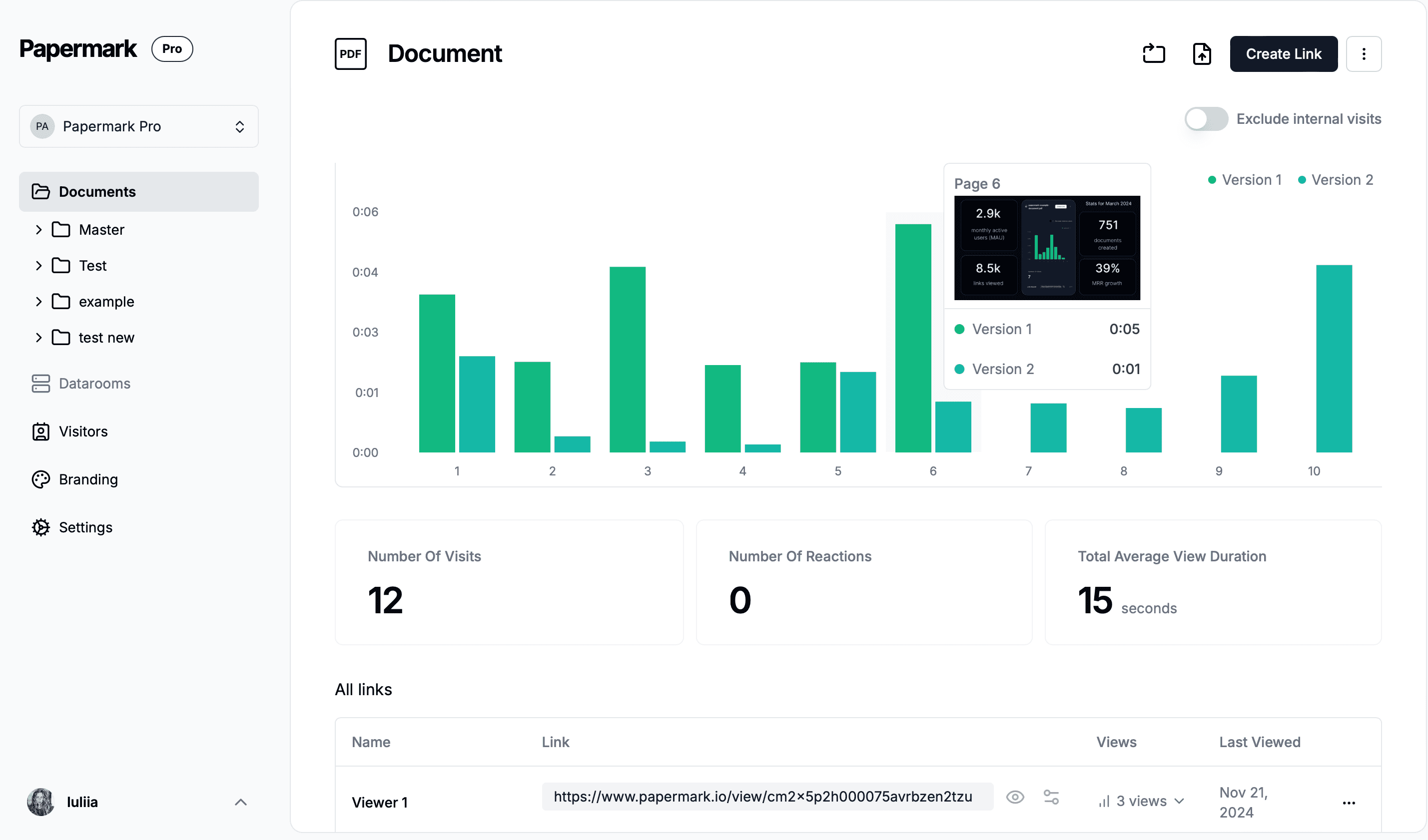
Where Papermark stands out for a fundraising context is visibility. Page-by-page analytics show exactly which sections an investor read and for how long, so a founder can tell the difference between a serious lead and a tire-kicker. Custom domains let you white-label the room under your own brand, and an AI-powered Q&A helps answer repetitive investor questions without a back-and-forth email chain.
Key features:
Page-by-page analytics that show which documents investors actually read.
Custom domains to white-label the data room under your own brand.
AI-powered Q&A for automated responses to investor questions.
Instant setup, with data rooms live in minutes rather than days.
Real-time notifications the moment a link is viewed.
GDPR-compliant infrastructure that aligns with Canadian PIPEDA expectations.
Pricing: Free plan available; Pro at €24/month (about $36 CAD); Business at €59/month (about $88 CAD); Data Rooms at €99/month (about $147 CAD).
Best for: Toronto tech startups raising venture capital, smaller M&A deals, and investor due diligence.
Canadian considerations: Data is hosted in the EU (Frankfurt), and Papermark meets GDPR standards that align closely with PIPEDA. That works for most startups and businesses; teams with a hard Canadian-residency mandate should confirm requirements first.
2. Firmex - the Toronto-headquartered VDR
Firmex is a virtual data room company founded in Toronto in 2006, which makes it one of the few genuinely Canadian VDR providers on this list. For a Toronto mid-market team that specifically wants a local vendor, a Canadian point of contact, and the option of Canadian data residency, Firmex is the natural first call. It has spent nearly two decades on diligence-heavy workflows for law firms, corporate development teams, and financial advisors.
The commercial model is predictable. Firmex uses fixed monthly pricing rather than per-page charges, which suits deals where document volume is hard to forecast. The interface is modern and easy to navigate, and support is available around the clock by phone and email. The trade-off is that it is a heavier setup than a self-serve tool, so a room typically takes days rather than minutes to stand up.
Key features:
Canadian company headquartered in Toronto.
Fixed monthly pricing with no per-page fees.
Clean, user-friendly interface.
24/7 phone and email support.
Canadian data-residency option available.
Pricing: Custom, typically in the $500 to $1,500/month range depending on scope, billed as fixed monthly rates.
Best for: Mid-market M&A, law firms, and Canadian businesses that require local data residency.
Canadian considerations: The strongest choice on this list if a Canadian provider with local data centers is a firm requirement.
3. Intralinks - enterprise option for large deals
Intralinks is a global enterprise VDR used by major Toronto investment banks and Bay Street law firms for their largest transactions. It is built for scale and scrutiny: think cross-border M&A, syndicated financings, and processes where hundreds of users need tightly controlled access to thousands of documents. The platform's reputation rests on a long track record of high-value deals and bank-grade security posture.
That power comes with enterprise pricing and enterprise timelines. Setup usually runs one to two weeks and involves dedicated project managers, which is appropriate for a nine-figure deal and excessive for a seed round. For most Toronto small and mid-sized businesses, Intralinks is more capability than the deal requires, but for the top end of the market it remains a default. If you are weighing it seriously, our Intralinks pricing breakdown goes deeper on the numbers.
Key features:
Enterprise-grade encryption and compliance.
Proven track record across thousands of global deals.
Dedicated 24/7 project management.
Advanced, granular permission controls.
Pricing: Custom, typically $10,000 to $50,000+ per deal, with setup fees and per-user charges.
Best for: Large M&A transactions, investment banking, and Bay Street law firms.
Canadian considerations: An international provider with many Canadian clients, but the premium pricing is usually overkill for smaller deals.
4. CapLinked - affordable cloud option
CapLinked is a cloud-based VDR that sits between self-serve tools and full enterprise platforms on price. It suits Toronto small businesses, real estate teams, and straightforward due diligence where the priority is a functional secure room without a long contract. Monthly plans and pay-as-you-go options make it easy to spin up for a single transaction and wind down afterward.
The platform includes practical collaboration features such as built-in task management and a Q&A workflow, plus mobile apps for iOS and Android and API access for teams that want to connect it to other systems. It is a US-based provider, so Toronto organizations that require Canadian data residency should confirm hosting details before committing, while those without that constraint will find it accessible and quick to deploy.
Key features:
Pay-as-you-go monthly plans with no long-term lock-in.
Built-in task management and Q&A collaboration.
iOS and Android mobile apps.
API access for integrations.
Pricing: Starter at $149/month; Professional at $599/month; Enterprise custom.
Best for: Small businesses, real estate transactions, and simple due diligence.
Canadian considerations: US-based, so a good fit for teams that do not require Canadian data residency.
5. ShareVault - mid-market VDR
ShareVault provides virtual data rooms aimed at mid-sized deals, with a pricing model built around predictability. Rather than charging per user, it bundles unlimited users into a flat monthly rate, which appeals to Toronto real estate firms, legal teams, and mid-market M&A processes that expect to invite many counterparties. The onboarding is quick and the support team is responsive, so a room can be operational within hours.
The platform's strength is that it removes the guesswork of per-seat billing while still offering the core security and organization features a diligence process needs. It is US-based, so as with other American vendors, Toronto organizations with residency requirements should verify where their data will live. For teams focused on cost control across a busy deal calendar, the flat model is the main draw.
Key features:
Unlimited users with no per-seat fees.
Predictable flat-rate monthly pricing.
Fast onboarding and setup.
Responsive customer support.
Pricing: From $495/month for the Business plan, with unlimited users and storage.
Best for: Real estate, legal firms, and mid-market M&A.
Canadian considerations: US-based but serves Canadian clients; confirm data-residency options before you commit.
6. iDeals - global VDR with strong compliance
iDeals is a widely used global virtual data room known for a polished interface and a deep security posture, and it has a meaningful base of Canadian users across M&A, private equity, and corporate finance. For a Toronto mid-market or enterprise team that wants an international provider without the heaviest legacy overhead, iDeals is a common shortlist entry alongside Firmex and Intralinks.
Its appeal is the combination of ease of use and recognized certifications such as SOC 2 and ISO 27001, together with granular permissions, watermarking, and 24/7 support. Pricing is quote-based and scoped to the project, so it requires a sales conversation rather than an instant sign-up. That suits organizations running a defined transaction, and is less convenient for a founder who wants a room live today.
Key features:
Clean, well-regarded user interface.
SOC 2 and ISO 27001 certifications.
Granular permissions and document watermarking.
24/7 customer support and project assistance.
Pricing: Custom, quote-based per project; contact sales for a scoped price.
Best for: Mid-market and enterprise M&A, private equity, and corporate finance.
Canadian considerations: International provider with Canadian clients; confirm data-residency and PIPEDA specifics during scoping.
7. RR Donnelley Venue - enterprise legacy option
Venue, from RR Donnelley, is an established enterprise VDR used by large Toronto corporations and law firms for complex, high-stakes matters. It is built for the deals where failure is expensive: major M&A, bankruptcy and restructuring, and intricate legal processes with demanding compliance reporting. Decades of experience and comprehensive certifications give it credibility at the top of the market.
The flip side is cost and complexity. Venue carries per-deal enterprise pricing and setup timelines measured in weeks, backed by dedicated project managers. For the vast majority of Toronto businesses this is far more platform than the situation calls for, and only makes sense when the transaction is genuinely large or highly regulated.
Key features:
Long-established, proven platform.
Dedicated 24/7 project management.
Comprehensive security with ISO and SOC 2 certification.
Detailed audit trails and compliance reporting.
Pricing: Custom, typically $15,000 to $100,000+ per deal.
Best for: Large M&A, bankruptcy and restructuring, and complex legal matters.
Canadian considerations: Expensive and complex; overkill for most Toronto businesses unless you are running mega-deals.
Comparison table: Toronto VDR providers
The table below summarizes how the seven providers compare on the factors Toronto buyers ask about most: entry price, whether the vendor is Canadian, data-residency options, ideal deal type, and how quickly you can be up and running. Read it as a shortlist filter, then use the sections above for the nuance behind each row.
Choosing a VDR in Toronto is partly a legal exercise, because the documents you upload almost always contain personal information governed by Canadian law. The central statute is PIPEDA, the Personal Information Protection and Electronic Documents Act, which sets out how private-sector organizations must collect, use, and protect personal data. A VDR does not make you compliant on its own, but the right one gives you the technical controls, encryption, access management, and audit logging, that a compliant process depends on.
Beyond the baseline of PIPEDA, two questions decide most Toronto shortlists. The first is data residency: where your files physically live. The second is cross-border transfer: what happens when you share documents with counterparties in the US or overseas. Both are answerable, but they should be answered before you upload a single sensitive file rather than after.
PIPEDA compliance
PIPEDA requires organizations to safeguard personal information with security appropriate to its sensitivity. In VDR terms, that means encryption at rest and in transit, access controls tied to identity, detailed audit trails of who viewed what, privacy practices aligned with the Act, and a clear breach-notification path. Most reputable providers, including every vendor in this guide, meet those requirements as a matter of course. The practical work on your side is confirming that each control is switched on and configured for your deal, not assuming the defaults are enough.
Data residency
Some Toronto organizations, particularly in government, healthcare, and regulated financial services, carry a requirement that data remain physically in Canada. That constraint narrows the field quickly. Firmex offers Canadian data-residency options, which is a large part of why it appears on so many local shortlists. Other providers may offer Canadian or North American hosting on request, so the correct move is to ask the vendor directly rather than assume. For most startups and general businesses without a residency mandate, EU hosting such as Papermark's Frankfurt infrastructure satisfies privacy expectations under GDPR, which aligns with PIPEDA principles.
Cross-border data transfer
Toronto deals are rarely contained within Canada. The moment you invite a US private equity fund or an overseas strategic buyer, your documents cross a border, and your obligations follow them. When counterparties sit outside Canada, confirm that your VDR provider supports the frameworks that matter for those jurisdictions, including GDPR for European parties, CCPA for California parties, and standard contractual clauses where personal data moves internationally. Building these checks into vendor selection avoids awkward renegotiation once a deal is already in motion.
A Toronto due diligence scenario
Consider Tanager Robotics, a hypothetical Toronto-based warehouse-automation startup preparing for acquisition by a US logistics group. The founders have twelve days before the buyer's diligence team expects access, and the target list runs to roughly 180 documents: audited financials, customer contracts, employee agreements, patent filings, and a cap table. Several contracts and all the employment records contain personal information covered by PIPEDA, and the buyer's counsel has flagged data residency as a review item.
Tanager's corporate development lead sets up a virtual data room the same morning. She structures folders by workstream, financial, legal, IP, and HR, then uploads the files and applies granular permissions so the buyer's junior analysts see only the financial and commercial folders while partners at the acquiring firm see everything. Every document carries a dynamic watermark stamped with the viewer's email, which discourages leaks during a competitive process. She enables an NDA gate on the room, so no counterparty reaches a file before accepting terms.
Over the next week, page-by-page analytics tell a story the founders could not otherwise see. The buyer's team spends hours on customer-retention data and the patent schedule, signaling where the real scrutiny sits. When a diligence question about a supplier contract arrives, the team answers it through the built-in Q&A rather than a scattered email thread, keeping a clean record. Because the audit trail logs every view, Tanager can later demonstrate exactly who accessed which personal-information documents, satisfying the buyer's PIPEDA review and closing the round without a residency dispute.
What Toronto businesses should look for
The right VDR depends less on brand and more on the shape of your deal. A founder optimizing for speed and cost has different priorities than a restructuring team optimizing for control and compliance. The four profiles below map the most common Toronto situations to a sensible starting point, and each opens with the priorities that should drive the decision rather than jumping straight to a product name.
For startups raising venture capital
Founders should optimize for affordability, speed, and investor-facing analytics. A room that costs €24 to €99/month, opens in minutes, and shows which sections investors read gives a small team leverage during a raise. The modern interface matters too, because investors judge polish. Papermark fits this profile most cleanly, and our guide to building a data room for startups walks through the folder structure investors expect.
For mid-market M&A
Here the priorities shift to predictable pricing, reliable support, and, for many Canadian buyers, a preference for a local provider. Fixed monthly costs in the $500 to $1,500 range, a reasonable setup window, and Canadian data-residency options are the deciding factors. Firmex is the natural choice when a Toronto-headquartered vendor matters, with Papermark a strong alternative when cost efficiency outweighs the residency preference. Our overview of the M&A process covers how the data room fits the wider deal.
For large enterprise deals
At the top of the market, budget becomes secondary to security depth, dedicated project management, and a proven track record across complex transactions. Enterprise buyers accept multi-week setup and per-deal pricing in exchange for control and support. Intralinks, iDeals, and RR Donnelley Venue are the established platforms for this tier, chosen for capability rather than convenience.
For real estate transactions
Real estate teams prioritize straightforward document organization, collaboration tools for brokers and lenders, affordable monthly pricing, and quick setup. The document volume is manageable but the parties are many, so unlimited-user or flat-rate models tend to win. CapLinked and ShareVault are purpose-built for this pattern at reasonable price points.
How Papermark works as a Toronto virtual data room
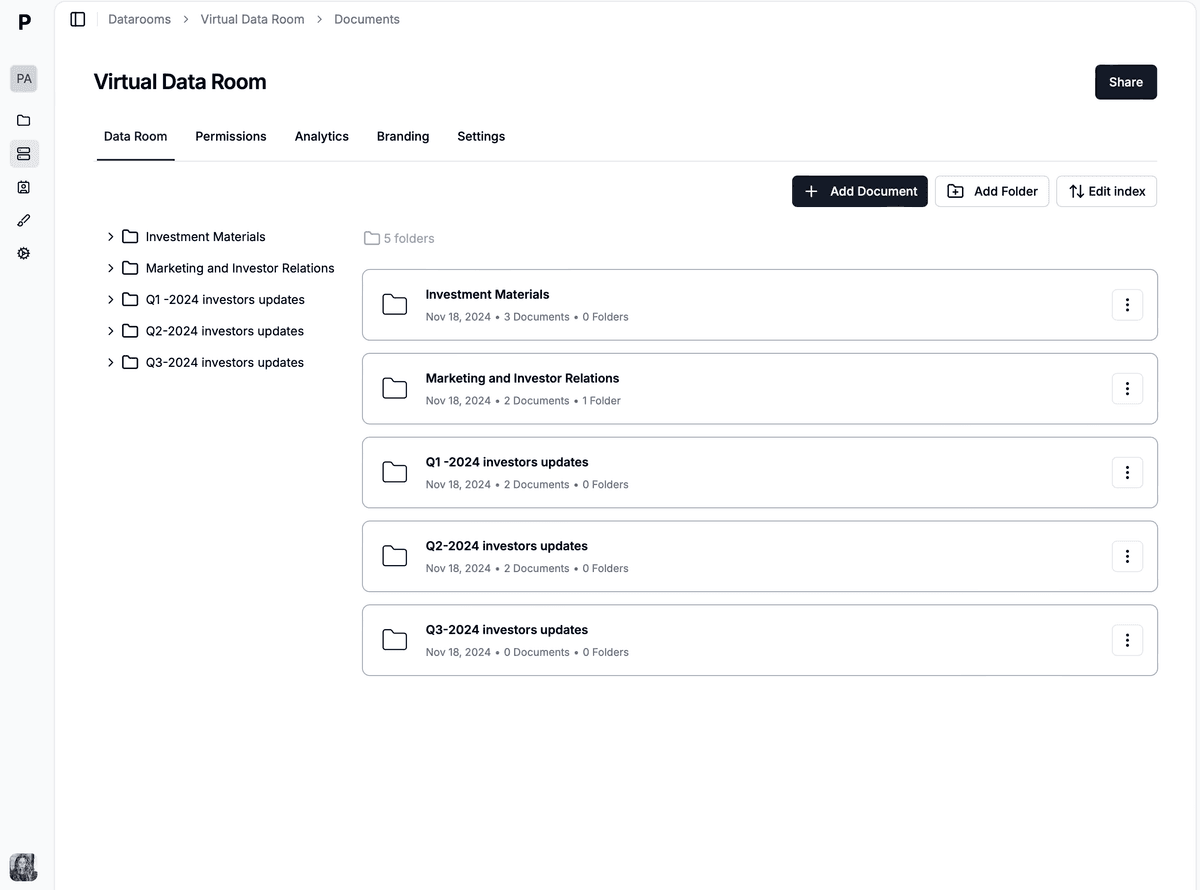
For a large share of Toronto teams, the practical winner is a modern, self-serve virtual data room, and this is where Papermark is designed to fit. It gives a founder, advisor, or corporate development lead an enterprise-style diligence environment without the enterprise sales cycle. You upload your financials, contracts, and IP documents, organize them into folders, and share a single secure link that you control from one dashboard. The €99/month Data Rooms plan brings the full toolkit; smaller teams can start on the free plan and grow into it.
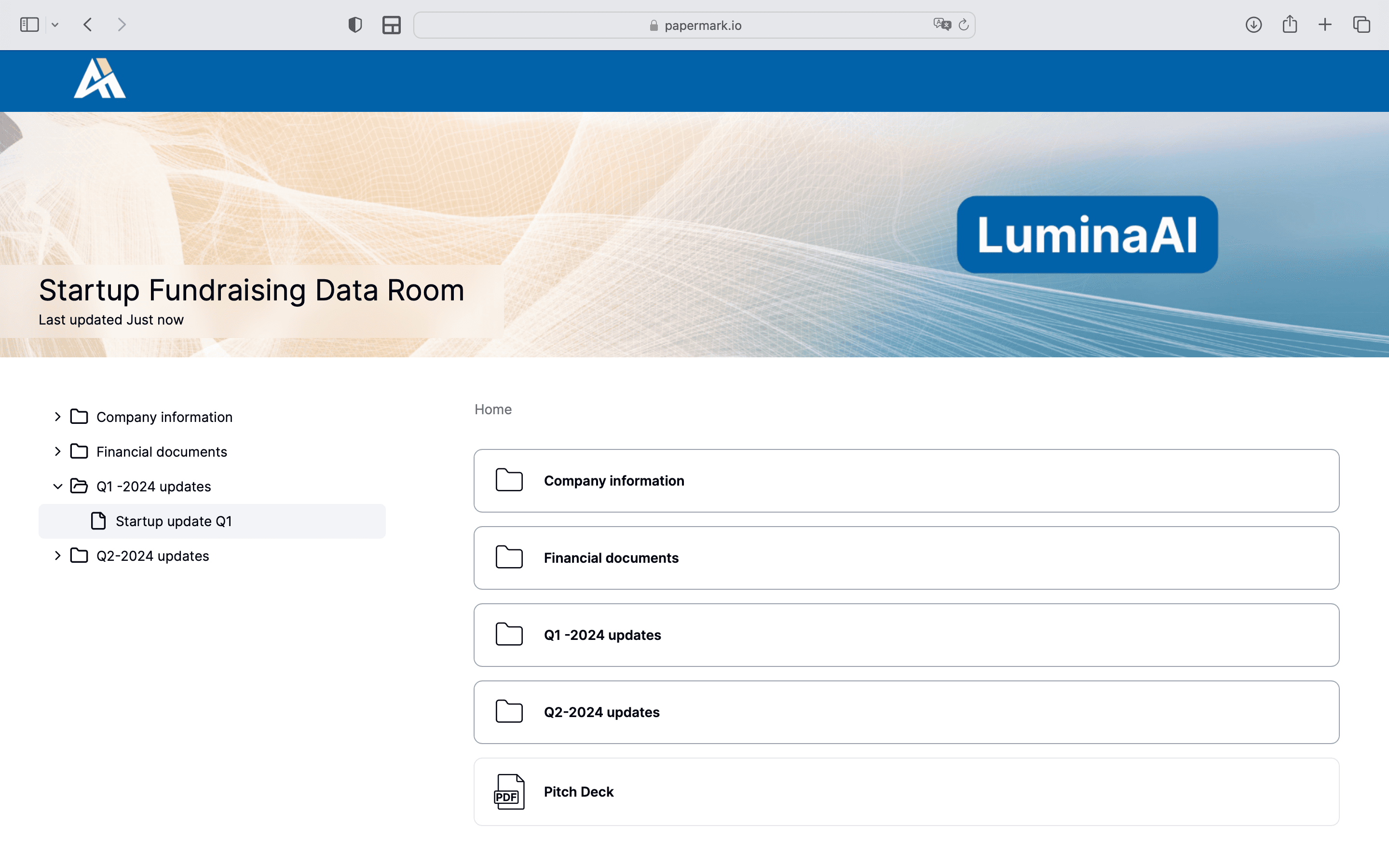
The security model is built for exactly the PIPEDA-sensitive, cross-border situations Toronto deals create. Granular permissions let you expose different folders to different counterparties, so a buyer's analysts and its partners see only what they should. Dynamic watermarking stamps each page with the viewer's email to deter leaks during a competitive process, and an NDA gate can require acceptance before anyone reaches a document. Every action feeds an audit trail, giving you a defensible record of who accessed which personal-information files, which is precisely what a PIPEDA review asks for.
What makes it especially useful during a live raise or sale is visibility. Page-by-page analytics show which documents each investor or buyer actually read and for how long, turning a data room from a passive vault into an early-warning system for where the scrutiny sits. A Q&A module keeps diligence questions in one auditable place instead of scattered email, full-text search helps large counterparties find documents fast, and custom domains let you present the room under your own brand. Data is hosted in the EU under GDPR standards that align with PIPEDA, and teams with a strict Canadian-residency mandate should confirm requirements up front.
Papermark's virtual data room gives Toronto founders and advisors granular permissions, watermarking, and page-by-page analytics in one secure room.
For startups and growing companies, Papermark is the best value. At €24 to €99/month with instant setup and page-by-page analytics, it fits venture fundraising and smaller M&A deals without an enterprise contract. For mid-market M&A, choose Firmex when a Toronto-headquartered provider and Canadian data residency matter, or Papermark when cost efficiency is the priority. For large or highly regulated enterprise deals, Intralinks, iDeals, or Firmex Enterprise offer the depth and support that budget-secondary transactions require.
Toronto's business landscape is diverse, so the right VDR is the one that matches your deal size, budget, timeline, and compliance requirements. For most modern teams, Papermark offers the strongest combination of features, price, and ease of use.