




datarooms
RR Donnelley Venue Review 2026: Pricing, Features, and 5 Alternatives
RR Donnelley Venue review for 2026: real pricing from $15,000, features, pros and cons, and 5 virtual data room alternatives including Papermark at €99/month.
DealRoom is an M&A lifecycle platform with a built-in virtual data room, sold on custom quotes that DealRoom's own comparison page now starts at $25,000/year, with unlimited users and an annual commitment. It wraps pipeline tracking, diligence request lists, AI document analysis, Q&A, and post-close integration around the room. This 2026 review covers what DealRoom is, what it costs, which use cases it actually fits, the advanced data-room features (including AI redaction) you still need on a sell-side, and 4 DealRoom alternatives.
Papermark is a secure, fully customizable, and developer-friendly data room for modern dealmakers, with page-level analytics, dynamic watermarking, unlimited data room visitors, a public API, CLI, and MCP server, AI redaction, and a Data Rooms plan from €99/month. It is the #1 alternative here when the job is still a permissioned room, not a buyer-led operating system.
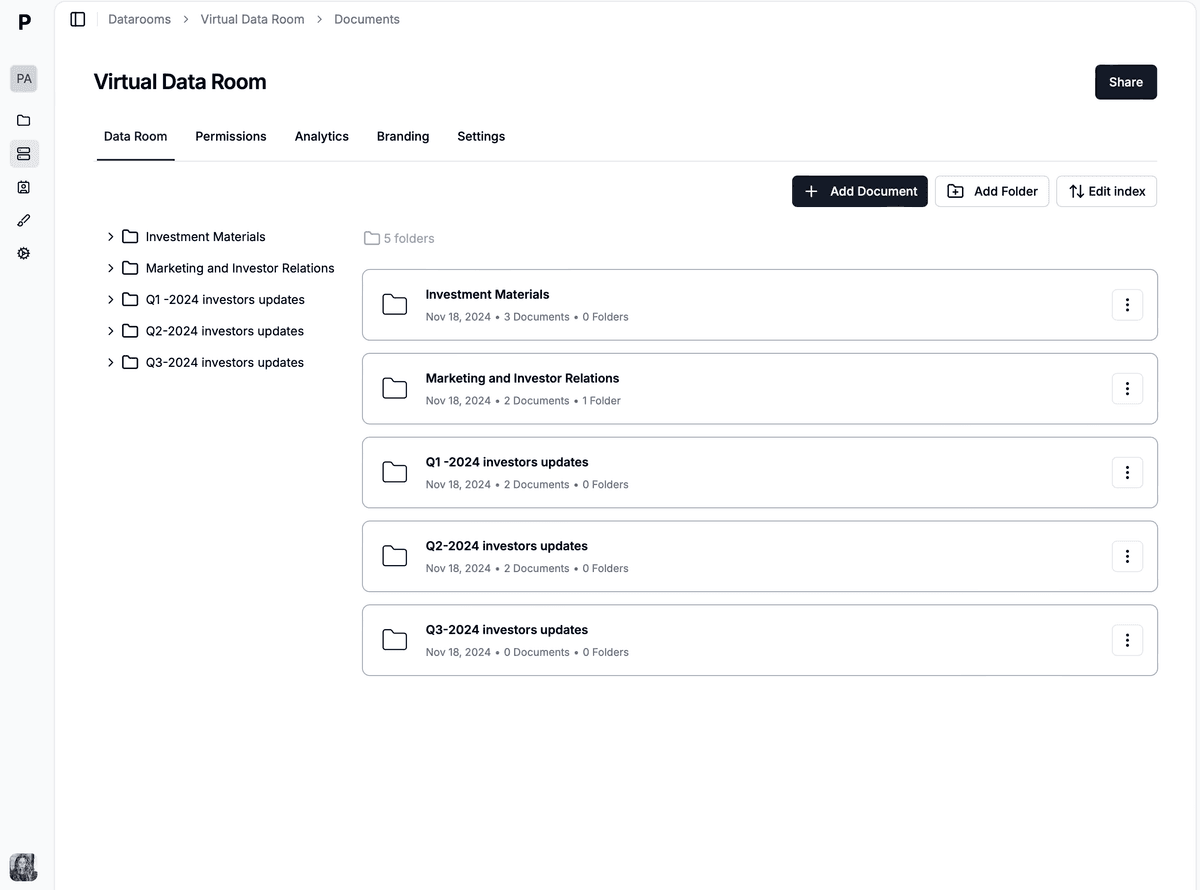
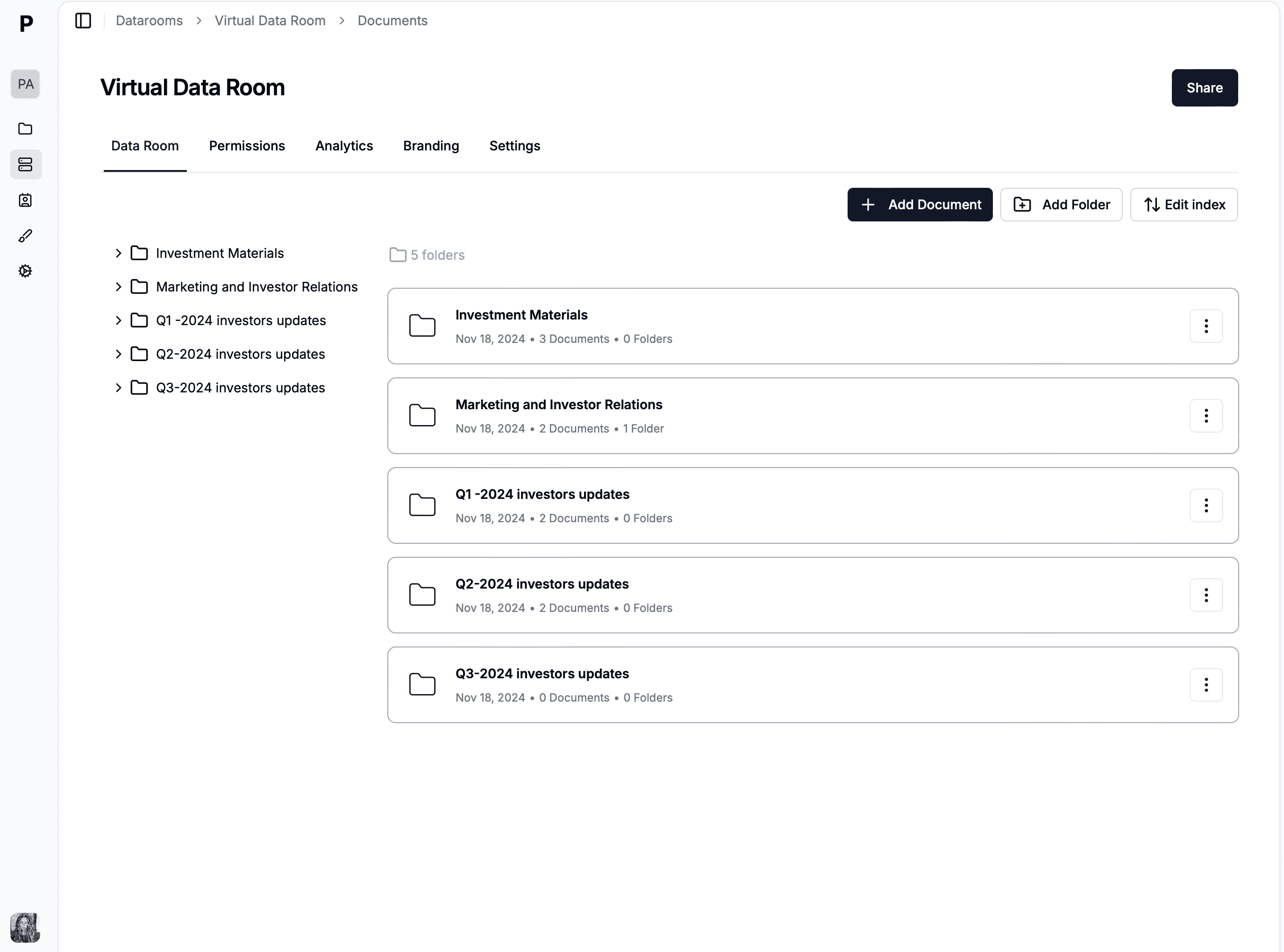
A Papermark M&A data room with workstream folders and per-link permissions, from €99/month.
DealRoom is a buyer-led M&A platform first and a virtual data room second. FirmRoom is the same company's self-serve document SKU, spun out in 2018. Most teams comparing "DealRoom VDR" are choosing between that full platform and a standalone room.
| # | Provider | Starting price | What you actually buy |
|---|---|---|---|
| 1 | Papermark | From €99/month | Standalone data room, analytics, AI redaction |
| 2 | Firmex | ~$625+/month reported | Project VDR, Datasite-owned since 2021 |
| 3 | CapLinked | From $399/month | Published subscription VDR, OCR search |
| 4 | Ansarada | Custom quote | AI scoring VDR, Datasite-owned since 2024 |
DealRoom itself is from $25,000/year on its public comparison page, priced by deal volume, unlimited users, annual commitment, no per-page overage. G2 lists DealRoom at 4.3/5 from 66 reviews. For the document-only sibling, see FirmRoom alternatives. For a wider field, see the best virtual data rooms.
DealRoom Inc. was founded in Chicago in 2012 by Kison Patel. The product is an M&A execution workspace: pipeline stages, a diligence request list, a built-in virtual data room, in-platform Q&A, and post-merger integration planning. The company calls this Buyer-Led M&A. The VDR is one module, not the whole SKU.
That is the opposite of a classic online data room. Intralinks or Datasite Diligence starts as a permissioned repository with a project manager. DealRoom starts as a deal operating system and stores files inside it. Corporate development teams that already think in stages (sourcing, LOI, confirmatory, close, Day 100) are the intended user. A founder sending a data room to six Series A funds is not.
In 2018 DealRoom spun FirmRoom out as a self-serve, storage-tier VDR to compete with per-page rooms. FirmRoom still brands itself FirmRoom by DealRoom. Switching from DealRoom to FirmRoom, or the other way, is an in-family move, not an independent exit. The FIRMROOM trademark is registered to DEALROOM INC. If independence from this vendor is why you are shopping, skip both and start with Papermark.
DealRoom's public AI layer is diligence-side, not redaction-side. Deal Builder generates a tracker from deal type and industry. An AI document organizer suggests folders as files land. Document intelligence extracts terms, dates, and obligations. Analysis summarizes across contracts. Suggested Findings pull risks from logged Outlook or Gmail threads, with a human accept/edit/reject step. That is useful on a buy-side with a hundred vendor contracts. It is a different job from AI redaction, which masks PII and custom terms in the files you are about to show a competing bidder.
The same company sells two products that shortlists still mix up. DealRoom is the lifecycle platform: pipeline, request lists, AI diligence, Q&A, integration. FirmRoom is the document VDR: storage tiers from $395/month, one room per plan, unlimited users, a 14-day trial, $150/GB overage. DealRoom's own comparison page is the source for that split. If your corp-dev team lives in stages and playbooks, FirmRoom will feel empty. If you needed a CIM and a contract folder with watermarks, DealRoom will feel like a freight system.
Pricing makes the mix-up expensive. FirmRoom is a monthly subscription with a GB cap. DealRoom is an annual platform fee from $25,000. Teams sometimes "upgrade" from FirmRoom after a sales call and discover they bought workflow they will not open. Teams sometimes buy DealRoom because the brand showed up in an M&A software roundup, then use 10% of the modules. The filter is simple. Count how many acquisitions you close in a year and whether you will assign diligence requests in software. If the answer is "one room, this quarter," start with Papermark or FirmRoom, not DealRoom. If you want to leave the family, skip FirmRoom too. The longer FirmRoom walkthrough is in FirmRoom alternatives.
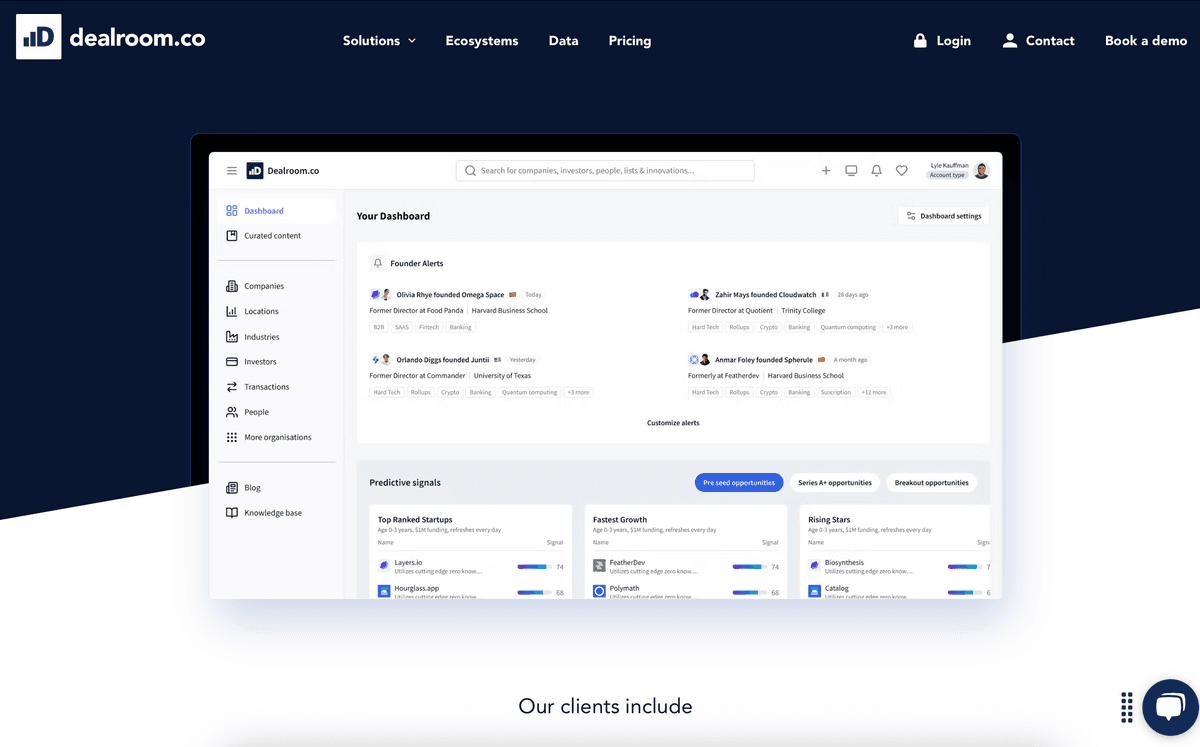
DealRoom wraps a VDR in pipeline, request lists, and integration planning.
The repository does the expected VDR work: granular folder and file permissions, bulk upload, indexing, full-text search, version control, and watermarking. Integrations listed on the product include Slack, SharePoint, Box, Dropbox, and Google Drive. Security claims include AES-256, SOC 2 Type II, and ISO 27001. None of that is rare in 2026. The differentiator is the workflow stacked on top.
Pipeline. One dashboard for many live deals, with stages, owners, and dates. This is why a team closing four to six buys a year pays for DealRoom at all. A team closing one sale does not need it.
Diligence requests. Checklists for financial, legal, commercial, and IT workstreams, with assignees and reminders. The seller answers in the same system instead of a side spreadsheet. Status dashboards show what is still open.
Q&A. Questions grouped by category and routed to an owner. On a process with 200 buyer questions this beats email. Papermark's Q&A module covers the same job from Data Rooms Plus, without the pipeline SKU.
Integration planning. After signing, the workspace becomes a 100-day task list. That is corp-dev territory. Fundraising rooms never open this tab.
DealRoom AI. Playbook generation, auto-file, term extraction, multi-contract summaries, deal-level chat, and email-derived suggested findings. DealRoom states it does not train on customer deal data. Quote-based AI add-ons sit behind the asterisks on the pricing page. Treat AI as a diligence accelerator for the buyer, not as a substitute for granular permissions or burned-in redaction on the seller side.
Limitations sit next to those modules. There is no self-serve rate card. Setup is a sales cycle and onboarding measured in days, not minutes. The interface is heavier than a document VDR because counterparties inherit the workflow, not just a link. Template customization is limited if your deal type is not in the playbook. Fundraising, real estate, and one-off legal sharing are a mismatch. G2's 4.3/5 from 66 reviews is a thinner public sample than Ideals or Papermark.
DealRoom does not publish a self-serve ladder. The pricing page describes volume-based subscriptions, unlimited users, no per-page charges, and an annual commitment. DealRoom's own VDR comparison page states that the M&A platform starts at $25,000 annually, covering pipeline, diligence, integration, and the AI-powered VDR. We quote that figure. Earlier buyer reports of $2,000 to $15,000 per deal still appear in the market; they are not a reason to understate the published annual start.
| What you are buying | Quoted range | Notes |
|---|---|---|
| DealRoom M&A platform (published start) | From $25,000/year | DealRoom comparison page, 2026. Annual commitment. |
| Per-deal quotes (buyer reports) | $5,000 to $15,000+ per deal | Directional, not a list price. Do not use the old $2,000 floor. |
| FirmRoom (same parent, document SKU) | From $395/month | 2 GB tier, one room, $150/GB overage. See FirmRoom alternatives. |
| Papermark Data Rooms | From €99/month | 7-day trial, unlimited rooms and data room visitors. |
What the annual fee typically bundles, per DealRoom's commercial copy: unlimited users, unlimited storage during the term, the workflow modules, and onboarding. AI diligence features are marked as included or add-on depending on the package you are shown. Volume discounts exist; you will not see them without sales.
The floor is the problem for everyone who is not a serial acquirer. $25,000/year is a line item a corp-dev budget can absorb against a $40M close. It is the wrong shape for a $3M acquisition, a seed raise, or a six-week confirmatory. Papermark's Data Rooms plan at €99/month billed annually is €1,188 a year. That is the affordable alternative when you needed a room, not an operating system. Broader context is in virtual data room cost.
DealRoom is a fit when all three are true: you close three or more acquisitions a year, several people on both sides will live in the tool for months, and someone will actually run the integration plan after signing. Drop any one of those and the annual fee is paying for empty modules. Mid-market advisory firms sometimes sit in the middle: they want checklists, they do not want to put every client on a $25,000 platform. Those firms usually land on a project VDR (Firmex, Papermark, CapLinked) and keep pipeline in the CRM they already have.
Four reasons show up in every shortlist conversation, and none of them require DealRoom to be "broken."
Price and the sales motion. Custom quotes, an annual commitment, and a $25,000 start push out founders, boutiques, and one-off sell-sides. Self-serve rooms (Papermark, CapLinked) publish a number and a trial.
You wanted a VDR. Pipeline and integration planning are the product. If you will never open them, you are paying for unused workflow and asking counterparties to learn it anyway.
Parent-company complexity. FirmRoom is the lighter SKU from the same company. Ansarada and Firmex on older shortlists now sit under Datasite. Independence is a real filter.
Advanced room controls sit elsewhere. DealRoom's AI reads contracts for the buyer. A seller still needs dynamic watermarking, one-click NDA, screenshot protection, page-level heatmaps, and, on PII-heavy packs, AI redaction that burns boxes into a new version. Those are data-room features, not pipeline features.
Match the room to the process, not to the last logo on a banker's slide.
Serial corporate acquirer. Pipeline, reusable checklists, email-derived findings, and integration planning. DealRoom. Budget from $25,000/year. FirmRoom is the wrong SKU here because it is one storage-capped room.
Mid-market sell-side, one or two bidders. You need NDA gating, watermarks, split permissions for first-round versus confirmatory, and a read on which folder the PE shop actually opened. That is Papermark. AI redaction if employment files and customer contracts go out with names still in them.
Fundraising. DealRoom is a poor fit, as the current article already said. Investors want a link, not a diligence operating system. Papermark's page-level analytics on the deck and the data room are the intent signal. See best data room for fundraising.
PII-heavy diligence (HR, healthcare, consumer lists). The advanced feature that matters is redaction, not playbook AI. Papermark scans for names, emails, phones, addresses, tax IDs, and account numbers, plus custom terms, and a reviewer accepts each box before it is burned in. That is AI redaction. DealRoom's document intelligence extracts terms for the buyer's tracker. It does not replace a seller's redaction pass.
Advisory boutique with several live mandates. Unlimited data rooms on Papermark's €99 plan beat FirmRoom's one-room cap and DealRoom's annual platform fee. White-label custom domains keep each client's room on the firm's brand.
Bank-run, counsel-named room. Intralinks or Datasite, not DealRoom and not Papermark's brand. DealRoom was never that product. See Datasite alternatives.
Sell-side with competing strategics. This is the case DealRoom's buyer-led story under-serves. Two strategics and one PE fund in the same process should not share a Q&A thread, should not see the same customer schedule, and should not get an unwatermarked zip. You split first-round and confirmatory with granular permissions, gate the link with a one-click NDA, stamp every page with dynamic watermarking, and watch page-by-page analytics to see who is actually reading the quality of earnings. If the HR folder still has home addresses, run AI redaction before the link goes out. Papermark is built for that seller motion. DealRoom is built for the team on the other side of the table.
| If this is your case | Pick |
|---|---|
| Best overall: room + analytics, published price | Papermark |
| Serial acquirer, pipeline through close | DealRoom (from $25,000/year) |
| Document-only SKU, same parent | FirmRoom, or leave the family |
| HR / customer PII in the pack | Papermark with AI redaction |
| Time-boxed advisory VDR | Firmex (Datasite-owned) |
| Published price under $450/month | Papermark or CapLinked |
| AI deal-readiness scoring | Ansarada (Datasite-owned) |
| Bank-run, 50,000+ pages | Intralinks or Datasite, not DealRoom |
| Competing strategics on a sell-side | Papermark (permissions, NDA, watermarks, analytics) |
Halcyon Robotics is a hypothetical mid-market industrial automation company running a buy-and-build, acquiring four to six smaller robotics and machine-vision firms a year. Its three-person corporate development team is the buyer DealRoom was designed for.
At any given moment Halcyon has eight to ten targets in the funnel. Before a lifecycle platform, the team tracked this in a spreadsheet, kept files in a separate VDR, and logged seller questions in email. Consolidating into DealRoom's pipeline gave the head of corp dev a single view of stage, owner, and outstanding requests. On a $40M close, a commercial and IT checklist, 200 categorized Q&A items, and a 100-day integration plan all sat in one workspace. Against a $40M transaction, a $25,000 annual platform fee (or a mid-market per-deal quote) is a process cost, not the deal.
The same team still has a seller-side problem DealRoom AI does not solve. When Halcyon sells a bolt-on two years later, competing bidders should not see unredacted employee names in the HR folder or customer identities in the contract set. That pass is AI redaction in a Papermark room: detect, review, burn into a new version, keep the original in history. Unlimited data room visitors and page-by-page analytics tell Halcyon which bidder lingered in warranties. The lesson is split: DealRoom for Halcyon's buy-side operating system, Papermark for the room it shows the other side.
A virtual data room for M&A is the permissioned workspace that holds the CIM, quality of earnings, customer contracts, and HR files while several bidders review them at once. Pipeline software can sit next to that room. It does not replace the controls below. Name them on a shortlist even if you stay on DealRoom for corp-dev workflow.
Granular permissions. First-round bidders see the teaser and a redacted commercial pack. Confirmatory sees quality of earnings and the full customer list. Granular permissions sit at folder and file level, with view-only and no-download. DealRoom has permissioned files. Papermark makes per-link expiry and viewer identity the default sharing model.
Dynamic watermarking. Every page can carry the viewer's email, IP, and timestamp. Dynamic watermarking is the deterrent when a PDF is screenshotted into a group chat. Static footer text is not the same control.
One-click NDA. The link does not render files until the counterparty accepts terms. One-click NDA writes an audit row you can export. Emailing a PDF NDA and then sending the room is how leaks start.
Screenshot protection. Screenshot protection reduces casual capture in the browser. It is not a substitute for watermarking. Use both on a contested auction.
Page-by-page analytics. Document-level "opened at 14:02" is DealRoom-class activity. Page-by-page analytics show which page, how long, and whether the link was forwarded. Sell-side teams use that as a live read on intent.
Q&A with permissions. Structured questions, scoped so competing buyers cannot see each other. Papermark ships this from Data Rooms Plus. DealRoom's Q&A is built for the buyer's tracker. Both can exist; only one is in the seller's branded room.
API, CLI, and MCP. API, CLI, and MCP create rooms, invite viewers, and read analytics from a repo or an agent. DealRoom's integrations are storage and Slack. Developer-friendly rooms are a Papermark lead, not a DealRoom lead.
A worked pass on a 400-page customer-contract set looks like this. Counsel flags 12 counterparty names and every personal email. You add those names as custom terms, choose a commercial plus GDPR reason, and run detection. The queue comes back with high-confidence emails and a mix of medium-confidence company names that collide with common words. A reviewer accepts the emails in bulk, declines the collisions, and draws two manual boxes over a scanned appendix the model skipped. Apply writes a new version. The link you send bidders serves only the burned file. The original stays in history for your own counsel. That afternoon of review replaces a paralegal day in Acrobat, and it is the opposite of DealRoom's "extract the change-of-control clause for the buyer's tracker."
AI redaction, in practice. Nothing applies automatically. Each detection lands in a review queue with category and confidence. Applying mutates the PDF content stream (text, vectors, and pixels inside the box), then saves a sanitized new version. The original stays in history. You can mix manual boxes with an AI sweep. A GDPR-reasoned pass leans into identifiers of natural persons. A commercial pass leans into pricing and names you typed as custom terms. Datasite, Intralinks, Ideals, Ansarada, and Imprima ship AI-assisted redaction on enterprise quotes that typically start around $25,000/year. Papermark includes AI redaction, with the same unlimited data room visitors and unlimited storage as every Data Rooms tier.
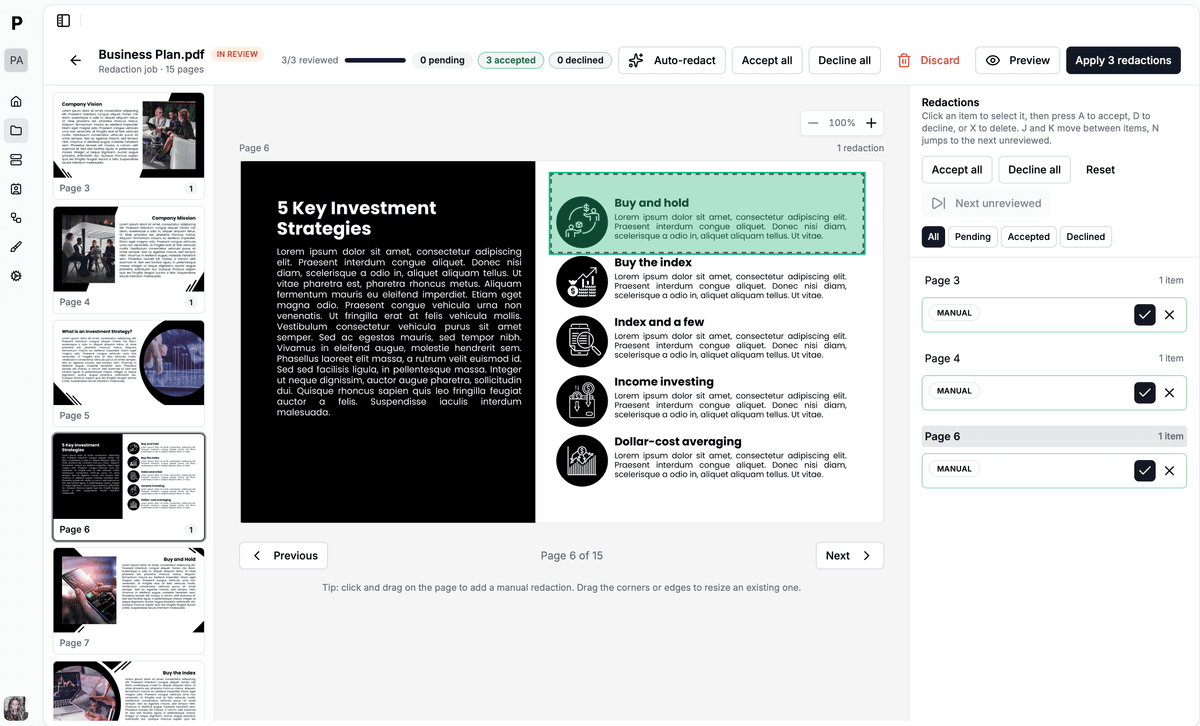
Every detection lands in a review queue, accepted or declined page by page before anything is applied.
Website: papermark.com
Pricing: From €99/month on the Data Rooms plan, 7-day free trial. Free plan available for document sharing.
Papermark is a secure, fully customizable, and developer-friendly data room built for modern dealmakers, with page-by-page analytics, dynamic watermarking, unlimited data room visitors, and transparent pricing from €99/month. Against DealRoom it is the room without the $25,000/year operating system. Open-source and self-hosting are available if you need data sovereignty DealRoom does not offer.
DealRoom logs activity in the deal workspace. Papermark shows which page a bidder spent time on, how long they lingered, and whether the link was forwarded. On a sell-side that is a live read on intent.
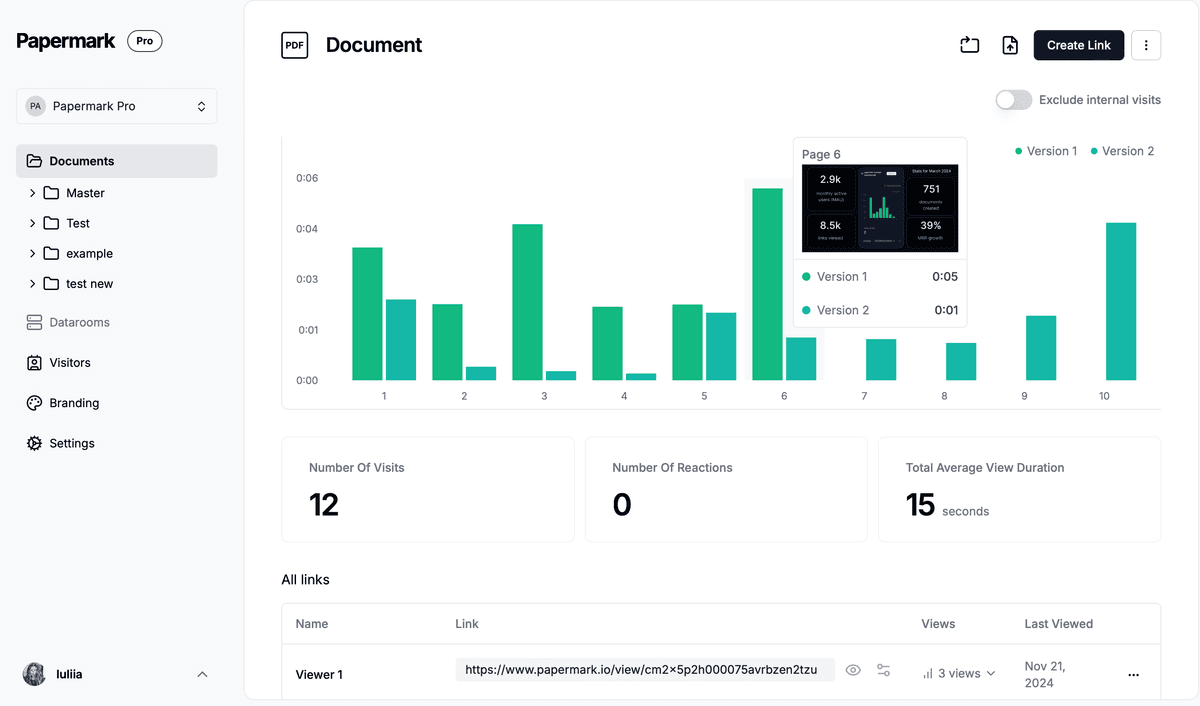
Page-level analytics are included rather than an enterprise reporting add-on.
Papermark covers the controls counterparties ask about: dynamic watermarking, view-only with screenshot protection, one-click NDA, and granular file- and folder-level permissions. Encryption is AES-256 at rest and TLS in transit. EU hosting in Frankfurt is available. It is ISO 27001 certified and SOC 2 Type II audited (SOC 2 from Data Rooms Plus and above), plus GDPR, HIPAA, and CCPA aligned. Details are on the security page.
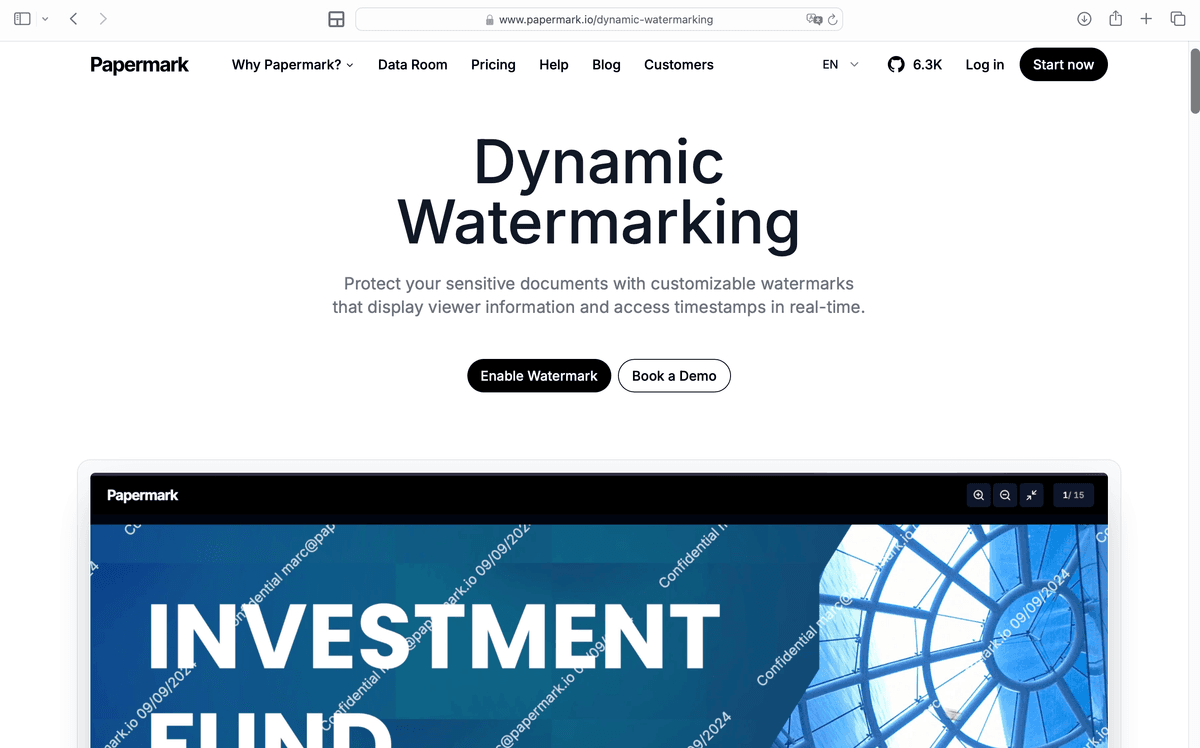
Run every room on your own custom domain. A public API, CLI, and MCP server can create rooms and read analytics programmatically, and AI redaction masks PII before competing bidders see the files.
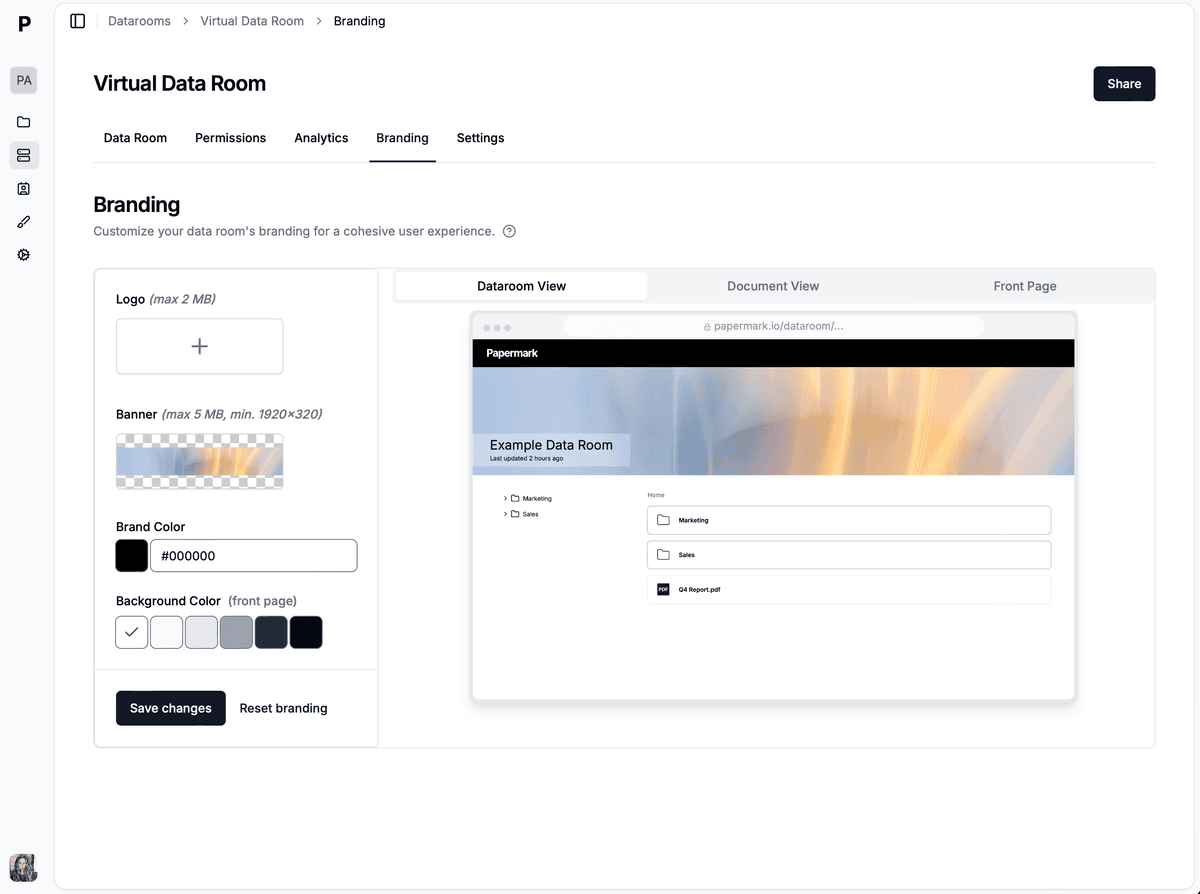
The Data Rooms plan is €99/month billed annually (€149 month-to-month) with a 7-day free trial and includes 3 team members, unlimited data room visitors, unlimited data rooms, unlimited documents, unlimited storage, a custom domain, dynamic watermarking, NDA agreements, and granular file-level permissions. Extra team members are €33/month.
Data Rooms Plus at €249/month adds 5 team members, the Q&A module, the visitor audit log, automatic file indexing, and SOC 2 Type II. Data Rooms Premium at €549/month covers 10 team members plus AI redaction, full API access, SSO, and whitelabeling. Data Rooms Unlimited at €999/month removes per-seat charges and adds self-hosted deployment.
Papermark rates 4.9/5 across 171 reviews on G2, Product Hunt, and community feedback, verified in 2026, and is used by 70,000+ companies. The honest limitation against a nine-figure, bank-specified process is brand. Papermark does not replace DealRoom's pipeline and 100-day integration planner. If that workflow is the job, stay on DealRoom. If the job is the room, do not pay platform prices for it.
No credit card required.
Website: firmex.com
Pricing: Custom quote. Reported entry around $625 to $995/month.
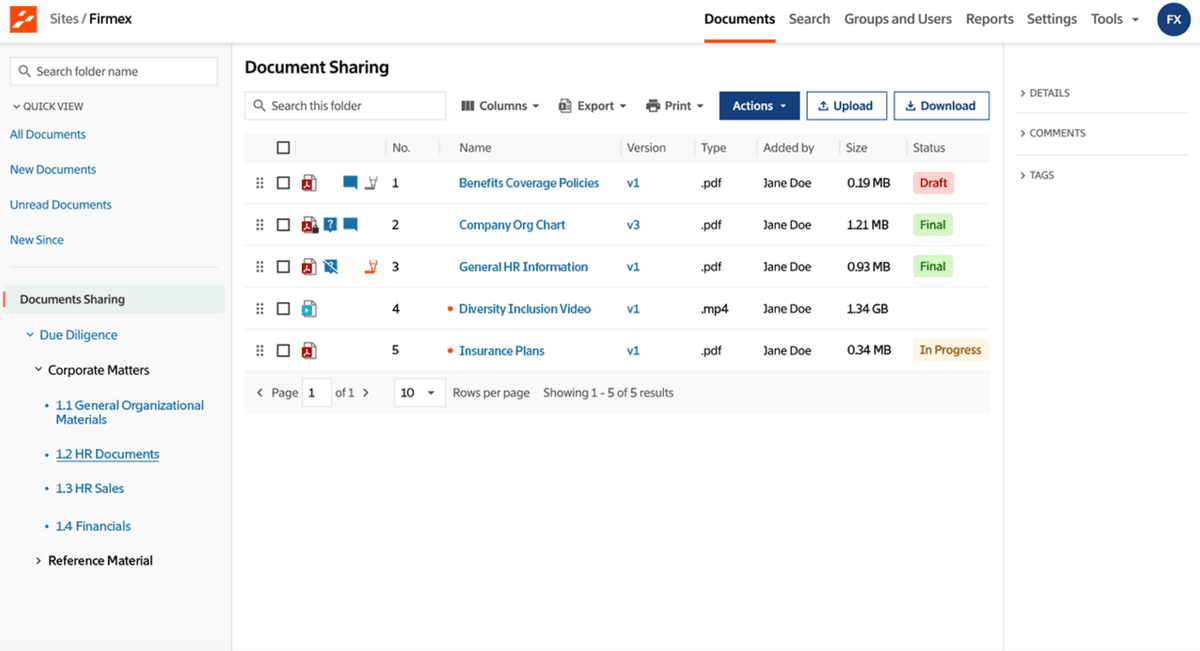
Firmex is a Canadian, project-based VDR used by mid-market boutiques. Features include watermarks, two-factor authentication, Q&A, and 24/7 support. It strips DealRoom's pipeline layer and focuses on the room.
Limitations: Datasite acquired Firmex in July 2021. Quote-only. Not an independent exit if you are also trying to avoid large VDR parents. See the Firmex review and Firmex VDR overview.
Website: caplinked.com
Pricing: From $399/month on the Team plan.

CapLinked is a published-price VDR with OCR search and no per-viewer charge for external reviewers. It is the DealRoom alternative when you wanted a subscription under $450/month and no annual M&A-platform commitment.
Limitations: G2 sits around 3.9/5 in recent VDR roundups. Custom branding and page-level analytics are limited versus Papermark. Independent of DealRoom and of Datasite.
Website: ansarada.com
Pricing: Custom quote. Historically reported from around $479/month; treat current deals as quote-only.
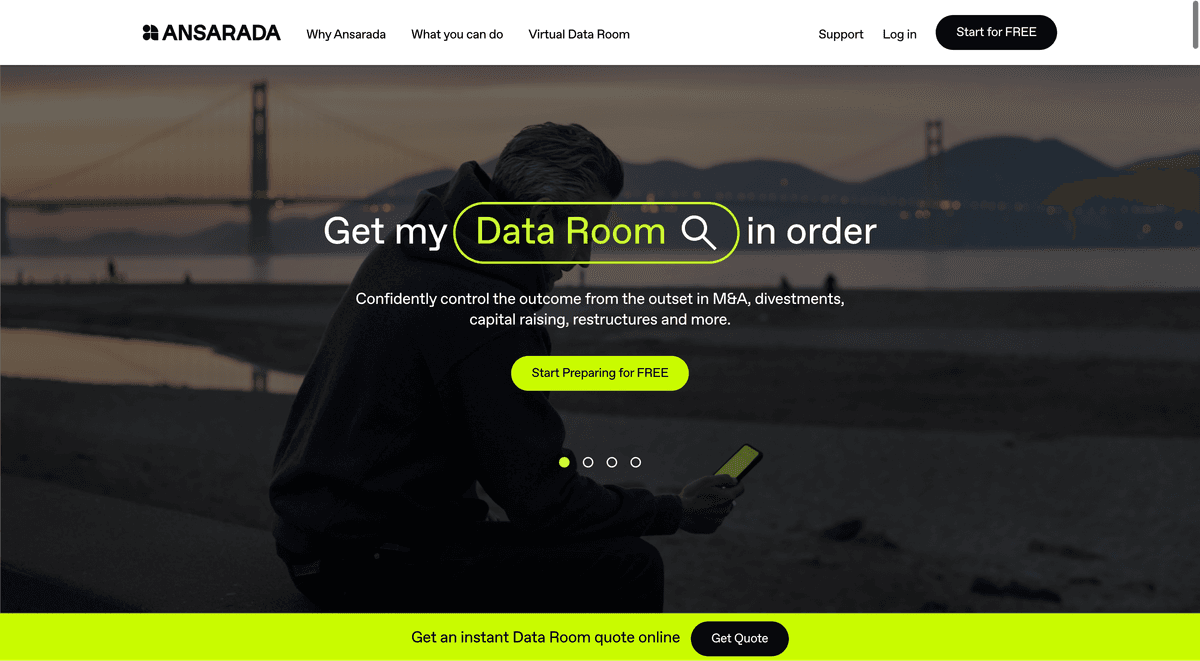
Ansarada layers deal-readiness scoring and bidder management on a VDR. Datasite completed the Ansarada acquisition in August 2024. AI-assisted redaction appears on the enterprise VDR set (Datasite, Intralinks, Ideals, Ansarada, Imprima) at quotes that typically start around $25,000/year, in the same band as DealRoom's published platform start.
Limitations: no longer independent of Datasite. Quote-only. Overkill if you needed a simple room. See the Ansarada overview and Ansarada alternatives.
| Feature | DealRoom | Papermark | Firmex | CapLinked | Ansarada |
|---|---|---|---|---|---|
| Starting price (quoted) | $25,000/year | €99/month | ~$625+/month | $399/month | Custom quote |
| Published self-serve price | |||||
| M&A pipeline / PMI | Partial | ||||
| Unlimited data room visitors | Unlimited users | Quote | Quote | ||
| Page-by-page analytics | Document-level | Document-level | Limited | Partial | |
| Q&A module | From Plus | Limited | |||
| AI redaction (seller PII pass) | Not the pitch | Limited | Enterprise quote | ||
| Buyer-side AI diligence | Limited | Scoring | |||
| Independent of DealRoom | Parent SKU | ||||
| API / MCP | Limited | Limited | Limited | Limited | |
| Self-hosted / open-source |
A data room for M&A is the permissioned workspace that holds the CIM, quality of earnings, customer contracts, and HR files while several bidders review them at once. Leaving DealRoom does not mean you needed FirmRoom or Datasite unless those products match the case.
Papermark is a secure, fully customizable, and developer-friendly data room for modern dealmakers. Set one-click NDA gating, stamp pages with dynamic watermarking, split bidders with granular permissions, watch page-by-page analytics, and run AI redaction before HR and customer files go out. Unlimited data room visitors are included on every plan.
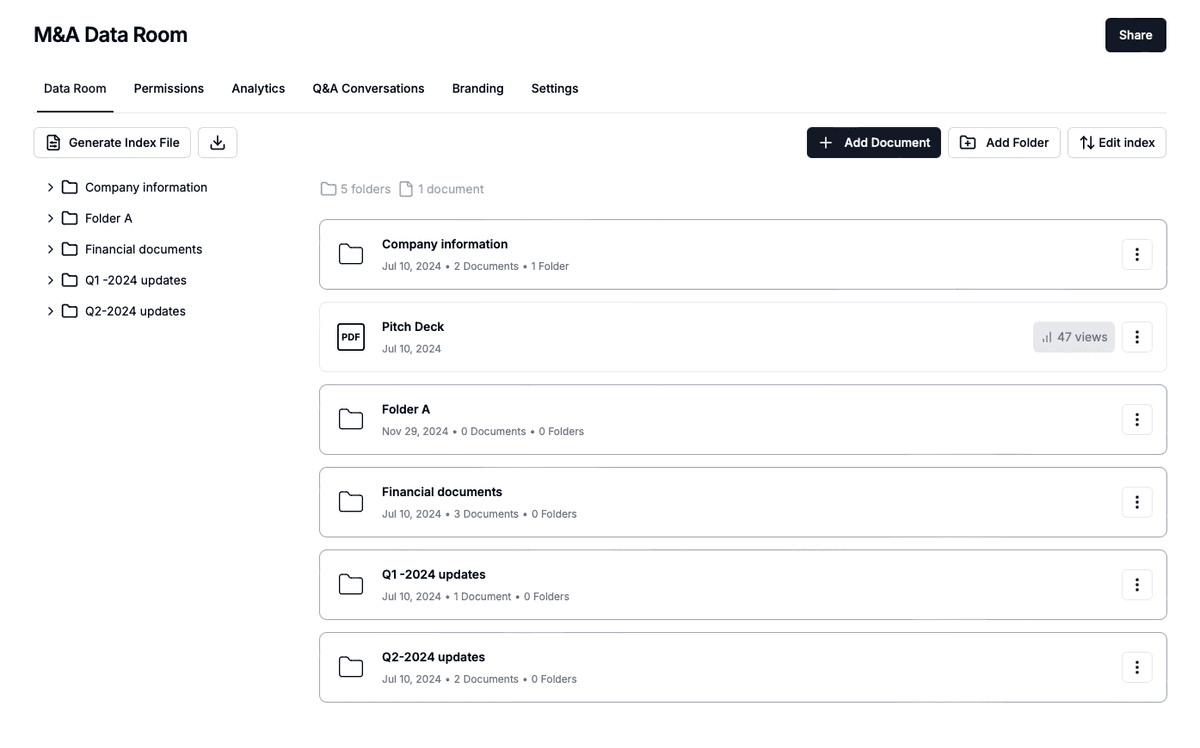
Workstream folders and per-link permissions on a Papermark M&A data room.
The Data Rooms plan is €99/month billed annually (€149 month-to-month), with a 7-day free trial, 3 team members, unlimited data rooms, unlimited documents, unlimited storage, a custom domain, dynamic watermarking, NDA agreements, and granular file-level permissions.
DealRoom is an M&A operating system with a VDR inside it, from $25,000/year on its own comparison page, with AI that helps buyers read contracts and email. Use it when you run several acquisitions a year and will live in pipeline and integration. Do not use it as a default fundraising or one-off sell-side room.
Papermark is the best overall alternative for the room itself: €99/month, unlimited data room visitors, page-by-page analytics, and AI redaction. Firmex and Ansarada are Datasite-family VDRs on quotes. CapLinked is the published-price peer under $400/month. FirmRoom is still DealRoom.
RR Donnelley Venue review for 2026: real pricing from $15,000, features, pros and cons, and 5 virtual data room alternatives including Papermark at €99/month.
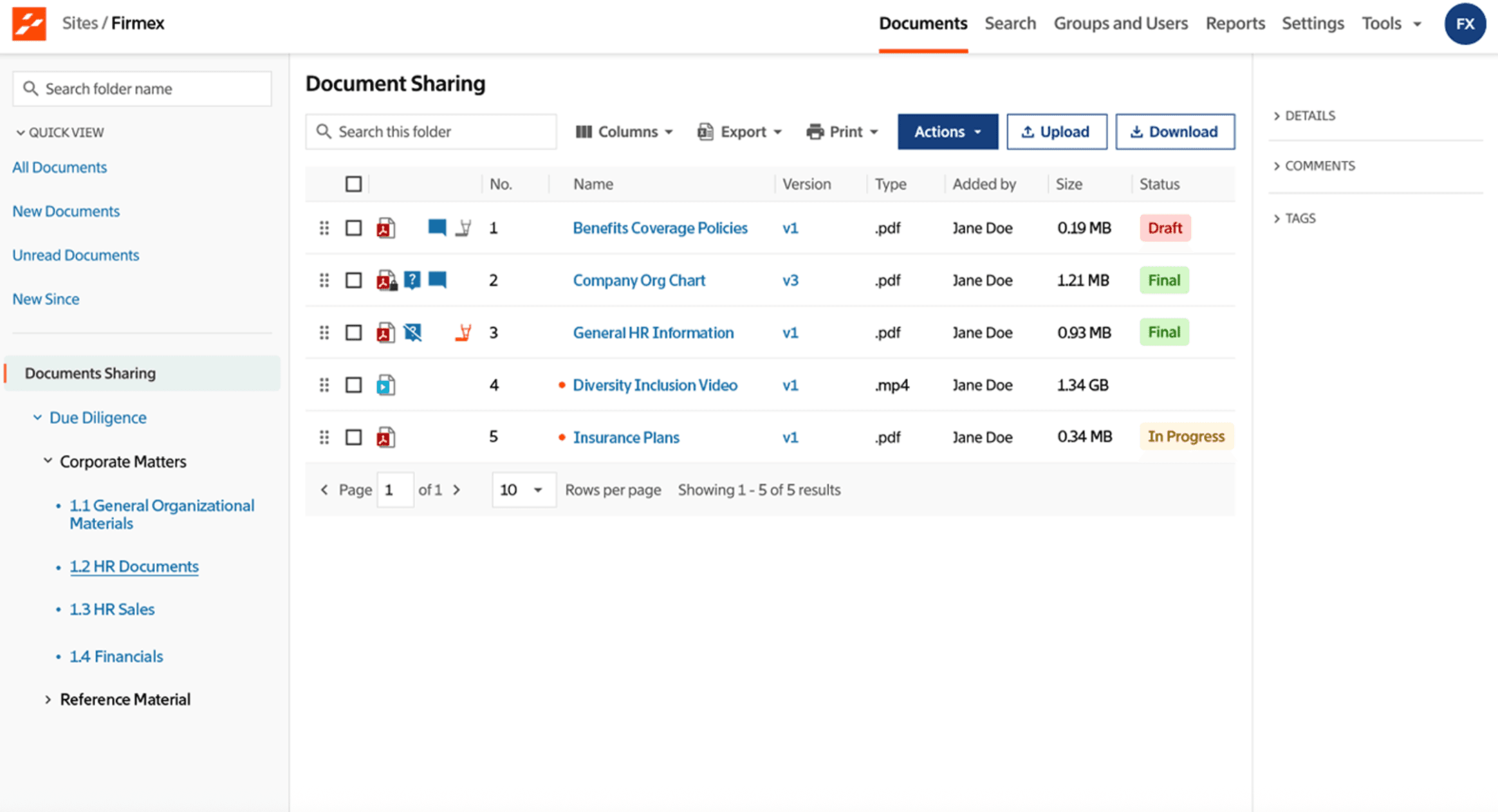
Honest Firmex review for 2026 - virtual data room features, pricing, screenshots, pros and cons, and how it compares to Papermark, iDeals, and Datasite.
HighQ Dataroom review for 2026: features, real pricing estimates, honest pros and cons, and 5 legal VDR alternatives including a data room from €99/month.