

datarooms
Firmex Review 2026: Features, Pricing, Pros, Cons, and Alternatives
Honest Firmex review for 2026 - virtual data room features, pricing, screenshots, pros and cons, and how it compares to Papermark, iDeals, and Datasite.
Merrill VDR (Merrill DataSite, now branded Datasite) is one of the original enterprise virtual data rooms, built for large M&A, restructuring, and investment-banking deals. This 2026 review covers what Merrill DataSite actually is, its features, its page-based pricing, the honest pros and cons, and five modern alternatives worth comparing.
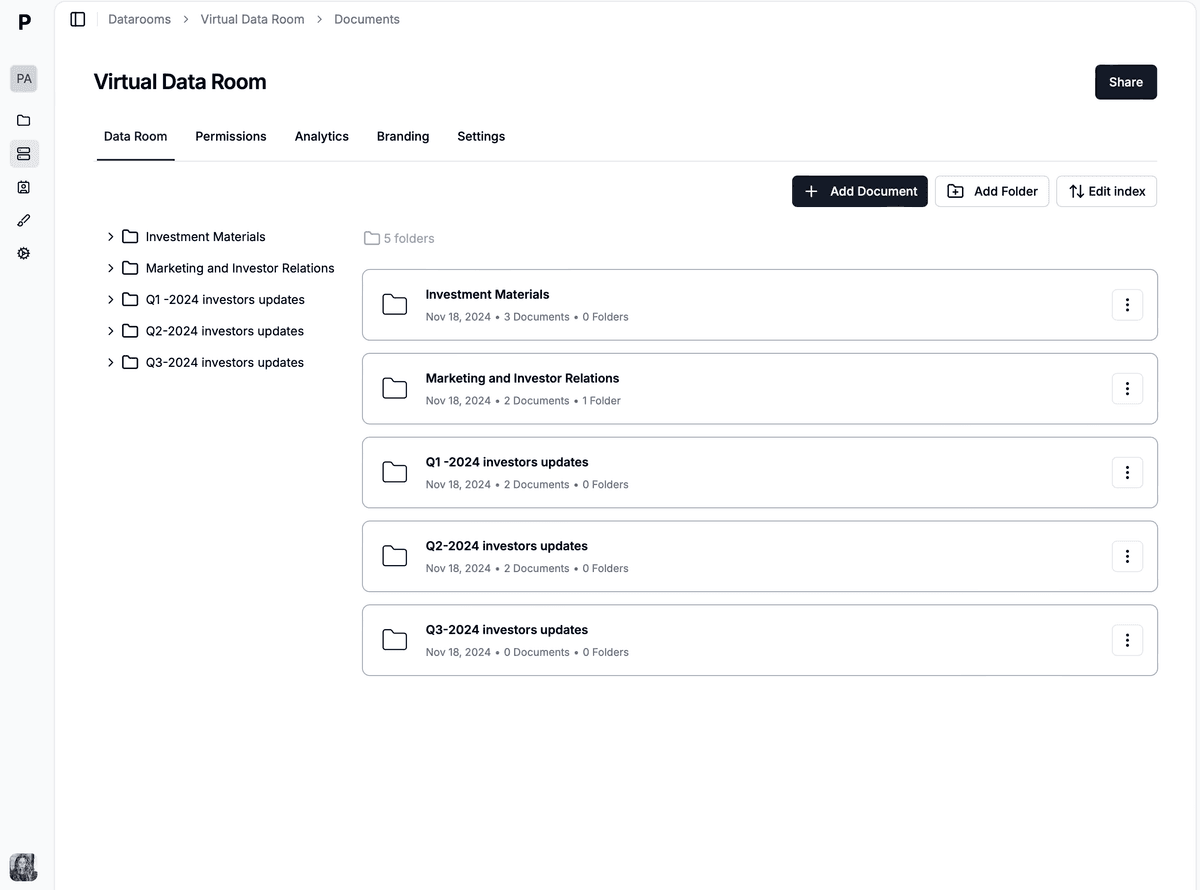
Merrill VDR is the virtual data room originally built by Merrill Corporation, a Minnesota-based financial-printing and document-services company. In 2018 the data-room business was relaunched under the name Datasite, so today "Merrill DataSite," "Datasite Merrill," and "Datasite" all describe the same secure online repository used for M&A, financing, and due diligence.
For most of two decades, Merrill DataSite was one of the default names in the virtual data room market, sitting alongside Intralinks and RR Donnelley Venue as the go-to platform for high-stakes transactions. When bankers talked about running due diligence "in Merrill," they meant uploading confidential deal documents into a secure, permissioned, watermarked environment where dozens of bidders and their advisors could review materials without the files ever leaving the platform.
The rebrand to Datasite matters for anyone researching the tool in 2026. If you search for "Merrill VDR pricing" or "Merrill DataSite login," you will land on Datasite properties, and the underlying product, security posture, and pricing model are what Datasite ships today. Throughout this review we use "Merrill VDR" and "Merrill DataSite" to describe that lineage, and note where Datasite has since modernized the platform. For a feature-level walkthrough of the current product, see our Datasite virtual data room overview.
Merrill's positioning has always been the top of the market. It is engineered for large, complex, multi-jurisdiction deals where a dedicated project manager, forensic audit trails, and enterprise security certifications are non-negotiable. That focus is also the source of most of its trade-offs, which we cover in detail below.
Merrill DataSite ships the full enterprise VDR feature set: secure document management, granular permissions, a structured Q&A workflow, dynamic watermarking, AI-assisted redaction and indexing, and a complete audit trail. The platform is built around the deal team, with pre-built folder templates, checklists, and trackers that mirror how banks and law firms actually run a diligence process from kickoff to close.
Where Merrill has invested most visibly in recent years is artificial intelligence. The platform uses machine learning to auto-categorize and index uploaded documents, run optical character recognition so scanned files become searchable, and suggest redactions of sensitive terms across thousands of pages at once. For a large carve-out or cross-border deal with tens of thousands of documents, that automation genuinely saves associate hours.
The collaboration layer is equally deal-centric. A centralized task checklist ties directly to the data-room index, so deal leads can see which sections are ready and which are still missing documents, and the Q&A module routes buyer questions to the right subject-matter expert while keeping competing bidders walled off from one another.
The core capabilities break down as follows:
This is a mature, complete platform. The gaps that matter are less about missing features and more about how the product is priced, onboarded, and operated day to day.
Merrill VDR pricing follows the legacy model that Datasite still uses today: quotes are custom, there is no public rate card, and the default structure is page-based. Research and user reports put the average upload cost around $0.60 per page, with additional charges for spreadsheets and special media types, and prices that tend to climb as a deal continuation period runs long. There is no transparent monthly subscription to point to, which is the single biggest difference from modern flat-rate providers.
The practical consequence is that cost scales with document volume rather than with time or value delivered. A data-heavy carve-out with hundreds of thousands of pages can reach well into six figures on an annual basis, and even small deals can feel expensive because the per-page structure carries fixed overhead that does not shrink proportionally for a lean document set. Setup and professional-services fees typically sit on top of the platform cost.
For teams that want predictability, the page-based model is hard to budget against because you rarely know your final page count when you sign. A useful frame of reference is our broader virtual data room cost breakdown, which compares page-based legacy pricing against flat monthly subscriptions across the market.
The cost picture in plain terms:
Enterprise-grade security and compliance. Merrill DataSite carries the certifications that regulated buyers and sell-side counsel expect: SOC 2 Type II, ISO 27001, and alignment with GDPR and CCPA. For a bank running a public-company deal, that posture is table stakes and Merrill delivers it.
Mature AI tooling for large document sets. Auto-indexing, OCR, and bulk smart redaction are genuinely useful when a room holds tens of thousands of files. This is where Merrill's investment shows, and it is a real advantage over lighter-weight tools on very large deals.
Strong Q&A and deal-management workflow. The structured Q&A module, index-linked checklists, and per-bidder scoping are built for competitive M&A processes with multiple parties, and they handle that complexity cleanly.
Dedicated support and services. Enterprise engagements include project managers, onboarding, and around-the-clock support, which matters when a permission issue surfaces the night before a signing.
Proven track record. As one of the original VDRs, Merrill DataSite has decades of deals behind it and a reputation that carries weight in conservative, procurement-heavy environments.
Opaque, page-based pricing. The single most common complaint is that costs are impossible to predict up front. Per-page charges, media premiums, and continuation fees make budgeting a guessing game, and the model penalizes document-heavy rooms and smaller deals alike.
No self-serve evaluation. There is no public free trial. Every engagement starts with a sales call and a custom quote, which is friction for a founder or a small deal team that needs a room live this week.
Dated onboarding and learning curve. The platform is feature-heavy and assumes professional setup. Teams frequently report needing training and a project manager before they are productive, which slows fast-moving deals.
No self-hosting and limited API. Merrill DataSite is cloud-only with limited API access. For banks, government contractors, or life-sciences teams with on-prem or data-sovereignty requirements, the lack of a self-hostable option is a hard constraint.
Overkill for smaller transactions. For a Series A raise, a startup acquisition, or a straightforward diligence process, the enterprise machinery adds cost and complexity without a proportional benefit. Modern flat-rate rooms cover the same core workflow at a fraction of the price.
Aldergate Partners, a hypothetical London-based mid-market M&A boutique, had used Merrill DataSite for years on its larger sell-side mandates. The security and Q&A workflow were never in question. The problem was economics and speed as the firm moved down-market into deals worth 20 to 80 million pounds.
On a recent carve-out, the team uploaded roughly 140,000 pages across financial, legal, and commercial workstreams. The page-based quote came back well into five figures before setup and continuation fees, and the deal timeline slipped because the room could not go live until the quote was signed and a project manager scheduled onboarding. For a mandate where the advisory fee was already tight, the data-room line item was disproportionate.
For the next three mandates, Aldergate ran a parallel evaluation. It kept Merrill for one regulated cross-border process where the buyer's counsel specifically required an incumbent enterprise VDR, and moved the other two, plus its ongoing pipeline of teasers and management-presentation shares, to a flat-rate platform at €99 per month. The switch cut per-deal data-room spend by more than 90 percent, let associates spin up rooms the same afternoon a mandate was signed, and gave partners page-by-page analytics showing exactly which bidders read the confidential information memorandum and where they lingered. Merrill stayed in the toolkit for the largest deals, but it was no longer the default.
Merrill DataSite maintains the compliance posture expected of a top-tier virtual data room. The platform is SOC 2 Type II audited and ISO 27001 certified, aligns with GDPR and CCPA for personal-data handling, and encrypts documents both in transit and at rest. Dynamic watermarks stamp viewer identity onto every page, and a forensic audit trail records who opened which document, when, and for how long.
For deals in regulated industries, this is the reassurance that gets a VDR through procurement. Where Merrill is more constrained is deployment flexibility: the platform is cloud-only, so organizations that require self-hosting or in-country data residency beyond the vendor's available regions cannot satisfy that with Merrill alone. Any serious VDR evaluation for a regulated buyer should confirm current certifications and data-residency options directly with the vendor, since these evolve.
The security fundamentals to verify on any shortlist:
No single virtual data room is right for every deal. Merrill DataSite is built for the largest, most regulated transactions, while flat-rate platforms are better aligned with fundraising, mid-market M&A, and ongoing investor relations. The table below sets Merrill against four common alternatives so you can see where each fits before reading the detailed profiles.
| Feature | Merrill VDR (Datasite) | Papermark | iDeals | Firmex | Intralinks |
|---|---|---|---|---|---|
| Pricing model | Page-based custom | Flat monthly | Custom quote | Per-project / subscription | Page-based custom |
| Starting price | Custom (page-based) | €99/month flat | ~$500/month | ~$150/month or $5K-$10K project | Custom (enterprise) |
| Free trial | None (sales-led) | 7-day self-serve | 30-day | On request | None |
| Setup time | 1-2 weeks | Under 1 hour | Days | Days | 1-2 weeks |
| Page-by-page analytics | Document-level | Yes | Partial | Document-level | Yes |
| Custom domain / white-label | Enterprise add-on | Included | Yes | Higher tier | Limited |
| Self-hostable | No | Yes (open-source) | No | No | No |
| AI indexing / redaction | Strong | Available | Available | Limited | Available |
| Best for | Large-cap, regulated M&A | All deal stages and sizes | Mid-market M&A with formal Q&A | Time-boxed mid-market deals | Large enterprise M&A |
If Merrill's page-based pricing, sales-led onboarding, or lack of self-hosting rules it out, several modern platforms cover the same core virtual data room workflow with clearer economics. The right choice depends on deal size, how long the room stays live, and whether you need a self-serve setup.
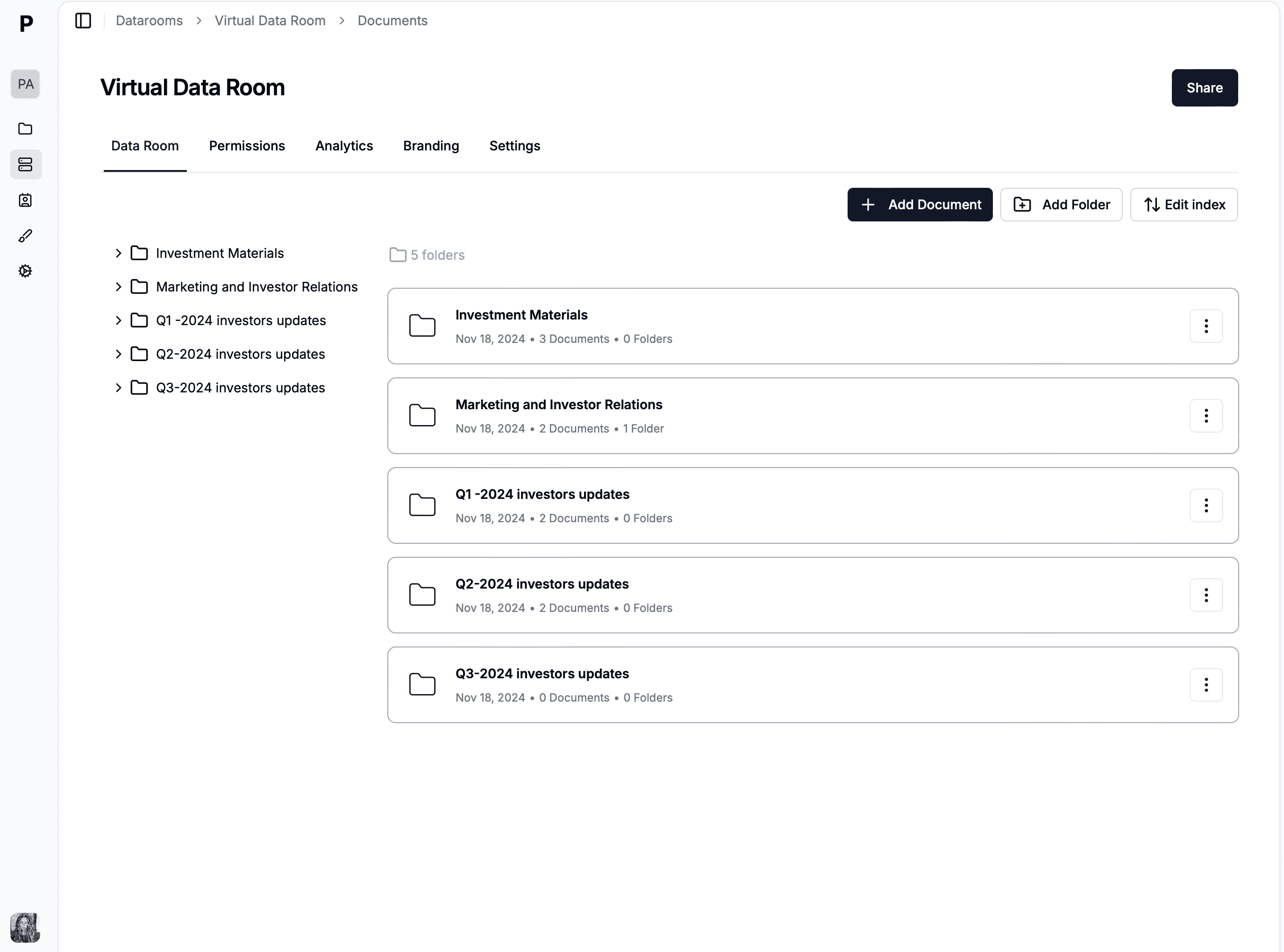
Papermark is a purpose-built, open-source virtual data room designed for founders, deal teams, and advisors who want enterprise security without enterprise pricing or complexity. It replaces the page-based model with a flat €99/month Data Rooms plan that includes unlimited data rooms, unlimited viewers, a custom domain, white-label branding, and page-by-page analytics. Rooms go live self-serve in under an hour with a 7-day free trial, and the open-source core means teams that need self-hosting or data residency can deploy it themselves. It suits fundraising, mid-market M&A, and ongoing investor relations especially well. See the Papermark data room.
iDeals is a well-regarded VDR positioned in the mid-market, with a strong Q&A module and solid security certifications. Pricing is custom, generally reported from around $500/month, and setup takes days rather than minutes. It is a reasonable fit when a formal, competitive Q&A process is central to the deal and you still want more polish than legacy tools offer.
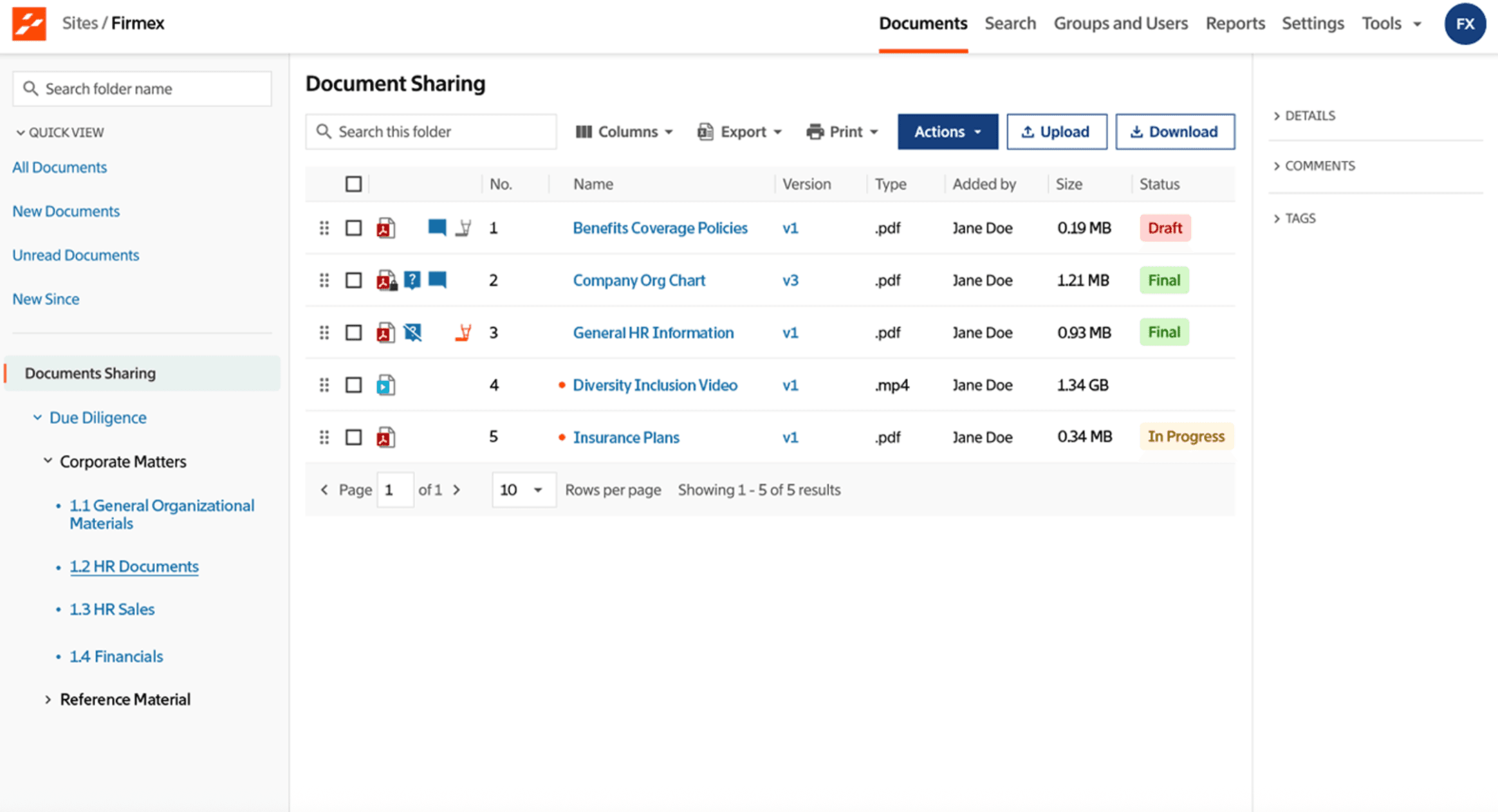
Firmex is a Canadian, project-based VDR used heavily by mid-market M&A boutiques and law firms. Its economics suit clean, time-boxed deals that close in three to six months, with entry subscriptions from roughly $150/month and typical mid-market projects at $5,000 to $10,000 per engagement. It is strong on Q&A and 24/7 support but weaker on flat pricing and page-by-page analytics. Read the full Firmex review.
Intralinks is Merrill's closest peer: another legacy enterprise VDR with global infrastructure, deep security, and dedicated support, priced with custom quotes comparable to Merrill. It is a like-for-like option for very large, cross-border transactions. For a setup walkthrough and comparison, see how to create a data room in Intralinks and the Intralinks alternatives guide.
For teams that want a subscription rather than a page-based quote, SecureDocs is available from $450/month as a subscription, and CapLinked lists around $399/month. Both trade some enterprise depth for pricing transparency and are worth a look for straightforward diligence where Merrill's AI and services are not required.
Papermark is the alternative most teams reach for when Merrill DataSite feels too expensive, too slow to stand up, or too heavy for the deal at hand. It is a modern virtual data room that keeps the security fundamentals that matter for M&A and due diligence, then removes the page-based pricing and the sales-led onboarding that define the legacy experience.
On pricing, the difference is structural. Instead of $0.60 per page and continuation premiums, Papermark charges a flat €99/month on the Data Rooms plan, and that single subscription covers unlimited data rooms, unlimited document visitors, and unlimited storage within fair use. A document-heavy carve-out that would run into five or six figures on a page-based quote costs the same as a lean Series A room, which makes budgeting a non-issue and lets advisory firms run multiple concurrent rooms without re-quoting each one.
On security, Papermark is SOC 2 Type II compliant and GDPR-aligned, encrypts data in transit and at rest, and enforces the controls a diligence process needs: granular permissions down to the folder and file, dynamic watermarking carrying viewer email, IP, and timestamp on every page, an integrated Q&A module, NDA gating on links, and a complete, exportable audit trail. Where Papermark pulls ahead of Merrill for dealmakers is analytics: page-by-page analytics and engagement heatmaps show exactly which bidder opened the CIM, which pages they lingered on, and where they dropped off, so partners can read investor intent in real time rather than settling for document-level opens. Full-text search, a documented REST API, custom domains, and an open-source, self-hostable core round out the platform for teams with data-residency or integration requirements.
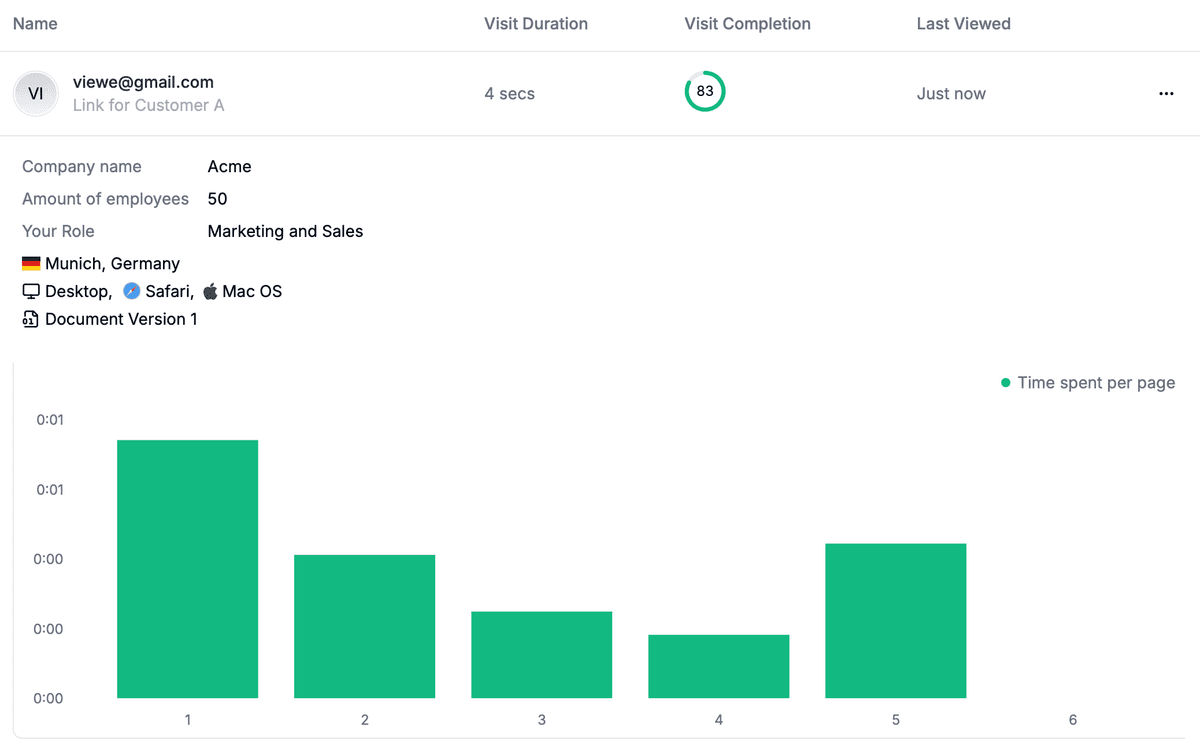
Papermark's page-by-page analytics show which pages each bidder reads during due diligence - visibility Merrill VDR's document-level reporting does not match.
For fundraising specifically, the workflow is seamless: share a teaser or pitch deck first, then upgrade the same link into a full data room when diligence begins, keeping all analytics in one place. You can start on the Papermark data room with a self-serve trial and have a secure room live the same day.
No credit card required.
Honest Firmex review for 2026 - virtual data room features, pricing, screenshots, pros and cons, and how it compares to Papermark, iDeals, and Datasite.
HighQ Dataroom review for 2026: features, real pricing estimates, honest pros and cons, and 5 legal VDR alternatives including a data room from €99/month.
An honest 2026 review of DealRoom VDR: real features, custom pricing from $2,000 per deal, strengths, weaknesses, and 4 alternatives for M&A and fundraising.