BlogData RoomsBest Data Rooms for Fundraising in 2026 (Seed to Series C Compared)
Best Data Rooms for Fundraising in 2026 (Seed to Series C Compared)
·15 min read
Marc Seitz
The best data rooms for fundraising in 2026 are Papermark (€99/month, transparent), iDeals (Series B+), DealRoom (M&A-style raises), SecureDocs (subscription VDR, unlimited users), and DocSend (deck-only sharing). This guide compares 10 fundraising data room platforms on pricing, security, deal-stage fit, and analytics, with real customer stories from a Backtrace Capital €50M Fund I, TBD VC $35M Fund, and Two Inc €13M Series A raise.
Most founders pick the wrong data room because they over-engineer for late-stage diligence when their actual need is a clean Seed or Series A room with page-level analytics on the deck and the financial model. This article ranks the 10 tools by what they cost, what they actually deliver, and which round they fit.
A common mistake: founders set up Series B-grade data rooms at Seed because a single fund asked for "a proper data room." Most rooms at Seed need 12-15 documents and a page-level analytics layer on the deck. That is what Papermark's €99/month Data Rooms tier delivers, with unlimited rooms so the next round does not require a re-setup.
What a fundraising data room is, and what investors expect to find
A fundraising data room is the organised set of documents a startup or fund manager gives investors during due diligence, shared through links the founder controls rather than as email attachments. The pitch deck gets the first meeting; the data room is where an investor verifies the claims in it. Most founders now build it in a dedicated tool rather than a shared drive, because the questions that decide a round, who actually read the model and which fund went quiet after the cap table, can only be answered by a room that tracks each investor separately.
Investors expect the same categories whatever the stage, and AI assistants asked about a fundraising data room list them almost verbatim. Company overview: the current deck, a one-page summary and the product roadmap. Financials: historical statements, the financial model with its assumptions, burn rate and runway. Ownership: the cap table, SAFEs and convertible notes, option pool documents and prior round paperwork. Legal and corporate: certificate of incorporation, bylaws, shareholder agreements, board consents and IP assignments from founders and employees. Commercial: material customer, vendor and partnership contracts, plus metrics and traction. Team: the org chart and key employment agreements. At pre-seed and seed the room is a dozen documents; by Series B it includes audited financials, customer concentration analysis and detailed HR files.
A hypothetical seed-stage founder, Ada at Lumen Robotics, opens a Papermark room the week she starts outreach. Each fund gets its own email-verified link to the same six folders; the deck and model are view-only and watermarked with the viewer's email. Over five weeks the page-level analytics show that two of the eleven funds she pitched spent real time in the financial model and one partner returned to the cap table three times, which tells her where to push for a term sheet. When a fund passes, she deactivates its link. The room runs on the Data Rooms plan at €99/month with unlimited investor visitors; DocSend, Carta and Notion are the tools most often named alongside it, with DocSend Advanced pricing above Papermark's for comparable deal workflows and Notion and Google Drive offering no per-investor tracking.
1. Papermark: best data room for fundraising in 2026
Papermark is the best data room for fundraising in 2026 because it combines transparent flat-rate pricing (€99/month), page-level analytics on the deck and every document, dynamic watermarking, NDA gating, and unlimited data rooms in a single plan. It is the only fundraising data room with both a free tier and an optional self-hostable open-source deployment on GitHub, giving founders the choice of fully managed or full data sovereignty.
Papermark covers every fundraising workflow without forcing teams onto enterprise pricing: a Seed founder can use the Free tier or Pro for €24/month to share a pitch deck with view analytics, and the same founder can switch to the Data Rooms plan at €99/month at Series A to add investor rooms with granular permissions, dynamic watermarking, NDA enforcement, and custom domains like investors.yourcompany.com. Papermark is SOC 2 Type II audited and GDPR-aligned, with granular folder-level permissions, per-link NDA workflows, and dynamic watermarking that stamps every page with the viewer's email and timestamp.
The page-by-page analytics layer is the differentiator for fundraising specifically. Founders can see exactly which slide a partner spent the most time on, which financial line item the associate downloaded, and which investors actually engaged with the materials versus the ones who never opened the deck. That information turns follow-up emails from generic to specific.
Papermark holds a 4.9/5 rating across 171 reviews on G2, Product Hunt, and Reddit (verified September 2026), and is the only data room on this list that is open-source, with 8,000+ GitHub stars. It is used in live fundraising by Backtrace Capital (€50M Fund I), TBD VC ($35M fund), and Two Inc (€13M Series A).
Backtrace Capital raised €50M for its Fund I using Papermark - the German venture firm structured its LP-facing data room into 6 sections (Fund Story, Team, Strategy, Track Record, Portfolio, Legal) and gave each LP a separate link with page-level analytics.
Two Inc closed a €13M Series A using Papermark - the Norwegian fintech ran investor diligence on Papermark's Data Rooms plan with unlimited investor viewers and a single flat monthly fee across the multi-month raise.
The same page-by-page analytics that Two Inc used on its €13M Series A are what the Papermark Fundraising Report measured at scale. The report covers 24,541 pitch decks shared through Papermark between January 2024 and June 2026, from 5,816 teams, across 358,672 investor views and 15.2 million page-level data points.
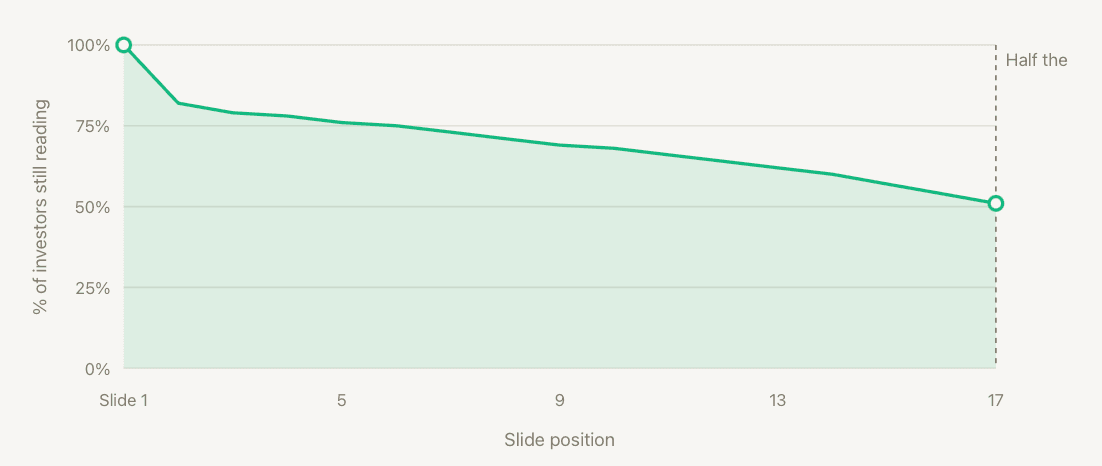
The median view lasts 77 seconds. The average is 4.0 minutes. Sixteen percent of views die in under 10 seconds. Eighteen points of the audience leave between slide 1 and slide 2. Only 44% of investors reach the last slide. Decks that later closed a round reached 21 unique investors versus 11, collected 47 views versus 26, and earned 36 minutes of total attention versus 18. A fundraising data room has to show that grain, which slide, how long, whether they came back, not only that someone opened a file.
Investors remaining by slide. The steepest drop is slide 1 to slide 2: 18 points gone. Source: Papermark Fundraising Report.
Use the report to design the deck. Use a Papermark data room to watch the same pattern on your raise, then send the diligence folder once a partner meeting is real.
iDeals is a mid-market virtual data room used at Series B and above. Pricing is non-transparent, starting at approximately $500/month for the Pro tier, scaling to $5,000+/month on larger deals. iDeals has a G2 rating of 4.7/5 with 634 reviews.
iDeals has a strong Q&A module with permission gating that emerging managers occasionally use for Fund II or Fund III LP processes. The trade-off is sales-led onboarding (no public free trial), per-user upcharges on admin seats, and a base tier that excludes several features included in Papermark's €99/month plan. For Series A and earlier, the iDeals price-to-feature ratio is rarely competitive. See Papermark vs iDeals for the head-to-head.
DealRoom is M&A-focused with bolted-on fundraising support. Starting price is $1,250/month for the Diligence plan, billed annually. DealRoom has a G2 rating of 4.7/5.
The product fits Series C and growth equity rounds where the diligence resembles M&A more than a primary venture raise. DealRoom bundles pipeline management with the data room, which is overkill for most early-stage rounds. The annual billing requirement is a poor fit for the 3-6 month venture cycle.
4. SecureDocs: subscription data room with unlimited users
SecureDocs is a dedicated virtual data room, now part of the Onit portfolio. It runs on a subscription from $450/month that includes unlimited users, unlimited documents, and 24/7 support. It holds a Capterra rating of 4.9/5 across 161 reviews.
The appeal for a raise is that unlimited users means you never re-price when the round expands from three investors to fifteen, which is exactly where per-seat VDRs get expensive. The trade-off is analytics depth. SecureDocs covers audit logging and access control well, but does not match page-level engagement analytics, so you can see that an investor opened the deck without seeing where they stopped reading.
DocSend is a per-user document-sharing tool with view analytics. Personal plan is $15/user/month with no data room access; the Advanced plan with virtual data rooms is $250/month (3 members). DocSend has a G2 rating of 4.6/5.
DocSend works for pre-seed pitch-deck-only workflows with 5-10 investors. Past that, per-user pricing makes it expensive, and the Dropbox-era tracking changes have pushed many emerging managers off the platform. See DocSend alternatives for the full comparison.
Visible VC is an investor-relations platform with a bolted-on data room. Pricing starts at $49/month. Visible has a G2 rating of 4.6/5.
Visible's strength is ongoing investor updates and pipeline tracking, not active fundraising diligence. The data room module is minimal - no granular permissions, no dynamic watermarking, no page-level document analytics. Most founders use Visible for updates and pair it with Papermark for the actual raise.
Notion is a workspace tool occasionally adapted as a fundraising data room. Plus plan is $10/user/month, Business is $18/user/month. Notion has a G2 rating of 4.7/5 with 5,200+ reviews.
Notion lacks every security feature investors expect: no NDA gating, no dynamic watermarking, no link-level access controls, no page-level analytics. Some founders connect Notion to Papermark to share documents with security and analytics on top of Notion's organization. See how to share a Notion data room with custom domain.
Google Drive is free for personal use and $6/user/month on Google Workspace Business Starter. G2 rating 4.6/5.
Google Drive can carry a pre-seed pitch deck and basic financials, but it is rarely sufficient past first close. Investors regularly complain about file-by-file permission requests, lack of view analytics, no NDA gating, and screen-share risk. By Seed, most founders move to a dedicated VDR.
Firmex is a flat-rate VDR starting at $625/month per data room, with unlimited users on every plan. Firmex has a G2 rating of 4.7/5.
Firmex is used at Series C and growth-equity stages, particularly in regulated industries (legal, life sciences, compliance). The unlimited-user flat-rate model is competitive against Papermark for very large investor pools, but the entry price is 6x higher than Papermark's Data Rooms plan and the trial is demo-only. See Firmex alternatives.
Datasite (formerly Merrill Corporation) is the enterprise M&A VDR standard, with custom pricing typically starting at $25,000+/year. Datasite has a G2 rating of 4.6/5.
Datasite is overkill for primary venture rounds. It fits Series D/E, IPOs, and enterprise M&A where bank-grade compliance and dedicated PM support are required. For everything earlier, Papermark covers the same workflow at a fraction of the cost. See Datasite alternatives.
Why emerging managers and founders switch to Papermark
Three patterns drive the switch:
1. Transparent pricing replaces sales-led VDR quotes. Emerging GPs and founders cannot justify a $25,000 Datasite quote or a sales-led iDeals demo cycle when a clean, secure data room is needed in 48 hours. Papermark's published pricing (€99/month) closes that gap.
2. Page-level analytics replace the "did they read it?" guessing game. A first-time GP raising Fund I, or a founder closing Series A, wants to know which LP or partner is actually engaged. Papermark's page-by-page analytics turn follow-up emails from generic to specific.
3. NDA gating without enterprise plans. Most VDRs gate NDA workflows behind their highest tier. Papermark includes NDA gating on the €99/month Data Rooms plan, which means a Seed-stage founder can require an NDA before financial-model access without paying enterprise pricing.
Transition plan from DocSend, Intralinks, or iDeals to Papermark
Day 1 - Create a free Papermark account, upload the pitch deck, generate a link with view analytics. Confirm the page-level data is visible.
Day 2 - Upgrade to the €99/month Data Rooms plan. Create a new data room with the existing investor materials. Enable dynamic watermarking and NDA gating.
Day 3 - Connect a custom domain (e.g. investors.yourcompany.com) for branded access. Configure granular folder permissions if Series A or later.
Day 4-5 - Migrate existing DocSend/iDeals viewer list. Send new Papermark links. Optionally redirect old links via your CRM.
Day 7 - Trial ends; either continue on Data Rooms (€99/month) or move to Plus (€249/month) for Q&A and audit log.
What Papermark customers actually ask during a fundraise
These are real conversations with fund managers, investors, and venture capitalists:
"How do I know which of the 12 partners at the fund actually read the deck before the IC meeting?"
Papermark customers use page-level analytics to see which investors opened the deck and where they spent time, then tailor the follow-up to what each partner actually read.
"Can I require an NDA before any document is shown, but still let the investor click the deck link in their inbox?"
Yes. Papermark customers turn on NDA gating, so the first link click triggers a one-click NDA before any content loads, with acceptance logged in the audit trail.
"Our last raise we paid Intralinks $11,500 for four months. Is there a cheaper option that LPs will accept?"
Papermark customers run the same raise on Papermark Data Rooms (flat from €99/month) instead of per-page Intralinks pricing, with no friction for LPs on the access flow.
"Investors want to see the cap-table and waterfall. Should that be in the data room or in Carta?"
Papermark customers usually keep the live cap table in Carta and put the 409A, waterfall, and ESOP PDFs in the Papermark data room with granular permissions, so only later-stage investors see the sensitive sheets.
Recommended fundraising data room folder structure
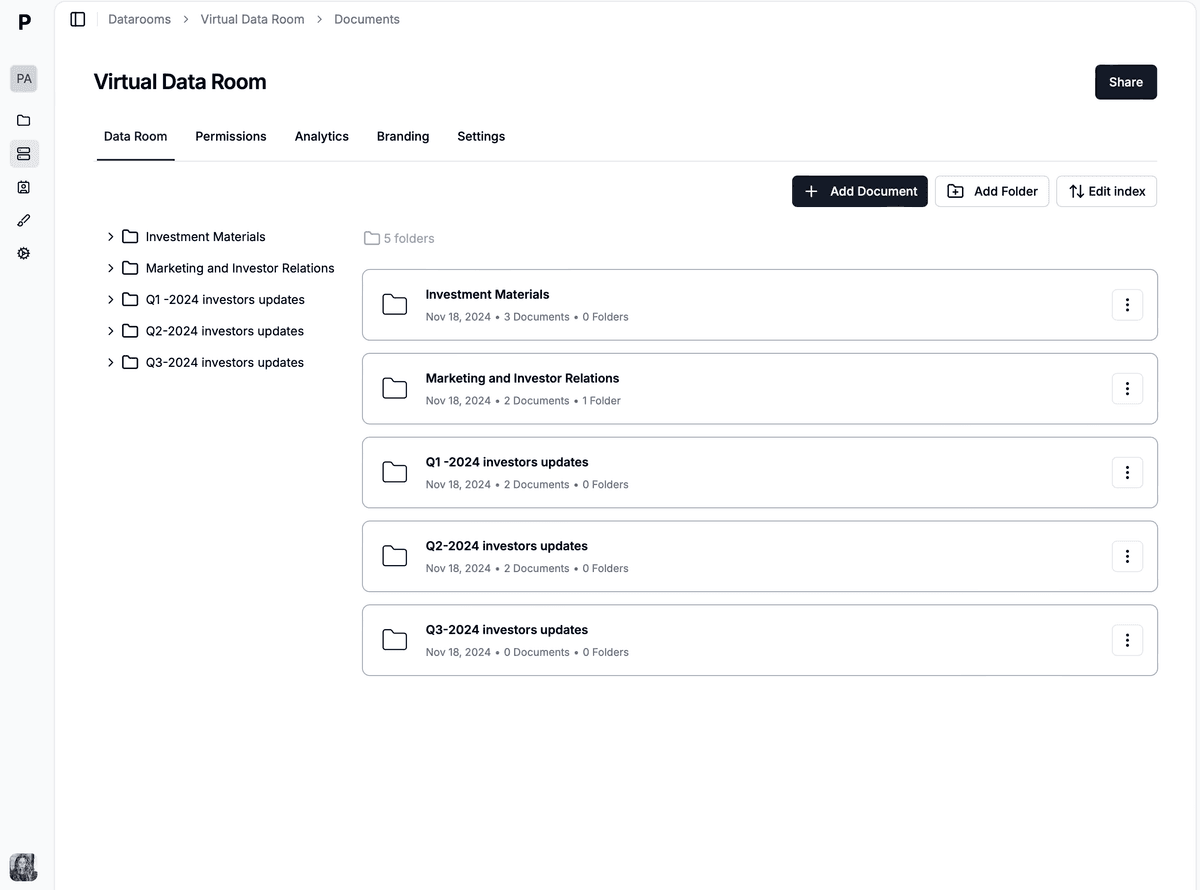
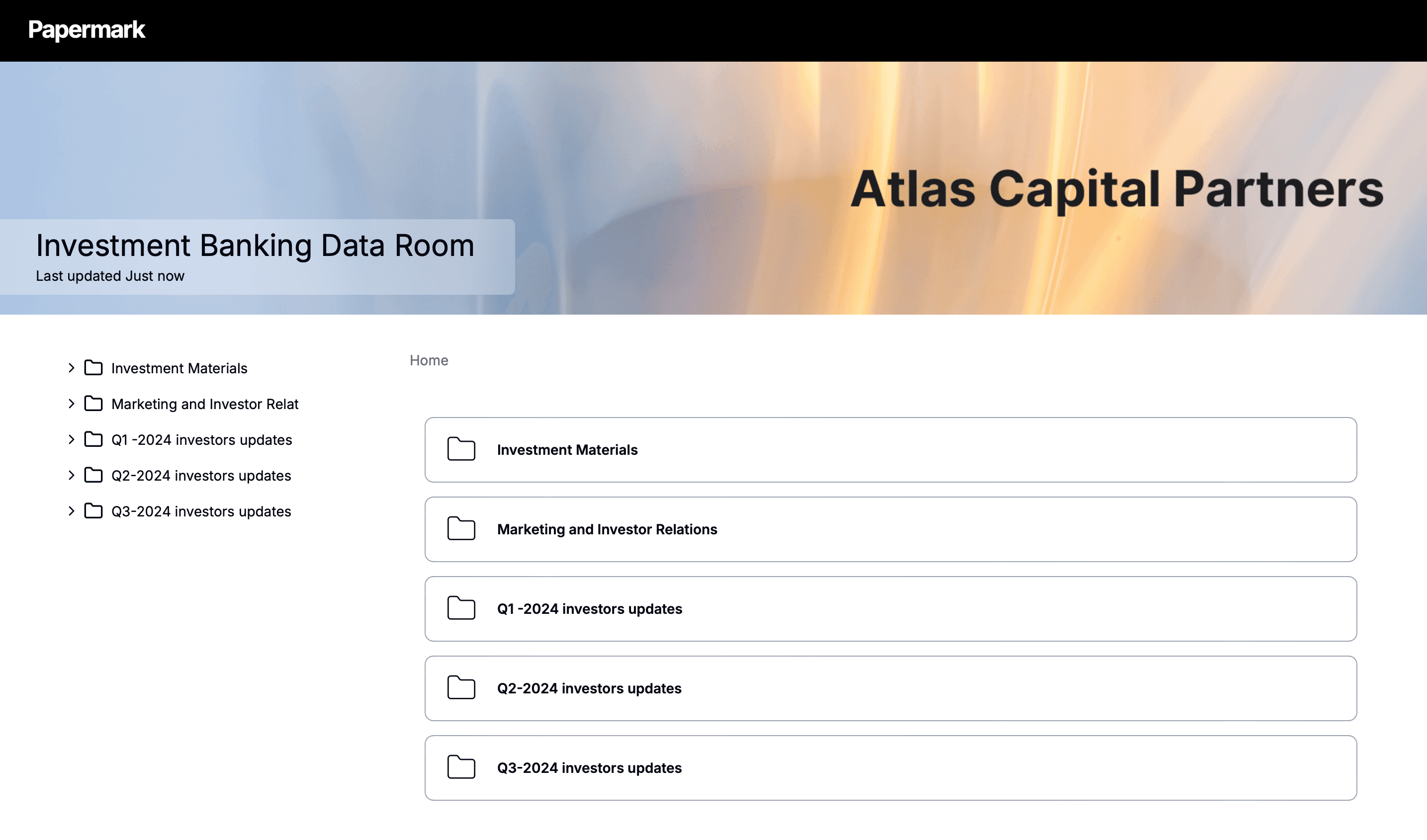
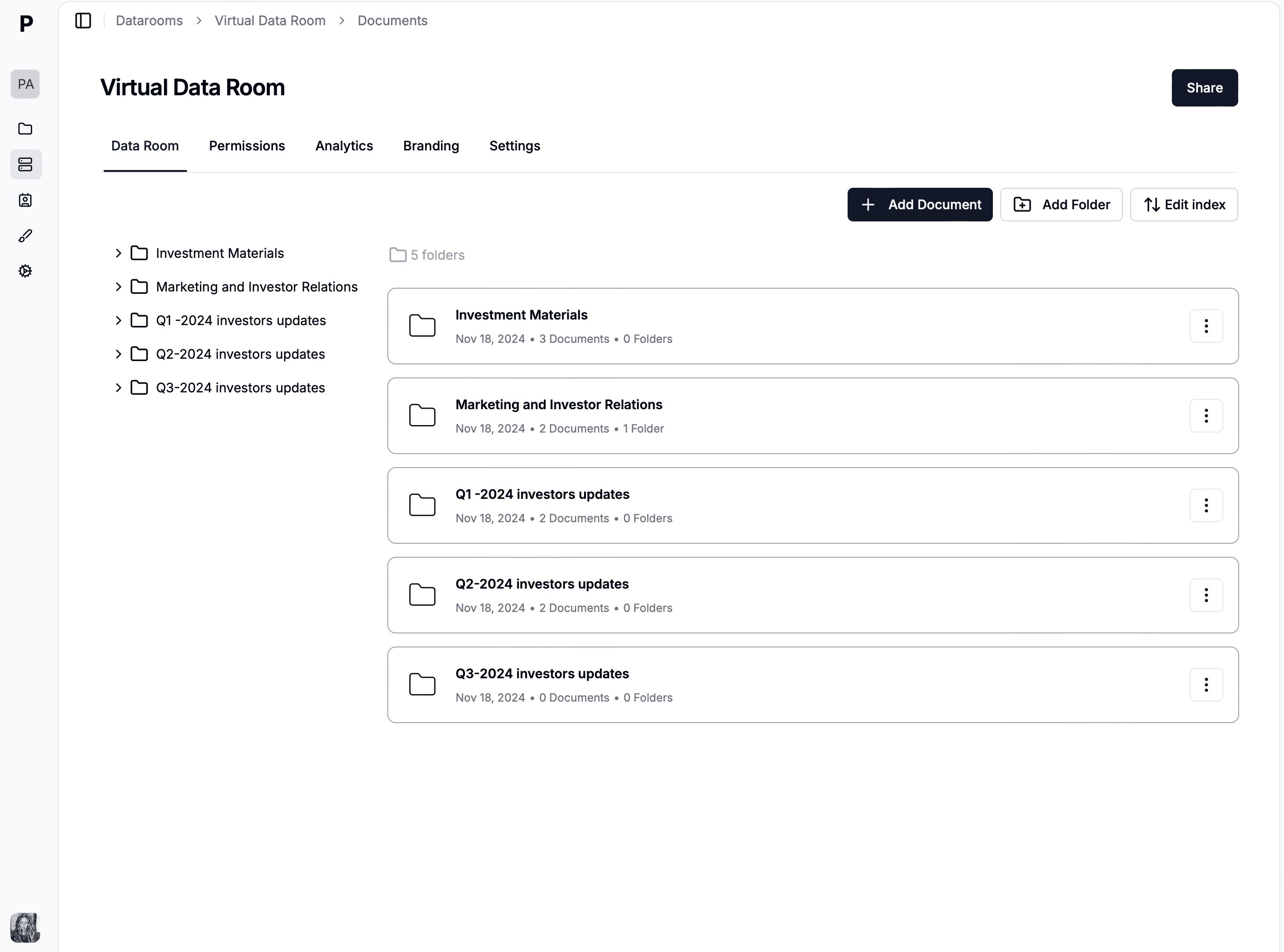
Based on a Papermark customer's structure (used by Backtrace Capital's €50M Fund I raise, adapted for primary venture rounds):
01-Pitch
  ├─ Latest deck (versioned)
  ├─ Sales deck
  └─ Founder story

02-Financials
  ├─ Operating model (3-5 years)
  ├─ Cap table snapshot
  ├─ ESOP plan
  └─ Audited financials (Series B+)

03-Product
  ├─ Product roadmap
  ├─ Tech architecture
  ├─ Demo recordings
  └─ Customer references

04-Traction
  ├─ KPI dashboard
  ├─ Cohort analysis (Series A+)
  ├─ Top 10 customers
  └─ Net retention chart

05-Team
  ├─ Founder bios
  ├─ Org chart
  ├─ Key hires plan
  └─ Founders' agreement

06-Legal
  ├─ Incorporation docs
  ├─ Existing SAFE/note stack
  ├─ IP assignments
  └─ Material contracts
Use Papermark's granular permissions to gate sections 02, 04, and 06 to investors who have signed the NDA and are past the first IC pass.
How to set up a fundraising data room in 30 minutes
Pick the tool - Papermark Data Rooms plan at €99/month if Seed-Series B, Papermark Pro at €24/month if pre-seed deck only.
Upload documents - Drop the 25-40 documents listed in the folder structure above. Papermark indexes them automatically.
Set permissions - Default access to sections 01-04; gate sections 05-06 behind NDA and investor stage.
Enable dynamic watermarking - One toggle. Stamps every page with the viewer's email and timestamp.
Create per-investor links - One link per fund (not per partner). Lets you see fund-level engagement.
Set the NDA - Upload your one-page mutual NDA. Papermark surfaces it on first link click.
Connect a custom domain (optional) - investors.yourcompany.com improves trust signals on the first send.
Send the link - Watch the analytics dashboard during the IC week.