

datarooms
Firmex Review 2026: Features, Pricing, Pros, Cons, and Alternatives
Honest Firmex review for 2026 - virtual data room features, pricing, screenshots, pros and cons, and how it compares to Papermark, iDeals, and Datasite.
RR Donnelley Venue is an enterprise virtual data room built for large M&A transactions, litigation, and complex due diligence. This 2026 review breaks down what Venue actually does, what it costs, where it falls short, and the five VDR alternatives worth comparing before you sign a contract.
RR Donnelley Venue is the virtual data room product line associated with RRD, one of the oldest names in document management and financial printing. Where consumer file-sharing tools stop at storage and links, Venue positions itself as a secure deal room for high-stakes transactions: the kind of process where a leak, an audit gap, or a permissions mistake can cost a client millions. It sits in the same legacy tier as Intralinks and Datasite, and it competes on security depth, compliance certifications, and hands-on professional services rather than on price or self-serve speed.
The platform is designed around enterprise workflows. A typical Venue engagement involves a dedicated project manager, a document-indexing phase, structured Q&A between buy-side and sell-side teams, and forensic-grade audit reporting that can be handed to counsel or regulators. That model made sense when data rooms were a specialist service bought a handful of times per decade, and it still resonates with investment banks and law firms running billion-dollar processes where the cost of the room is a rounding error next to the deal.
Venue is most often used for a specific set of high-value scenarios rather than everyday document sharing. The platform concentrates on transactions where security, chain-of-custody, and audit trails carry legal weight:
If your workflow looks more like a Series A raise, a startup acquisition, or routine investor updates, Venue is almost always more platform than the moment requires. That gap between enterprise capability and everyday need is exactly why so many teams end up comparing Venue against lighter, faster tools before they commit.
Venue's feature set is broad and clearly built for the enterprise buyer who is evaluating a data room against a security questionnaire rather than a free-trial checklist. The platform covers document security, granular access control, forensic audit logging, structured Q&A, redaction, and a services layer that most modern self-serve tools do not attempt. The table below summarizes the headline capabilities before we look at the ones that matter most in practice.
| Feature | What it does |
|---|---|
| Document security | AES 256-bit encryption, dynamic watermarking, DRM-style download and print controls |
| Access control | Folder, subfolder, and file permissions, time-based access, IP restrictions, role management |
| Audit trail | Detailed activity logs, page-level tracking, permission-change history, exportable compliance reports |
| Bulk operations | Mass upload, automated indexing, and large-scale document organization |
| Q&A module | Structured question-and-answer workflows for buy-side and sell-side diligence |
| Redaction | Built-in redaction and document sanitization |
| Professional services | Dedicated project managers, 24/7 phone support, onboarding, and training |
| Mobile access | iOS and Android apps for secure viewing on the move |
Enterprise-grade security is Venue's strongest claim, and it is a legitimate one. The platform encrypts data at rest and in transit with AES 256-bit encryption, carries ISO 27001 and SOC 2 Type II certifications, and supports GDPR and CCPA obligations. Dynamic watermarking stamps each viewer's identity across every page, document expiration and auto-deletion limit exposure after a deal closes, and administrators can revoke access or wipe cached files remotely. For a litigation data room or a regulated merger, this depth is the whole point.
The permissions and audit layers are where enterprise buyers spend most of their evaluation time. Venue lets administrators grant view-only, download, or print rights per user and per document, restrict access by IP address, enforce two-factor authentication, and set access windows that expire after a fixed number of days. Every action is logged: who opened which file, how long they spent on each page, what they downloaded, and when permissions changed. Those logs export into compliance reports that hold up under counsel and regulator scrutiny, which is a genuine differentiator against consumer tools.
The professional-services layer rounds out the offering. Rather than expecting an administrator to build the room alone, Venue assigns project managers who handle setup, document indexing, and training, backed by 24/7 phone and email support. For a first-time seller drowning in diligence requests, that hand-holding has real value. The trade-off is that this white-glove model is baked into the price and the timeline, which is where many teams start to look elsewhere.
Venue uses custom enterprise pricing with no published rate card, so the honest answer to "what does it cost" is "it depends, and you will need a quote." That opacity is standard in the legacy VDR tier, but it makes budgeting hard and comparison shopping harder. Based on how these engagements are typically structured, the total cost is assembled from several components rather than a single monthly fee, and the components stack quickly.
A Venue quote generally combines a one-time setup charge with recurring platform and usage fees plus optional services. The pieces below are the ones that most often appear on an invoice:
In practice, most small to mid-sized transactions start around $15,000 once setup and platform fees are combined, and large M&A processes routinely land between $50,000 and $150,000 or more. For a $500M acquisition run by a bank, that spend is trivial. For a founder raising a Series A or a mid-market company running a $20M sale, it is the difference between closing on schedule and blowing the budget on infrastructure.
The pricing model itself creates friction beyond the raw numbers. There is no transparency, so you cannot compare Venue to alternatives without entering a sales cycle. Minimums are high enough to exclude small businesses entirely. Billing is spread across multiple line items, which makes forecasting difficult. Contracts often run six to twelve months even when a deal closes in weeks, and overage charges can apply when you exceed storage or user limits. None of this is unusual for the enterprise VDR category, but all of it stands in sharp contrast to the flat, published pricing that newer tools use to win smaller deals.
No data room is right for every deal, and Venue is a clear case of a platform that is excellent for its intended buyer and poorly matched to everyone else. Weighed honestly, its strengths cluster around security, compliance, and support, while its weaknesses cluster around cost, speed, and modern usability. Reading both columns together is the fastest way to tell whether Venue fits your transaction or whether one of the alternatives below will serve you better.
On the strengths side, Venue delivers the depth that high-stakes deals demand:
The weaknesses are equally real and tend to surface fastest for smaller or faster-moving teams:
Venue is a specialist tool, and the clearest way to judge fit is by deal profile rather than company size alone. The platform earns its cost when the transaction is large, heavily regulated, and legally sensitive, and when a dedicated services team genuinely reduces risk. It becomes an expensive liability when the deal is small, fast, or straightforward, because you pay for enterprise machinery you will never fully use.
Venue is a strong fit for large M&A transactions in the $500M and up range, investment banks and law firms running complex processes, corporate restructuring and bankruptcy matters, cross-border acquisitions, and regulated industries such as finance and healthcare where compliance certifications and audit depth are non-negotiable. Government contractors with strict document-handling requirements also sit squarely in Venue's target market.
The platform is a poor fit for startups and small businesses, venture fundraising rounds, simple document sharing, most real estate transactions, and any budget-conscious team that cannot justify a five-figure minimum. For those buyers, the security gap between Venue and a modern SOC 2-compliant tool is narrow, while the cost and complexity gap is enormous. That mismatch is the reason the alternatives section below exists, and it is worth working through a concrete example before choosing.
Halyard Precision Manufacturing, a hypothetical maker of aerospace machined components based in Ohio, put itself up for sale at a target enterprise value of roughly $28M. The founder had never run a diligence process and assumed a legacy provider like RR Donnelley Venue was the default, so the corporate development lead requested a quote. The number came back at around $22,000 once setup, platform, and per-user fees were combined, with a two-week onboarding window and a project manager assigned to index the documents.
Two weeks was the problem. Halyard had three interested strategic buyers moving on overlapping timelines, and the advisory team wanted the data room live within days, not after an indexing engagement. The controller also balked at the storage-based fees, since the room would hold years of CAD files, quality-control records, and supplier contracts that pushed well past the base allowance.
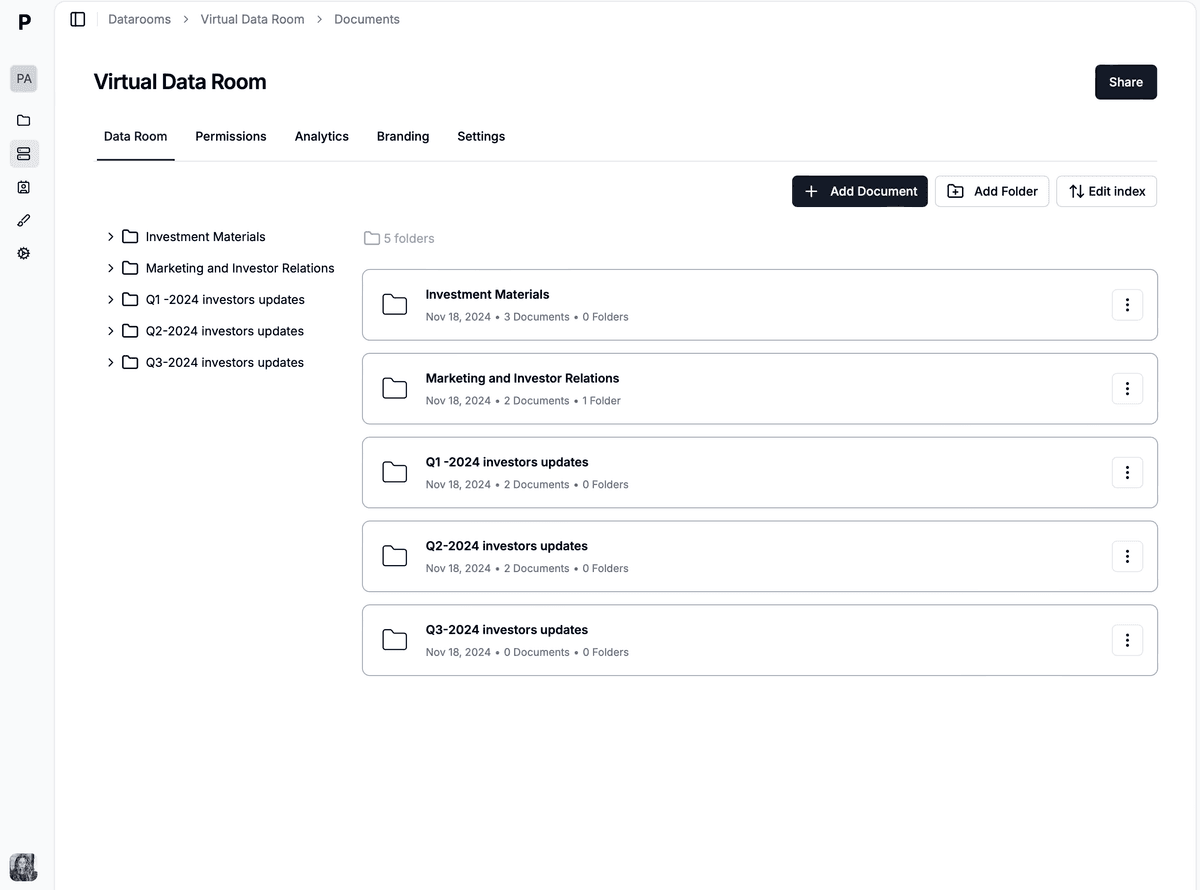
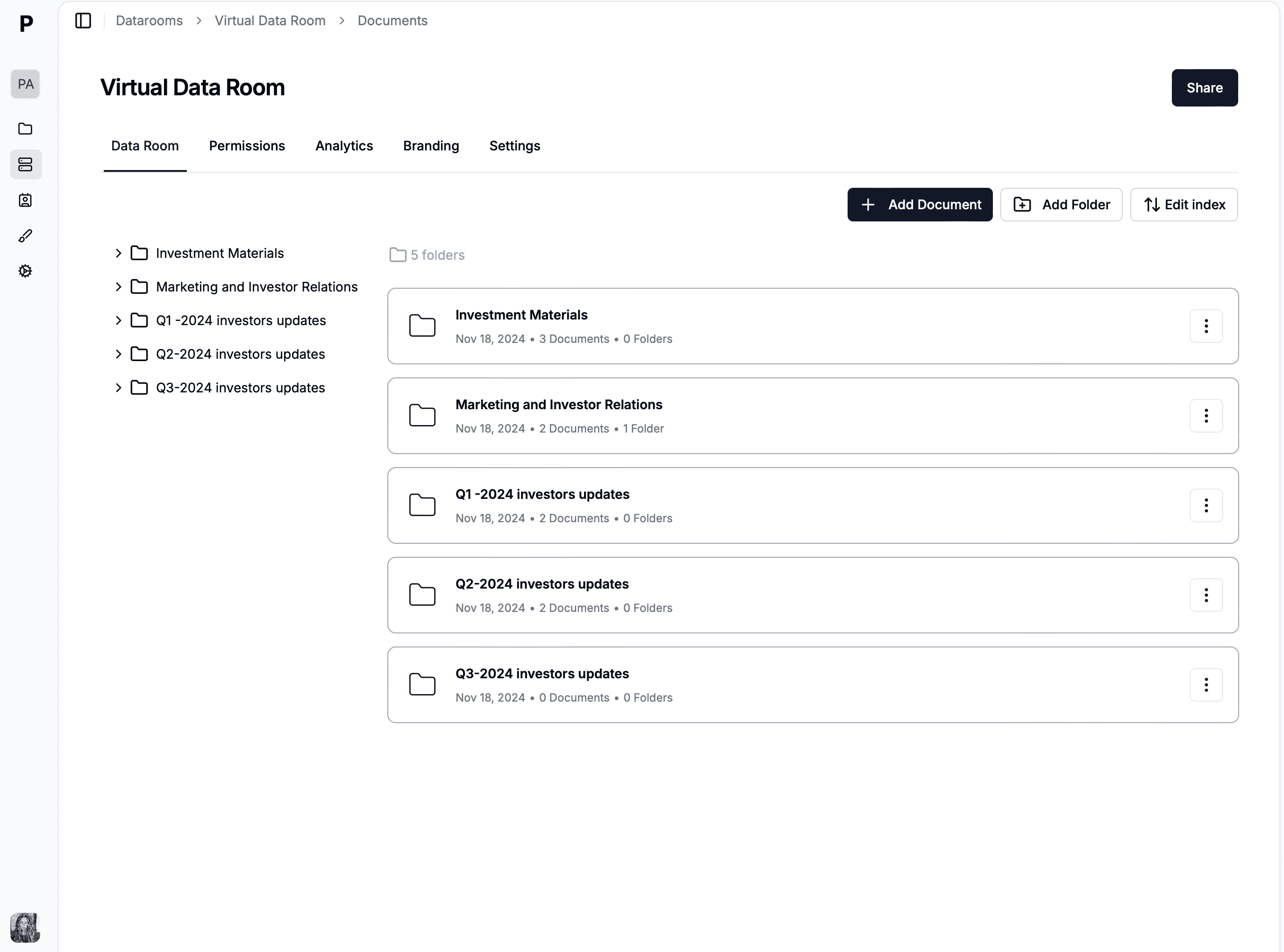
The team evaluated Papermark instead. They built the data room in an afternoon, organized folders by workstream (financials, legal, operations, IP), gated the room behind an NDA, and issued separate view-only links to each buyer with dynamic watermarking enabled. Page-by-page analytics told the advisors exactly which buyer spent forty minutes inside the customer-concentration file and which one barely opened the financials, which shaped how they prioritized follow-up calls. Total infrastructure cost for the entire process was €99 per month on the Data Rooms plan. Halyard closed with the most engaged buyer eleven weeks later, having spent on the data room roughly one percent of what the Venue quote would have cost, with no loss of security or audit rigor that mattered for a deal of that size.
If Venue's cost, contracts, or setup timeline are more than your deal needs, several alternatives cover the same core job at very different price points. The right choice depends on deal size and how much hand-holding you want. Modern self-serve tools like Papermark win on speed and transparency, mid-market platforms like Firmex sit in the middle, and legacy competitors like Intralinks and Datasite match Venue's enterprise weight and its enterprise price. The five options below span that whole range.
Papermark is an open-source virtual data room built for founders, deal teams, and modern companies that want secure sharing without enterprise bloat or opaque quotes. It covers the essentials that actually decide most sub-$100M deals: granular permissions, dynamic watermarking, NDA gating, audit trails, and page-by-page analytics that show exactly which pages an investor or buyer read and for how long. Setup takes minutes rather than weeks, and pricing is published rather than negotiated.
Pricing: Free plan, Pro at €24/month, Business at €59/month, and Data Rooms at €99/month. Best for Series A to B fundraising, startup and mid-market M&A, and investor due diligence. See the full virtual data room product page for details.
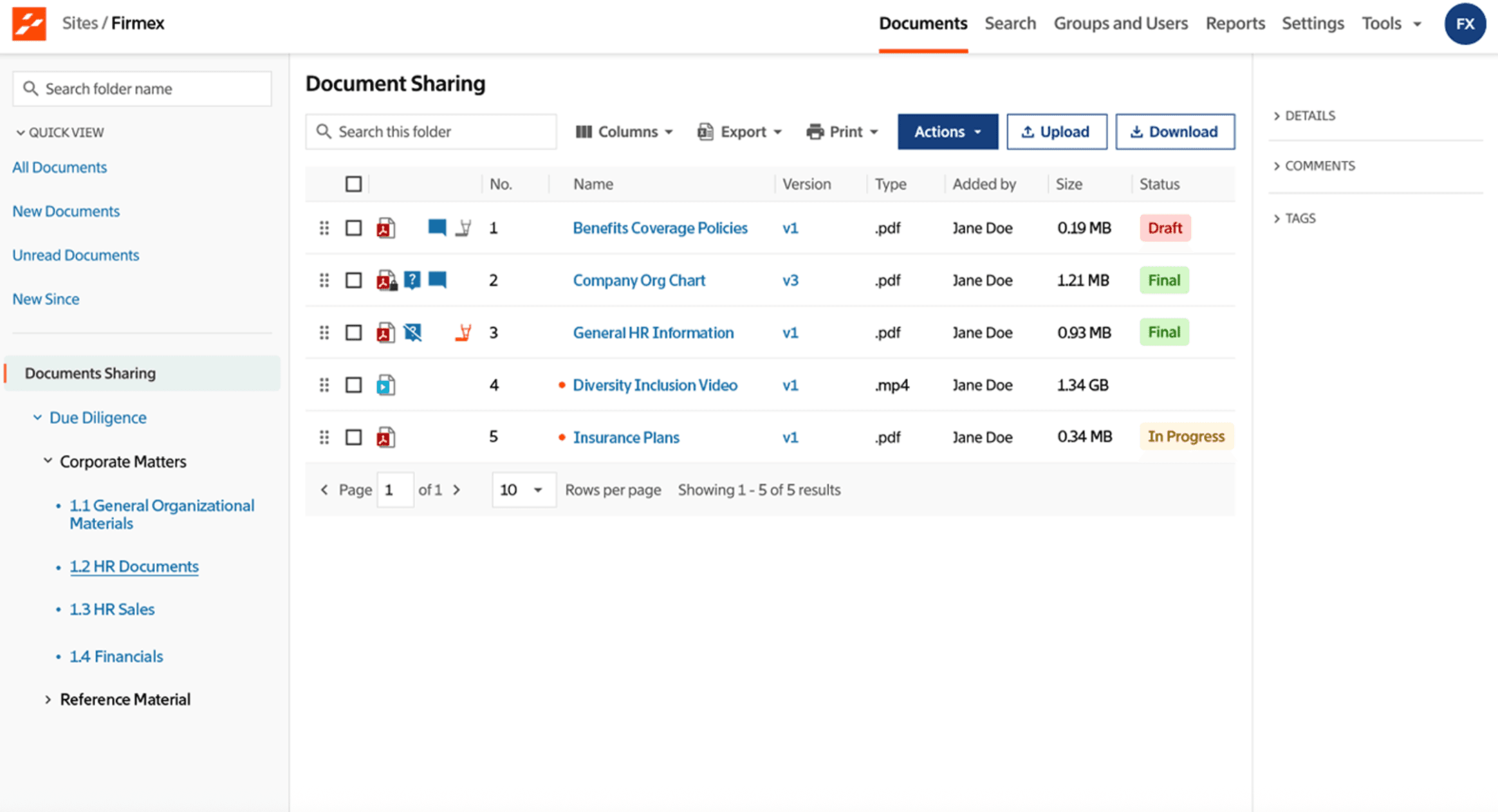
Firmex is a well-established VDR that sits between the legacy giants and the newer self-serve tools. It offers a more modern interface than Venue, predictable subscription pricing, and faster onboarding, while still handling the permissions and audit requirements that mid-market M&A, real estate, and legal teams expect. It is a sensible middle option when you want more service than a self-serve tool but less cost than an enterprise provider.
Pricing: from roughly $500 to $1,500/month depending on room count and features. Best for mid-market M&A, real estate diligence, and legal document exchange. For a deeper look, see the Firmex VDR overview.
Intralinks is Venue's closest peer in the legacy enterprise tier, owned by SS&C Technologies and built for the same large, cross-border, high-security processes. It offers comparable global infrastructure, comprehensive security, structured Q&A, and dedicated support. If you are comparing Venue at the very top of the market, Intralinks is the name that most often appears alongside it, and its pricing is similarly custom and quote-based.
Pricing: custom, broadly comparable to Venue. Best for large enterprise and global M&A. See the Intralinks features and pricing overview.
Datasite, formerly Merrill DataSite, is another established enterprise VDR with deep roots in investment banking. It brings detailed permissions, 24/7 support, and a strong reputation among bankers running sell-side processes. Like Venue and Intralinks, it uses custom pricing that typically starts in the five figures, so it competes on capability and track record rather than accessibility.
Pricing: custom, typically $10,000 and up. Best for investment banking and large M&A. Compare options in the Datasite alternatives guide.
SecureDocs is worth a look for teams that want enterprise-grade security with a simpler subscription than the fully custom giants. It offers a straightforward subscription starting from $450/month, unlimited users on its plans, and quick setup, which makes its total cost far easier to forecast than a Venue engagement. It is a reasonable middle path for regulated deals that still want predictable billing.
Pricing: from $450/month as a subscription. Best for compliance-focused deals that want predictable pricing. Learn more in the SecureDocs VDR overview.
The table below puts the headline differences side by side. It is not a substitute for a proper evaluation against your own security and workflow requirements, but it does make the trade-off obvious: legacy providers win on white-glove services and top-end enterprise depth, while modern tools win on price, speed, and usability. Where a deal falls on that spectrum is what should drive the choice.
| Factor | RRD Venue | Papermark | Firmex | Intralinks | SecureDocs |
|---|---|---|---|---|---|
| Starting price | $15,000+ | €99/month | $500/month | $10,000+ | $450/month |
| Free trial | No | Yes | Yes | No | Yes |
| Setup time | 1-2 weeks | Minutes | Days | 1-2 weeks | Hours |
| Interface | Legacy | Modern | Modern | Legacy | Modern |
| Learning curve | Steep | Easy | Moderate | Steep | Easy |
| Best for | Enterprise | Startups | Mid-market | Enterprise | Compliance |
| AI features | No | Yes | No | No | No |
| Support | 24/7 phone | Email and chat | 24/7 phone | Email and phone |
Teams that leave Venue rarely do so because it is insecure, because it is not. They leave because the platform is priced and paced for a different kind of deal than the one in front of them. The most common trigger is cost. A startup that receives a $25,000 quote for a Series A room is comparing that number against tools that do the same core job for a flat €99/month, and for a sub-$100M raise the security difference does not justify a hundredfold price gap. The math simply does not survive a budget review.
Complexity is the second driver. Venue's white-glove model assumes you want a project manager and days of training, which is valuable for a first-time seller on a mega-deal and pure overhead for a founder who wants to organize four folders and send a link. When the enterprise machinery adds steps rather than removing them, smaller teams treat it as friction. The dated interface compounds the problem: investors and buyers who spend their days in modern SaaS notice when a data room feels like software from a previous era, and a clunky viewing experience reflects on the seller.
Speed is often the deciding factor. Modern deals move on compressed timelines, and a one-to-two-week setup window can stall momentum at exactly the wrong moment. When a buyer is ready to review this week, waiting on indexing and onboarding is a competitive disadvantage. Between price, complexity, dated UX, and slow setup, the pattern is consistent: teams outgrow the fit long before they outgrow the security, and they switch to a tool that matches the tempo of the deal.
The choice between Venue and a modern alternative like Papermark is really a choice about deal profile. Match the tool to the transaction and the decision becomes straightforward: reach for enterprise machinery when the deal is large, regulated, and legally sensitive, and reach for a fast, transparent tool when it is not. The table below maps common scenarios to the better fit.
| Scenario | Better fit |
|---|---|
| $500M+ M&A transaction | RRD Venue |
| Series A to B fundraising | Papermark |
| Investment banking mega-deal | RRD Venue |
| Startup acquisition ($1M to $50M) | Papermark |
| Bankruptcy or restructuring | RRD Venue |
| Venture due diligence | Papermark |
| Regulated-industry mega-deal | RRD Venue |
| Fast-moving mid-market sale | Papermark |
The pattern is consistent across the grid. When the deal size, regulatory exposure, and legal sensitivity are all high, the cost of an enterprise VDR is a rounding error and its depth is worth having. When any of those factors is moderate, the enterprise premium buys you very little that you will actually use, and a modern tool closes the same deal faster and for a fraction of the price.
For the large share of deals that do not need Venue's five-figure engagement, Papermark delivers the parts of a virtual data room that actually move a transaction forward, without the contract, the setup fees, or the two-week onboarding. You create a data room in minutes, drag in your documents, and organize them into folders by workstream. Every room can be gated behind an NDA so that viewers accept your terms before they see a single file, and the acceptance is recorded in a version-aware audit log you can hand to counsel. Granular permissions let you control view, download, and print rights per link and per recipient, so a strategic buyer and a financial buyer never see the same thing unless you want them to.
Security is not the trade-off it might appear to be against a legacy provider. Papermark applies dynamic watermarking that stamps each viewer's email, IP, and timestamp across every page, supports custom domains and white-labeling so the room carries your brand rather than a vendor's, and maintains a full audit trail of who opened what and when. Papermark is SOC 2 compliant and built for the confidentiality that M&A and fundraising demand. Where it pulls ahead of Venue is on the modern workflow layer: page-by-page analytics show exactly which pages each buyer read and for how long, full-text search makes a large document set navigable, and a Q&A workflow keeps diligence questions organized in one place instead of scattered across email.
The commercial difference is the headline. Instead of a custom quote, setup charges, and per-user and storage fees, the Data Rooms plan is a flat €99/month, with a free tier and lower Pro and Business plans for lighter needs. There is no sales cycle required to see the product, no minimum contract length designed around a mega-deal, and no professional-services line item. For a founder, an operator, or a mid-market advisor, that combination of enterprise-grade security and self-serve simplicity is exactly what closes a deal without turning the data room into its own project.
Papermark is a modern virtual data room alternative to RR Donnelley Venue, with NDA gating, dynamic watermarking, and page-by-page analytics on the €99/month Data Rooms plan.
You can compare Venue against other legacy options in the DFIN Venue VDR overview and the M&A data rooms guide, or start building a data room directly on the Papermark data room page.
For a $500M or larger M&A transaction in a regulated industry, Venue is worth serious consideration. Its enterprise security, dedicated project managers, comprehensive compliance certifications, and forensic audit trails genuinely reduce risk on deals where the cost of the room is trivial next to the cost of a mistake. In that context, the price and the setup timeline are acceptable trade-offs for depth and support.
For a startup, a small business, or any modern company running a sub-$100M deal, Venue is hard to justify. The cost of $15,000 to $150,000 and the enterprise complexity buy you very little that a modern tool does not already provide for a fraction of the price. Papermark delivers the security, watermarking, permissions, and analytics that matter for those deals at a flat €99/month, with a modern interface and instant setup. Match the tool to the transaction, and most teams outside the enterprise mega-deal tier will be better served by a lighter, faster, transparent alternative.
No credit card required.
Honest Firmex review for 2026 - virtual data room features, pricing, screenshots, pros and cons, and how it compares to Papermark, iDeals, and Datasite.
HighQ Dataroom review for 2026: features, real pricing estimates, honest pros and cons, and 5 legal VDR alternatives including a data room from €99/month.
DealRoom VDR review for 2026: $25,000/year start, AI diligence, FirmRoom ownership, and 4 alternatives. Papermark from €99/month with AI redaction.