BlogUncategorizedIPO Advisory Services in 2026: Advisors, Roles, and Costs
IPO Advisory Services in 2026: Advisors, Roles, and Costs
·14 min read
Marc Seitz
Going public is the most complex transaction most companies will ever undertake. You're not just raising capital - you're inviting public scrutiny, taking on regulatory obligations, and fundamentally changing how your company operates.
That's why you need advisors. The right IPO advisory team guides you through the process, prevents costly mistakes, and maximizes your valuation. The wrong team wastes money and creates problems that haunt you for years.
This guide covers everything you need to know about IPO advisory services: who you need, what they do, and how much it costs.
Quick Recap: IPO Advisory Process
Here's the IPO advisory engagement process in numbered steps:
Assess IPO readiness - determine if you're ready to go public
Select lead underwriters - choose investment banks to manage the offering
Engage legal advisors - hire securities lawyers for company and underwriters
Appoint auditors - get Big Four accounting firm for financial statements
Form working group - assemble internal team and advisors
Begin due diligence - financial, legal, and business review
Draft registration statement - create S-1 or prospectus
Roadshow preparation - develop presentation for institutional investors
File with SEC - submit registration statement for review
Respond to SEC comments - address regulator feedback and amend filing
Roadshow - present to investors across multiple cities
Price the offering - set IPO price based on demand
Go effective - finalize all documents and launch trading
The alternative for document version control
No credit card required
Page by page analytics
Require email verification
Require password to view
Allow/Block specified viewers
Apply Watermark
Require NDA to view
Custom Welcome Message
Types of IPO Advisors You Need
An IPO requires multiple advisor types. Each plays a specific role.
Investment Banks (Underwriters)
What they do:
Structure the offering (size, price range, timing)
Market your company to institutional investors
Build the order book and allocate shares
Stabilize the stock price after IPO
Provide research coverage post-IPO
Who you need:
Lead bookrunner - Primary investment bank coordinating the offering. Usually a bulge bracket firm (Goldman Sachs, Morgan Stanley, JPMorgan, etc.)
Co-managers - 2-4 additional banks providing distribution and support
Syndicate banks - Sometimes regional or specialist banks join the syndicate
How they're compensated:
5-7% of gross proceeds (the "underwriting discount")
For a €200M IPO, that's €10-14M in fees
Split among lead and co-managers based on roles
When to engage: 12-18 months before target IPO date. You'll go through a "bake-off" process where banks pitch for the mandate.
Securities Lawyers
Company counsel:
Draft the registration statement (S-1/F-1 or prospectus)
Navigate SEC review process
Advise on disclosure requirements
Ensure compliance with securities laws
Review all transaction documents
Underwriters' counsel:
Perform legal due diligence
Draft underwriting agreement
Provide legal opinions
Ensure underwriters are protected
Who you need:
Top-tier securities law firm (Latham & Watkins, Wilson Sonsini, Cooley, Skadden, etc.)
Firms with deep IPO experience in your industry
How they're compensated:
Hourly billing (partners at €800-1,500/hour)
Total legal fees: €2-5M for mid-sized IPO
When to engage: 9-12 months before IPO
Accounting Firms
What they do:
Audit historical financial statements (3 years)
Review quarterly financials
Assist with technical accounting issues
Provide comfort letters to underwriters
Advise on financial reporting and controls
Who you need:
Big Four only (PwC, EY, Deloitte, KPMG) - public markets won't accept smaller firms
Ideally a firm experienced in your industry
How they're compensated:
Audit fees: €1-3M depending on company size and complexity
Additional fees for quarterly reviews and comfort letters
When to engage: 12-18 months before IPO. If you don't already have a Big Four auditor, switch now.
Financial Printers and Technology Providers
What they do:
Format and file SEC documents (EDGAR filing)
Produce prospectus and marketing materials
Host virtual data rooms
Manage roadshow logistics and technology
Common providers:
Donnelley Financial Solutions (DFIN)
Toppan Merrill
Broadridge
Cost: €300-800K for a typical IPO
IR and Communications Advisors
What they do:
Develop investor relations strategy
Train management for investor meetings
Write press releases and investor materials
Manage IPO announcement and ongoing communications
When you need them:
Pre-IPO: Help craft your equity story
During IPO: Support roadshow and media strategy
Post-IPO: Ongoing investor relations
Cost: Retainers of €15-30K/month, plus project fees
The Investment Banking Selection Process
Choosing underwriters is your most important advisor decision. Here's how to do it.
The Bake-Off
You'll invite 5-8 investment banks to pitch for your IPO mandate. They'll present their case for why you should choose them.
What banks will show you:
Valuation analysis - comparable companies and where you'd trade
Market conditions - IPO windows and investor sentiment
Distribution capability - which investors they can access
Research coverage - equity research analyst who'll cover you
Track record - recent IPOs in your sector
Deal team - who will actually work on your transaction
Questions to ask each bank:
How many IPOs have you led in our sector in the past 3 years?
Which institutional investors are you closest to in our space?
What research analyst will cover us, and what's their ranking?
How do you approach valuation and pricing?
What's your view on optimal offering size?
How will you support our stock post-IPO?
Choosing Your Lead Bank
What matters most:
Sector expertise - banks with deep relationships in your industry
Distribution strength - access to the right institutional investors
Research quality - top-ranked analysts in your sector
Track record - consistent post-IPO stock performance
Chemistry - you'll work closely with them for 6-12 months
Red flags:
Unrealistic valuation estimates (trying to win the mandate with inflated numbers)
Junior team members (if senior bankers won't be involved day-to-day, walk away)
Weak research coverage in your sector
High fee demands without justification
Syndicate Structure
Typical structure for €200M IPO:
Lead bookrunner: 40-50% of economics, coordinates everything
Joint bookrunner: 20-30% of economics, co-leads the deal
Co-managers (2-3 banks): 10-15% each, provide distribution support
Don't over-syndicate. Adding a 6th or 7th bank doesn't meaningfully improve distribution and dilutes accountability.
Legal Advisory in IPOs
Securities lawyers are critical to getting your IPO right. Here's what they do.
Company Counsel Responsibilities
Draft the registration statement:
Business description and risk factors
Management discussion & analysis (MD&A)
Financial statements and notes
Capitalization and ownership structure
Executive compensation disclosure
The S-1 or prospectus is often 200-300 pages. Every word matters. Inaccurate or misleading disclosures create liability.
Manage SEC review process:
File registration statement with SEC
Receive and respond to SEC comment letters
Amend filing based on SEC feedback (usually 2-3 rounds)
Navigate to "effectiveness" (SEC approval to go public)
Ensure compliance:
Securities Act of 1933 (registration requirements)
Securities Exchange Act of 1934 (ongoing reporting)
Sarbanes-Oxley compliance (internal controls)
Industry-specific regulations
Review all transaction documents:
Underwriting agreement
Lock-up agreements
Indemnification agreements
Agreements with advisors
Underwriters' Counsel
The underwriters hire their own lawyers to:
Conduct legal due diligence on your company
Identify legal risks and disclosure issues
Draft the underwriting agreement
Provide legal opinions at closing
Their job is to protect the underwriters from liability. They'll ask hard questions and demand thorough disclosure.
Choosing Your Law Firm
What to look for:
Top-tier securities practice (Am Law 100 firm)
Recent IPO experience in your sector
Strong relationships with SEC staff
Bench depth (you need partners and associates working full-time)
Cost management:
Negotiate a budget and fee cap if possible
Request regular billing updates
Push back on unnecessary work or junior associate time
Legal fees are your second-largest IPO cost after underwriting fees. Don't cheap out, but don't overpay either.
Accounting and Financial Advisory
Accounting firms do more than audit your financials. They help you become a public company.
Pre-IPO Audit and Preparation
Requirements:
3 years of audited financial statements
Quarterly reviews for current fiscal year
Compliance with SEC reporting standards (usually US GAAP or IFRS)
Common issues for pre-IPO companies:
Revenue recognition policies not compliant with SEC standards
Factor these ongoing costs into your decision to go public.
Alternatives to Traditional IPOs
Not every company should do a traditional IPO. Consider alternatives.
Direct Listing
How it works: Your existing shares trade publicly without raising new capital or using underwriters.
Pros:
No underwriting fees (save 5-7%)
No lock-up period
Employees and early investors can sell immediately
Cons:
No new capital raised
No underwriter support for stock price
More volatility risk
When it makes sense: Well-known companies with strong brands (Spotify, Coinbase) that don't need capital.
SPAC Merger
How it works: Merge with a special purpose acquisition company (SPAC) that's already public.
Pros:
Faster timeline (3-4 months vs. 6-12 for traditional IPO)
Can negotiate valuation directly
Less market timing risk
Cons:
SPAC sponsor takes 20% of equity (dilutive)
Regulatory scrutiny increasing
Post-merger stock performance often weak
When it makes sense: Companies that want speed and certainty more than maximum valuation.
Stay Private Longer
Secondary markets (like Forge or EquityZen) let employees and early investors sell shares privately.
Late-stage private rounds from crossover investors (funds that invest pre- and post-IPO) provide capital without going public.
When it makes sense:
You can still access growth capital privately
Don't want quarterly earnings pressure
Benefits of being public don't outweigh costs
Key Takeaways
IPO advisory services are essential to a successful public offering. Here's what matters:
Choose underwriters carefully - sector expertise and distribution matter more than who offers the highest valuation
Hire top-tier legal and accounting advisors - this is not the place to cut costs
Start early - 18-24 months of preparation is typical
Build a strong CFO and finance team - you need public company experience
Budget for the full cost - one-time costs of 7-12% of proceeds, plus ongoing public company costs
Use secure data rooms - protect sensitive documents during the process
Assess alternatives - traditional IPOs aren't the only path to liquidity
Be ready for permanent change - going public fundamentally transforms your company
The right advisors make the difference between a successful IPO and a problematic one.
How Papermark supports your IPO data room
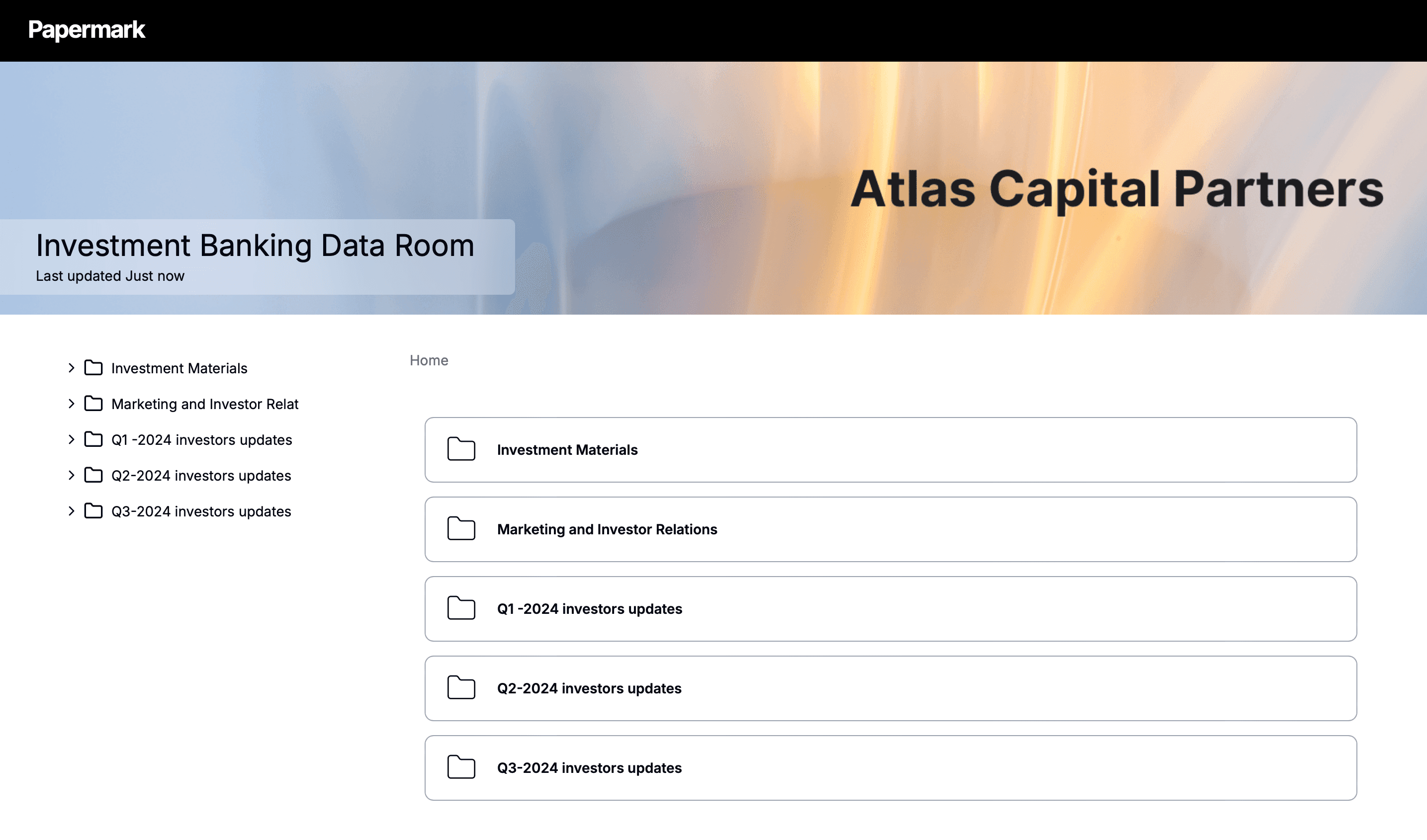
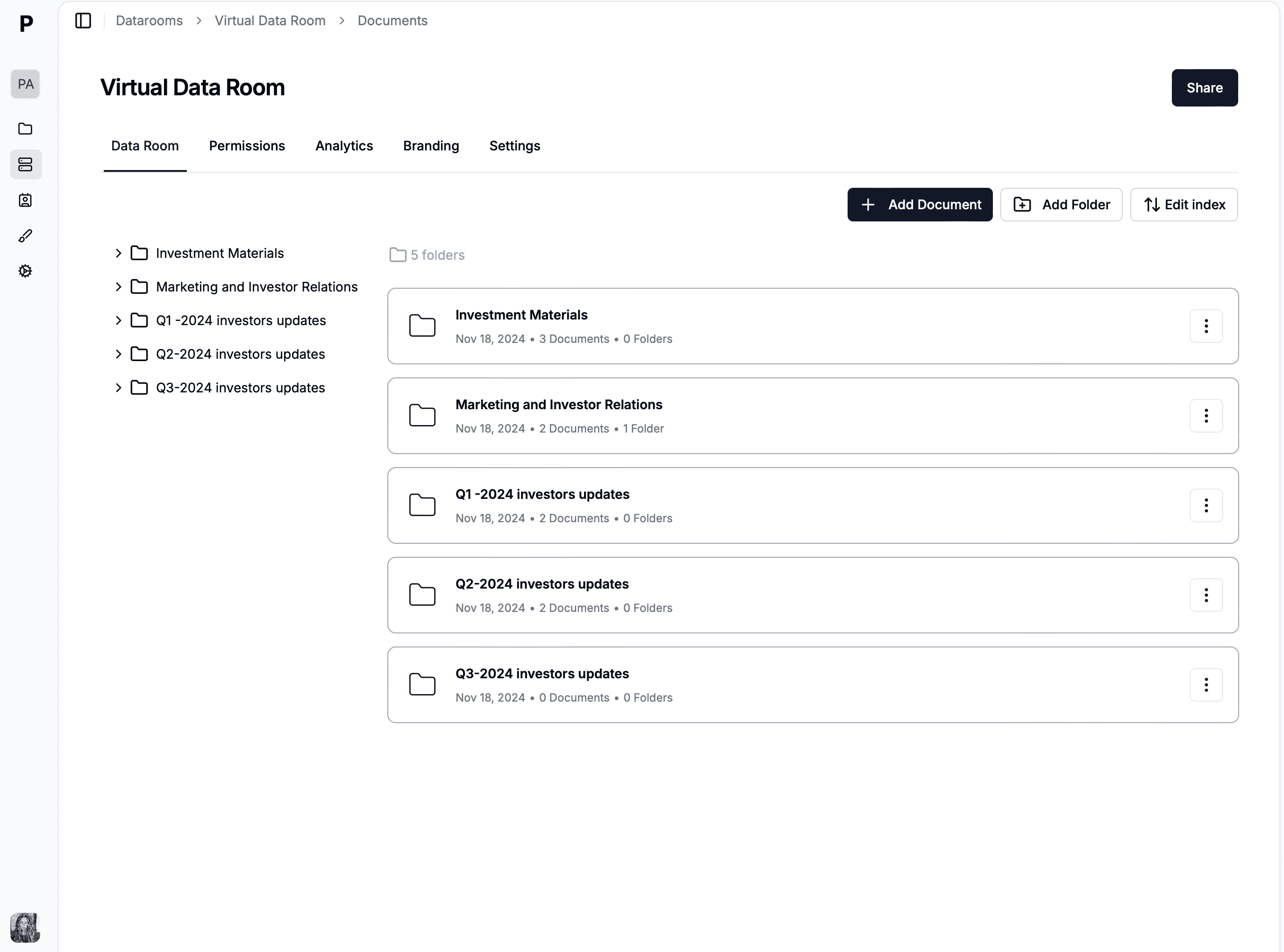
An IPO runs on documents. Your underwriters, legal counsel, auditors, and the SEC all work from the same body of financial statements, board minutes, cap tables, and material contracts, and every one of those files is confidential until the offering prices. A virtual data room is where that diligence happens, and the controls it gives you are what keep a leak from becoming a disclosure problem. Papermark is built for exactly this: a secure, auditable room that your bankers and lawyers can work in without emailing sensitive drafts back and forth.
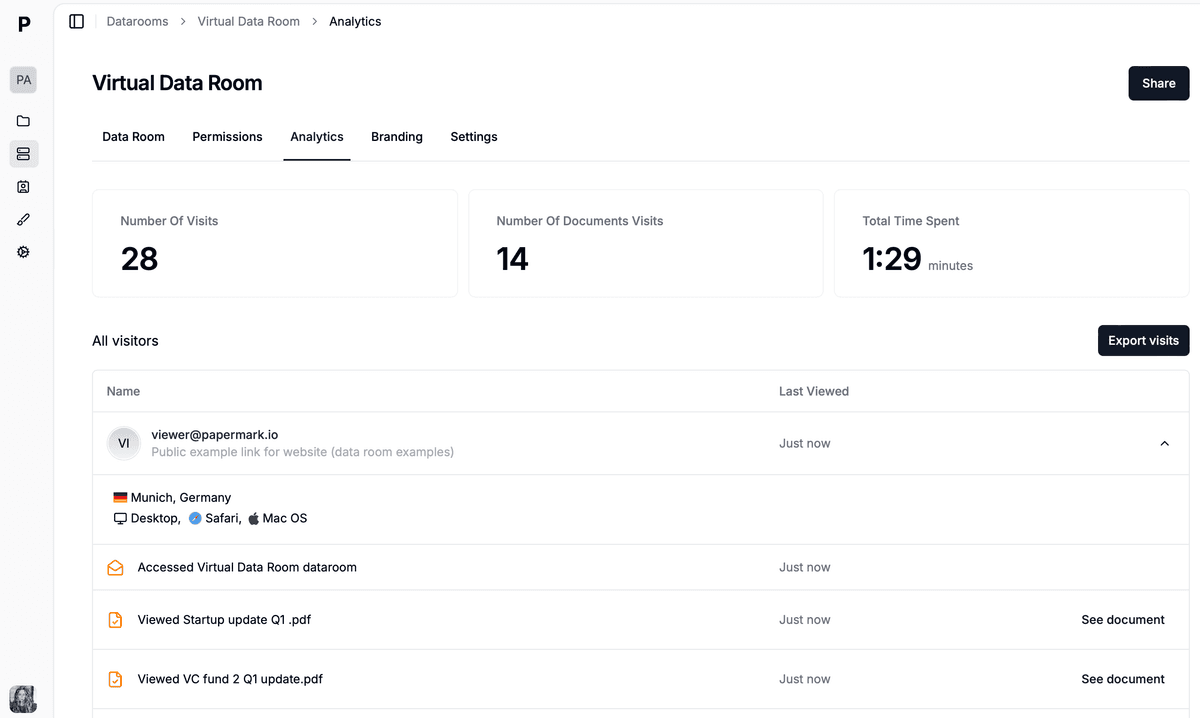
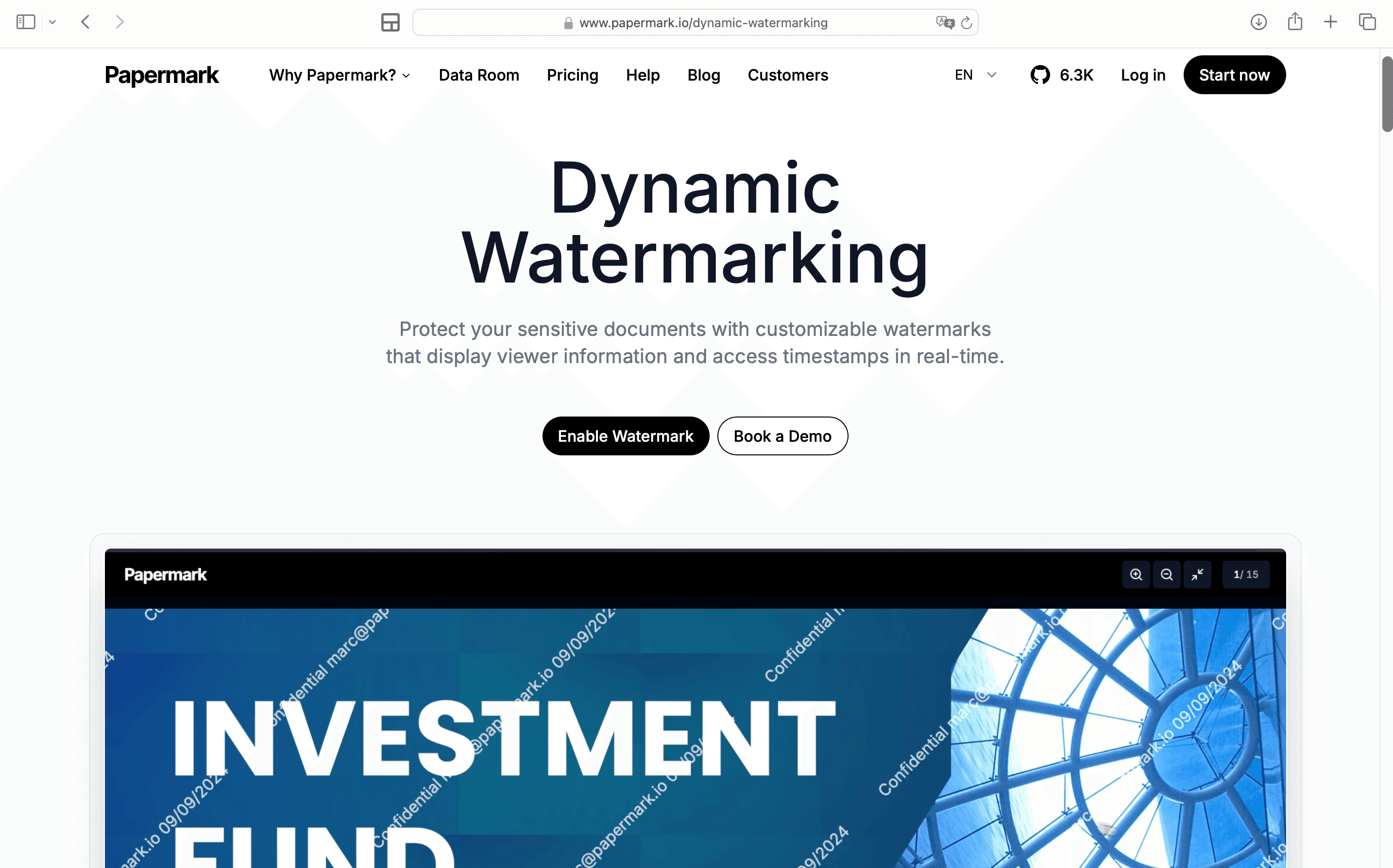
Granular, group-level permissions let you show underwriter counsel the full financial history while limiting a junior analyst or a prospective investor to a curated subset. Dynamic watermarking stamps each viewer's email, IP, and a timestamp onto every page, so a screenshot of an S-1 draft traces straight back to the person who opened it. Page-by-page analytics and a complete audit trail tell you who read the risk factors, how long they spent on the MD&A, and which contracts drew repeat visits - the same signal a bookrunner uses to gauge engagement. A built-in Q&A module keeps advisor questions and management answers in one threaded, exportable record instead of scattered across inboxes, and full-text search means a diligence team of forty people can find a specific indemnity clause in seconds.
Security is the part that matters most in a public offering, and Papermark is SOC 2 Type II compliant with GDPR support, granular access expiry, NDA gating on links, and the option to host on a custom domain so the room carries your brand rather than a vendor's. Pricing is flat: the Data Rooms plan is €99/month, a fraction of what legacy VDR providers charge per-page or per-project during a live deal, which matters when a transaction can stretch across 18 to 24 months.
Page-by-page analytics in a Papermark data room show which IPO diligence documents each advisor actually opened.
For the security requirements behind the room, see the Papermark security overview. When your advisory team is assembled and diligence is about to begin, a purpose-built data room is the workspace that holds it all together.