BlogData RoomsIPO Data Room Checklist 2026: What to Include, How to Prepare, and Features You Need
IPO Data Room Checklist 2026: What to Include, How to Prepare, and Features You Need
·12 min read
Marc Seitz
An IPO data room checklist is the master document list your company, counsel, auditors, and underwriters use to prove the business is ready to go public. It covers corporate governance, three years of audited financials, material contracts, IP, HR and compensation, litigation, regulatory filings, and underwriter diligence materials, organized in a numbered folder structure that scales from pre-IPO readiness (100-500 documents) to IPO execution (2,000-5,000+). This guide gives you the full checklist, a month-by-month preparation timeline, the eight VDR features IPO teams require, and how to run the whole workflow on Papermark, the platform 70,000+ dealmakers use for their highest-stakes transactions.
Quick recap
An IPO data room holds every document underwriters, auditors, and regulators need during the 6-18 month path to going public.
Two phases: pre-IPO readiness (months -18 to -4, internal working room) and IPO execution (months -4 to 0, full underwriter diligence).
Ten top-level folders cover corporate, financials, contracts, IP, HR, legal, regulatory, underwriter materials, marketing, and strategic documents.
US IPOs require S-1 (or F-1) support documents; EU IPOs require prospectus materials under ESMA Annex 1 with IFRS financials.
Typical size: 500-5,000+ documents; 20-80 active reviewers across counsel, banks, and auditors.
Preparation starts 12-18 months before filing, not two weeks before the roadshow.
Papermark covers the full IPO feature set on the same platform Lincoln Property ($50B AUM), Tesi (~€2B AUM), and thousands of pre-IPO companies already use.
For the broader IPO workflow (SEC review cycles, provider comparison, setup steps), see the companion guide: data room for IPO in 2026.
Master IPO data room checklist
Use this table as your readiness baseline. Every row maps to a numbered folder in the structure below. Priority reflects what underwriter counsel asks for first during diligence.
#
Category
Core documents
Priority
Phase
1
Corporate governance
Certificate of incorporation, bylaws, board and committee minutes (3-5 years), cap table, stock plans
High
Pre-IPO + execution
2
Audited financials
3 years audited statements, interim quarters, revenue by segment, tax returns, working capital
High
Pre-IPO + execution
3
Material contracts
Top 10-20 customer contracts, key vendor and supplier agreements, debt and credit facilities
Underwriting agreement drafts, diligence memos, comfort letter support, legal opinions
Medium
Execution
9
Marketing and investor
Teaser, CIM, roadshow deck, investor presentation, IR policies
Medium
Execution
10
Strategic and operational
Business plan, KPI dashboards, competitive analysis, product roadmap (internal)
Medium
Pre-IPO
1. Corporate governance documents
Corporate governance is the first folder underwriter counsel opens. It proves the company has been run like a public company before it actually is one.
Cap table and stock ledger (pre- and post-IPO pro forma)
Stock option plans, ESOP, and RSU grant records
Shareholder agreements and voting arrangements
Director and officer (D&O) insurance policies
Related-party transaction disclosures
How to prepare: Start collecting board minutes 12-18 months before filing. Missing or unsigned minutes are one of the most common diligence delays. Scan everything to searchable PDF. Redact executive session discussions that are not relevant to the offering. In Papermark, upload to folder 1.0 Corporate Governance and restrict access so only company management, company counsel, and the board group can view committee minutes.
IPO-specific note: Underwriters will compare your cap table against the S-1 share count disclosure. Any discrepancy between the data room cap table and the registration statement triggers a comment letter.
2. Audited financial statements
Three years of audited financials (US GAAP or IFRS) are non-negotiable for a US IPO. EU prospectuses require the same under IFRS.
Revenue breakdowns by segment, product line, and geography
Management discussion and analysis (MD&A) drafts
Financial model and projections (internal use, clearly labeled not for filing)
Working capital and liquidity analyses
Tax returns by jurisdiction (3-5 years)
Transfer pricing documentation (if multinational)
Debt schedules and covenant compliance certificates
Management representation letters (draft)
How to prepare: Coordinate with your audit firm early. The data room should mirror the audit workpapers structure so auditors can cross-reference without duplicate uploads. Use consistent naming: YYYY-MM-DD_AuditReport_FY2024.pdf. Keep draft and final versions in separate subfolders to avoid counsel reviewing superseded numbers.
3. Material contracts
Underwriter counsel reviews your largest revenue relationships contract by contract. Missing signatures or outdated versions are immediate red flags.
What to include:
Top 10-20 customer contracts ranked by revenue
Key supplier and vendor agreements
Partnership and joint venture agreements
Licensing and reseller agreements
Credit facilities, term loans, and convertible notes
Lease agreements (real estate and equipment)
Change-of-control and assignment clauses summary schedule
Non-compete and exclusivity agreements
How to prepare: Build a contract summary schedule first (counterparty, date, term, revenue impact, change-of-control provision). Then upload full PDFs behind the summary. Redact pricing where contracts allow, but never redact change-of-control clauses. Assign a contracts owner on your team who validates completeness before any external reviewer gets access.
4. Intellectual property
IP diligence confirms you own what the S-1 claims you own. Tech and biotech IPOs face the deepest scrutiny here.
What to include:
Patent and trademark registrations (organized by family)
Pending patent applications
License agreements (inbound and outbound)
Trade secret policies and access controls
Open-source software inventory with license types
IP assignment agreements (founders and employees)
Freedom-to-operate analyses (if available)
Domain name registrations
How to prepare: Run an IP audit 12 months before filing. Every founder, employee, and contractor should have signed IP assignment agreements on file. The open-source inventory matters for software companies: underwriters will ask about GPL contamination and copyleft obligations. Upload the inventory as a living document and update it as new dependencies are added during the S-1 drafting period.
5. Human resources and compensation
Executive compensation disclosure is heavily scrutinized in S-1 Item 11. The data room must support every number in the filing.
What to include:
Executive employment agreements (CEO, CFO, and named executive officers)
Compensation structure and equity grant history
409A valuation reports (most recent and historical)
Key-person retention and severance agreements
Organizational chart (current and 12-month hiring plan)
Employee handbook and HR compliance policies
Non-compete and non-solicitation agreements
Benefits summary and pension obligations
Contractor vs employee classification analysis (if gig workers are material)
How to prepare: Work with compensation counsel to ensure the data room matches S-1 disclosure tables exactly. 409A reports should be current (within 12 months). For EU IPOs, note that executive compensation disclosure rules differ from US S-1 Item 11, but the underlying documents are the same.
6. Legal and litigation
Litigation overhang kills IPO timelines. Underwriters need to see everything, settled and active.
What to include:
Active litigation files (complaints, motions, discovery status)
Settled litigation records (last 5 years)
Regulatory correspondence (SEC, FTC, DOJ, state attorneys general)
How to prepare: Resolve or settle immaterial litigation before filing if possible. For active cases, include a litigation summary memo with estimated exposure and insurance coverage. Never upload privileged attorney-client communications without counsel review. Create a separate subfolder for regulatory correspondence and restrict it to legal counsel and company management.
7. Regulatory and risk
This folder supports the risk factors section of the S-1 or prospectus and proves SOX readiness.
What to include:
Prior SEC filings (if already a reporting company)
Data privacy impact assessments and GDPR/CCPA compliance
Cybersecurity incident history and remediation
Whistleblower policy and hotline records
How to prepare: Start drafting risk factors 6 months before filing. Each risk factor should trace to a supporting document in the data room. SOX readiness is a multi-year project: the data room should show the trajectory (control design, testing results, remediation plans), not just a final memo.
8. Underwriter and banker materials
This folder is populated during IPO execution, not pre-IPO readiness. It holds the work product of the banking syndicate.
Due diligence memos (company, financial, legal, business)
Comfort letter supporting documentation
Legal opinions (company counsel and underwriter counsel)
Blue sky compliance materials
Lock-up agreements (insiders and major shareholders)
Directed share program documentation (if applicable)
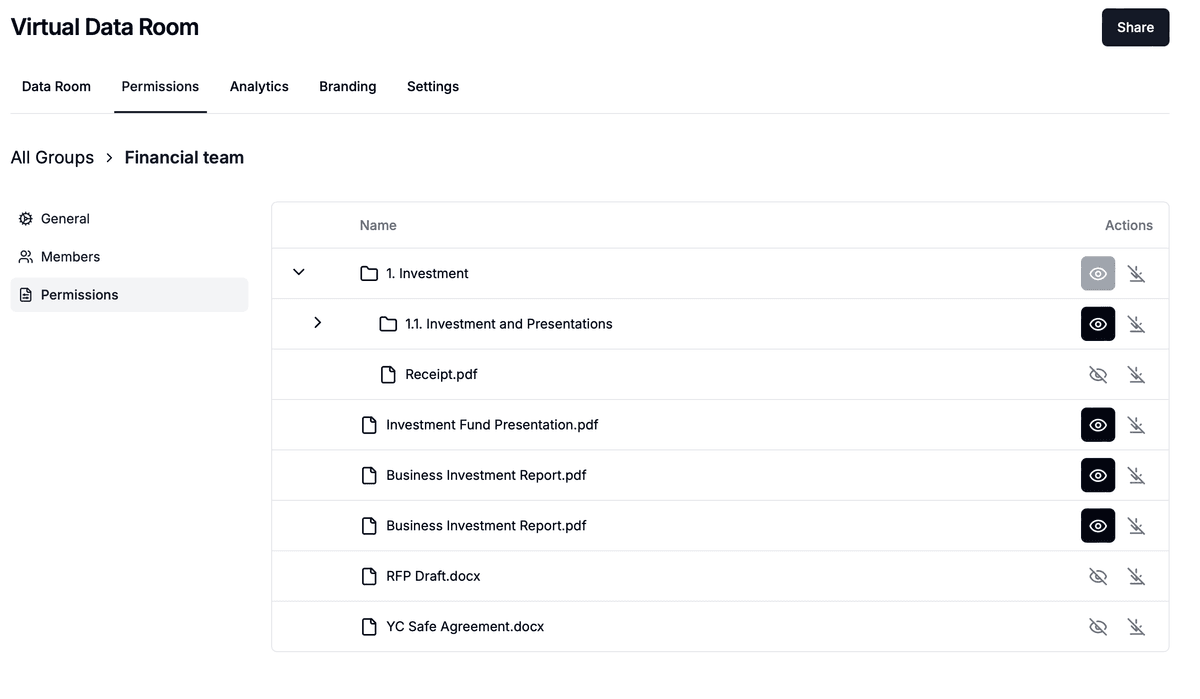
How to prepare: Scope this folder per bank. Each bookrunner's counsel should see their own diligence memos and work product, not a competing bank's. In Papermark, create viewer groups per underwriter and assign folder-level permissions accordingly.
9. Marketing and investor materials
Roadshow materials live here. They are the most widely shared documents in the data room and need the strongest access controls.
What to include:
Teaser and executive summary
Confidential information memorandum (CIM)
Roadshow presentation deck
Investor FAQ
IR policies and disclosure controls procedures
Analyst day materials (if applicable)
ESG report (if published)
How to prepare: Keep roadshow decks separate from the full diligence library. Many companies use a scoped link that exposes only this folder to late-stage institutional investors. Enable dynamic watermarking on every page of the roadshow deck before sharing.
10. Strategic and operational documents
This folder supports internal readiness and management presentations to the board. It is typically restricted to company management and the board during pre-IPO readiness.
What to include:
Business plan and strategic roadmap
KPI dashboards and unit economics
Competitive landscape analysis
Product roadmap (internal, not for filing)
Customer concentration analysis
Churn and retention cohort data
Sales pipeline and forecast models
Board presentation decks (quarterly)
How to prepare: Label every document "internal use only" in the filename. Restrict this folder to company management and board groups. Some documents here will inform S-1 drafting but should not be shared directly with underwriters without counsel review.
Recommended folder structure
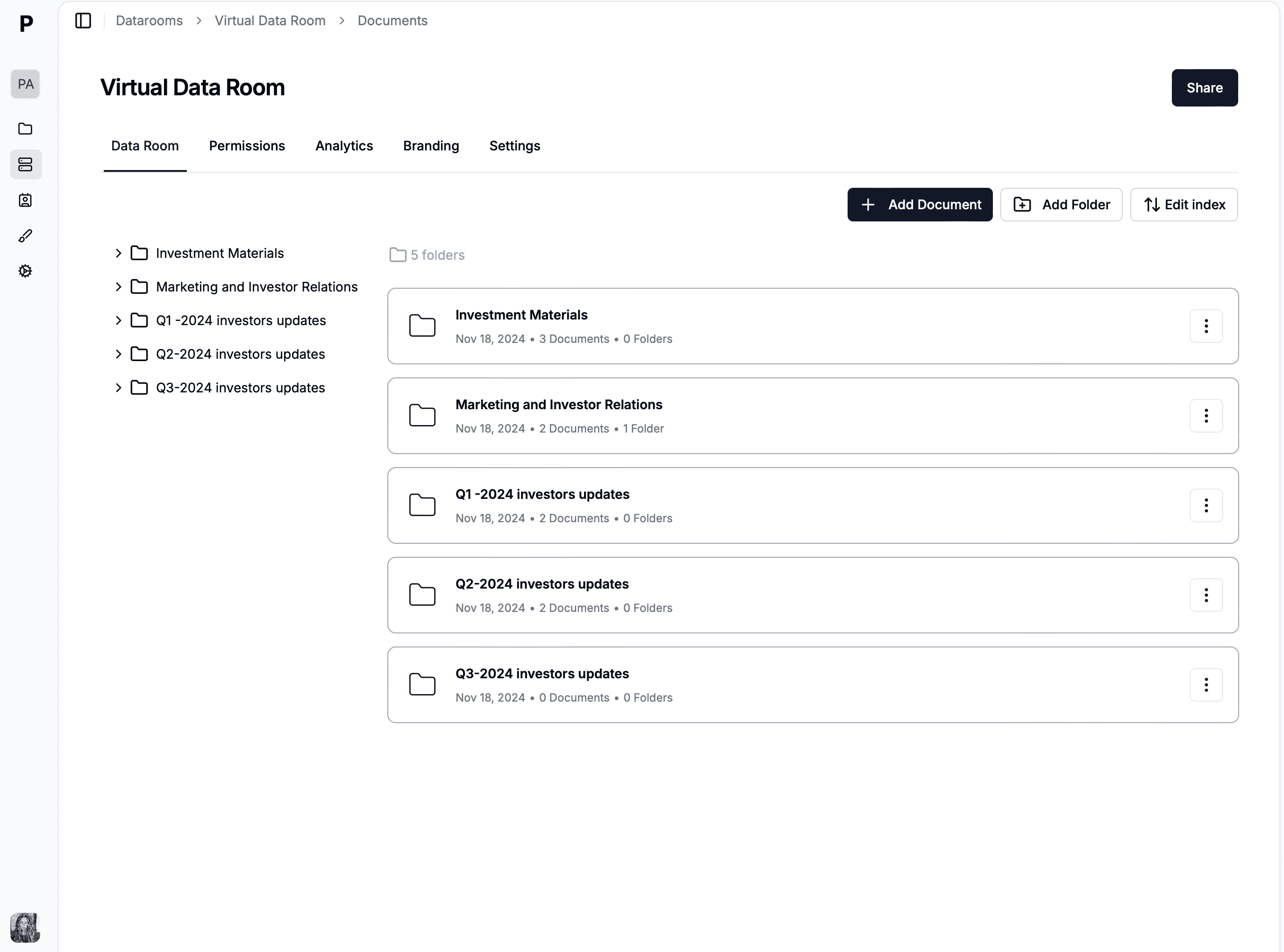
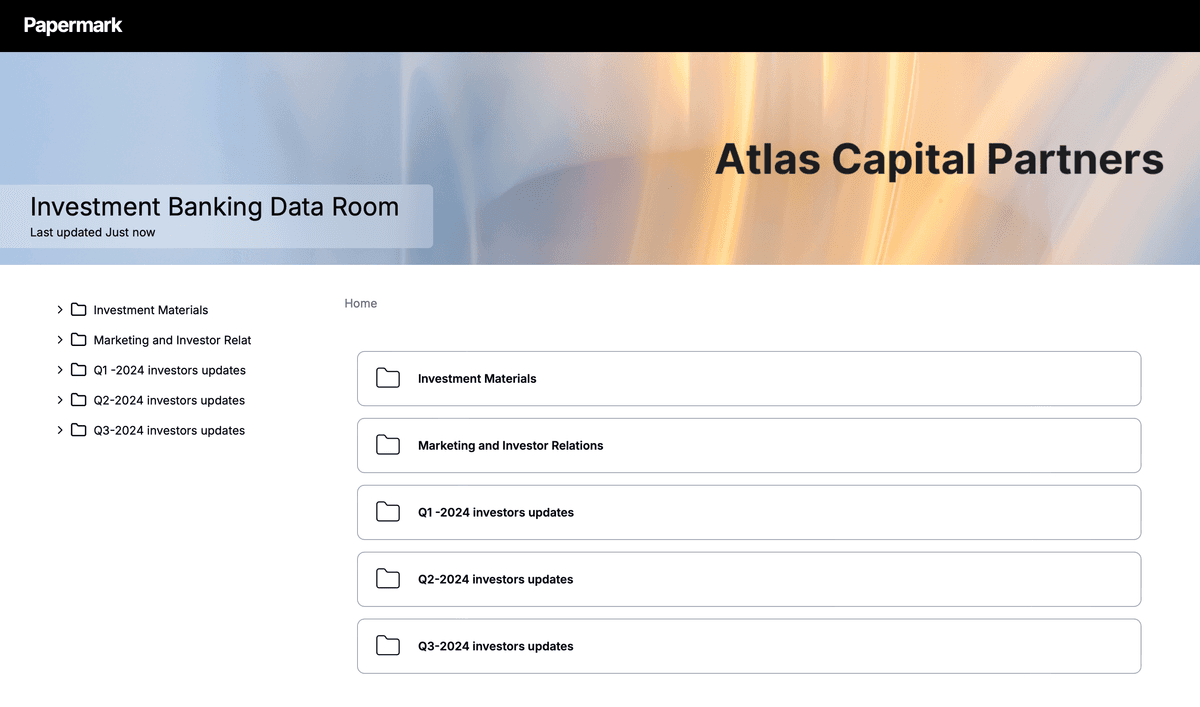
Number folders for consistent sort order and unambiguous Q&A referencing. Underwriter counsel will cite documents as "Section 3.2, Customer Contract #7."
How to prepare your IPO data room: month-by-month timeline
Months -18 to -12 (pre-IPO readiness begins):
Appoint a data room manager (typically VP Finance or Associate General Counsel)
Open an internal working room in Papermark with company management, counsel, and audit firm access
Begin collecting corporate governance documents and board minutes
Start SOX readiness assessment and document internal controls
Run IP audit and close assignment gaps
Build the contract summary schedule
Months -12 to -6:
Upload audited financials and tax returns as they become available
Populate legal and litigation folders
Draft initial risk factors with supporting documents
Refresh cap table and equity plan documentation
Add HR and compensation files (409A, executive agreements)
Enable basic audit logging and folder permissions
Months -6 to -4:
Select underwriters and expand the data room to IPO execution mode
Add underwriter counsel with per-bank scoped permissions
Enable dynamic watermarking, NDA gating, and Q&A module
Upload material contracts (full PDFs)
Populate regulatory and compliance folders
Begin page-level analytics monitoring
Months -4 to 0 (IPO execution):
S-1 drafting pulls documents from the data room continuously
SEC comment letter cycles add supplemental documents
Underwriter diligence memos populate folder 8.0
Roadshow materials go into folder 9.0 with watermarked scoped links
Q&A volume peaks: assign response owners per category
Export audit log before pricing as part of the offering record
Essential VDR features for IPO (with Papermark)
IPO diligence is not a job for Google Drive. Eight features separate a purpose-built virtual data room from generic cloud storage, and each one maps to a specific IPO workflow requirement.
1. Dynamic watermarking
Every document viewed in an IPO data room should carry a per-session watermark with the viewer's email, IP address, and timestamp. Material non-public information (MNPI) disclosure rules make this non-negotiable. Papermark stamps each page automatically on view.
Configure watermark settings per data room link. For roadshow decks shared with institutional investors, enable watermarking on every page before sending the scoped link. See dynamic watermarking for setup details.
2. Granular permissions per workstream
IPO diligence involves 20-80 reviewers across competing banks, company counsel, underwriter counsel, and auditors. Each group needs different folder access, and underwriter counsel from Bank A should not see Bank B's diligence memos.
In Papermark, create viewer groups per workstream and assign folder-level view or download permissions. Company management gets full access. Each underwriter's counsel gets scoped access to relevant folders plus their own subfolder in section 8.0. Auditors get folders 2.0 and 7.0 only.
3. NDA and agreement gating
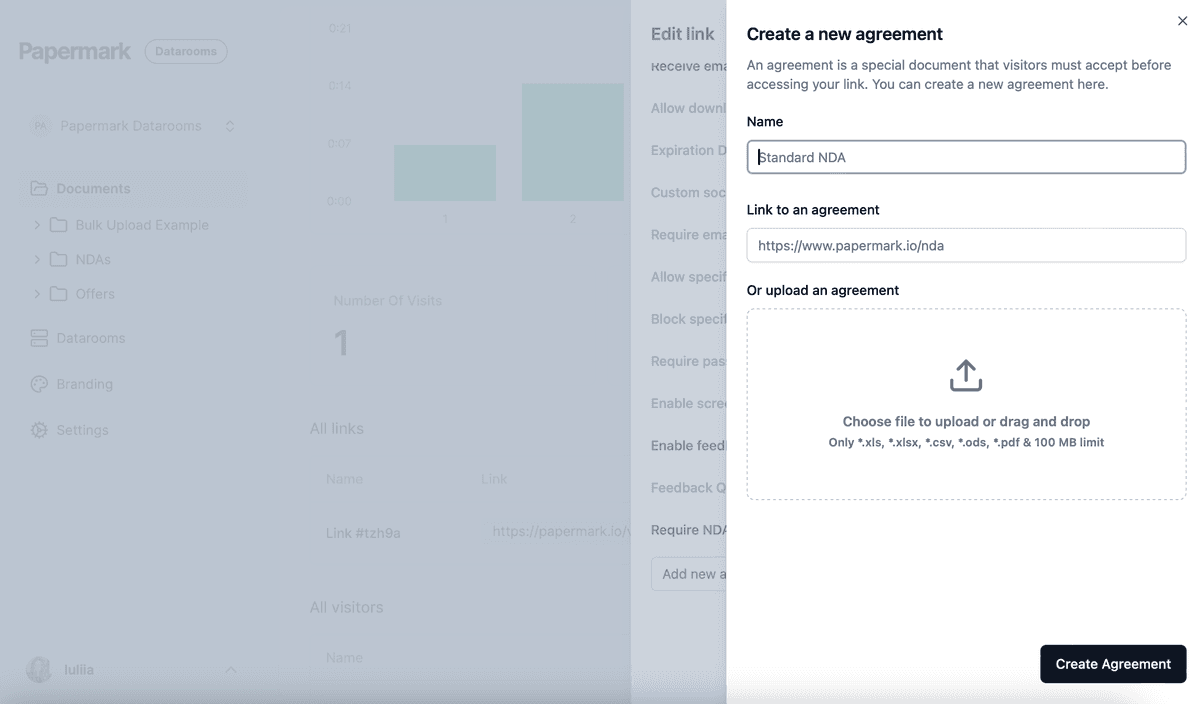
Every external reviewer should accept an NDA before accessing MNPI. Papermark supports one-click NDA acceptance and full electronic signatures on the same link that gates the data room.
Attach one NDA to the entire data room link so all 30 underwriter reviewers agree through the same flow. Every acceptance is logged next to document access in the audit trail. Read the full workflow in NDA compliance in virtual data rooms.
4. Q&A module with workstream scoping
IPO diligence generates hundreds of questions tied to specific documents. A threaded Q&A module keeps questions organized, assigns response owners, and prevents one bank's questions from leaking to another.
Route Q&A by folder category: financial questions go to the CFO team, legal questions to company counsel, contract questions to the contracts owner. In Papermark, enable Q&A on the data room and scope visibility per viewer group.
5. Page-by-page analytics
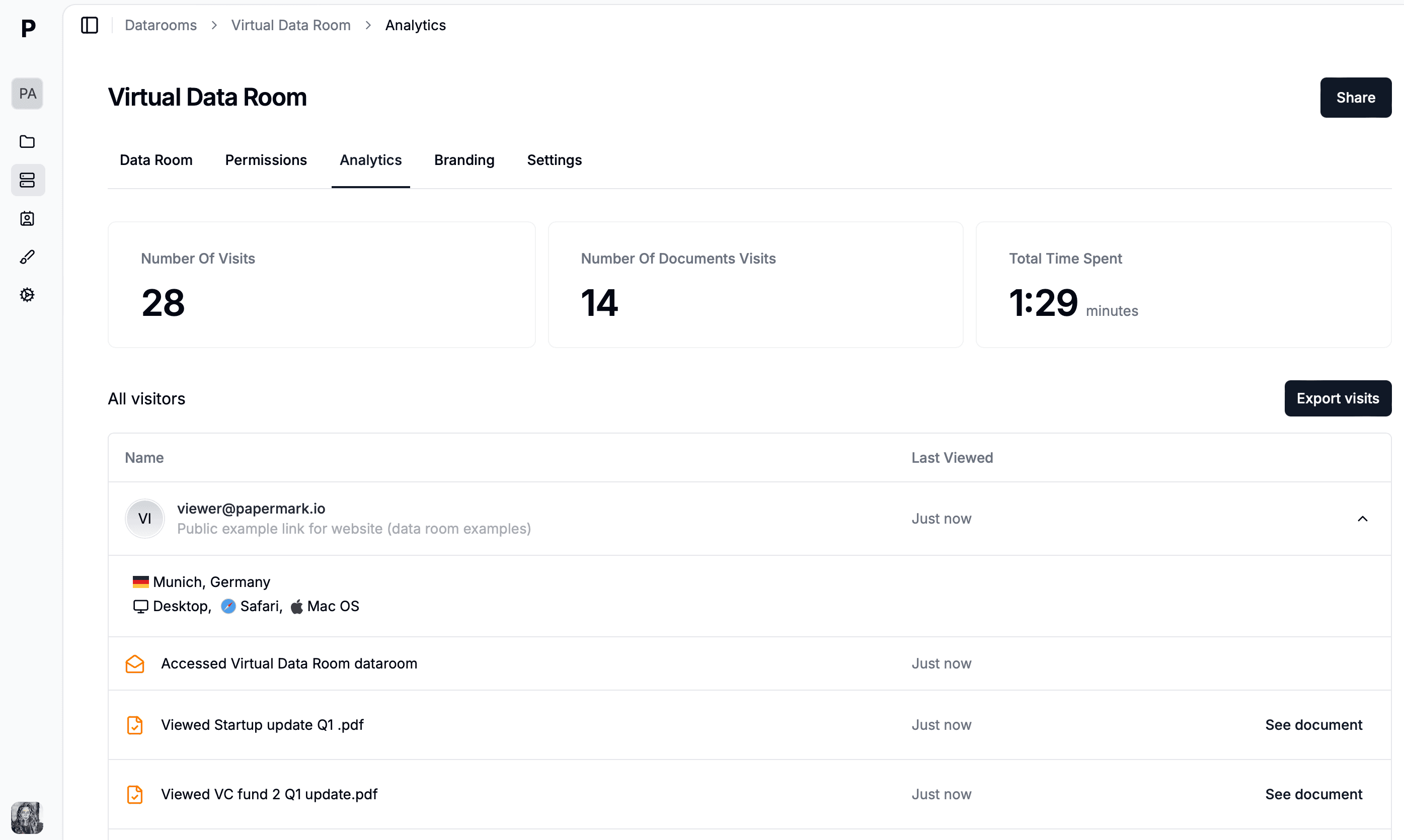
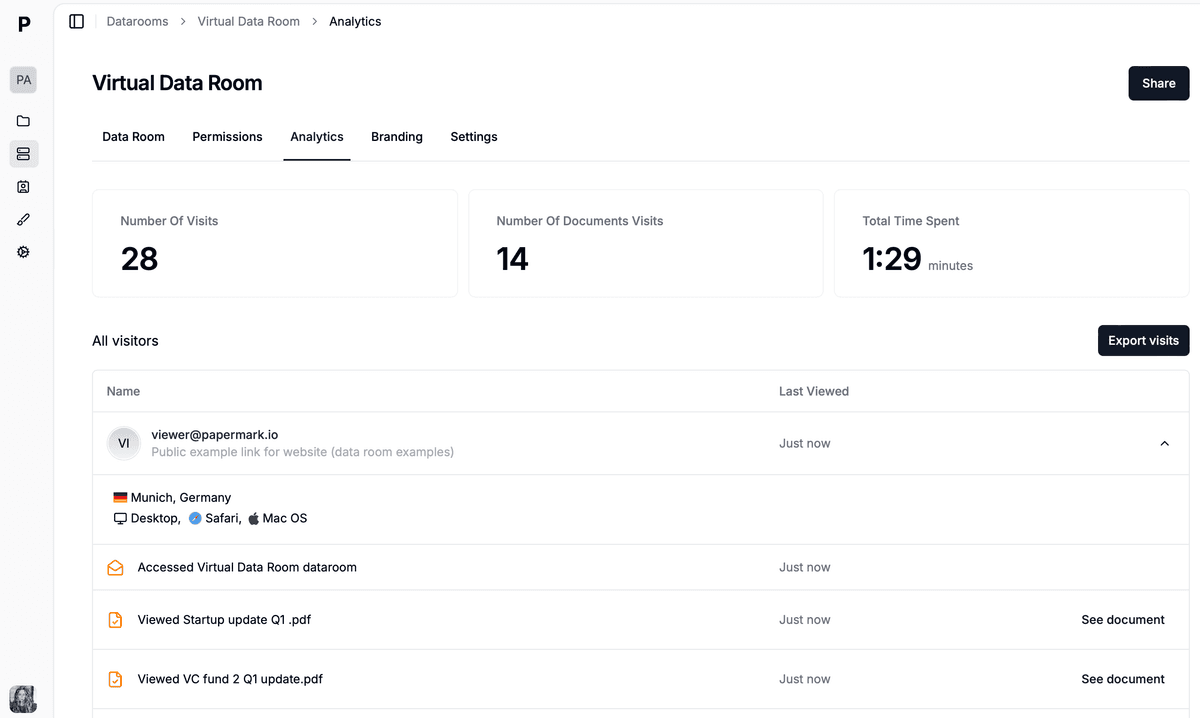
Analytics tell you which documents each workstream is actually reading, where diligence is stalling, and which sections will drive the next SEC comment letter. This is operational intelligence, not vanity metrics.
Check analytics weekly during IPO execution. If underwriter counsel has not opened folder 6.0 (litigation) after two weeks, that is a signal to proactively address litigation disclosure in the S-1 draft.
6. Audit log with export
The audit log is the evidentiary backbone of IPO compliance. It records every document upload, every viewer access, every permission change, and every NDA acceptance with timestamps. Export the full log before pricing and archive it as part of the offering record.
Underwriter counsel and company counsel both rely on this trail during SEC review and in the event of post-IPO litigation.
7. Custom domain and branding
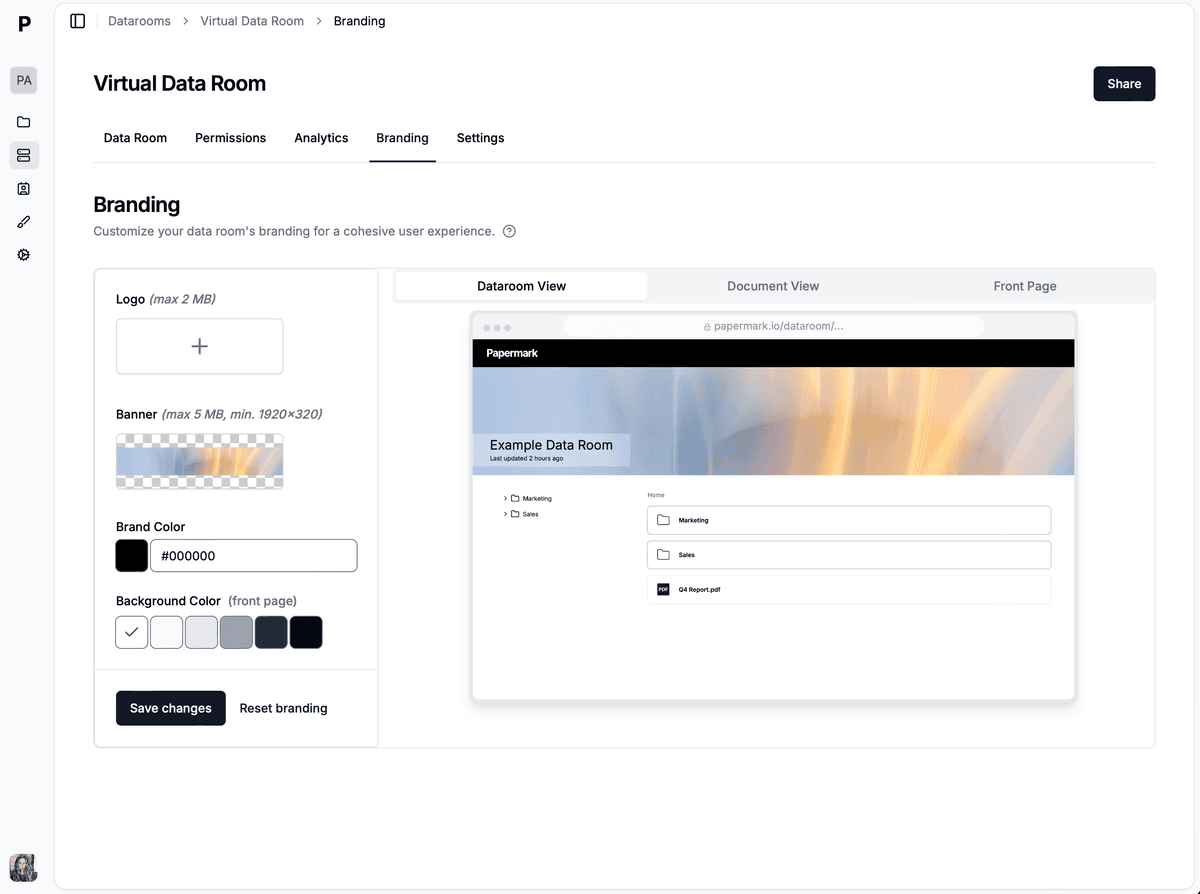
Underwriters and institutional investors should see your company's data room, not a vendor's logo. Custom domains and full white-labelling signal operational maturity.
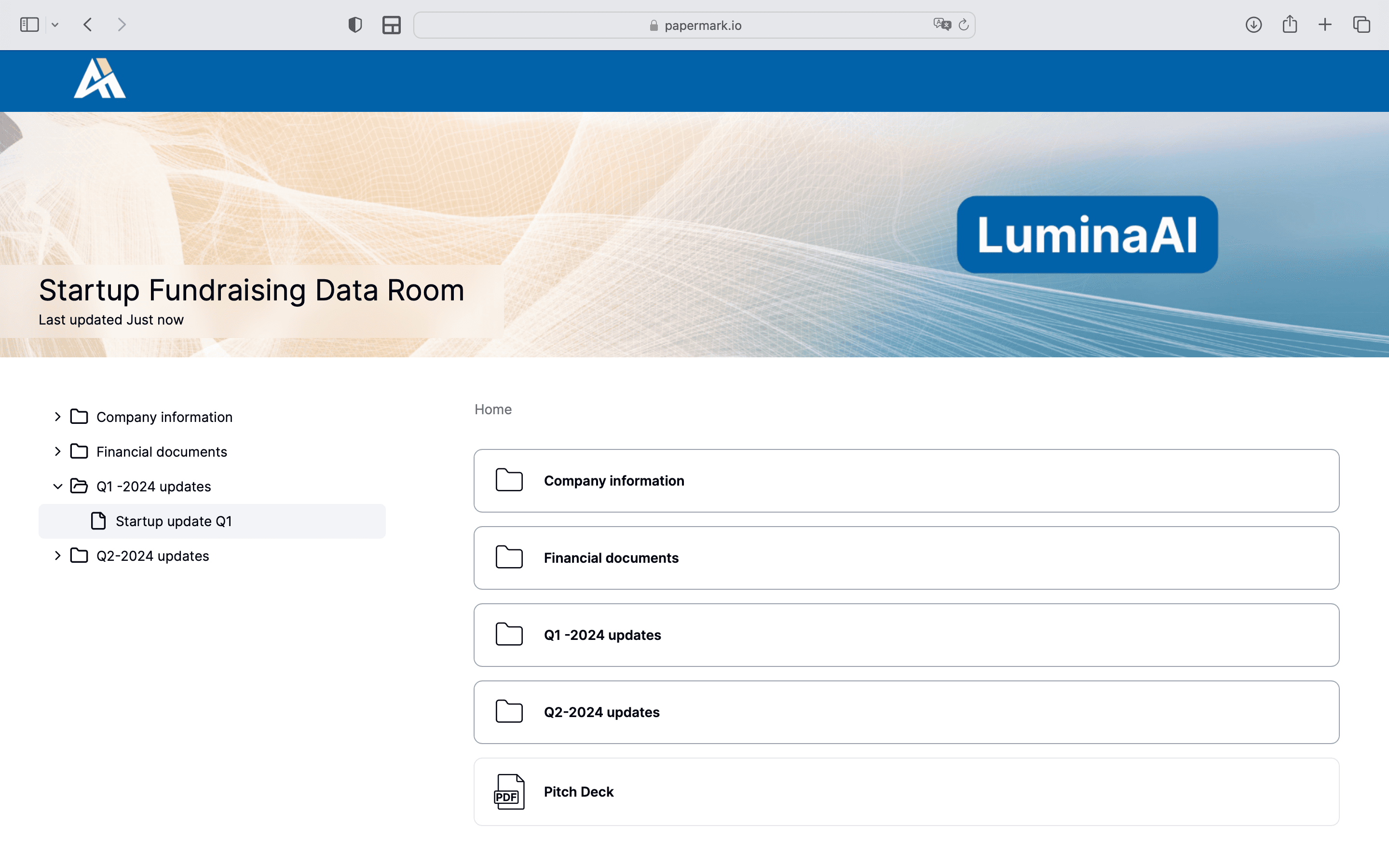
Point dataroom.yourcompany.com at your Papermark data room before inviting external reviewers. First impressions matter when sovereign wealth funds and pension funds evaluate whether you are ready to be public.
8. SOC 2 Type II compliance
SOC 2 Type II is the baseline compliance certification underwriter counsel checks for. Papermark maintains SOC 2 Type II, GDPR alignment, and HIPAA readiness. For biotech IPOs, confirm whether your VDR also supports 21 CFR Part 11 if FDA-regulated data is in the room.
Start 12-18 months before filing, not 12-18 days. Missing board minutes found in month -12 can be fixed. Missing material contracts found in month -2 delay the offering.
Validate completeness before external access. Run an internal review checklist against every row in the master table above. Unsigned contracts, draft financials without watermarks, and privileged communications uploaded by mistake are the top three internal review catches.
Never share privileged communications. Attorney-client privileged documents belong in counsel's files, not the data room. When in doubt, ask company counsel before uploading.
Use group permissions, not individual invitations. IPO reviewer groups change (banks join and leave the syndicate). Group-based permissions scale; individual invitations do not.
Monitor analytics weekly during execution. Page-level analytics surface which workstreams are behind and where S-1 revisions should focus.
Export the audit log before pricing. Archive it with the offering record. You will need it for 10-K filings, follow-on offerings, and any post-IPO litigation.
Plan for post-IPO continuity. Do not delete the room after pricing. Transition it to an investor relations portal for ongoing SEC compliance and shareholder communications.
Conclusion
An IPO data room is the operational backbone of going public. The checklist above covers every document category underwriters, auditors, and regulators expect, organized in a structure that scales from pre-IPO readiness through SEC review and roadshow. The eight VDR features (watermarking, permissions, NDA gating, Q&A, analytics, audit log, branding, SOC 2) are not optional extras. They are what separates a diligence-ready company from one that loses weeks to document chaos.
Papermark gives IPO teams all eight on the same platform 70,000+ dealmakers already trust, from Lincoln Property ($50B AUM) to pre-IPO companies preparing their first S-1. Map your documents against this checklist, open your room, and invite counsel the same day.
No credit card required.
Recent IPO examples: what their data rooms had to prove
The fastest way to understand what belongs in your IPO data room is to look at the companies that actually filed. Every S-1 that reached the SEC between 2023 and 2026 sat on top of a virtual data room where underwriters, auditors, and counsel pressure-tested the same categories in the checklist above. The public prospectus is only the visible tip. Underneath it, each company had to organize thousands of documents so that every risk factor, every revenue figure, and every material contract traced back to source. When you read a recent S-1, you are reading the summary of a diligence process that lived in a VDR for months.
Look at the 2024 cohort and a pattern emerges: the hardest diligence was never the boilerplate. It was the one or two things that made each business unusual. Reddit had to defend user-generated content, moderation liability, and brand-new data-licensing revenue. ServiceTitan had to explain complex preferred-stock terms alongside its vertical-SaaS metrics. Astera Labs had to prove that a handful of large customers in the AI-infrastructure supply chain were durable, not a bubble. In each case, the IPO data room carried the supporting evidence that the prospectus could only summarize in a paragraph.
The 2025 and 2026 cohorts made the same point at far greater scale. The IPO window reopened hard: 2025 delivered CoreWeave, Figma, Circle, and Klarna, and Q2 2026 became the largest quarter for US IPOs on record at $104.8 billion, capped by SpaceX listing on 12 June 2026 at a $1.77 trillion valuation, the largest IPO ever completed. Bigger deals did not simplify the diligence. They concentrated it: CoreWeave on customer concentration and debt, Figma on a collapsed acquisition, Cerebras on a single dominant customer.
That is the lesson for anyone building their own room. Your S-1 will be judged on the strength of your weakest disclosure, and your weakest disclosure is almost always the thing that makes your company interesting. Every company below went public with a very different story, but each one needed a virtual data room disciplined enough to let underwriter counsel verify that story fast. The table shows what each had to emphasize.
Company
Year
Exchange & sector
Data-room focus
S-1 emphasis
SpaceX
2026
Aerospace / satellite internet
Government and defense contracts, export-control (ITAR) compliance records, launch backlog, Starlink subscriber economics
Government-contract concentration, capital intensity, and founder control through dual-class structure. Listed 12 June 2026 at a $1.77T valuation, the largest IPO ever completed
Cerebras
2026
Nasdaq: CBRS — AI semiconductors
Customer contracts and concentration, wafer supply agreements, IP portfolio for wafer-scale silicon
Dependence on a single dominant customer, and durability of AI-compute demand. Priced at $185 on an upsized $5.6B raise
Quantinuum
2026
Nasdaq: QNT — quantum computing
Patent portfolio, parent-company and JV agreements, research and government contracts
Pre-commercial revenue against long research timelines, and related-party arrangements. Priced at $60, raising roughly $1.68B
Figma
2025
NYSE: FIG — design software
Enterprise contracts and retention cohorts, IP portfolio, records from the terminated Adobe acquisition
The collapsed Adobe deal and its break fee, competitive position, and durability of seat-based growth. Raised over $1.2B and rose about 250% on debut
Risk factors around moderation liability, community backlash, and a still-unprofitable model with new AI data-licensing revenue
Astera Labs
2024
Nasdaq: ALAB — semiconductors / AI connectivity
Customer contracts, supply-chain agreements, IP portfolio for connectivity silicon
Customer concentration and demand durability across the AI-infrastructure supply chain
Rubrik
2024
NYSE: RBRK — cybersecurity / cloud data security
Subscription and ARR schedules, security certifications, customer contracts
Subscription-revenue transition and net losses alongside recurring-revenue growth
ServiceTitan
2024
Nasdaq: TTAN — vertical SaaS for the trades
Cap table and preferred-stock terms, customer and usage metrics, financing disclosures
Complex preferred-stock and ratchet provisions disclosed alongside vertical-SaaS growth metrics
Instacart (Maplebear)
2023
Nasdaq: CART — grocery delivery / marketplace
Gig-worker classification files, retailer and advertising contracts, unit economics
Worker-classification risk, customer concentration, and growth normalization after the pandemic peak
Klaviyo
2023
NYSE: KVYO — marketing automation SaaS
Platform-partnership agreements, ARR and retention cohorts, data-processing terms
Dependence on a key platform partnership and the durability of recurring revenue
Organizing S-1 and underwriter documents in a structured data room.
The takeaway for your own filing is direct. Map your business against the master checklist above, then ask which single category is the one underwriters will dig into hardest. If you are a consumer platform, it is content and community risk, the way it was for Reddit. If you are infrastructure, it is customer concentration, the way it was for Astera Labs and again for CoreWeave and Cerebras. If your cap table is complicated, it is the equity and financing folder, the way it was for ServiceTitan. Build that folder first, populate it deepest, and keep it current, because that is where your IPO data room either accelerates the deal or stalls it.
None of these companies assembled that evidence in the final weeks. Each ran a diligence-ready virtual data room long before the roadshow, with the folder structure, permissions, and audit trail that let counsel work in parallel. That is exactly the workflow this checklist is built for. For the broader end-to-end process, see data room for IPO and investment banking data room, and for provider selection, best virtual data rooms in 2026.


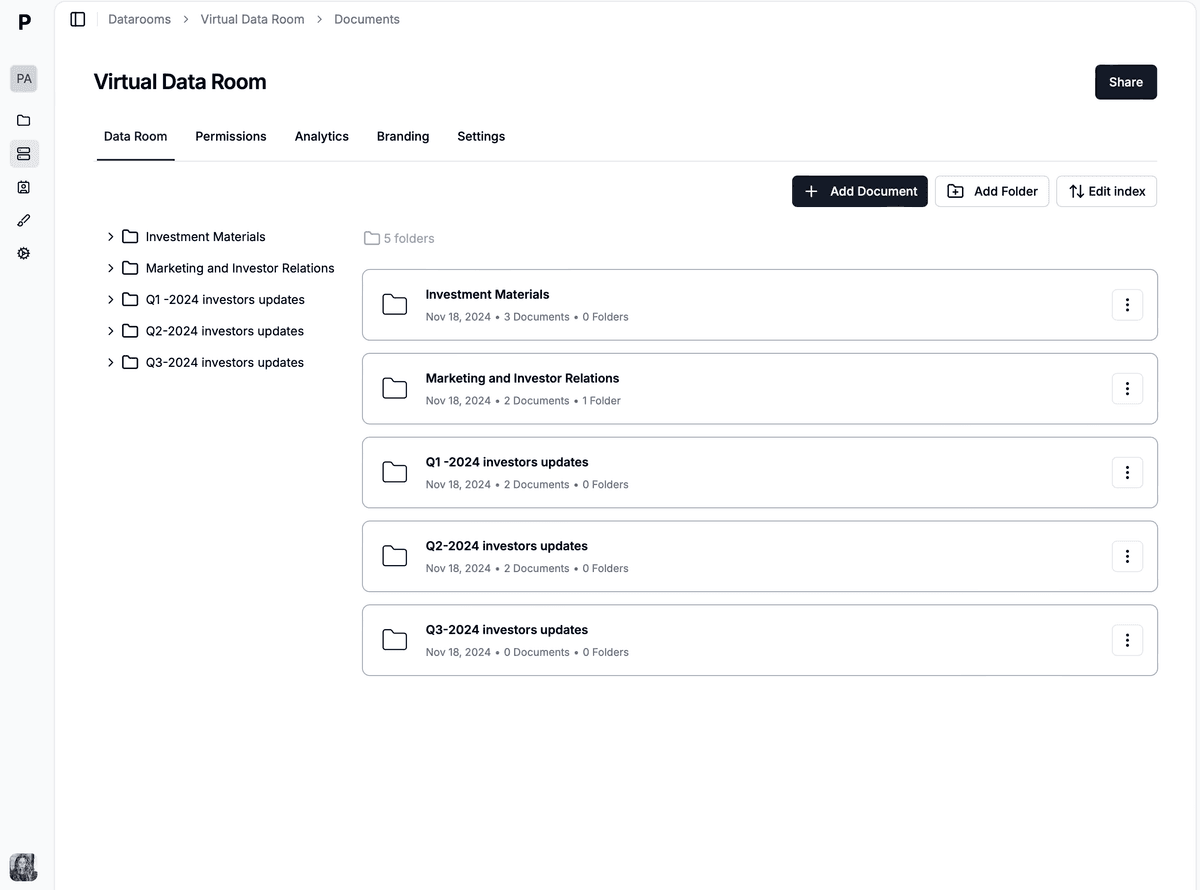
 Organizing S-1 and underwriter documents in a structured data room.