

fundraising
Capital Markets Advisory in 2026: Services, Fees, and When to Hire
Capital markets advisory in 2026: IPOs, follow-ons, and debt issuance, with 3-7% fee ranges, timelines, and when to hire an advisor.
Corporate finance advisory is the specialized advice companies use to make high-stakes financial decisions: raising capital, buying or selling a business, restructuring debt, and optimizing capital structure. Advisors combine financial modeling, deal execution, and strategic judgment. This guide explains what they do, what they charge, and when the fee is worth paying.
Corporate finance advisory is strategic financial guidance provided to companies, private equity firms, and institutional investors around the decisions that move the balance sheet: acquisitions, divestitures, financings, and restructurings. Where a management consultant works on operations and a lawyer works on documents, a corporate finance advisor sits between strategy and capital, translating a business objective into a fundable, closable transaction. The work blends quantitative rigor, financial modeling, valuation, and scenario analysis with the softer craft of running a process and negotiating terms.
The category is broad because the situations are. A founder deciding whether to sell, a private equity firm sourcing add-on acquisitions, a distressed manufacturer renegotiating covenants, and a board needing a defensible fairness opinion all fall under corporate finance advisory, yet each requires a different specialist. That breadth is why the market splits into distinct provider types rather than a single profession, and why matching the advisor to the situation matters as much as the fee.
Advisors bridge the gap between wanting a good financial outcome and actually engineering one. They bring transaction experience most executive teams touch only once or twice in a career, relationships with the buyers, investors, and lenders who write the checks, and the process discipline to keep a deal moving toward close while the management team keeps running the business.
The core services span the deal lifecycle:
The providers differ less in what they can do than in the deal sizes and situations they serve well. Investment banks anchor the top of the market. Bulge-bracket firms such as Goldman Sachs and JPMorgan handle the largest and most complex transactions, while middle-market banks like Houlihan Lokey and Piper Sandler dominate deals in the tens to low hundreds of millions. Their scale brings buyer and investor reach, but it also brings minimum fees that make small engagements uneconomical for both sides.
Boutique advisory firms occupy the specialist tier. Many are organized around a single industry or deal type, and their partners often carry deeper sector relationships than a generalist bank can offer. Below them, Big 4 accounting firms run substantial corporate finance divisions inside Deloitte, PwC, EY, and KPMG, strong on valuation, diligence, and mid-market M&A where their audit and tax relationships already sit. At the smallest end, independent advisors and solo practitioners serve founders and lower-middle-market owners who want senior attention on a sub-$10M transaction without a large firm's overhead.
Choosing among them is mostly a question of fit. The right provider is the one whose typical deal size, sector focus, and buyer network match your transaction, not simply the largest name that will take the mandate.
Corporate finance advisory is best understood as a set of distinct engagements, each with its own workflow, timeline, and fee logic. The five below account for the overwhelming majority of mandates. Most advisors specialize in one or two rather than claiming excellence across all of them, and the strongest results usually come from a specialist who has run your exact situation many times before.
M&A advisory helps companies buy or sell businesses, and it divides cleanly into two mirror-image engagements. On the sell-side, the advisor represents an owner seeking the best combination of price, terms, and certainty of close. On the buy-side, the advisor represents an acquirer trying to source, value, and win a target without overpaying. Both run for months and both live or die on process discipline and negotiation.
In a sell-side engagement the advisor first establishes a realistic price range through valuation work, then prepares the marketing materials, above all the confidential information memorandum (CIM), that present the business to the market. From there the work becomes process management: building a list of strategic and financial buyers, coordinating NDAs and a virtual data room, running site visits, and driving competitive tension so that offers, the letter of intent, and the final purchase agreement land in the seller's favor. The value an advisor adds here is rarely the paperwork; it is generating a competitive field and negotiating against it.
Sell-side engagements typically make sense when you are planning to sell the company, divesting a business unit, or formally exploring exit options. The typical fee is 2 to 5 percent of transaction value, often structured on the Lehman formula. As a worked example, selling a company with $50M of EBITDA for $250M might carry an advisory fee of roughly $6M, about 2.4 percent.
A buy-side engagement inverts the workflow. The advisor helps define a target profile and screening criteria, builds a pipeline of acquisition candidates, and then models valuation and deal structure once a target is in play. From there the advisor supports the LOI and definitive agreement, coordinates financial, legal, and operational due diligence, and often arranges the debt or equity financing that funds the purchase. Buy-side mandates suit companies pursuing growth through acquisition, consolidating a fragmented industry, or private equity firms sourcing platform and add-on deals. Fees usually run 1 to 3 percent of transaction value, or a monthly retainer of $25K to $100K. For a deeper walkthrough of the diligence phase on either side, see the M&A due diligence process.
Capital raising advisory helps a company secure equity or debt financing on the best available terms. The engagement is part packaging and part matchmaking: the advisor sharpens how the business is presented to capital providers, then runs a disciplined process to create choice among them. Equity and debt raises follow different playbooks because the counterparties, structures, and risks are different.
In an equity fundraising engagement, the advisor builds the equity story and financial model, defines the right investor targets across venture capital, growth equity, private equity, or strategic investors, and prepares the pitch deck, projections, and data room. Then comes process management: coordinating investor meetings, managing due diligence, and negotiating the term sheet on valuation and deal terms. This suits companies running Series A, B, or C rounds, raising growth equity for expansion, or arranging pre-IPO financing. Fees typically run 3 to 8 percent of capital raised, often as a retainer plus a success fee. Raising a $20M Series B, for instance, might carry a fee of roughly $1M to $1.6M at 5 to 8 percent.
A debt financing engagement is structured around leverage rather than dilution. The advisor designs the debt structure across term loans, revolving credit, and mezzanine layers, identifies the right lenders among banks, private credit funds, and debt funds, and models leverage ratios and covenants to establish realistic debt capacity. Negotiation then focuses on interest rates, covenants, and fees. Debt advisory suits companies funding an acquisition with leverage, refinancing existing debt at better terms, or raising growth capital without giving up equity. Fees usually run 1 to 2 percent of principal or a fixed fee of $50K to $200K. For the public-markets equivalent of these raises, see capital markets advisory.
Valuation services deliver an independent, defensible view of what a business or asset is worth. Unlike a broker's price opinion, a formal valuation follows recognized methodology and is built to withstand scrutiny from auditors, tax authorities, courts, or a board. Advisors triangulate across a discounted cash flow analysis, comparable company analysis, and precedent transactions, then reconcile the ranges into a supportable conclusion.
The work covers full business valuations, fairness opinions that give a board cover to approve a transaction, purchase price allocation for accounting and tax after a deal closes, and the valuation of intangible assets such as patents, trademarks, and customer relationships. Companies commission valuations for annual financial reporting under standards like ASC 350 and IFRS 3, for tax and estate planning, for litigation support in shareholder disputes, and to support buy-sell agreements. Depending on complexity, fees typically fall between $15K and $100K.
Restructuring and turnaround advisory helps distressed companies stabilize and repair their financial position before problems become terminal. The advisor works on both sides of the balance sheet and cash flow statement, renegotiating debt and securing covenant waivers on one side while driving operational turnaround, cost reduction, and working capital improvement on the other. Because distress compresses time, a 13-week cash flow forecast usually becomes the central operating document of the engagement. Our corporate restructuring hub covers the debt, operational and legal options in more depth.
Much of the value is in stakeholder negotiation, aligning creditors, lenders, and equity holders around a plan that keeps the business alive, and in bankruptcy advisory when a Chapter 11 filing and exit path become the best option. These engagements suit companies facing covenant violations or default risk, negative cash flow and shrinking runway, or a pressing need to renegotiate debt terms. Fees are typically a monthly retainer of $50K to $250K plus a success fee tied to the outcome.
Strategic financial planning is the least transactional of the five, focused on long-term capital structure and financial strategy rather than a single deal. The advisor works to optimize the debt-to-equity mix, set dividend policy and payout ratios, build integrated three-statement models, and run scenario planning across growth, acquisition, and financing paths. The output is a financial roadmap rather than a closed transaction.
This service suits private equity firms optimizing portfolio company capital structures, companies preparing for an IPO, and management teams doing serious long-range planning. Fees are usually a monthly retainer of $10K to $50K or a defined project fee. It often runs alongside the other four services rather than instead of them, setting the strategy that later capital raises and M&A execute.
Corporate finance fees look complicated but reduce to a few building blocks that recur in different combinations: retainers that pay for work regardless of outcome, success fees that reward a closed transaction, and hourly or project fees for defined scopes. Understanding how these stack is the single most useful thing a first-time buyer of advisory services can do, because the headline percentage rarely tells the whole story. The right question is not "what is your fee?" but "what do I pay if we close, and what do I pay if we don't?"
Retainers and success fees exist for different reasons. A retainer aligns the advisor's near-term cash flow with the real cost of doing careful preparation work, and it signals that the client is a serious, committed principal rather than a tire-kicker. A success fee aligns the advisor's upside with the client's, paying out only when a transaction actually closes. Most well-structured engagements blend the two, and the negotiation is really about where the balance sits.
Retainers compensate the advisor for the preparation-heavy early phase of an engagement, before any transaction is certain. A monthly retainer typically runs $10K to $100K per month, while a one-time engagement retainer might run $50K to $500K upfront. The retainer covers financial modeling and analysis, preliminary valuation work, materials preparation such as the pitch deck or CIM, and the initial identification of buyers or investors. Retainers are most common in long-term advisory relationships, buy-side M&A, and capital raising preparation, where months of work precede any close.
Success fees are the transactional core of most M&A and capital raising engagements, paid only when the deal closes. Sell-side M&A success fees run 2 to 5 percent of transaction value, buy-side fees 1 to 3 percent, and capital raising fees 3 to 8 percent of capital raised. Many sell-side fees follow the Lehman formula, a declining scale that takes a higher percentage of the first dollars and less of the last.
The classic Lehman formula charges 5 percent on the first $1M of value, 4 percent on the second $1M, 3 percent on the third, 2 percent on the fourth, and 1 percent on everything above $4M. On a $10M sale that works out to $50K plus $40K plus $30K plus $20K plus $60K, a total of $200K, an effective rate of 2 percent. On larger deals the effective rate keeps falling, which is why headline percentages mean little without the underlying scale.
Hourly and project fees suit work with a defined scope rather than an open-ended transaction, valuation and financial modeling being the most common. Senior partners bill $500 to $1,000 per hour, mid-level professionals $300 to $600, and junior staff $150 to $300. Where the scope is clear, advisors often quote a fixed project fee of $25K to $200K instead, which gives the client budget certainty and the advisor an incentive to work efficiently.
Most sell-side M&A and capital raising engagements use a hybrid of the above. A common structure pairs a monthly retainer of $25K to $50K with a success fee of 1 to 3 percent of transaction value, and credits the accumulated retainer against the success fee at closing. That crediting arrangement matters: it means the retainer functions as an advance on the success fee rather than an additional charge, so a deal that closes costs less in net retainer than the monthly figures suggest.
The decision to hire an advisor comes down to whether the value they add exceeds their fee, and that calculus shifts with both company stage and situation. Early-stage companies raising modest rounds can often manage without one; larger, more complex, or higher-stakes transactions almost always benefit. The clearest signal you need an advisor is a gap between the transaction you want and the relationships, experience, or bandwidth you have to execute it.
Company stage is the first lens. A startup raising a seed or Series A round usually needs at most a boutique or independent advisor, if any. A growth-stage company raising a Series B or C, or arranging debt, is well served by a middle-market investment bank. A mature company approaching an IPO wants a bulge-bracket or strong middle-market bank, and any company selling itself or a business unit wants an industry-specialized M&A advisor who knows the likely buyers.
| Stage | Typical need | Advisor type |
|---|---|---|
| Startup (Seed to Series A) | Venture capital fundraising | Boutique or independent advisor |
| Growth (Series B to C) | Growth equity or debt financing | Middle-market investment bank |
| Mature (Pre-IPO) | Late-stage financing or IPO prep | Bulge bracket or middle-market bank |
| Exit | Sell company or business unit | Industry-specialized M&A advisor |
Situation is the second lens, and it often overrides stage. Five scenarios reliably justify an advisor's fee. When you are raising capital but lack investor relationships, an advisor brings access to institutional investors, third-party credibility, and process management. When you are selling and want maximum value, an advisor generates competitive tension, surfaces buyers you would never find alone, and negotiates better terms. When you are pursuing an acquisition without M&A experience, an advisor provides target screening, valuation, deal structuring, and negotiation support. When you are facing financial distress, an advisor handles creditor negotiation, liquidity management, and restructuring options. And when you need an independent valuation, an advisor delivers a defensible fair-market-value opinion that stands up to audit, tax, or litigation scrutiny.
Consider Wexmoor Instruments, a hypothetical $180M-revenue maker of precision laboratory measurement devices whose two founders had decided to retire. Wexmoor was profitable, with roughly $28M of EBITDA, but the founders had never sold a company and knew only a handful of the strategic acquirers in their niche. They engaged a middle-market M&A boutique with deep instrumentation sector coverage on a hybrid fee: a $40K monthly retainer credited against a success fee structured on the Lehman formula.
Over the first ten weeks the advisor built the financial model, wrote the confidential information memorandum, and assembled a target list of 22 buyers, split between strategic acquirers in scientific instruments and private equity platforms rolling up the sector. Rather than approach a single logical buyer, the advisor ran a controlled auction. NDAs and diligence materials flowed through a virtual data room, and the advisor tracked which bidders were most engaged by watching who returned to the financial model and customer contracts.
Three parties submitted letters of intent. The lead strategic bidder, who had privately told the founders months earlier they might "explore something," opened at $240M. The competitive process pulled the final price to $312M, with a cleaner earnout structure and a shorter escrow than the opening offer. On that outcome the advisor's fee ran to roughly $6.2M, about 2 percent. The founders netted far more than the fee cost them, and they spent the process running the business rather than managing 22 buyer relationships. That gap between the unadvised and advised outcome is the entire case for hiring well.
Once you have decided to hire, the selection process should test for fit and track record rather than brand alone. The best advisor for a $30M industrial sale is often a boutique partner who has closed a dozen similar deals, not a global bank that will staff the mandate with junior analysts. Five criteria separate a strong choice from a costly mismatch, and each comes with questions worth asking directly in the pitch.
Industry expertise comes first. Sector-specific advisors bring relevant buyer and investor relationships, credible comparables, and an instinct for where value and risk actually sit in your business. Ask how many transactions they have completed in your industry, which comparable companies they have advised, and whether they have relationships with the specific buyers or investors you would want at the table.
Deal-size fit is the second filter, and getting it wrong is expensive in both directions. As a rough guide, deals under $10M suit independent or boutique advisors, deals between $10M and $100M suit middle-market firms, and deals of $100M and above suit bulge-bracket banks or top boutiques. Hiring a bulge-bracket bank for a $5M deal wastes money on overhead the transaction cannot support; hiring a solo advisor for a $200M sale leaves reach and negotiating leverage on the table.
The remaining three criteria are track record, fee transparency, and team quality:
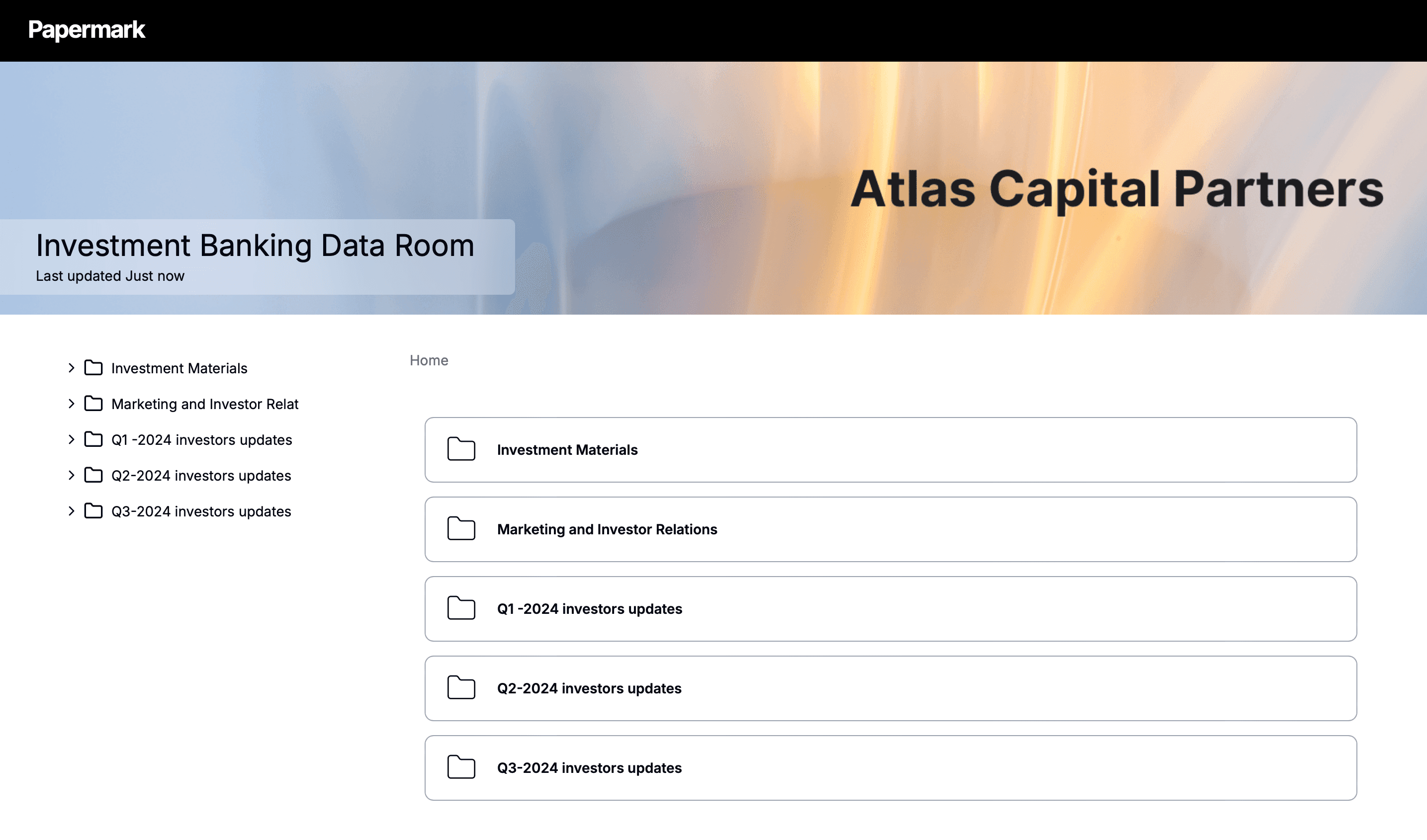
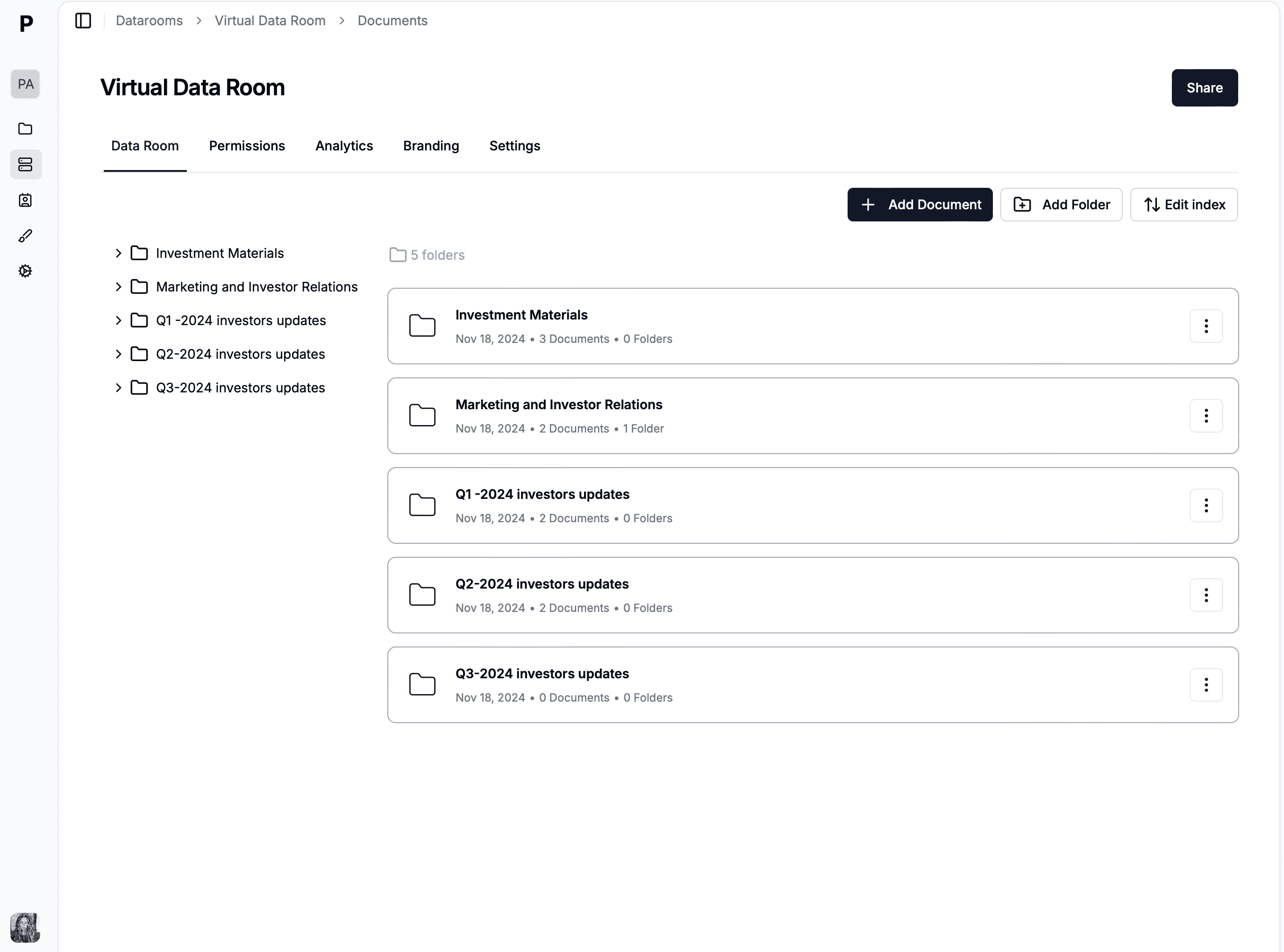
Nearly every corporate finance engagement, whether a sell-side auction, a Series B raise, or a debt refinancing, hinges on sharing sensitive financial information with parties who have not yet signed a deal. Financial models, the confidential information memorandum, customer contracts, cap tables, and valuation work all need to reach buyers, investors, and lenders without leaking to competitors or losing the paper trail of who saw what. This is exactly the job a virtual data room is built for, and it is where Papermark fits into the advisory workflow.
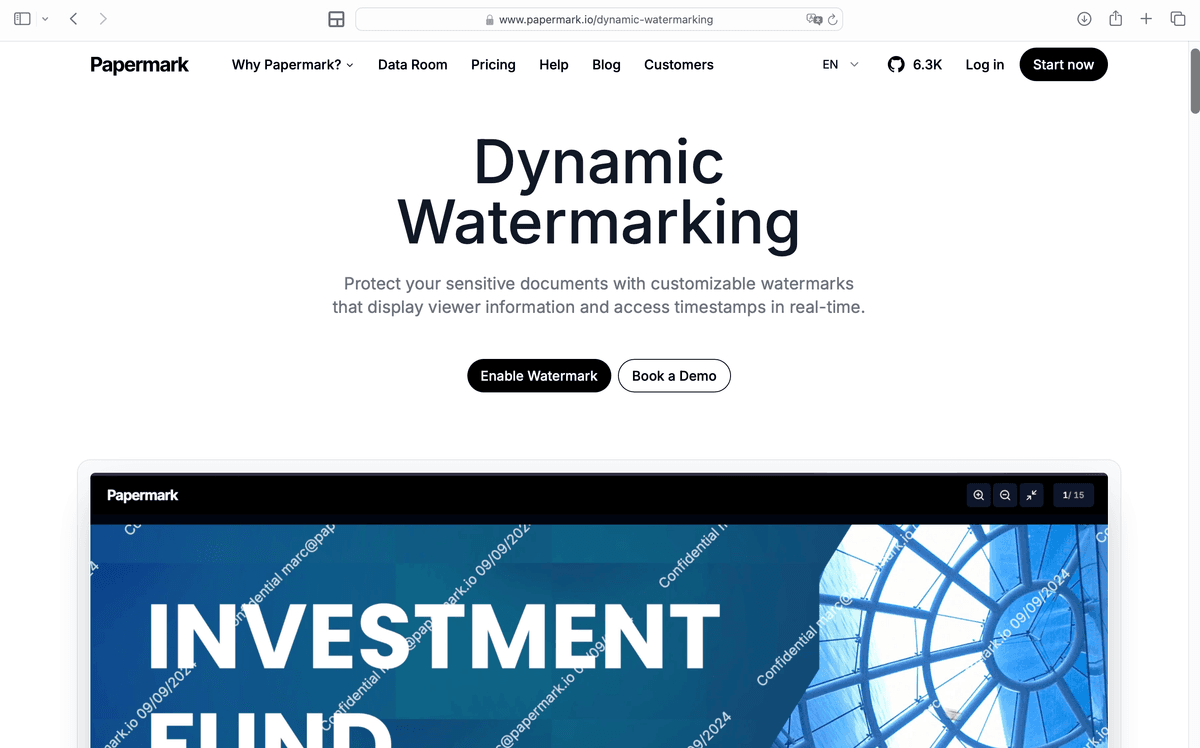
Papermark gives advisors and their clients a secure data room to organize a transaction and control access to every document in it. Granular permissions let you show different materials to different stakeholder groups, so strategic buyers, financial sponsors, and lenders each see only what is appropriate to their stage of the process. NDA gating requires viewers to accept a confidentiality agreement before any file opens, which matters when a CIM is circulating among a competitor's corporate development team. Dynamic watermarking stamps each viewer's email, IP, and a timestamp across confidential projections and valuation models, so a leaked page traces straight back to its source.
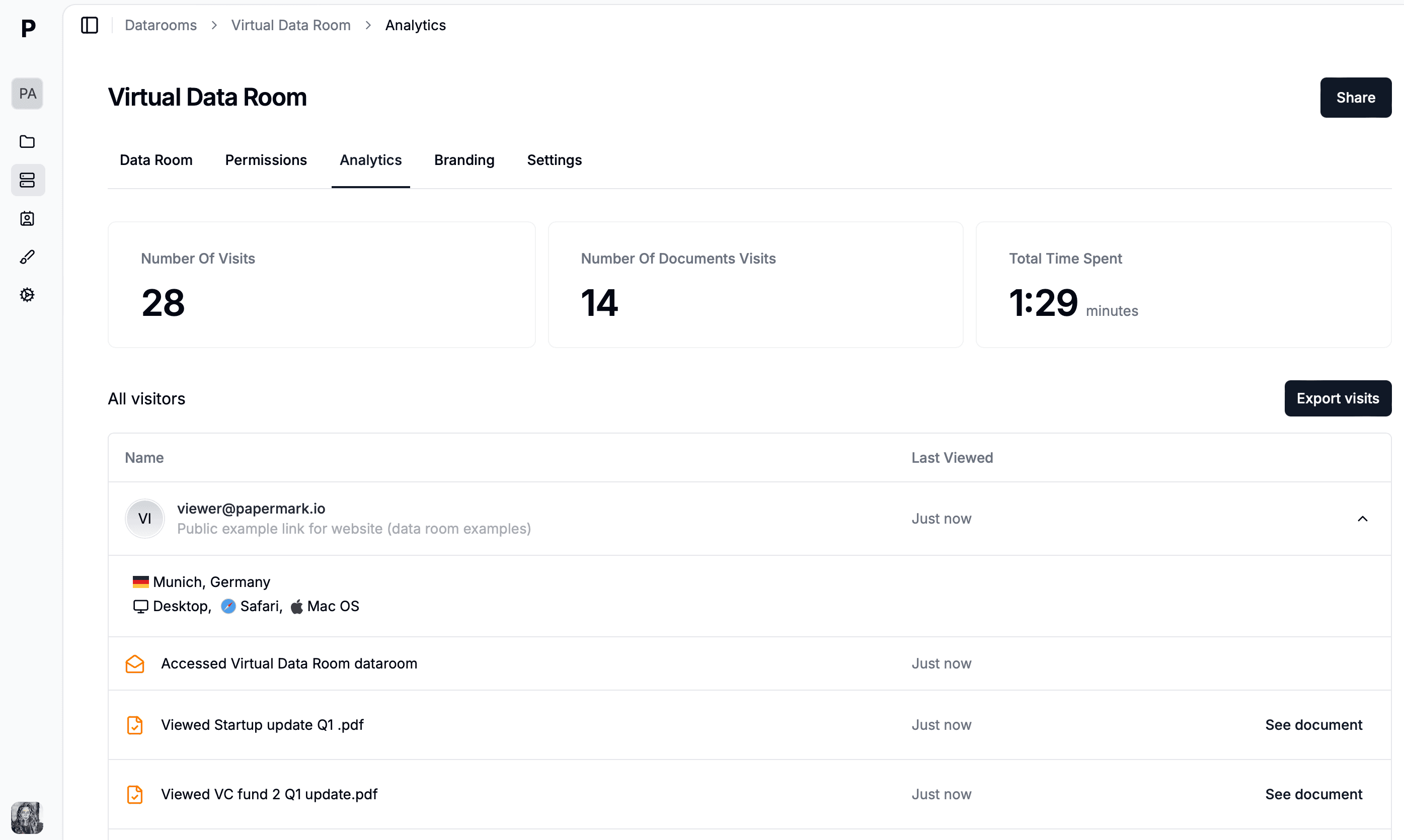
The analytics are where a data room becomes a live read on deal momentum rather than just a storage locker. Page-by-page analytics and a full audit trail show exactly which buyers returned to the financial model, lingered on customer contracts, or never opened the diligence folder at all. Advisors use that signal to prioritize the most engaged bidders and to time follow-ups, much as the advisor did in the Wexmoor scenario above. Full-text search, custom domains for a branded deal room, and SOC 2 Type II security round out the feature set, and the Data Rooms plan starts at €99 per month, a fraction of a single hour of senior advisory time.
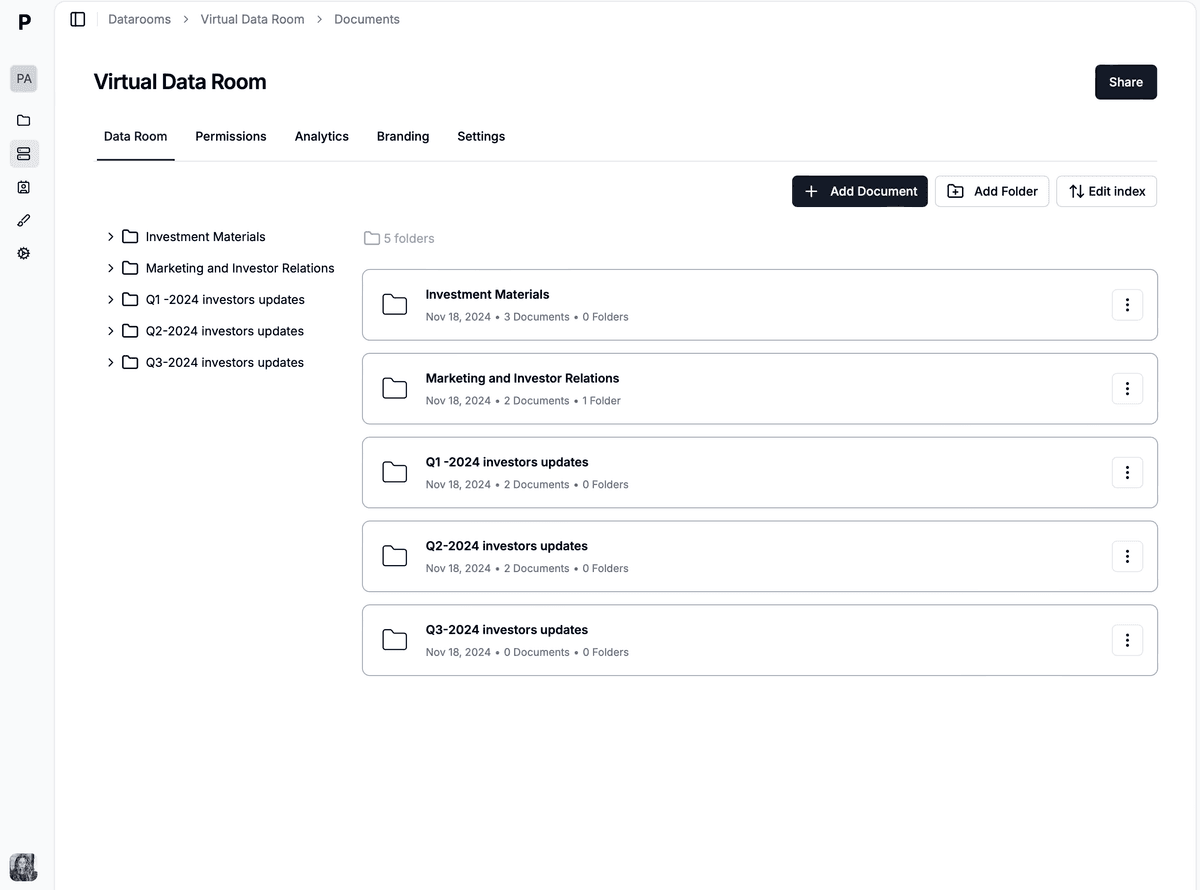
A Papermark virtual data room organizes financial models, the CIM, and due diligence materials for corporate finance transactions.
For teams running M&A or fundraising processes, the data room becomes the shared workspace between the advisor, the client, and every buyer or investor. It also feeds cleanly into the broader diligence workflow covered in our guide to the M&A due diligence process and complements the public-markets work described in capital markets advisory.
Corporate finance advisory is a broad discipline spanning M&A, capital raising, valuation, and restructuring, and no single provider is strong across all of it. Fee structures vary by service, with retainers paying for preparation and success fees rewarding a close, and the crediting arrangement between them often matters more than the headline percentage. Industry expertise consistently produces better outcomes than brand, and matching the advisor to your deal size keeps you from overpaying for overhead or underbuying reach. Above all, a good advisor tends to increase the outcome by more than the fee, which is why the question is rarely whether to pay for advice but which advisor to pay.
Capital markets advisory in 2026: IPOs, follow-ons, and debt issuance, with 3-7% fee ranges, timelines, and when to hire an advisor.
Compare 13 Charlotte investment banks and M&A advisory firms for 2026, with typical deal sizes, sector focus, fee ranges, and how to choose the right advisor.
Compare 13 verified retail M&A advisory firms by deal size, channel focus and mandate type, plus what retail and e-commerce owners prepare before a sale in 2026.