BlogFundraisingCapital Markets Advisory in 2026: Services, Fees, and When to Hire
Capital Markets Advisory in 2026: Services, Fees, and When to Hire
·16 min read
Marc Seitz
Capital markets advisory is the specialized investment banking work of helping a company raise money through public and private markets, from an IPO or follow-on equity offering to corporate bonds, convertible notes, and private placements. It is about accessing capital, not buying or selling companies, and the difference shapes everything an advisor does.
This guide explains what capital markets advisors actually do, how the transactions differ, what they charge, and when a company at each stage should bring one in.
Quick recap
Capital markets advisory helps companies raise capital through equity and debt offerings such as IPOs, follow-on offerings, corporate bonds, convertible notes, PIPEs, and private placements.
It is a subset of investment banking focused on accessing markets, distinct from M&A advisory, venture fundraising, and commercial bank lending.
Equity offerings typically cost 3-7% of proceeds, debt issuance 0.5-2% of principal, plus advisory retainers of roughly $50K-$500K a year.
A U.S. IPO usually takes 12-18 months from engagement to listing; a follow-on or PIPE can close in 4-8 weeks.
Most advisors focus on deals above $50M, while boutique firms handle $10M-$50M transactions at higher percentage fees.
The main selection criteria are sector expertise, institutional investor relationships, execution track record, fee structure, and the seniority of the deal team.
Every offering runs on heavy document exchange, so a secure virtual data room with granular permissions and audit trails is central to execution.
What is capital markets advisory?
Capital markets advisory is a specialized investment banking service focused on helping companies access public and private capital markets. The advisor sits between the company that needs funding and the institutional investors, underwriters, and rating agencies that supply it, and their job is to structure the raise, price it correctly, and get it executed on favorable terms. Where an M&A banker is paid to change who owns a business, a capital markets advisor is paid to bring new capital into it without necessarily changing control.
The work spans both equity and debt. On the equity side it covers taking a company public through an IPO, raising more money afterward through follow-on offerings, and placing shares privately with institutions through PIPEs and Reg D deals. On the debt side it covers issuing corporate bonds, convertible notes, and privately placed notes to qualified institutional buyers. In every case the advisor is managing the same core problem: matching the company's financing need to real investor demand at a price both sides can accept.
It helps to be precise about what falls outside the category, because the boundaries are where founders most often get confused. Capital markets advisory is not the same as the services next to it, and hiring the wrong specialist wastes months.
M&A advisory, which is about buying or selling whole companies rather than raising capital
Venture capital fundraising, which is handled directly by VCs or by VC-focused advisors, not capital markets desks
Bank loans and revolving credit facilities, which are commercial banking products rather than securities offerings
Put simply, capital markets advisory sits at the intersection of corporate finance and the securities markets. When a company needs to sell stock or bonds to investors, this is the discipline that runs the process.
Types of capital markets transactions
Capital markets advisors work across a spectrum of transaction types, and each one carries its own timeline, cost, investor base, and regulatory path. Understanding the differences matters because the right structure depends on how much a company needs, how quickly, and how much dilution or leverage it is willing to take on. An early-stage company approaching its first public listing faces a very different process from a listed company topping up its balance sheet or a profitable issuer tapping the bond market.
The five structures below cover the large majority of engagements. Each section describes what the advisor is responsible for, a realistic timeline, and the fee range you should expect, so you can map your own financing need to the closest fit before you ever sit down with a banker.
Initial public offerings (IPOs)
An IPO takes a private company public for the first time, and it is the most complex and most scrutinized transaction on this list. The advisor runs valuation modeling to set an offering price range, assembles a syndicate of underwriters, coordinates the investor roadshow, and shepherds the SEC registration process built around the S-1. As demand comes in they build the order book, gauge appetite, recommend a final price, and support the stock in the days after listing through stabilization.
Timelines run long because so much has to be built before the company can file. A typical U.S. IPO takes 12-18 months from engagement to listing, and the underwriting fee usually lands in the range of 2-7% of proceeds, with smaller deals paying the higher percentages. For a full document walkthrough of what a listing requires, see the IPO data room checklist and the guide to a data room for IPO.
Follow-on and secondary offerings
Once a company is public it can raise more capital through a follow-on offering, and these move far faster than an IPO because the disclosure infrastructure already exists. A primary offering issues new shares and raises fresh capital for the company, a secondary offering sells existing shares held by insiders without raising new money, and a mixed offering combines the two. The advisor's job is to price the deal against current market conditions, coordinate with the underwriters, manage timing to minimize dilution, and file the prospectus supplement.
Because the company is already reporting, a follow-on typically closes in 4-8 weeks and costs in the range of 3-5% of proceeds. Timing is the real skill here: issuing into strength lowers dilution, while a poorly timed raise can pressure the stock and signal weakness to the market.
Debt issuance
Companies that want capital without diluting shareholders issue debt, and this is a large part of capital markets work. Investment-grade bonds serve highly rated issuers at lower coupons, high-yield bonds serve lower-rated companies at higher interest, convertible bonds carry an equity conversion feature, and 144A private placements target qualified institutional buyers. The advisor determines the debt structure and terms, coordinates with the credit rating agencies, runs an investor roadshow, and handles pricing, allocation, and documentation such as the indenture and prospectus.
Debt deals are cheaper to execute than equity because the marketing and disclosure burden is lighter. A typical issuance takes 6-12 weeks and costs 0.5-2% of the principal amount. For most established companies, accessing the bond market is a repeatable exercise once the first deal has built a relationship with investors and rating agencies.
PIPE transactions
A PIPE, or private investment in public equity, places equity or convertible securities privately with institutional investors in a company that is already public. Companies reach for a PIPE when they need capital faster than a traditional follow-on allows, when they want lighter disclosure, or when the deal size is modest, often in the $10M-$100M band. The advisor sources institutional investors, negotiates pricing that usually sits at a discount to the market, structures the transaction, and prepares the investor materials.
These deals move quickly, typically closing in 4-8 weeks, and the advisor fee generally runs 3-7% of proceeds. The discount to market is the price of speed and certainty, so a PIPE makes most sense when a company values a fast, confirmed raise over squeezing out the last few cents of valuation.
Convertible note offerings
Convertible notes are debt securities that convert into equity under defined conditions, and they blend features of both markets. The advisor structures the conversion terms, including the conversion price and ratio, models the dilution scenarios so management understands the eventual equity impact, coordinates with rating agencies where relevant, and markets the notes to the specialized base of convertible bond investors.
Convertibles usually take 6-10 weeks to complete and cost in the range of 1-3% of principal. They appeal to growth companies that want cheaper coupons than straight high-yield debt while deferring the dilution of an outright equity raise, which is why they are common among companies with strong growth stories but volatile share prices.
What capital markets advisors do
Beyond running individual transactions, a good capital markets advisor works across the full lifecycle of a raise, and the value they add often shows up long before and long after the deal itself. The engagement usually breaks into three phases: preparing the company to access the market, executing the transaction, and supporting the company once the securities are trading. Treating advisory as a one-off event around the closing date underrates what the best firms actually contribute.
The pre-transaction phase is where readiness is built. The advisor evaluates financials and corporate governance, identifies the gaps that would trip up a public company, helps strengthen the board and management team, and pushes to improve financial reporting systems so the company can withstand scrutiny. In parallel they do the strategic work of determining the optimal capital structure, modeling financing scenarios, timing market entry, and choosing the transaction type that fits the company's needs.
Execution is the phase most people picture when they think of investment banking. Here the advisor prepares the offering materials, coordinates with legal counsel, files SEC registration statements, and builds the financial models and projections. They construct the investor targeting list, run the roadshow logistics, present to institutions, and field investor questions. As orders arrive they build the book, recommend pricing, allocate shares, and negotiate with cornerstone investors who anchor the deal.
The final phase is post-transaction support, which separates a transactional banker from a long-term partner. This includes stock price stabilization for IPOs, coordinating analyst coverage, helping stand up investor relations, and planning the next secondary offering. The relationships built during the raise carry directly into the company's life as a public issuer.
Pre-transaction: readiness assessment, governance review, capital structure design, and market timing
Execution: documentation, SEC filings, roadshow, book-building, pricing, and allocation
Post-transaction: stabilization, analyst coverage, investor relations setup, and follow-on planning
Case study: how Solaria Halide Semiconductor ran its IPO data room
Solaria Halide Semiconductor, a hypothetical fabless chip designer with $140M in annual revenue, engaged a capital markets advisor 15 months before its planned Nasdaq listing. The advisor's first move was a readiness assessment that surfaced two problems: the company's financial reporting could not close the books fast enough for public-company deadlines, and its board lacked an audit committee chair with public-company experience. Over the following six months the advisor helped Solaria Halide fix both, then began building the equity story around its design wins in automotive silicon.
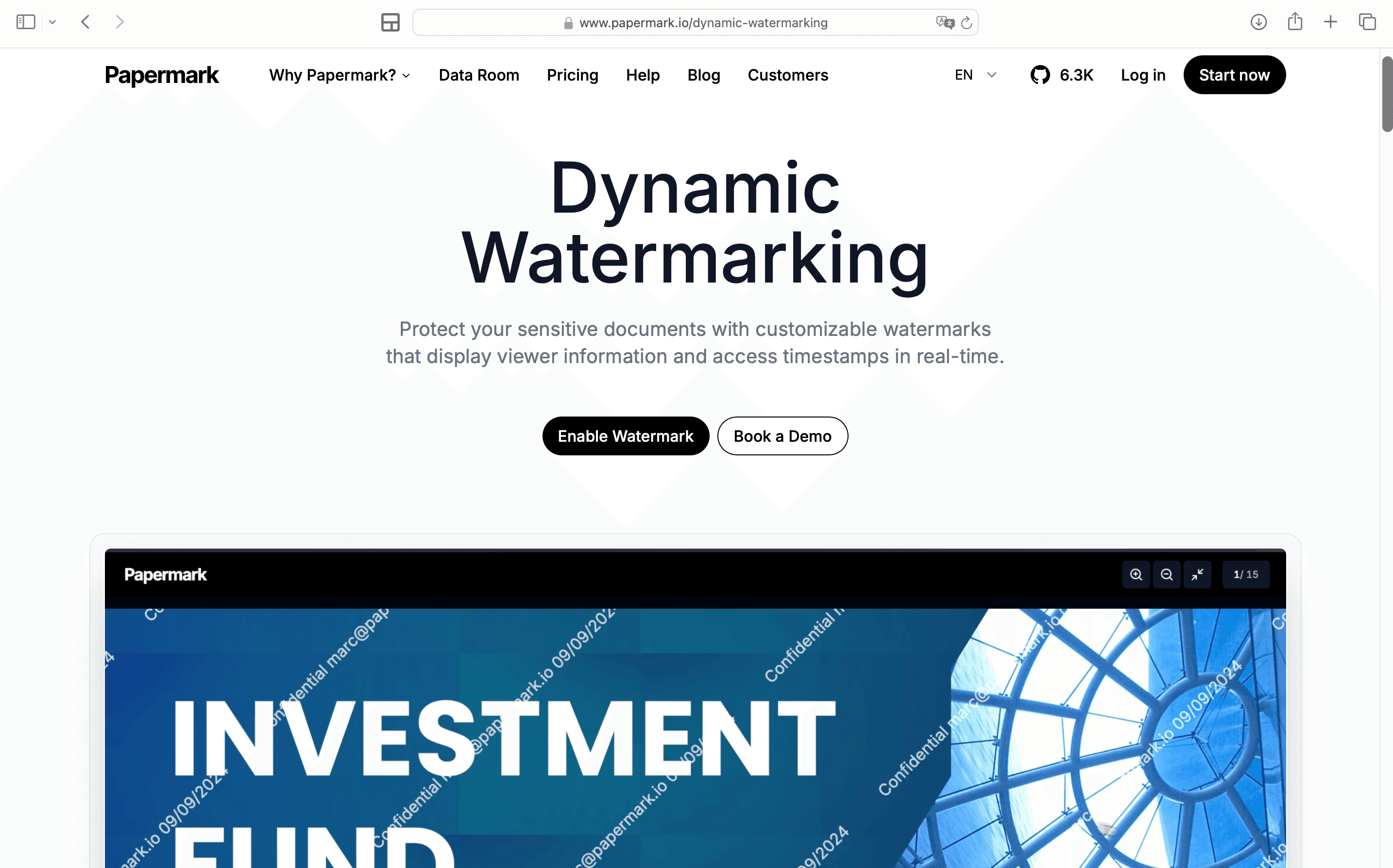
As the S-1 process started, the deal team stood up a virtual data room to run the exchange of diligence materials between the company, underwriters, and legal counsel. Draft registration statements, audited financials, customer contracts, and the financial model all lived behind granular permissions, so the lead underwriter's team saw the full set while junior syndicate members saw only what their role required. Every draft carried a dynamic watermark, and the audit trail showed exactly which banker opened the revenue model and for how long.
When the roadshow opened, the advisor extended controlled access to a curated set of institutional investors and used page-by-page analytics to see which parts of the story drew the most attention. Investors lingered on the automotive backlog schedule, which told the advisor to lead with that data in the pricing conversation. Solaria Halide priced at the top of its range, raised $180M, and its investor relations team kept the same data room live for the first post-IPO follow-on discussions a year later. The controlled, measurable document flow did not price the deal by itself, but it removed friction at every step and gave the advisor real signal on where demand was building.
How advisors get paid
Capital markets advisory fees are built around the transaction, and understanding the full structure matters because the headline percentage is only part of the total. Most engagements combine three components: a retainer that covers preparation work, a success-based transaction fee paid when the deal closes, and reimbursement of out-of-pocket expenses such as legal, accounting, and travel. The retainer keeps senior bankers engaged during the long preparation phase, while the transaction fee aligns the advisor's payoff with actually getting the deal done.
The percentages vary widely by transaction type, with equity deals carrying the highest fees because they demand the most marketing and disclosure work, and debt deals carrying the lowest. The table below shows typical ranges, but remember that smaller deals sit at the top of each range and large deals at the bottom, since much of the work is fixed regardless of size.
Transaction type
Typical fee
IPO
3-7% of proceeds (median around 5%)
Follow-on offering
3-5% of proceeds
Debt issuance
0.5-2% of principal
PIPE transaction
3-7% of proceeds
Advisory retainer
$50K-$500K annually
It is easier to see the full cost with a worked example. Consider a company raising $100M through an IPO. The underwriting fee at 5% is $5M, split roughly evenly between the lead underwriter and the rest of the syndicate. On top of that sit legal fees of $1-2M, accounting fees of $500K-$1M, an advisory retainer of $250K-$500K, and other costs such as printing and roadshow logistics of around $250K. Added together, the all-in cost of the raise lands near $7.5M-$9M, or roughly 7.5-9% of proceeds. The lesson is to budget for the total cost of going public, not just the quoted underwriting percentage.
When to hire capital markets advisors
Timing an advisor engagement is itself a strategic decision, and the right moment depends entirely on which transaction you are heading toward. Bringing an advisor in too late for an IPO means racing to fix governance and reporting gaps under deadline pressure, while engaging one too early for a simple debt refinancing burns retainer fees with little to show. The trigger, in every case, is a concrete financing need paired with a realistic sense of how long the preparation will take.
For an IPO, the honest answer is 12-18 months before the target listing date. The triggers are usually a company with revenue above roughly $100M for a U.S. listing, a strong growth trajectory, a credible path to profitability, and favorable market conditions. During this window the advisor assesses readiness, identifies gaps in governance and reporting, helps build financial forecasting systems, and shapes the equity story that investors will eventually buy.
Some companies need capital before they are ready for a full listing, and this is where pre-IPO financing comes in, typically 6-12 months out. The advisor structures a private placement, sources late-stage investors, and negotiates the terms of a pre-IPO round that bridges the company to its public debut while quietly testing investor appetite for the story.
Public companies reach for advisors when they need growth capital, want to strengthen the balance sheet by paying down debt, or need to give insiders liquidity through a follow-on. Companies that want to avoid equity dilution turn to advisors for debt financing, whether to refinance existing obligations at better terms or to fund acquisitions and large capital expenditure. In each of these cases the advisor's role is to time the offering, choose the structure, and access the right pool of investors.
Follow-on offerings: growth capital, balance-sheet repair, or insider liquidity
Debt financing: avoiding dilution, refinancing, or funding acquisitions
How to choose capital markets advisors
Choosing an advisor is one of the highest-leverage decisions in the whole financing process, because the right firm can add meaningfully to the price it achieves while the wrong one can leave money on the table or fail to get the deal done at all. The evaluation comes down to five areas, and the strongest candidates are the ones that combine genuine sector knowledge with deep investor relationships and a track record you can verify. Treat the selection like a hiring decision, not a beauty contest, and press for specifics rather than credentials.
Sector expertise comes first because investors buy stories they understand, and an advisor who knows your industry can frame yours far more persuasively. Ask how many IPOs or debt offerings they have completed in your sector, what comparable companies they have advised, and whether they hold sector-specific investor relationships. Market relationships matter just as much, since the ability to source demand from institutions is what ultimately prices a deal. Probe which investors they can reach, how they generate demand, and what their record on pricing and book-building looks like.
The remaining three areas are about execution, cost, and attention. A transaction track record tells you whether the firm can actually close, so ask about success rates, average IPO underpricing or overpricing, and how their past deals traded in the aftermarket. Fee structure needs to be understood in full, not just as a headline percentage, so clarify the retainer, the transaction fee, the expenses you will bear, and any success-based tiers. Finally, confirm that senior people will run your deal, because you want experienced bankers rather than junior staff. Ask who leads the engagement, how the team is structured, and how many other live deals they are juggling at the same time.
How Papermark supports capital markets transactions
Every transaction in this guide runs on the controlled exchange of sensitive information, and that is exactly where a purpose-built virtual data room earns its place in the process. Capital markets deals require sharing extensive financial, legal, and operational material with underwriters, legal counsel, rating agencies, and institutional investors, often over months and across dozens of parties with different access needs. Papermark gives advisors and companies a secure virtual data room to organize those materials and, just as importantly, to see how they are being used.
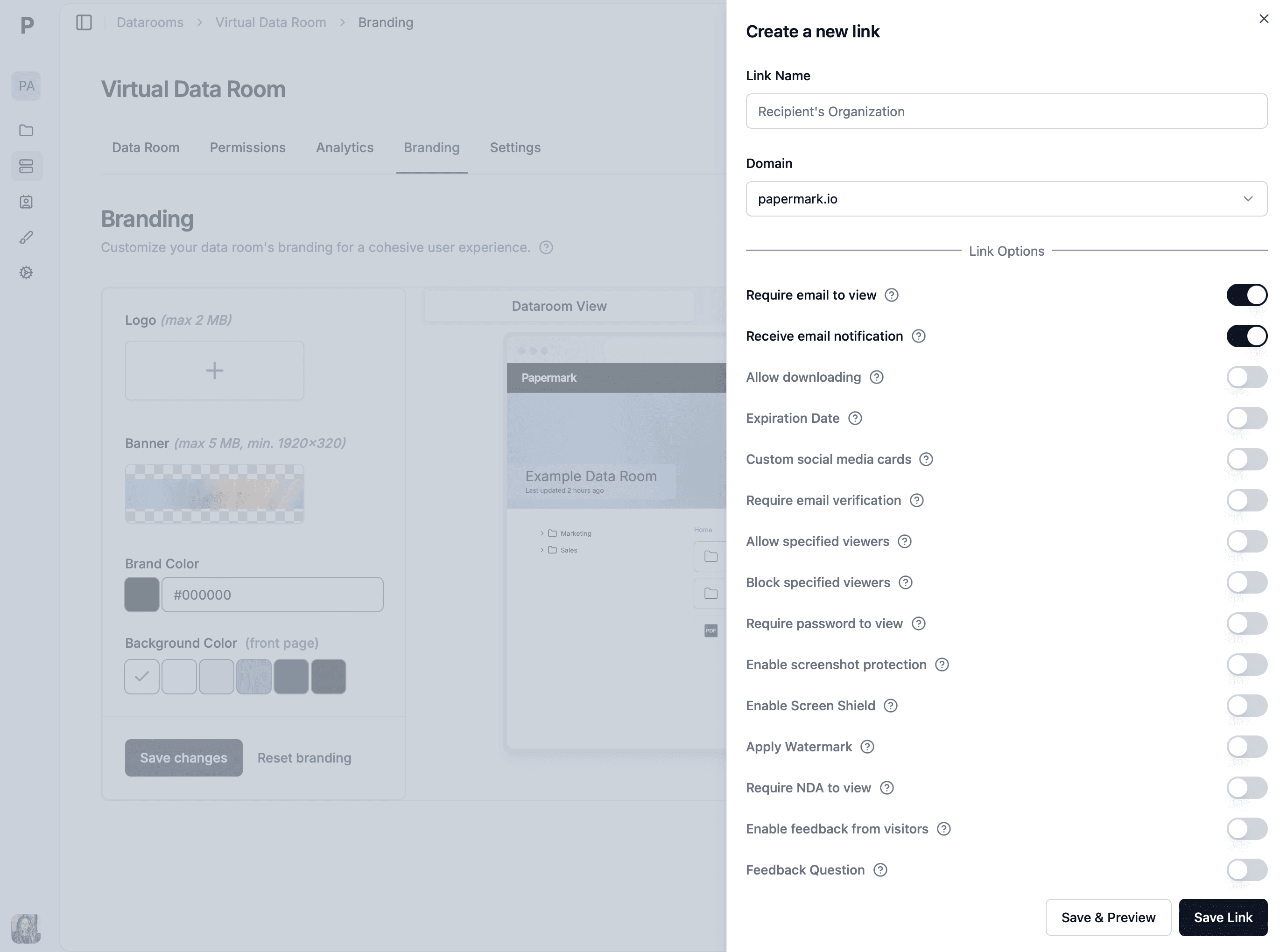
The features that matter most for an offering are the ones that control and measure access. Granular permissions let a deal team give the lead underwriter the full document set while limiting junior syndicate members or a specific investor to only the folders their role requires. Dynamic watermarks stamp each viewer's identity across sensitive financial projections and draft registration statements, which discourages leaks during a live process. The audit trail and page-by-page analytics show exactly which investor opened the revenue model, how long they spent on the backlog schedule, and where attention is concentrating, giving the advisor real signal to bring into pricing and allocation conversations. NDA gating requires each party to accept confidentiality terms before any file opens, and full-text search lets diligence teams find a clause across hundreds of documents in seconds.
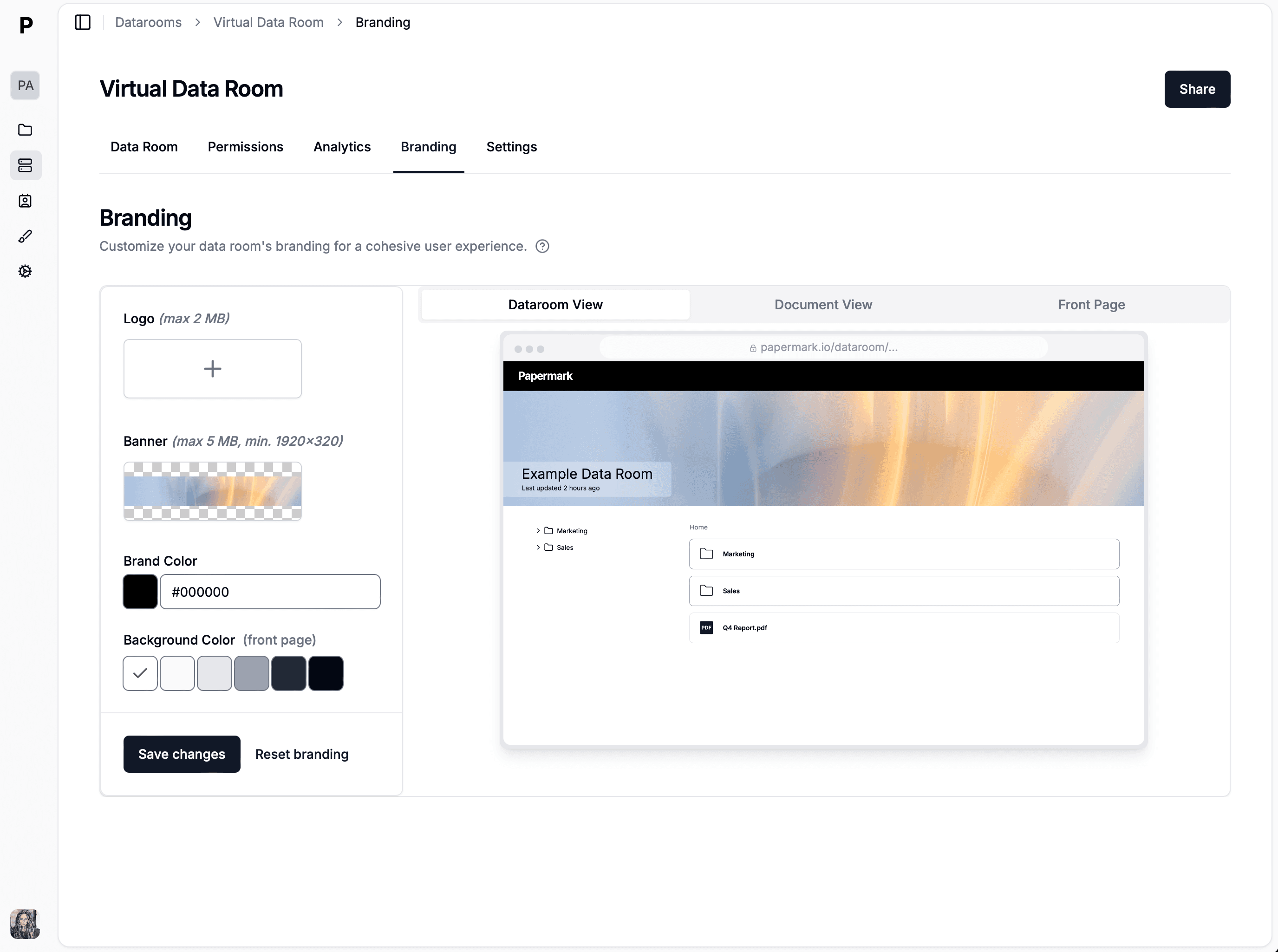
Papermark backs this with SOC 2 Type II security, custom domains so the data room carries the deal's branding, and pricing that starts at €99/month for the Data Rooms plan, which is a fraction of what legacy providers charge for a single offering. For advisors running IPOs, follow-ons, PIPEs, or debt deals, that combination of security, control, and analytics turns document management from an administrative burden into a source of insight. For deeper workflows, see how teams use a data room for investment banking and how a due diligence data room is structured, or explore the best data rooms for fundraising.
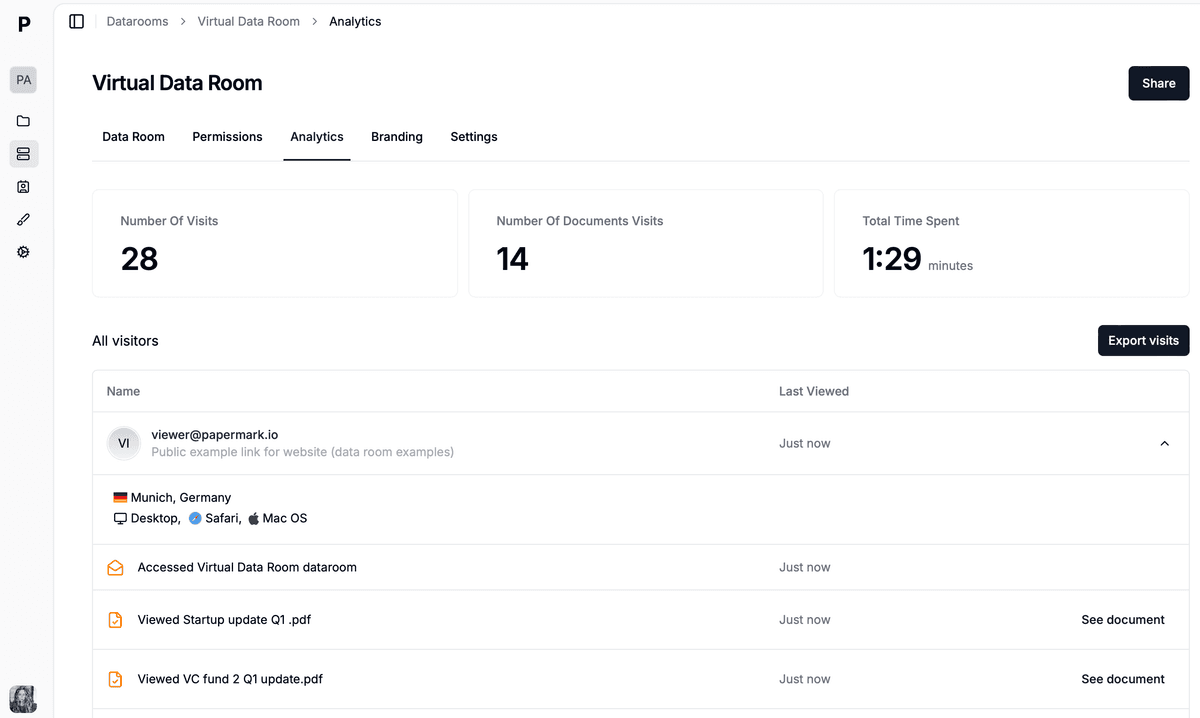
Page-by-page analytics in a Papermark virtual data room show which investors reviewed which sections of the offering materials.
The alternative for document version control
No credit card required
Page by page analytics
Require email verification
Require password to view
Allow/Block specified viewers
Apply Watermark
Require NDA to view
Custom Welcome Message
Key takeaways
Capital markets advisory is a specialized discipline focused on accessing public and private markets rather than on M&A, and treating it as interchangeable with other banking services is the first mistake to avoid. Costs are transaction-based, running 3-7% for equity, 0.5-2% for debt, and adding retainers and expenses on top, so budget for the all-in figure rather than the headline percentage.
For an IPO, hiring early pays off, because 12-18 months of preparation on governance, reporting, and the equity story materially improves outcomes. Sector expertise and institutional relationships are what separate strong advisors from the rest, since they translate directly into better pricing and deeper demand. And post-transaction support, from stabilization to investor relations, is a real part of the service that is easy to undervalue when you are focused on the closing date.