10 Best Building Products M&A Advisory Firms and Banks in 2026
·11 min read
Marc Seitz
Building products M&A is running hot at the top of the market while private owners face a very different reality on the ground. This guide profiles 10 verified building products M&A advisory firms, each with a documented practice in the sector rather than a generic industrials page, along with deal bands and sub-sector coverage.
Distribution consolidation is the story. QXO alone has committed more than $19 billion to acquisitions since January 2026, including a pending $17 billion purchase of TopBuild and the $2.3 billion acquisition of Kodiak Building Partners, according to research published by Brown Gibbons Lang. That level of activity resets comparable multiples for everyone below it.
Manufacturers see a different picture. Residential construction volumes remain sensitive to rates, and buyers underwrite through-cycle margins rather than a peak year. A window fabricator that earned 18% EBITDA margins in a strong year and 9% in a weak one will be priced closer to the second number unless the adviser can explain why the mix has changed.
Sub-sector matters as much as size. Basic materials, fenestration, specialty coatings, interior products and distribution all have different buyer pools, and the advisers below split along those lines.
If you would rather scan the field before reading the profiles, the M&A advisors database lists all 10 Building Products specialists below alongside every other adviser we have researched, filterable by industry, city and deal size.
Quick list of building products M&A advisory firms
Brown Gibbons Lang: Middle market bank with a dedicated building products investment banking team.
Harris Williams: Global middle market bank with a Building Products and Materials group.
Lincoln International: Global mid-market bank listing building products inside its industrials practice.
Capstone Partners: Middle market bank with a Building Products and Construction Services team.
FMI Capital Advisors: Investment banking arm of FMI, focused on the built environment.
Balmoral Advisors: Chicago middle market bank with a building products practice.
PMCF: Michigan middle market adviser covering building products and manufacturing.
Stout: Global advisory firm with real estate and construction sector coverage.
Greenwich Capital Group: Midwest bank with a real estate and building products vertical.
Livingstone Partners: International mid-market bank listing building products under industrials.
How to get yes from building products M&A advisory firms
Advisers in this sector screen on whether your earnings are explainable through a cycle. A manufacturer that can show margins across the last downturn and a coherent story about why the next one will be less painful gets an engagement letter. One whose entire track record is the post-2020 boom does not, because the adviser knows a buyer will normalise it back.
End market mix is the first thing they test. New residential, repair and remodel, commercial and infrastructure behave differently, and repair and remodel exposure is worth a premium precisely because it holds up when housing starts fall. Bring revenue split by end market for three years, not just by product.
Customer concentration is the second, and in distribution-heavy categories it is severe. If two large distributors or a single national homebuilder account for half your revenue, expect that to cost a turn or more and to drive the structure toward an earn out.
Third is document readiness. Building products diligence pulls customer and supplier agreements, freight and input cost history, plant level production and capacity data, environmental reports on every site, and product certification and warranty records. Staging that in a permissioned workspace is the fix, and our review of the best virtual data rooms covers what each tier costs.
Bring these to a first banker meeting:
Three years of financials plus a trailing twelve month adjusted EBITDA bridge
Revenue by end market: new residential, repair and remodel, commercial, infrastructure
Customer concentration by revenue, with contract or rebate terms
Input cost and freight history, plus your pricing actions against them
Plant level capacity, utilisation and capital expenditure history by site
Environmental reports for each site, product certifications and warranty claims history
No credit card required.
Papermark is our #1 VDR provider for M&A transactions right now. In two deals we used custom branding, dynamic watermarking, and granular permissions.
Only ten firms below made this list, because a documented building products practice is rarer than a generic industrials page. Filter on evidence rather than on a sector logo.
Named practice: The firm should publish a building products team, not just an industrials heading.
Sub-sector evidence: Basic materials, fenestration, coatings, interiors and distribution are separate buyer pools.
Deal band honesty: Request the median closed enterprise value over 24 months, plus the smallest and largest.
Buyer coverage: Ask which strategics and sponsors in your category they have actually closed with.
Cycle experience: Ask what they sold in 2009 and 2023, not just in the boom years.
Fee model: Middle market mandates run a $20,000 to $60,000 monthly retainer plus a success fee.
FINRA registration: Securities transactions require a registered broker dealer, so ask which one.
References: Two owners who closed in the last 18 months, including one deal that repriced.
How to approach building products M&A advisory firms
Approach three or four firms in parallel with the same information and compare their views on normalised earnings, because that is where their valuation ranges will actually diverge.
Confidentiality matters most with customers and key employees. In categories where a handful of distributors control access to the market, a customer who hears you are selling can slow reorders while they assess the risk, and that shows up in your numbers during diligence.
Decide whether you are selling the business, taking a minority partner, or selling a division.
Shortlist four firms with a documented practice in your sub-sector.
Send a blind summary: products, end market mix, revenue, normalised EBITDA, plants, timing.
Ask for a written valuation view with the comparable transactions behind it.
Ask who the fifteen most likely buyers are and which of them the team has closed with.
Check the engagement letter for exclusivity, tail period, expense cap and fee schedule.
Set the document policy before signing: tracked links, watermarks, no unrestricted downloads.
Require weekly written updates on outreach, indications and diligence requests.
Comparing the building products M&A advisory firms
#
Firm
Typical deal size
Building products coverage
1
Brown Gibbons Lang
Middle market
Basic materials, fenestration, coatings, interiors, distribution
2
Harris Williams
Middle market
Building products and materials, industrials
3
Lincoln International
Mid-market, global
Building products within industrials
4
Capstone Partners
Middle market
Building products and construction services
5
FMI Capital Advisors
Middle market
Built environment, contractors, building products
6
Balmoral Advisors
Middle market
Building products, chemicals and materials
7
PMCF
Middle market
Building products, manufacturing, distribution
8
Stout
Middle market
Real estate and construction, industrials
9
Greenwich Capital Group
Lower middle to middle market
Real estate and building products
10
Livingstone Partners
Mid-market, international
Building products within industrial
1. Brown Gibbons Lang
BGL runs one of the most clearly defined building products investment banking teams in the middle market, covering everything from aggregates and lumber through fenestration and interior components, and it publishes recurring research on distribution consolidation.
Deal size: Middle market
Sub-sectors: Basic materials, fenestration and glass, specialty coatings, interior and exterior components, distribution
End markets: Residential, commercial construction, infrastructure
Location: Cleveland, Ohio, with offices across the United States
Notable: Dedicated building products team publishing 2026 research on distribution M&A and consolidation
2. Harris Williams
Harris Williams maintains a Building Products and Materials group inside a global middle market bank, which means a seller gets sector specialists and an international buyer list from the same firm.
Deal size: Middle market
Sub-sectors: Building products and materials, industrial manufacturing and distribution
End markets: Residential, commercial, infrastructure
Location: Richmond, Virginia, with offices in the United States and Europe
Notable: Global investment bank listing Building Products and Materials among its named industry groups
3. Lincoln International
Lincoln lists building products explicitly within its industrials practice and covers the mid-market globally, which is useful when the likely acquirer is a European or Asian strategic rather than a domestic one.
Deal size: Mid-market, global
Sub-sectors: Building products, industrial manufacturing, distribution and services
End markets: Residential, commercial, infrastructure
Location: Chicago, with offices across the Americas, Europe and Asia
Notable: Global mid-market bank stating its industrials team completes more engagements than any other mid-market adviser
4. Capstone Partners
Capstone runs a Building Products and Construction Services team providing M&A, capital formation and financial advisory to middle market businesses across both the products and the services side of the sector.
Deal size: Middle market
Sub-sectors: Building products, construction services, industrials
End markets: Residential, commercial, infrastructure
Location: Boston, Massachusetts, with offices across the United States
Notable: Named team providing M&A, capital formation and advisory to construction services and building products businesses
5. FMI Capital Advisors
FMI is the specialist option. Its investment banking arm sits inside a firm built entirely around the built environment, which means the bankers already understand contractor economics, backlog quality and how building products flow to the job site.
Deal size: Middle market
Sub-sectors: Building products, contractors, engineering and construction, infrastructure services
End markets: Residential, commercial, industrial, infrastructure
Location: Denver, Colorado, with FMI offices across the United States
Notable: Investment banking arm of FMI, a firm dedicated to the built environment
6. Balmoral Advisors
Balmoral lists building products as one of five named practices alongside chemicals and materials, which is a useful combination for manufacturers whose value depends as much on formulation as on fabrication.
Deal size: Middle market
Sub-sectors: Building products, chemicals and materials, industrials
End markets: Residential, commercial, industrial
Location: Chicago, Illinois, with a New York presence
Notable: Independent middle market bank covering M&A, capital raising and special situations
7. PMCF
PMCF covers building products from Michigan alongside manufacturing and distribution, and it publishes sector research that makes its view on valuations easy to check before you sign anything.
Deal size: Middle market
Sub-sectors: Building products, manufacturing, distribution, plastics and packaging
End markets: Residential, commercial, industrial
Location: Michigan, with offices in the United States
Notable: Middle market adviser guiding owners, chief executives and private equity firms through transactions
8. Stout
Stout combines investment banking with valuation, transaction advisory and dispute work, and it names real estate and construction as a covered industry. That mix suits an owner who needs a valuation opinion or a quality of earnings review as well as a sale process.
Deal size: Middle market
Sub-sectors: Real estate and construction, industrials, distribution
End markets: Residential, commercial, infrastructure
Location: Offices across the United States, Europe and Asia
Notable: Global advisory firm covering corporate finance, valuation, transaction advisory and disputes
9. Greenwich Capital Group
Greenwich lists real estate and building products as one of its named verticals and works the lower and middle market from the Midwest, which suits owner-operated manufacturers and specialty contractors.
Deal size: Lower middle market through middle market
Sub-sectors: Real estate and building products, industrials and manufacturing
End markets: Residential, commercial
Location: Birmingham, Michigan, with offices in Cleveland, Nashville and New York
Notable: Middle market bank with a named real estate and building products vertical
10. Livingstone Partners
Livingstone names building products as a sub-sector inside its industrial practice and operates across the United States, Europe and Asia, which broadens the buyer list beyond domestic strategics.
Deal size: Mid-market, international
Sub-sectors: Building products, distribution, manufacturing and related services
End markets: Residential, commercial, infrastructure
Location: Chicago, with offices across Europe and Asia
Notable: International mid-market bank listing building products within its industrial sector coverage
Ten firms is a deliberately short list. Plenty of middle market banks will take a building products mandate, but these are the ones that publish a named practice or sub-sector in the space, which is the minimum evidence worth using as a filter.
Why you need secure document sharing in a building products sale
Building products diligence is site heavy. Buyers request environmental reports and permits for every plant, capacity and utilisation data by line, customer and rebate agreements, input cost and freight history, product certifications, and warranty and claims records, and multiple bidders want them at once.
The people asking for those files are frequently your competitors. The most credible buyer for a regional window fabricator is usually another fabricator in an adjacent state, and the distribution consolidators canvassing the market buy in territories where they already sell. Sending a folder of rebate agreements and plant cost data by email to fifteen parties, ten of whom will never bid, hands your national account terms and your line-level economics to businesses you will still be quoting against next season.
A confidentiality leak in this sector costs you on three fronts. Plant staff who hear the business is for sale start taking calls from the competitor down the road, national accounts that learn your rebate ladder use it in the next annual negotiation, and a distributor who suspects a change of ownership quietly starts dual sourcing. Email attachments cannot be recalled, cannot be watermarked, and tell you nothing about who actually opened them.
Data room for building products M&A
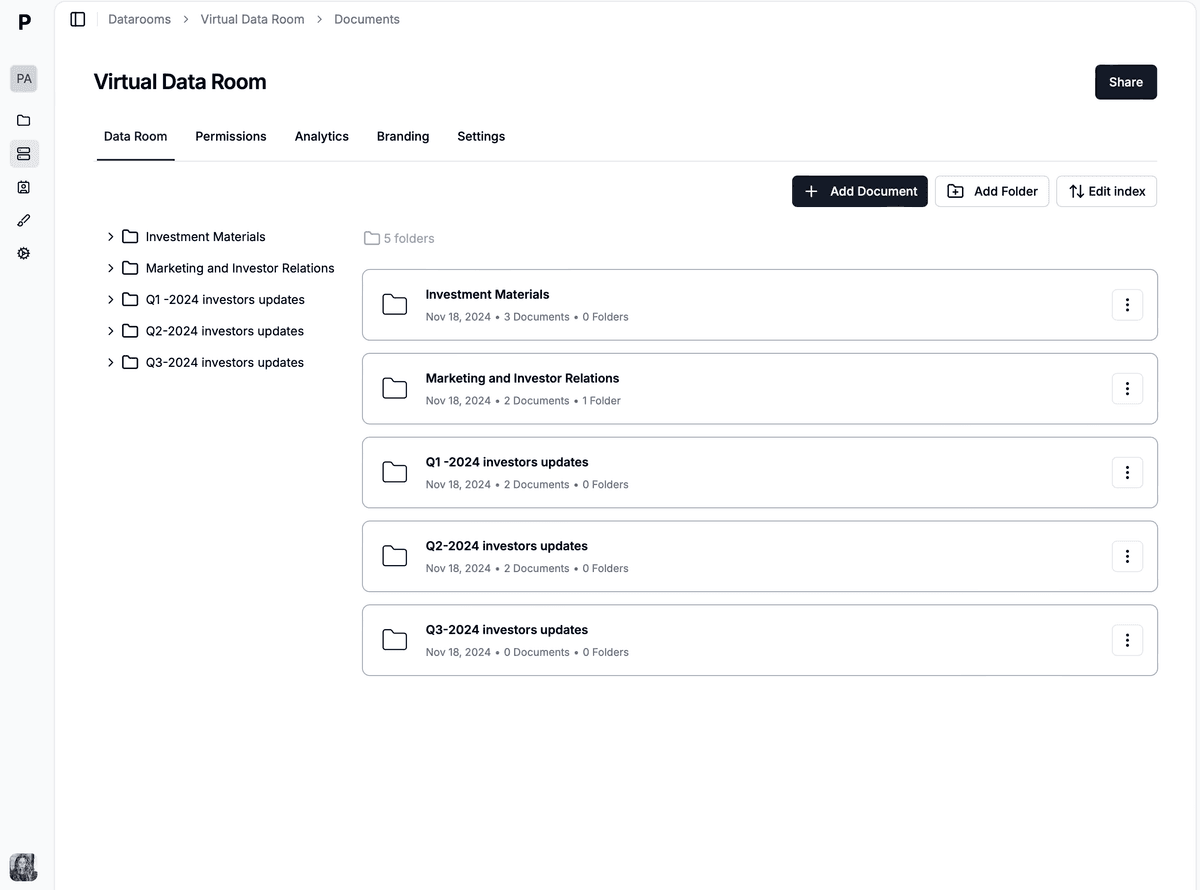
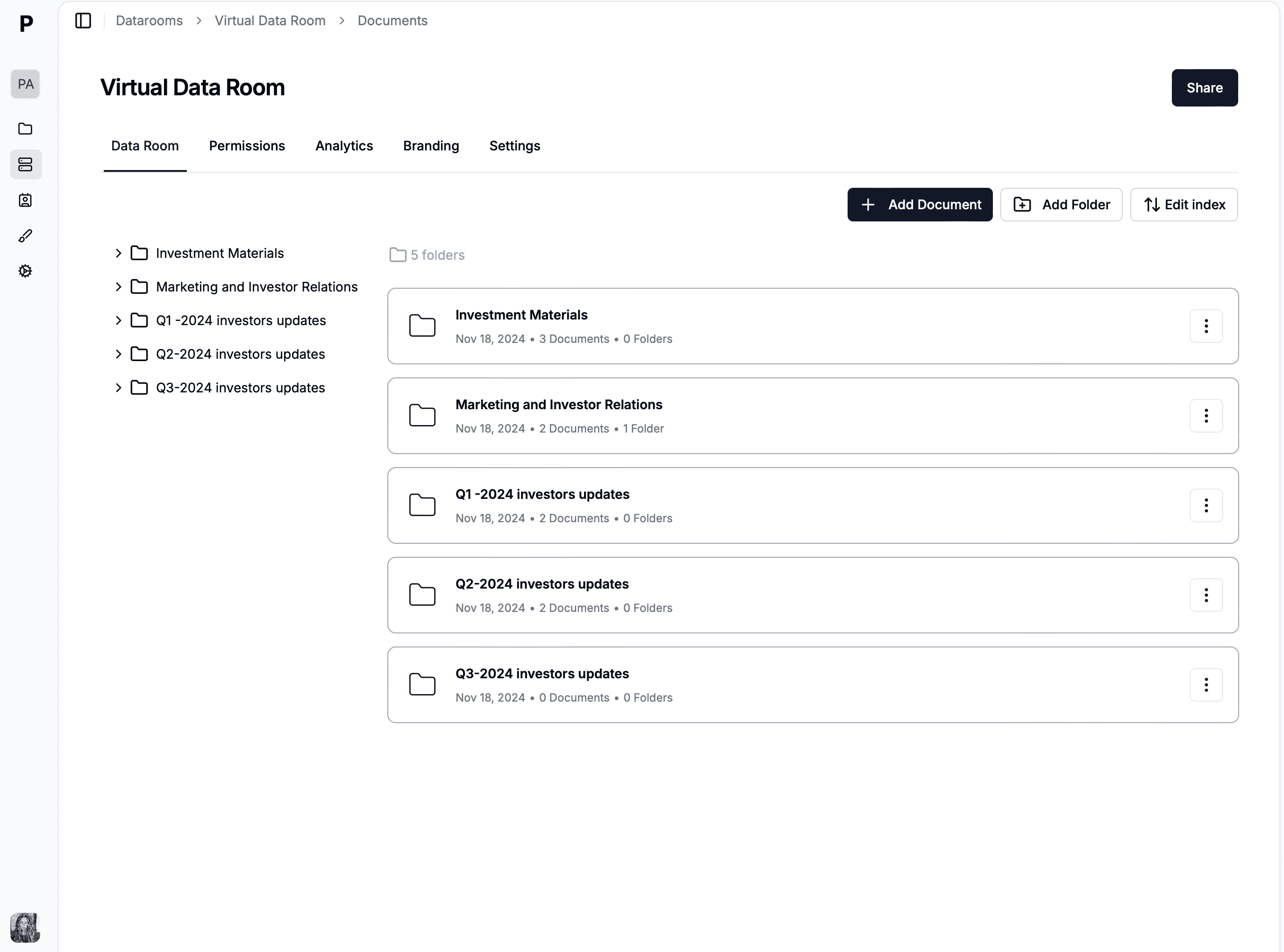
Folder-level permissions let a banker open the general file to fifteen buyers and plant cost data to two.
A data room for building products M&A is the permissioned workspace where your banker stages the diligence file and runs several buyers through it at once, without any of them seeing what the others see. It is what advisers mean when they ask whether your documents are ready before they take the mandate.
Papermark is a secure, fully customizable, and developer-friendly data room built for exactly this: a secure data room for your building products M&A process that keeps the sensitive parts of the file locked while the process runs. NDA agreements sit on the link itself, so a competing manufacturer signs before your customer pricing renders. Dynamic watermarking burns each viewer's email and the timestamp onto every page, which is the practical deterrent when the file contains rebate terms with national accounts. Granular file-level permissions let your banker open the general folder to fifteen parties while customer agreements and plant level cost data stay locked to the final two.
Page-by-page analytics tell your banker where interest is real. When one strategic spends twenty minutes on the end market mix exhibit and another has not opened the room since day two, the follow-up list writes itself. Automatic file indexing keeps a multi site environmental file navigable instead of collapsing into an unsearchable folder tree.
The Data Rooms plan is €149/month, or €99/month billed annually, with a 7-day free trial, and includes 3 team members, unlimited data rooms, unlimited documents, a custom domain, dynamic watermarking, NDA agreements, and granular file-level permissions. Open a secure data room before the teaser goes out and reuse it through diligence.
Why Papermark as a data room provider for M&A
Most virtual data rooms were built for bankers and priced for them. Papermark is a secure data room for modern dealmakers, and it is more customizable and more branded than any other VDR on the market.
Security first. SOC 2 Type II, granular file-level permissions, dynamic watermarking on every page, and NDA agreements that sit on the link itself.
Open source and self-hostable. The codebase is public, and Enterprise can run it in your own environment, which matters when a buyer's IT team asks where the documents actually live.
Branded and white-labelled. Custom domain and full white-labelling, so the room carries your firm's name rather than a vendor's.
AI and MCP. 57 typed MCP tools over the Model Context Protocol let Claude, Cursor, ChatGPT or your own code drive the room, plus a REST API for everything else.
Chat with your data room. Papermark AI answers questions across the room and the documents in it, so you are not scrolling a folder tree to find one clause.
Built for building products deals. Permissions are set per file, so plant-level data and environmental reports can stay locked while the general file stays open.
Did not find the right building products M&A adviser?
If your business is smaller than these firms take, or you want a valuation view before signing an exclusive, the alternative is approaching strategic and sponsor buyers directly with counsel and a transaction accountant supporting you.
If none of the ten above fits, the M&A advisors database lists every firm we have researched by city and by industry, with deal sizes and sectors side by side. Filter to building products to compare these ten against each other, or check your metro if you would rather work with an adviser locally.