

mergers-and-acquisitions
Due Diligence Template 2026: 150-Point Checklist for M&A and Fundraising
A ready-to-use due diligence template for 2026 with a 150-point checklist covering financial, legal, commercial, operational, and technology diligence.
Due diligence is never one-size-fits-all. A SaaS company buying a rival runs different checks than a venture fund vetting a Series A startup or a private equity firm buying a factory. The examples below walk through five real-world scenarios, each with a named but hypothetical company, so you can see what actually gets reviewed and why deals move on price.
Before the individual scenarios, it helps to understand the shape that every diligence process shares. A buyer or investor requests a defined set of documents, a data room is assembled, reviewers work in parallel across finance, legal, and operations, and each workstream reports back the risks it found. The output is not a pass or fail grade. It is a list of issues, each attached to a dollar value or a proposed remedy.
The reason the examples below diverge so sharply is that risk lives in different places for each deal type. In software, the risk is often hidden in churn cohorts and whether customer contracts survive a change of control. In manufacturing, it is deferred maintenance and a single supplier that could halt the line. In real estate, it is soil contamination the seller never disclosed. A generic checklist misses these because it treats every transaction the same. Real examples show where experienced buyers actually look.
What ties the scenarios together is the discipline of pricing what you find. A thorough diligence process that surfaces a problem and then adjusts the offer is a success, even when the number moves. The failure mode is discovering the same problem after closing, when there is no longer any leverage to negotiate. Each example below ends with an outcome that reflects this: the deal usually still happens, but on terms informed by what came out of the data room.
Cartograph Software, a mapping and location-analytics company, agreed in principle to acquire Pineboard Analytics, a smaller competitor, for $15M. Cartograph's corporate development lead opened a data room and gave three internal teams parallel access: finance, legal, and a two-engineer technical squad. The letter of intent set a 45-day exclusivity window, which framed the entire timeline.
Finance started with three years of Pineboard's financials and a monthly recurring revenue breakdown by cohort. The headline revenue looked healthy, but when the team rebuilt the churn analysis from raw billing exports rather than the summary deck, gross revenue churn came in materially higher than the seller had represented. Two of Pineboard's top ten customers, together roughly a fifth of revenue, were also on month-to-month terms rather than the annual contracts implied in the pitch.
Legal, meanwhile, read every enterprise contract for change-of-control and assignment language. A handful of the largest agreements required customer consent to transfer, which meant Cartograph could not assume it would keep that revenue on day one. The technical team reviewed the codebase for security issues and open-source license exposure and flagged a dependency with a copyleft license buried in the billing service.
None of these findings ended the deal. They repriced it. Cartograph moved its offer from $15M to $13M, structured part of the difference as an earnout tied to the at-risk accounts renewing, and required the license issue be remediated before close. The lesson from this hypothetical case is the one that recurs across M&A: the summary deck is a starting point, and the real numbers live in the raw exports inside the data room.
Buyers running a software acquisition typically concentrate on four areas:
Tessellate, a fintech startup building embedded-payments infrastructure, raised an $8M Series A led by Vireo Ventures. Fundraising diligence runs in the opposite direction from an acquisition: the investor is buying a minority stake in a company that will keep operating independently, so the emphasis falls on future trajectory and governance rather than on integration risk. Vireo's partners cared less about audited history, which barely existed, and more about whether the growth was real and repeatable.
The core of the review was unit economics. Vireo rebuilt Tessellate's customer acquisition cost and lifetime value from first principles, checked the payback period, and stress-tested the 18-month model against the actual burn rate to confirm the round genuinely extended runway rather than papering over a hole. On the qualitative side, the partners ran reference calls with former colleagues and a sample of customers, and they read the incorporation documents to confirm a clean Delaware C-corp structure with founder IP properly assigned.
The finding that moved terms was governance rather than performance. Tessellate's cap table carried a tangle of SAFEs at inconsistent caps plus a thin, already-committed option pool. Vireo funded the round but at a $7M pre-money valuation, conditioned on cleaning up the SAFE conversions and expanding the option pool before close so the incoming money was not immediately diluted by hiring.
A typical Series A diligence request covers a compact but demanding set of items:
Kestrel Industrial Partners, a lower-mid-market private equity firm, pursued a $50M buyout of Thornwood Manufacturing, a family-owned maker of precision metal components. Private equity diligence is the most forensic of the five examples because the firm is putting leverage on the business and needs the cash flows to be exactly what they appear. The centerpiece is a quality-of-earnings study, run by an outside accounting firm, that normalizes EBITDA by stripping out the owner's above-market salary, one-time expenses, and personal costs run through the company.
Alongside the earnings work, Kestrel commissioned an operational assessment. An engineer walked the facility, rated the condition of the equipment, and checked safety and environmental compliance. This is where the deal's defining issue emerged: several critical machines were near end of life, and the family had been deferring maintenance to flatter cash flow. The team also mapped the supply chain and found a sole-source supplier for one key alloy, a concentration risk that could stop production if that vendor faltered.
Kestrel adjusted its offer from $50M to $45M to reflect roughly $3M of near-term capital expenditure the buyer would have to fund, plus a cushion for the supplier risk. The firm also built a management-equity incentive into the deal to retain the plant manager, whose institutional knowledge was itself a key-person risk. As with the other examples, diligence did not stop the transaction; it recalibrated the price to the reality the data room revealed.
Private equity buyers concentrate their diligence on:
Rowan Capital, a real estate investment firm, went under contract to buy a $25M multi-tenant office building. Property diligence has a different rhythm from the corporate examples because much of it is physical and time-boxed by a contractual inspection period. Rowan's team ordered a full building inspection covering roof, HVAC, electrical, and plumbing, and commissioned a Phase I environmental assessment as a matter of routine.
The Phase I flagged a former dry-cleaning tenant in the building's history, which triggered a Phase II investigation with soil and groundwater sampling. In parallel, Rowan's analysts worked the financial side: they audited the rent roll tenant by tenant, checked lease expirations against the offering assumptions, and reconciled three years of operating expenses against the seller's stated net operating income. A title search confirmed clear title with no undisclosed liens.
The Phase II confirmed limited contamination requiring remediation, and Rowan negotiated a $1M price reduction to cover the cleanup and the associated risk. The rent-roll audit also revealed that two leases were expiring within the first year, which shaped Rowan's underwriting of renewal risk even though it did not change the headline price. The pattern holds once more: the environmental report and the lease review did not end the deal, they set the terms on which it closed.
Commercial real estate diligence generally covers:
Verdant Robotics, a warehouse-automation manufacturer, evaluated Copperline Components as the sole supplier of a custom actuator before awarding a multi-year contract. Vendor diligence is smaller in dollar terms than an acquisition but no less consequential operationally, because a critical supplier that fails can halt a production line as surely as a bad acquisition can sink a balance sheet. Verdant's procurement and quality teams ran the review jointly.
Financial stability came first. Verdant pulled a credit report and recent financial statements to confirm Copperline had the liquidity to fund the tooling and inventory the contract required, and checked that insurance coverage was adequate. Operational capability came next: a facility audit assessed production capacity against Verdant's growth plan, verified ISO 9001 certification, and reviewed the quality-control process and the supplier's own business-continuity plan. Because the actuator firmware touched Verdant's network, the security team also reviewed Copperline's cybersecurity posture and SOC 2 status.
The outcome here was not a price adjustment but a structural safeguard. Verdant awarded a three-year contract conditioned on quarterly business reviews and a commitment from Copperline to qualify a second manufacturing site within twelve months, reducing the single-facility risk that the audit had surfaced. The through-line with the other examples is that diligence converts an unknown into a managed, priced, or contractually mitigated risk.
Supplier and vendor diligence typically examines:
Read side by side, these scenarios point to a handful of patterns that hold regardless of transaction type. Financial review is universal: every buyer, investor, and procurement team rebuilt the numbers from source data rather than trusting a summary. The most valuable findings almost always came from that reconstruction, whether it was Cartograph's churn cohorts or Thornwood's normalized EBITDA. If you take one habit from these examples, it is to verify the headline figures against the raw exports.
The second pattern is that diligence reprices far more often than it terminates. Four of the five examples ended in a closed deal on adjusted terms, and the fifth added contractual safeguards rather than walking away. Buyers who treat diligence as a search for reasons to renegotiate, rather than reasons to quit, extract the value the process is designed to create. The leverage exists only before signing, which is why finding an issue during diligence is a win and finding it afterward is a loss.
The third pattern is coordination. In each example, several workstreams ran at once against a shared, well-organized document set, and the quality of that shared workspace shaped how fast and how thoroughly the review went. This is the practical reason a virtual data room has become standard on deals of any size: it is what lets a finance team, a law firm, and a technical reviewer work the same files in parallel without stepping on each other. The next section covers how Papermark supports that workflow specifically.
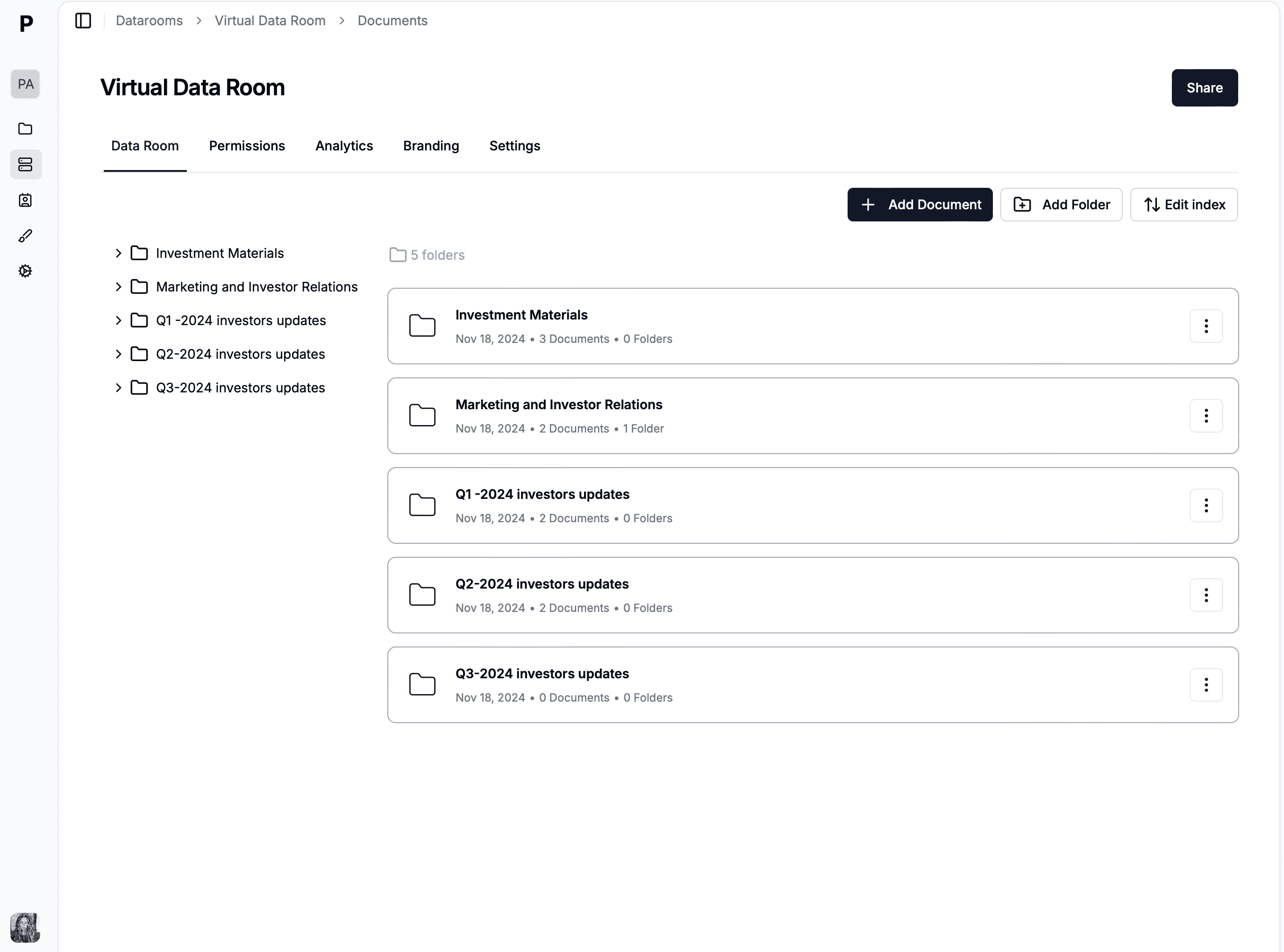
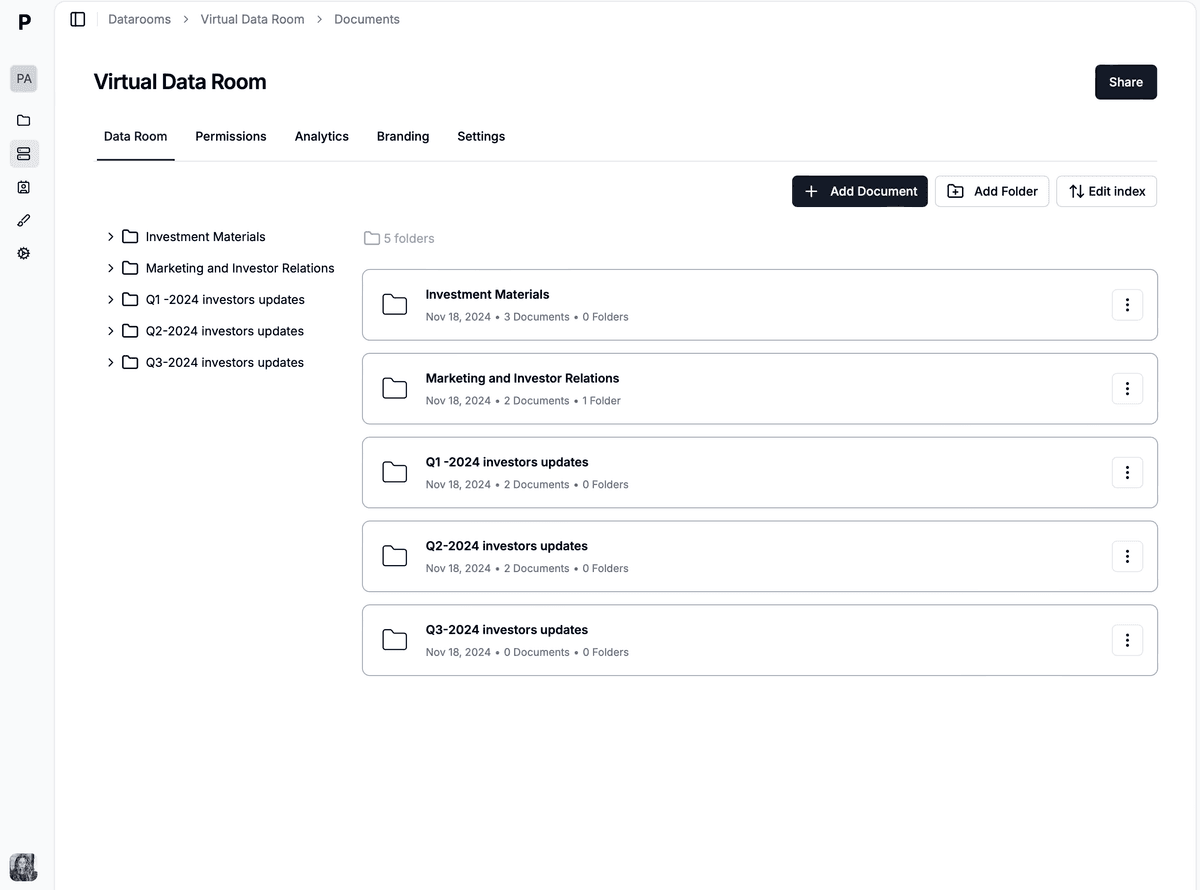
Every scenario above depended on sharing hundreds of confidential documents with several parties at once while keeping tight control over who saw what. That is precisely the problem a virtual data room solves, and it is what Papermark is built for. Rather than emailing files or dropping them in a consumer file-sharing folder, you assemble a structured data room, organize documents by category into folders, and issue each reviewer a secure link scoped to exactly what they should see.
Granular permissions are the feature that makes the parallel-workstream pattern possible. In the Cartograph example, the finance team, the outside counsel, and the two engineers each needed a different slice of the room, and Papermark's folder- and file-level access controls with visitor groups let you grant that without maintaining five separate copies. Dynamic watermarking stamps each viewer's email, IP, and a timestamp across every page, which discourages leaks of sensitive financials, and NDA gating can require a viewer to accept an agreement before a single file opens. For regulated deals, Papermark maintains a full audit trail and is SOC 2 Type II compliant, so you can prove exactly who accessed what and when.
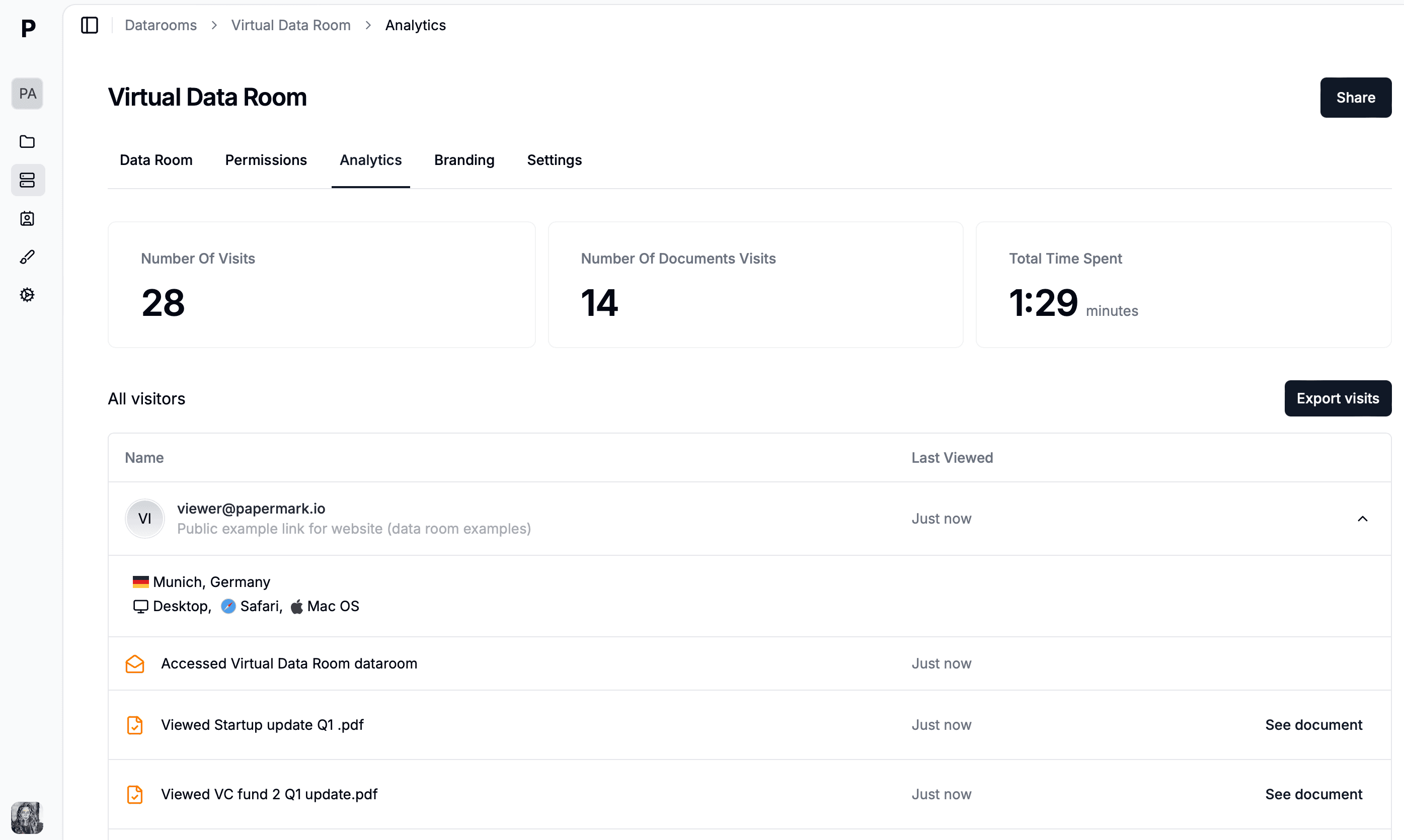
The analytics matter just as much on the sell side. Page-by-page analytics show which sections a buyer actually spent time on, which is an early signal of where the negotiation will focus, and full-text search lets reviewers find a clause across hundreds of documents in seconds. Papermark's Data Rooms plan starts at €99 per month flat, which keeps a professional-grade diligence workspace accessible for a Series A round or a vendor review, not just a nine-figure buyout. You can connect a custom domain so the room carries your brand rather than a generic vendor URL.
Papermark's virtual data room gives every due diligence workstream secure, permissioned access with page-by-page analytics.
If you want to see the full document set behind these scenarios, the due diligence template and the due diligence questionnaires cover the checklists and question lists that pair with the examples here.
A ready-to-use due diligence template for 2026 with a 150-point checklist covering financial, legal, commercial, operational, and technology diligence.
A due diligence questionnaire (DDQ) guide with 170 questions across financial, legal, commercial, operational, and technology topics for 2026 M&A deals.
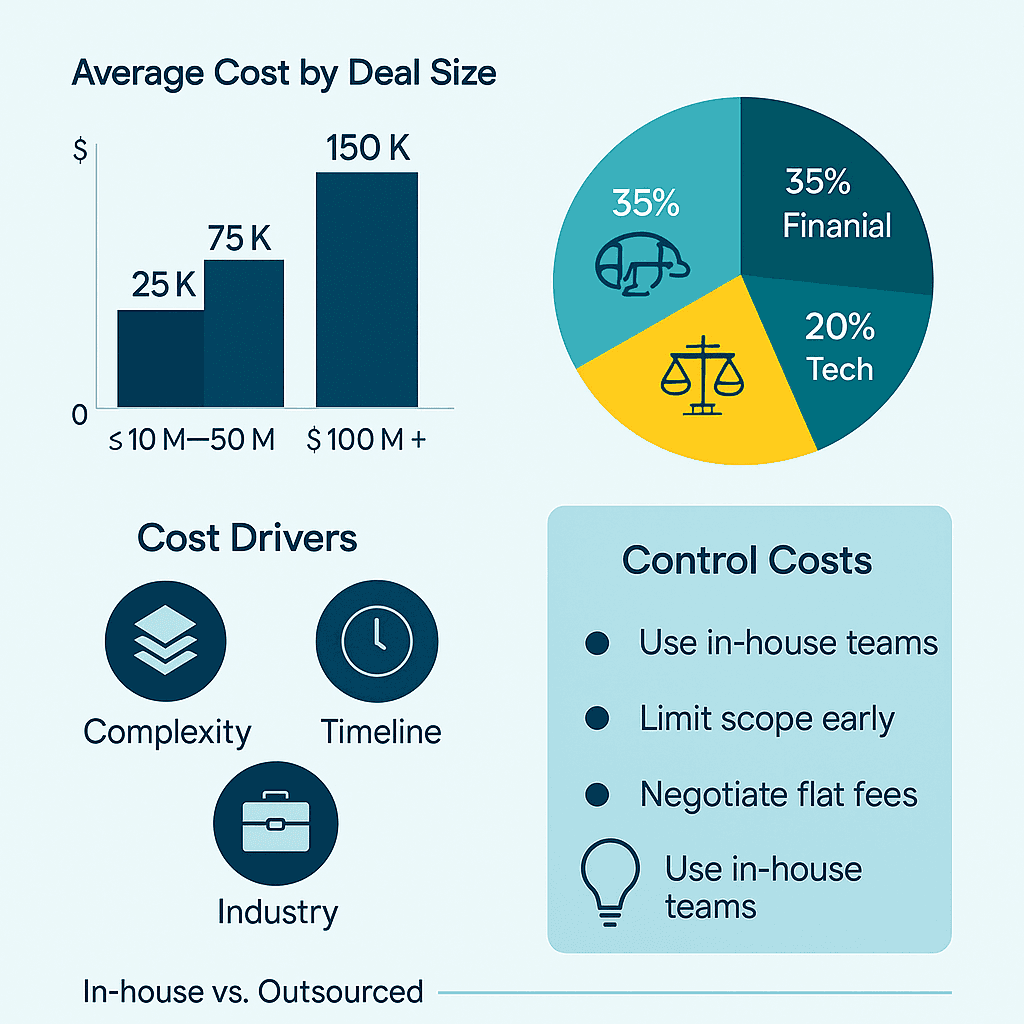
Due diligence cost in 2026 by deal type: M&A, investment, legal, and financial fees from $10K seed reviews to $2M+ mega-deals, plus 5 proven ways to cut costs 20-40%.