

mergers-and-acquisitions
Due Diligence Questionnaires (DDQs): 170 Questions to Ask in 2026
A due diligence questionnaire (DDQ) guide with 170 questions across financial, legal, commercial, operational, and technology topics for 2026 M&A deals.
Due diligence does not have to start from scratch every time. A due diligence template is a reusable checklist of every document and question a buyer or investor is likely to raise, organized by workstream. Reused across deals, it saves weeks of preparation and stops critical items slipping through the cracks.
A due diligence template is the master list that turns a chaotic document scramble into a repeatable process. Whether you are a founder raising a Series A, a corporate development team acquiring a competitor, or a private-equity firm underwriting a buyout, the underlying questions rhyme: is the business what the seller says it is, and what risks are hidden in the details. A template captures those questions once so that every future deal starts from a known baseline rather than a blank page.
The value shows up on both sides of the table. For a buyer or investor, the template is a coverage guarantee: it ensures the review touches financials, contracts, intellectual property, litigation, and technology rather than fixating on the numbers alone. For a seller, the same list works in reverse as a preparation guide. Sellers who assemble these documents proactively, an exercise often called vendor due diligence, move faster through the process and negotiate from a position of strength because there are fewer surprises to renegotiate against.
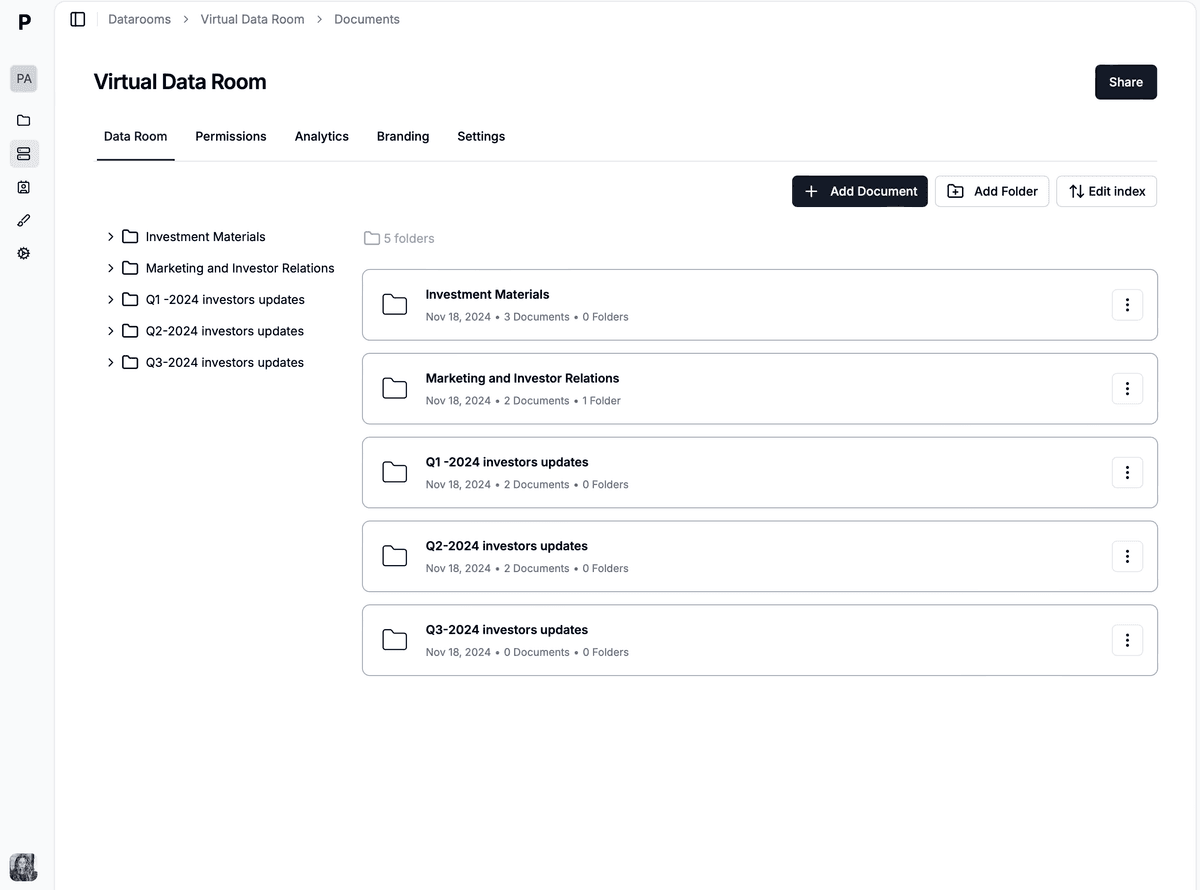
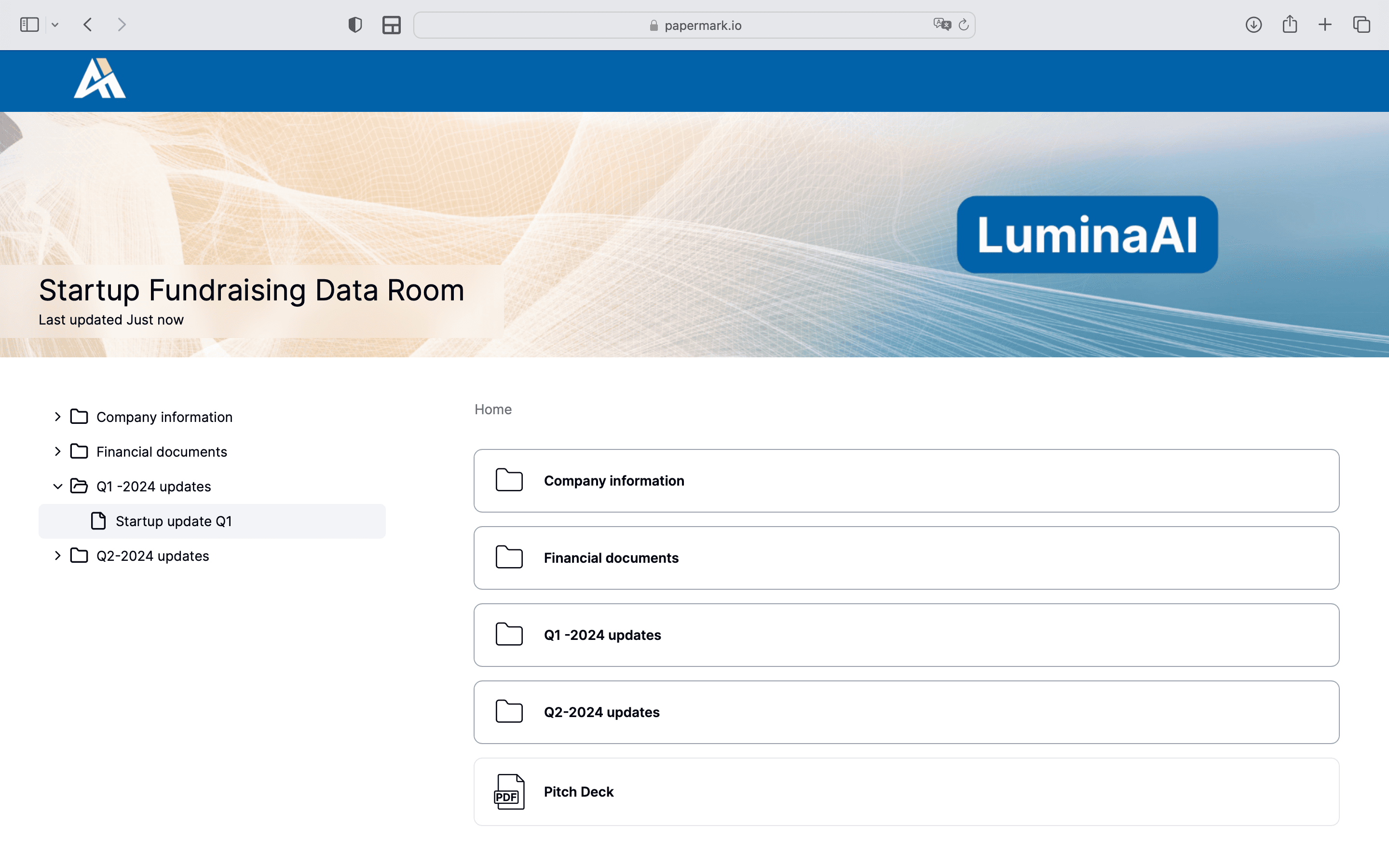
The template is also the blueprint for your data room. Each checklist category becomes a top-level folder, each sub-category a subfolder, and each line item a document to upload. That one-to-one mapping is why the structure below is worth adopting even if you tailor the individual items. For a deeper walk through folder design, see our guide to data room folder structure, and for concrete examples of how deals actually unfold, our due diligence examples breakdown.
Financial due diligence is where most reviews begin because it drives valuation directly. The buyer's goal is to confirm that reported revenue, margins, and cash flows are real, sustainable, and free of one-time distortions. That means reconciling audited statements against management accounts, understanding how revenue is recognized, and separating recurring income from one-off spikes. Expect a quality-of-earnings (QoE) analysis on any deal of meaningful size, which normalizes EBITDA by stripping out non-recurring items and owner add-backs.
The second focus is the balance sheet and everything that sits off it. Debt schedules, covenants, contingent liabilities, and related-party transactions all change the effective purchase price even when they never appear in the headline number. Working capital gets special attention because the target level is negotiated into the deal and directly affects how much cash changes hands at close. Assemble these documents in the order a reviewer reads them, starting with the historical financials.
Historical financials
Revenue and customers
Expenses, profitability, and metrics
Debt, tax, and projections
Legal due diligence confirms that the seller actually owns what it is selling and that nothing in the contract stack or litigation history will blow up after close. The starting point is corporate housekeeping: the certificate of incorporation, bylaws, board and shareholder minutes, and above all a clean, current cap table. On venture and growth deals, messy equity records, undocumented option grants, or missing IP assignments from early founders are among the most common reasons a deal slows or reprices.
From there the review moves to the contracts that carry the business and the liabilities that could follow the buyer home. Change-of-control provisions matter enormously in M&A because they can let key customers or partners walk away the moment ownership changes. Intellectual property, employment agreements, regulatory licenses, and open litigation each get their own pass. For a structured set of the questions counsel will ask, pair this section with our due diligence questionnaires resource.
Corporate and ownership
Contracts and agreements
Intellectual property
Employment, compliance, and litigation
Commercial due diligence looks outward rather than inward. Where financial diligence verifies the numbers the company already produced, commercial diligence tests whether those numbers can continue and grow. Reviewers size the total addressable market, map the competitive landscape, and pressure-test the assumptions baked into the growth plan. The core question is whether the business has a durable position or is riding a temporary wave that will not survive new ownership.
Customer evidence sits at the heart of this workstream. Segmentation, acquisition channels, win-loss analysis, and satisfaction scores such as NPS reveal how the company actually wins and keeps business, not just how it describes itself in the deck. On sell-side deals, strong commercial diligence material is often the difference between a full-price outcome and a discounted one, because it substitutes evidence for the buyer's skepticism. The distinction between financial and commercial diligence is a frequent point of confusion, and our M&A due diligence process guide walks through how the two run in parallel.
Market and competition
Customers and sales
Product and growth
Operational due diligence examines how the business actually runs day to day and how well it will hold together under new ownership. The reviewer looks at the organizational chart, documented processes, the supply chain, and the physical or production footprint. The underlying concern is key-person risk and process fragility: a company that depends on a handful of undocumented workflows or a single irreplaceable operator is harder to integrate and riskier to own.
Technology and people round out the picture. Even for non-software businesses, IT infrastructure, cybersecurity posture, and disaster-recovery readiness are now standard review areas because an outage or breach after close lands on the buyer. Team and culture assessment, including retention risk among key employees and any pending succession gaps, often determines whether the value modeled in the spreadsheet actually survives the transition.
Operations and processes
Technology and systems
Team and culture
For software and technology targets, a dedicated technical review sits alongside the financial and legal workstreams. Technology due diligence assesses whether the product is built to last: the architecture, the state of the codebase, accumulated technical debt, and how gracefully the system scales under load. A modern, well-documented stack supports the valuation, while heavy technical debt or a fragile monolith becomes a negotiating lever for the buyer.
Security and compliance carry disproportionate weight here, especially for anything handling regulated or customer data. A current SOC 2 Type II report, recent penetration testing, and clean vulnerability scans signal maturity and shorten the review. The team and delivery process, meaning how the company ships, tests, and recovers from incidents, tells the buyer whether the roadmap is credible. If you are assembling a technical data room, our data room checklist for 2026 covers the supporting document set in more detail.
Product and architecture
Security and compliance
Development, infrastructure, and metrics
A template only earns its keep when you adapt it to the deal in front of you. Not every line item applies to every transaction, and forcing an irrelevant checklist on a small deal creates busywork that slows everyone down. The four steps below turn the static list above into a live workflow: customize it, load it into a data room, assign ownership, and track progress to close.
The most important early decision is scope. A SaaS acquisition demands deep technology diligence, while a services business may skip that workstream entirely and lean harder on customer contracts and key-person risk. Match the depth to the check size. Once you have pruned and extended the list, the rest of the process is about organization and accountability rather than raw effort.
1. Customize for your deal. Remove irrelevant sections, add industry-specific items, and adjust depth based on deal size. A 500,000 dollar acquisition should not carry the same 150-point burden as a 50 million dollar buyout; focus first on financial, legal, and customer diligence.
2. Organize into a virtual data room. Create a folder structure that mirrors the checklist categories so reviewers find documents where they expect them:
3. Assign responsibility. Divide the checklist across the team so nothing is orphaned. Finance owns financial diligence, legal counsel owns legal and compliance, operations or the CEO owns commercial and operational, and the CTO or tech lead owns technology on software deals.
4. Track progress. Use the checkboxes to track document collection, and hold a short regular standup to surface blockers early. Regular check-ins are what prevent the last-minute scramble that derails otherwise-healthy deals.
Quillstream Analytics, a hypothetical Series B revenue-intelligence SaaS company, agreed to be acquired by a larger data-platform buyer for 42 million dollars. Rather than wait for the buyer's request list, the CFO pulled this template into a shared tracker three weeks before the letter of intent was signed and ran it as a vendor due diligence exercise. She pruned the roughly 150 items to the 110 that fit a software business, dropping the manufacturing and production-capacity lines and adding a data-processing-agreement inventory for the company's enterprise customers.
Each of the five workstreams got an owner. The finance lead assembled three years of audited statements plus a management-prepared quality-of-earnings summary, the general counsel reconciled the cap table and chased two outstanding founder IP assignments from the company's earliest days, and the VP of engineering compiled the SOC 2 Type II report and a candid technical-debt memo. Everything landed in a virtual data room whose folders mirrored the checklist categories exactly.
When the buyer's advisors opened access, they found 94 percent of their standard request list already present and indexed. The two open items, the founder IP assignments, were flagged in a cover note with a remediation date rather than discovered as a surprise later. Diligence that the buyer had scoped for 75 days closed in 48. The preparation did not change the fundamentals of the business, but it removed the friction and information gaps that typically invite a price chip, and Quillstream held its valuation through to signing.
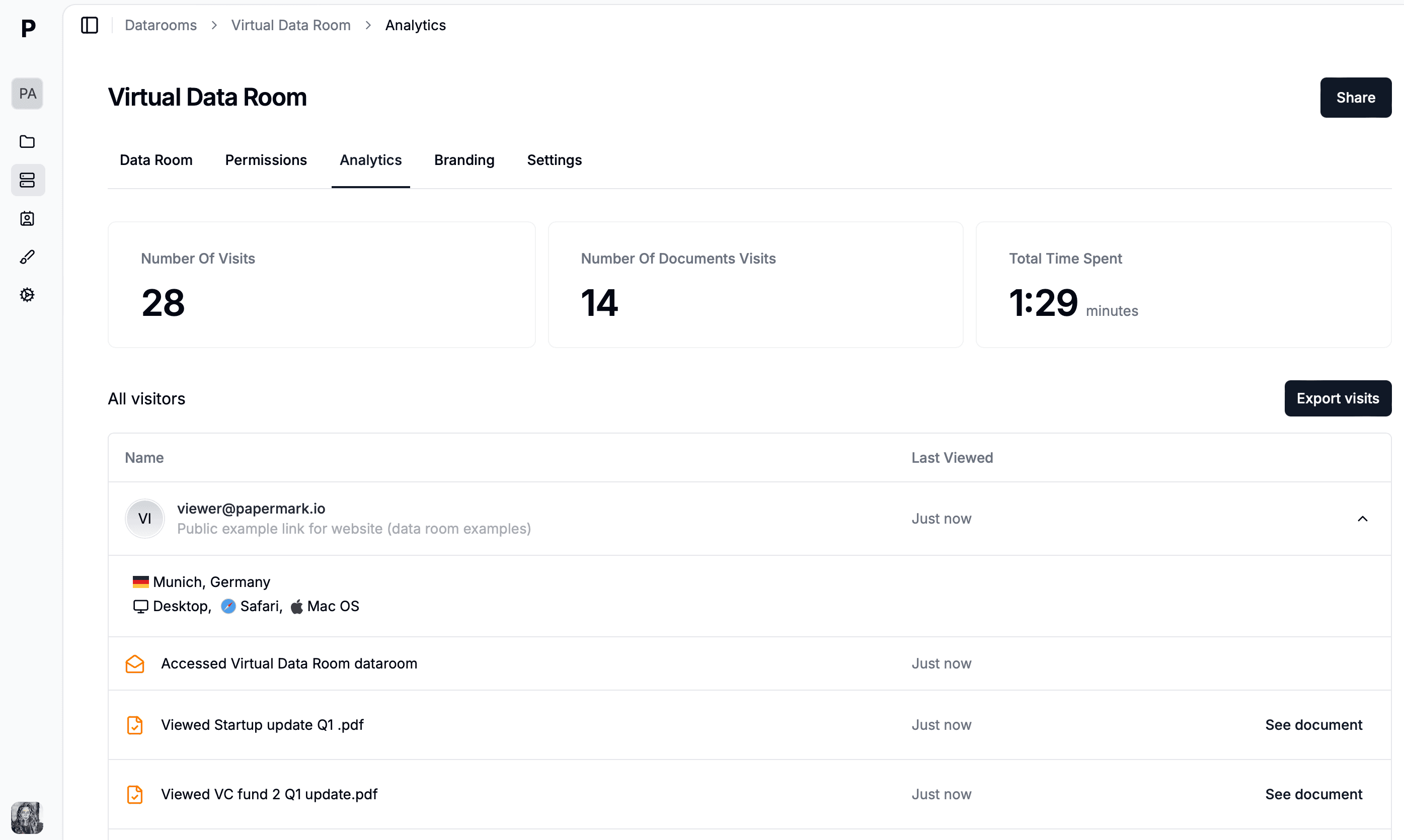
Once your template is built, the bottleneck moves from what to collect to how to share it securely. Email threads and shared Dropbox folders were never designed for a review where a dozen advisors need scoped access to hundreds of confidential documents. A purpose-built virtual data room closes that gap, and Papermark maps naturally onto the five-workstream structure above: create one top-level folder per checklist category, upload each line item, and you have a review-ready deal room.
The controls are what make it safe to open. Granular permissions let you decide which reviewer group sees which folders, so the finance advisors reach the financial diligence folder while legal counsel works the legal stack, without either seeing the other's workspace. Dynamic watermarking stamps each viewer's email across every page to deter leaks, and NDA gating requires acceptance before any document loads. Visitor groups organize reviewers by function, mirroring the finance, legal, and technology owners you assigned in step three.
Papermark's page-by-page analytics and full-text search turn the data room into an intelligence source rather than a passive repository. You can see exactly which documents each buyer opened, how long they spent on the debt schedule or the customer contracts, and where interest is concentrating, which is a genuine signal of where negotiation is heading. A complete audit trail records every view for compliance, and SOC 2 Type II certification plus custom domains keep the experience secure and on-brand. The Data Rooms plan starts at €99 per month, a fraction of legacy VDR pricing; our virtual data room cost breakdown compares the options.
Organize every due diligence checklist category into a secure Papermark data room with granular permissions and page-by-page analytics.
Starting from a template rather than a blank page is the single biggest time saver in any deal, but the template only works when you treat it as a living document. Customize it to the transaction, set up your data room structure before you begin collecting, and give every section a clear owner so nothing falls through. Track progress in the open, and lean on a purpose-built data room rather than email once the volume of sensitive documents grows. Sellers who prepare early and share securely consistently close faster and defend valuation better than those who react to each buyer request as it arrives.
A due diligence questionnaire (DDQ) guide with 170 questions across financial, legal, commercial, operational, and technology topics for 2026 M&A deals.
How the M&A due diligence process works in 2026. Seven phases, a citable checklist, red flags, document categories, and the data room setup buyers expect.
Learn how to conduct commercial due diligence to validate market position, customer value, and growth potential before acquisitions or investments.