Environmental due diligence in 2026: your Phase I report expires in 180 days
·17 min read
Marc Seitz
Environmental due diligence is the investigation a buyer runs before acquiring property or a business to find contamination, permit violations, and regulatory liabilities it would otherwise inherit. It usually starts with a Phase I environmental site assessment and escalates to Phase II sampling only when the Phase I finds something worth testing.
Quick recap
Environmental due diligence identifies contamination, permit gaps, and compliance liabilities attached to real property or an operating business before a deal closes.
A Phase I environmental site assessment is a non-intrusive review of records, site conditions, and interviews, performed under ASTM E1527-21.
Phase I reports identify recognized environmental conditions (RECs), plus historical and controlled RECs where past contamination has been addressed.
ASTM E1527-21 is the standard EPA recognizes as satisfying All Appropriate Inquiries under 40 CFR Part 312; the earlier E1527-13 standard stopped qualifying on 13 February 2024.
Completing All Appropriate Inquiries before closing is what preserves CERCLA liability defenses such as the bona fide prospective purchaser and innocent landowner protections in the US.
Phase II is intrusive sampling of soil, groundwater, and soil vapor, performed only when the Phase I identifies a REC worth testing.
A Phase I typically costs $2,000 to $6,000 and takes 2 to 4 weeks; a Phase II typically runs $10,000 to $100,000 and takes 4 to 8 weeks.
The 180-day trap: Phase I report components older than 180 days must be updated before closing, and the report is generally treated as stale after one year.
In the EU, liability flows from the Environmental Liability Directive 2004/35/EC plus national soil regimes rather than CERCLA.
A data room for environmental due diligence keeps Phase II laboratory results scoped to the right reviewers and preserves the disclosure record for years after closing.
Papermark hosts a data room for environmental due diligence with granular permissions, watermarking, and audit logs from €99/month.
Environmental liability is one of the few risks in a transaction that can exceed the purchase price, and one of the few that follows the asset rather than the contract. A buyer who takes title to a contaminated parcel can be held responsible for cleanup regardless of who caused the problem, which is why environmental review is the workstream lenders refuse to waive. This guide covers what Phase I and Phase II actually involve, the legal framework behind them, the seven-step process, and realistic costs and timelines.
Environmental reports are also the diligence documents with the longest half-life. A Phase II laboratory package can matter in a dispute a decade after closing, and it should never have been forwarded by email in the first place. A data room for environmental due diligence solves both the sharing and the record. Section 9 covers the setup step by step.
1. What is environmental due diligence?
Environmental due diligence is the process of investigating environmental conditions and regulatory compliance at a property or business before an acquisition, financing, or lease. Its purpose is twofold: to price the risk of contamination and remediation, and to preserve the legal defenses that limit a buyer's liability for pollution it did not cause.
The scope depends on the deal. In a real estate transaction, the review focuses almost entirely on the parcel: what has been on it, what is next to it, whether tanks were ever buried there, and whether the soil or groundwater has been affected. In a corporate acquisition of an operating business, the review is broader, covering permits, waste handling practices, air and water discharge compliance, hazardous materials storage, worker exposure records, and any pending notices of violation.
Environmental review also increasingly overlaps with ESG reporting. Buyers backed by institutional capital ask for emissions data, waste and water metrics, and evidence of compliance with sustainability reporting obligations that flow down to acquired subsidiaries. The environmental workstream is where that data gets collected, even when the driver is disclosure rather than contamination.
The output is a report, or a set of them, that classifies findings by severity and estimates remediation cost. Those estimates flow into the deal in one of four ways: a price reduction, an indemnity from the seller, an escrow holdback, or environmental insurance. On badly contaminated sites, they occasionally kill the transaction outright.
2. Phase I environmental site assessment
The Phase I environmental site assessment is the standard first step, and for most transactions it is the only step. It is non-intrusive, meaning nothing is drilled, dug, or sampled. The environmental professional reviews records, walks the site, interviews people who know it, and forms an opinion about whether there is evidence of a release or a threatened release of hazardous substances.
Four components make up the work. The records review pulls federal, state, and local environmental databases, historical aerial photographs, fire insurance maps, city directories, and title records to reconstruct what has occupied the site going back to its first developed use. The site reconnaissance is a physical walkthrough looking for stained soil, drums, transformers, floor drains, vent pipes, and evidence of underground storage tanks. Interviews cover the current owner, occupants, and local regulators. The report then ties it all together.
The findings are expressed in defined terms. A recognized environmental condition, or REC, means the presence or likely presence of hazardous substances or petroleum products at the site under conditions indicating a release. A historical REC describes past contamination that has been remediated to unrestricted use. A controlled REC describes past contamination left in place under some form of restriction, such as a deed covenant limiting the land to industrial use. The distinction matters, because a controlled REC can constrain what a buyer is allowed to build.
Finding type
What it means
What it does to the deal
REC
Presence or likely presence of a release at the site
Usually triggers a Phase II before the buyer will price it
Historical REC (HREC)
Past contamination remediated to unrestricted use
Informational, unless standards have since tightened
Controlled REC (CREC)
Contamination left in place under a restriction
Limits future use and development rights, not just cost
De minimis condition
Present but not a threat to health or the environment
Noted in the report, no action expected
Business environmental risk
Non-scope items such as asbestos, lead paint, radon, mould
Priced separately, often through a building survey
Two dates control the shelf life of a Phase I, and together they are the trap that catches buyers on slow deals. Components including the records review, site visit, interviews, and lien search must be updated if they are more than 180 days old at the time of acquisition, and the report as a whole is generally treated as stale after one year. Buyers who sign a long letter of intent and close eight months later often need an update rather than a new assessment, which is far cheaper at $800 to $2,000 but still has to be commissioned before, not after, title transfers. A report that has aged out does not preserve the liability defense it was bought for.
3. Phase II environmental site assessment
A Phase II environmental site assessment is triggered when the Phase I identifies a REC that needs testing to resolve. Where Phase I asks whether there is reason to suspect contamination, Phase II asks what is actually in the ground, at what concentration, and how far it has moved. It is intrusive, and it is the point where costs stop being predictable.
The work is designed around the specific finding. If the concern is a former underground storage tank, the sampling targets soil and groundwater near the tank location. If it is a dry cleaner in an adjacent unit, the concern is chlorinated solvents in groundwater and soil vapor intrusion into the building, which requires vapor sampling. If it is a manufacturing site, the scope may include multiple monitoring wells, soil borings across the property, and analysis for metals, petroleum hydrocarbons, and increasingly per- and polyfluoroalkyl substances.
Phase II findings drive the commercial conversation. A result showing contamination confined to a small area near a removed tank may cost tens of thousands to remediate and can be handled with an escrow. A result showing a groundwater plume migrating off-site toward a neighboring property is a different situation entirely, because it creates third-party liability exposure that is difficult to bound. In those cases, buyers often restructure to an asset purchase, seek an environmental indemnity backed by insurance, or walk.
How a finding is handled depends on what the sampling shows, and the commercial remedy differs in each case. The mapping below is the one deal teams work from once the laboratory data lands.
Phase II finding
How it surfaces
Commercial remedy
Contamination confined on site, bounded volume
Soil borings around a former tank, delineated laterally
Seller indemnity plus environmental insurance, or walk
Soil vapor intrusion into an occupied building
Sub-slab vapor sampling above indoor air screening levels
Mitigation system priced as a first-year capital line
Historical contamination already under a restriction
Deed covenant or land-use control found in the records review
Development plan re-costed, since use rights are limited
PFAS detected with no cleanup standard yet set
Analytical suite extended beyond the classic parameters
Specific indemnity, because the exposure is unquantified
Phase II laboratory packages are the documents most worth restricting: view-only, watermarked, and released only to named reviewers.
Access is the practical constraint. Phase II requires the seller to permit drilling on a property they still own, and sellers are often reluctant because sampling creates a record and may trigger reporting obligations. Negotiating site access rights into the letter of intent avoids a stalemate later.
4. The regulatory framework behind the process
Environmental due diligence exists because of liability rules that attach to ownership rather than fault. In the United States, the Comprehensive Environmental Response, Compensation, and Liability Act imposes strict, joint, and several liability for cleanup on current owners and operators, past owners and operators at the time of disposal, and parties who arranged for disposal. A buyer who takes title to a contaminated site becomes liable even if the contamination predates them by fifty years.
The escape route is All Appropriate Inquiries. By conducting an AAI-compliant investigation before acquiring the property and meeting continuing obligations afterward, a buyer can qualify for the bona fide prospective purchaser, innocent landowner, or contiguous property owner defenses. The EPA's AAI rule sits at 40 CFR Part 312, and the agency recognizes ASTM E1527-21 as satisfying it. This is why the standard matters commercially: a Phase I performed to an outdated standard may not preserve the defense at all, and the earlier ASTM E1527-13 standard stopped qualifying on 13 February 2024.
Other US statutes shape the operational side of the review. The Resource Conservation and Recovery Act governs hazardous waste generation, storage, and disposal, and generator status determines the paperwork burden. The Clean Air Act and Clean Water Act drive permitting for emissions and discharges. The Toxic Substances Control Act covers chemicals such as PCBs in older transformers and light ballasts. Asbestos-containing materials and lead-based paint are separate concerns in any building constructed before the 1980s.
Outside the US the framework differs but the commercial logic is identical. The EU Environmental Liability Directive 2004/35/EC applies a polluter-pays regime to environmental damage, national soil protection laws such as the German Federal Soil Protection Act govern contaminated land, and the UK operates a contaminated land regime under Part 2A of the Environmental Protection Act 1990. Cross-border deals need local counsel, because the identity of the liable party and the availability of purchaser defenses vary by jurisdiction.
5. The 7-step environmental due diligence process
A well-run environmental workstream is sequential, and each step is a gate that decides whether the next one is needed. Skipping ahead wastes money; skipping back wastes time. The seven steps below describe how the process typically runs on a mid-market deal with property involved.
Timing matters more than most buyers expect. Environmental work has the longest lead time of any diligence workstream because laboratory turnaround and drilling schedules are outside the deal team's control, and a Phase II can easily consume six weeks. Deal teams that commission the Phase I in the first week of exclusivity keep their options open; those who wait until week five are choosing between closing blind and extending the LOI.
Scope the review. Decide whether you need a property-level assessment, a compliance audit of operations, or both, and identify every site the target owns, leases, or formerly operated.
Commission the Phase I. Engage a qualified environmental professional and give them access to title records, prior reports, and site contacts. Expect 2 to 4 weeks.
Review the findings. Read the REC list closely and distinguish genuine RECs from historical and controlled RECs, which carry very different implications for future use.
Decide on Phase II. Sample only where a REC justifies it. Negotiate site access with the seller and agree in advance who receives the results and what gets reported to regulators.
Audit operational compliance. For an operating business, review permits, waste manifests, discharge monitoring reports, storage tank registrations, and any notices of violation from the past five years.
Quantify and allocate. Convert findings into a remediation cost estimate, then allocate the risk through price adjustment, indemnity, escrow, or environmental insurance.
Document and carry forward. Preserve the reports, maintain the continuing obligations that keep your liability defense intact, and hand the file to whoever runs the site post-close.
Step seven is the one buyers treat as administrative and later wish they had not. The continuing obligations that keep a bona fide prospective purchaser defense alive include complying with land use restrictions, taking reasonable steps regarding known releases, and cooperating with regulators, and every one of those is evidenced by documents. Keeping the whole environmental file in a data room for environmental due diligence, rather than in whichever advisor's inbox it landed in, is what makes that evidence retrievable in year six.
6. What environmental due diligence costs and how long it takes
Environmental costs are modest at Phase I and unpredictable at Phase II, which is the core budgeting problem. A Phase I is close to a commodity, priced by property size and complexity. A Phase II is priced by the number of sampling points, the depth of drilling, and the analytical suite, and any of those can expand once the first results come back.
Buyers should budget the Phase I as a certainty and the Phase II as a contingency. On a portfolio of industrial properties, assuming that one in three sites will need Phase II work is a reasonable planning starting point, and a single site with a solvent history can consume more than the rest combined. For how environmental fits into the total diligence bill, see our breakdown of due diligence cost.
#
Scope
Typical cost
Typical timeline
1
Phase I ESA, commercial property
$2,000 to $6,000
2 to 4 weeks
2
Phase I update (under 1 year old)
$800 to $2,000
1 to 2 weeks
3
Phase II ESA, limited scope
$10,000 to $30,000
4 to 6 weeks
4
Phase II ESA, complex site
$30,000 to $100,000+
6 to 10 weeks
5
Operational compliance audit
$15,000 to $60,000
3 to 6 weeks
6
Remediation (site dependent)
$50,000 to several million
Months to years
The timeline column is the more important half of that table. A 60-day exclusivity period cannot absorb a complex Phase II at 6 to 10 weeks, which means the decision to sample has to be made in the first fortnight or not at all. That is the sequencing reality behind the most common environmental mistake, covered in section 8.
7. Worked scenario: acquiring the Brackwell Coatings site
Brackwell Coatings is a family-owned industrial coatings business with $14M of revenue operating from a 4.2-acre site it has owned since 1979. A strategic buyer signs a letter of intent at $21M and commissions a Phase I in the first week of a 90-day exclusivity period.
The Phase I comes back in 19 days with two recognized environmental conditions. Historical city directories show a fuel oil distributor occupied the eastern portion of the parcel from 1954 to 1971, and aerial photographs show what appear to be two above-ground tanks that no longer exist. Separately, the site reconnaissance finds a floor drain in the mixing room that discharges to an unidentified point, with staining around it. Neither finding is fatal, and neither can be resolved without sampling.
The buyer negotiates site access and commissions a limited Phase II: four soil borings in the former tank area, two monitoring wells, and soil vapor sampling near the mixing room slab. The work costs $26,000 and takes five weeks including laboratory turnaround. Results show petroleum hydrocarbons in soil above screening levels in a confined area near the former tanks, and no detectable solvents in the vapor samples. The estimated remediation cost is $185,000 for excavation and disposal.
Brackwell Coatings: $211,000 of environmental cost and risk
$211Ktotal exposure
Remediation covered by seller escrow150000 · 71%
$150,000 held for 24 months
Remediation above the escrow35000 · 17%
$35,000 residual buyer exposure
Phase II investigation, buyer-funded26000 · 12%
$26,000 over five weeks including lab turnaround
Worked scenario. The buyer funds the $26,000 Phase II; of the $185,000 remediation estimate, $150,000 sits in a 24-month escrow and the $35,000 balance stays with the buyer unless the seller indemnity is triggered.
The parties settle on a $150,000 escrow held for 24 months plus a seller indemnity for off-site migration, rather than a price cut, because the seller disputes the buyer's cost estimate. All 61 environmental documents, including the two reports, the laboratory data packages, the tank records, and eight years of waste manifests, sit in a data room folder with view-only access for the lender and download rights for the buyer's environmental counsel. The deal closes 84 days after the LOI.
8. Common mistakes in environmental due diligence
The most common mistake is commissioning the Phase I too late. Environmental work sits on the critical path more often than any other workstream because of laboratory and drilling lead times, and a buyer who orders the report in week five of a 60-day exclusivity has already given up the option of a Phase II without an extension.
The second is treating the Phase I as a formality that produces a clean report. The value is in the REC list and the reasoning behind it, not in the conclusion paragraph. A report that identifies a controlled REC with a deed restriction limiting the site to industrial use is telling the buyer something material about future development rights, even though nothing needs remediating today.
The third is ignoring the ownership structure. Environmental liability attaches to the property and, under successor liability doctrines, can reach an asset buyer even when the purchase agreement says otherwise. That is one of the few places where the usual asset-versus-stock protection is weaker than buyers assume, as covered in our guide to merger vs acquisition.
The fourth is poor document control. Environmental reports contain findings that can trigger reporting obligations and that competitors, neighbors, and plaintiffs would find useful. Circulating draft laboratory results over email, with no record of who received them, is a genuine risk rather than a housekeeping complaint, and it is exactly what a data room for environmental due diligence exists to prevent.
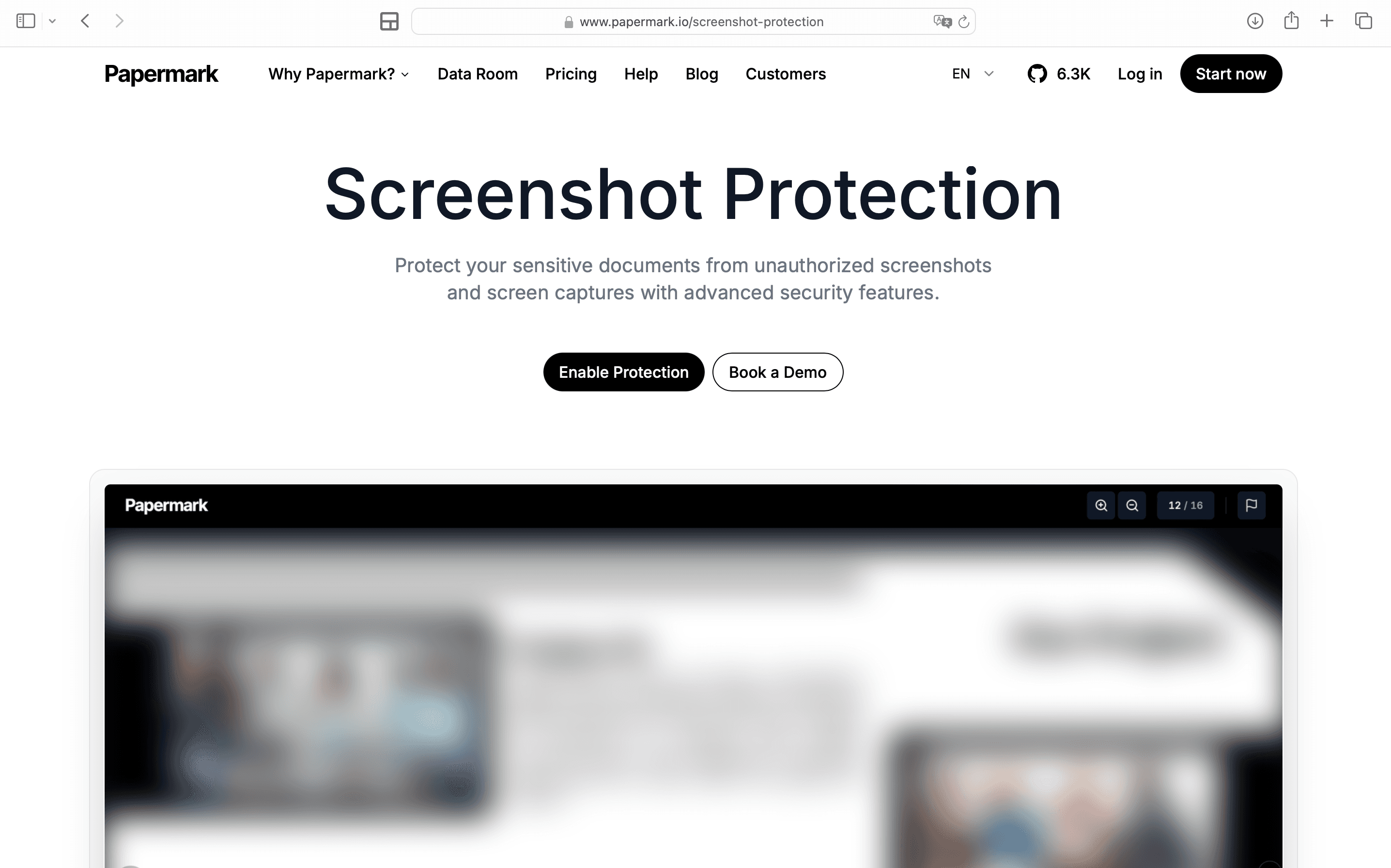
Watermarking every page of a laboratory package with viewer identity is what turns an untraceable leak into an attributable one.
The fifth is letting the report age past the 180-day mark without noticing. Deals slip, and a Phase I commissioned in month one of a transaction that closes in month nine needs its records review, site visit, interviews, and lien search updated before title transfers. The update costs $800 to $2,000. Discovering afterward that the All Appropriate Inquiries defense was never preserved costs whatever the cleanup costs.
Manage due diligence with a virtual data room
No credit card required
Page by page analytics
Unlimited documents & folders
Permission management
Dynamic watermarks
NDA collection
Real-time alerts
Custom branding
Audit trail
9. Data room for your environmental due diligence
A data room for environmental due diligence carries a document set with an unusually long life. A financial model is stale within a quarter. A Phase II laboratory package can decide a contribution claim ten years after closing, and the question then is not what the report said but who received it, when, and whether it was disclosed.
Papermark is a secure, fully customizable, and developer-friendly data room built for modern dealmakers, with page-by-page analytics, dynamic watermarking, and transparent pricing (open-source and self-hosting available).
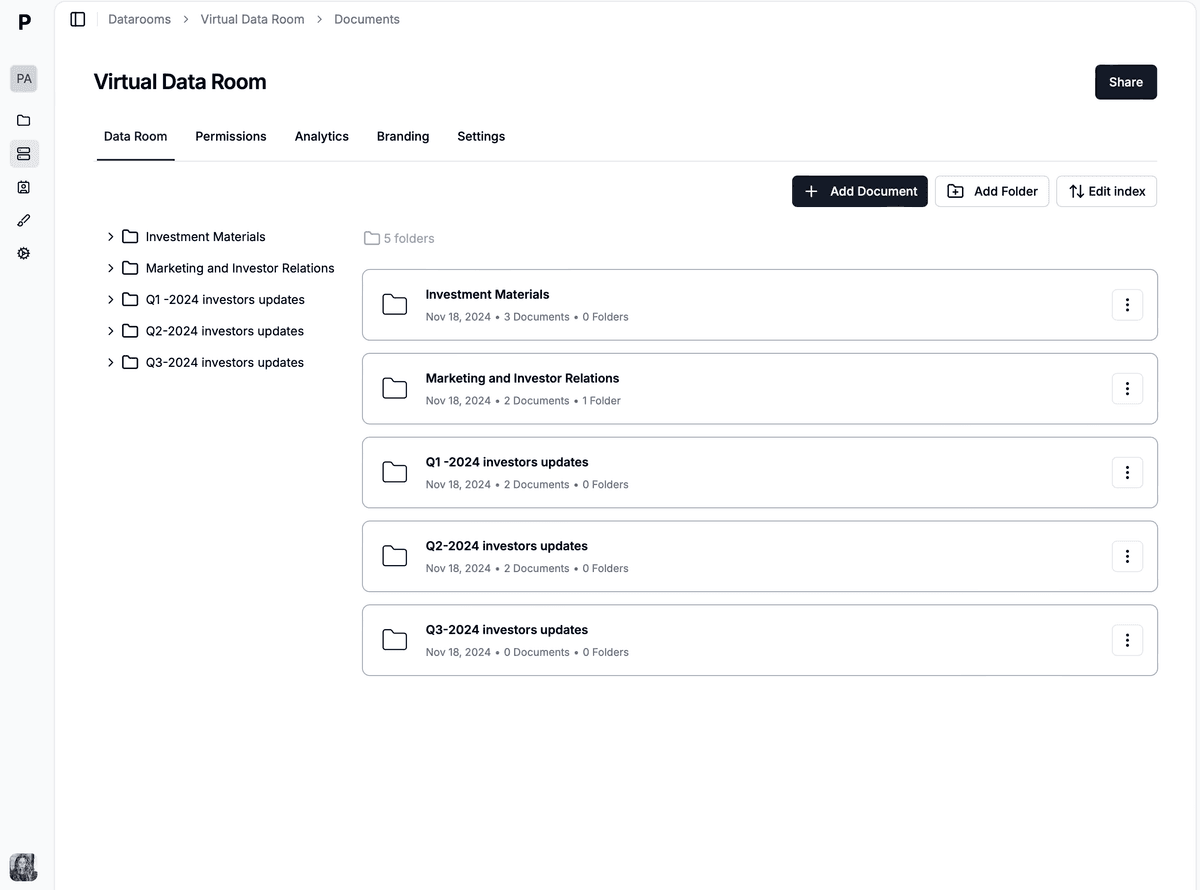
An environmental due diligence data room with one folder per document class, so laboratory packages carry different permissions from permits.
Why you need a data room for environmental due diligence
Environmental documents are the ones most often left in an advisor's inbox, and they are the ones you will most want to find later. There are four concrete reasons a dedicated data room for environmental due diligence earns its place. If you are still choosing a platform, our comparison of the best virtual data rooms covers pricing model, bidder management and compliance across the main providers.
Laboratory results are dangerous before they are understood. A first-round soil result above a screening level, circulated before the consultant has delineated the extent, reads to a neighbour, a plaintiff, or a local reporter as an admission. Draft laboratory data belongs behind a link restricted to named reviewers, not in a reply-all thread with the broker copied in.
The lender and the environmental counsel need different rights over the same file. The lender needs to read the Phase II to size the escrow. Environmental counsel needs to download it to advise on the indemnity language. The operational diligence team, in most deals, needs neither. That is three permission levels on one document, and a shared drive has one.
The 180-day rule makes upload dates evidence. When a Phase I component has to be refreshed before closing, the proof that it was refreshed in time is the dated upload record. A data room for environmental due diligence timestamps every version; an email attachment does not, and neither does a folder someone has since reorganised.
Continuing obligations run for years after closing. Preserving a bona fide prospective purchaser defense means keeping land use restrictions, reasonable steps, and regulator correspondence documented and retrievable. An archived room is that file. Four inboxes and a departed advisor are not.
The rest of this section is the practical setup: five steps to build a room that handles all four.
Step 1: build the room by document class, not by site
Create one folder per document class rather than dumping everything into a single environmental folder: Phase I reports, Phase II reports and laboratory data, permits and registrations, waste manifests, notices of violation, tank records, and prior remediation files. On a multi-site portfolio, nest sites inside those classes rather than the other way round, because permissions follow sensitivity, and sensitivity follows document class.
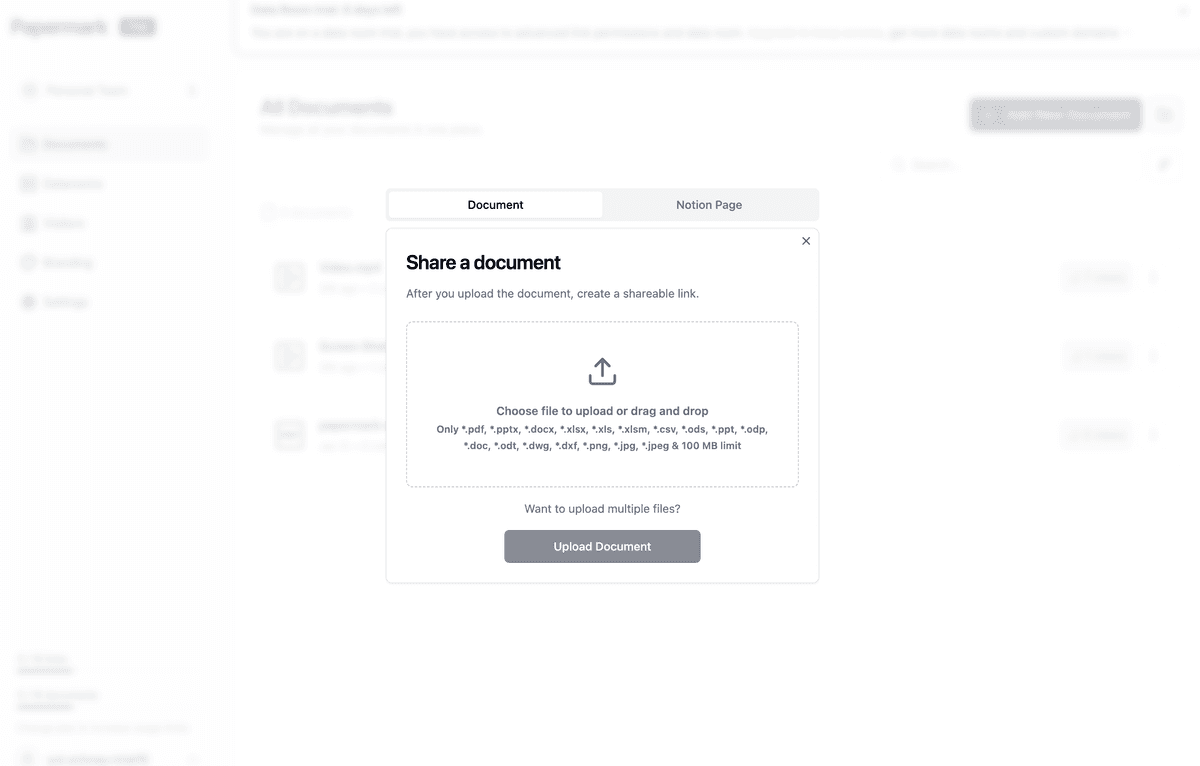
Upload in bulk by dragging the tree straight in. Automatic file indexing on the Data Rooms Plus plan builds and maintains the index as documents arrive, which matters here because laboratory packages land in waves over five or six weeks rather than all at once.
Environmental files run large; unlimited documents with no file size limit is what lets a full laboratory data package go in unsplit.
Step 2: set permissions per reviewer, not per folder owner
This is where the environmental folder differs most from the financial one. Four parties typically need four different views of the same reports.
Reviewer
Folders granted
Rights
Buyer's environmental counsel
All environmental folders
View and download
Lender
Phase I, Phase II summary, permits
View only
Environmental insurer
Phase I, Phase II, prior remediation
View only, watermarked
Operational diligence team
Permits and manifests only
View only
Seller's counsel
Full room, read-only mirror
View only, watermarked
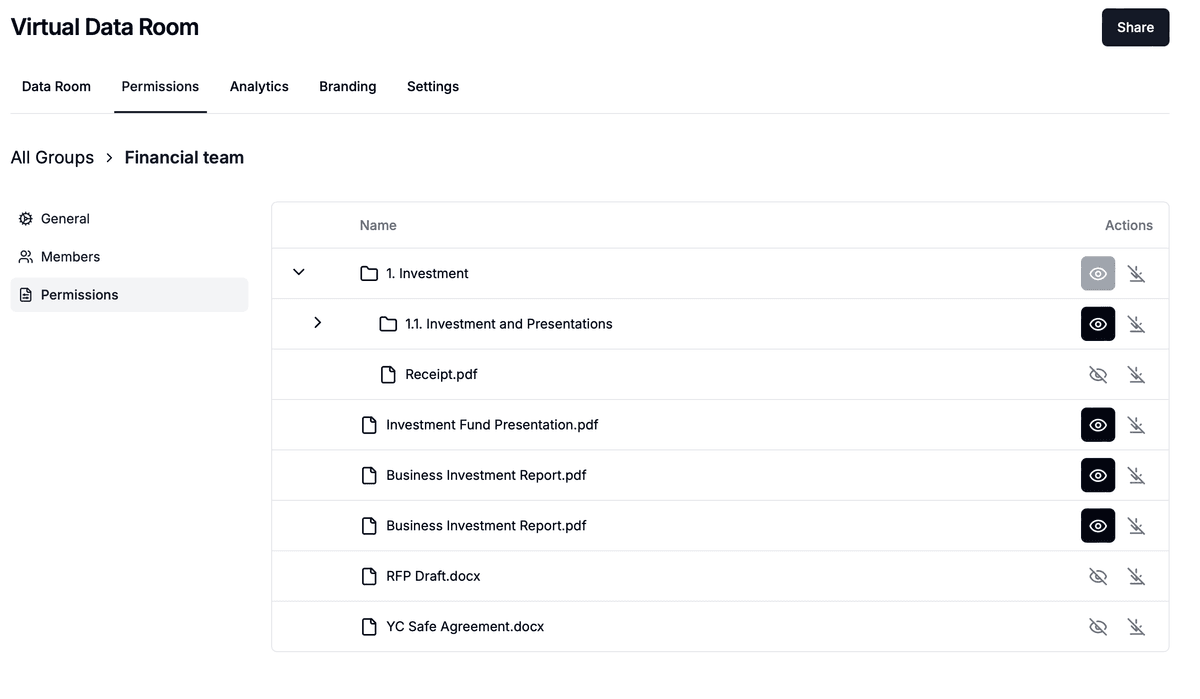
Granular file-level permissions are set per link rather than per user, so each party gets its own link carrying its own folder scope, email allowlist or domain restriction, and download rule. Nobody creates an account, which is what keeps a consultant or an insurer's underwriter from ignoring the room and asking for an email attachment instead.
Granular folder and file permissions keep Phase II laboratory results scoped to the right reviewers.
Step 3: watermark the laboratory data and switch off download
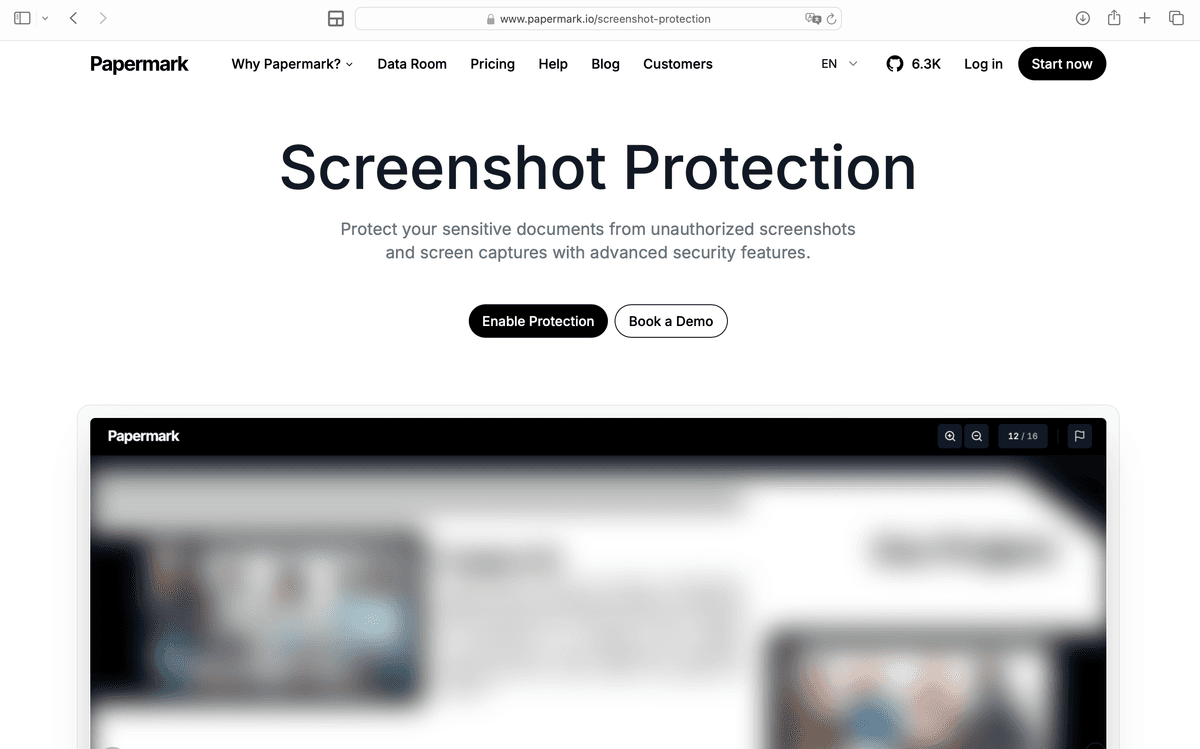
Set the Phase II folder to view-only and turn on dynamic watermarking, which stamps every page with the viewer's email, IP address, and timestamp as it renders. On draft laboratory results specifically, screenshot protection adds a further deterrent while the consultant is still delineating the extent.
The honest limit is worth stating: a file that has been downloaded cannot be recalled by any platform. That is exactly why download is disabled rather than discouraged on draft laboratory data, and why watermarking exists, so a leaked page traces to a named viewer.
Step 4: keep questions attached to the report that prompted them
Environmental questions are technical and they arrive tied to a specific figure on a specific page. A reviewer reads a boring log, then asks whether the sample at 3.5 metres was above or below the water table. Answered over email, that exchange is invisible to the lender who will ask the same thing next week.
The Q&A module attaches each question to the document that prompted it, with permissions controlling who sees which threads, so the insurer never sees the lender's questions. The log exports for the closing file, which on an environmentally sensitive site is a document the insurer will want.
Step 5: read the analytics, then archive the whole file
Page-level analytics show which reviewer opened which document, when, and for how long. A lender's consultant who has spent twenty minutes on the vapour sampling section is about to raise intrusion, and you have a week to get the consultant's answer ready.
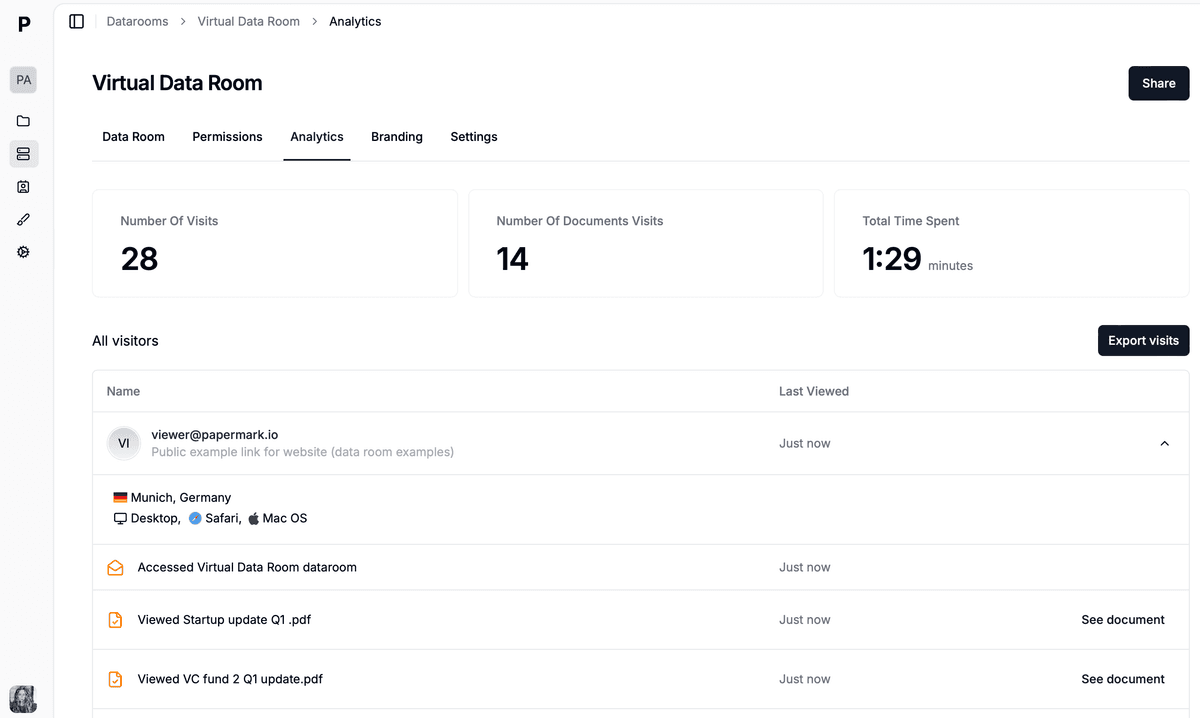
Per-visitor analytics show which environmental reports each reviewer opened, which is the earliest signal of where the escrow negotiation goes.
After closing, data room freeze makes the room immutable and exports it as an archived ZIP with a certificate. When a contribution claim surfaces eight years later, that archive is the record of exactly what was disclosed, to whom, and on what date, which is the evidence a continuing-obligations defense rests on.
Papermark is our #1 VDR provider for M&A transactions right now. In two deals we used custom branding, dynamic watermarking, and granular permissions.
The Data Rooms plan is €99/month with a 7-day free trial and includes 3 team members, unlimited data room visitors, unlimited data rooms, unlimited documents with no file size limit, a custom domain, dynamic watermarking, NDA agreements, and granular file-level permissions. Data Rooms Plus at €249/month adds 5 team members, the Q&A module, the audit log, automatic file indexing, and SOC 2 Type II. Premium at €549/month adds 10 members, AI redaction, the public API, SSO, and whitelabeling. Data Rooms Unlimited at €999/month removes per-seat charges entirely, so teams that add reviewers mid-deal pay one number regardless of headcount, and it carries every Premium capability including AI redaction. Environmental files are large, and the absence of a file size limit matters when a single laboratory data package runs to hundreds of megabytes.