

mergers-and-acquisitions
Buy-side due diligence in 2026: what it really costs before you sign
Buy-side due diligence in 2026: the 7 workstreams, the LOI to signing timeline, real fee ranges, and how to run a data room for buy-side due diligence.
Sell-side due diligence is the review a seller commissions on its own business before going to market. It exists to find the problems a buyer's advisers would otherwise find after the letter of intent, when the only remedy available to the seller is a price reduction. Most sellers start it 3 to 6 months before launch.
Sellers spend months building a story for the information memorandum and no time stress-testing it. Then a buyer's accountants spend six weeks in the numbers and produce a list of adjustments the seller has never seen, at a point where exclusivity has been granted and there is no other bidder to walk to.
A sell-side process also means putting 400 to 500 documents in front of buy-side teams who should not see the same folders or each other's activity. A data room for sell-side due diligence handles that with one scoped link per team. Section 9 covers the setup step by step.
Sell-side due diligence is a structured review of a business commissioned by its owner, in advance of a sale, using the same methods a buyer's advisers would use. The seller hires an independent accounting firm and, depending on deal size, a law firm and a tax adviser. The output is a report the seller reads first.
The point is not reassurance, it is sequence. Every material issue surfaces at some stage of a sale, and the only variable a seller controls is when. An issue found five months before launch is a project: renegotiate the contract, file the amended return, write the memo explaining the add-back. The same issue found three weeks after the letter of intent is signed is a negotiation the seller enters holding nothing.
That difference is the commercial case for the workstream. A buyer who discovers a €1.2M earnings adjustment during confirmatory diligence will ask for a price cut at the multiple, which on a 9x deal is roughly €10.8M. A seller who found it before launch marketed on the lower number and never had the conversation. The report also becomes the spine of the document request list and the folder structure of the room, and buyers read that preparation as competence.
It is not a substitute for the buyer's own work. No serious acquirer takes a seller-funded report at face value and skips confirmatory diligence. It narrows the range of things the buyer can find, and removes the surprise from the things they will.
These three terms describe overlapping work, and the differences that matter are who pays, who is allowed to rely on the output, and when it is delivered.
Buy-side due diligence is the familiar case. The acquirer signs a letter of intent, engages accountants, lawyers, tax specialists and often commercial and IT reviewers, and spends 6 to 12 weeks confirming what it is buying. The report drives both the price adjustment and the indemnities in the purchase agreement. Our guide to financial due diligence covers what that review examines.
Sell-side due diligence is the mirror image and is most common in North America. The seller commissions the review, usually a quality of earnings report, and uses it to prepare. It is shared with bidders on a clearly non-reliance basis: it informs the process without transferring any duty of care to the reader.
Vendor due diligence is the European convention and goes further. The seller engages accounting, legal, tax and sometimes commercial advisers to produce full VDD reports written to a standard buyers can eventually rely on. Drafts circulate to all bidders non-reliance. At signing, the winning bidder and its lenders receive the definitive report under a reliance letter, letting them treat it as if they had commissioned it, subject to a negotiated liability cap. Our vendor due diligence checklist covers the scope.
| Type | Who commissions it | Who relies on it | What it covers | When delivered |
|---|---|---|---|---|
| Buy-side | Acquirer, after the LOI | Acquirer and its lenders | Financial, tax, legal, commercial, IT | 6 to 12 weeks, before signing |
| Sell-side | Seller, before launch | Seller only; bidders read it non-reliance | Usually quality of earnings | 3 to 6 months before market |
| Vendor (VDD) | Seller, before launch | Bidders in draft; winning buyer and lenders under reliance letter | Full financial, tax, legal, often commercial | Drafts at launch, final at signing |
The practical consequence is a choice about how far to go. A founder selling an $8M EBITDA business to a US private equity buyer rarely needs a full VDD package. A sponsor running a competitive European auction on a €300M asset will produce one, because bidders expect it and the reliance letter lets a debt provider underwrite quickly. The middle path is a sell-side quality of earnings, an informal legal clean-up, and a well-built room.
A retrade is a buyer reducing the price, or worsening the terms, after the letter of intent has been signed. It is not necessarily bad faith: a buyer who finds reported EBITDA is €1.5M lower than represented is entitled to reprice. But the leverage at that moment is asymmetric, because the seller has granted exclusivity, absorbed several hundred thousand in adviser fees, and has no alternative bidder to walk to.
Advisers who track lower middle market transactions report that roughly 30 to 40 percent of deals are retraded at least once, with the typical reduction between 5 and 12 percent of headline price. On a €40M enterprise value, a 7 percent retrade is €2.8M, between thirty and fifty times what a sell-side quality of earnings report costs.
The three most cited triggers are working capital adjustments, quality of earnings normalizations that strip out an add-back the seller assumed would stand, and customer concentration visible in the data but never framed. A fourth, unquantified tax or licensing exposure, shows up less often but is the most expensive, because the remedy is an escrow or a specific indemnity rather than a one-off adjustment.
| Finding | How the buyer surfaces it | Typical retrade mechanic | What the seller does first |
|---|---|---|---|
| Unsustainable earnings adjustment | Each add-back tested against invoices and recurrence | EBITDA reduced, price cut at the multiple | Drop the add-backs that will not survive |
| Customer concentration | Revenue by customer over 36 months, contract expiry dates | Price cut, earnout or escrow tied to retention | Renew top contracts early, document in the room |
| Working capital peg that will not hold | Monthly net working capital over 12 to 24 months | Peg reset, cutting cash at close euro for euro | Build the average yourself, normalise for seasonality |
| Unquantified tax or licensing exposure | Nexus review, VAT filings, entitlement checks | Specific indemnity or escrow, sometimes both | Quantify, correct, disclose with the workings |
The working capital case deserves attention because sellers treat it as a technicality. The peg is the normal level of net working capital the business must deliver at closing, and every euro the actual balance falls below it comes off the price. A seller who has built and normalised that analysis first negotiates from a position of authorship. Our guide to the working capital adjustment covers the mechanics.

Customer contracts and renewal letters defeat a concentration retrade, which is why they go out watermarked rather than by email.
The defence against all four is the same and it is unglamorous: evidence, assembled before anyone asks. A signed three-year renewal with the concentrated customer, dated four months before launch, removes the concentration argument. The same renewal explained verbally in a management meeting is a talking point, not a document.
The sequence below is a well-run sell-side process counted backwards from launch. The weeks are market convention and compress on smaller deals, but the ordering rarely changes: you cannot build a credible room before you know what the quality of earnings review will say.
Readiness assessment comes first and is by far the cheapest step. Usually run by the corporate finance adviser, it asks whether the business can survive a process at all: are the accounts on a consistent basis, is there a cap table nobody disputes, are the material contracts signed and findable, is there a shareholder who has not agreed to sell. Deals die on those questions more often than on valuation.
The quality of earnings work then runs 4 to 8 weeks to a draft plus 2 to 3 weeks of owner review. Legal and tax clean-up runs in parallel on what the readiness assessment turned up: unsigned contracts, lapsed filings, an undocumented option pool, a dormant subsidiary that should have been struck off.
| # | Stage | What happens | Weeks before launch |
|---|---|---|---|
| 1 | Readiness assessment | Review accounts, cap table, contracts, shareholder alignment | 24 to 20 |
| 2 | Sell-side quality of earnings | Test EBITDA, add-backs, working capital, revenue recognition | 20 to 10 |
| 3 | Legal and tax clean-up | Unsigned contracts, lapsed filings, entity and option housekeeping | 16 to 8 |
| 4 | Data room build and index | Assemble 400 to 500 documents by workstream, index, set permissions | 10 to 4 |
| 5 | Management and Q&A prep | Rehearse the story, agree who answers what | 6 to 2 |
| 6 | Launch and buyer waves | Teaser, NDA, information memorandum, staged room access | 0 onwards |
Step 4 is where most of the effort lands. Assembling 400 to 500 documents takes 6 to 10 weeks, not because the files are hard to find but because half of them need something: a signature page that was never scanned, a schedule referenced in a contract that nobody has, three versions of a policy with no way to tell which is current. Building the data room for sell-side due diligence early turns that from a launch-week emergency into a background task.
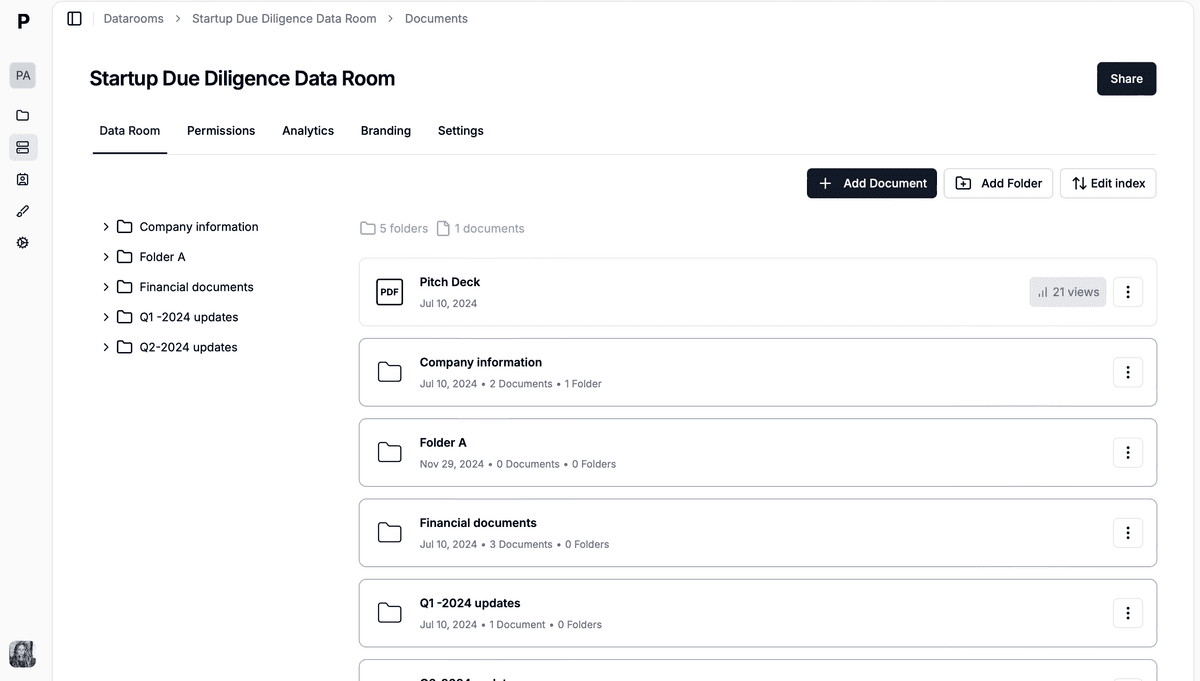
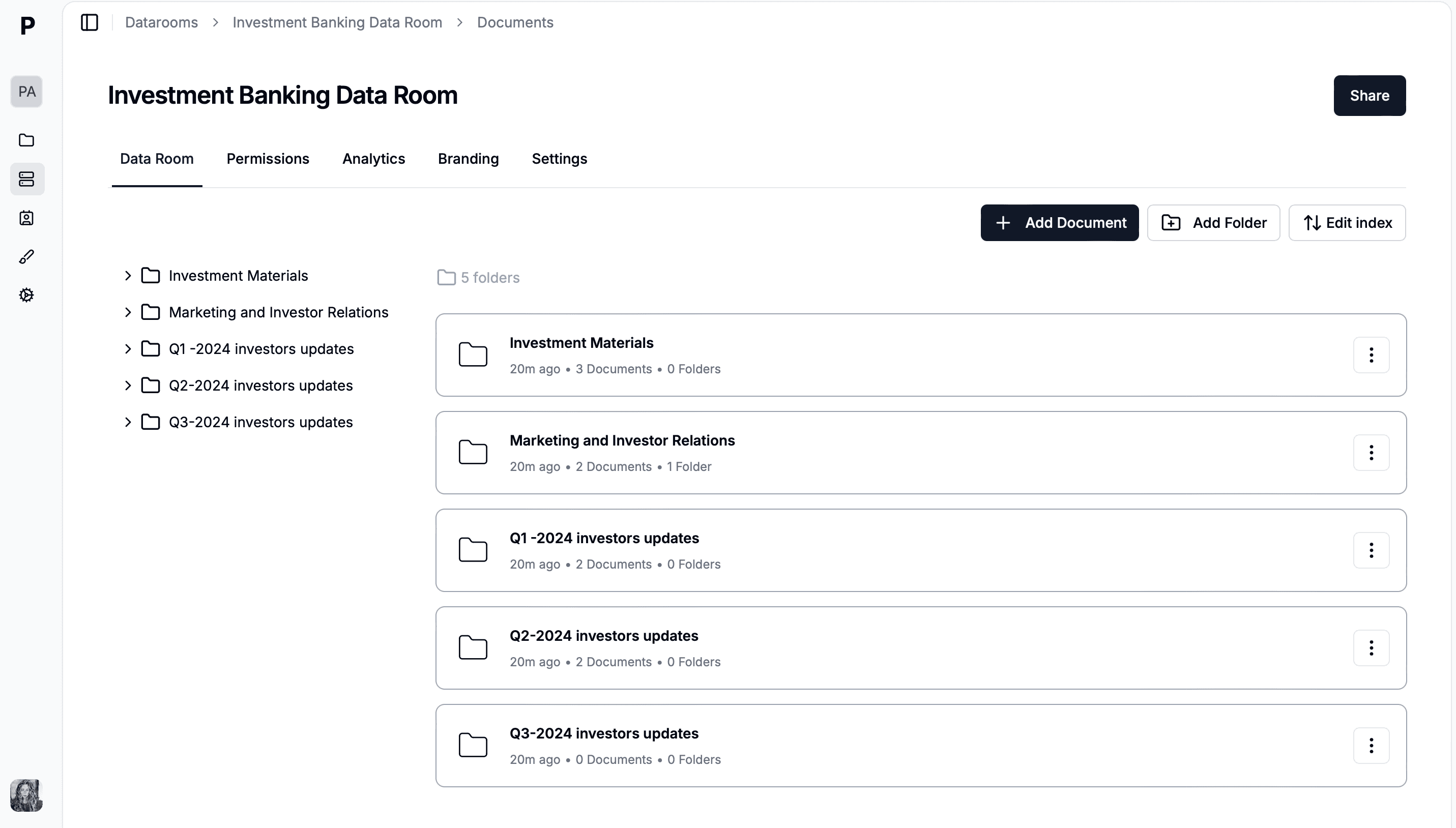
The sell-side room is built in step 4, so the first buyer question does not land on an empty folder.
Step 5 is the one most often skipped and it is cheap. Management presentations fail in predictable ways: two executives give different answers to the same question, the finance director is surprised by a number in his own deck, nobody has decided who fields the question about the departed sales director. One rehearsal with the adviser playing the hostile buyer fixes most of it. Our walkthrough of the M&A due diligence process covers how the buyer sequences its own work.
Step 6 runs the room in waves. A first wave of bidders sees a restricted set behind an NDA, and a shortlist gets the full room once indicative offers are in. That staging is a permissions decision, not a folder decision, which is why the room needs different scopes over the same files.
The core purchase is a quality of earnings report, and its scope is narrower and deeper than people expect. It is not an audit and does not opine on whether the financial statements are fairly stated. It reconstructs earnings: it tests each EBITDA add-back for whether it is genuinely non-recurring, examines revenue recognition and cut-off, rebuilds monthly net working capital across 12 to 24 months to support a peg, and analyses revenue and margin by customer and product.
Pricing follows deal size closely. Market ranges put a sell-side quality of earnings at $15,000 to $25,000 below $3M of EBITDA, $25,000 to $50,000 in the $3M to $10M band, and $50,000 to $75,000 or more above $10M. Complexity moves it: multiple entities, several currencies, or a recent acquisition inside the period all add scope. Our breakdown of due diligence cost sets those figures alongside what the buy-side spends.
A full vendor due diligence package sits in a different bracket because it is three or four reports rather than one. Financial, legal, tax and sometimes commercial VDD, each written to reliance standard, is a six-figure exercise on a mid-market European asset.
The comparison that decides it is cost against the price reduction the work is meant to prevent. On a €40M enterprise value, a 7 percent retrade is €2.8M. A $65,000 sell-side quality of earnings that prevents it returns roughly forty times its cost, and that arithmetic holds at almost every deal size because both the fee and the retrade scale with the business.
One caveat keeps the case honest. Sell-side diligence does not stop a buyer who simply wants a discount and is using diligence as cover; it removes the pretext, not the motive.
The document set is organised around the workstreams that will ask for it, not around how the company files things internally. This is the most useful structural decision a seller makes, because the buy-side arrives as three or four teams with separate request lists, and a room mirroring those teams answers most of the first wave before it is asked. Our guide to data room folder structure covers the conventions that make an index survive 500 files.
In a mid-market process the total lands between 400 and 500 documents. Financial and legal dominate the count, tax is smaller but disproportionately sensitive, and commercial and HR are moderate in volume and high in confidentiality, because customer contracts name pricing and employee files name people who do not know the business is for sale.
Sensitivity determines what goes out on which terms. A customer contract with pricing schedules given to a bidder who is also a competitor is a commercial asset handed to a rival, and it should be view-only, watermarked, and released to the shortlist rather than the first wave. A data room for sell-side due diligence is the mechanism; deciding it at upload is the discipline.
| Buy-side workstream | Folders the seller builds | Typical documents | Sensitivity |
|---|---|---|---|
| Financial | Statutory and management accounts, trial balance, QoE databook | 90 to 150 | High |
| Legal and corporate | Constitution, cap table, board minutes, material contracts, litigation | 120 to 180 | High |
| Tax | Returns, assessments, transfer pricing, VAT filings | 40 to 70 | Very high |
| Commercial | Customer contracts, pricing, pipeline, churn, renewals | 50 to 90 | Very high |
| HR and people | Org chart, anonymised payroll, key contracts, incentive plans | 30 to 60 | Very high |
| Operations and IT | Facilities, insurance, licences, systems, security | 30 to 60 | Medium |
Three practices separate a room that works from one that generates questions. Index everything with a stable numbering scheme, so a question referencing document 4.2.17 means the same thing in week ten as in week two. Version every file, because a buyer who finds two versions of a contract will ask about both. And pre-answer the obvious questions inside the folder: a memo on the revenue restatement, next to the restated accounts, prevents a fortnight of correspondence. Sellers who have run a process before also work through the due diligence questionnaires they received last time.
Halden Logistics is a hypothetical founder-owned contract logistics business in the Netherlands with €140M of revenue and €16.4M of reported EBITDA. The founder wants to sell within a year, and the adviser recommends sell-side work first.
The sell-side quality of earnings is commissioned five months before launch at a fee of roughly $65,000, consistent with the above-$10M EBITDA band, and runs seven weeks to draft. The founder has proposed €1.9M of add-backs. The reviewer sustains €1.1M and rejects €800,000: the founder's aircraft costs, and an "exceptional" warehouse systems project that recurred in each of the last three years. Adjusted EBITDA is restated at €15.6M, and the business goes to market on that number.
The review surfaces two structural issues. The largest customer is 31 percent of revenue on a contract expiring 14 months after a realistic closing date, and monthly net working capital swings by €4.2M between the December peak and the March trough, making a naive 12-month average peg unfavourable. The founder renews the customer contract for three years before launch, and the adviser builds a seasonally normalised peg. Room preparation then takes seven weeks and produces 470 documents across six workstream folders.
Worked scenario. Financial and legal account for more than half the document set, but tax, commercial and HR carry the material that is released only to the shortlist.
Three bidders reach confirmatory diligence over a four to six month process. Each sends legal, tax and business teams of three to five people, and each team gets its own scoped link into the same room. In week five the leading bidder raises customer concentration and proposes a 6 percent reduction. The seller answers with the renewal executed before launch, already in folder 4.1, and the audit log showing the bidder's own legal team opened it in week one. The price holds.
The most expensive mistake is starting too late. A seller who calls the accountants after the letter of intent has bought a second opinion, not leverage, because everything the review finds arrives mid-exclusivity. The value of the exercise is the option to fix things, and that option expires at launch.
The second is treating the report as a marketing document. Sellers occasionally push their accountants to sustain add-backs that will not survive a buy-side review, and the result is worse than doing nothing: the buyer's team finds the same items, concludes the report was written to a conclusion, and discounts everything else in it. A sell-side report only works if it is credibly independent.
The third is preparing the numbers and neglecting the paperwork. Deals slip far more often on a missing shareholder consent, an unsigned lease, or an option grant that was never board-approved. The M&A due diligence checklist shows what the other four workstreams will ask for.
The fourth is running the process out of email and a shared drive. With three bidders sending three teams each, a seller is managing a dozen counterparties across 470 files on one permission set. Worse, there is no record: when a warranty claim arrives eighteen months later and the question is whether a specific contract was disclosed, an inbox is not an answer.
The fifth is forgetting that disclosure has a legal function. In most European deals, what was properly disclosed limits what can later be claimed under the warranties, so the disclosure bundle and the room contents must reconcile exactly. Where the parties buy representations and warranties insurance, the underwriter reads that record too.
A data room for sell-side due diligence has a specific shape that a fundraising room does not. The seller is one party facing several bidders, each arriving as three or four professional teams with different scopes and a strong interest in not revealing to each other what they are focused on. The room serves all of them from one document set without letting the wrong link see the wrong folder.
The second difference is the audit requirement. The record of who saw what and when supports the disclosure position for years after closing, so the room needs a per-visitor page-level log and a way to make everything immutable at close.
Papermark is a secure, fully customizable, and developer-friendly data room built for modern dealmakers, with page-by-page analytics, dynamic watermarking, and transparent pricing (open-source and self-hosting available).
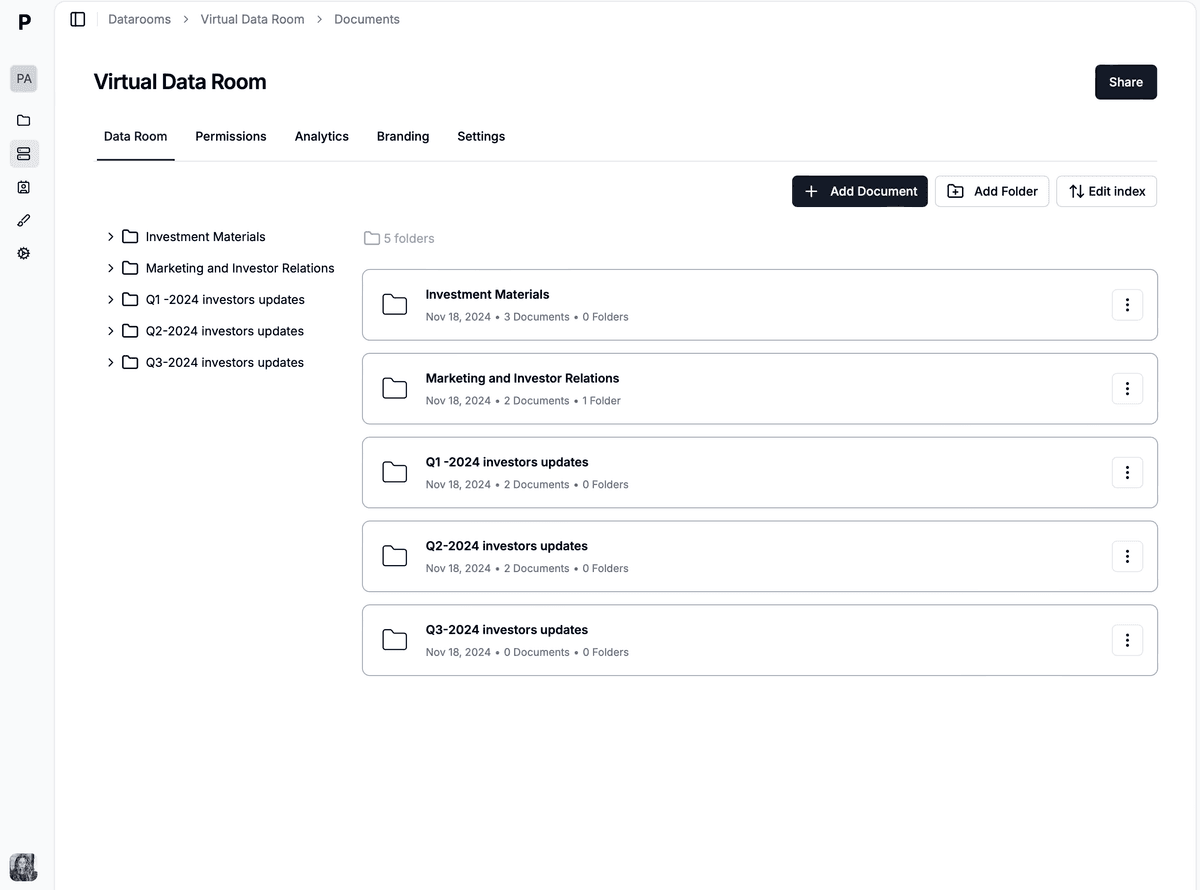
One sell-side room holding all 400 to 500 documents, with access scoped per buy-side team.
Sellers frequently start on the tooling they already have, then migrate mid-diligence. There are four reasons a dedicated data room for sell-side due diligence earns its place from day one. If you are still choosing a platform, our comparison of the best virtual data rooms covers pricing model, bidder management and compliance across the main providers.
Each bidder sends three teams, and they should not see each other. A legal team of four, a tax team of three and a business team of five work for the same acquirer, but the seller has no reason to let the tax team observe what the legal team is reading, and a competitor's commercial team should not be in the customer contracts folder in the first wave. A data room for your sell-side process issues one scoped link per team over the same files.
The most valuable documents are the most dangerous to circulate. Customer contracts with pricing, the top-customer renewal, anonymised payroll and the transfer pricing file win the argument on valuation, and are what a losing bidder should not retain. View-only access with dynamic watermarking makes them usable in diligence and traceable afterwards.
Questions arrive in waves and fragment over email. A bidder reads the quality of earnings databook, asks for the three underlying schedules, then asks a follow-up the tax team has already raised elsewhere. Across three bidders and several hundred open questions, an inbox loses the thread.
The disclosure record outlives the deal. When a warranty claim surfaces a year after closing, the question is what was disclosed, to whom, and when. A per-visitor audit log answers it. A shared drive does not.
Create a single room for the transaction, with one top-level folder per buy-side workstream: financial, legal and corporate, tax, commercial, HR and people, operations and IT. Resist the instinct to build a room per bidder: duplicating 470 files across three bidders means every update has to be made three times, and it will not be.
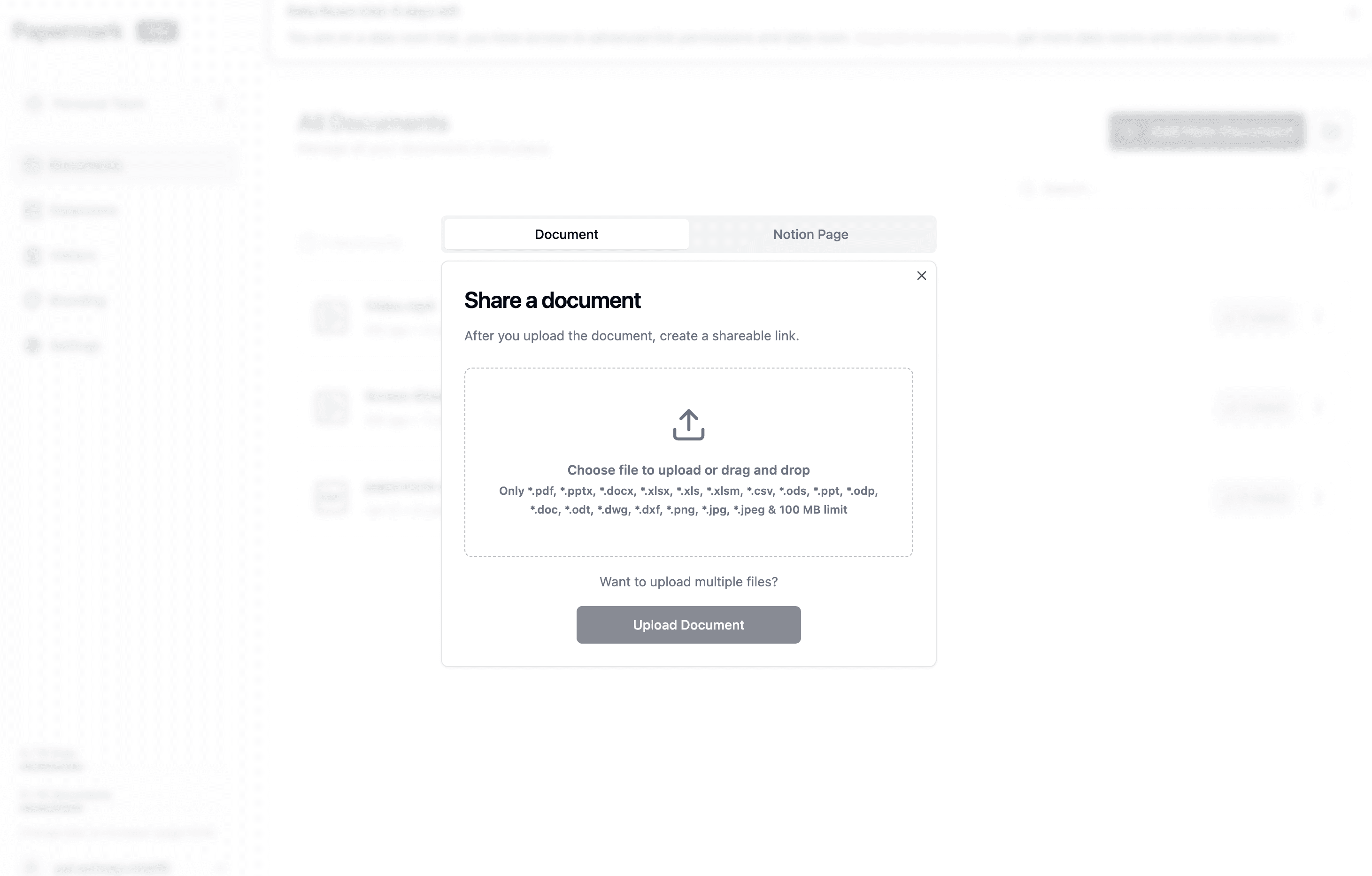
Upload by dragging the folder tree straight in. Automatic file indexing maintains the numbered index as documents arrive, which matters because the set grows through the process. A stable index number lets a question in week ten refer to the same document it did in week two.
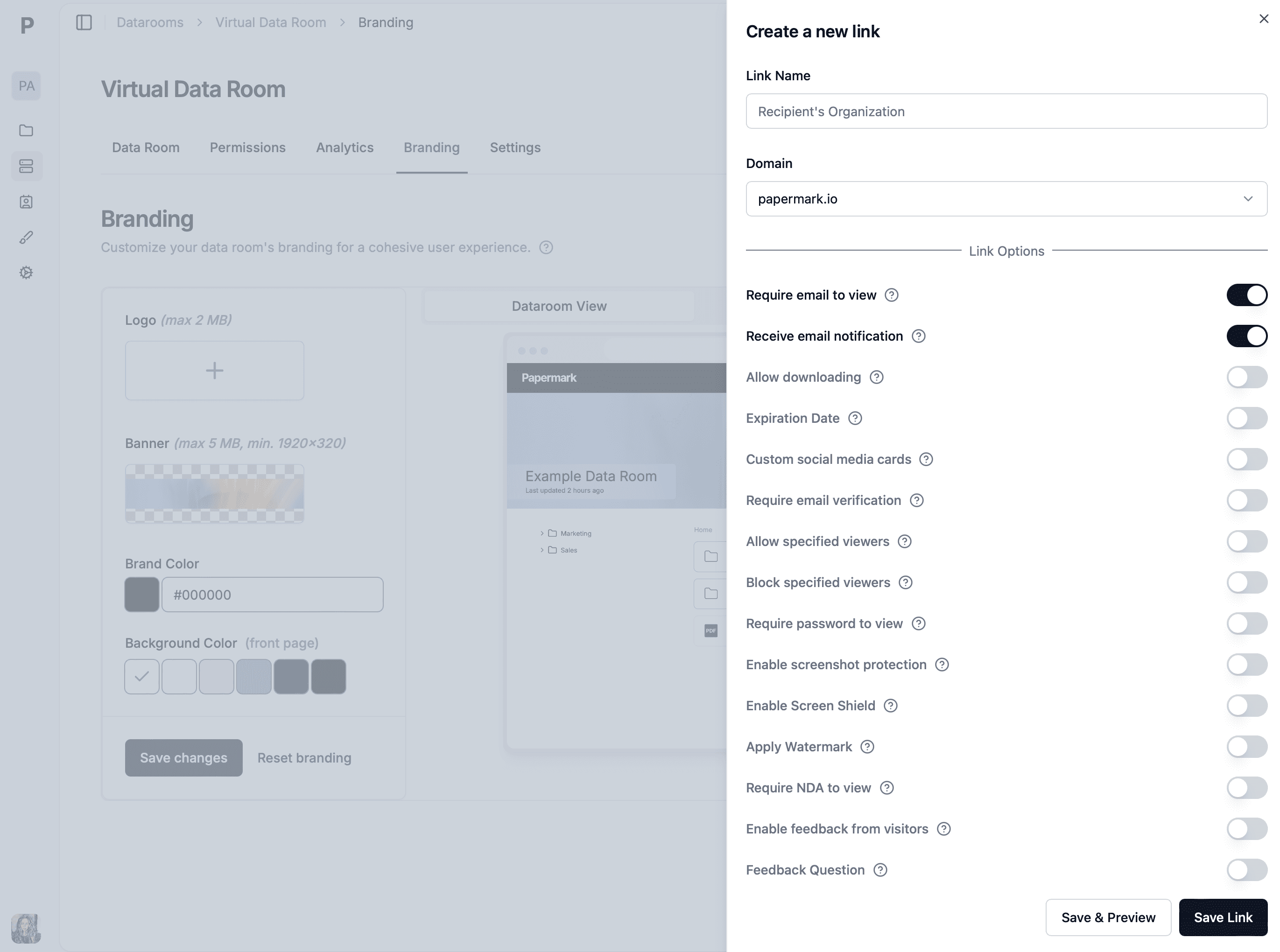
This is the step that defines a sell-side room. Each bidder gets a set of links rather than one, and each carries its own folder scope, email allowlist, and download rule. A typical configuration looks like this:
Granular file-level permissions are set per link rather than per user, so the tax team never sees the legal folder and neither sees the other's activity. Access is link-based, so no reviewer creates an account, which removes the friction that makes senior advisers avoid a room. An email allowlist per link stops a forwarded URL becoming an open door.
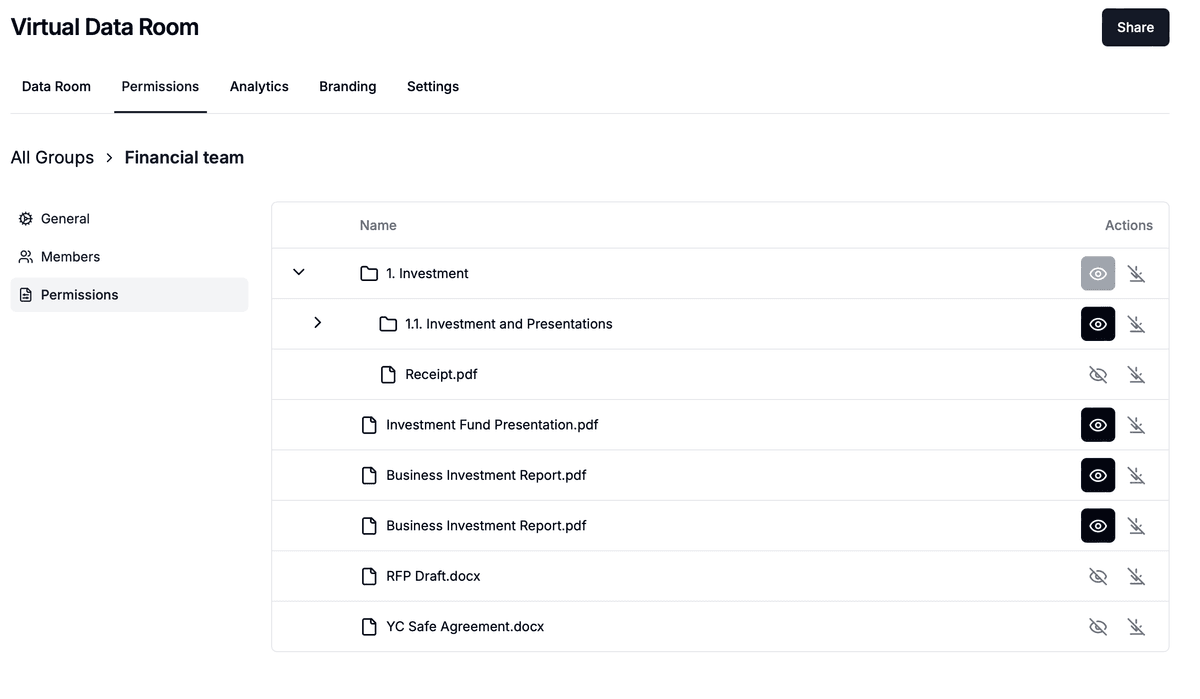
Permissions are set per link, so the legal, tax and business teams of one bidder each see a different slice.
Switch the commercial, HR and tax folders to view-only and turn on dynamic watermarking, which renders the viewer's email, IP address and timestamp onto every page. Screenshot protection adds a deterrent on pricing schedules, and NDA agreements attach to the link so acceptance is captured before any file opens.
One honest limit is worth stating: a downloaded file is legally treated as fully read, and no platform can recall it. That is why download is disabled rather than discouraged on the folders naming customers and employees, and why watermarking exists. It makes a leak traceable to a named viewer.
Questions arrive per team and reference specific documents. The Q&A module attaches each thread to the document that prompted it, with permissions controlling who sees which threads, so one bidder's tax question is never visible to another bidder. Answers publish to a single team or to everyone where the question is generic, which stops the seller answering the same thing five times. The log exports for the closing file.
Page-level analytics and the per-visitor audit log show which team opened which document, on which page, and for how long. That is intelligence about your own deal: a bidder whose business team has spent an hour in the churn analysis is building a case about retention, and you will hear it the following week. A bidder who has not opened the room in ten days is not really bidding.
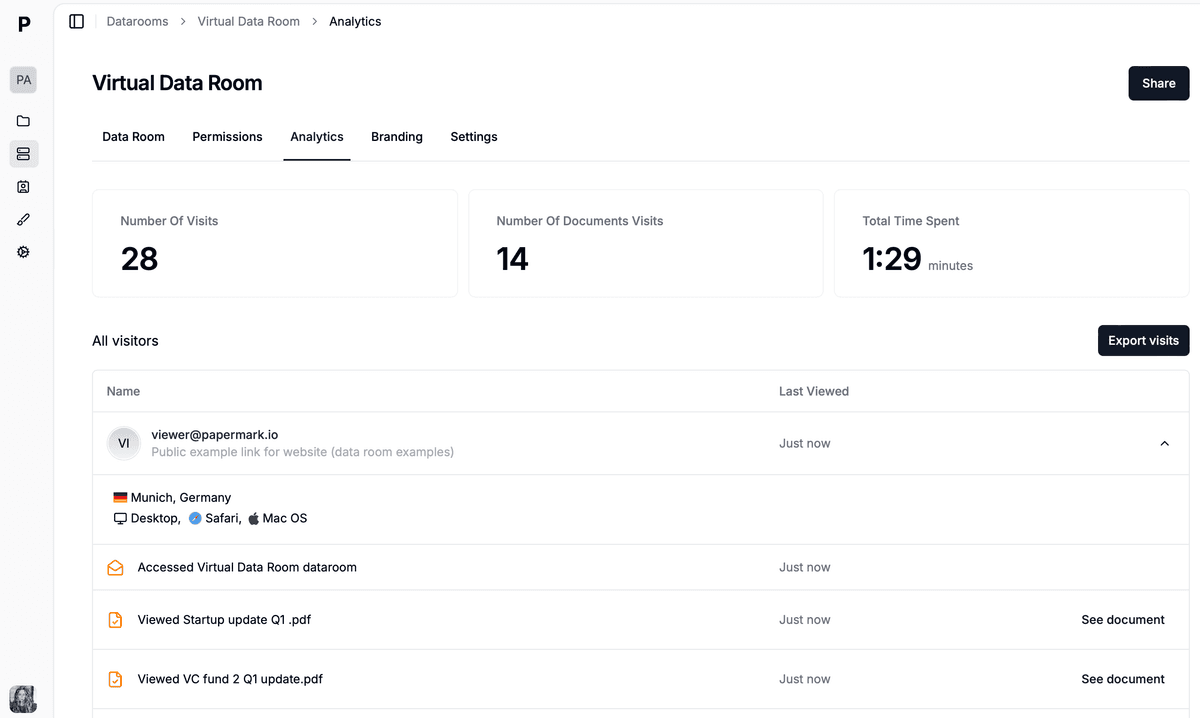
Per-visitor analytics show which buy-side team opened which document, an early signal of the next question.
At close, data room freeze makes the room immutable and exports it as an archived ZIP with a certificate. That archive, with the audit log, is the disclosure record when a warranty claim arrives eighteen months later.

Papermark is our #1 VDR provider for M&A transactions right now. In two deals we used custom branding, dynamic watermarking, and granular permissions.
Tyler
The Data Rooms plan is €99/month with a 7-day free trial and includes 3 team members, unlimited data room visitors, unlimited data rooms, unlimited documents, custom domain, dynamic watermarking, NDA agreements, and granular file-level permissions. Data Rooms Plus at €249/month adds 5 team members, the Q&A module, the audit log, automatic file indexing, and SOC 2 Type II, which is what most sell-side processes need because Q&A and the audit trail are what the process runs on. Premium at €549/month adds 10 team members, AI redaction, the REST API, SSO, and white-labelling. Data Rooms Unlimited at €999/month removes per-seat charges entirely, so teams that add reviewers mid-deal pay one number regardless of headcount, and it carries every Premium capability including AI redaction. Unlimited data rooms under one subscription lets an adviser run concurrent mandates without a per-project fee.
No credit card required.
Buy-side due diligence in 2026: the 7 workstreams, the LOI to signing timeline, real fee ranges, and how to run a data room for buy-side due diligence.
Financial due diligence in 2026: 3 pillars, a 6-week timeline, the working capital peg that costs more than EBITDA, and the data room for financial due diligence.
IP due diligence in 2026: the 7 asset classes, the chain-of-title trap, open-source and AI risk, and how to run it in a data room for IP due diligence.