



mergers-and-acquisitions
Merger vs Acquisition 2026: 7 Differences and the Consent Trap
Merger vs acquisition in 2026: 7 differences in structure, control, tax, and consents, plus how to run a data room for a merger or acquisition.
A SAFE is an equity agreement that converts into shares at a future priced round. A convertible note is a loan that converts into the same shares but carries interest and a maturity date. Both defer valuation. Only one of them can come due in cash.
Founders treat the SAFE versus convertible note question as a legal preference. It is really a cap table question: the instrument decides who absorbs dilution when the round takes longer than planned, and how much of the company you own the morning after the Series A closes.
Both instruments generate paperwork that has to reach a lot of people at once: executed agreements, side letters, board consents, the cap table, and whatever diligence the lead asks for. A data room for a SAFE or convertible note round keeps that in one place with one link per investor. Section 9 covers the setup step by step.
A SAFE, or Simple Agreement for Future Equity, is a contract in which an investor pays money now in exchange for the right to receive shares later, at the price set by a future priced round. Y Combinator introduced it in 2013 to replace the convertible note in seed financings, and it is now the default instrument for pre-seed and seed rounds in the US and increasingly in Europe.
The important thing about a SAFE is what it is not. It is not a loan. There is no principal to repay, no interest accruing in the background, and no date on which anything becomes due. It converts on an equity financing and has payout provisions for a liquidity event or a dissolution, but no investor can walk in at month 20 and ask for their money back.
That asymmetry is why founders like it and why some investors do not. A SAFE holder takes pure equity risk with none of the creditor protections a noteholder has, in exchange for simplicity and speed. The market accepted the trade: a standard YC post-money SAFE runs about five pages and can be signed and funded in a day.
Economically the SAFE does one job. It fixes the terms on which the investor's money becomes shares, through a valuation cap, a discount, both, or neither. Everything else is mechanics: change of control, dissolution, and how the conversion arithmetic is performed.
The variants matter. YC publishes a cap-only version, a discount-only version, and an MFN version with no economic terms at all. Roughly 72 percent of SAFEs issued in 2025 used a valuation cap with no discount, making cap-only the dominant structure by a wide margin. Expect it to be the starting point of most 2026 conversations, with the negotiation on the cap number rather than the document. Our pre-money SAFE template walks through the original structure and where it still shows up.
A convertible note is a short-term loan from an investor to a startup that is designed to convert into equity rather than be repaid in cash. The investor lends, say, $250,000. The note accrues interest. At a defined trigger, usually the closing of a qualified priced round, the principal plus accrued interest converts into shares of that round at a discount, a cap, or both.
Because it is debt, a note behaves like debt in three ways a SAFE does not. It appears as a liability on the balance sheet, which matters when a lender, a landlord, or an acquirer reviews the company. It accrues interest, typically 4 to 8 percent a year for seed-stage notes and most often 5 to 6 percent. And it has a maturity date, typically 18 to 24 months, at which the company must repay, convert, or negotiate an extension.
Maturity is the term founders underweight. In the ordinary case nothing happens: the round closed, the note converted, and the date is irrelevant. In the case that matters, the round slipped, the date arrives, and the noteholders technically have the right to demand repayment of money the company does not have. Investors almost always agree to extend rather than push a portfolio company into default, but that negotiation happens from a position of very little founder leverage.
The interest is not paid in cash. It accrues and converts alongside the principal, so the investor ends up with slightly more shares than the headline cheque implies. On a $250,000 note at 6 percent outstanding for 18 months, the converting amount is $272,500.
Notes are also more expensive to paper, usually involving a note purchase agreement, the notes themselves, board and often stockholder approvals, and sometimes subordination terms. That is one practical reason SAFEs took over the pre-seed market. Notes remain common for bridge financings, for investors whose mandate requires debt, and in markets where the SAFE is less established. Our guide to seed funding for startups covers where each sits in a financing sequence.
Most comparisons list ten differences. Six of them actually change what happens to your company. The rest are documentation details your counsel will handle.
The first and largest is legal character. A SAFE is an equity agreement; a convertible note is a debt instrument. Everything else follows from that single fact: interest exists because it is a loan, maturity exists because it is a loan, creditor remedies exist because it is a loan. If you understand one thing about the SAFE vs convertible note comparison, understand that one.
The second is cost of capital, which a SAFE does not carry beyond the dilution. The third is the deadline. The fourth is what triggers conversion. The fifth is the protections the investor holds in a downside case. The sixth is time and legal cost, which is where the practical preference for SAFEs at pre-seed comes from.
| # | Dimension | SAFE | Convertible note |
|---|---|---|---|
| 1 | Legal character | Equity agreement, sits in equity or mezzanine | Debt instrument, sits as a liability |
| 2 | Interest | None | Typically 4 to 8 percent a year, accrues and converts |
| 3 | Maturity | No maturity date, no repayment trigger | Typically 18 to 24 months, then repay, convert or extend |
| 4 | Conversion trigger | Equity financing, liquidity event or dissolution | Qualified financing, maturity, or change of control |
| 5 | Investor protections | Contractual payout on liquidity or dissolution only | Creditor rights, repayment demand, sometimes security |
| 6 | Legal cost and speed | One short document, often signed same week | Purchase agreement plus notes plus approvals |
Read the table as a risk transfer rather than a scorecard. The SAFE moves downside risk to the investor: if the company stalls, they have no lever to pull. The note moves it back to the founder, because the maturity date arrives whether or not the founder wants the conversation.
Because a note is debt, it is also visible to anyone doing diligence later, including an acquirer. Buyers running startup due diligence treat outstanding notes as a liability to be resolved before closing. Unconverted SAFEs raise the same cap table question without carrying the debt label.
Neither instrument sets a valuation. Both set a rule for deriving a price later, built from at most two economic terms plus one fallback. Understanding them is most of what a founder needs to negotiate competently.
The valuation cap is a ceiling on the valuation used to convert the investor's money. If the cap is $8 million and the priced round happens at a $30 million pre-money valuation, the investor converts as if the company were worth $8 million, which is the whole point of investing early. If the round prices below the cap, the cap does nothing. It is the most negotiated number in an early round because it is the only term that materially changes the investor's outcome.
The discount rate converts the investor's money at a percentage below the round price. Discounts commonly range from 10 to 30 percent, with 20 percent the frequent starting point. Where a cap protects the investor against a large valuation jump, the discount rewards them for being early even if the valuation barely moves. When an instrument carries both, the investor takes the lower conversion price.
An MFN SAFE is the third path and contains no cap and no discount when signed. If the company later issues a SAFE or note on better terms, the MFN holder can elect to adopt them. Investors accept it when they want to be first without pricing the company. The cost is handing the pricing decision to whoever negotiates the next instrument.
| Structure | How the price is set | Who it favours | How common |
|---|---|---|---|
| Cap only | Lower of the cap or the round price | Investor in a strong up round | Roughly 72 percent of 2025 SAFEs |
| Discount only | A set percentage below the round price | Investor in a flat round | Less common alone, usually 10 to 25 percent |
| Cap and discount | Whichever gives more shares | Investor in every scenario | Common in competitive rounds |
| MFN only | No terms at signing, adopts later terms | Investor who does not want to price | True pre-seed, friends and family |
Pro rata rights sit outside all of this and are easy to miss. The standard YC post-money SAFE does not grant a right to participate in the next round. That comes from a separate side letter, signed with specific investors. If a lead says pro rata is standard, they mean it is standard to ask for, not that it is in the document you are about to sign.
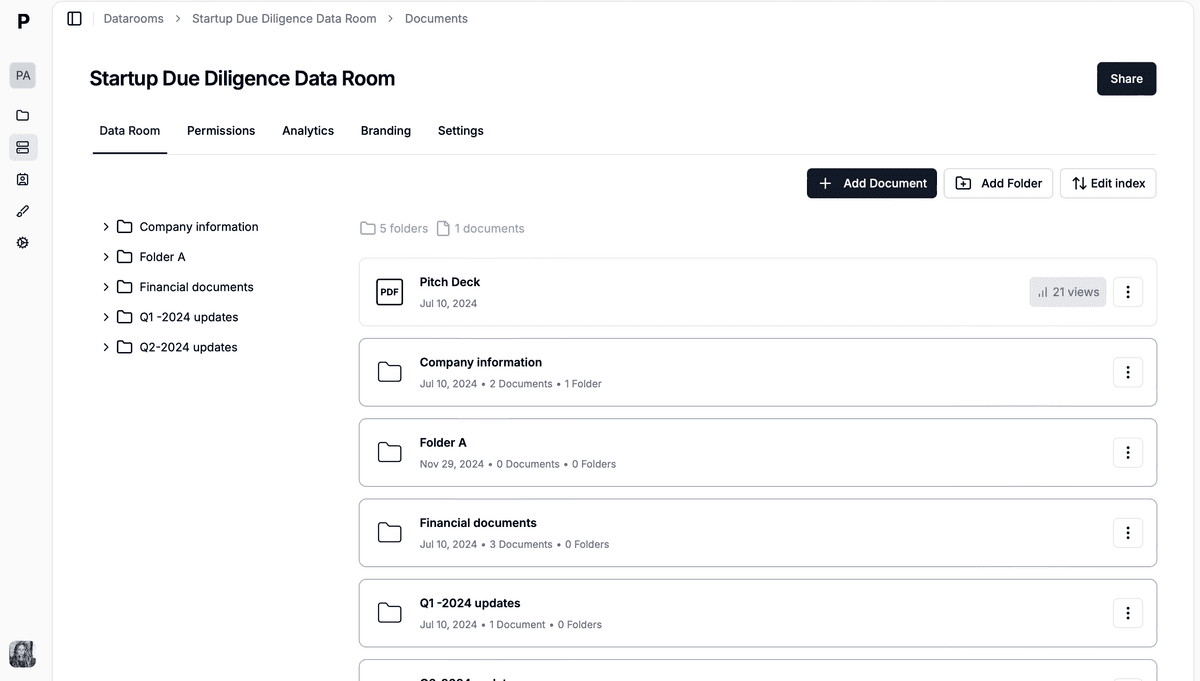
Every executed SAFE, note, and pro rata side letter should live in one folder, because the stack is only manageable when it is visible in one place.
A round assembled from eleven cheques produces eleven signed instruments, an unknown number of side letters, and at least one MFN holder who has to be told what the last investor got.
In 2018 Y Combinator retired the original pre-money SAFE and replaced it with a post-money version, which is what YC publishes today. The change was presented, correctly, as a clarity improvement. It also shifted dilution in a direction founders should understand before signing their fourth one.
Under the original pre-money SAFE, an investor's percentage was calculated on a capitalisation that excluded the other SAFEs converting at the same time, so every SAFE diluted every other SAFE. An investor who put in $500,000 at a $10 million cap expected roughly 5 percent, and if the company sold two more SAFEs first, the actual outcome was nearer 4.55 percent. Nobody could compute their ownership at signing.
The post-money SAFE fixes the percentage at signing. The capitalisation used includes all converting SAFEs and notes plus the existing option pool, so the number the investor computes on the day they wire is the number they get. That is a real transparency improvement, and it is why investors adopted the post-money version quickly.
The consequence is arithmetic rather than ideology. If each holder's percentage is locked and the company then issues another SAFE, that new percentage has to come from somewhere. It comes from the common stock, which at pre-seed means the founders. Under the post-money SAFE, holders of common stock bear the entirety of the dilution from every subsequent SAFE or note until an equity financing occurs.
That is the structural fact behind almost every founder complaint about SAFEs. The post-money version is not unfair; its dilution is front-loaded onto the founder and invisible unless you model the stack. A founder who signs a $500,000 SAFE at a $10 million post-money cap has sold exactly 5 percent permanently, and every further SAFE sells more of the remaining 95 percent.
The trap is not any single SAFE. It is the arithmetic of several, at different caps, signed months apart, each modelled in isolation. Founders instinctively average the caps in their heads. Post-money SAFEs do not average. They add.
Take a company with two founders holding 8,000,000 shares and no outside capital. Over a year it raises $1.5 million on three post-money SAFEs: $400,000 at a $6 million cap, which is 6.67 percent; $600,000 at a $10 million cap, which is 6.00 percent; and $500,000 at a $15 million cap, which is 3.33 percent. Each looks modest alone, and the last feels almost free because the cap has tripled since the first cheque.
Added together they are 16.0 percent of the company, sold before a single share has been priced. The mental model that produced the trap was "we raised one and a half million at roughly a ten million cap, so about fifteen percent". Change the first cap to $4 million and the same $1.5 million costs 19.33 percent.
| Instrument | Amount | Post-money cap | Ownership sold | Founders remaining |
|---|---|---|---|---|
| Starting point | 0.00 percent | 100.00 percent | ||
| SAFE 1 (angels) | $400,000 | $6,000,000 | 6.67 percent | 93.33 percent |
| SAFE 2 (seed fund) | $600,000 | $10,000,000 | 6.00 percent | 87.33 percent |
| SAFE 3 (strategic) | $500,000 | $15,000,000 | 3.33 percent | 84.00 percent |
| Total on SAFEs | $1,500,000 | Blended, not averaged | 16.00 percent | 84.00 percent |
Three habits keep the stack honest. Maintain a live pro forma cap table including every unconverted instrument. Convert the question from dollars to percent before agreeing a cap: say "this cheque sells 3.3 percent", never "this is a five hundred thousand dollar SAFE". And set a ceiling for the pre-priced-round phase, commonly 20 to 25 percent of total pre-Series-A dilution.
Two further items belong in the same model. Convertible notes bring accrued interest, which converts into additional shares and is almost always left out. And the option pool refresh a Series A lead requires is typically 10 to 15 percent post-close, which in most term sheets comes out of the pre-money and therefore out of the founders rather than the new investor.
Marloe Systems is a hypothetical industrial sensing startup in Berlin with two founders holding 8,000,000 shares between them. It raises opportunistically over fourteen months rather than running a single process, which is the normal pattern and the one that produces the surprise below.
The first cheque is $350,000 from a group of angels at a $6 million post-money cap, which is 5.83 percent. Six months later a seed fund puts in $900,000 at a $9 million cap, which is 10.0 percent, because the fund insists on a cap reflecting where it thinks the Series A will price. A strategic investor adds $250,000 at a $12 million cap, which is 2.08 percent. Finally a family office that requires a debt instrument provides a $150,000 convertible note at 6 percent interest with a 24-month maturity and a $10 million cap.
Eighteen months later the Series A closes. The note has accrued $13,500 of interest, so $163,500 converts at the $10 million cap, which is 1.64 percent rather than the 1.50 percent the founders modelled. Total pre-round ownership sold is 19.55 percent. The founders had told themselves it was around fifteen.
The Series A is $6 million at a $24 million post-money valuation, so the new investor takes 25 percent, and the lead requires a 10 percent option pool. Existing holders therefore retain 65 percent after the round and the pool. The founders' 80.45 percent becomes 52.29 percent, and the SAFE and note holders' 19.55 percent becomes 12.71 percent.
Worked scenario. The founders expected roughly 60 percent. The gap comes from stacking four instruments at four caps and leaving accrued interest and the pool refresh out of the model.
Nothing in that sequence was a mistake in isolation. Every cap was defensible, the note was the only way to take the family office money, and the pool refresh was standard. The 8-point gap between expectation and outcome came entirely from modelling four instruments separately instead of together.
The decision usually rests on three inputs: how likely a priced round is inside 24 months, whether any investor requires a debt instrument, and how much legal budget the round can absorb. Everything else is preference.
If you are raising a first outside cheque at pre-seed in 2026, the default answer is a post-money SAFE with a cap and no discount. It is the market standard, the cheapest instrument to paper, and investors and their counsel have seen it hundreds of times, which removes negotiation cycles. Around 90 percent of pre-seed rounds now use SAFEs, so proposing one is not a position you have to defend.
Choose a convertible note when there is a specific reason: a bridge between priced rounds where the lender wants seniority and a deadline, an investor whose mandate or jurisdiction requires debt, or a family office with an internal policy. Notes are also more common outside the US, where local counsel may be more comfortable with a debt instrument.
| Your situation | Usual instrument | Why |
|---|---|---|
| First pre-seed cheque, US or EU | Post-money SAFE, cap only | Market standard, one document, fastest to close |
| Bridge between priced rounds | Convertible note | Maturity date and creditor rights are the point |
| Investor mandate requires debt | Convertible note | The counterparty cannot hold an equity agreement |
| Cannot justify a valuation yet | MFN SAFE | No economic terms until a later instrument sets them |
| Raising over 12 months in tranches | Post-money SAFE, one cap | Holding one cap avoids the stacking trap |
Whichever instrument you pick, the diligence request that arrives before the wire is broadly the same: the certificate of incorporation and any amendments, the current cap table including every unconverted instrument, previously signed SAFEs and notes with their side letters, board consents authorising the issuance, founder IP assignment and employment agreements, and recent financial statements. Our startup due diligence checklist sets out the full list.
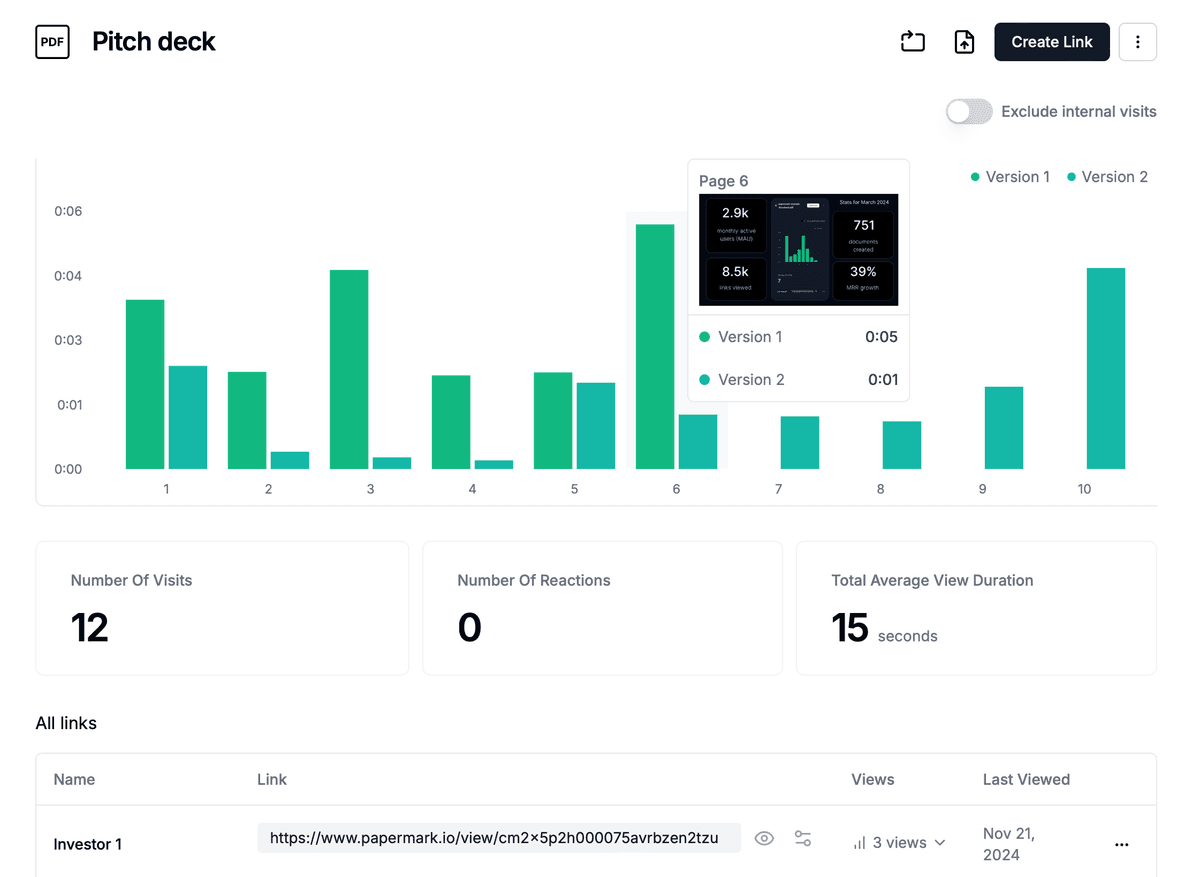
Analytics tell you which investors actually opened the cap table, which is a better signal of intent than a reply to an email.
That list is why a round run over email drags. Eleven investors, each asking for a different subset at a different point, produce a thread nobody can reconstruct when the Series A lead asks what was disclosed. An investor data room collapses that into one link per party.
A data room for a SAFE or convertible note round is a different artifact from an M&A room. The document set is small, usually 20 to 60 files, but the audience is large and heterogeneous: a dozen angels, one or two funds running real diligence, a strategic investor who should not see the pipeline, and a family office whose counsel wants the note documents alone. The problem is not volume. It is that the same folder has to look different to eight people over months.
Timing differs too. An M&A room opens, runs, and closes. A convertible round runs alongside the business for a year. The deck changes, the model is refreshed quarterly, and the cap table changes with every signature, so investors who saw version one need version four and you need to know who saw which.
Papermark is a secure, fully customizable, and developer-friendly data room built for modern dealmakers, with page-by-page analytics, dynamic watermarking, and transparent pricing (open-source and self-hosting available).
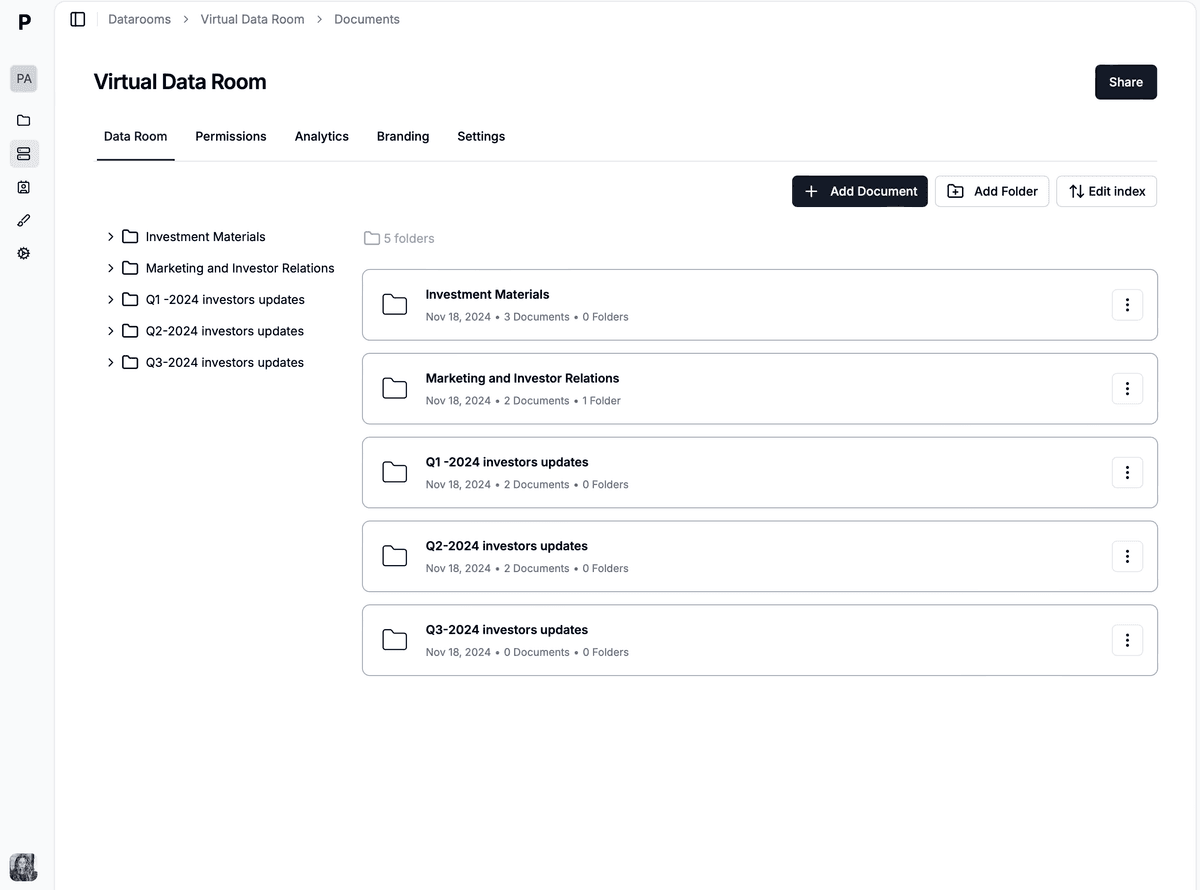
A convertible round room organised by folder, so a teaser-level investor and a lead running diligence can share one underlying document set.
Most seed rounds run on email attachments and a shared drive link, and for the first three investors that is fine. It stops being fine around the fifth. There are four concrete reasons a dedicated data room for your convertible round earns its place. If you are still choosing a platform, our comparison of the best virtual data rooms covers pricing, permissions and analytics across the main providers.
The audience is tiered and the documents are not. An angel writing $25,000 gets the deck, summary financials, and the SAFE. A fund writing $900,000 gets the cap table, the full model, customer contracts, and the founder agreements. A strategic investor who competes with one of your customers should see neither the pipeline nor the contracts. One shared drive link gives you one permission set for all three, so founders either overshare or keep three copies and lose track of which is current.
Everything changes mid-round. Over a fourteen-month raise the deck goes through four versions, and sending version four by email leaves the earlier three live in a dozen inboxes. Document versioning with notifications replaces the file behind the same link and tells everyone who has access that it moved.
You need to know who is real. In a round assembled from many small cheques, the scarce resource is founder attention. Knowing that a partner spent eleven minutes on the cap table while another never opened the link changes who you call this week.
The disclosure record matters at Series A. When the lead's counsel runs diligence, one question is what earlier investors were told and when. A per-visitor audit log answers that in a minute. An inbox does not.
The rest of this section is the setup: five steps to build a data room for a SAFE or convertible note round.
Create one room whose folder structure separates what every investor sees from what only a diligence-stage investor sees. A workable default is five folders: company and corporate, financials and model, product and traction, legal and IP, and instruments (signed SAFEs, notes, side letters, and the current cap table). Keep the instruments folder complete from the first signature.
Upload the folder tree directly rather than file by file. Automatic file indexing on the Data Rooms Plus plan maintains the index as documents arrive, which matters when the document set grows for a year.
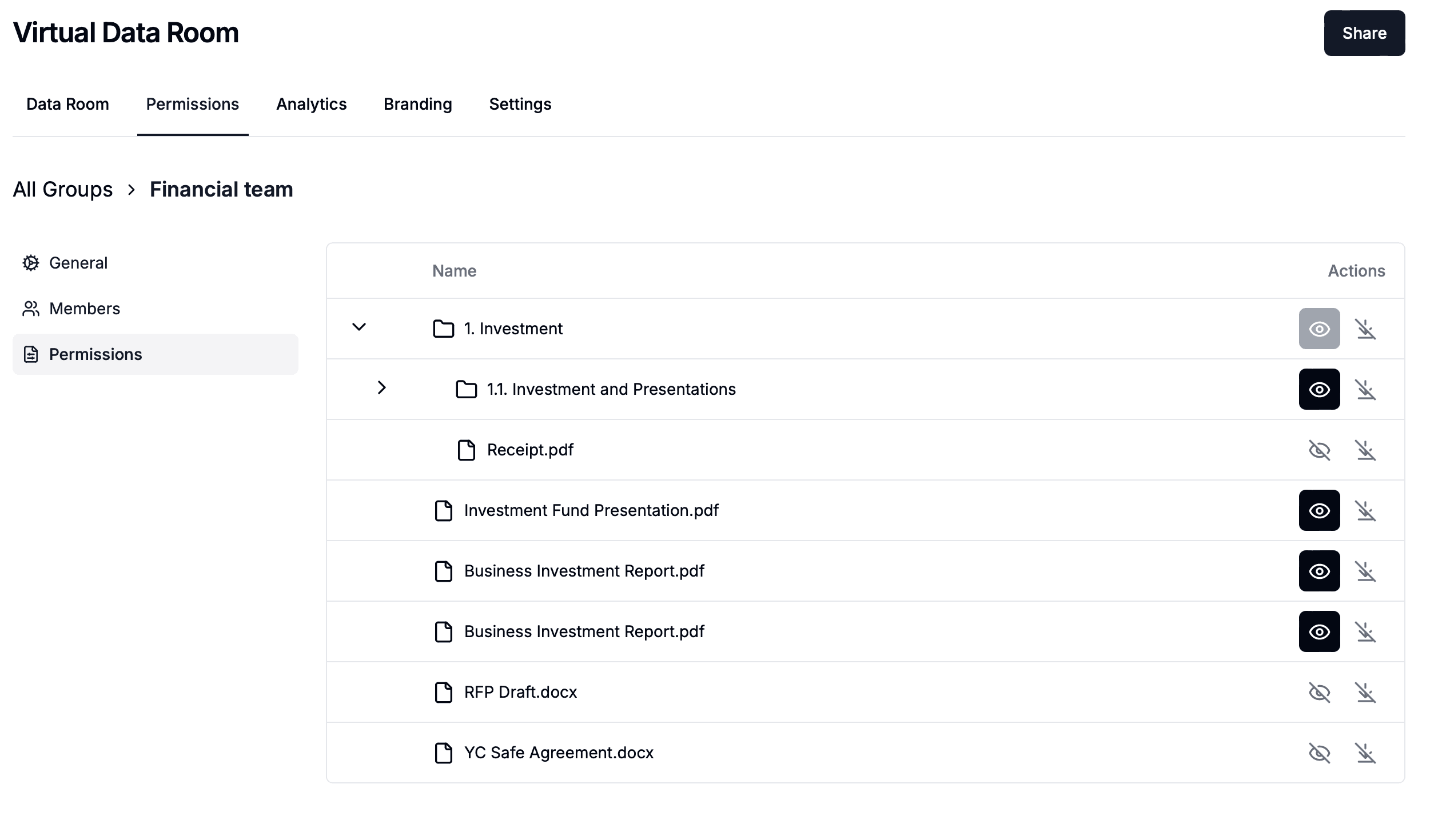
This is the step that replaces the three-copies-of-everything habit. Granular file-level permissions are set per link rather than per user, so one room produces as many views as you need: the lead fund sees all five folders with download rights, an angel sees company and traction, a strategic investor gets view-only watermarked access to a summary set, and the noteholder's counsel sees the instruments and legal folders alone.
Access is link-based, so no investor has to create an account, which removes the most common reason a busy angel never opens what you sent. Email allowlist restricts a link to named addresses where the folder is sensitive.
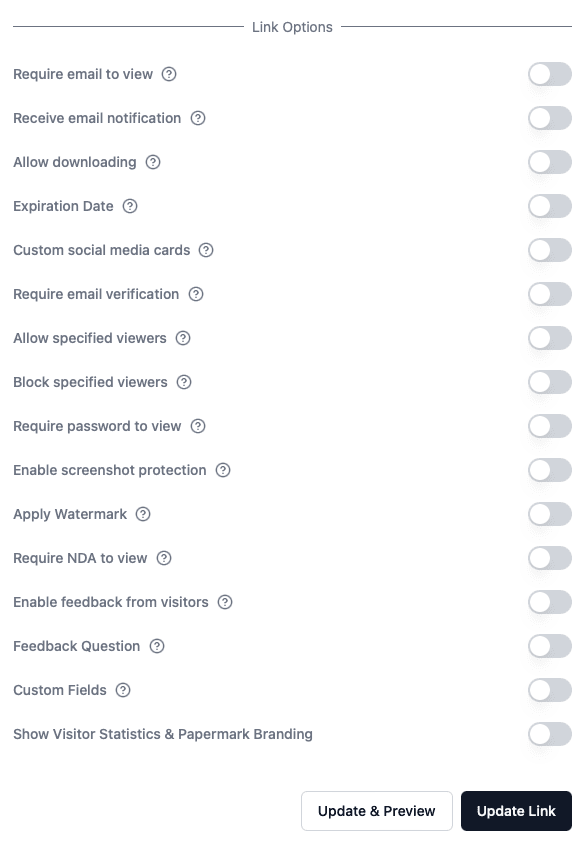
Permissions are set per link, so the lead fund and a small angel cheque see different folders of one room.
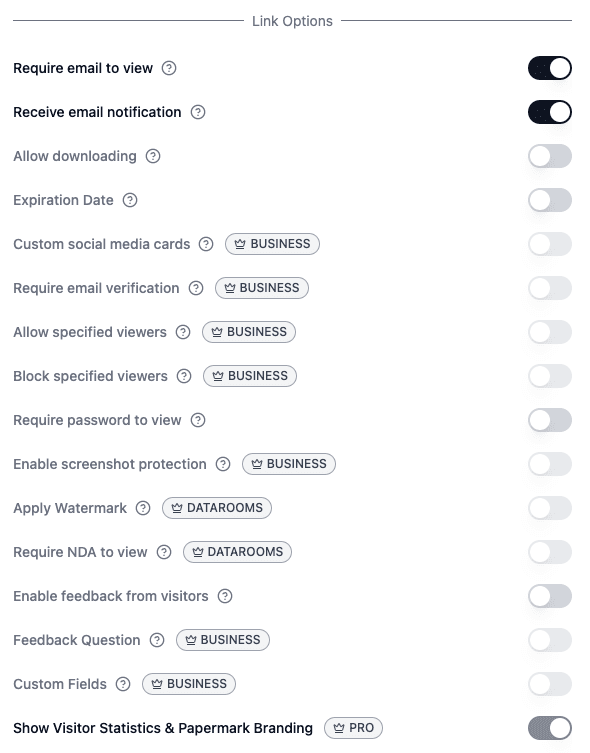
Most angels will not sign an NDA to see a deck, and asking them to is a good way to lose the cheque. The diligence tier is different: customer contracts, the full model, and founder agreements are worth gating. One-Click NDA attaches an NDA to a specific link, so the investor accepts in the browser before the folder opens and the acceptance is recorded against their email with a timestamp and the version accepted.
If you update the NDA mid-round, that log shows which investors accepted which version, the question that arises when a strategic investor turns out to be building something adjacent. Our guide to the startup NDA agreement covers what to put in it.
A convertible round is a credibility exercise as much as a document exercise. White-labelling and branding applies your logo, colours, and typography to the room and the viewer, and a custom domain puts it on something like vdr.yourcompany.com. That also reduces the firewall and spam-filter problems that quietly kill access at larger institutions.
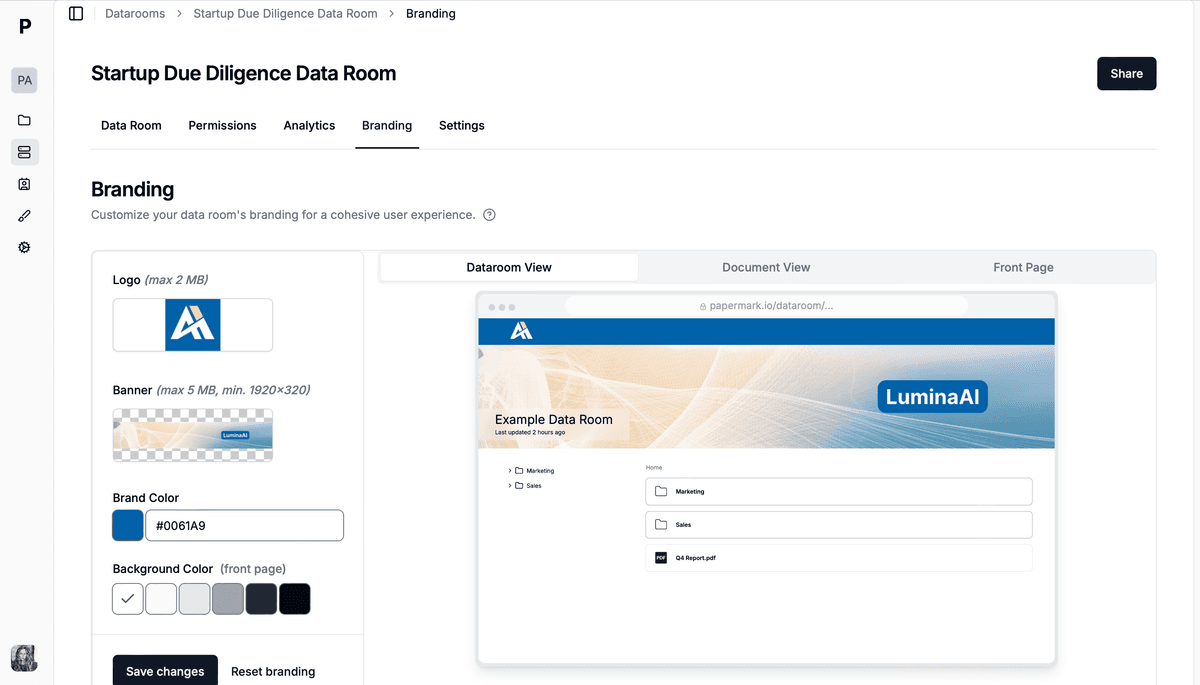
Branding and a custom domain make the room look like part of the company rather than a forwarded file link.
Page-level analytics show which investor opened which document, on which page they stopped, and for how long. In a round with fifteen conversations running in parallel, that is the cheapest prioritisation signal available: the partner who spent eleven minutes on the retention page is in a different conversation from the one who opened the deck for forty seconds.
When a fund starts real diligence, the Q&A module on Data Rooms Plus keeps questions attached to the document that prompted them, with permissions controlling who sees which threads. The audit log records every view, download, and NDA acceptance, which is the disclosure record you will want at Series A.
Papermark is our #1 VDR provider for M&A transactions right now. In two deals we used custom branding, dynamic watermarking, and granular permissions.
Tyler
The Data Rooms plan is €99/month with a 7-day free trial and includes 3 team members, unlimited data room visitors, unlimited data rooms, unlimited documents, custom domain, dynamic watermarking, NDA agreements, and granular file-level permissions. Data Rooms Plus at €249/month adds 5 team members, the Q&A module, the audit log, automatic file indexing, and SOC 2 Type II. Premium at €549/month adds 10 team members, AI redaction, the API, SSO, and white-labelling. Data Rooms Unlimited at €999/month removes per-seat charges entirely, so teams that add reviewers mid-deal pay one number regardless of headcount, and it carries every Premium capability including AI redaction. Unlimited data rooms under one subscription means a fundraising room and an investor-update room carry no per-project fee.
No credit card required.
Merger vs acquisition in 2026: 7 differences in structure, control, tax, and consents, plus how to run a data room for a merger or acquisition.
The types of mergers and acquisitions in 2026: 5 economic types, 5 legal structures, the asset vs stock tax trap, and how to run the data room for M&A deals.
HSR filing in 2026: the $133.9M threshold, fees from $35,000 to $2.46M, the 30-day wait, the Item 4(c) trap, and the data room for an HSR filing you run it from.