7 Types of Mergers and Acquisitions in 2026 and the Tax Trap
·17 min read
Marc Seitz
The types of mergers and acquisitions fall on two axes. The first describes the economic relationship between the parties: horizontal, vertical, conglomerate, market-extension, and product-extension. The second describes the legal structure used to execute the deal, which is what determines the tax bill.
Quick recap
The five economic types are horizontal, vertical, conglomerate, market-extension and product-extension, classified by how the businesses relate commercially.
A horizontal merger combines direct competitors in one market, which is why it draws the heaviest antitrust review; a vertical merger combines a buyer and a supplier in one supply chain and is reviewed on foreclosure instead.
The legal structures are the asset purchase, stock purchase, direct statutory merger, forward and reverse triangular merger, and tender offer.
Buyers prefer asset purchases because they get a stepped-up basis and amortise Section 197 intangibles, including goodwill, over 15 years.
Sellers prefer stock purchases because a C corporation asset sale is taxed twice, at corporate level and again on distribution.
A Section 338(h)(10) election treats a qualifying stock purchase as a deemed asset sale for tax, and the buyer grosses up the price to cover the seller's extra tax.
A reverse triangular merger leaves the target alive as a subsidiary, preserving contracts and licences an asset purchase would need consent to move.
The deal type changes the diligence scope, so a data room for mergers and acquisitions for a horizontal deal needs clean team controls a conglomerate deal does not.
Papermark hosts a data room for mergers and acquisitions with granular file-level permissions, dynamic watermarking, and per-visitor analytics from €99/month.
Most guides to the types of mergers and acquisitions stop at the five economic labels, the half of the subject that changes nothing about how a deal is documented. The half that decides the tax bill, the consent list and the closing timetable is the legal structure. This guide covers both, plus the trap where buyer and seller want incompatible structures.
Each structure produces a different document set. A data room for mergers and acquisitions carries contract schedules for an asset deal, a full corporate history for a stock deal, and clean team walls for a horizontal one. Section 9 covers the setup.
1. What are the types of mergers and acquisitions?
The types of mergers and acquisitions sit on two independent axes, and confusing them is why deal conversations go in circles. The first is economic: what is the commercial relationship between the two businesses before they combine? That answers whether the deal is horizontal, vertical, conglomerate, market-extension or product-extension. The second is legal: by what mechanism does ownership move? That answers whether the transaction is an asset purchase, a stock purchase, a statutory merger, a triangular merger or a tender offer.
The two axes are orthogonal. A horizontal deal can be executed as an asset purchase or as a reverse triangular merger; a conglomerate acquisition can be a tender offer or a plain share purchase agreement. Knowing a deal is vertical tells you where the synergy case comes from and how regulators will react, but nothing about who pays the tax.
The economic type is decided by strategy and fixed before anyone opens a diligence file, and our guide to strategic acquisitions covers how that plan gets built. The legal structure is decided by lawyers and accountants during the letter of intent, and it is genuinely negotiable. Underneath both sits the question of whether a transaction is a merger or an acquisition at all, which we cover in merger vs acquisition. One note: the label in a press release is a communications decision, not a legal one.
2. The five economic types of mergers and acquisitions
The five economic types describe how the two businesses overlap. Horizontal deals combine direct competitors. Vertical deals combine different stages of one supply chain. Conglomerate deals combine businesses with no commercial relationship. Market-extension deals combine similar businesses in different geographies. Product-extension deals combine related but non-competing products sold to the same customers.
Each type has its own synergy logic and its own failure mode. Horizontal deals promise cost synergies and deliver antitrust risk. Vertical deals promise margin capture and deliver channel conflict. Conglomerate deals promise diversification and deliver a management team running a business it does not understand. The type tells you which failure mode to underwrite.
Type
What it combines
Strategic rationale
Characteristic risk
Named example
Horizontal
Direct competitors, same market
Scale, cost synergies, pricing power
Antitrust challenge
Exxon and Mobil, 1999
Vertical
Buyer and supplier, one chain
Margin capture, supply security
Foreclosure claims
AT&T and Time Warner, 2018
Conglomerate
Unrelated industries
Diversification, capital allocation
Conglomerate discount
Berkshire and Precision Castparts, 2016
Market extension
Same industry, new geography
Same model, new territory
Regulatory mismatch
Walmart and Flipkart, 2018
Product extension
Related products, shared customers
Cross-selling into a live channel
Cross-sell never arrives
PepsiCo and Quaker Oats, 2001
Two of the five get argued about. Market extension and product extension are often grouped together as congeneric deals, because the businesses are related but not competing. And some vertical deals look horizontal, because a supplier that also sells direct competes with its own buyer. Where the label is ambiguous the antitrust analysis resolves it, since the agencies define the relevant market whether or not the parties have.
3. Horizontal and vertical deals, and why antitrust concentrates on one
Horizontal deals are the most scrutinised category, and the reason is arithmetic. When two competitors in one market combine, the number of independent competitors falls by one and the combined share is the sum of the two. Every other type leaves competitor count unchanged.
That arithmetic is written into how US agencies review deals. Under the 2023 Merger Guidelines issued jointly by the Federal Trade Commission and the Department of Justice, a market with a Herfindahl-Hirschman Index above 1,800 is highly concentrated and an increase of more than 100 points is significant. A merger producing both is presumed unlawful unless rebutted, and the presumption also applies where the combined firm would hold more than 30 percent share alongside an HHI increase above 100.
None of that bites on a conglomerate deal and only indirectly on a vertical one. Vertical deals are reviewed under a foreclosure theory: that the combined firm refuses to supply, or raises the price of supply, to downstream rivals. The theory is harder to prove and has a mixed record. The DOJ challenged AT&T's acquisition of Time Warner on that basis in 2017 and lost at trial and on appeal.
Any reportable US transaction requires a premerger notification and a waiting period regardless of type, and our HSR filing guide covers the 2026 thresholds, which start at $133.9 million. A conglomerate deal above the threshold usually clears the 30-day wait and closes; a horizontal deal with real overlap can attract a Second Request, and substantial compliance routinely takes three to six months.
That difference changes how the seller runs the process. In a horizontal sale the buyer's commercial team cannot see customer-level pricing, contract terms or the forward pipeline before closing, because the parties are still competitors and sharing that is itself a competition law risk. The remedy is a clean team: a ring-fenced group of outside advisors and non-commercial employees who review the material and report only aggregated conclusions.
In a horizontal deal, the clean team link opens the customer pricing folder and the buyer's commercial link does not.
Vertical deals have their own information problem, and it is commercial rather than legal. When a manufacturer buys a distributor, the distributor's other supplier relationships become visible to a competitor of those suppliers, many of whom hold termination rights.
4. Conglomerate, market-extension and product-extension deals
Conglomerate deals combine businesses with no commercial relationship. The acquirer buys cash flows rather than synergies, and the case rests on capital allocation: that the acquirer deploys the target's cash better than its own board, or that combined earnings are less volatile than either stream alone. Berkshire Hathaway's 2016 purchase of Precision Castparts is the canonical example.
The risk is that there is no operating synergy to fall back on when the target underperforms. Public markets often apply a conglomerate discount, valuing a diversified group below the sum of its parts on the theory that investors diversify more cheaply themselves. Diligence shifts as a result: with no integration case, the buyer spends less on operational separability and far more on standalone quality of earnings and management depth.
Market-extension deals apply a working model to a territory where the acquirer does not operate. Walmart's 2018 acquisition of a majority stake in Flipkart is the obvious case: same industry, different geography, no overlap to review. The argument is that the playbook and the capital travel across the border even though the customers do not. The risk is that the playbook does not travel: regulatory regimes, labour law, tax residency, data protection and payment behaviour all change at the border, and each can invalidate part of the model. Cross-border deals also add foreign investment screening and a second set of filings, covered in our guide to cross-border M&A.
Product-extension deals add an adjacent product to an existing channel. PepsiCo's 2001 acquisition of Quaker Oats brought Gatorade into a beverage system that already reached every relevant shelf: the same trucks, the same buyers, one more product. The risk is valuation rather than operations. Cross-sell synergies are the easiest number to inflate and the hardest to verify, because they depend on customer behaviour that has not happened yet. A buyer paying a premium for cross-sell should ask diligence for evidence of channel fit rather than projections: overlapping customer lists, compatible contract terms, and any pilot that actually ran.
5. The legal structures: how the deal is executed
Once the type is settled, the deal is executed through one of a few legal structures. Each moves ownership by a different mechanism, and that mechanism determines who consents, which liabilities travel, how the deal is taxed and how long closing takes.
An asset purchase transfers named assets under an agreement with schedules. Nothing moves unless it is listed, which is why the buyer can leave unwanted liabilities behind and why every contract with an anti-assignment clause needs a counterparty signature. A stock purchase transfers the shares, so the company continues unchanged under a new owner and every liability comes with it.
A statutory merger operates by law rather than by conveyance: the parties sign a merger agreement, file with the state, and assets and liabilities move automatically when the filing takes effect. Triangular structures put a subsidiary between acquirer and target. In a forward triangular merger the target merges into the subsidiary and disappears. In a reverse triangular merger the subsidiary merges into the target, which survives as a wholly owned subsidiary, and that is why the reverse form is the default where contracts, licences or permits are hard to reassign.
A tender offer is the public-company route: the acquirer buys shares directly from shareholders, bypassing the board's proxy process. Under the Williams Act the offer must stay open at least 20 business days, and Delaware's Section 251(h) lets the acquirer complete the second-step merger without a shareholder vote once it holds enough shares to have approved it.
Structure
Consents required
Liability transfer
Default tax treatment
Typical use case
Asset purchase
Every anti-assignment clause, permits, leases
Only what the buyer assumes
Taxable, buyer gets stepped-up basis
Distressed deals, carve-outs, S corp targets
Stock purchase
Change-of-control clauses only
Everything, known and unknown
Taxable, carryover basis
Private targets, few shareholders
Direct statutory merger
Change-of-control clauses, shareholder vote
Everything, by operation of law
Can be a tax-free reorganisation
Two entities into one survivor
Forward triangular merger
Change-of-control clauses, no acquirer vote
Everything, into the subsidiary
Tax-free only with substantial stock
Liability shield, portable contracts
Reverse triangular merger
Change-of-control clauses, no acquirer vote
Everything, target survives
Tax-free only if stock buys 80 percent
Licences and permits must stay put
Tender offer
Shareholder acceptance, 20 business days
Everything, target survives
Taxable if cash, tax-free if qualifying stock
Public targets, including hostile bids
Read the table as a trade. Moving from a stock purchase to an asset purchase buys liability protection and a tax benefit at the price of a consent project that runs for months and lets every counterparty renegotiate. Moving from a direct merger to a reverse triangular merger buys a liability shield and removes the acquirer's shareholder vote at the price of maintaining a subsidiary. These choices are made in the letter of intent, where the structure paragraph deserves more attention than it gets.
One warning. Successor liability doctrine means an asset purchase does not always leave liabilities behind. Courts have found buyers liable where the transaction was a de facto merger, where the buyer is a mere continuation of the seller, where liabilities were expressly assumed, or where the deal was a fraudulent transfer. Environmental liability, some employment obligations and certain state tax claims follow the assets whatever the agreement says.
6. The tax trap: why buyers want assets and sellers want stock
This is the structural conflict inside almost every private mid-market deal, and it is worth understanding before the letter of intent rather than after. Buyers want an asset purchase because it produces a stepped-up basis: the buyer's tax basis in each acquired asset becomes what the buyer paid rather than the seller's depreciated figure. Tangible assets are then depreciated on the higher number, and intangibles including goodwill, customer lists and non-compete agreements are amortised straight-line over 15 years under Section 197. On a deal with substantial goodwill that write-off is worth real money in present value, and buyers price it.
Sellers want a stock purchase because of how the two structures tax them. A C corporation selling assets is taxed twice: at corporate level on the gain, and again at shareholder level when proceeds are distributed. Selling shares produces a single layer of capital gains tax, and the gap is often large enough that a seller accepts a materially lower headline price for a stock deal.
Even without double taxation the asset sale is worse for the seller, because depreciation recapture converts part of what would have been capital gain into ordinary income at higher rates. How much depends on the allocation of purchase price across asset classes, a negotiated schedule both parties file with the IRS and therefore have to agree. It is one of the most consequential exhibits in the document set and one of the last to get attention.
The bridge between the two positions is the Section 338(h)(10) election. Where the target is an S corporation or a subsidiary in a consolidated group, buyer and seller can jointly elect to treat a qualifying stock purchase as if the target had sold all its assets and liquidated. The legal form stays a stock purchase, so contracts and licences stay in place and no consent project is required. The tax form becomes an asset sale, so the buyer gets the step-up.
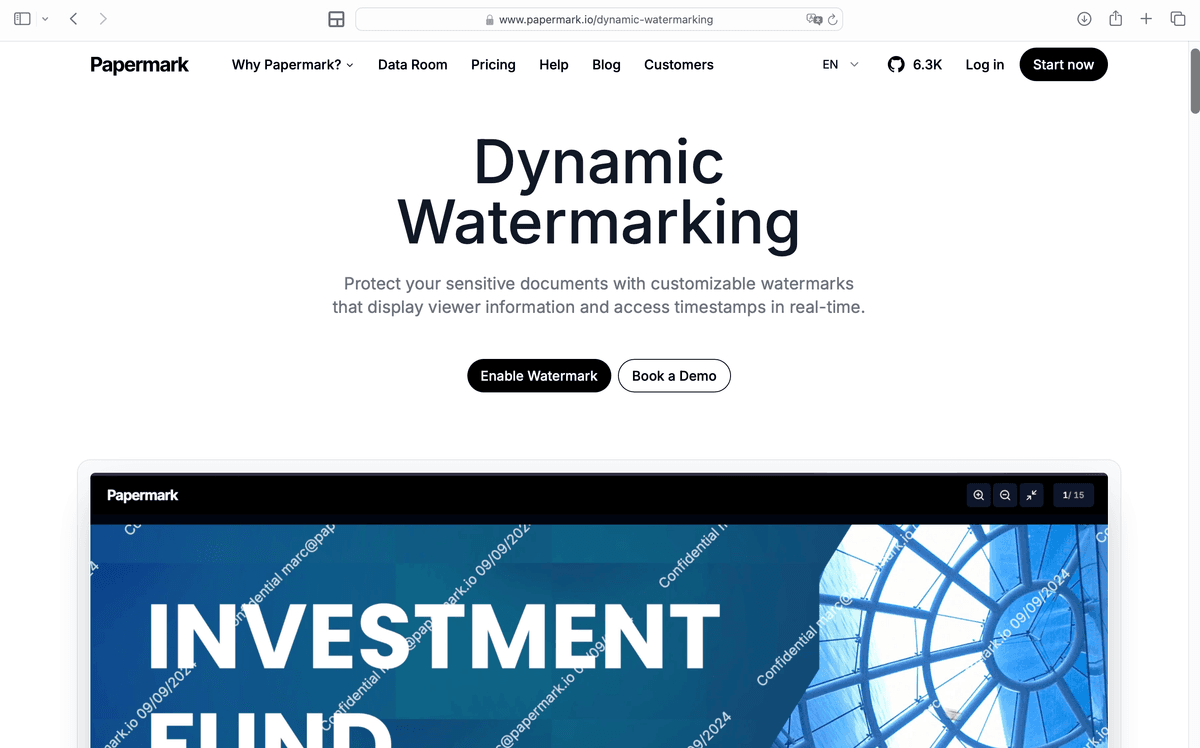
Tax schedules and allocation exhibits are worth watermarking, because they circulate to advisors on both sides.
The election is not free for the seller, and that is where the negotiation lands. Taxed as if it sold assets, the seller usually pays more than on a straight stock sale. The commercial answer is a gross-up: the buyer raises the price enough to leave the seller in the same after-tax position and keeps what is left of the benefit. It only makes sense when the present value of the buyer's future depreciation and amortisation deductions exceeds the seller's incremental tax cost, and on an asset-light services business it frequently does not.
A Section 336(e) election achieves a similar result unilaterally on the seller's side, which matters when the buyer is a partnership such as a private equity fund and cannot make a 338 election. For S corporation targets, an F reorganisation followed by an LLC interest sale is the other common route.
One point is easy to miss. A stock purchase with a 338(h)(10) election is still legally a stock purchase, so the buyer inherits every liability, including litigation and historic tax positions. The election changes tax treatment and nothing else, which is why the indemnity package must do the work an asset purchase would have done structurally, and why buyers take out representations and warranties insurance.
7. How the deal type changes the diligence scope and the data room
Every deal needs the same core diligence: financial, legal, tax, commercial, operational. What changes is which folders carry the weight and who may see them. A seller who builds one generic index and reuses it across deal types will find the buyer's request list rewriting the room in week two.
The economic type sets the emphasis. A horizontal buyer reads customer contracts and pricing, where both the synergy and the antitrust exposure live. A vertical buyer reads supply agreements and the target's other counterparty relationships. A conglomerate buyer reads standalone quality of earnings and management depth, because nothing else supports the case. A product-extension buyer reads the channel.
The legal structure sets the volume. An asset purchase multiplies the contracts workstream, because every material agreement is read for an anti-assignment clause and each becomes a consent to chase. A stock purchase multiplies corporate history: full cap table, prior financings, option grants and historic tax filings.
Deal type
Folders that carry the most weight
Access control that matters most
Horizontal
Customer contracts, pricing, market share, Item 4(c) material
Cap table, minutes, prior financings, historic tax filings
Full history to counsel and tax advisor
The access column is what sellers underestimate. The clean team requirement in a horizontal deal is a competition law control, not a preference, and a shared drive cannot implement it because it has one permission set. A data room for mergers and acquisitions issues one link per party over the same documents. Our M&A due diligence checklist covers the underlying request list.
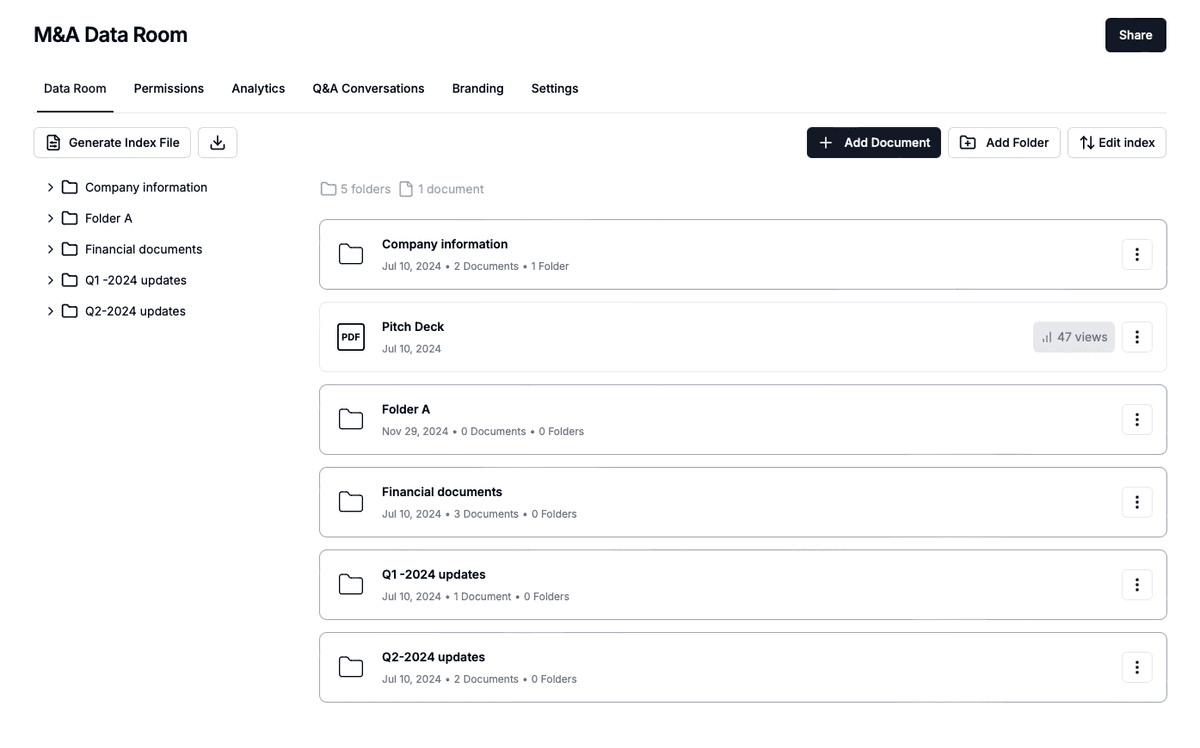
An M&A data room with folders mapped to the workstreams the deal structure creates, not a generic index.
8. Worked scenario: Brantmere Packaging picks a structure
Brantmere Packaging, a hypothetical $180 million revenue folding-carton manufacturer, has board approval to deploy $60 million and two live targets: Delcroft Resins, a $26 million revenue polymer supplier Brantmere already buys from, available at $34 million, and Norvale Cartons, a $41 million revenue direct competitor, available at $54 million.
The vertical deal is straightforward. Delcroft is an S corporation with three shareholders, one site and 40 supply agreements, so counsel recommends an asset purchase for the liability protection and the basis step-up. The allocation sets $12 million against plant and equipment, $6 million against inventory and receivables, $9 million against identified intangibles including the supply contracts, and $7 million to goodwill. That $16 million of Section 197 intangibles and goodwill amortises over 15 years, roughly $1.07 million of deductions a year.
Delcroft Resins: purchase price allocation on a $34M asset purchase
$34Mpurchase price
Plant and equipment12 · 35%
Depreciated on the stepped-up basis
Inventory and receivables6 · 18%
No lasting tax benefit
Identified intangibles9 · 26%
Supply contracts, amortised over 15 years
Goodwill7 · 21%
Section 197, straight-line
Worked scenario. The $16M of Section 197 intangibles and goodwill amortises straight-line over 15 years, which is why the buyer wants the asset structure.
The horizontal deal is harder. Norvale is a C corporation, so its shareholders will not sell assets at any price Brantmere will pay, and the deal has to be a stock purchase or a reverse triangular merger. It clears the reportability test, so a premerger notification is required, and the two compete in three of the same regional accounts. Counsel sets up a clean team of two outside consultants and the CFO, who alone see Norvale's customer-level pricing.
Both processes run on the same platform with different configurations. Delcroft's room holds 190 documents across 9 folders, with a consent tracker that grows as signatures return. Norvale's room holds 340 documents across 12 folders, with pricing and win-loss data restricted to the clean team link. Brantmere signs Delcroft first because the consent project needs the runway, and puts Norvale under a letter of intent with the antitrust clock starting the same week.
Manage due diligence with a virtual data room
No credit card required
Page by page analytics
Unlimited documents & folders
Permission management
Dynamic watermarks
NDA collection
Real-time alerts
Custom branding
Audit trail
9. Data room for mergers and acquisitions
The document set in an M&A process is not one thing. An asset purchase generates a contract-by-contract consent tracker. A stock purchase generates a full corporate history buyer counsel reads line by line. A horizontal deal generates documents one group of the buyer's own people is legally not allowed to see. A shared folder cannot express any of that. A purpose-built room can: hundreds of documents, a different view per team, proof afterwards of who saw what, and no account creation.
Papermark is a secure, fully customizable, and developer-friendly data room built for modern dealmakers, with page-by-page analytics, dynamic watermarking, and transparent pricing (open-source and self-hosting available).
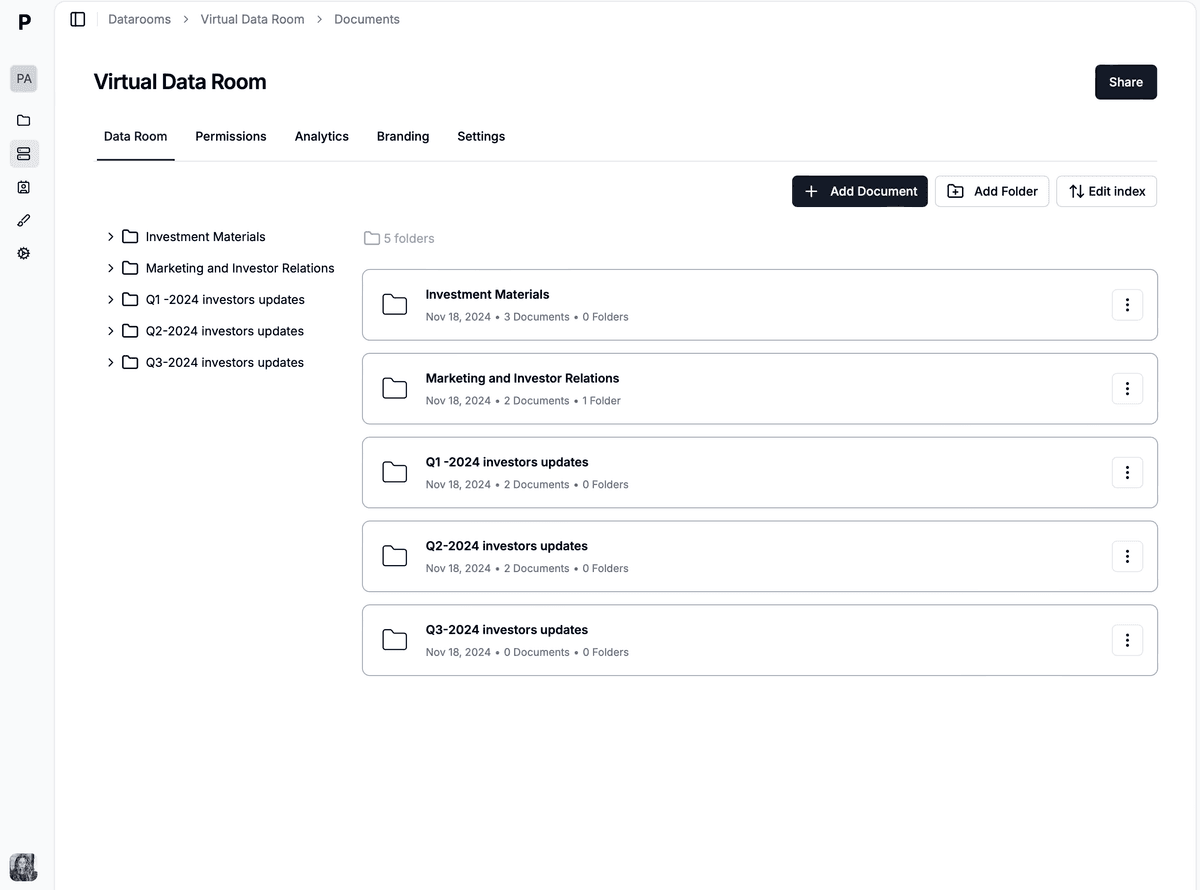
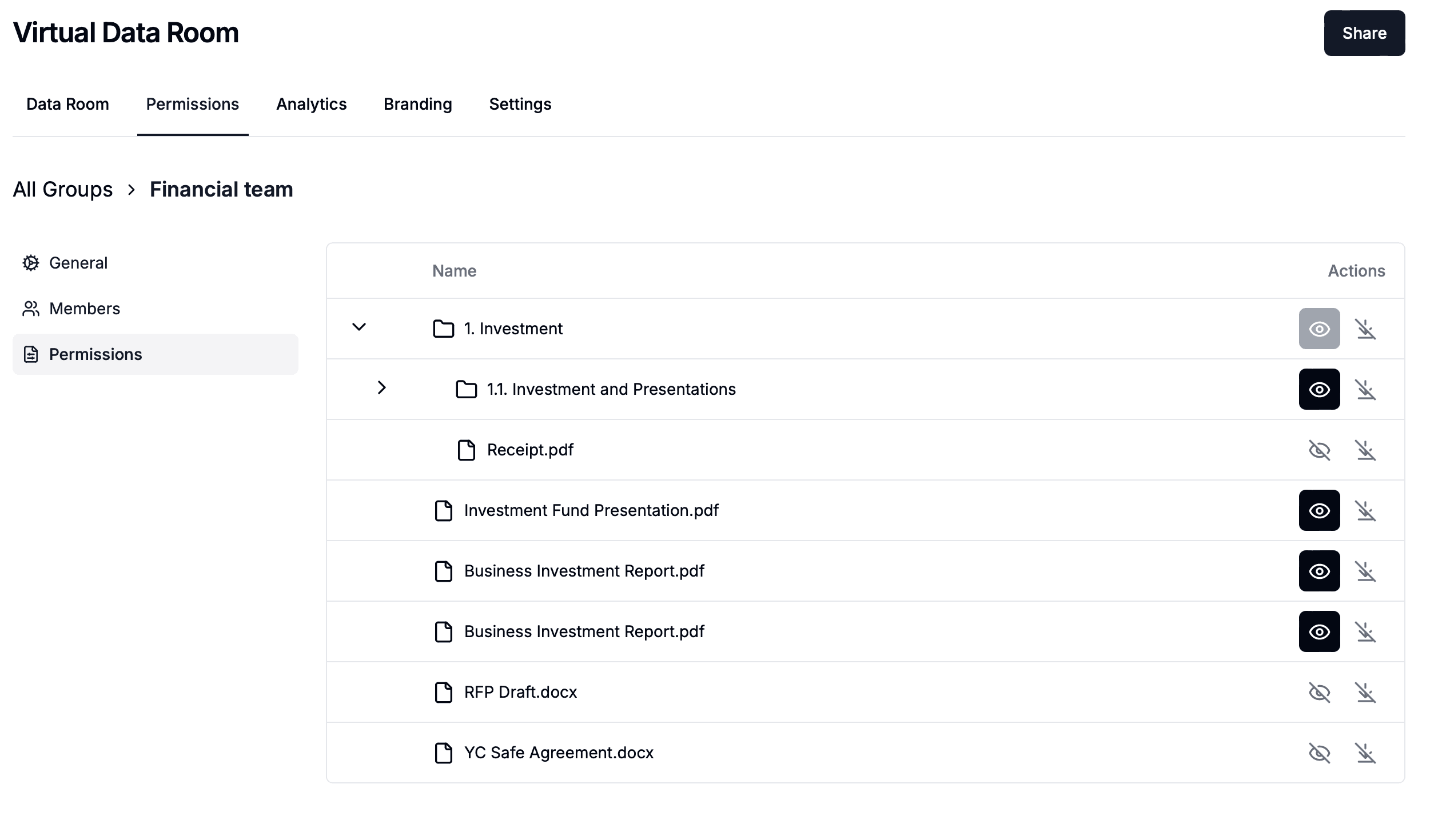
A data room organised by workstream, so permissions differ by folder rather than by document.
Why you need a data room for mergers and acquisitions
Most sell-side processes start on a shared drive and move when the first buyer complains. There are four reasons a dedicated data room for mergers and acquisitions is worth setting up on day one. If you are still choosing, our comparison of the best virtual data rooms covers pricing, bidder management and compliance across the main providers.
Different deal types need different walls. A horizontal deal legally requires a clean team wall between the buyer's advisors and its commercial staff. A vertical deal needs supplier identities restricted until exclusivity. A cross-border deal needs a scoped link per jurisdiction. A drive gives one permission set for all three.
The structure decides what the room tracks. An asset purchase becomes a consent project with its own tracker and its own effect on the closing date. Those documents arrive in waves as counterparties respond, and versioning plus upload notifications keep the tracker honest.
Advisors will not create accounts. A mid-market deal involves buyer counsel, seller counsel, a tax advisor, a quality of earnings team and a lender. Friction at the door means the busiest of them asks for files by email, and the controlled process ends.
The disclosure record outlives the deal. When an indemnity claim arrives two years after closing, the question is what was disclosed, to whom and on what date. A per-visitor audit record answers that. An inbox does not.
What follows is the five-step setup.
Step 1: build folders around the structure, not a generic index
Start from the structure. An asset purchase room needs a contracts folder subdivided by counterparty type with a consent status, plus asset registers and the price allocation. A stock purchase room needs a corporate history folder with the cap table, prior financings, option grants and historic tax filings. Getting that right before uploading avoids restructuring the room in week three. Upload the whole tree by drag and drop, and automatic file indexing on the Data Rooms Plus plan builds and maintains the numbered index as documents arrive, which matters because M&A request lists arrive in waves.
Step 2: set one link per party, including the clean team
This is where the deal type shows up. Each party gets a link with its own folder scope, email allowlist and download rule.
Party
Folders granted
Rights
Buyer counsel
All folders
View and download
Buyer commercial team
All except customer pricing and win-loss
View and download
Clean team
Customer pricing, win-loss, market share
View only, watermarked
Tax advisor
Tax filings, allocation schedule, corporate history
View and download
Lender
Financials, material contracts, asset registers
View only
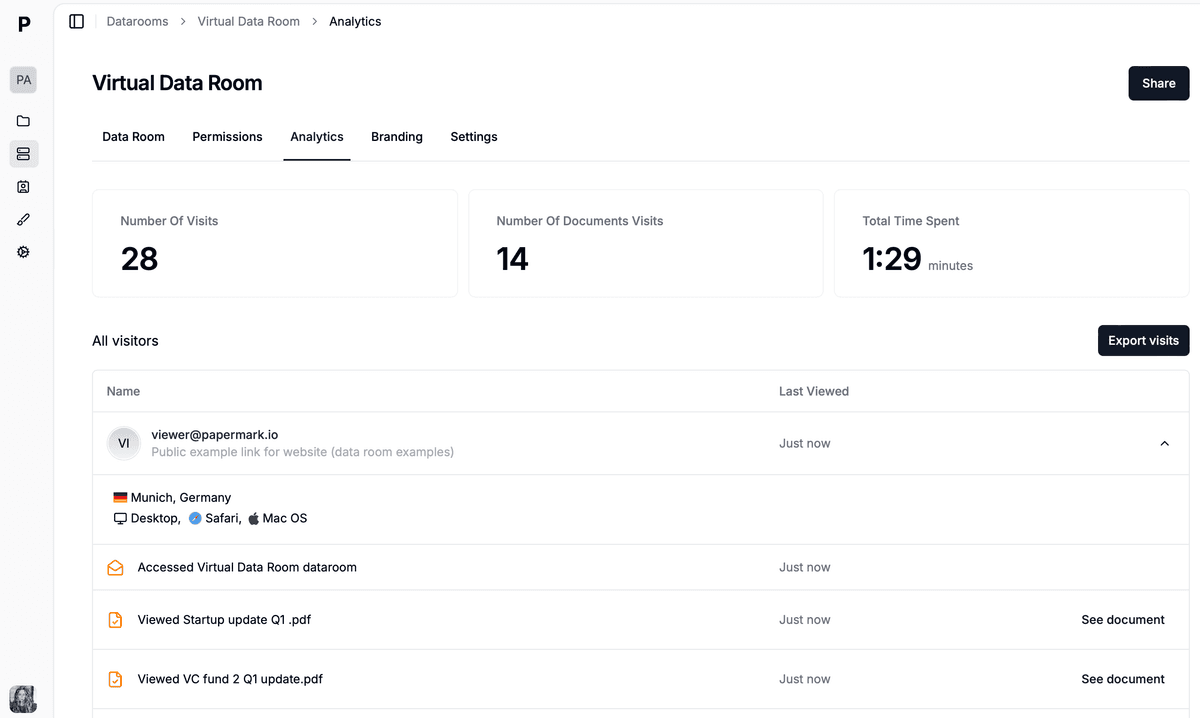
Granular file-level permissions are set per link rather than per user, so a document visible on one link is invisible on another. Access is link-based, so no advisor creates an account.
Step 3: gate the sensitive material before it opens
Put the teaser and summary financials behind an NDA gate and keep detailed material closed until exclusivity. One-Click NDA requires each visitor to accept before any file renders, and logs the acceptance against the visitor and the version accepted.
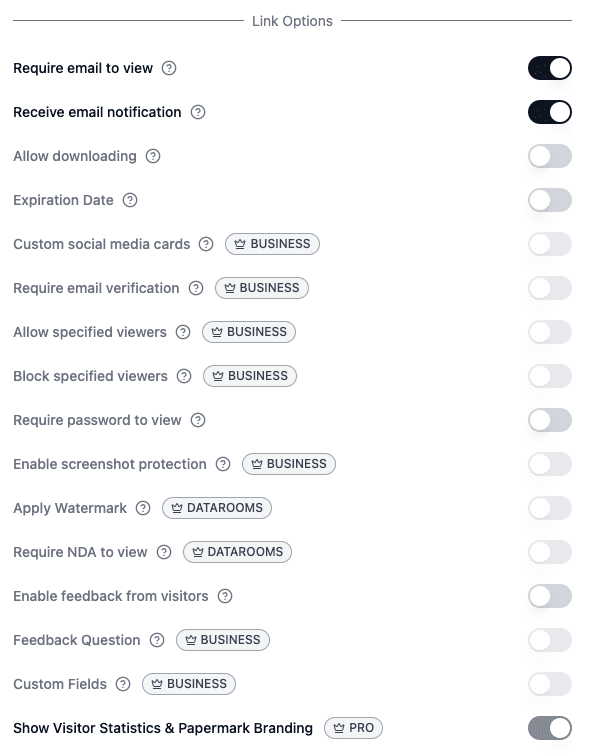
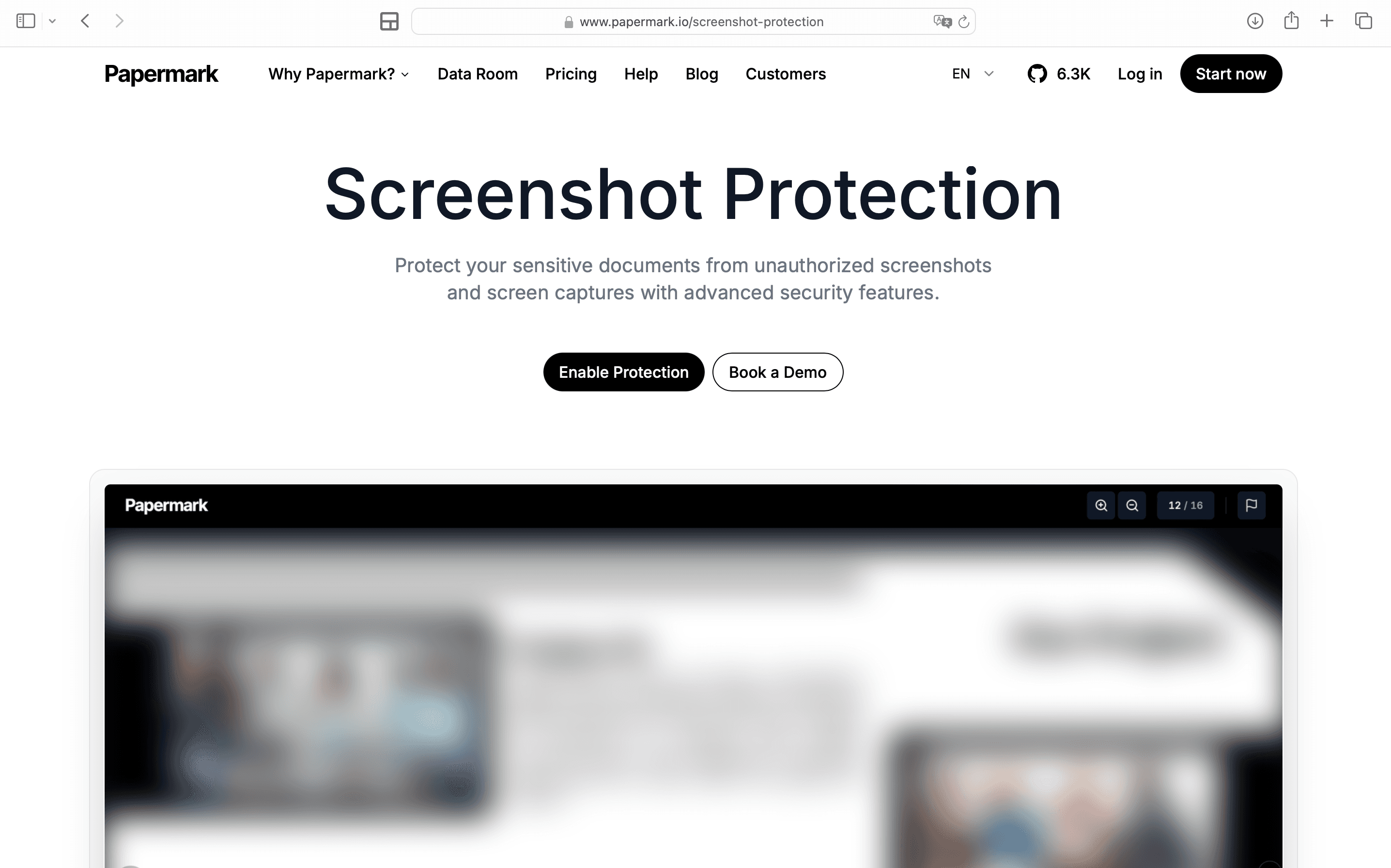
For folders that stay sensitive after the gate, switch off download and turn on dynamic watermarking, which stamps the viewer's email, IP address and timestamp onto every rendered page. A downloaded file is legally treated as fully read and no platform can recall it, which is why download is disabled rather than discouraged on pricing and IP folders.
Step 4: run the request waves through Q&A
M&A questions arrive attached to documents. The tax advisor reads the allocation schedule and asks three questions; the lender reads the same schedule and asks a different one. Over email those threads fragment across four inboxes.
The Q&A module attaches each question to the document that prompted it, with permissions controlling which group sees which threads, so a clean team question never appears on the commercial team's link. Answers publish to one bidder or all, and the log exports for the closing file.
Step 5: read the analytics, then freeze the room
Page-level analytics show which party opened which document, when and for how long. That is a signal in a competitive process: a bidder who spent forty minutes in the customer contracts folder is building a synergy case; one who never opened the financials will not bid.
Per-visitor analytics show which bidder opened which document and for how long.
After closing, data room freeze makes the room immutable and exports it as an archived ZIP with a certificate, which is the record of what was disclosed and to whom if an indemnity claim arrives two years later.
Papermark is our #1 VDR provider for M&A transactions right now. In two deals we used custom branding, dynamic watermarking, and granular permissions.
The Data Rooms plan is €99/month with a 7-day free trial and includes 3 team members, unlimited data room visitors, unlimited data rooms, unlimited documents, custom domain, dynamic watermarking, NDA agreements, and granular file-level permissions. Data Rooms Plus at €249/month adds 5 team members, the Q&A module, the audit log, automatic file indexing, and SOC 2 Type II. Premium at €549/month adds 10 team members, AI redaction, the REST API, SSO and white-labelling. Data Rooms Unlimited at €999/month removes per-seat charges entirely, so teams that add reviewers mid-deal pay one number regardless of headcount, and it carries every Premium capability including AI redaction. Data rooms are unlimited on every tier, so an acquirer running two processes pays once, not per project.