

datarooms
Investment Due Diligence Checklist 2026: 25 Documents Investors Actually Want
The complete investment due diligence checklist for 2026 - financial, legal, operational, commercial, and technical document categories for VC, PE, and M&A.
Due diligence on early-stage startups is different from evaluating mature companies. You can't rely on years of financials or proven business models. Instead, you're betting on people, potential, and a product that's barely out of beta.
But that doesn't mean you skip due diligence. You just focus on different things. After investing in dozens of startups at the seed and Series A stage, here's the complete checklist I use to evaluate deals.
Here's the startup due diligence process in numbered steps:
For early-stage startups, the team is more important than the product. Products pivot, but founders don't.
Domain expertise - Do they deeply understand the problem they're solving? The best founders have lived the problem for years. Airbnb founders ran design conferences and needed a way to handle overflow bookings. Stripe founders built payment systems for startups.
Technical capability - If it's a technical product, at least one founder should be able to build it. Non-technical founders building SaaS usually struggle unless they have a strong technical co-founder.
Complementary skills - The best founding teams have:
Three technical co-founders with no business skills or three MBA co-founders with no technical skills both struggle.
Founder commitment - Are they full-time? Do they have enough equity to stay motivated through hard times? Founders with under 10% each post-seed are dilution risks. They'll lose motivation as their ownership shrinks.
Previous exits - Second-time founders with previous exits have:
But first-time founders can be amazing too - they're often more hungry and creative.
Frequent pivots - Changing direction every 6 months signals they don't understand their market.
Blame external factors - "We would've hit our numbers but COVID/the economy/competitors..." Great founders adapt.
Can't articulate the vision - If the founder rambles when you ask "what are you building?" they're not clear on their own strategy.
Ego over substance - More focused on press coverage than customer metrics.
Reluctance to share data - Hiding metrics or refusing to open up financials is a huge red flag.
First 10 hires matter - At seed stage, review each hire. Are they A-players?
Retention - If they've churned through 5 engineers in 12 months, that's a problem.
Leadership bench - Who's the #2 in each function? Strong teams have depth below the founders.
You need to understand what they built, how well it works, and whether it can scale.
Use the product yourself - Don't just watch a demo. Create an account and use it like a customer would.
Core workflow - Can you complete the main use case without hitting bugs or confusing UX?
Performance - Is it fast? Does it handle edge cases?
Mobile experience - If it has a mobile app, test it. Most founders optimize for desktop and neglect mobile.
What's impressive vs. what's janky - Every early product has rough edges. The question is: does the core value proposition work despite the jank?
Find 5-10 users to interview:
Look for strong engagement signals:
Red flags:
For technical investors or with technical advisors, review:
Code quality - Have a senior engineer review a few pull requests and key modules. Are there tests? Is it documented? Is the architecture sound?
Tech stack - Modern, scalable stack (e.g., React, Node, Python, AWS/GCP) or outdated legacy tech?
Technical debt - Every startup has some. The question is: how much and can they pay it down?
Security - Basic security practices in place? Encrypted data, secure auth, vulnerability scanning?
Scalability - Can the current architecture handle 10x growth without a complete rewrite?
Third-party dependencies - What APIs or services do they rely on? Single points of failure?
You're betting the market is big enough and growing fast enough to support a valuable company.
Don't trust the founder's TAM - Every founder claims a "$100B market." Do your own research.
Bottom-up calculation:
Example: If you're selling €10K/year software to e-commerce companies with 50-500 employees:
That's your realistic addressable market, not the entire global e-commerce software market.
Who are the real competitors?
Competitive advantages:
Market positioning:
Competitive response:
What will drive growth from here?
Can they grow faster than the market? If the market grows 10% annually and they're growing 200%, how are they taking share?
Early-stage financials are simple but still important. You need to understand burn rate, runway, and unit economics.
For pre-revenue startups:
For startups with revenue:
Revenue quality:
Forecasting:
Monthly burn rate - How much cash they spend per month net of revenue.
Runway - How many months until they run out of money.
If they have €800K in the bank and burn €100K/month, they have 8 months of runway.
Red flags:
Green flags:
Even early-stage companies should understand their unit economics:
Customer Acquisition Cost (CAC) - Total sales and marketing spend ÷ new customers acquired.
Lifetime Value (LTV) - Average revenue per customer × gross margin % ÷ monthly churn rate.
LTV:CAC ratio - Should be >3:1 for a healthy business. If you spend €1,000 to acquire a customer, they should generate €3,000+ in gross profit over their lifetime.
Payback period - How many months to recover CAC? Less than 12 months is good, 6 months is great.
For early-stage, these are directional - You don't have enough data for statistical significance. But you should see a path to healthy unit economics.
Talk to customers directly. This is the most valuable part of startup due diligence.
Ask 5-10 paying customers:
Look for patterns:
Red flags:
For B2B startups with a sales process:
Talk to 2-3 prospects in late-stage deals:
If the startup says they have "€2M in pipeline" but prospects say "we're just evaluating, not ready to buy yet," there's a mismatch.
Even seed-stage companies need clean legal foundations. You're checking for deal-breakers and risks.
Incorporation - Incorporated in the right jurisdiction? (For US investors, usually Delaware C-corp. For European investors, often UK Ltd or local equivalent.)
Authorized shares - Enough authorized shares to cover option pool and future funding?
Board composition - Who's on the board? Founder control or investor control?
Corporate records - Clean minutes from board meetings? Proper documentation for past fundraising?
Who owns what?
Red flags:
Future dilution - After this round, will founders still have enough equity to stay motivated?
Who owns the technology?
Third-party IP:
Key agreements to review:
Change of control clauses - Do customers or partners have the right to cancel if the company is acquired? This can kill M&A exits.
Founder agreements:
Key employee contracts:
Regulatory compliance:
Litigation:
Clean legal structure is table stakes. Major legal issues at seed stage = walk away.
Talk to people who've worked with the founders before. You'll learn things you won't get from the pitch.
Former bosses - How did the founder perform? Strengths and weaknesses?
Former colleagues - What's it like to work with them?
Previous investors or advisors - Why did they invest or advise? Would they do it again?
Customers from previous companies - If the founder has sold to customers before, what was that experience like?
Professional competence:
Character and integrity:
Founder dynamics (if co-founders):
Red flags from references:
Most investors skip reference checks. Don't. You'll learn critical information.
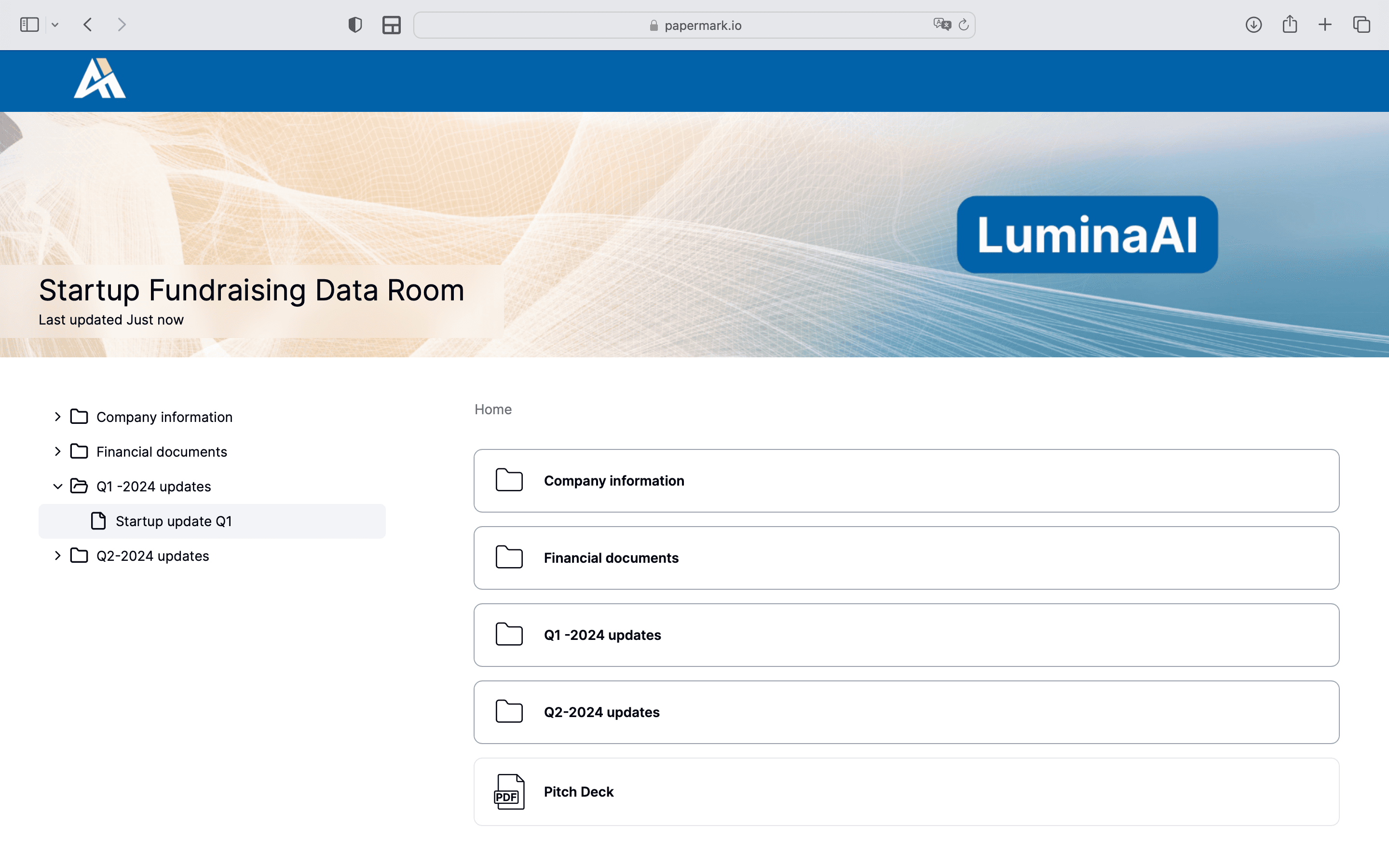
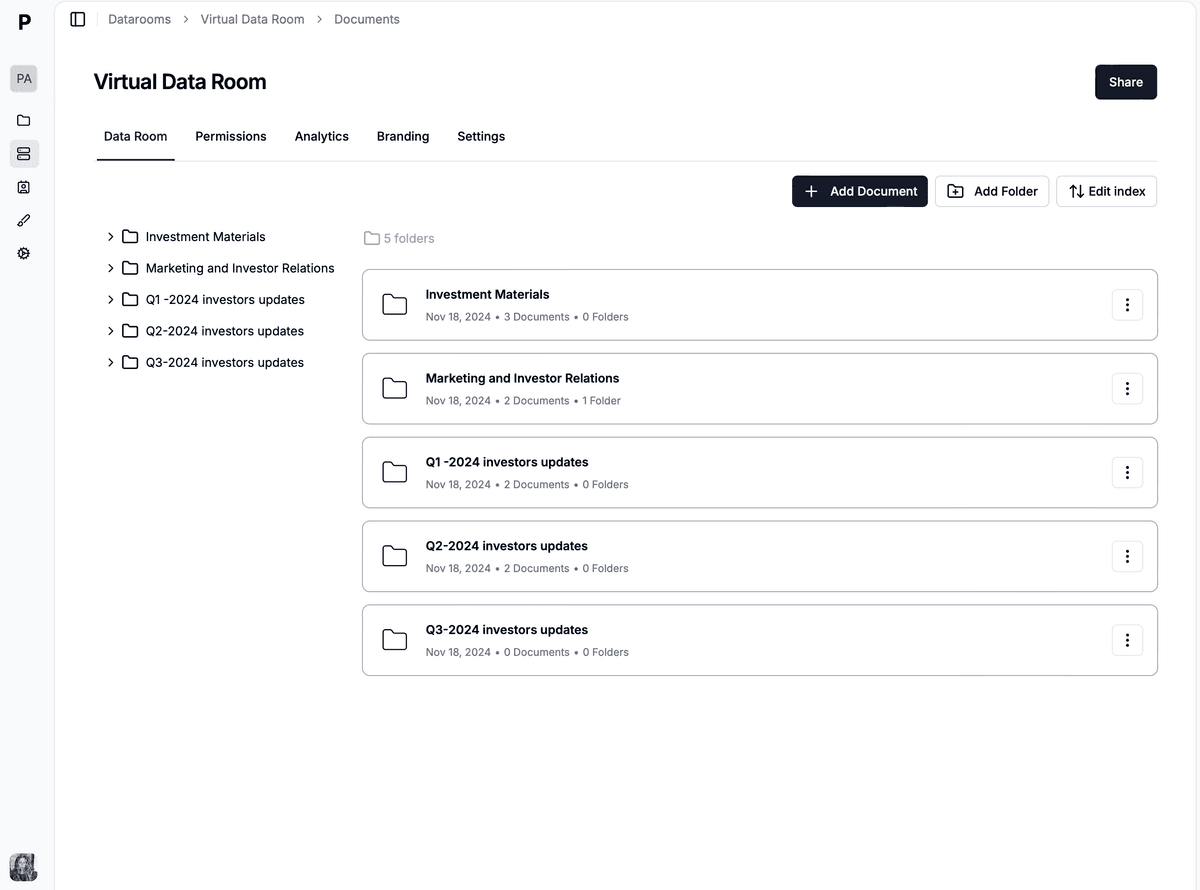
Organized founders create data rooms that make due diligence easy. Disorganized founders make you chase documents.
Company information:
Financial documents:
Product and technology:
Customers and sales:
Legal documents:
Team:
Founders use Papermark to create professional data rooms that make investors happy.
Why it works:
A well-organized data room signals professionalism. A messy Google Drive folder signals chaos.
Once you've completed diligence and want to invest, you need to agree on valuation and terms.
Pre-seed: €2-5M post-money valuation
Seed: €5-10M post-money valuation
Series A: €15-30M post-money valuation
Valuations depend heavily on:
Don't over-optimize valuation. Founders often focus on maximizing valuation at the expense of getting the right investors and terms.
Liquidation preference - 1x non-participating is standard. Avoid participating preferred or multiple liquidation preferences.
Pro rata rights - Investors get the right to invest in future rounds to maintain ownership.
Board seats - At seed, investors typically get 1 board seat or board observer rights.
Protective provisions - Investors can block major decisions (selling the company, raising down rounds, etc.).
Information rights - Investors receive regular financial updates and can inspect company records.
Vesting - Founder shares should vest over 4 years with a 1-year cliff.
After reviewing hundreds of early-stage deals, here are the mistakes I see investors make:
Over-relying on the pitch deck - The deck is marketing. Do actual diligence.
Not talking to customers - This is the #1 most valuable diligence step for early-stage companies.
Focusing only on the product - At this stage, team and market matter more than the current product.
Skipping reference checks - You'll learn things that won't come up in pitches.
Overweighting demo day metrics - 6 months of hockey stick growth doesn't mean it's sustainable.
Analysis paralysis - Seed investing requires conviction with incomplete information. Don't over-analyze.
Ignoring red flags - If something feels off, it probably is. Don't talk yourself into a bad deal.
Startup due diligence is about evaluating potential, not past performance. Here's what matters most:
The best early-stage investments combine strong conviction with thorough diligence.
The complete investment due diligence checklist for 2026 - financial, legal, operational, commercial, and technical document categories for VC, PE, and M&A.
Everything PE firms need to know about conducting thorough due diligence on acquisition targets, from financial analysis to integration planning.
A ready-to-use due diligence template for 2026 with a 150-point checklist covering financial, legal, commercial, operational, and technology diligence.