



mergers-and-acquisitions
Independent Sponsor in 2026: 7 Steps and the Carry Split Trap
The independent sponsor model in 2026: three fee layers, promote tiers, capital partners, and running the deal in a data room for independent sponsors.
An HSR filing is the premerger notification that parties to a large acquisition must submit to the US Federal Trade Commission and Department of Justice before closing, after which a statutory waiting period runs. For 2026, deals valued above $133.9 million are potentially reportable.
The Hart-Scott-Rodino Antitrust Improvements Act requires parties to notify the FTC and DOJ before closing a reportable transaction, then wait out a statutory period before completing.
The 2026 size-of-transaction threshold is $133.9 million, up from $126.4 million, and applies to transactions closing on or after 17 February 2026.
Where the deal value is above $133.9 million but not above $535.5 million, the size-of-person test also applies: one party needs $267.8 million in sales or assets and the other $26.8 million.
Transactions valued above $535.5 million are reportable regardless of the size of the parties.
Filing fees run across six tiers from $35,000 for the smallest reportable deals to $2,460,000 for transactions of $5.869 billion or more.
The standard waiting period is 30 days, reduced to 15 days for cash tender offers and certain bankruptcy transactions.
A Second Request stops the clock, and a new 30-day period only begins once both parties have substantially complied.
Civil penalties for failing to file or for closing early have been running at $53,088 per day of violation.
The expanded 2025 HSR form was vacated by a federal district court on 12 February 2026, and after the Fifth Circuit denied a stay on 19 March 2026 filers returned to the pre-2025 form.
The Item 4(c) and 4(d) document collection is where filings go wrong, because a single internal slide can convert a routine notification into a Second Request.
A data room for an HSR filing has an unusual constraint: some material must reach outside counsel and the agencies while staying invisible to the counterparty.
Papermark hosts a data room for an HSR filing with granular permissions, dynamic watermarking, and a per-visitor audit log from €99/month.
This article is general information about the HSR process, not legal advice. Antitrust reportability analysis is fact-specific and should be run by qualified counsel on every deal.
The thresholds and fees are the easy part, and every antitrust practice publishes them in January. The part that decides whether a deal closes on schedule is the Item 4(c) and 4(d) collection: documents prepared by or for officers and directors that analyse the transaction competitively. Agencies read them closely, and one careless board slide costs more than the whole filing fee.
Collecting those documents means pulling material from senior custodians on both sides and routing it so outside counsel sees everything while the counterparty sees nothing it should not. A data room for an HSR filing is how that constraint gets enforced rather than merely intended. Section 7 covers the setup step by step.
The Hart-Scott-Rodino Act creates a premerger notification regime rather than an approval regime. Parties to a reportable transaction file a notification with both the Federal Trade Commission and the Antitrust Division of the Department of Justice, pay a fee, and then wait. If neither agency acts before the waiting period expires, the parties are free to close. No affirmative clearance is issued and no letter arrives saying the deal is approved; silence is the answer.
The obligation is on both sides. The acquiring person and the acquired person each file, and although only the acquiring person pays the fee, both must complete a form describing their businesses, their revenues by industry code, their corporate structure, and their overlapping activities. Filing is triggered by the transaction meeting objective jurisdictional tests, not by whether anyone believes the deal raises competitive concerns. Plenty of entirely benign transactions are reportable and plenty of genuinely problematic small deals are not.
Reportable transactions cover more than classic mergers. Acquisitions of voting securities, non-corporate interests, and assets can all trigger the requirement, as can the formation of certain joint ventures and, in some circumstances, executive compensation arrangements involving stock grants. There is a long list of exemptions, including acquisitions of goods in the ordinary course of business, most real property acquisitions, and acquisitions of foreign assets or issuers with insufficient US nexus. Working out whether a specific deal is reportable, and at what value, is genuinely technical work.
The consequences of getting it wrong are financial and reputational rather than merely procedural. Closing without filing, or closing before the waiting period expires, exposes both parties to civil penalties that have been running at $53,088 for each day of violation, and the agencies have shown a consistent willingness to pursue them.
The HSR thresholds are recalculated every year against changes in gross national product, and the FTC announced the 2026 figures in January. They apply to transactions closing on or after 17 February 2026, and to notifications filed on or after that date. A deal signed in December 2025 that closes in March 2026 is tested against the new numbers, not the old ones.
There are two tests, and the interaction between them is where most confusion arises. The size-of-transaction test asks what the deal is worth. The size-of-person test asks how big the parties are. For deals in the middle band, both tests must be met. Above the upper threshold, size of person becomes irrelevant.
| Test | 2026 threshold | 2025 threshold |
|---|---|---|
| Size of transaction (minimum) | More than $133.9 million | More than $126.4 million |
| Size of transaction (size-of-person no longer applies above) | More than $535.5 million | More than $505.8 million |
| Size of person, larger party | $267.8 million in sales or assets | $252.9 million |
| Size of person, smaller party | $26.8 million in sales or assets | $25.3 million |
Reading the table in practice: a $200 million acquisition is reportable only if one party has at least $267.8 million in annual net sales or total assets and the other has at least $26.8 million. A $600 million acquisition is reportable whatever the size of the parties, because it clears the $535.5 million line. And a $120 million acquisition is not reportable on size of transaction alone, no matter how large the acquirer, because it sits below $133.9 million.
Valuing the transaction is itself a substantive exercise. For acquisitions of voting securities, the value includes securities already held by the acquirer, not just those being bought, and unlisted securities are valued at fair market value determined in good faith by the acquirer's board. Assumed liabilities, earn-outs, and contingent consideration all have specific treatment. This is the step where deals most often get misclassified, usually by treating the headline price as the transaction value.
The acquiring person pays the fee, and the amount depends on the transaction value rather than on the complexity of the review. The fee structure was restructured in 2023 into six tiers, and the tier boundaries and amounts are adjusted annually. The 2026 fees below apply alongside the 2026 thresholds from 17 February 2026.
The fee is due at filing and is not refundable if the deal is abandoned or if the agencies clear it in a day. On smaller reportable transactions the $35,000 fee is often dwarfed by the legal and economic advisory costs of preparing the filing; at the top of the scale, $2.46 million is a material line item in the deal budget that needs to be allocated between the parties in the purchase agreement.
| Transaction value | 2026 filing fee |
|---|---|
| More than $133.9 million but less than $189.6 million | $35,000 |
| $189.6 million to less than $586.9 million | $110,000 |
| $586.9 million to less than $1.174 billion | $275,000 |
| $1.174 billion to less than $2.347 billion | $440,000 |
| $2.347 billion to less than $5.869 billion | $875,000 |
| $5.869 billion or more | $2,460,000 |
Allocate the fee in the purchase agreement rather than assuming it. The statutory obligation sits with the acquiring person, but the commercial allocation is negotiable and frequently split, and on a $600 million transaction the difference between paying $275,000 and splitting it is worth more than most of the other closing mechanics being argued about at the same time.
The form itself became a moving target in 2026, and deal teams working from 2025 playbooks need to check the current position before they start collecting documents. The FTC's expanded HSR rules took effect on 10 February 2025 and substantially increased what filers had to produce: narrative descriptions of the transaction rationale, competition overlap and supply relationship descriptions, expanded document collection from a wider set of custodians, and detailed information on minority holders and prior acquisitions.
The burden increase was not marginal. The FTC's own estimate was that average preparation time would rise from about 37 hours per filing under the old form to roughly 105 hours under the new one, with acquiring persons in transactions involving overlaps or supply relationships averaging around 121 hours. In practice that meant weeks of additional work and materially higher counsel fees on transactions that raised no competitive issue at all.
That regime did not survive. A federal district court granted summary judgment vacating the expanded rulemaking on 12 February 2026, and on 19 March 2026 the Fifth Circuit denied the FTC's motion to stay that judgment pending appeal. The practical effect was immediate: the FTC announced it was accepting filings on the pre-February-2025 form and instructions, which require revenue data by industry code, competition-related documents from officers and directors, and basic structural information, without the expanded narrative and custodian requirements.
Two caveats matter for anyone planning a filing now. The FTC's appeal remains pending, so the position could change, and the agency has indicated it will continue to accept the vacated 2025 form on a voluntary basis during a transitional period. Some filers choose to submit the fuller form anyway where they expect substantive review, on the theory that front-loading the information reduces the chance of a Second Request. Confirm the current form with antitrust counsel before you start, because rebuilding a document collection mid-process is expensive.
The practical difference between the two regimes is almost entirely about how many people you have to canvass and how much narrative you have to write. That is a document logistics problem, which is why the form question drives how a data room for an HSR filing gets structured.
| Requirement | Pre-2025 form (in use from March 2026) | Expanded 2025 form (vacated) |
|---|---|---|
| Average preparation time | About 37 hours per filing | About 105 hours, 121 with overlaps |
| Transaction rationale narrative | Not required | Required, in narrative form |
| Competition overlap description | Not required | Required for overlaps and supply relationships |
| Document custodians canvassed | Officers and directors | A materially wider custodian set |
| Minority holders and prior acquisitions | Limited disclosure | Detailed disclosure required |
| Revenue by industry code | Required | Required |
The 37 hours against 105 hours comparison is the FTC's own estimate, and it understates the calendar impact. The work is not evenly distributed: most of it lands on a small number of senior custodians who are travelling, which is exactly the population least likely to answer an email asking for their board materials.
Once both parties have filed and the fee has been paid, the statutory waiting period begins. For most transactions it is 30 days. For cash tender offers and certain bankruptcy transactions it is 15 days. If the waiting period expires without action, the parties may close, and in transactions raising no issues the agencies will sometimes grant early termination, though the availability of early termination has varied considerably in recent years.
If either agency wants to look further, it issues a Request for Additional Information and Documentary Material, universally called a Second Request. This is the pivotal event in any merger review. The Second Request stops the clock entirely, and a fresh 30-day period only begins once both parties have substantially complied with what is typically an extremely broad demand for documents, data, and interrogatory responses. Substantial compliance on a large deal routinely takes three to six months and can involve reviewing millions of documents.
Because Second Requests are so costly, the practical goal of a well-run filing is to avoid one. That means getting the Item 4(c) and 4(d) document collection right, since those are the documents prepared by or for officers and directors that analyze the transaction with respect to markets, market shares, competition, and competitors. Agencies read them closely, and an internal presentation that casually describes a deal as eliminating the company's toughest competitor will do more damage than any economic model. Careful document hygiene before a deal is even signed is the standard mitigation.
One option worth knowing is the pull and refile. The acquiring person can voluntarily withdraw the notification and resubmit it within two business days, which restarts the initial waiting period without a second filing fee and buys the agencies another 30 days to finish looking. It is used when a staff attorney signals that they need more time but have not decided to issue a Second Request, and a fresh 30 days is far cheaper than the three to six months and millions of dollars a Second Request costs.
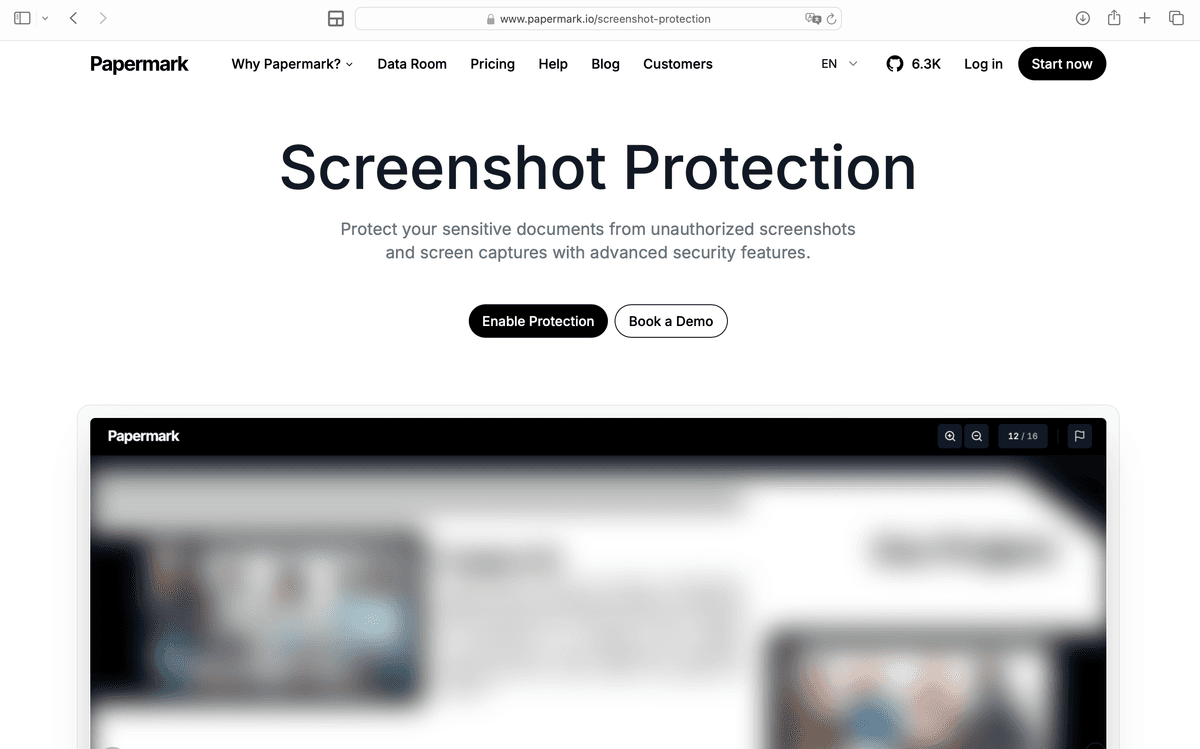
Item 4(c) board decks are the most consequential documents in the filing, which is why they sit in a view-only, screenshot-protected folder scoped to counsel.
Ashgrove Diagnostics, a clinical laboratory group with $410 million in annual net sales, agrees to acquire Perlin Labs, a specialty testing business, for $312 million in cash. Perlin has $58 million in sales. The signing date is 4 May 2026 and the parties want to close by the end of July.
Counsel confirms reportability quickly. The transaction value of $312 million exceeds $133.9 million, so the size-of-person test applies: Ashgrove clears the $267.8 million requirement with $410 million in sales and Perlin clears the $26.8 million requirement with $58 million. The deal is reportable. It falls in the $189.6 million to $586.9 million band, so Ashgrove pays a $110,000 filing fee.
The heavy work is the document collection. Counsel canvasses Ashgrove's chief executive, chief financial officer, head of corporate development, and the board for anything prepared by or for them analyzing the acquisition in competitive terms. The collection produces 74 documents, including three board decks, a strategy memo, and an internal model. One of the decks contains a slide describing Perlin as the only credible alternative provider in two metropolitan markets, which counsel flags immediately as the item most likely to attract attention.
Worked scenario. The 3 board decks are 4 percent of the collection and carry most of the risk, which is why they get view-only, watermarked access scoped to outside counsel.
Ashgrove and Perlin file on 21 May, using the pre-2025 form. The materials are shared with outside antitrust counsel at two firms, the parties' respective corporate teams, and an economic consultancy, through one data room with a scoped link per team. Because Perlin's board materials contain commercially sensitive pricing that Ashgrove must not see before closing, the Perlin folders are permissioned so that only outside counsel and the economists can open them, with view-only access and watermarking on every page. The waiting period expires on 20 June without a Second Request, and the parties close in early July.
Five teams, one filing room, five scoped links: the structure that keeps Perlin's pricing material away from Ashgrove before closing.
A data room for an HSR filing solves a problem that no other deal room has to solve. In ordinary diligence, more disclosure to the counterparty is better. Here, some of the material must reach outside counsel, the economists, and eventually the agencies, while remaining invisible to the other side of the transaction, because exchanging competitively sensitive information before closing is itself an antitrust problem. Gun-jumping risk is a permissions requirement, not a policy statement.
Papermark is a secure, fully customizable, and developer-friendly data room built for modern dealmakers, with page-by-page analytics, dynamic watermarking, and transparent pricing (open-source and self-hosting available).
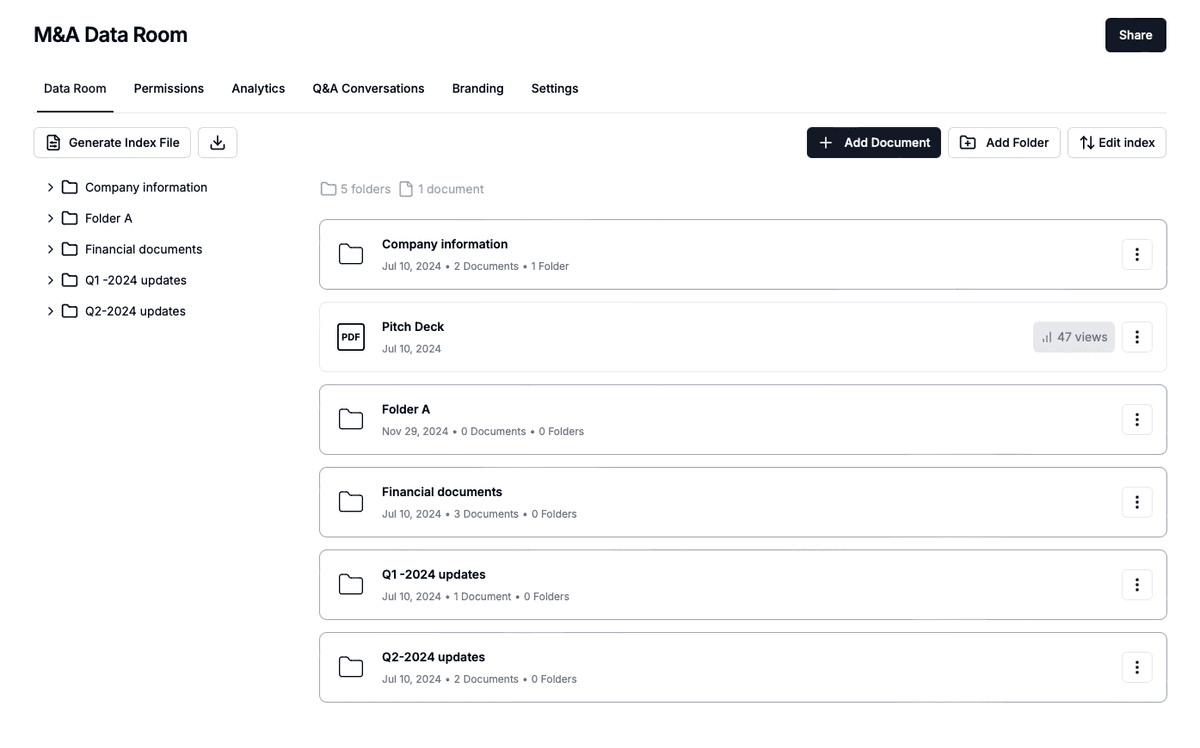
A data room for an HSR filing, with each party's Item 4(c) collection in its own permissioned folder.
Four features of the HSR process make a dedicated room worth the setup time, and none of them apply to an ordinary diligence exercise. If you are still choosing a platform, our comparison of the best virtual data rooms covers pricing model, bidder management and compliance across the main providers.
Gun jumping makes open access a legal risk. Perlin's board materials contain pricing that Ashgrove must not see until closing. In a shared folder that is enforced by asking people not to look. In a data room for an HSR filing it is enforced by the folder simply not appearing on the acquirer's link, which is a materially different conversation to have with a regulator if it is ever questioned.
The 4(c) and 4(d) collection comes from the least responsive people in the company. Chief executives, chief financial officers, heads of corporate development, and board members are the custodians, and chasing their board decks by email is how a 37-hour filing becomes a three-week one. A room with a named file request per custodian, and a notification when it lands, converts that chase into a checklist.
Five teams review the same documents from different sides. The acquirer's corporate team, the acquirer's antitrust counsel, the target's corporate team, the target's counsel, and an economic consultancy all need overlapping but distinct access. That is five permission sets, and a shared drive offers one.
Completeness gets questioned later. If the agencies query whether a collection was complete, or a gun-jumping allegation surfaces, the useful evidence is which participant was given access to which document and when. A per-visitor, page-level log answers it. An email archive does not, because it cannot show what was withheld.
The rest of this section is the practical build: five steps to a data room for an HSR filing that holds up under all four.
Create the structure before the collection starts: a shared folder holding the transaction agreement, structural information, and revenue by industry code, then one Item 4(c) and 4(d) folder per party, then a folder for the economists' workpapers. The party folders never merge, even after filing, because the confidentiality wall between them has to survive to closing.
Automatic file indexing on the Data Rooms Plus plan numbers documents as they arrive, which matters because the HSR form references documents by number and a renumbering after submission is a genuine problem.
| Participant | Folders granted | Rights |
|---|---|---|
| Acquirer's outside antitrust counsel | Shared, acquirer 4(c), target 4(c), economics | View and download |
| Target's outside antitrust counsel | Shared, target 4(c), acquirer 4(c), economics | View and download |
| Acquirer's corporate team | Shared and acquirer 4(c) only | View and upload |
| Target's corporate team | Shared and target 4(c) only | View and upload |
| Economic consultancy | Shared, both 4(c) folders, economics workpapers | View only, watermarked |
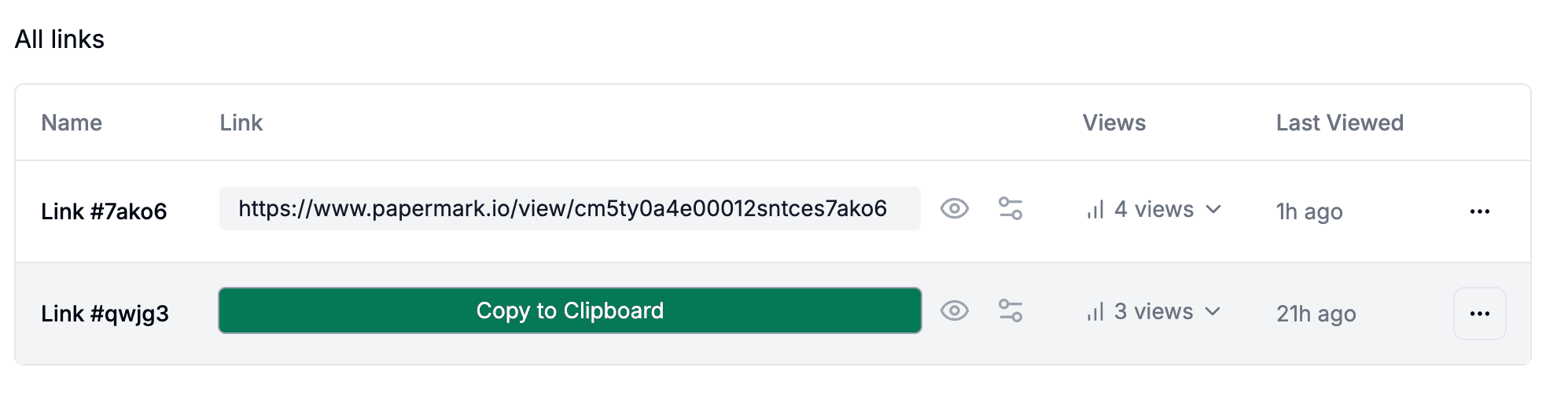
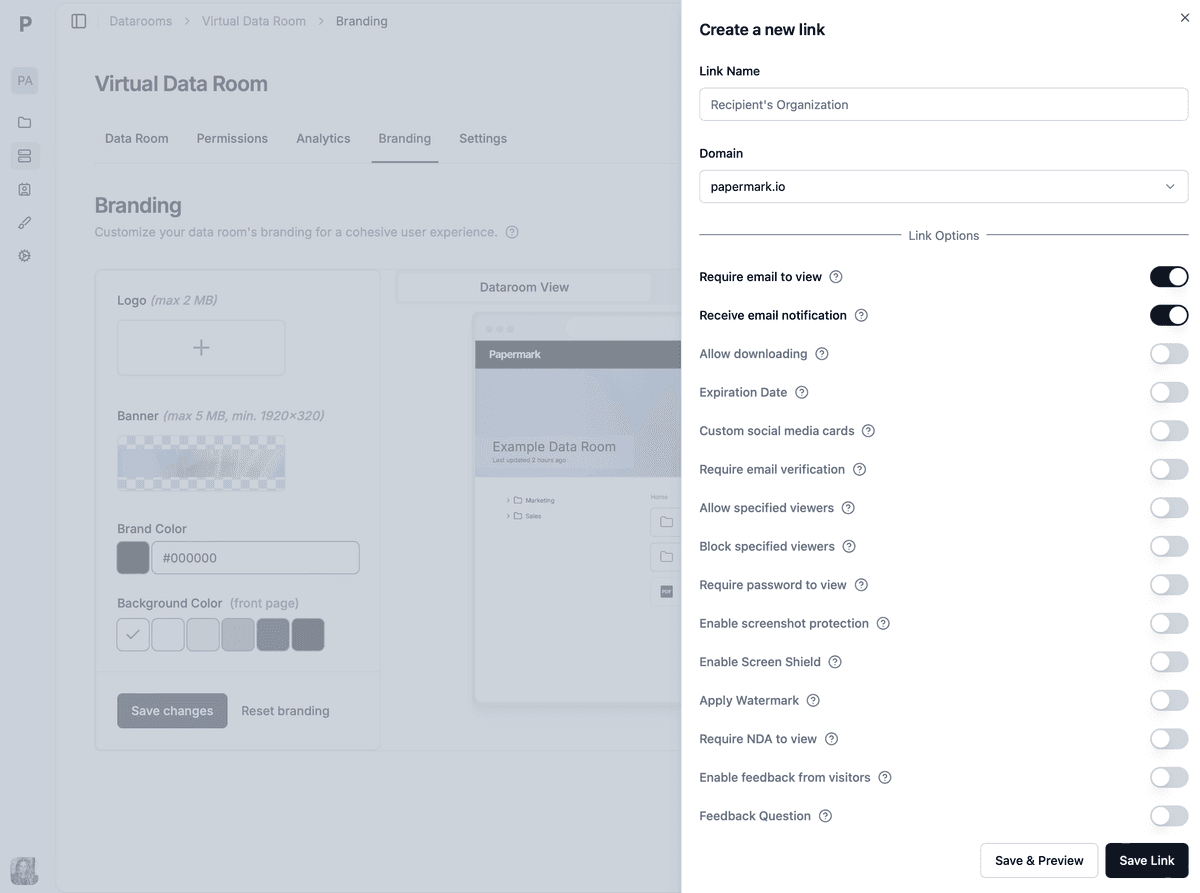
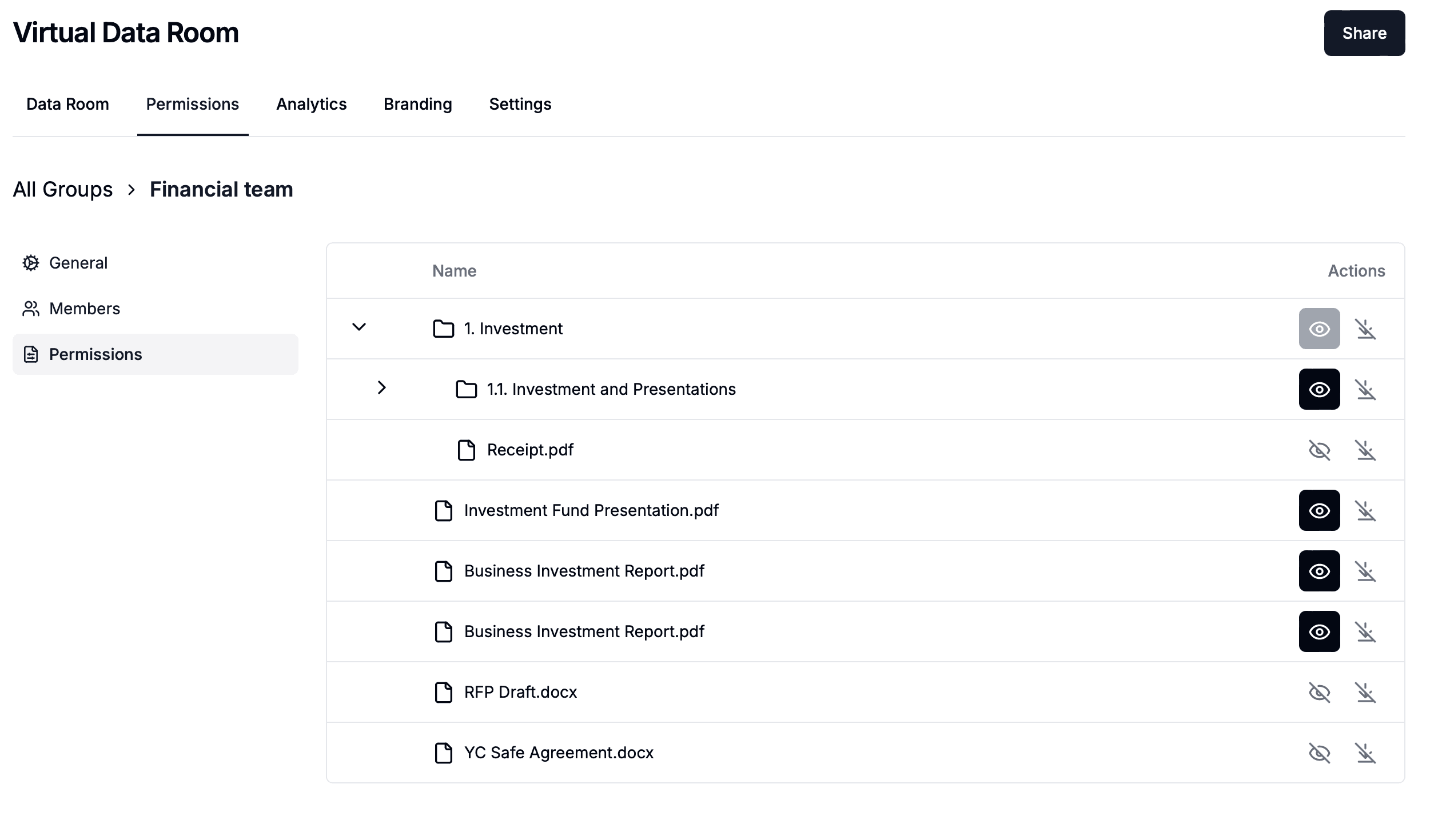
Granular file-level permissions are set per link rather than per user, each with its own email or domain allowlist so access is tied to the firms actually engaged. Email verification checks individual identity without forcing a busy general counsel to create an account, which is the friction that pushes people back to email attachments.
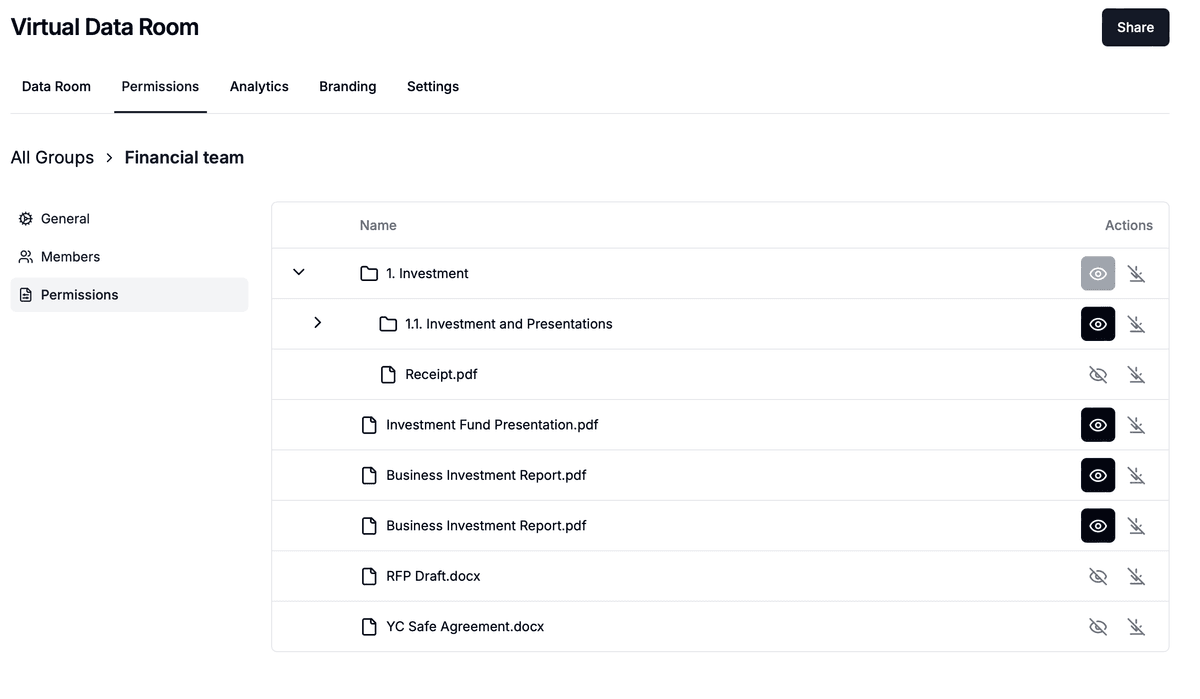
Granular permissions keep each party's Item 4(c) documents visible to outside antitrust counsel while remaining closed to the counterparty.
Set both Item 4(c) folders to view-only, turn on dynamic watermarking so every page carries the viewer's email, IP address, and timestamp as it renders, and add screenshot protection on the board decks specifically. When the same deck is being read by five teams across three firms, watermarking is what makes any leak attributable rather than merely deniable.
Say the limit out loud rather than implying it. A downloaded file is legally treated as read and cannot be recalled, which is precisely why download stays off on the 4(c) folders instead of being discouraged in a covering email.

Dynamic watermarking renders viewer email, IP, and timestamp onto every page of a board deck reviewed by five separate teams.
Request files lets counsel ask a named custodian for specific documents inside the room, with the request visible on their dashboard rather than buried in an inbox, and new-document notifications tell the filing team the moment something arrives. On a collection that canvasses a chief executive, a chief financial officer, a head of corporate development, and a board, that difference is usually worth a week.
The Q&A module handles the follow-ups, threading each question against the document that prompted it, with permissions controlling who can see which threads so the target's counsel never reads the acquirer's internal deliberations.
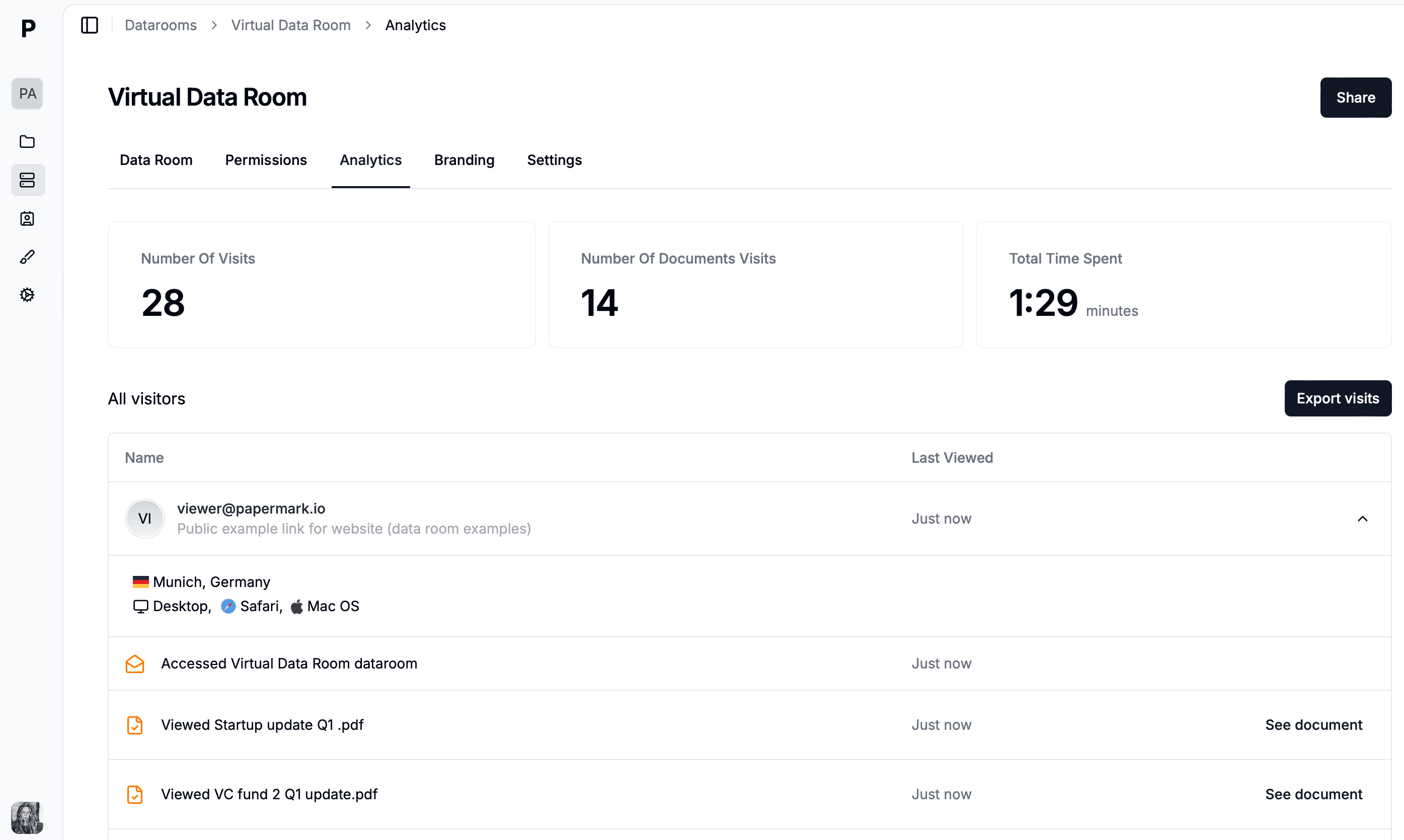
Page-level analytics record which participant opened which document, when, and for how long. That is the evidence base if completeness is queried or a gun-jumping allegation is raised, and it is also the practical check that outside counsel has actually reviewed the deck you flagged.
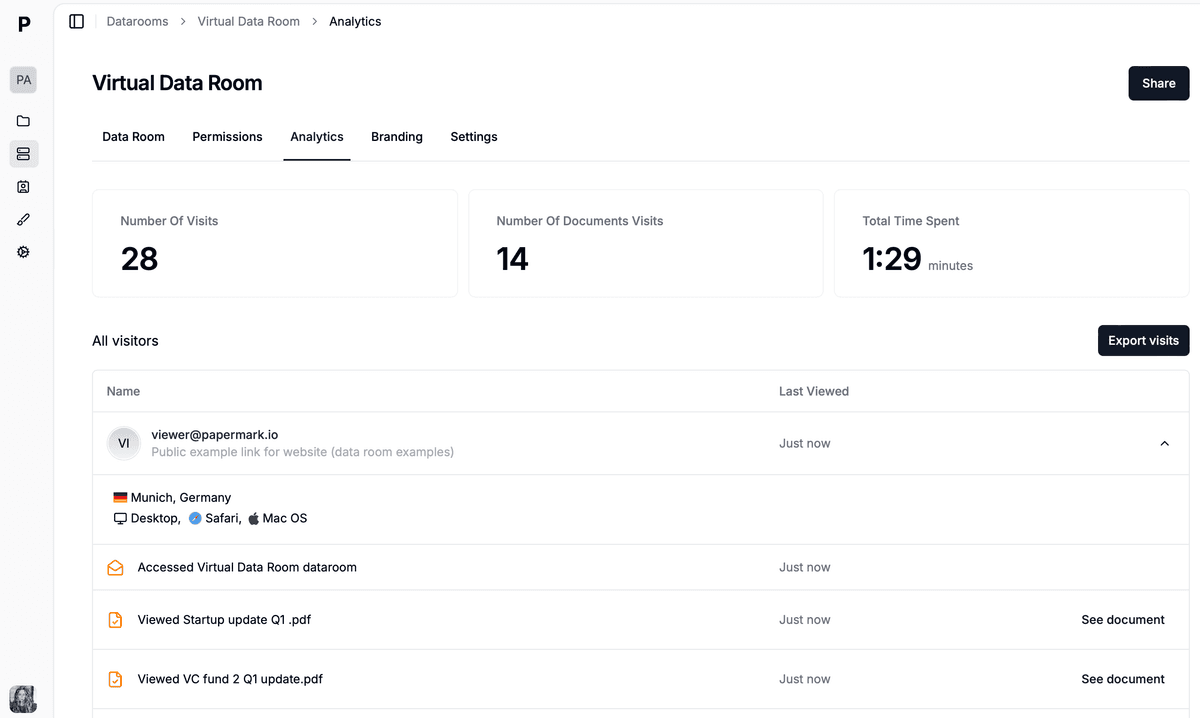
Per-visitor analytics show which participant opened which Item 4(c) document and for how long.
Keep the room live through the 30-day waiting period rather than archiving at submission, because a Second Request can arrive on day 29 and the collection you already have is the starting point for substantial compliance. Once the deal closes, data room freeze exports the whole thing as an immutable ZIP with a certificate.

Papermark is our #1 VDR provider for M&A transactions right now. In two deals we used custom branding, dynamic watermarking, and granular permissions.
Tyler
The Data Rooms plan is €99/month with a 7-day free trial and includes 3 team members, unlimited data room visitors, unlimited data rooms, unlimited documents with no file size limit, a custom domain, dynamic watermarking, NDA agreements, and granular file-level permissions. Data Rooms Plus at €249/month adds 5 team members, the Q&A module, the audit log, automatic file indexing, and SOC 2 Type II, which is the tier a filing needs because the audit log is the evidence. Premium at €549/month adds 10 members, AI redaction, API access, SSO, and whitelabeling. Data Rooms Unlimited at €999/month removes per-seat charges entirely, so teams that add reviewers mid-deal pay one number regardless of headcount, and it carries every Premium capability including AI redaction.
Set against a filing fee that starts at $35,000 and reaches $2,460,000, the room is immaterial. What matters is that a collection producing 74 documents initially, and potentially hundreds of thousands under a Second Request, does not run on per-page or per-gigabyte pricing.
No credit card required.
The independent sponsor model in 2026: three fee layers, promote tiers, capital partners, and running the deal in a data room for independent sponsors.
Entrepreneurship through acquisition in 2026: four search models, SBA financing up to $5M, an 8-step process, and the data room for an ETA acquisition.
Management buyout in 2026: the 7 stages, the funding gap between 80% debt and 30% equity, the conflict of interest, and the data room for a management buyout.