Datasite Virtual Data Room Overview 2026: Features, Pricing, Merrill DataSite
·13 min read
Marc Seitz
Datasite Diligence (formerly Merrill DataSite) is an enterprise virtual data room for M&A, financing, restructuring, and due diligence, sold on custom page-based quotes rather than a published price. This 2026 overview covers what the Datasite virtual data room is, how it relates to Merrill DataSite, its features and pricing, and how it compares to Papermark, a secure, fully customizable, and developer-friendly data room for modern dealmakers, with page-level analytics, dynamic watermarking, unlimited data room visitors, and transparent pricing from €99/month.
Quick recap
What Datasite is: the enterprise virtual data room formerly called Merrill DataSite; Merrill Corporation relaunched the product as Datasite in 2018, so Merrill VDR, Merrill DataSite, and Datasite now describe the same platform.
Best for: large-cap M&A, IPOs, restructuring, and regulated cross-border deals run by investment banks and law firms.
Pricing model: legacy page-based pricing at roughly $0.40 to $0.85 per page (commonly $0.60), custom quotes only, no public rate card. Typical deal rooms land at $25,000+/year. A 10 GB room can reach $720,000 per year.
Standout features: AI-assisted indexing and redaction, structured Q&A, dynamic watermarking, granular permissions, OCR, and a detailed audit trail.
Notable weaknesses: opaque per-page pricing, dated onboarding, steep learning curve, no self-hosting, limited API access, no self-serve free trial.
Compliance: SOC 2 Type II, ISO 27001, GDPR, and CCPA aligned.
Verified rating: 4.5/5 from 399 G2 reviews as of 2026.
Modern alternative: Papermark at a flat €99/month with unlimited data rooms, unlimited data room visitors, page-by-page analytics, a custom domain, and an optional self-hostable open-source deployment.
No credit card required.
What is Datasite virtual data room?
Datasite Diligence is a secure online repository for confidential deal documents. Banks, private equity firms, and corporate law teams use it so dozens of bidders and advisors can review materials without the files leaving a permissioned, watermarked environment.
The product line is older than the Datasite brand. Merrill DataSite was the virtual data room built by Merrill Corporation, a Minnesota-based financial-printing and document-services company. For most of two decades it sat alongside Intralinks and RR Donnelley Venue as a default name for high-stakes transactions. When bankers talked about running due diligence "in Merrill," they meant this room.
In 2018 the data-room business relaunched as Datasite. If you search for "Merrill VDR pricing" or "Merrill DataSite login" in 2026, you land on Datasite properties. The underlying product, security posture, and page-based pricing model are what Datasite ships today. Merrill VDR, Merrill DataSite, Datasite Merrill, and Datasite all point to the same platform. For a more affordable data room than that page-based quote, see Datasite alternatives.
Datasite is built for the top of the market: large, complex, multi-jurisdiction deals where a dedicated project manager, forensic audit trails, and enterprise certifications are non-negotiable. The typical buyer is an M&A team that runs several processes a year and has a procurement function that is comfortable with a sales cycle. That model suits a bank running a $500M sale and suits almost nobody running a $15M one.
The product line is broader than a single data room. Datasite Diligence is the VDR itself, the piece most people mean when they say Datasite. Around it sit Datasite Prepare for organising documents before a process opens, Datasite Acquire for buy-side pipeline work, and Datasite Outreach for managing the marketing phase of a sale. Buying the suite is part of the pitch, and part of the price.
Key features of Datasite virtual data room
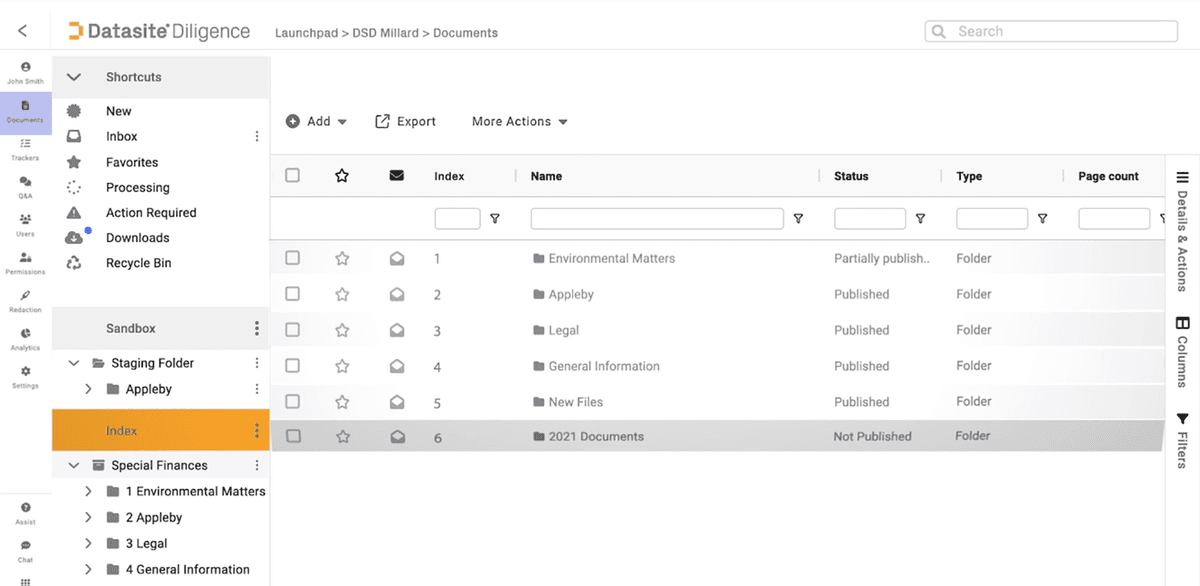
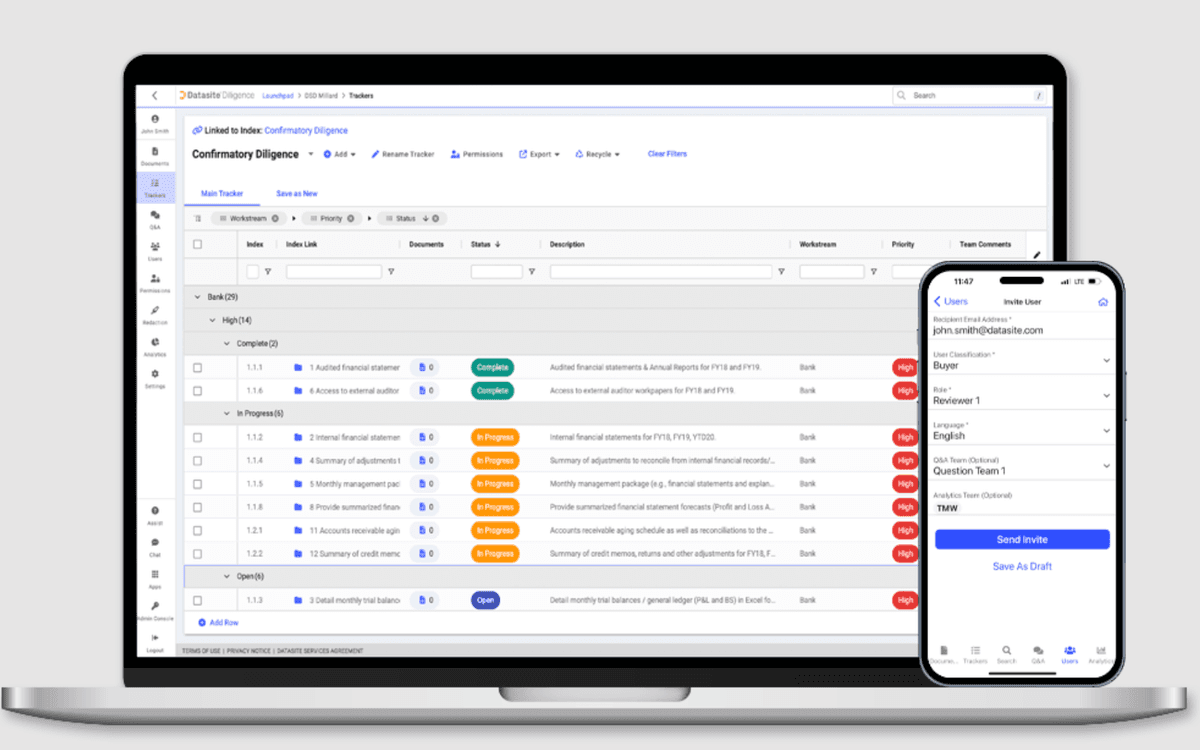
The Datasite virtual data room ships the full enterprise VDR feature set: secure document management, granular permissions, a structured Q&A workflow, dynamic watermarking, AI-assisted redaction and indexing, and a complete audit trail. The platform is built around the deal team, with pre-built folder templates, checklists, and trackers that mirror how banks and law firms run a diligence process from kickoff to close.
Fast setup and content management
Datasite organizes content the way a sell-side process expects it: folders that match a diligence index, bulk import that preserves structure, and templates so a new room does not start from a blank tree.
Drag-and-drop file and folder upload
Bulk import with folder-structure preservation
Built-in templates and proven folder structures
Email-to-project upload
Version control and checklists tied to the index
Seamless collaboration
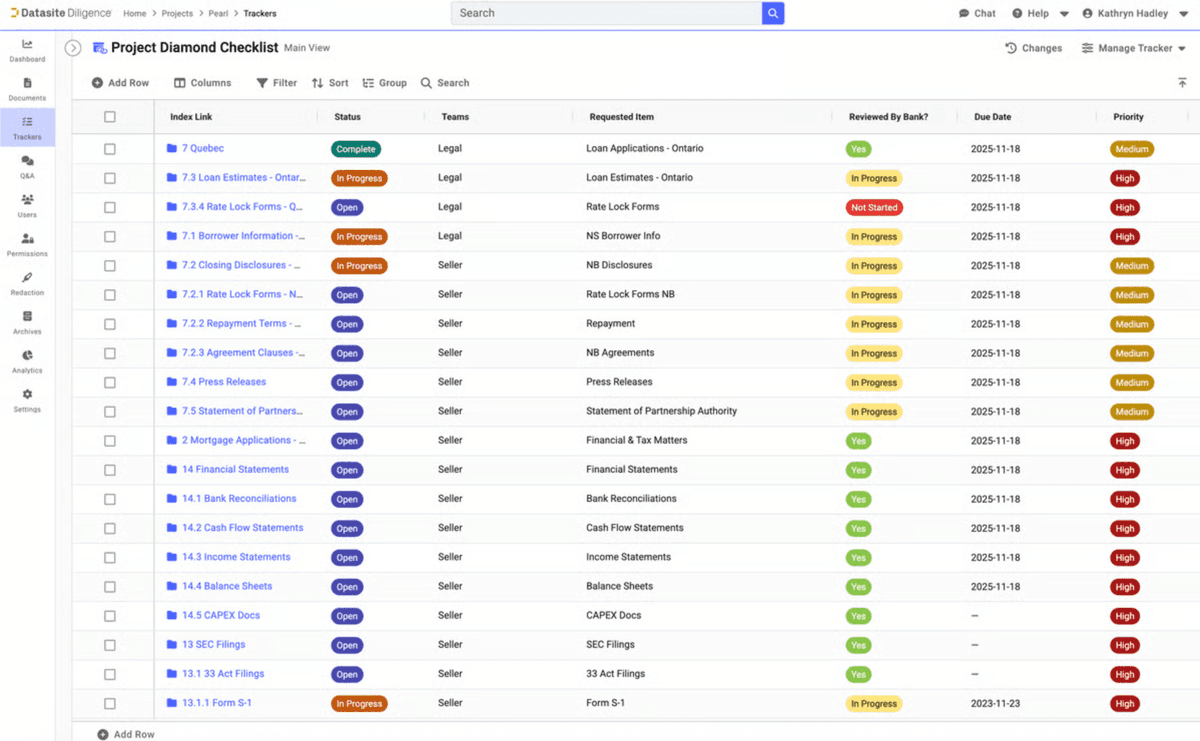
The collaboration layer is deal-centric. A centralized task checklist ties directly to the data-room index, so deal leads can see which sections are ready and which are still missing documents. The Q&A module routes buyer questions to the right subject-matter expert and keeps competing bidders walled off from one another.
Centralized checklist of tasks
Trackers linked to the index
Integration with emails and spreadsheets
Structured Q&A with per-bidder scoping
Customizable permission settings
Powerful AI capabilities
Where Datasite has invested most visibly in recent years is artificial intelligence. The platform uses machine learning to auto-categorize and index uploaded documents, run optical character recognition so scanned files become searchable, and suggest redactions of sensitive terms across thousands of pages at once. For a large carve-out or cross-border deal with tens of thousands of documents, that automation saves associate hours.
AI-powered categorization and indexing
Automatic content translation across 10+ languages
Smart redaction and unredaction of sensitive terms
OCR for searchable scans
Machine-learning document classification
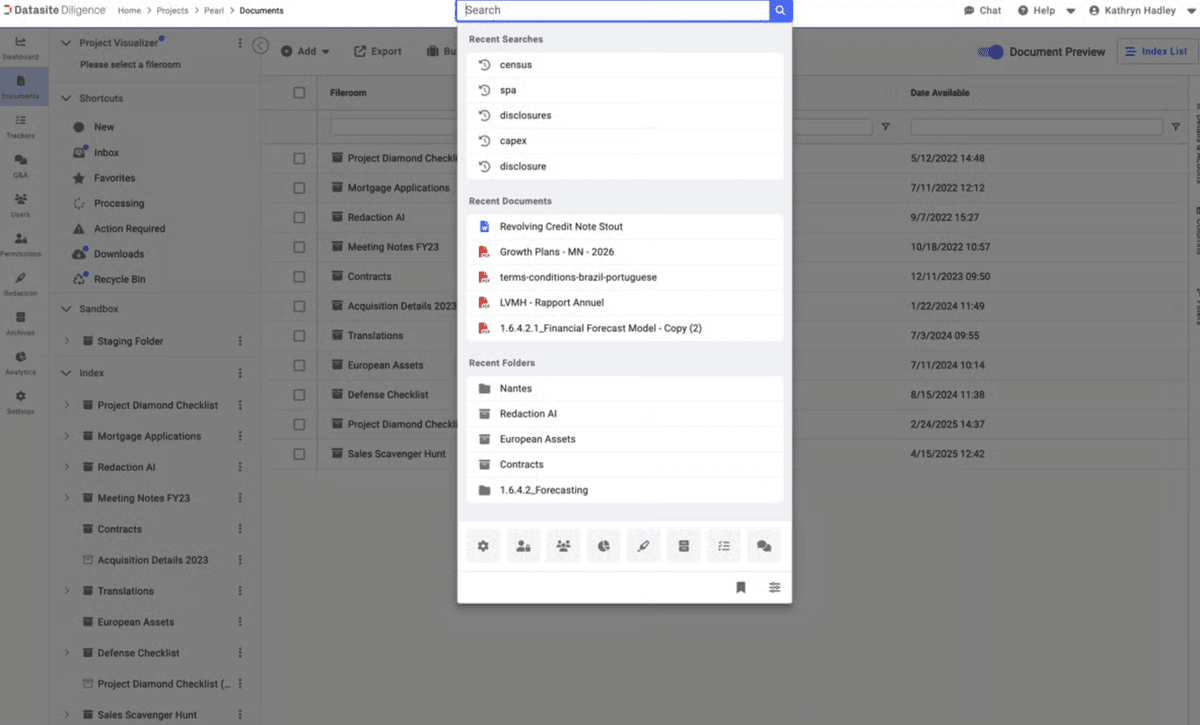
Word and phrase search across the room
Mobile app for on-the-go access
Q&A workflow management
Advanced security features
Security is the reason regulated buyers still put Datasite on a shortlist. The room encrypts content, stamps viewer identity onto pages, and records who opened what.
Granular folder- and file-level permissions, including view-only and no-download modes
IP restrictions and two-factor authentication
Detailed, exportable audit trails
Comprehensive analytics
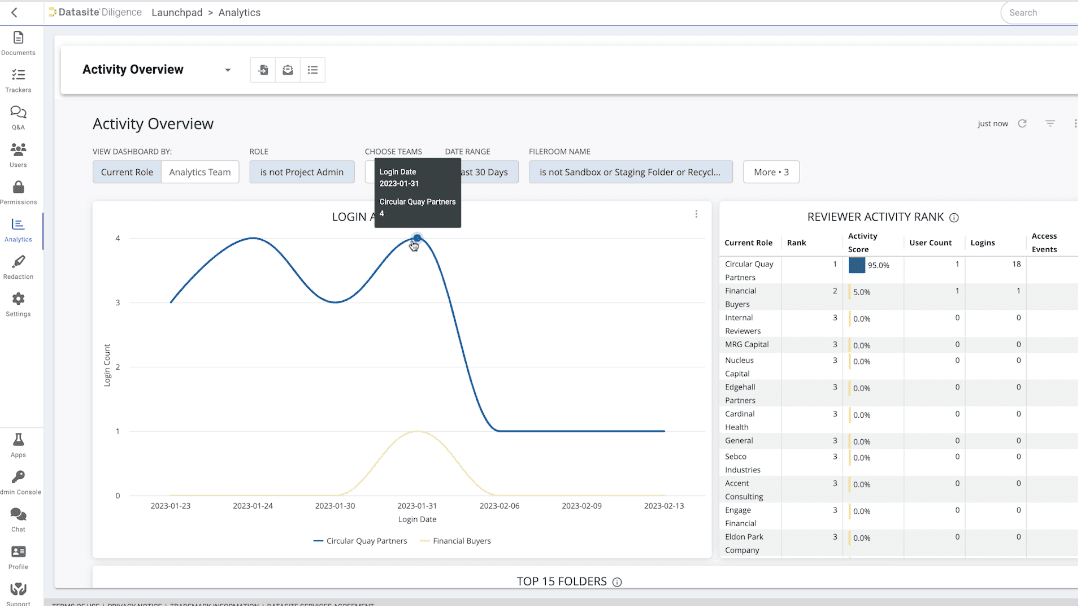
Datasite reports activity at the document level: who opened a file, how teams engage, and scheduled dashboards for the deal lead. That is useful for a managed process. It is not the same as page-by-page analytics that show which page of the CIM a bidder lingered on.
Real-time activity monitoring
Document-level engagement tracking
Team activity analysis
Customizable reporting dashboards
Scheduled automatic reports
Datasite reviews: what users actually say
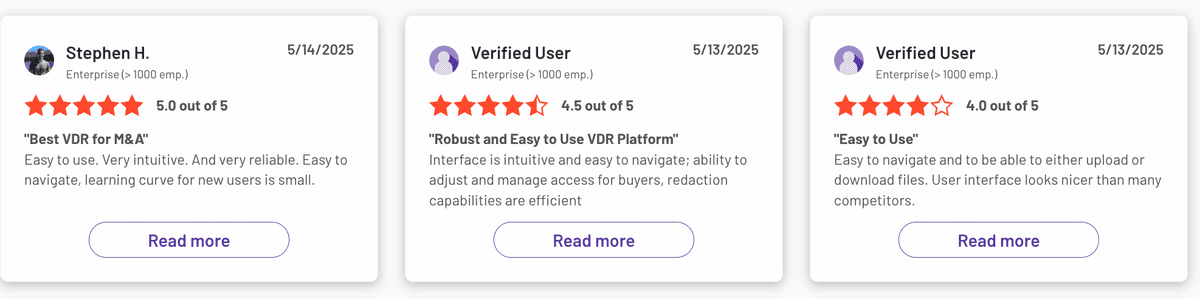
On G2, Datasite Diligence holds 4.5 out of 5 from 399 reviews as of 2026. Reviewers cite bulk upload, indexing, redaction, and responsive project support. The recurring criticisms are cost, the opacity of the quote, a clunky Q&A follow-up flow, and an interface that carries a learning curve for occasional users.
The quotes below are pulled from G2, Capterra, and Software Advice. They sit alongside the headline score, not instead of it.
Reviewers who stay with Datasite usually point at navigation, document organisation, and support:
"Easy to use. Very intuitive. And very reliable. Easy to navigate, learning curve for new users is small."
"Datasite organizes documents in a manner that is easy to find. Appreciate ability to add different security features to different documents."
"Interface is intuitive and easy to navigate; ability to adjust and manage access for buyers, redaction capabilities are efficient."
Support comes up often as a reason teams tolerate the rest of the product. One reviewer wrote that customer support is "always available to answer any questions I've had in the past, and promptly."
The complaints cluster in four places.
Pricing. The most common con is the page-based model. Reviewers say Datasite continues to charge based on page count, which makes budgets move with document volume rather than with the deal.
"Only con to Datasite is pricing. The legacy providers continue to charge based on page count and special media, while new entrants are offering a flat subscription price based on storage needs."
Q&A. Some users find the Q&A module hard to work in once a seller closes a thread, and email notifications do not always deep-link back to the question.
"Q&A functionality can be clunky. Hard to follow-up if sellers closes question out. Email notifications on Q&A don't link back to specific question addressed"
File management. Moving large batches of files and folders is described as clunky, and search is called basic compared with what deal teams expect on a 10,000-page room.
"Moving large numbers of files and folders feel clunky; the search function is also basic"
Notifications. New-upload emails are not split by folder, which makes bulk drops hard to triage.
"The notifications of new file uploads are not separated by the folder they are in, which can be challenging when trying to view bulk new uploads."
Read together, the reviews describe an enterprise VDR that works at scale and is expensive and opaque to budget. Keep Datasite when the buy side or the page count demands it, and look at a flat-rate room when it does not.
A Datasite room does not start with a self-serve signup. You scope page count and duration with sales, wait for the project to be provisioned, then configure the room with a project manager. Once you have access, the workflow looks like this.
Initial setup. Create the virtual data room project, choose a pre-built template or a custom index, and configure security settings and permissions.
Content organization. Upload documents via drag-and-drop or bulk import, let AI-powered categorization help with indexing, and apply watermarks and view/download controls.
Collaboration management. Set workflow roles and categories, configure Q&A teams so competing bidders cannot see each other's questions, and establish approval workflows.
Deal monitoring. Track engagement metrics, monitor team activity, and generate progress reports for the deal lead.
Setup typically takes one to two weeks once the quote is signed. That timeline is the gap most mid-market teams feel first, before they see the invoice.
Datasite virtual data room pricing
Datasite does not publish prices. You contact sales for a custom quote. The figures below come from vendor-verified industry reporting and buyer accounts rather than from a Datasite rate card. Reported rates sit in the $0.40 to $0.85 per page range depending on file type, total volume, and negotiated terms, with roughly $0.60 the figure quoted most often. For a fuller market comparison, see our virtual data room cost breakdown and Datasite pricing.
Cost scales with document volume rather than with time or value delivered. A 12,000-page diligence set is not unusual for a mid-market industrial business once you include contracts, HR files, permits, and five years of statements. At $0.60 a page, that is $7,200 in upload charges before a single bidder opens a document. A 10 GB implementation can reach $720,000 per year.
Alongside per-page charges, engagements are commonly structured as subscriptions with a defined duration. Industry reporting puts a typical Datasite deal room at $25,000 or more per year, with large processes reaching $50,000 to $100,000 and above. Extensions past the contracted duration, additional storage, and additional administrative users are the three line items that most often push a final invoice above the quoted one.
Cost element
How it is charged
What buyers report
Page volume
Per page uploaded, by file type
$0.40 to $0.85 per page, commonly around $0.60
Room subscription
Per project, for a fixed duration
$25,000+/year typical, $50,000 to $100,000+ on large processes
Duration extension
Per additional month or quarter
Negotiated separately, rarely priced in the original quote
Storage overage
Per GB above the contracted tier
A common source of variance on document-heavy deals
Professional services
Per engagement
Project management and onboarding, bundled or itemised by quote
The platform also charges extra for Excel files and special media. There is no public monthly subscription and no self-serve trial. Access starts with a sales conversation and a scoping exercise around page counts.
The comparison that matters is not Datasite against a cheaper enterprise VDR. It is the per-page model against a flat monthly one. A flat subscription prices the room, not the paper, so a 12,000-page set and a 2,000-page set cost the same.
Worked scenario: a sell-side advisor prices two rooms
Northline Partners is a hypothetical boutique advisory firm in Manchester running the sale of a €40M revenue packaging business. The diligence set, once the seller has finished scanning, runs to about 11,400 pages across 620 documents: statutory accounts, management packs, 140 customer contracts, employment files for 210 staff, environmental permits, and a property portfolio.
The process is expected to run seven months from teaser to completion, with an initial round of nine bidders narrowing to three for confirmatory diligence. Northline needs one room, three access tiers, watermarking on everything, and a Q&A log it can hand to counsel at signing.
Priced on the reported Datasite model at $0.60 a page, the 11,400-page set carries roughly $6,840 in upload charges alone. Add a room subscription in the range industry reporting associates with a mid-market process and a seven-month duration, and Northline is budgeting five figures before it has decided whether the seller will add a second tranche of contracts in month four.
Priced on a flat monthly subscription, the same room is a fixed line. Papermark's Data Rooms plan is €99 a month with unlimited documents and no per-page charge, so seven months is €693 regardless of whether the page count is 11,400 or 22,000. Northline's decision then turns on features rather than on arithmetic: does it need AI redaction, and does the buy side expect a bank-standard room.
For this deal the firm chose the flat plan and redacted the 140 customer contracts manually over four days of paralegal time. On a $500M process with 90,000 pages, the same firm would reach the opposite conclusion, and that is the real dividing line in this category.
Pros: what Datasite does well
Enterprise-grade security and compliance. Datasite carries the certifications that regulated buyers and sell-side counsel expect: SOC 2 Type II, ISO 27001, and alignment with GDPR and CCPA. For a bank running a public-company deal, that posture is table stakes.
Mature AI tooling for large document sets. Auto-indexing, OCR, and bulk smart redaction are useful when a room holds tens of thousands of files. This is a real advantage over lighter-weight tools on very large deals.
Strong Q&A and deal-management workflow. Structured Q&A, index-linked checklists, and per-bidder scoping are built for competitive M&A processes with multiple parties.
Dedicated support and services. Enterprise engagements include project managers, onboarding, and around-the-clock support, which matters when a permission issue surfaces the night before a signing.
Proven track record. As one of the original VDRs, Merrill DataSite and now Datasite have decades of deals behind them and a reputation that carries weight in conservative, procurement-heavy environments.
Limitations of Datasite virtual data room
The gaps that matter are less about missing features and more about how the product is priced, onboarded, and operated day to day.
Opaque, page-based pricing. Costs are hard to predict up front. Per-page charges, media premiums, and continuation fees make budgeting a guessing game, and the model penalizes document-heavy rooms and smaller deals alike.
No self-serve evaluation. There is no public free trial. Every engagement starts with a sales call and a custom quote, which is friction for a founder or a small deal team that needs a room live this week.
Dated onboarding and learning curve. The platform is feature-heavy and assumes professional setup. Teams frequently report needing training and a project manager before they are productive.
No self-hosting and limited API. Datasite is cloud-only with limited API access. For banks, government contractors, or life-sciences teams with on-prem or data-sovereignty requirements, that is a hard constraint.
Overkill for smaller transactions. For a Series A raise, a startup acquisition, or a straightforward diligence process, the enterprise machinery adds cost and complexity without a proportional benefit. Modern flat-rate rooms cover the same core workflow at a fraction of the price.
In short: complex custom quotes only, a steep learning curve, limited customization, no self-hosting, required training, and limited API access.
Datasite compliance and security
Datasite maintains the compliance posture expected of a top-tier virtual data room. The platform is SOC 2 Type II audited and ISO 27001 certified, aligns with GDPR and CCPA for personal-data handling, and encrypts documents in transit and at rest. Dynamic watermarks stamp viewer identity onto every page, and a forensic audit trail records who opened which document, when, and for how long.
For deals in regulated industries, this is the reassurance that gets a VDR through procurement. Where Datasite is more constrained is deployment flexibility: the platform is cloud-only, so organizations that require self-hosting or in-country data residency beyond the vendor's available regions cannot satisfy that with Datasite alone. Confirm current certifications and data-residency options directly with the vendor, since these evolve.
The security fundamentals to verify on any shortlist:
Certifications: SOC 2 Type II and ISO 27001, requested under NDA
Encryption: AES-256 at rest and TLS in transit
Access controls: granular permissions, two-factor authentication, and IP restrictions
Auditability: exportable activity logs for the post-close record
Deployment: cloud, on-prem, or self-hosted, and which regions are supported
Case study: how a boutique advisory outgrew Datasite
Aldergate Partners, a hypothetical London-based mid-market M&A boutique, had used Datasite (and Merrill DataSite before the rebrand) for years on its larger sell-side mandates. The security and Q&A workflow were never in question. The problem was economics and speed as the firm moved down-market into deals worth 20 to 80 million pounds.
On a recent carve-out, the team uploaded roughly 140,000 pages across financial, legal, and commercial workstreams. The page-based quote came back well into five figures before setup and continuation fees, and the deal timeline slipped because the room could not go live until the quote was signed and a project manager scheduled onboarding. For a mandate where the advisory fee was already tight, the data-room line item was disproportionate.
For the next three mandates, Aldergate ran a parallel evaluation. It kept Datasite for one regulated cross-border process where the buyer's counsel specifically required an incumbent enterprise VDR, and moved the other two, plus its ongoing pipeline of teasers and management-presentation shares, to a flat-rate platform at €99 per month. The switch cut per-deal data-room spend by more than 90 percent, let associates spin up rooms the same afternoon a mandate was signed, and gave partners page-by-page analytics showing exactly which bidders read the confidential information memorandum and where they lingered. Datasite stayed in the toolkit for the largest deals, but it was no longer the default.
Datasite alternatives
No single virtual data room is right for every deal. Datasite is built for the largest, most regulated transactions. Flat-rate platforms fit fundraising, mid-market M&A, and ongoing investor relations better. If page-based pricing, sales-led onboarding, or the lack of self-hosting rules Datasite out, several platforms cover the same core workflow with clearer economics. The full list lives in our Datasite alternatives guide and on the Datasite alternatives page.
The table below sets Datasite against the alternatives teams actually shortlist. Papermark is listed first as the flat-rate option this overview recommends for most mid-market deals.
#
Provider
Starting price
Pricing published?
Best for
1
Papermark
From €99/month (7-day trial)
Mid-market M&A, fundraising, advisors who want a fixed monthly number
2
Datasite
Custom quote (~$0.40 to $0.85 per page, $25,000+/year typical)
Large-cap sell-side M&A run by a bank
3
Intralinks
Custom quote (~$10,000 to $200,000+/year)
Regulated, syndicated and cross-border transactions
4
Ideals
Custom quote (30-day free trial)
Mid-market deals wanting fence view and Q&A
5
Firmex
Custom quote (entry subscriptions reported at $625 to $995/month)
Advisory firms running several rooms a year
6
Ansarada
Custom quote
Deal-readiness scoring before a sale process
7
SecureDocs
From $450/month
Single transactions with a short timeline
8
DocSend
From $250/month (Advanced, 3 users)
Pitch deck tracking rather than full diligence
Pricing transparency across 8 data room providers (2026)
8providers
Publishes a price on its website3 · 38%
Papermark from €99/month, SecureDocs from $450/month, DocSend from $250/month
Custom quote, sales call required5 · 63%
Datasite, Intralinks, Ideals, Firmex, Ansarada
Based on each vendor's own pricing page, checked in 2026. Custom-quote providers publish no rate card; the figures quoted for them in this guide come from industry reporting and buyer accounts.
Three of the eight let a buyer size a budget without talking to anyone. The other five require a discovery call.
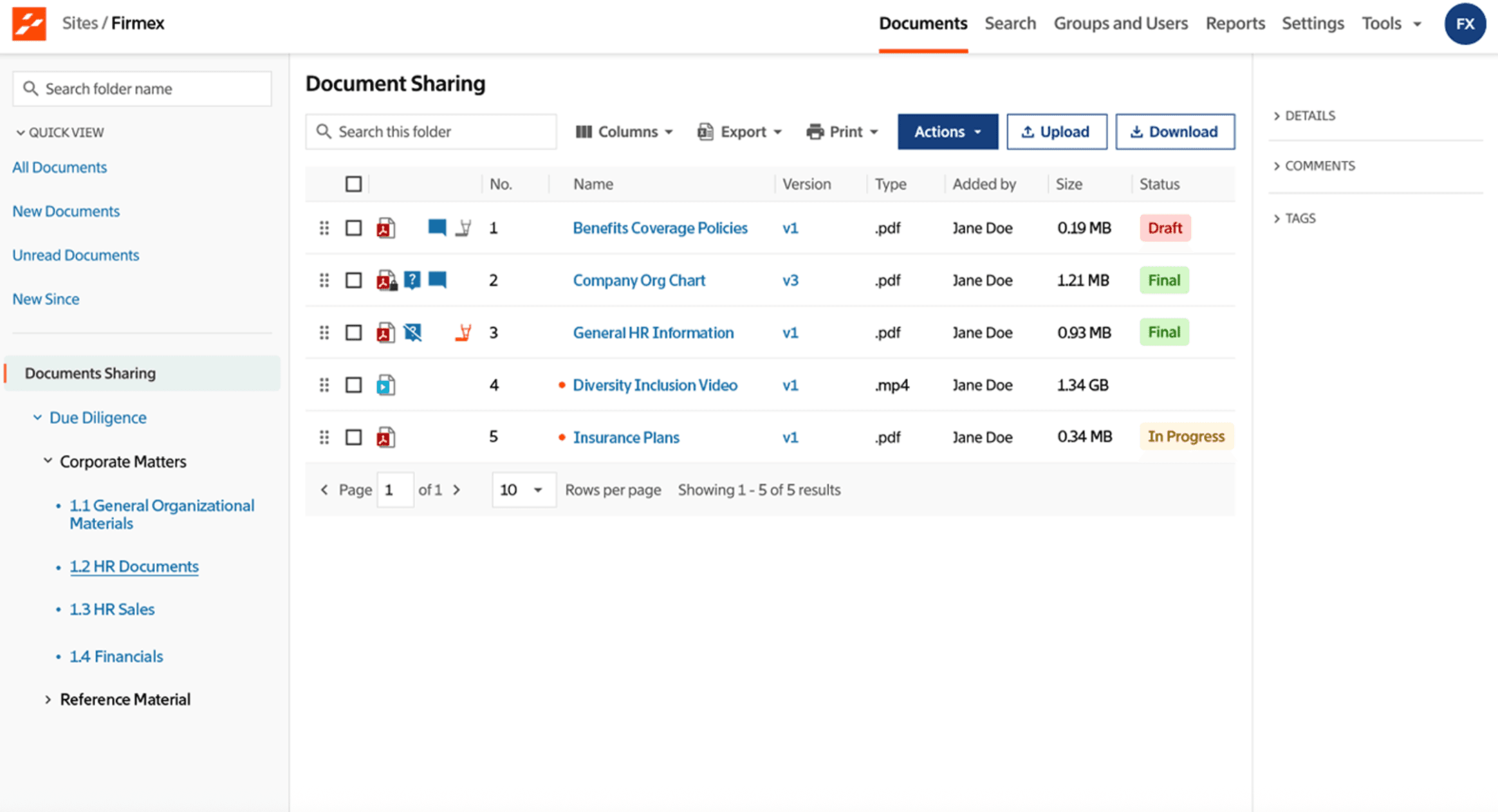
Intralinks is Datasite's closest peer, another legacy enterprise VDR with custom quotes in the $10,000 to $200,000+ per year range. See Intralinks alternatives. Ideals is a mid-market VDR with a 30-day trial and custom pricing. Firmex suits time-boxed mid-market projects, with reported entry subscriptions around $625/month. Ansarada pairs a VDR with deal-readiness scoring, which is useful twelve months before a sale and less useful once a process is live. SecureDocs publishes a price from $450/month. DocSend from $250/month is a document-tracking product rather than a diligence VDR; see Papermark vs DocSend.
How to choose between Datasite and the alternatives
The decision comes down to three questions, and only the first one is really about features.
How many pages will the room hold, and who pays for them? If the answer is tens of thousands of pages and the fee is being passed to a client or absorbed into a transaction fee, per-page pricing is survivable. If the answer is a five-figure page count on a mid-market deal funded from your own P&L, a flat monthly plan removes the variable entirely.
Does the buy side expect a specific room? On large-cap processes, buy-side counsel occasionally has a house preference, and there is no point fighting it. Below roughly $100M in enterprise value that expectation largely disappears, and the seller picks.
How much preparation work do you actually have? AI-assisted redaction is worth real money when hundreds of contracts need masking. It is worth nothing when the seller has forty documents.
If this is true
Lean towards
Large-cap sell-side, bank-run, 50,000+ pages
Datasite or Intralinks
Mid-market M&A, predictable monthly cost matters
Papermark
Hundreds of contracts need redacting before launch
Datasite, or Papermark for AI redaction
You want to test on your own documents before paying
Papermark or Ideals
Several rooms a year across a small advisory firm
Papermark or Firmex
One deal, short timeline, no branding requirement
SecureDocs
Pitch deck distribution rather than diligence
DocSend or Papermark
You need self-hosting or EU data residency
Papermark
Why consider Papermark as a Datasite alternative?
Papermark is a secure, fully customizable, and developer-friendly data room built for modern dealmakers, with page-level analytics, dynamic watermarking, unlimited data room visitors, and transparent pricing from €99/month. It keeps the security fundamentals that matter for M&A and due diligence, then removes the page-based pricing and sales-led onboarding that define Datasite.
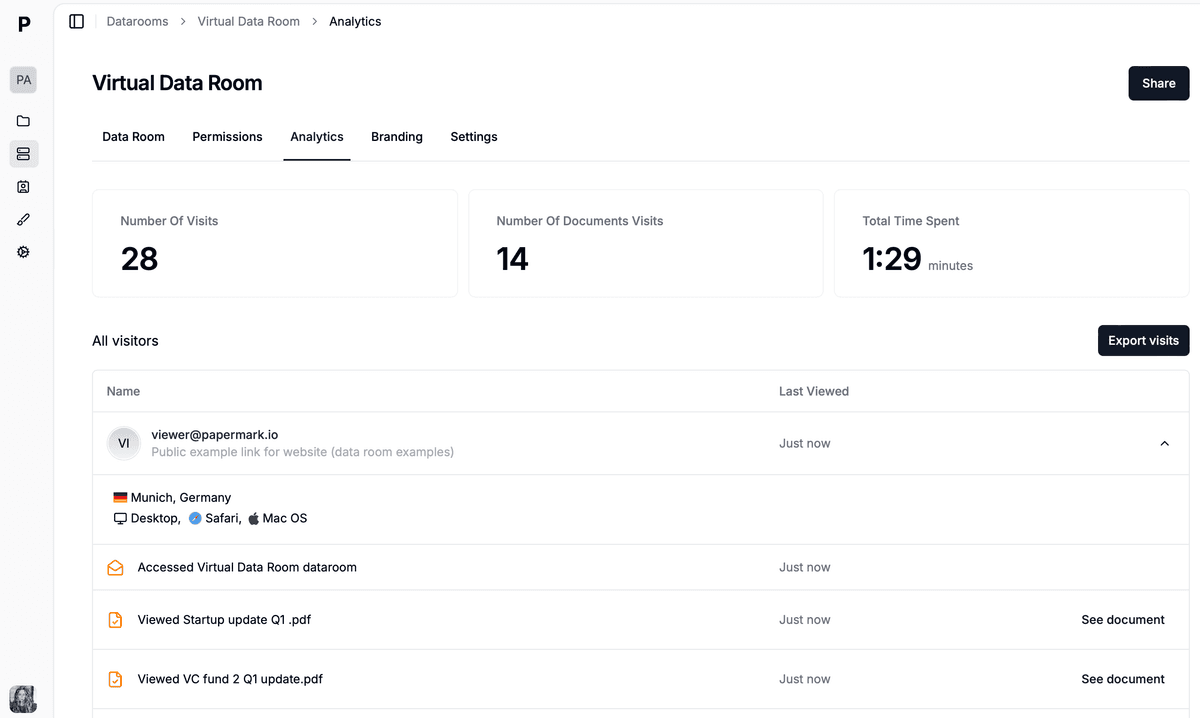
Papermark page-by-page analytics show which pages each bidder reads during due diligence, visibility Datasite's document-level reporting does not match.
Transparent, flat pricing
Instead of $0.60 per page and continuation premiums, the Data Rooms plan is a flat €99/month. That single subscription covers unlimited data rooms, unlimited data room visitors, and unlimited storage. A document-heavy carve-out that would run into five or six figures on a page-based quote costs the same as a lean Series A room.
The Data Rooms ladder, quoted at the annual rate:
Data Rooms, €99/month, 3 team members: unlimited data room visitors, unlimited data rooms, unlimited storage, custom domain, dynamic watermark, NDA, granular permissions
Data Rooms Plus, €249/month, 5 team members: visitor audit log, Q&A module, automatic file indexing, SOC 2 Type II
Data Rooms Premium, €549/month, 10 team members: AI redaction, full API access, SSO, whitelabeling
Data Rooms Unlimited, €999/month: unlimited team members, self-hosted deployment, bring-your-own AWS bucket
Papermark rates 4.9/5 across 171 reviews on G2, Product Hunt, and community feedback, verified in 2026, and is used by 70,000+ companies. The honest limitation against Datasite on a nine-figure process is brand: some bulge-bracket buy sides still expect an incumbent enterprise VDR.
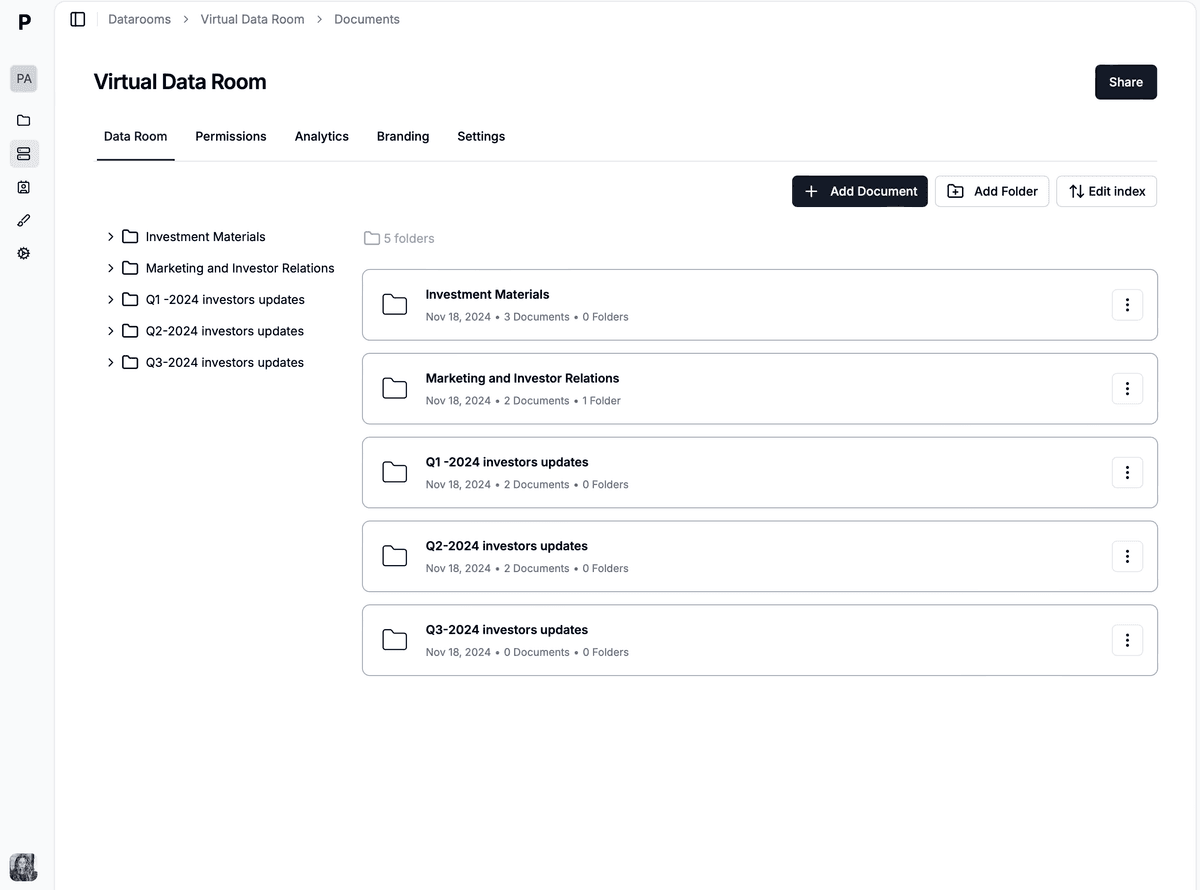
A Papermark data room organised by diligence workstream, with permissions set per link rather than per named user.
Enterprise-grade security and compliance
Papermark is SOC 2 Type II compliant (from Data Rooms Plus) and GDPR-aligned, encrypts data in transit and at rest, and enforces the controls a diligence process needs: granular permissions down to the folder and file, dynamic watermarking carrying viewer email, IP, and timestamp on every page, an integrated Q&A module, NDA gating on links, and a complete, exportable audit trail.
Page-by-page analytics
Where Papermark pulls ahead of Datasite for dealmakers is analytics. Page-by-page analytics and engagement heatmaps show exactly which bidder opened the CIM, which pages they lingered on, and where they dropped off. Partners can read investor intent in real time rather than settling for document-level opens.
Developer-friendly, and also open-source
Need to embed the data room in an existing workflow? Papermark exposes a public API, CLI, and MCP server, so engineering teams and AI agents can create rooms, set permissions, and read analytics programmatically. The core codebase is open-source, so you can self-host or customize without vendor lock-in. Datasite does not offer that path.
5-minute setup, zero training required
Invite stakeholders with a single share link, drag-and-drop your documents, and you are live. The interface feels familiar to anyone who has used Google Drive or Dropbox. For fundraising, share a teaser or pitch deck first, then upgrade the same link into a full data room when diligence begins.
Read case study →
We saved 70% by transitioning to Papermark. And managed to scale our sales. Our team loves this modern data rooms.
Alonso Benavides Panizo
SVP of Finance at Yuno | Founding team
Feature comparison: Papermark vs Datasite VDR
Compare plans
Papermark
Datasite VDR
Pricing
€99/month (3 users included)
Custom quote (page-based)
Unlimited data rooms
Unlimited storage
Custom limits
Unlimited data room visitors
Max file upload
Unlimited
Limited
Page-level analytics
Document-level
Custom domain and branding
Limited
Watermark and screen protection
Granular access controls
Video upload and advanced analytics
Limited
Q&A module
API, CLI, and MCP
Limited
Self-hosted / on-prem
Open-source core
AI redaction
Build your data room in minutes
No credit card required
Page by page analytics
Unlimited documents & folders
Custom domain & branding
Dynamic watermarks
Granular permissions
NDA & agreements
Activity notifications
SOC 2 & ISO 27001 certified
Conclusion
The Datasite virtual data room (formerly Merrill DataSite) is a comprehensive enterprise VDR with AI indexing, structured Q&A, and the certifications large-cap M&A still expects. The trade-offs are the ones teams actually switch over: custom per-page quotes around $0.60 a page, no self-serve trial, a one-to-two-week setup, limited API access, and no self-hosting.
For organizations that want the same core diligence workflow without that complexity, Papermark is a secure, fully customizable, and developer-friendly data room for modern dealmakers, with page-level analytics, unlimited data room visitors, and a Data Rooms plan at €99/month.