



datarooms
Best Data Rooms for Fundraising in 2026 (Seed to Series C Compared)
The 10 best data rooms for fundraising in 2026 compared on pricing, security, and best-fit round. Real customer stories from Backtrace Capital, TBD VC, and Two Inc.
The fundraising stack a founder in an accelerator batch actually needs is small: something to share and track the deck, a data room for diligence, a way to keep 90 investor conversations straight, a cap table, and a habit of sending updates. This guide covers 10 startup fundraising tools in 2026, what each one does, its published pricing, and at least one honest limitation.
The short version: Papermark for deck sharing and the data room, Attio or Foundersuite for the investor CRM, Visible for updates, Carta or Pulley for the cap table, and Clerky for the closing paperwork. Everything else on this list is optional.
No credit card required.
How we picked these startup fundraising tools: every tool is one a seed-stage founder can sign up for without a sales call, and every price is taken from the vendor's own pricing page or an equivalently verifiable source, re-checked in 2026. Where a vendor publishes both monthly and annual rates, we quote the higher monthly figure, because that is what you pay for a three-month raise. Where a vendor publishes no price, we say custom quote rather than guess. Competitors are described neutrally, and each one carries a stated limitation.
| # | Tool | Category | Starting price | Best for |
|---|---|---|---|---|
| 1 | Papermark | Deck analytics and data room | Free, data rooms from €99/month | Sharing the deck and running diligence in one place |
| 2 | DocSend | Deck analytics and data room | From $15/month, data rooms $250/month | Founders already inside the Dropbox ecosystem |
| 3 | Attio | CRM for the raise | Free, paid from €39/user/month | Running an investor pipeline like a sales pipeline |
| 4 | Foundersuite | Investor CRM and database | Free, paid from $745/year | Founders who want the CRM and the investor list together |
| 5 | Visible | Investor updates and reporting | Free, paid from $69/month | Monthly updates to existing investors |
| 6 | OpenVC | Investor discovery | Free, Premium $99/month | Building a target list without paying for data |
| 7 | Crunchbase | Investor and market research | Free, Pro from $49/month | Checking who funded your comparables |
| 8 | Carta | Cap table and 409A | Free tier, Launch from $2,988/year | Companies expecting a priced round soon |
| 9 | Pulley | Cap table | Startup from $1,200/year | Founders who want scenario modelling early |
| 10 | Clerky | Incorporation and closing docs | $9 per safe, $819 lifetime package | Issuing safes correctly without a lawyer per document |
Two notes on reading that table. First, the two cap table tools price by stakeholder count and bill annually, so the monthly-equivalent figure understates what you will actually be invoiced. Second, only three tools on this list are genuinely necessary in the first month of a raise: something to share the deck, something to hold the documents, and something to track who you spoke to.
Pricing models matter more than headline prices when you are raising, because a raise is a spike rather than a steady state. A flat monthly subscription can be started and stopped around a three-week Demo Day window. An annual stakeholder-tiered contract cannot.
Each tool is assigned to its primary published pricing model, taken from the vendor's own pricing page in 2026. Cap table tools bill annually by stakeholder count, which is why they sit in their own group.
What that means in practice:
Website: papermark.com
Pricing: Free plan €0. Pro €24/month, Business €59/month. Data Rooms from €99/month with a 7-day free trial.
Papermark is a secure, fully customizable, and developer-friendly data room built for modern dealmakers, with page-by-page analytics, dynamic watermarking, and transparent pricing from €99/month. For a founder raising a seed round it does the two jobs that matter most in the same account: it turns the pitch deck into a tracked link, and it holds the secure data room investors get after the meeting. It is also open-source and self-hostable for teams that want full data control.
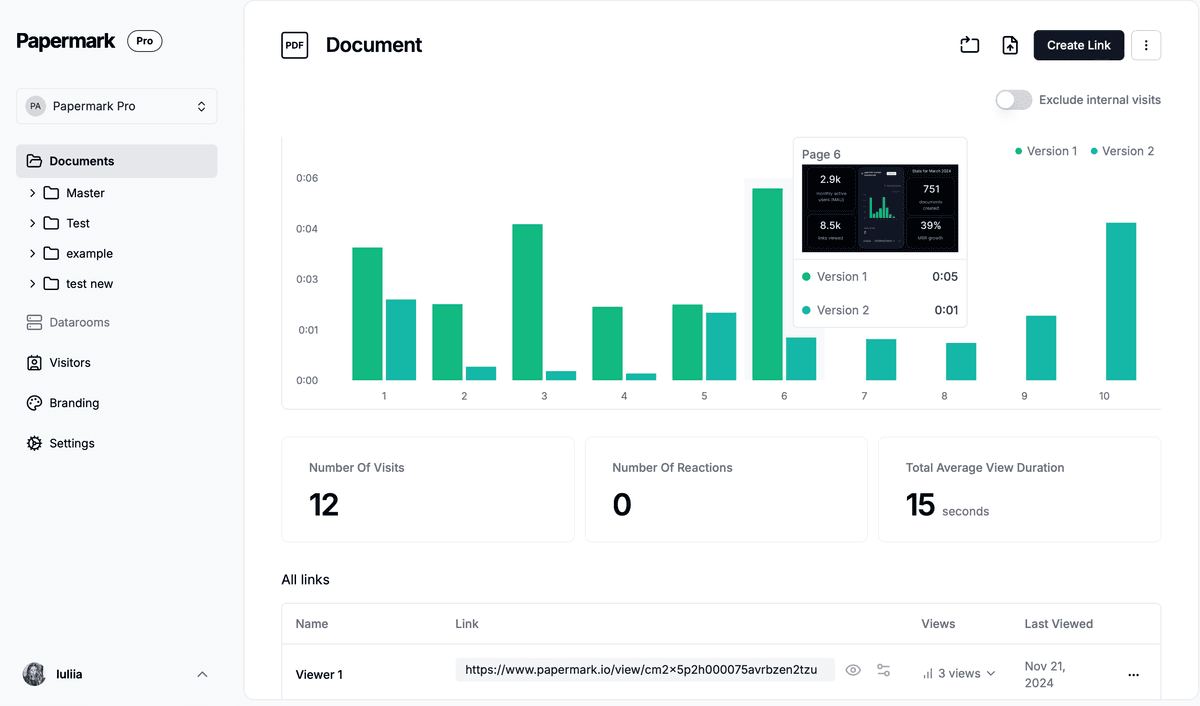
The reason founders start here is the analytics. Send the deck as a link and you see who opened it, which slides they spent time on, whether they came back, and whether the link was forwarded to a colleague at the same firm. During a batch that can mean 148 distinct viewers on one deck, and the useful list is not the 148, it is the 23 who reached the metrics slide and stayed there.
That signal is directly actionable. An investor who re-opens the deck two days later and lingers on the financial model is a follow-up worth making that afternoon. One who spent eleven seconds is not. See pitch deck sharing for the link setup.
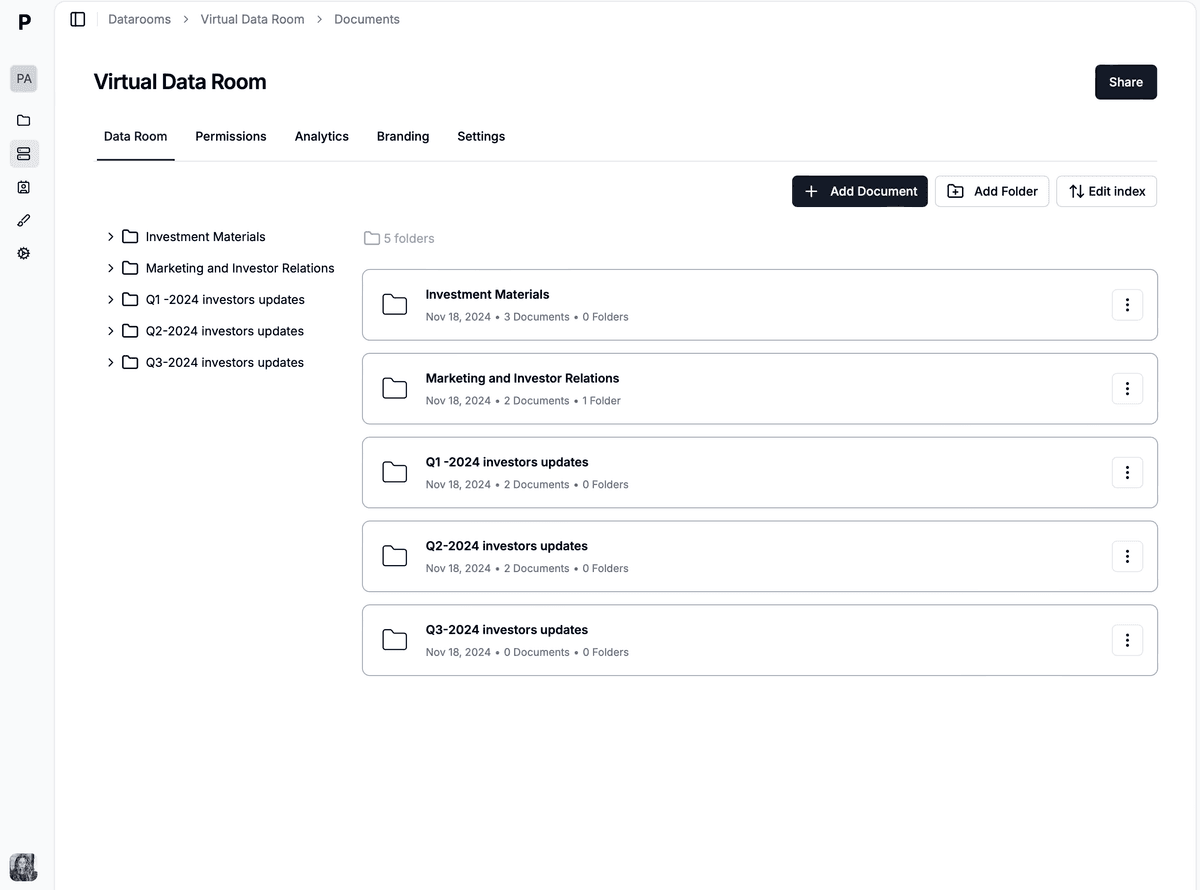
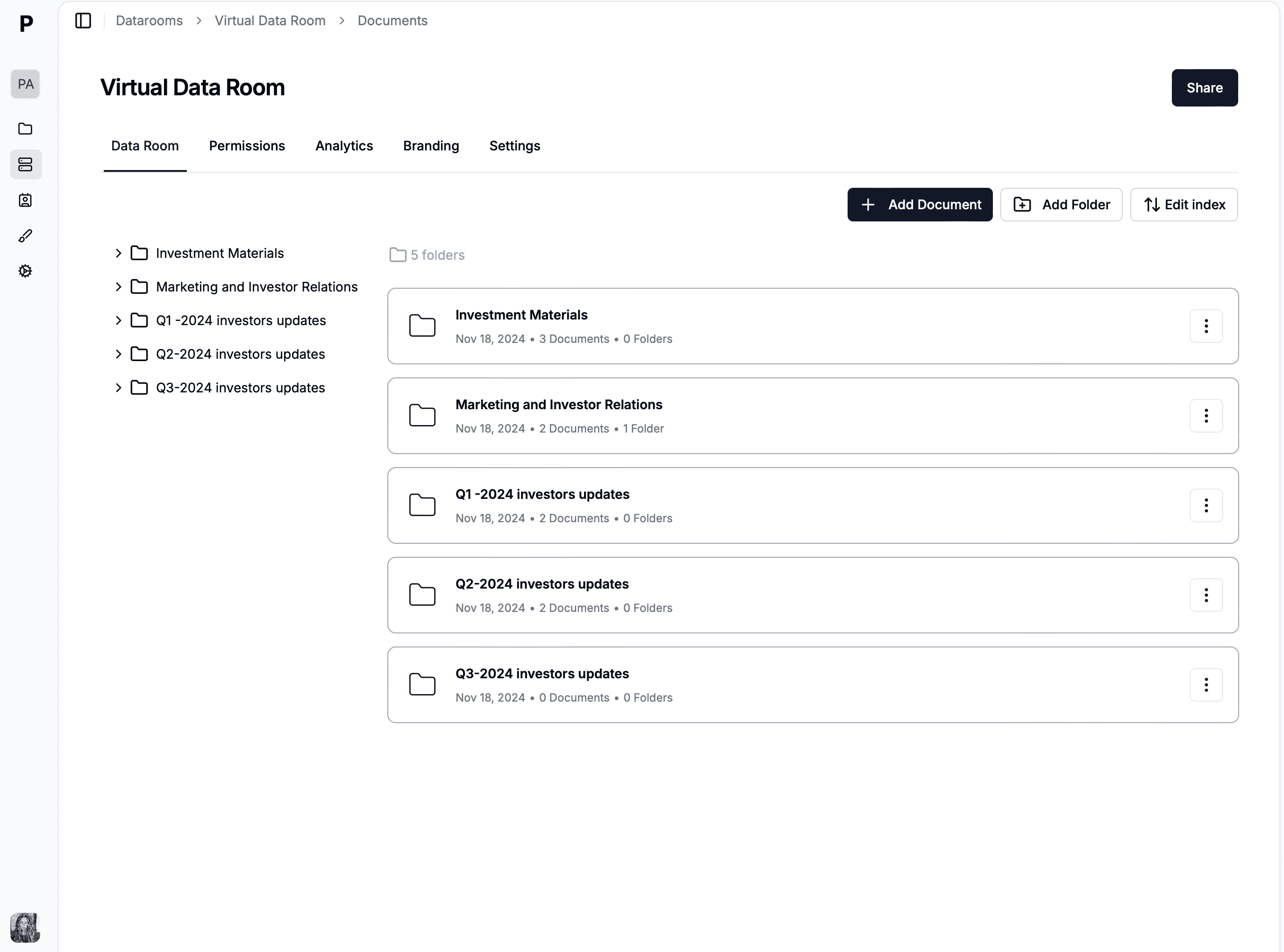
Most deck tools stop at the deck. Papermark runs the full data room in the same account: unlimited rooms, unlimited documents, folder and file-level permissions, a custom domain, and NDA gating where you need it. That means the teaser link you send on a cold intro and the diligence link you send after a meeting are two links over the same underlying room, with different scopes.
For a seed round the room is small, usually around 24 documents in six folders. For a Series A eighteen months later it grows, and the audit log, Q&A module, and automatic file indexing on the higher plans are there when it does.
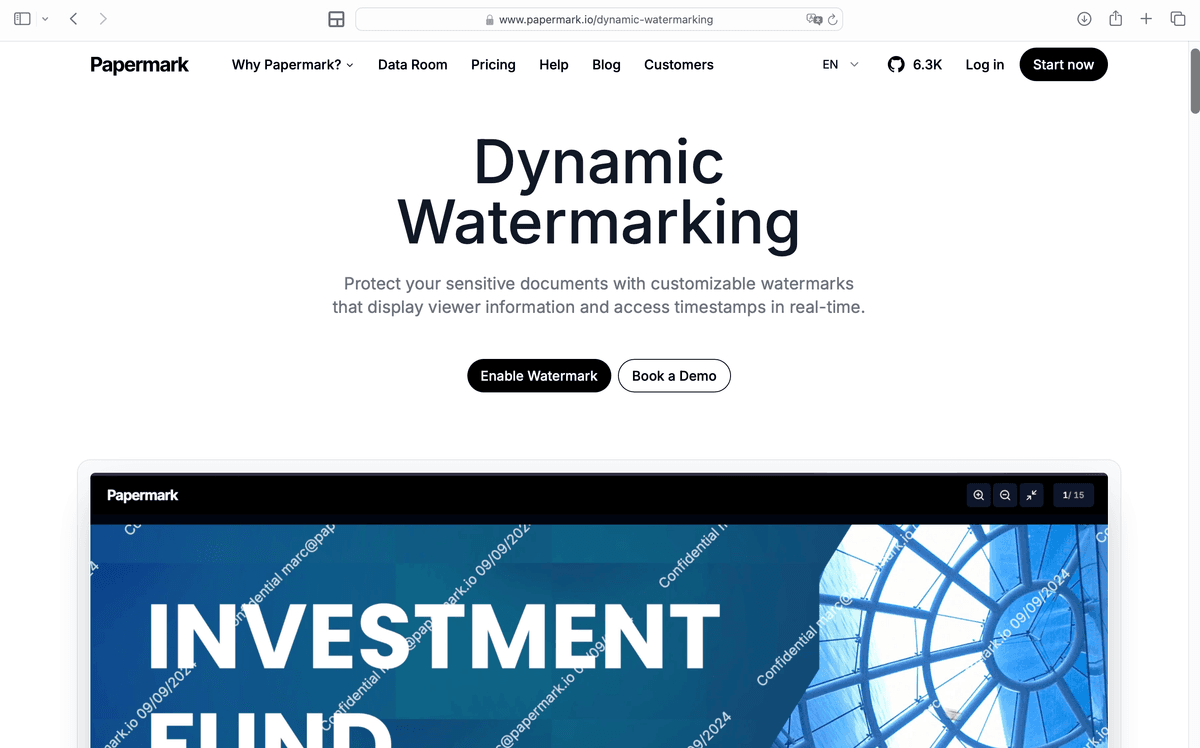
Every link carries its own controls: password protection, email verification, allow and block lists, expiry dates, download on or off per folder, screenshot protection, and dynamic watermarking that stamps the viewer's email, IP, and timestamp onto each page as it renders. Papermark is SOC 2 Type II, GDPR, HIPAA, and CCPA compliant, with AES-256 encryption at rest and EU (Frankfurt) data residency available.
The practical version for a founder: your deck can be downloadable while your bank statements are view-only and watermarked, in the same room, without maintaining two copies of anything.
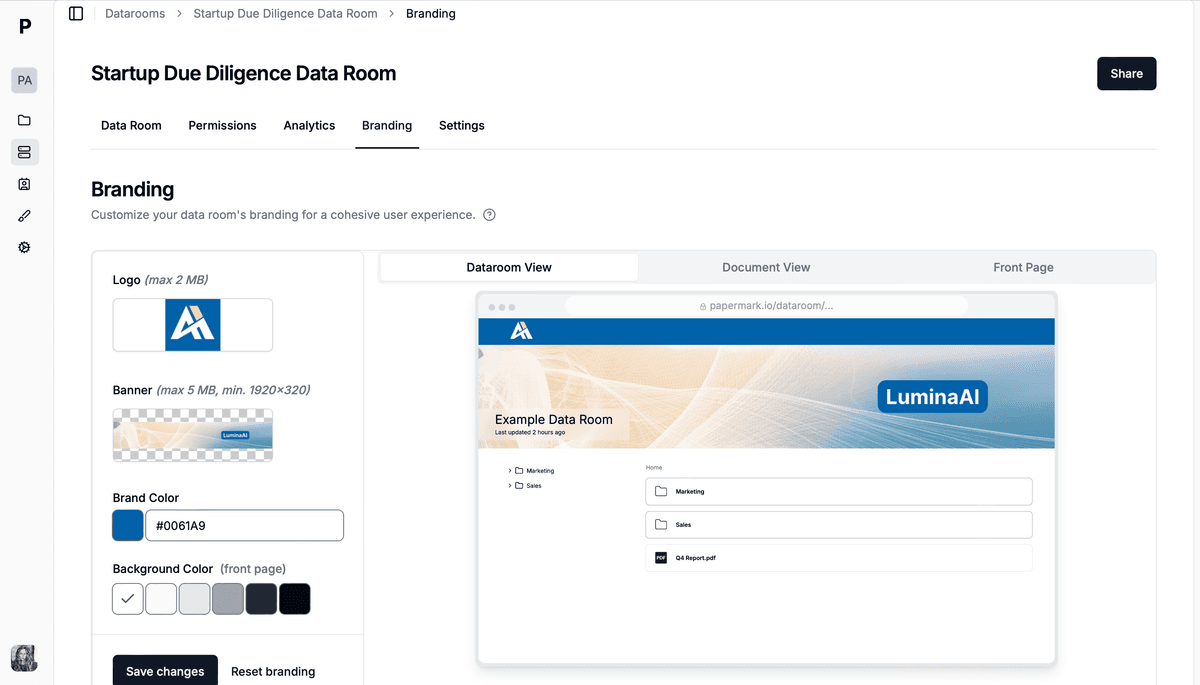
Run the room on your own domain with your logo, colours, and a short welcome message. Custom domains for data rooms are included from the €99/month Data Rooms plan. An investor opening a branded room on your domain reads it as a company; a generic vendor URL with a random string reads as a file dump.
Website: docsend.com
DocSend, owned by Dropbox, is the incumbent in deck tracking and the tool most investors have seen before. It provides page-level analytics on shared documents, email verification for viewers, NDA gating, and a virtual data room product on its upper tier. Founders who already run Dropbox for storage often land here by default.
Features: document analytics with page-by-page engagement, viewer email verification, passcode and NDA gates, custom branding and domains, team spaces, and a data room tier.
Limitations: the data room capability sits on the Advanced plan at $250/month, which is a steep step up from the $65/month Standard tier, and there is no free plan, only a trial. Pricing is per user, so adding a co-founder increases the bill.
Pricing: Personal $15/month, Standard $65/month, Advanced $250/month for data rooms, Enterprise custom quote.
Ratings: G2 4.5/5 (890+ reviews), Capterra 4.6/5 (234+ reviews).
Website: attio.com
Attio is a general-purpose CRM that founders increasingly use for fundraising because its data model is flexible enough to treat investors as a pipeline with custom stages, notes, and reminders. If you already run Attio for sales, adding a fundraising pipeline costs nothing extra beyond seats.
Features: custom objects and pipelines, email and calendar sync, automations, reporting, and a free tier for up to 3 seats.
Limitations: it is not fundraising software. There is no investor database, no deck tracking, and no update distribution, so you are building the fundraising workflow yourself. Per-seat pricing also means the cost scales with team size rather than with the raise.
Pricing: Free for up to 3 seats. Plus €39/user/month, Pro €93/user/month billed monthly, Enterprise custom quote.
Website: foundersuite.com
Foundersuite bundles an investor CRM with an investor database, so the target list and the pipeline live in the same product. It also includes update distribution and a document room, which makes it the closest thing on this list to an all-in-one fundraising tool for founders who prefer one login.
Features: investor CRM with pipeline stages, a searchable investor database, investor update distribution, and basic document sharing.
Limitations: the bundled document room is basic compared with a purpose-built data room, with no dynamic watermarking or per-link folder permissions of the depth diligence needs. Database coverage and contact accuracy vary by geography, so a target list still needs manual verification.
Pricing: Basic free. Silver $745/year, Gold $1,069/year, Platinum $1,609/year when billed annually; monthly billing is priced roughly 10% above the annual rate.
Website: visible.vc
Visible is built around investor updates and reporting rather than the raise itself. Founders use it to send a structured monthly update with charts pulled from connected metrics sources, and it has a fundraising pipeline and data room feature on higher tiers. If you only need the email itself, our free investor update email generator drafts one in seconds.
Features: investor update composer with metric charts, distribution lists, engagement tracking on updates, fundraising pipeline, and a data room on upper plans.
Limitations: the update product is stronger than the data room product, and the data room sits behind the higher tiers. Founders raising a first round with no existing investors get less value than those already reporting to a cap table.
Pricing: Starter free. Base $69/month, Core $149/month, Growth $249/month when billed monthly. Annual billing reduces these to $59, $129, and $199 respectively.
Website: openvc.app
OpenVC is a free platform for finding investors, with a searchable list of funds, filters by stage, geography, and sector, and a pitch submission flow. Most of what a founder needs to build a target list is available without paying.
Features: investor search with stage and sector filters, warm intro finder, pitch deck submission, deck reviews, and pipeline tracking on the free tier.
Limitations: it is a discovery tool, not a system of record. Outreach limits apply on the free tier, and the quality of a fund profile depends on how recently it was updated, so a target list still needs checking against the fund's own site.
Pricing: Free tier covers investor search, pitch submission, filters, and pipeline. Premium is $99/month or $299/year, adding daily outreach contacts, more filters, the intro finder, and deck templates.
Website: crunchbase.com
Crunchbase is the research layer: who funded your closest comparables, at what stage, and how recently. Founders use it to build a first-pass target list and to check whether a fund that says it does seed has actually written a seed cheque in the last year.
Features: company and investor profiles, funding round history, advanced search filters, saved lists, a browser extension, and API access on higher tiers.
Limitations: data accuracy varies, particularly for rounds outside the US, and contact details for individual partners are limited. It is a research tool rather than a workflow tool, so the output still has to be moved into a CRM.
Pricing: Free tier for basic profiles. Pro from $49/month, Enterprise custom quote with API access.
Website: carta.com
Carta is the default cap table platform for US venture-backed companies and the one most investors expect to see. It manages equity issuance, option grants, 409A valuations, and stakeholder access, and it produces the cap table view an investor asks for during diligence.
Features: cap table management, electronic share issuance, option grant workflows, 409A valuation service, scenario modelling, and stakeholder portals.
Limitations: cost climbs quickly with stakeholder count, and 409A valuations are usually billed separately. Carta does not publish a straightforward monthly rate for its paid tiers, so most companies negotiate an annual contract.
Pricing: free tier for companies under roughly 25 stakeholders and $1M raised. Launch is commonly quoted from $2,988/year, Build from $5,988/year, and Grow from $11,988/year; above that, custom quote.
Website: pulley.com
Pulley is the main independent alternative to Carta for early-stage cap tables, with a focus on scenario modelling: what your ownership looks like after this safe converts, after the option pool refresh, and after the priced round.
Features: cap table management, safe and note tracking with conversion modelling, templated equity agreements, share certificates, 409A valuations on higher tiers.
Limitations: no free plan, so the entry cost starts at $1,200/year even for a two-founder company with a handful of stakeholders. Ecosystem familiarity is lower than Carta's, which occasionally means explaining the export format to an investor's analyst.
Pricing: Startup $1,200/year including the first 25 stakeholders, Growth $3,500/year including the first 40, Enterprise custom quote. Angels investing $50,000 or less count as half a stakeholder.
Website: clerky.com
Clerky generates the startup legal paperwork that founders otherwise pay a law firm to assemble: incorporation, post-incorporation setup, stock plans, safes, convertible notes, hiring documents, and board consents. It is not legal advice, it is correctly-generated standard documents.
Features: Delaware incorporation, post-incorporation setup, stock plan adoption, safe and convertible note generation, hiring paperwork, board consents, and a document archive.
Limitations: it covers standard forms only, so anything negotiated or unusual still needs a lawyer. It is US-focused, which makes it a poor fit for founders incorporating outside Delaware.
Pricing: Delaware incorporation $427, post-incorporation setup $299, stock plan adoption $199. Safes are $9 each and convertible notes $19 each, or $99 for six months of unlimited issuances. The Company Lifetime Package is $819 one-time.
Four of the ten tools offer some form of document sharing, and they are not equivalent. Foundersuite and Visible bundle a light document room alongside their main product, which is convenient but shallow. Papermark and DocSend are built around document sharing and analytics, which is why the difference shows up in the controls rather than in whether the feature exists.
The distinctions that matter during a raise are narrow: can you set download on for the deck and off for the financials in the same room, can you watermark a page with the viewer's identity, and can an investor open it without creating an account.
| Capability | Papermark | DocSend | Foundersuite | Visible |
|---|---|---|---|---|
| Page-level deck analytics | Basic | Basic | ||
| Full data room | (from €99/month) | (from $250/month) | Light document room | Upper tiers only |
| Dynamic watermarking | ||||
| Per-folder download control | ||||
| NDA gate on a link | ||||
| No viewer account required | ||||
| Free tier usable for the deck | ||||
| Open-source, self-hostable |
If document sharing is the only thing you need in month one, the free tiers on Papermark, Foundersuite, and Visible all send a deck. The moment diligence starts and you need to restrict downloads on financials while leaving the deck open, the list narrows to two.
Most founders over-buy at the start of a raise and then cancel three subscriptions two months later. The table below is what a two-founder company raising a seed round genuinely needs, and what can wait.
| Job | Tool | Monthly cost | Can it wait? |
|---|---|---|---|
| Share and track the deck | Papermark free plan | €0 | No, start here |
| Hold the diligence documents | Papermark Data Rooms | €99 | No, before the first meeting |
| Track investor conversations | Attio free tier | €0 up to 3 seats | No, from week one |
| Build the target list | OpenVC free tier | €0 | No, but free is enough |
| Issue the safes | Clerky | $9 per safe | No, at term sheet |
| Manage the cap table | Carta free tier or Pulley | €0 to $100 equivalent | Yes, until the round closes |
| Send investor updates | Visible | $69 | Yes, until you have investors |
| Research comparables | Crunchbase Pro | $49 | Yes, free tier covers most of it |
Run that way, a seed raise costs about €99/month plus roughly $54 in safe generation, and everything else stays free until the round is done. The three paid upgrades worth making later are the data room's Plus tier when Series A diligence starts, a cap table platform once you have more than 25 stakeholders, and Visible once you actually have investors to report to.
Four criteria decided what made this list and what did not.
Self-serve. Every tool here can be signed up for and used the same day, without a demo call. A founder in week one of a raise cannot wait for a sales cycle, which rules out most enterprise fundraising and investor relations software.
Published pricing. Nine of the ten publish a price on their own site. Where a vendor does not publish a monthly figure, as with Carta's paid tiers, we say so rather than converting an annual number and presenting it as monthly. We never quote a price a vendor has not stated somewhere verifiable.
Actually used at seed. Tools built for growth-stage or fund-side workflows were excluded even where they are excellent, because a two-person company raising on safes will not use a portfolio monitoring platform or a $2,000-per-seat relationship intelligence CRM.
Stated limitations. Every entry carries at least one, including ours. A list where every tool is excellent is a list that has not been used.
One category is deliberately missing: pitch deck design tools. They matter, but they are a different purchase and are covered separately in our roundup of the best pitch deck software. For platform selection on the document side specifically, our comparison of the best virtual data rooms goes deeper on pricing model, permissions, and compliance across the dedicated providers, and best startup fundraising tools covers a wider set of investor-facing products.
The 10 best data rooms for fundraising in 2026 compared on pricing, security, and best-fit round. Real customer stories from Backtrace Capital, TBD VC, and Two Inc.

A data room for YC startups in 2026: the 24 documents investors ask for after Demo Day, how it pairs with deck analytics, tiered links, and pricing from €99/month.
Discover the 15 best startup fundraising tools in 2026 to streamline investor outreach, manage pitch decks, and close funding rounds faster with powerful analytics and automation.