



datarooms
500 Startups Data Room in 2026: 22 Documents and a €99 Setup
A 500 Startups data room in 2026: the 22 documents accelerator founders need, cross-border diligence, tiered investor links, and setup from €99/month.
A data room for YC startups is a small, curated set of documents that lets an investor go from interested to wired in days rather than weeks. At this stage it is not a due diligence archive. It is 24 files, organised into six folders, shared on a link you control.
Demo Day compresses a fundraise that would normally take three months into about three weeks. Hundreds of investors look at a batch at once, the good rounds fill quickly, and the founders who close fastest are almost never the ones with the best documents. They are the ones whose documents were already ready when the first partner said yes.
This guide covers what actually goes in a data room for YC startups, what changes between Demo Day week and confirmatory diligence, how tiered links work, the mistakes that stall a close, and what it costs to run. Section 8 is the practical build.
A YC data room is a secure, link-shared folder set containing the documents a seed investor needs to confirm what your deck already claimed. That is the whole job. It is not a due diligence archive, it is not an attempt to look institutional, and it is not the place to put every contract your company has ever signed.
The confusion comes from search results written for M&A. A virtual data room for a company sale holds hundreds or thousands of documents across a four to six month process, with staged access, a Q&A module, and multiple bidder groups. A data room for Y Combinator-stage startups holds about 24 files and is usually open for three weeks. Building the first thing when you need the second wastes a week you do not have during a batch.
What it is, concretely, is a trust accelerator. An investor who has met you and liked the pitch now has a small set of questions: are the numbers in the deck the numbers in the bank, is the cap table clean, does the company own its code, and who else is in. A data room that answers all four in one link removes the back-and-forth that otherwise eats the week between the second meeting and the wire.
It is also a signal. Founders who send a tidy, indexed room within an hour of the meeting look like people who will be easy to work with for the next eight years. Founders who send four separate email attachments over three days, one of which is the wrong version of the model, look like the opposite. The documents are the same either way.
One clarification worth making explicitly: Y Combinator does not mandate, endorse, or supply any particular data room tool, and nothing in this guide should be read as a YC policy. The standard deal terms below are published by YC; the document list and the workflow are what founders in accelerator batches typically converge on.
Y Combinator's published standard deal is $500,000 in two parts: $125,000 on a post-money SAFE for 7% of the company, and $375,000 on an uncapped SAFE with most favored nation terms. The MFN portion takes the terms of the most favourable safe issued between the start of the batch and the next priced round, which is why the cap you set on your own seed safes matters more than founders expect.
That structure shapes the diligence you get. Because YC's money is already committed and the instrument is standard, the round you raise around Demo Day is usually further safes rather than a priced equity round. Safe rounds carry light diligence by design: no board seat, no protective provisions, and often no lawyer on the investor side. What investors do check is small, specific, and almost always the same list.
The heavier diligence arrives at Series A, typically nine to eighteen months later, when a lead investor commissions real legal and financial review. Everything you put in the seed data room becomes the starting point for that process, which is a good reason to build it properly the first time rather than assembling it twice.
| Stage | What investors actually ask for | Typical turnaround |
|---|---|---|
| Before Demo Day | Deck, one-pager, current metrics | Same day |
| Demo Day week | Deck, metrics, round terms, cap table summary | Within hours |
| Post-meeting diligence | Financials, cohort retention, customer list, safes issued | 24 to 48 hours |
| Pre-wire confirmation | Incorporation docs, IP assignments, stock plan, bank statements | 2 to 5 days |
| Series A, 9 to 18 months later | Full legal and financial review, contracts, employment records | 4 to 8 weeks |
The column that matters is the third one. At seed, the constraint is never the investor's analysis, it is your response time. A round that could close in ten days takes four weeks because three different investors each waited two days for a document that should have been in a folder from the start.
Six folders, four documents each. That is the shape most accelerator-stage rooms settle into (a Techstars data room lands on about 20 files in the same six folders), and it is enough to answer every standard seed question without turning the room into a project. Add more only when an investor asks for something specific, and put it in the folder where it belongs rather than at the root.
The overview folder is what an investor opens first, so it carries the one-pager and the current deck. The team folder is where the IP question gets answered, and it is the folder founders most often get wrong. The traction folder is the one investors spend the most time in, because it is where the deck's claims get checked against exports rather than slides.
| Folder | Documents | Count | When to add it |
|---|---|---|---|
| 01 Overview | One-pager, current deck, cap table summary, incorporation certificate and charter | 4 | Before Demo Day |
| 02 Team | Founder bios, org chart with open roles, signed IP assignment for every contributor, stock plan and option pool summary | 4 | Before Demo Day |
| 03 Product | Roadmap for the next 4 to 6 quarters, architecture overview, security and data handling summary, demo video or sandbox link | 4 | Demo Day week |
| 04 Traction | Monthly revenue and ARR history, cohort retention, customer list with contract values, sales pipeline snapshot | 4 | Demo Day week |
| 05 Financials | Monthly P&L since inception, bank statements, burn and runway model, 18-month forecast with assumptions | 4 | Post-meeting |
| 06 Legal | All safes and notes issued with terms, stock plan and grant ledger, top customer contracts, trademark and IP filings | 4 | Pre-wire |
Three of those 24 deserve specific comment because they are where seed rounds actually stall.
The cap table. Not a screenshot from a slide. A current table showing every holder, every safe with its cap and discount, the option pool, and the post-round position at the valuation you are raising at. If your YC safe, your pre-YC angel safes, and your new round are not all in one place, an investor will build it themselves and get a different number to yours, and that conversation costs three days.
IP assignment. Every founder, employee, contractor, and friend-who-helped-for-a-weekend needs a signed agreement assigning their work to the company. This is the single most common finding at Series A and the easiest to fix at seed, when the people involved still answer your messages.
Bank statements. Investors check that the revenue in the deck reaches the bank account. Three to six months of statements, exported as PDFs, ends that question in one click. Founders resist this one and should not; it is standard, and the alternative is a call about it.
Our startup data room checklist covers the same ground for non-accelerator companies. The 24 documents in the table are the YC data room checklist fundraising founders should have ready before Demo Day.
A YC Series A data room checklist comes 9 to 18 months later, when a lead commissions legal and financial review. The YC Series A diligence checklist data room adds 12 to 24 months of monthly financials, every material customer contract, employment records, and a Q&A trail on top of those 24 files. The startup due diligence checklist is the longer list for that round. Do not build it during Demo Day week.
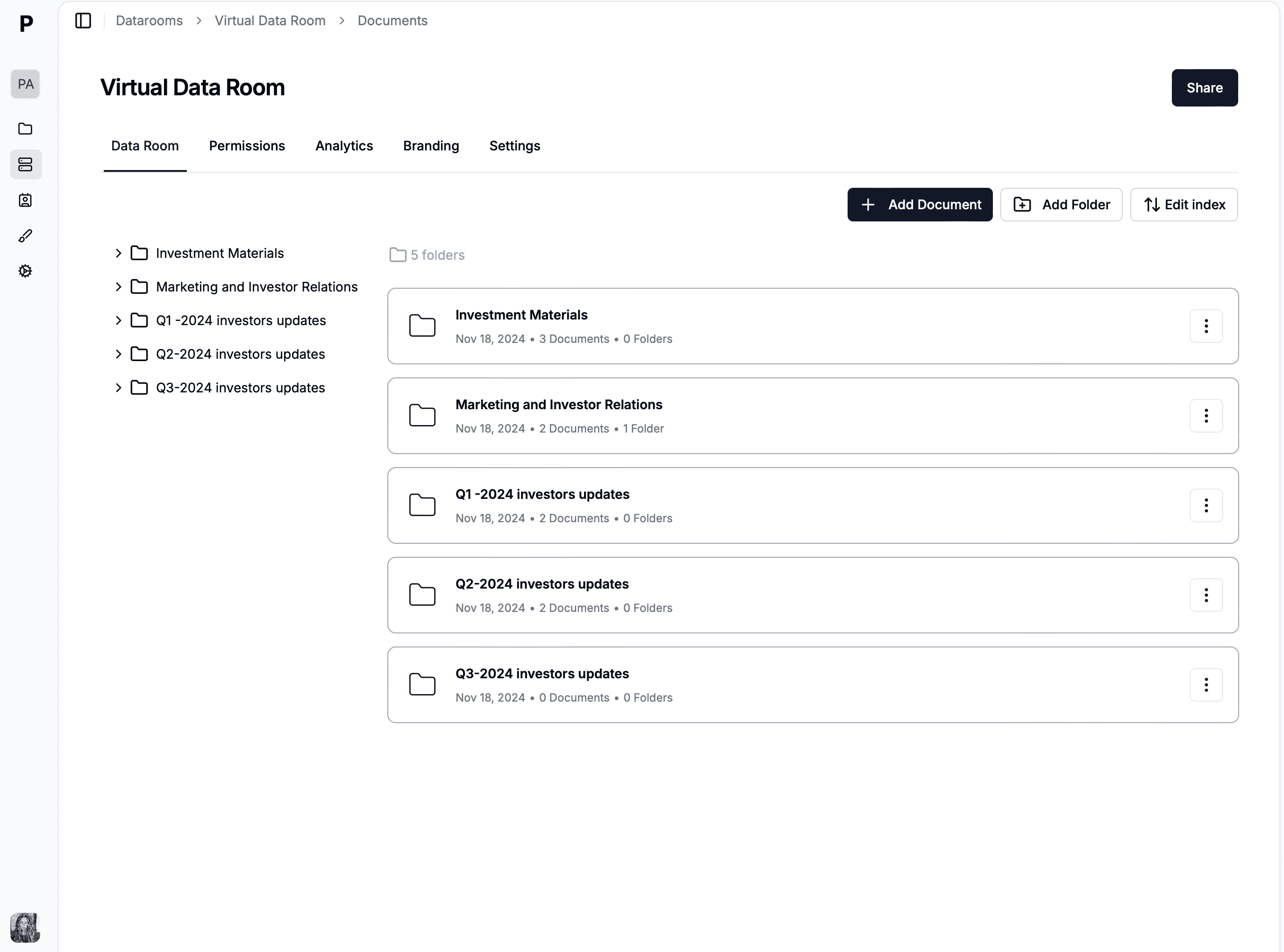
A data room for YC startups is six folders and about 24 documents, not a due diligence archive.
The pitch deck and the data room do different jobs and should be measured differently. The deck creates interest and gets the meeting. The data room removes doubt and gets the wire. Sending both at once, in the same link, on a cold intro, is the most common mistake founders make in Demo Day week, because it gives away your financials to hundreds of people who were never going to invest.
The deck is also where the most useful data comes from. When your deck is a tracked link rather than a PDF attachment, you can see who opened it, which slides they read, how long they spent on the metrics slide, and whether they forwarded it to a colleague. A partner who spent four minutes on your cohort chart and then forwarded the link to two people at the same firm is a different follow-up from one who opened it for eleven seconds.
That signal is worth more at YC scale than anywhere else, because you are running dozens of conversations simultaneously and you cannot afford to allocate the same effort to each. Our guide to tracking activity on your pitch deck covers what to read into the numbers, and how to send a pitch deck to investors covers the mechanics.
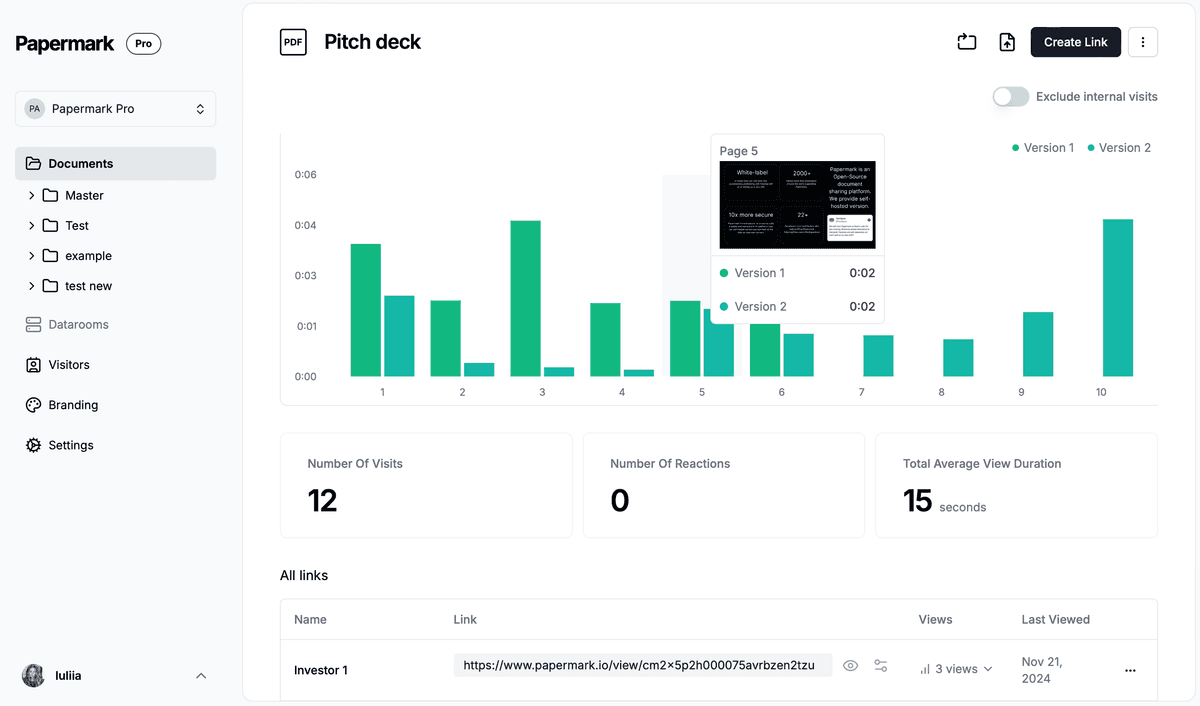
Per-slide analytics show which investors read past the metrics slide, which is where the follow-up list comes from.
The practical sequence is: deck link on the intro, meeting, data room link after the meeting, and a specific document link if a follow-up question needs one. Three artifacts, three moments, all measurable. What you never want is a Google Drive folder shared with edit-adjacent permissions to forty strangers, which is what happens by default when a founder is moving fast.
The single most useful configuration for accelerator-stage fundraising is tiered access from one underlying room. Link one is public-ish: the deck, the one-pager, and nothing else, sent to anyone who asks. Link two is the real room, sent after a meeting, gated by email verification and often by an NDA.
This solves a real problem. In Demo Day week you will send your materials to more people than you can vet, including scouts, angels, associates gathering market intelligence, and at least one person who is not an investor at all. Your revenue by customer and your burn model should not be in that distribution. Your deck should.
| Setting | Teaser link | Diligence link |
|---|---|---|
| Contents | Deck and one-pager only | All 6 folders, 24 documents |
| Who gets it | Anyone who asks, cold intros, scouts | Investors after a real meeting |
| Email verification | Optional | Required |
| NDA gate | Optional, usually no at seed | |
| Download | Deck only | Off for financials, on for the deck |
| Watermark | Off | On, viewer email and timestamp |
| Expiry | End of the batch | 30 days, renewable |
Note the NDA row. At seed, asking an investor to sign an NDA before seeing a deck is a well-known way to look inexperienced, and most professional investors will decline. The exception is a specific sensitive document, such as an unfiled patent application or a named customer contract, which can carry its own gated link inside the room. Our note on the startup NDA agreement covers where the line usually sits.
The expiry row matters more than it looks. Links that stay open forever become links that get forwarded a year later to someone raising against you. Setting the diligence link to 30 days, renewable on request, costs nothing and closes that hole.
Kestrel Labs is a hypothetical two-founder developer tools company in a YC batch, doing $18,000 in monthly recurring revenue at Demo Day with 34 paying teams and 11% month-on-month growth. The founders are raising $2.5M on a post-money safe at a $22M cap, having already taken YC's standard $500,000.
They build the room in the week before Demo Day: 24 documents, six folders, about four hours of work, most of which is spent chasing two contractors for signed IP assignment agreements that should have existed a year earlier. The deck goes out as a tracked link. The diligence link stays closed.
Demo Day week produces 96 investor conversations. The deck link is opened 211 times by 148 distinct viewers. Analytics show that 61 of those viewers reached the metrics slide and 23 spent more than two minutes on it. The founders use that list, not the full 148, to decide who gets a same-day follow-up.
Worked scenario. Percentages are share of total time spent across all documents by the 38 investors who received the diligence link. Traction and financials together took more than half the attention, which is where preparation pays.
Thirty-eight investors get the diligence link. Two ask questions that are not answered by the 24 documents: one wants gross margin by customer cohort, the other wants the churn definition written down. Both answers are uploaded into the traction folder the same day, which means the next eleven investors never ask.
One firm's associate spends 26 minutes across the financials folder over two evenings and then goes quiet. The founders see the activity, follow up specifically on runway, and learn the concern was an 8-month runway at the current burn. They add a scenario to the model showing 14 months at a reduced hiring plan. That firm leads the round.
The round closes 23 days after Demo Day at $2.6M. The founders attribute roughly a week of that speed to the room existing before the first meeting rather than after it, which is the ordinary experience: nothing dramatic, just the absence of four separate two-day delays.
The most common mistake is building the room after the first investor asks for it. By then you are assembling documents under time pressure, in parallel with running meetings, and the version of the model you send to investor three is not the version you sent to investor one.
The second is over-building. A seed room with 140 documents, an index, and a Q&A module signals that you have spent time on the wrong thing. Twenty-four documents that are all current beats a hundred that are half stale.
The third is a cap table that does not reconcile. Every safe you have issued, including the pre-batch angel who sent $25,000 on a handshake and a template, has to appear with its cap and discount. The MFN term on YC's $375,000 portion makes this arithmetic matter, and an investor who finds a safe you forgot will wonder what else is missing.
The fourth is sharing through a consumer file service. A Drive folder gives you one permission level, no watermarking, no expiry, no page-level analytics, and no way to tell whether the partner read the deck or the associate did. It also usually leaks your personal account name into the share dialog.
The fifth is leaving links open after the round. A diligence link that still works six months later is a document you no longer control, and the people most likely to open it then are not investors.
A data room for your YC startup should be built in an afternoon, shared in two tiers, and measurable end to end. That is a different product requirement from an enterprise VDR, and it is why most accelerator founders end up on a self-serve tool rather than a sales-led one.
Papermark is a secure, fully customizable, and developer-friendly data room built for modern dealmakers, with page-by-page analytics, dynamic watermarking, and transparent pricing (open-source and self-hosting available). For a founder in a batch, the relevant part is that the deck and the data room live in the same account, so the analytics from the intro link and the analytics from the diligence room describe the same investor.
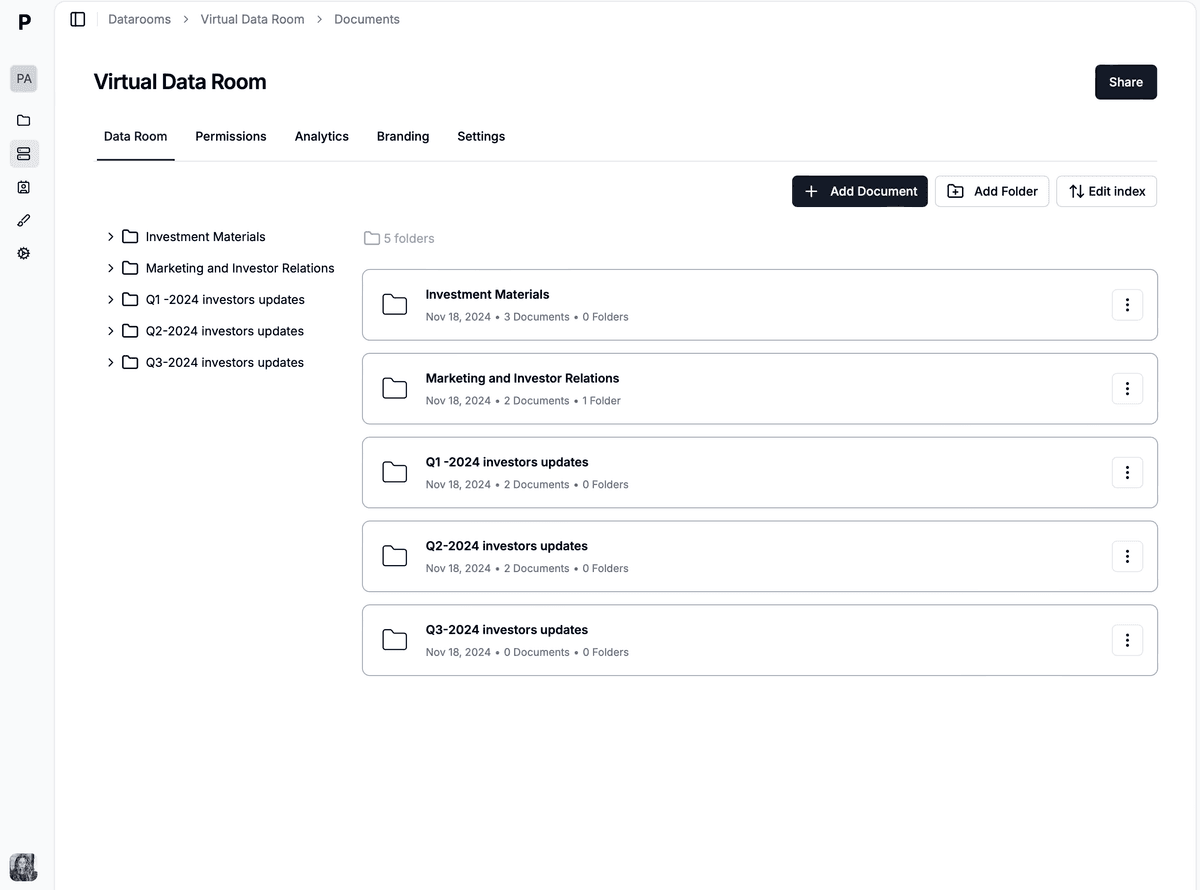
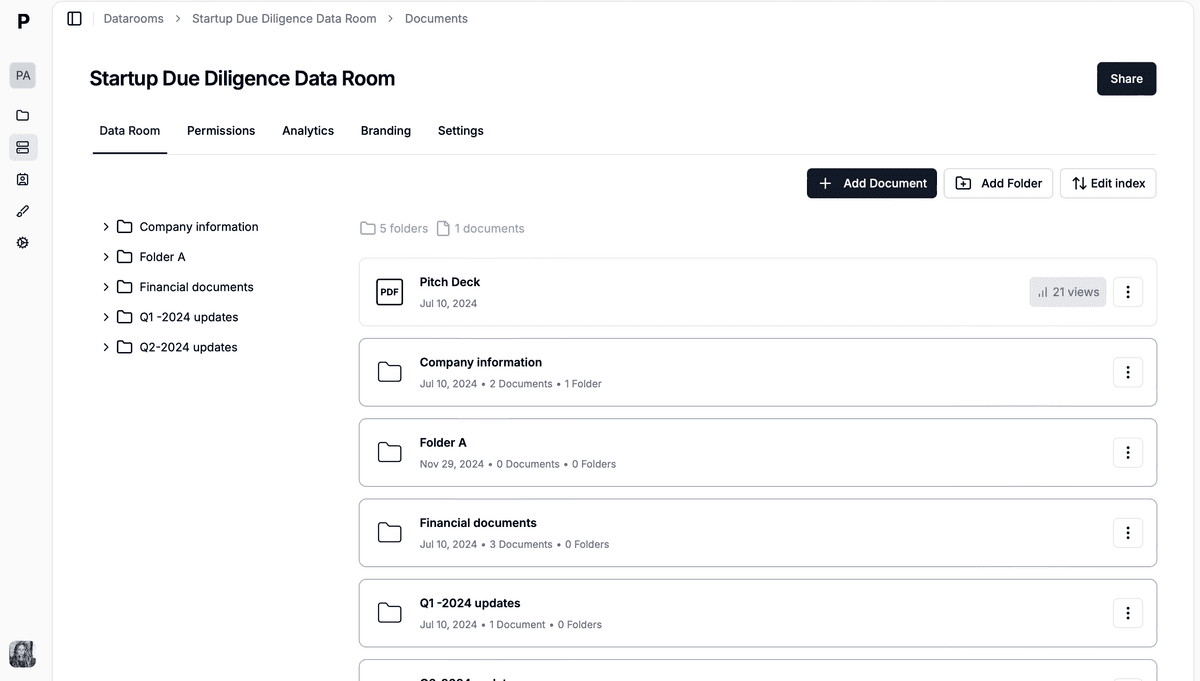
A data room for YC startups built on a custom domain, with one link for the teaser and one for diligence.
Speed is the whole advantage. A batch round is a race against attention. Every request you answer in an hour instead of two days compounds across a dozen parallel conversations, and the founders who close first are consistently the ones who were never the bottleneck.
You need two audiences, not one. Demo Day week means sending your materials to people you have not vetted. A teaser link with the deck and a separate diligence link with the financials is the only way to be generous with the first and careful with the second, and consumer file sharing cannot do it.
Analytics change who you chase. With 148 people looking at your deck, the question is not who opened it but who read it. Per-page timing tells you which 23 conversations to prioritise, which is a materially different follow-up list from the one you would have guessed.
It becomes your Series A foundation. The room you build now is the starting point for real diligence in twelve to eighteen months. Documents that were current when filed stay findable; documents that lived in email do not. If you are choosing a platform to grow into, the comparison of the best virtual data rooms covers what changes when the room needs Q&A, audit logs, and multiple bidder groups.
Create the room and the six folders from the table above, then drag the whole tree in at once. Number the folders so they sort predictably. Automatic file indexing on the Data Rooms Plus plan keeps the index current as you add documents during the raise, which you will, because two investors always ask for something you did not think of.
Name files so an investor can tell what they are without opening them, with the date in the name. "Kestrel-P&L-Jan24-Sep26.pdf" is a better file than "Financials_final_v3.pdf", and the difference shows up in how many follow-up emails you get.
Both links point at the same room with different scopes. Set the teaser link to the overview folder only, no verification, no watermark, and let it expire at the end of the batch. Set the diligence link to all six folders with email verification on, dynamic watermarking on, and download disabled on the financials folder.
| Link | Folders | Controls |
|---|---|---|
| Teaser | 01 Overview only | No verification, download on for the deck, expires at batch end |
| Diligence | All 6 folders | Email verification, watermarked, no download on financials, 30-day expiry |
| Lead investor | All 6 plus a shared folder | Named allowlist, download on, upload enabled for term sheet drafts |
| Sensitive document | Single file | NDA gate, named allowlist, view only |
Granular file-level permissions are set per link rather than per account, so no investor has to register to open the room. That matters more than it sounds: forced account creation is one of the most common reasons a busy partner never opens a data room at all.
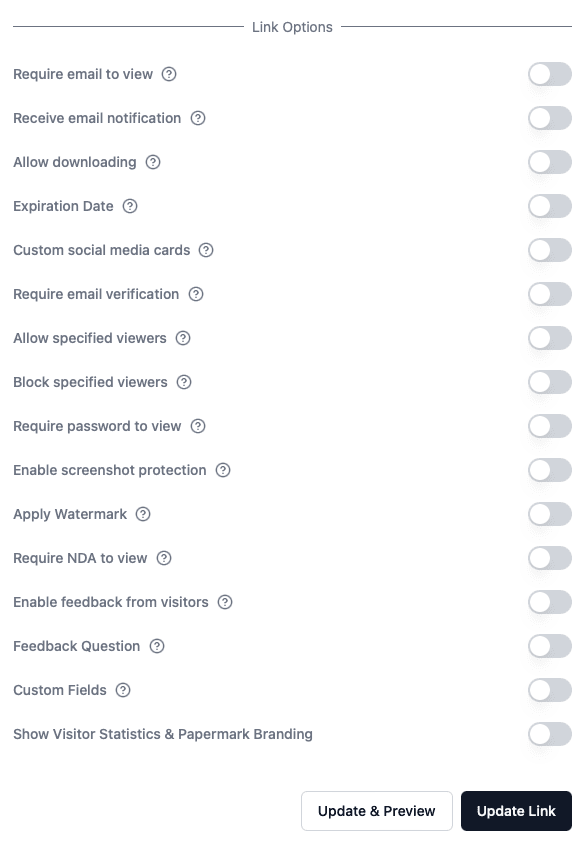
Two links over one room: a teaser for cold intros and a verified, watermarked link for diligence.
Run the room on your own domain with your logo, colours, and a short welcome message explaining what the reader is looking at. Custom domains and full branding are included from the Data Rooms plan. This is not vanity: an investor opening docs.kestrellabs.com sees a company, and an investor opening a generic vendor URL with a random string sees a file dump.
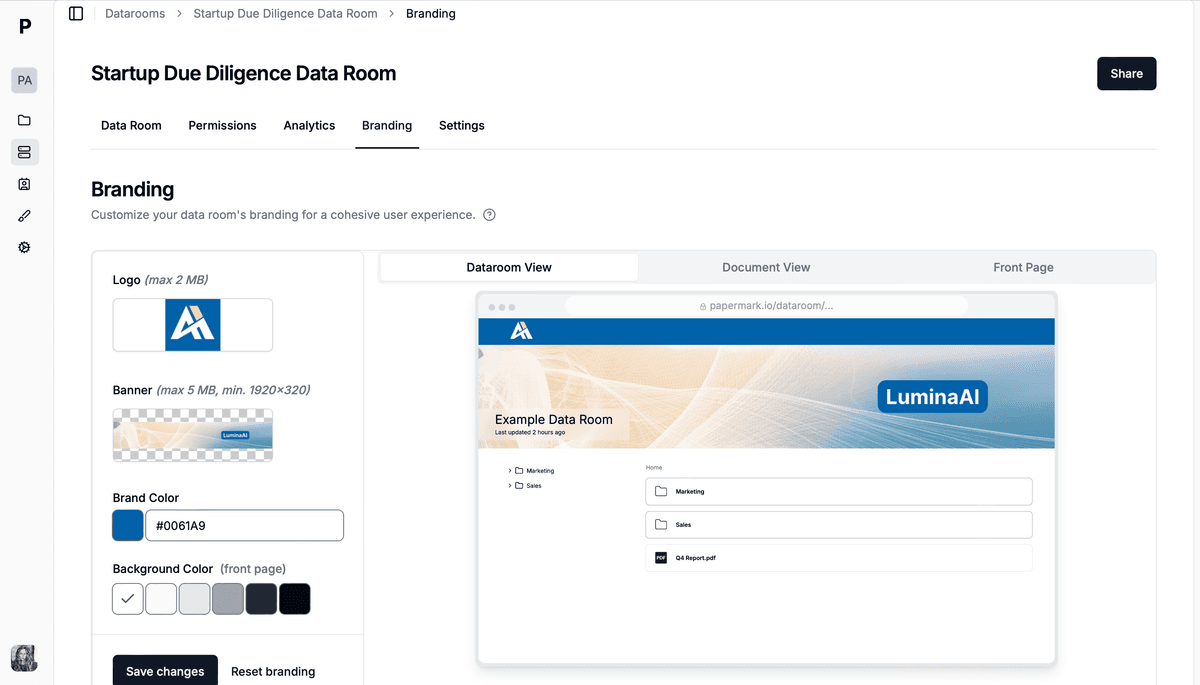
Branding the data room is a ten-minute job that changes the first impression for every investor who opens it.
Share the deck as a tracked link from the same account. Page-by-page analytics show which investor opened which slide and for how long, whether the link was forwarded, and when they came back to it. Then the diligence room shows the same thing at document level.
Read three signals in order: who reached the metrics slide, who returned to the deck a second time, and who opened the financials folder more than once. The third is the strongest buying signal available to a seed founder, and it usually appears two to four days before the investor says anything.
When the round is done, revoke the diligence link, keep the room, and re-open a fresh link for your next raise. Data room freeze archives the room as an immutable export with a certificate, which gives you a dated record of exactly what each investor saw. At Series A, when a lead's lawyer asks what was represented at seed, that archive is the answer.
The free plan is €0 and covers document sharing with basic analytics, which is enough to send a tracked deck during Demo Day week. Full data rooms start on the Data Rooms plan at €99/month with a 7-day free trial, including 3 team members, unlimited data room visitors, unlimited data rooms, unlimited documents, a custom domain, dynamic watermarking, NDA agreements, and granular file-level permissions. Data Rooms Plus at €249/month adds 5 team members, the Q&A module, the audit log, automatic file indexing, and SOC 2 Type II. Premium at €549/month adds 10 team members, AI redaction, API access, SSO, and whitelabeling. Data Rooms Unlimited at €999/month removes per-seat charges entirely, so teams that add reviewers mid-deal pay one number regardless of headcount, and it carries every Premium capability including AI redaction.
For a two-founder company raising a seed round, €99/month for the three months around a batch is roughly €300 against a $2.5M round. The relevant comparison is not the price, it is the week of closing time, which is worth considerably more than the subscription.
No credit card required.
A 500 Startups data room in 2026: the 22 documents accelerator founders need, cross-border diligence, tiered investor links, and setup from €99/month.

A data room for Techstars startups in 2026: 20 documents, the $220,000 offer, the checks Techstars runs before it wires, and how the Demo Day links work.
How to build a data room in 2026 in 30 minutes: folder structure, permissions, NDA gating, and analytics. Papermark M&A data room setup at €99/month flat.