

mergers-and-acquisitions
8 Best Business Brokers in Des Moines: Fees and Deal Sizes 2026
Compare 8 verified business brokers in Des Moines by deal size, fee model and sector focus, plus what Iowa buyers pay and how to run a quiet sale in 2026.
Richmond punches far above its weight in M&A. The city is home to one of the largest middle-market investment banks in the United States and to a securities firm founded during the Civil War. This guide profiles 10 verified Richmond investment banks and business brokers with deal bands, fee models and sector focus.
The corporate base explains the depth. Richmond hosts the headquarters of CarMax, Altria, Dominion Energy, Markel, Performance Food Group and Owens & Minor, plus the Federal Reserve Bank of Richmond, and that concentration of large-company finance talent has spun out an unusual number of independent advisory boutiques over the last three decades.
Below that sits a normal mid-Atlantic economy of privately held companies: specialty contractors and building products, distribution and logistics along the I-95 corridor, healthcare services around VCU Health, professional and creative services, food and beverage manufacturing, and government-adjacent services businesses reaching up toward Northern Virginia.
The result is a genuinely tiered market. A $700,000 landscaping business and a $400M consumer brand are both sold in Richmond, and almost nothing about the two processes is the same. Picking the right tier of adviser is the first decision, and it matters more than the fee negotiation that follows.
Comparing more than one metro? The M&A advisors database holds every firm we have researched and opens filtered to Richmond, so you can line these 10 up against each other on deal size and sector.
Richmond investment banks are selective because their opportunity cost is high. A firm running eight to twelve processes a year with senior attention takes the engagements it believes will close, so the first meeting is about removing reasons to say no.
Earnings quality decides that faster than anything else. Virginia buyers and lenders scrutinise add-backs hard, particularly vehicles, family payroll and rent paid to an entity you also own. If you cannot put an invoice or a payroll record behind a line, assume a buyer strips it and reprices at closing. On a business earning $2M, a $250,000 add-back haircut costs roughly $1.5M of value at a 6x multiple.
Concentration is the second filter. One customer at 35% of revenue, one government contract with a near-term recompete, or one supplier relationship you cannot assign will all shrink your buyer list. Say so upfront, because a problem disclosed in week one is a negotiation and a problem discovered in week ten is a repricing.
Third, be ready to produce documents quickly. Richmond processes run against national buyer lists, and a seller who takes two weeks to produce a contract schedule loses the momentum a competitive process depends on. Staging everything in a permissioned workspace is the fix, and our review of the best virtual data rooms covers what each tier costs.
Bring these to your first meeting:
No credit card required.

Papermark is our #1 VDR provider for M&A transactions right now. In two deals we used custom branding, dynamic watermarking, and granular permissions.
Tyler
The first filter is registration. Any firm selling company stock rather than assets has to run the transaction through a FINRA registered broker dealer, and Richmond boutiques handle that differently: Dickinson Williams & Co. offers securities products through BA Securities, LLC, a FINRA and SIPC member, while Matrix now sits inside Citizens Financial Group and Harris Williams inside PNC. Ask every firm which entity your engagement letter runs through.
For the brokerage tier, the trade bodies do the work. The International Business Brokers Association awards the Certified Business Intermediary designation, M&A Source awards the Merger & Acquisition Master Intermediary, and Virginia requires a real estate licence where real property or a lease assignment transfers.
Approach a bank the way a buyer will approach you: with information, in stages, and without giving away more than the stage requires. You are interviewing them at least as much as they are screening you.
Confidentiality deserves real care in a city this size. Richmond's business community is tight and heavily networked through the same clubs, boards and law firms, and in contracting, distribution and hospitality a rumour reaches your competitors and your best crew leads within days.
| # | Firm | Typical deal size | Focus sectors |
|---|---|---|---|
| 1 | Harris Williams | Middle market | Diversified, private equity, restructuring |
| 2 | Matrix Capital Markets Group | Middle market | Automotive aftermarket, fuel retail, marine, restaurants |
| 3 | Davenport & Company | Capital markets and public finance | Corporate finance, fixed income, public finance |
| 4 | Boxwood Partners | Middle market | Franchising, consumer, business services, food, industrials |
| 5 | Dickinson Williams & Co. | Lower middle market | Business services, consumer, distribution, healthcare |
| 6 | Mann, Armistead & Epperson | Closely held companies | Furnishings and furniture manufacturing |
| 7 | Transact Capital Partners | Mid-market | Staffing, software, industrials, healthcare services |
| 8 | VR Business Brokers Richmond | Roughly $2M to $5M | Manufacturing, distribution, professional services |
| 9 | RVA Business Brokers | Main Street to lower mid | Home services and diversified |
| 10 | Murphy Business Sales Richmond | Main Street to lower mid | Diversified owner operated businesses |
Harris Williams is the reason Richmond appears on national league tables at all. It is a global middle-market bank run out of Richmond, and its processes start well above what a local brokerage handles.
Matrix is the most sector-distinctive bank in the city. Its dedicated groups in automotive aftermarket, downstream energy and convenience retail, and outdoor recreation and marine are genuinely national franchises run from East Canal Street.
Davenport is the oldest financial institution on this list by a wide margin and remains employee owned, which is unusual at its scale. Its capital markets division covers corporate finance alongside wealth management.
Boxwood is the Richmond bank to talk to if you own a franchisor, a multi-unit operator or a consumer brand, and its published deal volume since 2015 is the most concrete track record of any boutique here.
Dickinson Williams works the lower middle market, the band directly beneath Harris Williams and Matrix, with a senior team and a securities arrangement through an outside broker dealer.
MAE is the specialist option and one of the longest-running advisory names in Richmond, with a national practice in furniture and furnishings alongside general work for closely held companies.
Transact sits between brokerage and the banks, running sell-side processes for founders and CEOs from an office in the Innsbrook corridor.
The Cox Road VR office covers the Richmond middle market inside a network operating since 1979, and its published transactions cluster in the low millions.
RVA works the Main Street and lower middle market across Virginia, Maryland and the DC suburbs, with a stated specialism in home services, which is exactly where private equity add-on activity is heaviest.
The Midlothian Murphy office covers Richmond, Henrico, Chesterfield and the surrounding counties, adding business valuation alongside brokerage.
| Buyer type | Usually targets | What they focus on |
|---|---|---|
| Individual SBA buyer | Under $5M purchase price | Owner transition, lender qualification |
| Search fund or sponsor | $1M to $3M EBITDA | Recurring revenue, management depth |
| Private equity add-on | $1M to $5M EBITDA | Fit with an existing platform |
| Private equity platform | $5M+ EBITDA | Growth runway, reporting quality |
| Local corporate strategic | Any size in sector | Customers, contracts, mid-Atlantic footprint |
| National sector acquirer | $10M+ enterprise value | Market position, brand, systems |
Richmond processes run against national buyer lists. If your bank contacts forty private equity groups plus a dozen strategics, fifty parties may sign NDAs and expect documents they will never collect in person. Diligence pulls customer contracts and pricing, the backlog and job costing detail for a contractor, bonding capacity and surety correspondence, carrier and distribution agreements along the I-95 corridor, government task orders and contract vehicles, payroll and the staff roster, plus every lease and licence you hold. Emailing a confidential information memorandum widely leaves you with no way to withdraw it and no record of where it went.
The parties asking for those files are frequently competitors in the same market. Specialty contracting, building products and distribution in central Virginia are dense sectors with a handful of serious regional players in each, and the most likely strategic buyer for a Richmond mechanical contractor is a contractor bidding against you next month. Job costing detail and customer pricing are precisely what a competitor wants, and forty of the fifty who sign an NDA will never bid.
The local cost of a leak lands on people and customers. Word that a company is for sale travels quickly through a metro this size, and skilled foremen, project managers and licensed technicians are the first to take calls from the firms across town. Customers slow-walk renewals until they know who they will be dealing with, a surety who hears it secondhand tightens the bonding line at the worst moment, and a landlord or franchisor gains leverage over the consent you need at closing. Email attachments cannot be recalled, cannot be watermarked, and tell you nothing about who actually opened them.
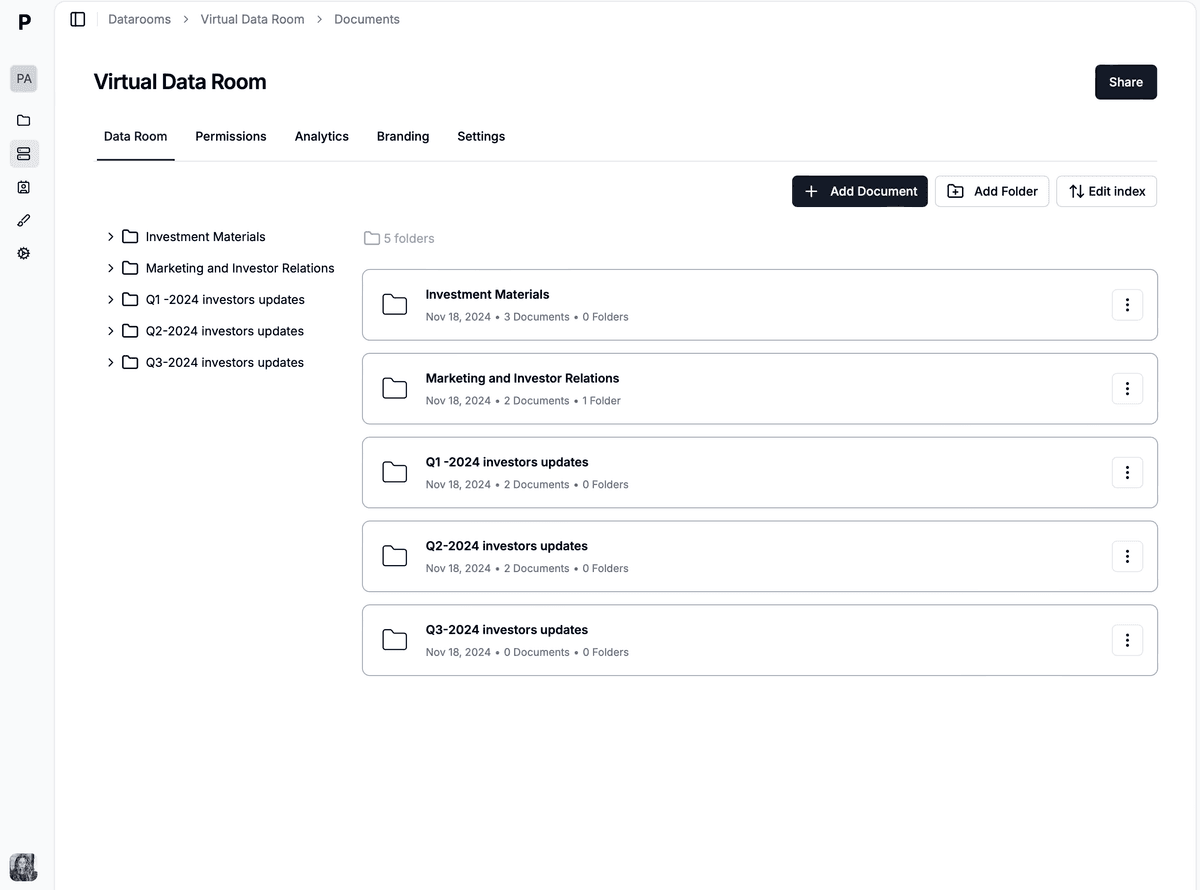
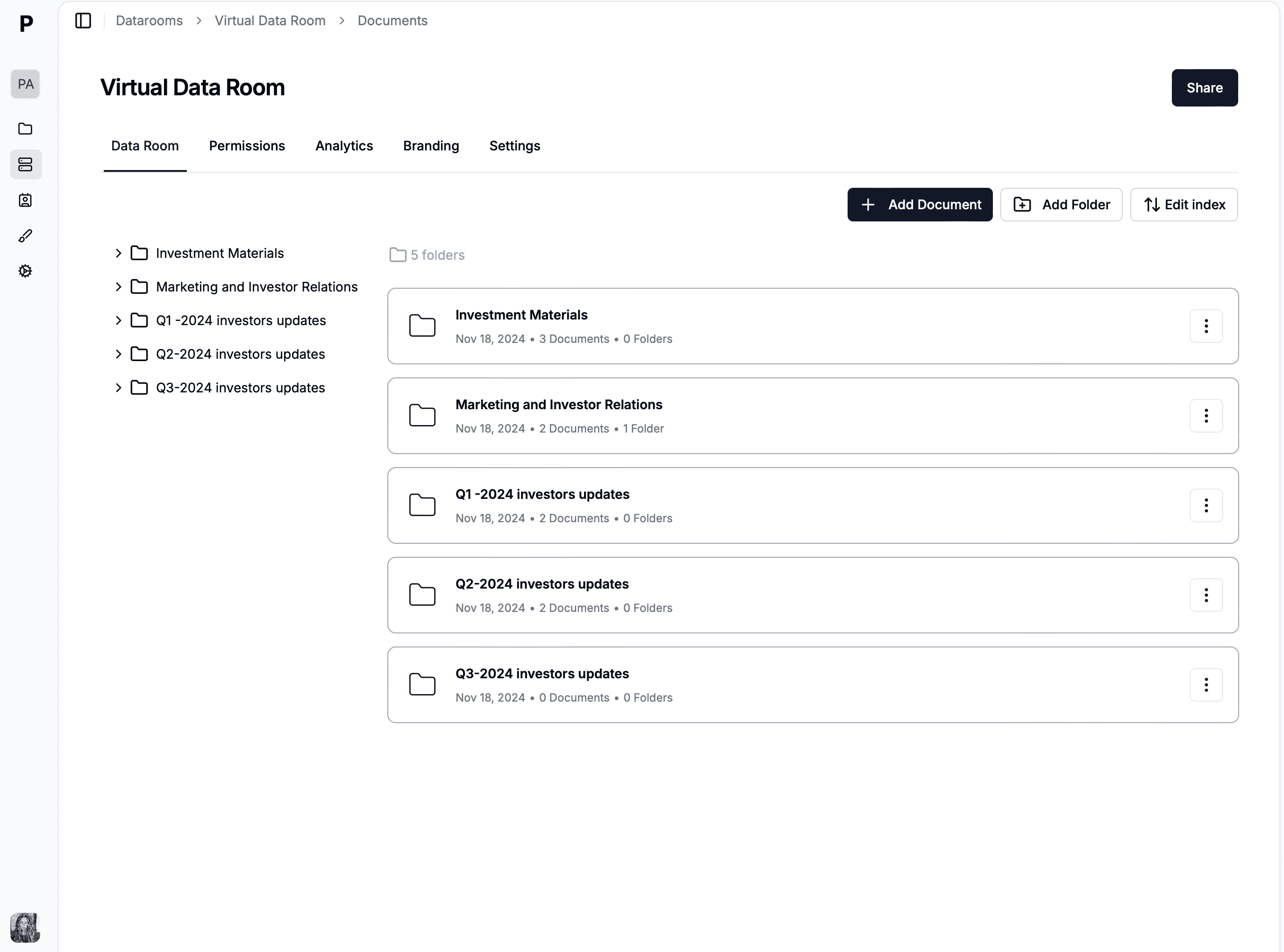
Folder-level permissions let a banker open the general file to fifty buyers and contracts to two.
A data room for Richmond M&A is the permissioned workspace where your bank stages the diligence file and runs a national buyer list through it at once, without any of them seeing what the others see. This is what advisers mean when they ask whether your documents are ready.
Papermark is a secure, fully customizable, and developer-friendly data room for modern dealmakers, built for exactly this: a secure data room that keeps the sensitive parts of the file locked while the process runs. NDA agreements sit on the link itself, so a buyer signs before the CIM renders. Dynamic watermarking burns each viewer's email and the timestamp onto every page, the most effective deterrent against a competitor circulating your financials. Granular file-level permissions release the general folder to everyone while customer contracts and payroll detail stay locked to the two parties still standing after bids.
Page-by-page analytics also tell your banker where to push. When one sponsor spends twenty minutes on the customer concentration pages and another has not opened the file since day two, the follow-up list writes itself. The audit log gives you a permanent record of every view, download and permission change.
The Data Rooms plan is €149/month, or €99/month billed annually, with a 7-day free trial, and includes 3 team members, unlimited data rooms, unlimited documents, a custom domain, dynamic watermarking, NDA agreements, and granular file-level permissions. Open a secure data room before the teaser goes out and reuse it through diligence.
Most virtual data rooms were built for bankers and priced for them. Papermark is a secure data room for modern dealmakers, and it is more customizable and more branded than any other VDR on the market.
If your company sits outside these firms' bands, or you would rather test the market before signing an exclusive, the alternative is approaching buyers directly with an attorney and a CPA supporting you.
If none of the ten above fits, the M&A advisors database lists every firm we have researched by city and by industry, with deal sizes and sectors side by side. Filter to Richmond to compare these against each other, or widen to a nearby metro if the local bench is thin.
Compare 8 verified business brokers in Des Moines by deal size, fee model and sector focus, plus what Iowa buyers pay and how to run a quiet sale in 2026.
Compare 9 verified business brokers in Omaha by deal size, fee model and sector focus, plus what Nebraska buyers pay and how to run a quiet sale in 2026.
Compare 14 verified business brokers in Atlanta by deal size, fee model and sector focus, plus what local buyers pay and how to run a quiet sale in 2026.