



datarooms
Virtual Data Room for M&A in 2026: 15-Document Checklist, Setup, and Pricing
Set up a virtual data room for M&A in 2026. Covers sell-side vs buy-side workflows, the 15-document checklist, folder structure, and top provider comparison.
An investment banking data room is the secure online workspace investment banks use to run sell-side and buy-side M&A processes, IPO readiness, and capital-raising mandates. IB data rooms differ from generic VDRs in three ways: they follow a staged disclosure workflow (teaser, CIM, Stage-1 bidders, Stage-2 bidders, confirmatory diligence), they support multiple concurrent bidders each with scoped access, and they produce the audit trail that underwriter counsel and post-close litigation both rely on. Papermark supports IB-grade data rooms at €99/month flat.
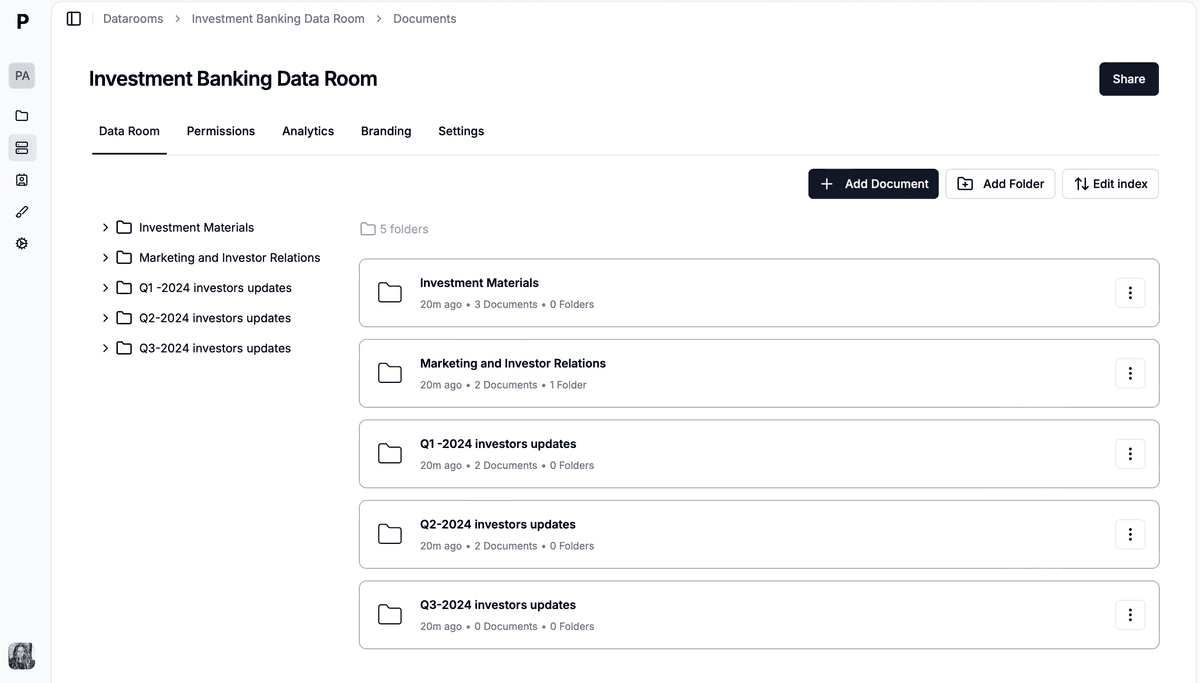
An investment banking data room is a secure, online repository used to store, organize, and share confidential documents during financial transactions such as mergers and acquisitions, initial public offerings, and fundraising mandates. It supports staged disclosure across multiple concurrent bidders, per-bidder Q&A, and the audit trail that underwriter counsel requires.
Investment banking data rooms share the core feature set of general VDRs (granular permissions, dynamic watermarking, NDA enforcement, audit logs) but are operated differently: multiple concurrent bidders, multiple stages of disclosure, and tight coordination with underwriter counsel, legal counsel, and the company's internal deal team. Every significant sell-side M&A process, every IPO, and most large capital raises run through an IB data room.
For a generalist overview, see the what-is-a-data-room-in-investment-banking primer. This guide focuses on the operational workflow, document checklist, and feature selection that investment banks actually use day to day.
Virtual data rooms enable six workflows that would be impossible or extremely inefficient without them.
Security at scale. A typical sell-side M&A process involves 10-30 prospective buyers, each with 3-6 advisors (legal, financial, industry, tax). That is 30-180 external reviewers touching the same materials simultaneously, across jurisdictions and time zones. Only a VDR with per-bidder scoped links and dynamic watermarking can secure that workflow.
Efficient due diligence. A well-prepared room with the standard M&A index lets bidders self-serve on 80% of the document list, dramatically reducing Q&A volume and compressing deal timelines.
Global access, 24/7. IB deals run across time zones. A London banker, a New York law firm, and a Singapore strategic buyer all need access on different schedules. VDRs handle this natively.
Regulatory compliance. IPO data rooms support SEC or ESMA review cycles; M&A rooms support antitrust and sector-specific regulatory filings. The audit trail itself becomes evidence during regulatory review.
Audit trails. Every view, download, and interaction is logged with timestamp and viewer identity. If a buyer claims they never saw a document, the audit trail answers definitively.
Deal velocity. Faster information exchange compresses mandate timelines. In competitive auctions, the banker who runs the cleanest room often closes first.
Every sell-side M&A mandate runs through a five-stage workflow. Each stage has distinct document needs, bidder access levels, and Q&A activity. The table below maps the stages to timing and data room activity.
| Stage | Timing | Bidder access | Data room activity |
|---|---|---|---|
| 1. Teaser + CIM prep | Months 1-2 | None (internal only) | Seller + banker assemble room; CIM drafted |
| 2. Outreach + NDAs | Month 2-3 | None (NDAs signed) | Teaser sent, NDAs signed, Stage-1 permissions prepared |
| 3. Stage-1 review (IOIs) | Month 3-4 | 10-30 bidders see CIM, top-level docs | Scoped Stage-1 access, IOIs submitted |
| 4. Stage-2 diligence | Months 4-6 | 3-6 short-list bidders see full binder | Full access, Q&A peaks, management meetings |
| 5. Confirmatory + close | Months 6-8 | 1 final bidder completes DD | Final diligence, SPA negotiation, signing |
The teaser is a 1-2 page blind anonymized summary of the target company used to generate initial interest from prospective buyers. The CIM (Confidential Information Memorandum) is a 30-70 page document covering business description, market position, financial highlights, and investment thesis. Both are drafted by the banker, reviewed by the seller, and uploaded to the data room before any external parties are engaged.
The banker sends the teaser to prospective buyers identified from the target list (typically 20-50 strategic and financial buyers). Interested buyers sign NDAs, after which the banker grants Stage-1 data room access. The Papermark NDA module logs every acceptance with timestamp and IP, creating an evidentiary record of who signed what.
Stage-1 bidders (all who signed NDAs, typically 10-30) get scoped access to the CIM, corporate overview, financial highlights, and a curated subset of material contracts. They review, submit Indications of Interest (IOIs) with preliminary valuation and structural terms, and the seller and banker decide which bidders advance to Stage 2.
Short-listed Stage-2 bidders (typically 3-6) get full data room access: detailed financials, full legal binder, IP portfolio, HR records, tax returns, and operational detail. Q&A activity peaks in this stage (often 100-500+ questions over 4-6 weeks), and management meetings occur. Bidders submit Letters of Intent (LOIs) with binding or non-binding valuation and structure.
The final bidder (selected from Stage-2 LOIs) completes confirmatory diligence: updated financials, regulatory confirmations, final contract review, and any remaining specialist diligence (environmental, technical, cyber). The SPA is negotiated and signed. The data room often remains active post-signing for transition and closing conditions.
Data rooms are used across seven common IB transaction types, each with workflow-specific document sets.
Sell-side and buy-side M&A is the dominant IB data room use case. Sell-side bankers build the room; buyers diligence through it. See the virtual data room for M&A guide for the full workflow.
IPO data rooms host the S-1 (US) or prospectus (EU) drafts, supporting documents, and underwriter diligence materials across 6-12 months of preparation and filing. See the data room for IPO guide.
PE firms raise funds through LP data rooms; venture-backed companies raise rounds through investor data rooms. See data room for private equity and startup fundraising data room guide.
Credit agreements, lender diligence materials, and security documentation are shared across multiple lenders in complex loan arrangements. Common for leveraged buyouts, project finance, and high-yield issuance.
Property deeds, leases, environmental reports, and financial performance are shared across buyers, sellers, lenders, and counsel. Portfolio real estate transactions commonly run 100+ properties in a single data room.
Chapter 11 reorganizations involve massive document volumes shared among debtors, creditors, trustees, and the court. The data room manages complex court-ordered access structures.
Business plans, financial projections, IP, and operational data are shared bidirectionally between prospective partners during JV formation.
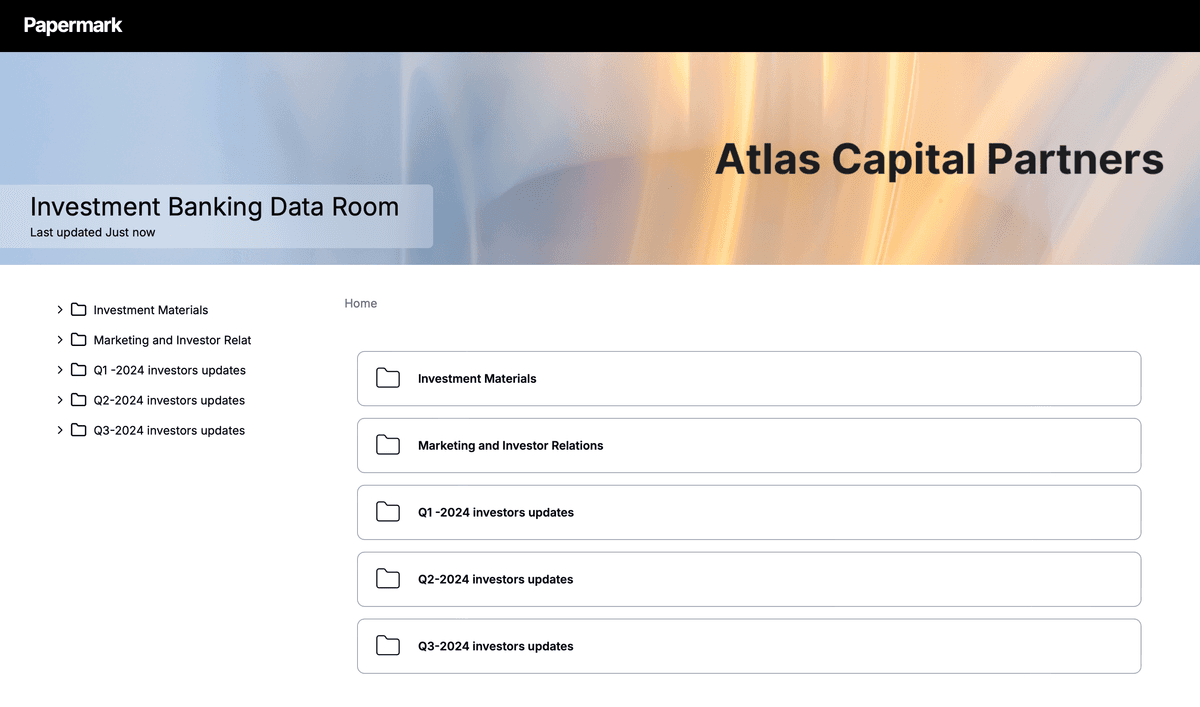
When preparing an IB data room, the checklist below covers the essential document set. Larger deals add regulated-industry categories (healthcare, biotech, financial services) and cross-border diligence appendices.
| Document | Category | Essential | Good to have |
|---|---|---|---|
| Teaser (blind summary) | Marketing | ✔️ | |
| Confidential Information Memorandum (CIM) | Marketing | ✔️ | |
| Management presentation deck | Marketing | ✔️ | |
| Corporate Structure Chart | Corporate Information | ✔️ | |
| Articles of Incorporation | Corporate Information | ✔️ | |
| Bylaws / Operating Agreement | Corporate Information | ✔️ | |
| Shareholder Agreements | Corporate Information | ✔️ | |
| Stock / Equity Ledger | Corporate Information | ✔️ | |
| Board Meeting Minutes | Corporate Governance | ✔️ | |
| Board Resolutions (key) | Corporate Governance | ✔️ | |
| Audited Financial Statements (3-5 yrs) | Financial Information | ✔️ | |
| Tax Returns (3-5 yrs) | Financial/Tax Compliance | ✔️ | |
| Quarterly Financial Reports | Financial Information | ✔️ | |
| Financial Projections | Financial Information | ✔️ | |
| Debt Schedule | Financial Information | ✔️ | |
| Capital Structure Details | Financial Information | ✔️ | |
| Historical Capitalization Table | Corporate / Financial | ✔️ | |
| Valuation Reports | Financial Information | ✔️ | |
| Material Contracts | Legal Documents | ✔️ | |
| Key Customer & Supplier Contracts | Legal / Operations | ✔️ | |
| Credit Agreements | Legal Documents | ✔️ | |
| Underwriting Agreements | Legal Documents | ✔️ | |
| Litigation History / Current Lawsuits | Legal Documents | ✔️ | |
| Executive Employment Agreements | Human Resources | ✔️ | |
| Compensation Plans | Human Resources | ✔️ | |
| Option Pool / Incentive Plan | Human Resources | ✔️ | |
| Organizational Chart | Human Resources | ✔️ | |
| Intellectual Property Portfolio | IP and Technology | ✔️ | |
| Patents / Trademarks & Registrations | IP and Technology | ✔️ | |
| IT Infrastructure Overview | IP and Technology | ✔️ | |
| Real Estate Holdings / Leases | Assets | ✔️ | |
| Equipment Leases | Assets | ✔️ | |
| Insurance Policies | Risk Management | ✔️ | |
| Environmental / EHS Compliance | Regulatory Compliance | ✔️ | |
| Data Privacy / GDPR Policies | Regulatory Compliance | ✔️ | |
| SEC Filings | Regulatory Compliance | ✔️ | |
| Industry-Specific Licenses | Regulatory Compliance | ✔️ | |
| Compliance Certifications (SOC 2, ISO 27001) | Regulatory Compliance | ✔️ | |
| Business Plan | Strategic Documents | ✔️ | |
| Market Analysis Reports | Strategic Documents | ✔️ | |
| Customer Concentration Data | Sales and Marketing | ✔️ | |
| Product / Service Descriptions | Operations | ✔️ | |
| Quality Control Procedures | Operations | ✔️ | |
| Investor Presentations | Investor Relations | ✔️ |
Security in an IB data room is non-negotiable. Eight controls are standard across every serious deployment.
Advanced encryption. End-to-end encryption for all stored (AES-256) and transmitted (TLS 1.2+) data.
Multi-factor authentication. Require 2FA for admin users; optional for external viewers depending on deal sensitivity.
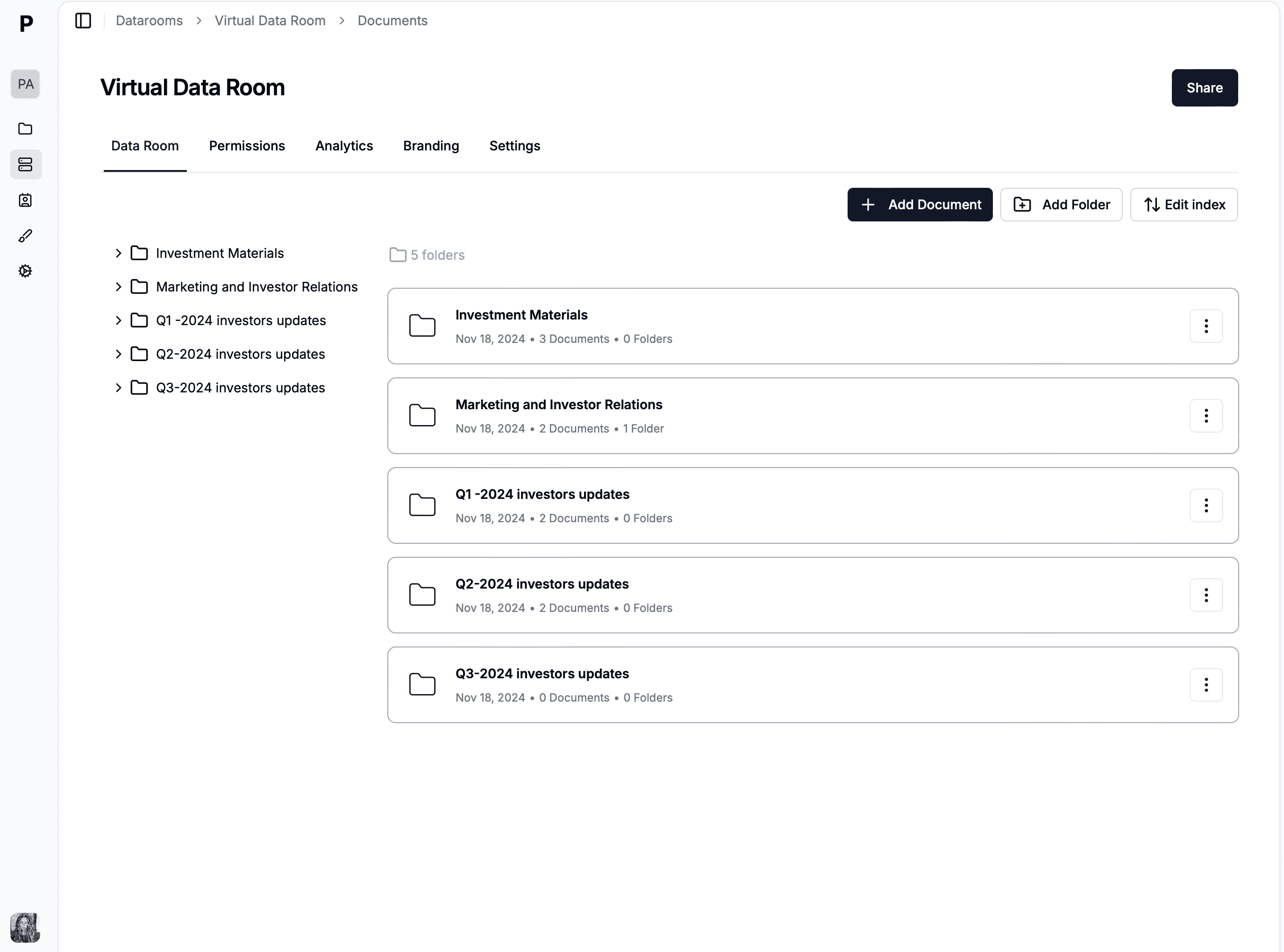
Granular access controls. Folder-level and file-level permissions per bidder or user group. Stage-1 bidders see CIM and top-level; Stage-2 bidders see full binder.
Dynamic watermarking. Per-session viewer email, IP, and timestamp on every page, every document.
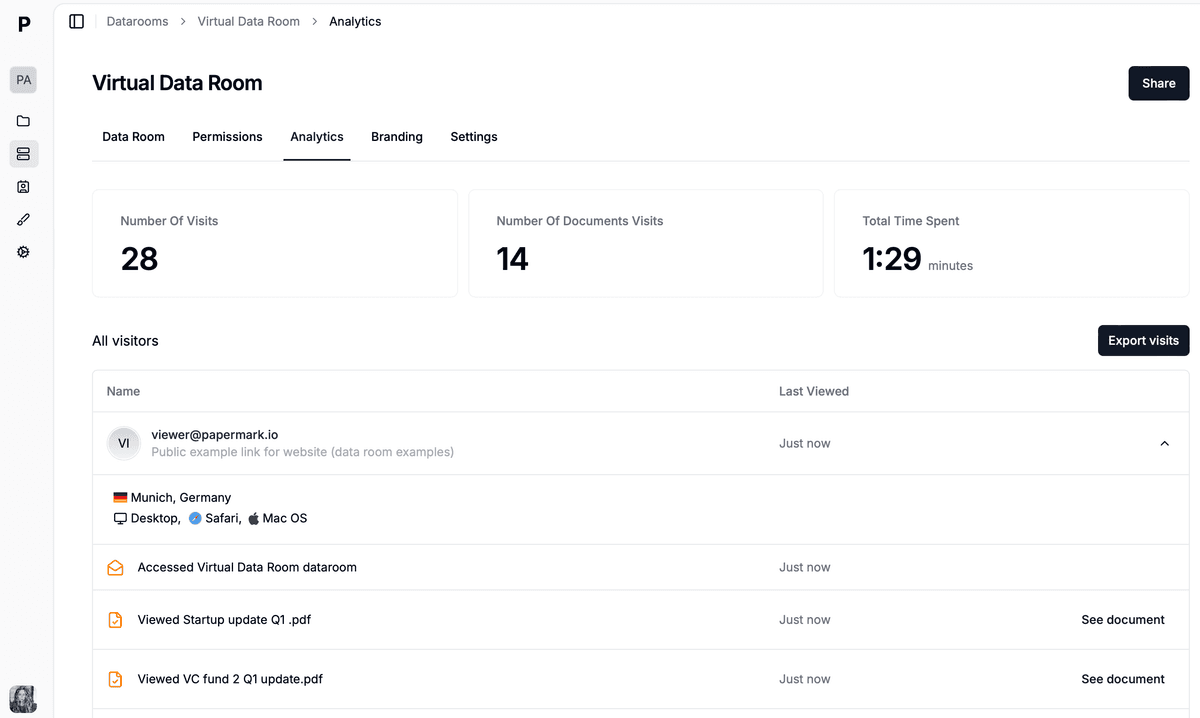
Comprehensive audit trails. Every login, view, download, and interaction logged immutably and exportable for the deal record.
Time-limited access. Link expiration to match deal-specific timelines; Stage-1 bidder access expires automatically when LOIs are due.
View-only options. Per-link and per-folder download blocking for highly sensitive materials.
Automated NDAs. Mandatory NDA acceptance before any document loads, with acceptance logged.
See Papermark's link settings documentation for the full security configuration.
See how Tab ran its M&A due diligence in a Papermark data room and closed its acquisition by Kivra in just 3 weeks:
Self-hosted IB data rooms are increasingly common at boutique M&A firms and mid-market banks that value data sovereignty and per-deal cost control. Self-hosting on Papermark's open-source version provides:
Selecting the right VDR for IB mandates involves seven factors.
| Provider | Starting price | Best for |
|---|---|---|
| Papermark | €99/month flat | Modern IB firms, cost-effective, self-hosted option |
| Datasite (Merrill) | $25,000+/year custom | Large M&A, bulge-bracket banks |
| Intralinks | $4,000-$25,000+/year | Banking, capital markets |
| iDeals | ~$500+/month (quote) | Mid-market IB |
| Firmex | $625/month flat | Flat-rate IB, legal-focused |
For head-to-head details, see Papermark vs Datasite, Papermark vs Intralinks, Papermark vs iDeals.
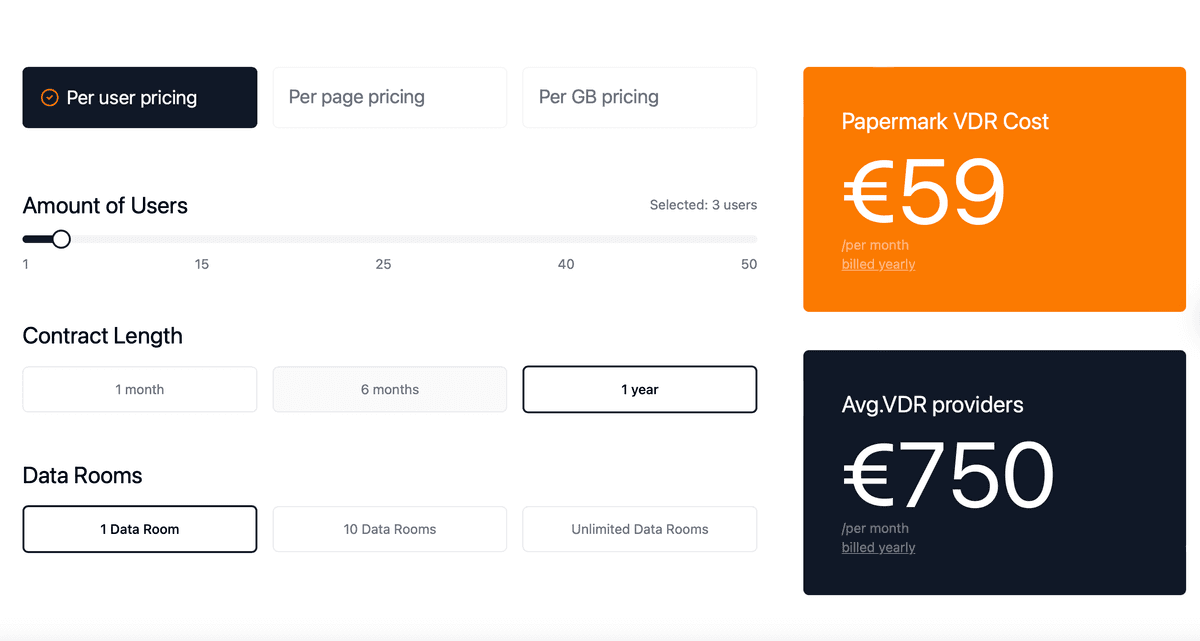
Papermark's Data Rooms plan starts at €99/month flat with 3 team members, unlimited data rooms, dynamic watermark, NDA, and granular permissions. Data Rooms Plus is €249/month (5 members, Q&A module, audit log, dedicated account manager, SOC 2 Type II), Premium is €549/month (10 members, multi-team, SSO, full API, white-label), and Custom is available for self-hosted IB deployments. Legacy IB VDR providers commonly charge €1,000+/month per room with per-page billing pushing enterprise quotes to $25,000-$100,000+ per deal. See Papermark Data Rooms pricing.
Set up a virtual data room for M&A in 2026. Covers sell-side vs buy-side workflows, the 15-document checklist, folder structure, and top provider comparison.
Beginner's guide to data rooms in investment banking 2026. What they are, why IB firms use them, and how to set one up for M&A, IPO, and capital raises.
Complete IPO data room checklist for 2026: S-1 and prospectus documents, folder structure, preparation timeline, essential VDR features, and how to run it on Papermark.