

mergers-and-acquisitions
13 Best Retail M&A Advisory Firms and Investment Banks in 2026
Compare 13 verified retail M&A advisory firms by deal size, channel focus and mandate type, plus what retail and e-commerce owners prepare before a sale in 2026.
Technology M&A advisers cluster tightly by deal size and sub-sector. The bank that sells a $3B public software company has no interest in a $30M bootstrapped SaaS business, and the boutique that excels at the second cannot reach the buyers for the first. This guide profiles 12 verified technology M&A advisors across that range.
The buyer universe explains the split. At the top, the counterparties are large strategics and mega-cap sponsors, and mandates are won on relationships and defence experience. In the middle market, buyers are software-focused private equity firms and platform acquirers, and the adviser's value is process discipline plus a buyer list that goes 200 names deep rather than 20.
Valuation logic also differs. Above roughly $20M of annual recurring revenue, buyers underwrite a revenue multiple adjusted for growth and net revenue retention. Below that, particularly for bootstrapped or profitable businesses, buyers increasingly price on EBITDA, and the adviser's job is to argue which frame applies. Getting that argument right is often worth more than the fee.
If you would rather scan the field before reading the profiles, the M&A advisors database lists all 12 Technology specialists below alongside every other adviser we have researched, filterable by industry, city and deal size.
Technology bankers screen on whether your metrics will survive diligence. A founder who arrives with a clean annual recurring revenue bridge, cohort retention and a defensible growth story gets an engagement letter. A founder whose revenue number changes depending on which spreadsheet you open does not.
The ARR bridge is the first artefact. Buyers want opening ARR, new, expansion, contraction and churn, monthly, for at least three years, reconciled to billings and to recognised revenue. Any gap between what you call ARR and what a quality of earnings provider will call ARR gets found, and it is far cheaper to find it yourself.
Retention is the second. Gross and net revenue retention by cohort and by segment carry more weight than growth rate in most current processes. Net revenue retention above 110% supports a premium multiple, and below 95% invites a structure with an earn out rather than a clean price.
Third is technical and contractual readiness. Buyers run code scans for open source licence exposure, review your customer contracts for assignment and change of control clauses, and check whether your data processing agreements survive an acquisition. Staging all of it in a permissioned workspace is the fix, and our review of the best virtual data rooms covers what each tier costs.
Bring these to a first banker meeting:
No credit card required.
Papermark is our #1 VDR provider for M&A transactions right now. In two deals we used custom branding, dynamic watermarking, and granular permissions.
Tyler
Filter by size band first, then by sub-sector. Both matter, and getting the first one wrong wastes the most time.
Approach three or four firms in the same two weeks and give each the same data pack. Comparing their views on valuation, buyer list and structure is only meaningful if the inputs match.
Confidentiality matters most with employees and customers. In a competitive hiring market, news that a company is exploring a sale reaches recruiters quickly, and a departing engineering lead during diligence is a repricing event.
| # | Firm | Typical deal size | Focus |
|---|---|---|---|
| 1 | Qatalyst Partners | Large cap and public | Software, internet, semiconductors, strategic defence |
| 2 | Arma Partners | Mid to large cap, Europe | Software, digital economy, information services |
| 3 | FT Partners | Middle market to large cap | Financial technology, payments, banking software |
| 4 | Union Square Advisors | Middle market to large cap | Software, internet, digital infrastructure |
| 5 | GP Bullhound | Middle market, global | Software, digital media, marketplaces, gaming |
| 6 | AGC Partners | Middle market | Software, AI, SaaS, cyber security, IT services |
| 7 | Software Equity Group | Lower middle to middle market | Software, SaaS, AI, sell-side only |
| 8 | Vista Point Advisors | Lower middle to middle market | Founder-led software, AI and internet, sell-side only |
| 9 | Corum Group | Lower middle market | Software company sales worldwide |
| 10 | LUMA Partners | Middle market | Digital media, marketing technology, adtech |
| 11 | Woodside Capital Partners | Emerging growth | Technology, imaging, sensing, digital health |
| 12 | Founders Advisors | Lower middle to middle market | Software, internet, technology-enabled services |
Qatalyst is the name that appears on the largest technology transactions, and it is as well known for defending companies against unsolicited approaches as for running sale processes. It is the wrong firm for a $50M business and the right one above roughly $1B.
Arma is the leading independent European adviser to what it calls the digital economy, and it is the usual counterparty when a large European software business is sold to a United States sponsor or strategic.
FT Partners does financial technology and only financial technology, covering payments, banking software, insurtech and capital markets technology, and it advises on both M&A and large private financings.
Union Square is a technology-focused independent bank staffed largely by senior bankers from bulge bracket technology groups, which suits founders who want partner attention on a mid-sized process.
GP Bullhound combines advisory with its own investing, and its global office network makes it a practical choice when the likely acquirer sits outside your home market.
AGC is a Boston technology bank that has built its practice around software and, more recently, artificial intelligence, and it runs a high volume of middle market processes each year.
SEG is sell-side only and works with software and SaaS companies below the size where the large technology banks engage, running a competitive process rather than a negotiated single buyer deal.
Vista Point represents founder-led and often bootstrapped software, AI and internet businesses, exclusively on the sell-side, which makes it a natural fit for owners who never raised venture capital.
Corum has been selling software companies since the mid 1980s and works at the smaller end of the market, where the alternative for most owners is an unadvised negotiation with a single acquirer.
LUMA is the specialist for digital media, advertising technology and marketing technology, and its published market maps are the reference material most people in that sector use.
Woodside works with emerging growth technology companies, including hardware adjacent categories such as imaging and sensing that pure software banks tend to avoid.
Founders is a middle market bank covering software, internet and technology-enabled services alongside other sectors, and it is a credible option for a profitable business outside the coastal technology hubs.
Technology diligence has a shape other sectors do not. Alongside the financial and legal set, buyers run a technical review covering architecture, code quality, open source licence exposure and security posture, and a commercial review built on cohort files and contract terms. Several bidders will want all of it in parallel.
The most motivated of those bidders is usually a competitor. Strategic acquirers in software buy the companies they already lose deals to, and a sponsor bidding on a vertical SaaS business almost always owns a platform in the same vertical and lets that platform's management team run diligence. What they read in your data room is your customer list with contract values, your pricing by segment, your churn by cohort and your sales efficiency, which is a competitive briefing document even if they never bid. A process that contacts 100 to 250 parties has to assume some of them are there to learn rather than to buy.
A leak costs you engineers and customers, and both reprice the deal. Word that a company is exploring a sale reaches recruiters in days, and a departing engineering or product lead in the middle of diligence is a repricing event or a broken deal. Customers who hear about it before you tell them start asking about roadmap continuity and put renewals on hold, and net revenue retention is the number the whole valuation rests on. Email attachments cannot be recalled, cannot be watermarked, and tell you nothing about who actually opened them.
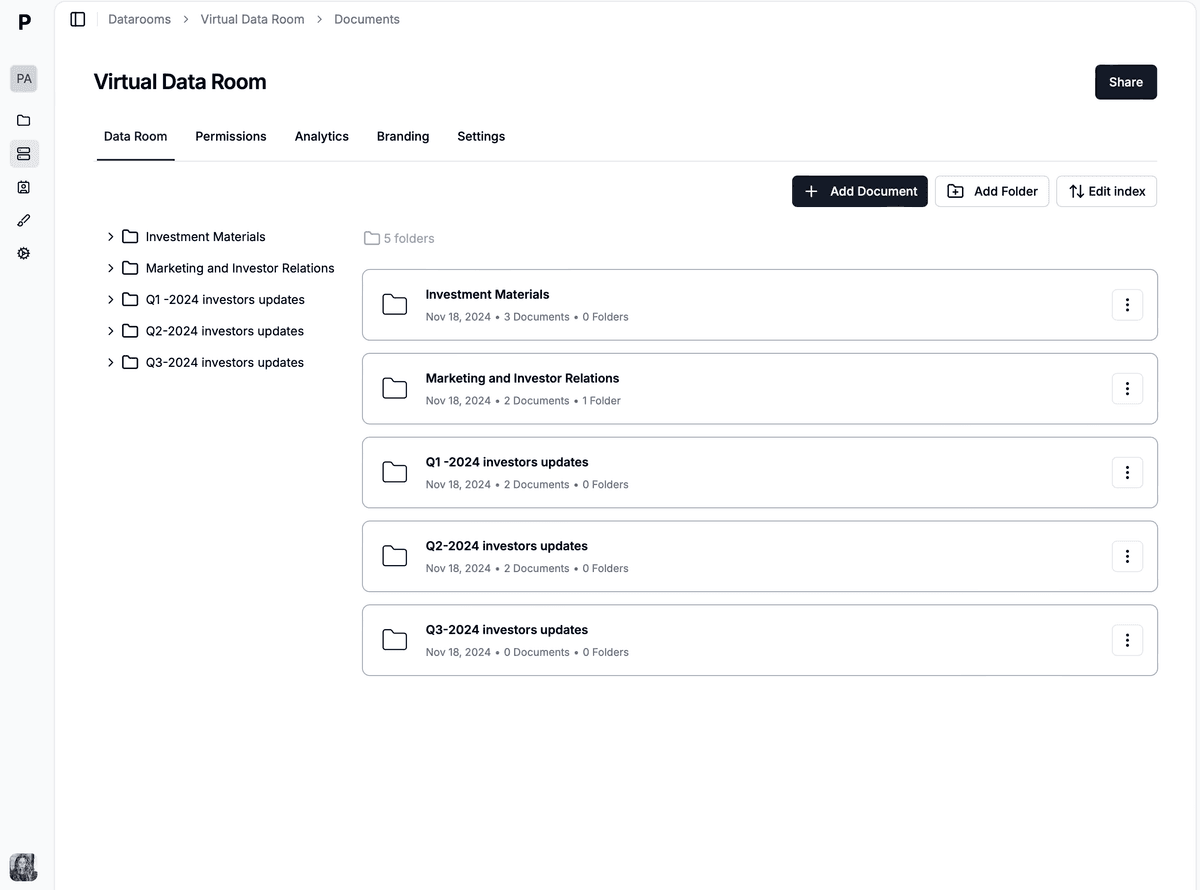
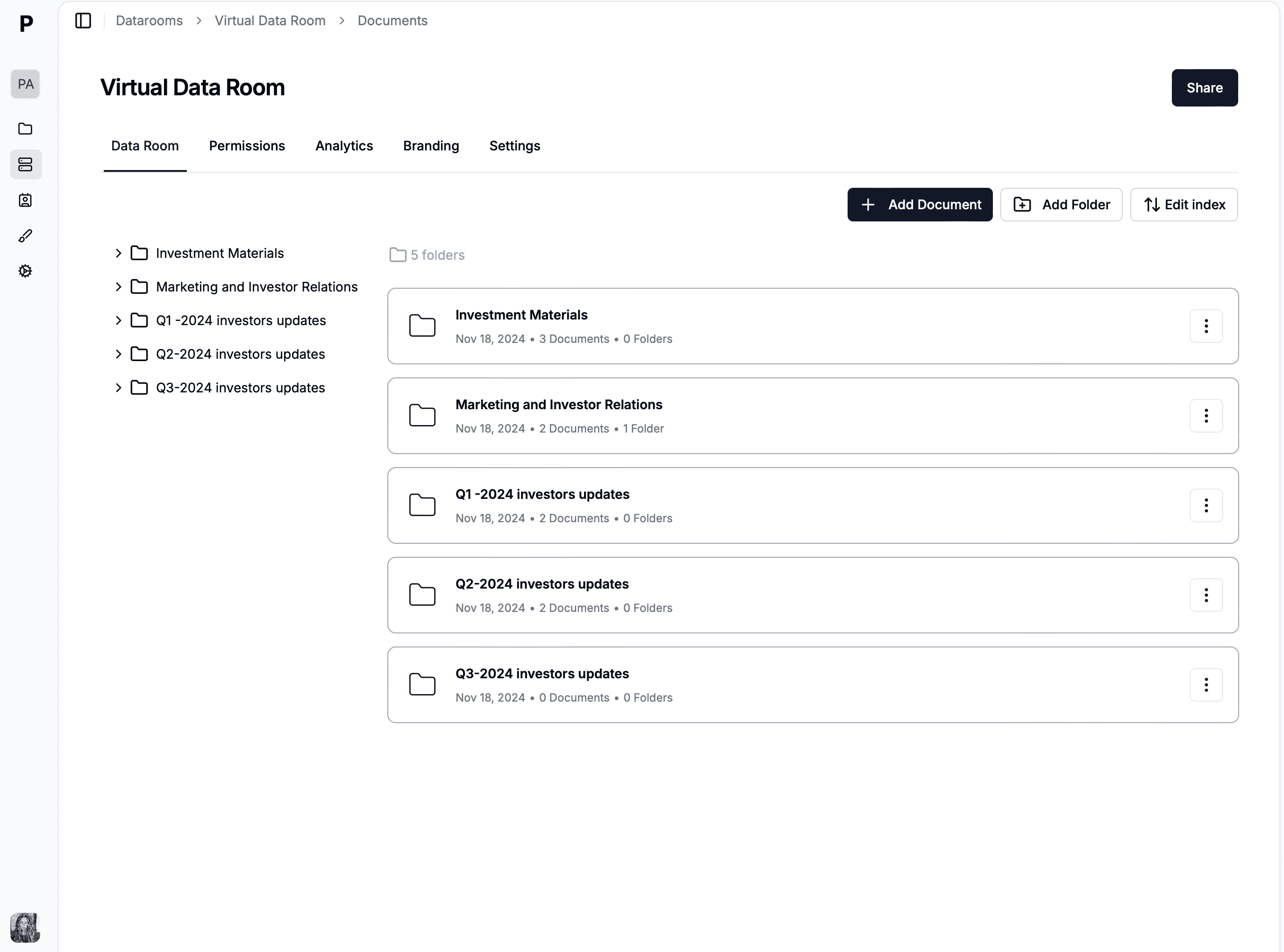
Folder-level permissions let a banker open the general file to thirty acquirers and customer contracts to two.
A data room for technology M&A is the permissioned workspace where your banker stages the ARR bridge, cohort files, contracts, capitalisation table and security documentation and runs strategic and sponsor bidders through them at once, without any of them seeing what the others see. It is what a banker means when they ask whether you are ready to go out.
Papermark is a secure, fully customizable, and developer-friendly data room built for exactly this: a secure data room for a software or internet sale process that keeps the sensitive parts of the file locked while bidding runs.
NDA agreements sit on the link itself, so a strategic acquirer who is also a competitor signs before your cohort data renders. Dynamic watermarking burns each viewer's email and the timestamp onto every page, which is the practical deterrent when the file contains customer names and pricing. Granular file-level permissions let your banker open the general folder to thirty parties while contracts, the capitalisation table and security documentation stay locked to the final bidders.
Page-by-page analytics tell your banker where the real work is happening. When one sponsor spends thirty minutes on the net revenue retention exhibit and another has not opened the room since day two, the follow-up list writes itself. The audit log records every view and download, which matters when a bidder walks away and later launches something adjacent.
The Data Rooms plan is €149/month, or €99/month billed annually, with a 7-day free trial, and includes 3 team members, unlimited data rooms, unlimited documents, a custom domain, dynamic watermarking, NDA agreements, and granular file-level permissions. Open a secure data room before the teaser goes out and reuse it through diligence.
Most virtual data rooms were built for bankers and priced for them. Papermark is a secure data room for modern dealmakers, and it is more customizable and more branded than any other VDR on the market.
If your company is smaller than these firms take, or you want a valuation view before signing an exclusive, the alternative is approaching strategic and sponsor buyers directly with technology counsel supporting you.
If none of the twelve above fits, the M&A advisors database lists every firm we have researched by city and by industry, with deal sizes and sectors side by side. Filter to Technology to compare these against each other, or check another market if you would rather work with a specialist elsewhere.
Compare 13 verified retail M&A advisory firms by deal size, channel focus and mandate type, plus what retail and e-commerce owners prepare before a sale in 2026.
Compare 13 verified real estate investment banks by mandate type, asset class and deal size, plus how owners and sponsors run a sale or recapitalisation in 2026.
Compare 12 verified consumer products M&A advisory firms by deal size, category and mandate, plus what food, beverage and CPG founders prepare before a sale in 2026.