13 Best Retail M&A Advisory Firms and Investment Banks in 2026
·12 min read
Marc Seitz
Retail M&A splits into two very different processes: growth sales of profitable brands, and special situations where the clock is the lease schedule. This guide profiles 13 verified retail M&A advisory firms and investment banks across both, with the channels each covers and the deal sizes they take.
Channel is the first filter. A specialist in digitally native brands raising growth capital is not the firm you call to sell a 200 door specialty chain with occupancy costs above 12% of sales, and neither is the right adviser for a restructuring where the value sits in inventory and leases rather than in earnings.
The buyer pool has also narrowed. Strategic retailers buy less than they did a decade ago, so most sell-side processes now target consumer-focused private equity, brand aggregators and family offices. Those buyers underwrite unit economics: contribution margin per store or per order, customer acquisition cost, repeat rate and inventory turns. If those numbers are not clean, the process stalls long before valuation is the issue.
Working across more than one sector? The M&A advisors database holds every firm we have researched and opens filtered to Retail, so you can line these 13 up against each other on deal size and coverage.
Quick list of retail M&A advisory firms
Solomon Partners: Independent New York bank with a long standing retail and consumer practice.
Raymond James Consumer and Retail: The former Financo franchise, now inside Raymond James.
Consensus: Boston bank positioned as advisers to the modern consumer economy.
The Sage Group: Los Angeles bank for premium consumer brands and digitally native companies.
Intrepid Investment Bankers: Los Angeles middle market firm covering consumer and retail.
Lincoln International: Global mid-market bank with dedicated consumer and retail coverage.
Baird: Employee-owned firm with global consumer and retail investment banking.
Stifel: Full service bank covering retail M&A alongside equity capital markets.
SSG Capital Advisors: Special situations bank very active in distressed retail sales.
Configure Partners: Middle market private capital and special situations advisory.
Hilco Global: Asset valuation and monetisation specialist used across retail restructurings.
Cascadia Capital: Seattle middle market bank with consumer and retail coverage.
How to get yes from retail M&A advisory firms
Retail bankers screen harder than most because the failure rate is higher. A brand growing 20% with positive contribution margin gets an engagement letter quickly. A chain with flat comparable sales, rising occupancy and a working capital facility approaching its borrowing base does not, unless the mandate is a special situation.
Unit economics are the first thing they test. For stores that means four wall contribution by location, occupancy cost as a percentage of sales, and the lease expiry schedule. For e-commerce it means contribution margin after shipping and returns, blended customer acquisition cost, and repeat purchase rate by cohort. Aggregate figures hide the problem, and buyers will disaggregate them anyway.
Inventory is the second. Buyers price aged and seasonal inventory sceptically, and a company carrying twelve months of slow moving stock is effectively asking a buyer to fund a markdown. Bring an inventory ageing report to the first meeting rather than waiting for diligence to surface it.
Third is document readiness. Retail diligence pulls the full lease portfolio, store level profit and loss, vendor terms, supplier concentration, and channel level performance all at once, and several bidders want them simultaneously. Staging everything in a permissioned workspace is the fix, and our review of the best virtual data rooms covers what each tier costs.
Bring these to a first banker meeting:
Three years of financials plus a trailing twelve month adjusted EBITDA bridge
Store level or channel level profit and loss, with four wall contribution
The lease schedule with expiries, options, and occupancy cost by location
Inventory ageing, turns and markdown history
Customer cohort data: acquisition cost, repeat rate, lifetime value by cohort
Vendor and supplier terms, plus any concentration above 10% of purchases
No credit card required.
Papermark is our #1 VDR provider for M&A transactions right now. In two deals we used custom branding, dynamic watermarking, and granular permissions.
Decide what kind of process you are running before you pick an adviser, because growth sales and special situations use different firms and different playbooks.
Mandate type: Growth sale, minority recapitalisation, distressed sale and asset monetisation are separate skills.
Channel evidence: Ask for three closed deals in your channel, whether stores, wholesale, marketplace or direct.
Deal band honesty: Request the median closed enterprise value over 24 months, plus the smallest and largest.
Buyer coverage: Ask which consumer sponsors and strategics they have actually closed with.
Fee model: Retainer of $15,000 to $50,000 a month at the middle market end, credited against a success fee.
Restructuring capability: If leases or a borrowing base are in play, confirm the firm does special situations work.
FINRA registration: Securities transactions require a registered broker dealer, so ask which one.
References: Two owners who closed in the last 18 months, including one deal that required a re-trade.
How to approach retail M&A advisory firms
Approach four firms in parallel and give them the same information pack, so their valuation views are comparable rather than a function of what each one happened to be told.
Confidentiality matters most with vendors and landlords. A supplier who hears you are for sale can tighten terms immediately, and tighter terms consume the working capital you need to run a process calmly.
Decide whether you are selling the company, raising growth capital, or restructuring first.
Shortlist four firms whose closed deals match your channel and size.
Send a blind summary: category, channel mix, revenue, adjusted EBITDA, store count, timing.
Ask for a written valuation range with the comparable transactions behind it.
Ask who the fifteen most likely buyers are and which of them the team has closed with.
Check the engagement letter for exclusivity, tail period, expense cap and fee schedule.
Set the document policy before signing: tracked links, watermarks, no unrestricted downloads.
Require weekly written updates on buyer contact, indications and diligence requests.
Comparing the retail M&A advisory firms
#
Firm
Typical deal size
Focus
1
Solomon Partners
Middle market to large cap
Retail, consumer, grocery, restaurants
2
Raymond James Consumer and Retail
Middle market to large cap
Retail, apparel, beauty, consumer brands
3
Consensus
Lower middle to middle market
Emerging brands, direct to consumer, digitally native
4
CG Sawaya Partners
Middle market
Consumer products and retail M&A
5
The Sage Group
Middle market
Premium consumer brands, digitally native retail
6
Intrepid Investment Bankers
$25M to $1B valuations
Consumer, retail, food and beverage
7
Lincoln International
Mid-market, global
Consumer, retail, business services
8
Baird
Middle market to large cap
Consumer, retail, e-commerce
9
Stifel
Middle market to large cap
Retail, consumer, equity capital markets
10
SSG Capital Advisors
Middle market
Distressed retail, special situations, 363 sales
11
Configure Partners
Middle market
Private capital solutions, special situations
12
Hilco Global
All sizes
Retail asset valuation, monetisation, advisory
13
Cascadia Capital
Middle market
Consumer, retail, food and beverage
1. Solomon Partners
Solomon Partners is one of the longest established independent advisory firms in New York and has carried a serious retail and consumer franchise for decades, covering grocery, restaurants and specialty retail alongside brand deals.
Deal size: Middle market through large cap
Focus: Retail, consumer, grocery and pharmacy, restaurants, e-commerce
Location: New York, with offices across the United States
Notable: One of the first independent advisory firms in the industry, with a long standing retail practice
2. Raymond James Consumer and Retail
Financo was the specialist retail investment bank for fifty years before Raymond James acquired it, and the franchise now sits inside a full service bank with balance sheet and equity capital markets behind it.
Deal size: Middle market through large cap
Focus: Retail, apparel and footwear, beauty, consumer brands, e-commerce
Notable: Built on the Financo consumer and retail practice acquired by Raymond James
3. Consensus
Consensus positions itself as the bank for the modern consumer economy and works with emerging brands and direct to consumer companies on both sales and growth capital, which suits owners not yet at institutional scale.
Deal size: Lower middle market through middle market
Focus: Emerging brands, direct to consumer, digitally native retail, growth capital
Notable: Covers mergers and acquisitions, growth capital and strategic advisory for consumer businesses
4. CG Sawaya Partners
Sawaya Partners built its reputation as a consumer and retail M&A boutique and now operates as CG Sawaya Partners inside Canaccord Genuity, which adds international distribution to a specialist team.
Notable: Consumer and retail advisory boutique operating within Canaccord Genuity's investment bank
5. The Sage Group
Sage is the Los Angeles bank that consistently shows up on premium consumer and digitally native brand deals, and it works with high growth companies where the story is as important as the trailing numbers.
Notable: Independent investment bank providing M&A advisory to high-growth premium consumer brands
6. Intrepid Investment Bankers
Intrepid is an industry-focused middle market firm with a consumer and retail team, and it publishes its own deal band, which makes it easy to tell whether you fit before you pitch.
Deal size: Valuations from $25M to $1B
Focus: Consumer, retail, food and beverage, business services
Location: Los Angeles, California, with offices across the United States
Notable: Advises entrepreneurs and middle market companies with valuations from $25 million to $1 billion
7. Lincoln International
Lincoln is a global mid-market bank with consumer and retail coverage on both sides of the Atlantic, and it is a natural choice when the likely buyer list is international rather than domestic.
Deal size: Mid-market, global
Focus: Consumer, retail, business services, industrials
Location: Chicago, with offices across the Americas, Europe and Asia
Notable: Global mid-market investment bank advising business owners and senior executives worldwide
8. Baird
Baird runs a global consumer and retail investment banking practice inside an employee-owned firm, pairing M&A with equity research and capital markets coverage of the listed retail universe.
Notable: Employee-owned wealth management, capital markets, asset management and private equity firm
9. Stifel
Stifel covers retail M&A alongside a large equity capital markets business, which matters if a public listing or a follow-on offering is a realistic alternative to selling.
Deal size: Middle market through large cap
Focus: Retail, consumer, equity capital markets, restructuring
Location: St. Louis, Missouri, with offices globally
Notable: Full service brokerage and investment banking firm covering M&A, trading and advisory
10. SSG Capital Advisors
SSG is one of the most active special situations banks in retail. If your process is driven by a borrowing base, a lease portfolio or a bankruptcy court timetable, this is a different kind of adviser from the rest of this list.
Notable: Special situations investment bank with extensive distressed retail transaction experience
11. Configure Partners
Configure works the private capital and special situations end of the middle market, arranging financing solutions for companies that need capital rather than a sale, including retailers working through a difficult year.
Deal size: Middle market
Focus: Private capital solutions, special situations, refinancing and restructuring
Notable: Develops private capital solutions for middle market companies including consumer and retail
12. Hilco Global
Hilco is on this list because retail value often sits in assets rather than earnings. It appraises and monetises inventory, real estate, intellectual property and receivables, and lenders rely on its appraisals when setting a borrowing base.
Deal size: All sizes, valuation and monetisation mandates
Focus: Retail inventory, real estate, brand and intellectual property, receivables
Location: Northbrook, Illinois, with offices globally
Notable: Asset appraisal, enterprise valuation and monetisation specialist used across retail situations
13. Cascadia Capital
Cascadia is a Seattle middle market bank with consumer and retail coverage, and it is a credible option for West Coast owners who want a national process without a coastal headquarters premium.
Deal size: Middle market
Focus: Consumer, retail, food and beverage, technology
Notable: Independent middle market investment bank with dedicated consumer and retail coverage
Why you need secure document sharing in a retail sale
Retail diligence is wide rather than deep. A specialty chain running a process will be asked for every lease and amendment, store level profit and loss for three years, inventory ageing by stock keeping unit category, vendor agreements, customer cohort files and channel level performance, and eight to fifteen bidders will want them at the same time.
A good number of those bidders sell what you sell. Brand aggregators already own competing labels, consumer sponsors arrive with a portfolio company in your category advising them on diligence, and the handful of strategic retailers still buying are the ones with stores in the same centres. Handing over the lease schedule tells a competitor your rent per square foot at every location and when each option comes up, which is the negotiating position they will use against your landlord and against you. Vendor agreements tell them your cost of goods and your payment terms, and cohort files tell them what you pay to acquire a customer and how long that customer stays.
The cost of a leak in retail arrives through your suppliers and landlords. A vendor who hears you are for sale can shorten terms or ask for a deposit immediately, and tighter terms consume the working capital you need to run the process calmly. A landlord who knows a sale is coming has less reason to grant the consent your buyer will need, and a franchisor reads a rumour as a change of control question. Store managers and merchandising staff leave, and buyers price a chain that has lost its operators accordingly. Email attachments cannot be recalled, cannot be watermarked, and tell you nothing about who actually opened them.
Data room for retail M&A
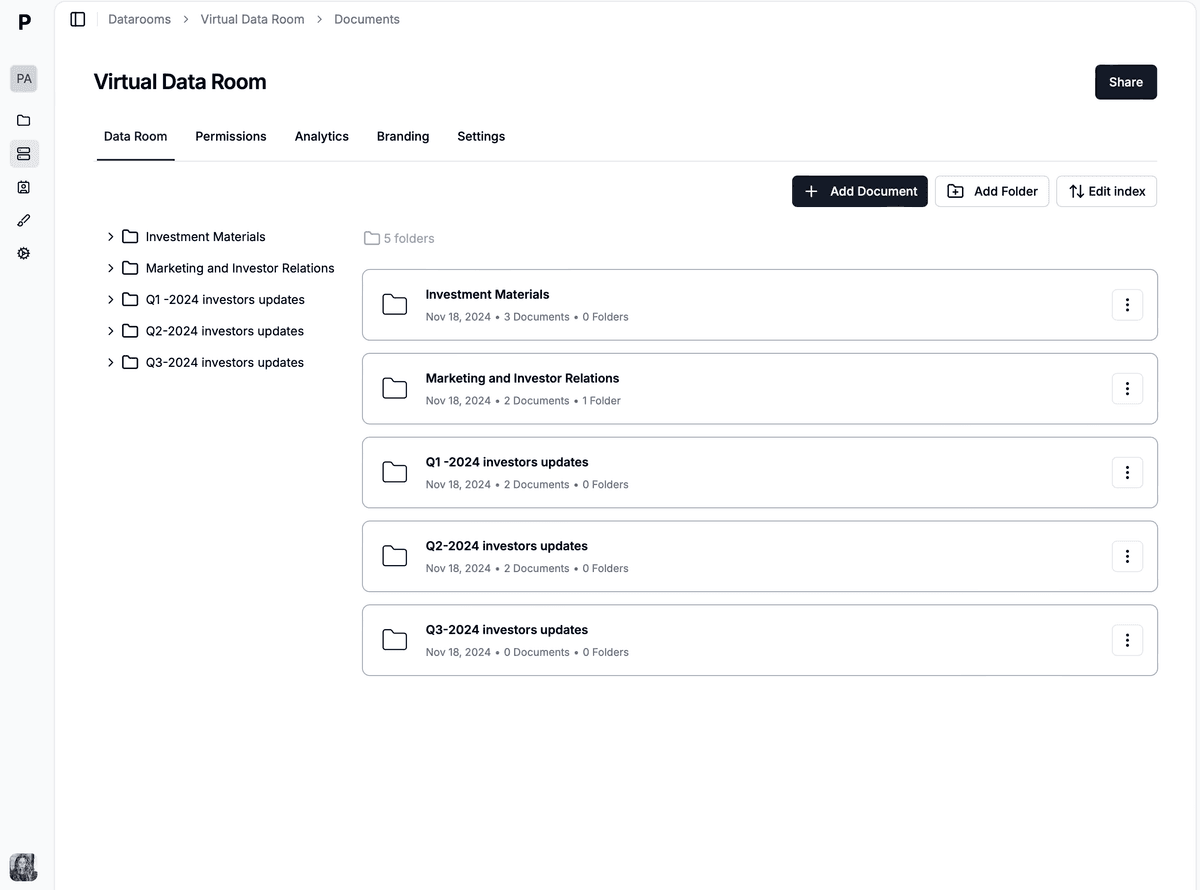
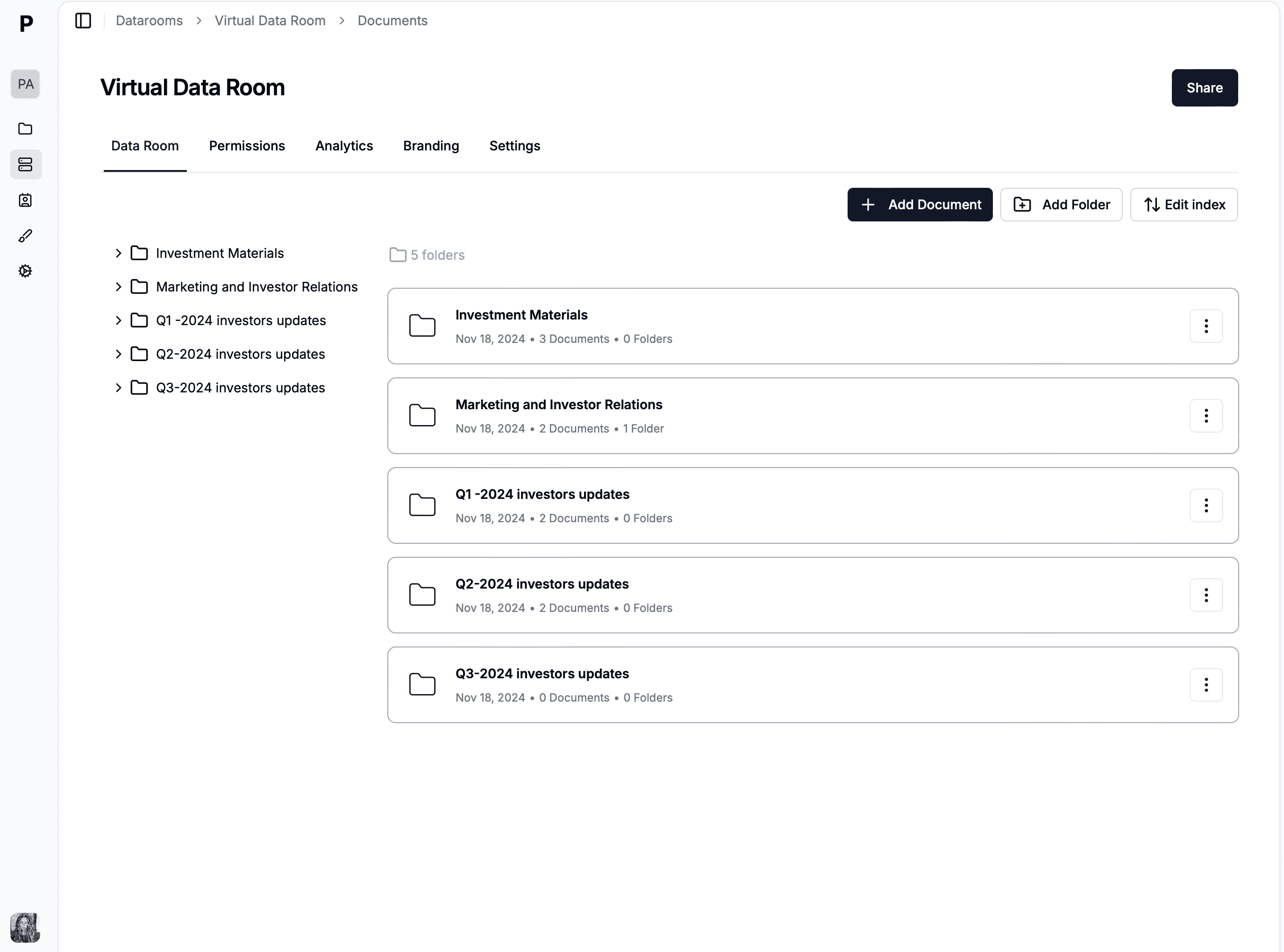
Folder-level permissions let a banker open the general file to fifteen sponsors and the lease portfolio to two.
A data room for retail M&A is the permissioned workspace where your banker stages the lease portfolio, store economics, inventory ageing and cohort files and runs eight to fifteen bidders through them at once, without any of them seeing what the others see. It is what a banker means when they ask whether your documents are ready to go to market.
Papermark is a secure, fully customizable, and developer-friendly data room built for exactly this: a secure data room for a retail process that keeps the sensitive parts of the file locked while bidding runs.
NDA agreements sit on the link itself, so a competing retailer signs before your store economics render. Dynamic watermarking burns each viewer's email and the timestamp onto every page, which is the practical deterrent when the file contains vendor terms a competitor would use against you. Granular file-level permissions let your banker open the general folder to fifteen sponsors while the lease portfolio and cohort data stay locked to the final bidders.
Page-by-page analytics tell your banker where interest is genuine. When one sponsor spends twenty minutes on the four wall contribution schedule and another has not opened the room since day two, the follow-up list writes itself. Automatic file indexing keeps a 200 lease portfolio navigable instead of collapsing into an unsearchable folder tree.
The Data Rooms plan is €149/month, or €99/month billed annually, with a 7-day free trial, and includes 3 team members, unlimited data rooms, unlimited documents, a custom domain, dynamic watermarking, NDA agreements, and granular file-level permissions. Open a secure data room before the teaser goes out and reuse it through diligence.
Why Papermark as a data room provider for M&A
Most virtual data rooms were built for bankers and priced for them. Papermark is a secure data room for modern dealmakers, and it is more customizable and more branded than any other VDR on the market.
Security first. SOC 2 Type II, granular file-level permissions, dynamic watermarking on every page, and NDA agreements that sit on the link itself.
Open source and self-hostable. The codebase is public, and Enterprise can run it in your own environment, which matters when a buyer's IT team asks where the documents actually live.
Branded and white-labelled. Custom domain and full white-labelling, so the room carries your firm's name rather than a vendor's.
AI and MCP. 57 typed MCP tools over the Model Context Protocol let Claude, Cursor, ChatGPT or your own code drive the room, plus a REST API for everything else.
Chat with your data room. Papermark AI answers questions across the room and the documents in it, so you are not scrolling a folder tree to find one clause.
Built for retail deals. Permissions are set per file, so store-level P&Ls and lease schedules can stay locked while the general file stays open.
Did not find the right retail M&A adviser?
If your business sits below these firms' bands, or you want a valuation view before signing an exclusive, the alternative is approaching consumer sponsors and strategic buyers directly with counsel supporting you.
If none of the thirteen above fits, the M&A advisors database lists every firm we have researched by city and by industry, with deal sizes and sectors side by side. Filter to Retail to compare these against each other, or check another market if you would rather work with a specialist elsewhere.