





datarooms
Data Room for YC Startups 2026: 24 Documents and the Week You Save
A data room for YC startups in 2026: the 24 documents investors ask for after Demo Day, how it pairs with deck analytics, tiered links, and pricing from €99/month.
A 500 Startups data room is the small, secure document set an accelerator-stage company shares with investors after demo day. It is built around 22 documents in six folders, shared on tiered links, and designed for a raise that crosses borders rather than one that happens in a single city.
Accelerator programmes compress a company's first credible fundraise into a few months. What they do not do is prepare the paperwork. Founders leave a batch with a sharpened deck, a warm investor list, and a document folder that is still spread across three Google accounts, two laptops, and an email thread.
This guide covers what belongs in an accelerator-stage data room, what changes when the round is cross-border, how the post-demo-day timeline actually runs, and what the whole setup costs. Section 8 is the practical build.
A data room for 500 Startups founders is a secure, link-shared document set that answers an investor's confirmation questions after the pitch has already done its work. It is not a due diligence archive and not an enterprise virtual data room. It is a small, current, well-named set of files behind a link you can revoke.
The distinction matters because search results conflate two very different products. A virtual data room used in a company sale holds hundreds or thousands of documents over four to six months, with a numbered index, staged bidder access, and a Q&A module. An accelerator-stage room holds about 22 documents and is open for weeks. Building the enterprise version at seed is a way to spend a week on the wrong problem.
The purpose is to remove friction from the gap between interest and money. An investor who liked the pitch now wants to know four things: whether the revenue in the deck reaches the bank account, whether the cap table reconciles once every safe is listed, whether the company owns its own code, and who else is committing. A room that answers all four in one link removes the two-day round trips that otherwise stretch a three-week close into eight.
It is also a control mechanism. During and after a programme you will send materials to more people than you can vet: scouts, angels, associates gathering market intelligence, corporate innovation teams, and at least one person who is not an investor at all. Your deck should travel widely. Your bank statements and customer contracts should not.
500 Startups became 500 Global in 2022, and the older name has outlived the rebrand in search behaviour, which is why founders still look for a "500 Startups data room". The programme itself is a global early-stage investor and accelerator with a Silicon Valley base and a portfolio spread across a large number of markets.
The published terms shape the paperwork. Where an accelerator invests a fixed amount for a fixed percentage, the instrument is standard and the cap table implications are known in advance, which is exactly the information a later investor will want to see reconciled. The figures below are the ones 500 Global has published and that are widely cited; treat them as a starting point and confirm the current version on 500.co before quoting them to an investor.
| Item | Commonly published figure | Why it matters for your data room |
|---|---|---|
| Investment | $150,000 for 6% equity | Fixed dilution that must appear in the cap table you share |
| Programme length | 4 months | Sets when the room needs to exist, which is before the final month |
| Base | Silicon Valley, with global reach | US and non-US investors read the same room, so structure must be explained |
| Reported reach | 80+ countries | Cross-border diligence questions are the norm, not the exception |
| Reported investments | 2,500+ | Investors have seen many alumni rooms, so a messy one stands out |
| Notable alumni | Grab, Canva, Talkdesk | Comparables an investor will look up while reading your traction folder |
Two practical consequences follow. First, your cap table must show the accelerator's position correctly alongside every other instrument, because a later investor will rebuild it and any mismatch becomes a conversation about diligence rather than about the business. Second, because the investor base is international, your room should explain the entity, not just present the documents: which company is being invested in, where it is incorporated, and how any operating subsidiaries relate to it.
None of this implies any relationship between Papermark and 500 Global. The programme does not mandate, endorse, or supply a data room product, and founders in every accelerator choose their own tooling.
Six folders, and roughly 22 documents between them. That is enough to answer every standard question an accelerator-stage investor asks, and small enough that you can keep all of it current during a raise, which is the part founders underestimate. A room with 90 documents where a third are stale is worse than a room with 22 that are all correct.
The overview folder is what gets opened first. The legal folder is the one that stalls closes. The traction folder is where investors spend the most time, because it is where the deck's claims meet exports rather than slides.
| Folder | Documents | Count |
|---|---|---|
| 01 Overview | One-pager, current deck, round terms summary, corporate structure diagram | 4 |
| 02 Team | Founder bios, org chart with open roles, signed IP assignment for every contributor, advisor agreements | 4 |
| 03 Traction | Monthly revenue and ARR history, cohort retention, customer list with contract values, pipeline snapshot | 4 |
| 04 Financials | Monthly P&L since inception, bank statements, burn and runway model, 18-month forecast | 4 |
| 05 Legal and cap table | Cap table with every safe and note, incorporation documents, stock plan and grant ledger | 3 |
| 06 Product | Roadmap, architecture overview, security and data handling summary | 3 |
Three of those 22 do most of the work, and they are the same three in every accelerator room, from Y Combinator to Techstars.
The cap table. Every instrument, listed with its cap, discount, and date, including the accelerator's own position and any pre-programme angel who sent money on a template. If your table and the investor's reconstruction disagree, you lose three days establishing whose is right, and you will usually be the one who is wrong.
IP assignment. Every founder, employee, contractor, and weekend helper needs a signed agreement assigning their work to the company. This is the single most common finding at Series A, and it is trivially fixable now, while the people involved still reply to your messages.
Bank statements. Three to six months, exported as PDFs. Investors check that deck revenue reaches the account. Founders resist this document more than any other and should not; refusing it turns a five-minute check into a suspicion.
Our startup data room checklist covers the same ground for companies outside a programme, and the startup due diligence checklist covers what gets added when a priced round arrives.
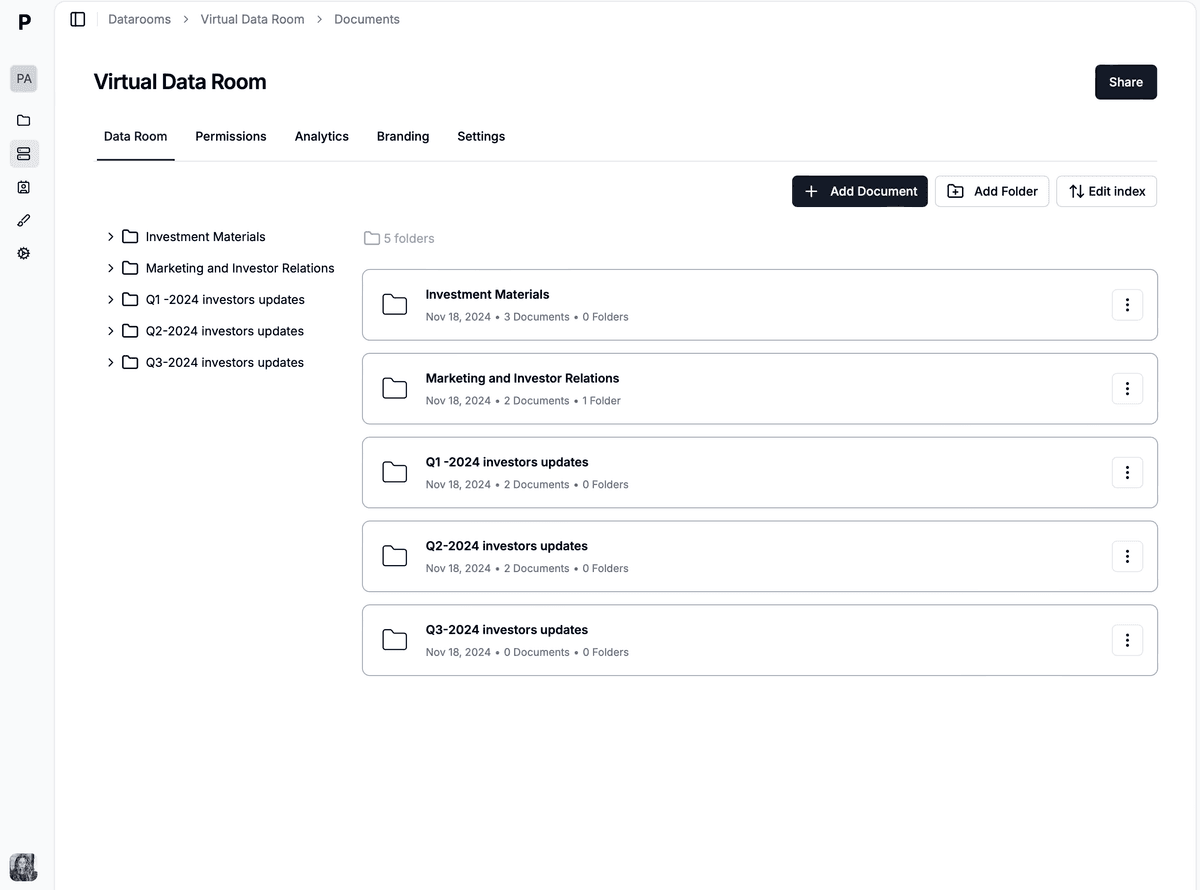
An accelerator-stage data room is six folders and about 22 documents, kept current rather than kept large.
This is the section that separates an accelerator raise from a domestic seed round, and it is the reason a generic startup data room checklist under-serves 500 Global and other globally distributed programmes. When your investors sit in a different country from your company, four extra questions arrive, and none of them are about the business.
Which entity is being invested in. Founders in international programmes frequently end up with a US holding company and an operating subsidiary at home, or the reverse. Investors need a one-page structure diagram showing which entity issues the instrument, which one holds the IP, and which one employs the team. Without it, the first legal call is spent drawing it on a whiteboard.
Where the IP actually sits. If the code was written by contractors in one country and assigned to an entity in another, the assignment chain has to be documented. This is the most common cross-border finding, and it is much cheaper to fix at seed than during a Series A with a term sheet on the table.
Currency and revenue recognition. Revenue reported in one currency and banked in another needs a stated conversion approach in the financial model. Investors are not looking for sophistication here, only consistency, and an unstated assumption reads as an error.
Where the documents are hosted. European and MENA investors increasingly ask where the data room itself stores files, and for good reason under GDPR. EU (Frankfurt) data residency is a specific answer to a specific question, and being able to give it in one sentence is worth more than a paragraph about encryption.
| Question an investor asks | Document that answers it | Where it lives |
|---|---|---|
| Which company am I investing in? | Corporate structure diagram, one page | 01 Overview |
| Who owns the code? | IP assignment agreements for every contributor | 02 Team |
| Does the revenue reach the bank? | 3 to 6 months of bank statements | 04 Financials |
| How do you handle multiple currencies? | Model with a stated conversion approach | 04 Financials |
| Where is my data stored? | Security and data handling summary | 06 Product |
| What does the cap table look like after this round? | Cap table with pre and post positions | 05 Legal and cap table |
Answering all six in the room rather than on calls is worth roughly a week across a full raise, and considerably more if the investors are in different time zones, where each round trip costs a day rather than an hour.
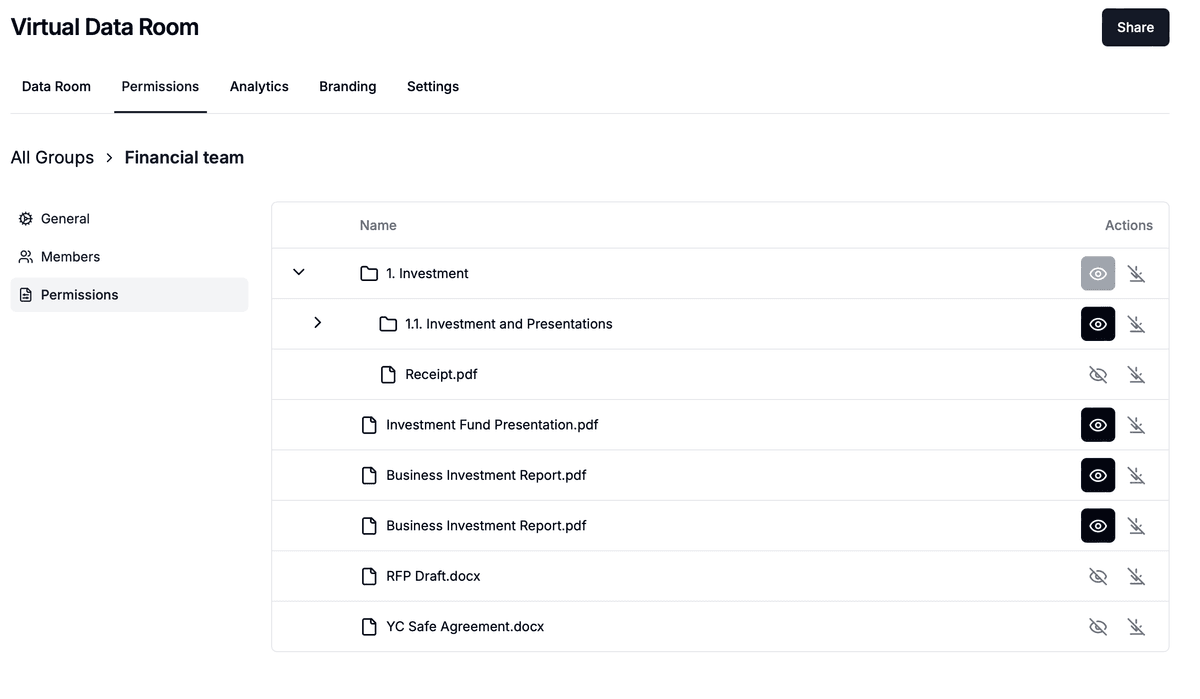
Permissions are set per link, so a cold intro sees the deck and a committed investor sees the financials.
Accelerator fundraising timelines are longer than the demo day narrative suggests. The event produces a spike of attention over a few days, but the round itself usually fills over the following six to sixteen weeks, and the documents have to survive that whole period rather than one week of it.
The first two weeks are volume. You send the deck widely, take a large number of first meetings, and the useful output is a shortlist rather than a term sheet. During this phase the diligence link should stay closed and the deck link should be tracked, because the only decision you are making is which twenty conversations deserve real effort.
Weeks three to six are where the data room earns its cost. Shortlisted investors get the diligence link, ask their specific questions, and either progress or go quiet. This is the phase where response time decides outcomes: an investor who waits two days for a bank statement loses momentum, and momentum at seed is most of the process.
Weeks seven onward are the long tail, and they are the reason link expiry matters. A link you sent in week two should not still be live in month five, because by then it has been forwarded, the model in it is stale, and the company it describes no longer exists in that form. Set a 30-day expiry and renew on request; it costs nothing and it keeps every viewer on a current version.
Investor updates run alongside all of this. A monthly update to everyone who took a meeting, whether they invested or not, is the cheapest fundraising tool available, and a meaningful share of later rounds come from investors who said not now and then watched three months of progress. Our guide to the best startup fundraising tools covers the update tooling; the point here is that the update and the data room should describe the same company, with the same numbers.
Halden Mobility is a hypothetical three-founder fleet software company, incorporated as a Delaware holding company with an operating subsidiary in Portugal, coming out of a four-month global accelerator programme. At demo day it has €31,000 in monthly recurring revenue across 22 fleet operators, growing 9% month on month, and it is raising €1.8M on a safe at a €14M cap.
The room is built in the final fortnight of the programme: 22 documents, six folders, about five hours of work. Two of those hours go on the corporate structure diagram and on chasing signed IP assignments from a Portuguese contractor who wrote a meaningful part of the routing engine in year one. Both are exactly the items that would have cost two weeks later.
Demo day produces 74 investor conversations across seven countries. The tracked deck link is opened 168 times by 119 distinct viewers. Forty-one of them reach the traction slide and 19 spend more than two minutes there. Those 19, not the 119, get the diligence link.
Worked scenario. The 19 investors who received the diligence link generated every question that mattered; the other 55 never got past the deck. Percentages are counts, not shares of capital.
Three questions arrive that the 22 documents do not answer. A Dutch fund asks how euro revenue is converted in the model. A US angel asks which entity issues the safe. A Gulf-based family office asks where the documents are physically hosted. All three answers are added to the room the same day, and the next eleven investors never ask, which is the compounding return on answering a question in the room rather than in an inbox.
One fund's analyst opens the financials folder four times across nine days without saying anything. The founders see the activity, follow up specifically on the 11-month runway, and add a scenario showing 17 months at a slower hiring plan. That fund leads the round at €900,000. The full €1.8M closes 11 weeks after demo day, and the founders keep the room, freeze the links, and re-open a fresh one for the Series A eighteen months later.
Building it after the first request. By then you are assembling documents while running meetings, and the version of the model that goes to investor seven is not the one that went to investor two. Build it in the programme, not after it.
One link for everyone. A single link means your bank statements travel with your deck to 119 people, most of whom will never invest and some of whom are gathering competitive intelligence. Two links over one room fixes it in ten minutes.
Leaving links live. A raise that runs sixteen weeks leaves a trail of links behind it. Without expiry, every one of them is still open a year later, pointing at a stale model, and the people most likely to open them then are not investors.
Ignoring the structure question. International founders consistently underestimate how much time gets lost to an unexplained entity structure. One diagram in the overview folder prevents it.
Treating the accelerator's investment as a footnote. It is a fixed, known position on your cap table, and it is the first thing a later investor reconciles. Get it right in the table you share, with the date and the instrument named.
A data room for 500 Startups and accelerator founders has a narrow specification: fast to build, cheap to run for a few months, tiered so that one room serves two audiences, and measurable enough that you can tell a real investor from a polite one. That is a different product from an enterprise VDR, which is why most accelerator founders end up on a self-serve tool.
Papermark is a secure, fully customizable, and developer-friendly data room built for modern dealmakers, with page-by-page analytics, dynamic watermarking, and transparent pricing (open-source and self-hosting available). For an accelerator founder the useful part is that the deck and the room live in the same account, so the analytics from the cold intro and the analytics from the diligence room describe the same investor.
Two audiences, one room. Demo day means sending materials to people you have not vetted. A teaser link carrying the deck and a separate diligence link carrying financials is the only way to be generous with the first and careful with the second. Consumer file sharing gives you one permission level, which forces you to choose.
Cross-border questions need documents, not calls. When your investors sit in four countries, every unanswered structural question costs a day rather than an hour. Putting the structure diagram, the IP assignment chain, and the data hosting answer in the room converts four calls into four files.
Analytics change who you chase. With 119 people looking at your deck, the useful list is the 19 who read the traction slide properly. Per-page timing produces that list; guesswork produces a different and worse one.
The room outlives the raise. What you build now becomes the foundation for Series A diligence twelve to eighteen months later. If you are weighing platforms for the longer horizon, the comparison of the best virtual data rooms covers what changes when you need Q&A, audit logs, and multiple investor groups.
Create the room, number the six folders from the table above, and drag the whole structure in at once rather than uploading files individually. Automatic file indexing on the Data Rooms Plus plan keeps the index current as documents get added mid-raise, which always happens.
Name files so an investor knows what they are without opening them, and put the date in the name. "Halden-PL-Jan25-Sep26.pdf" saves more follow-up emails than any amount of folder structure.
Both point at the same room with different scopes. The teaser link exposes the overview folder only, with no verification and no watermark, and it can expire at the end of the programme. The diligence link exposes all six folders with email verification on, dynamic watermarking on, and download disabled on the financials folder.
| Link | Folders | Controls |
|---|---|---|
| Teaser | 01 Overview only | No verification, download on for the deck, expires at programme end |
| Diligence | All 6 folders | Email verification, watermarked, no download on financials, 30-day expiry |
| Lead investor | All 6 plus a shared folder | Named allowlist, download on, upload enabled for term sheet drafts |
| Regional investor | All 6 | Domain restriction, EU hosting, watermarked |
Granular file-level permissions are set per link rather than per account, so no investor has to register to open the room. Forced account creation is one of the most common reasons a busy partner never opens a data room at all, and across time zones that friction costs more than it does locally.
Run the room on your own domain, with your logo and colours and a short welcome message that names the entity and explains what the reader is looking at. Custom domains and advanced branding are included from the Data Rooms plan. For international investors this doubles as a credibility signal, because a company with its own document domain looks like a company rather than a project.
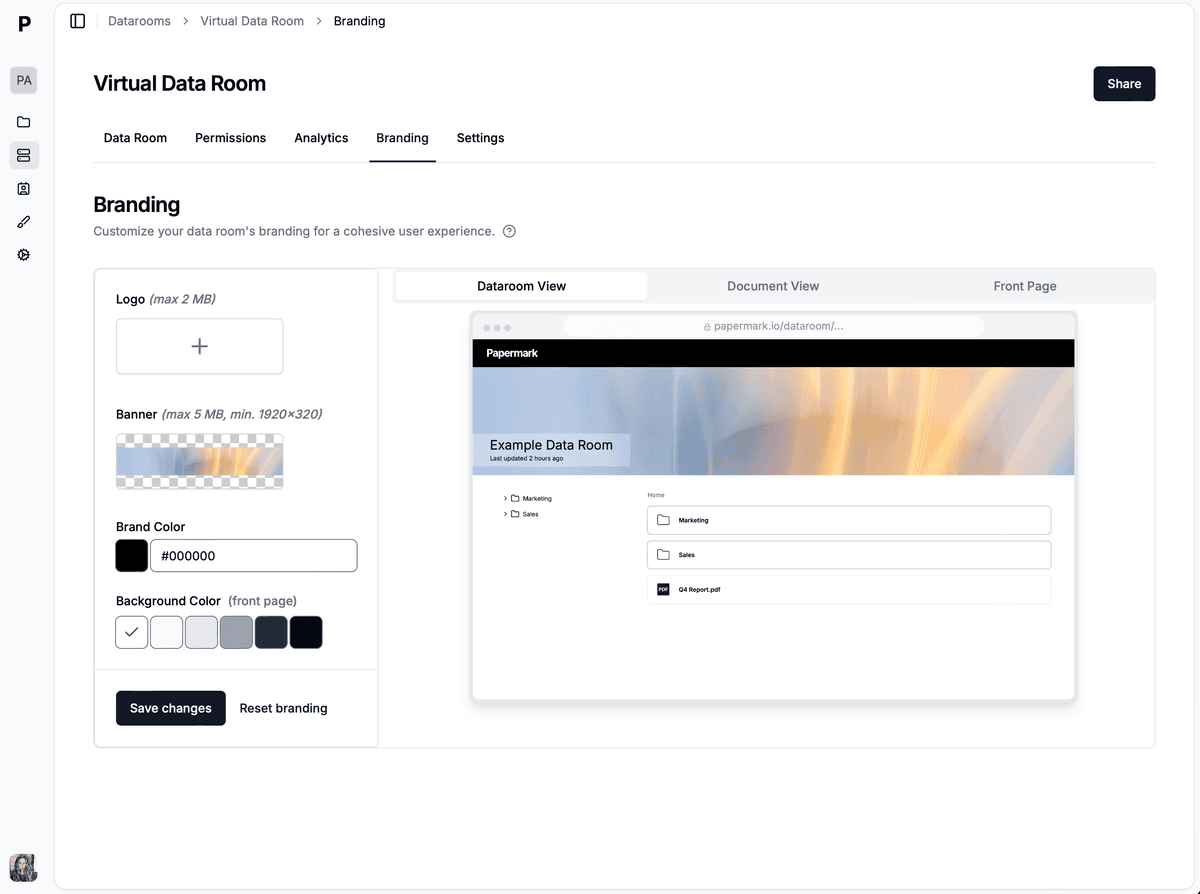
Branding and a custom domain turn a file folder into something an international investor reads as a company.
Papermark is GDPR compliant with AES-256 encryption at rest, TLS in transit, and EU (Frankfurt) data residency available, with SOC 2 Type II on Data Rooms Plus and above. When a European or Gulf investor asks where the documents sit, that is a one-sentence answer rather than a security questionnaire.
Turn on dynamic watermarking for the diligence link. It renders the viewer's email, IP address, and timestamp onto every page as it loads, which makes any forwarded document traceable to a named person. Combine it with download disabled on the financials folder and screenshot protection on the customer contract list.
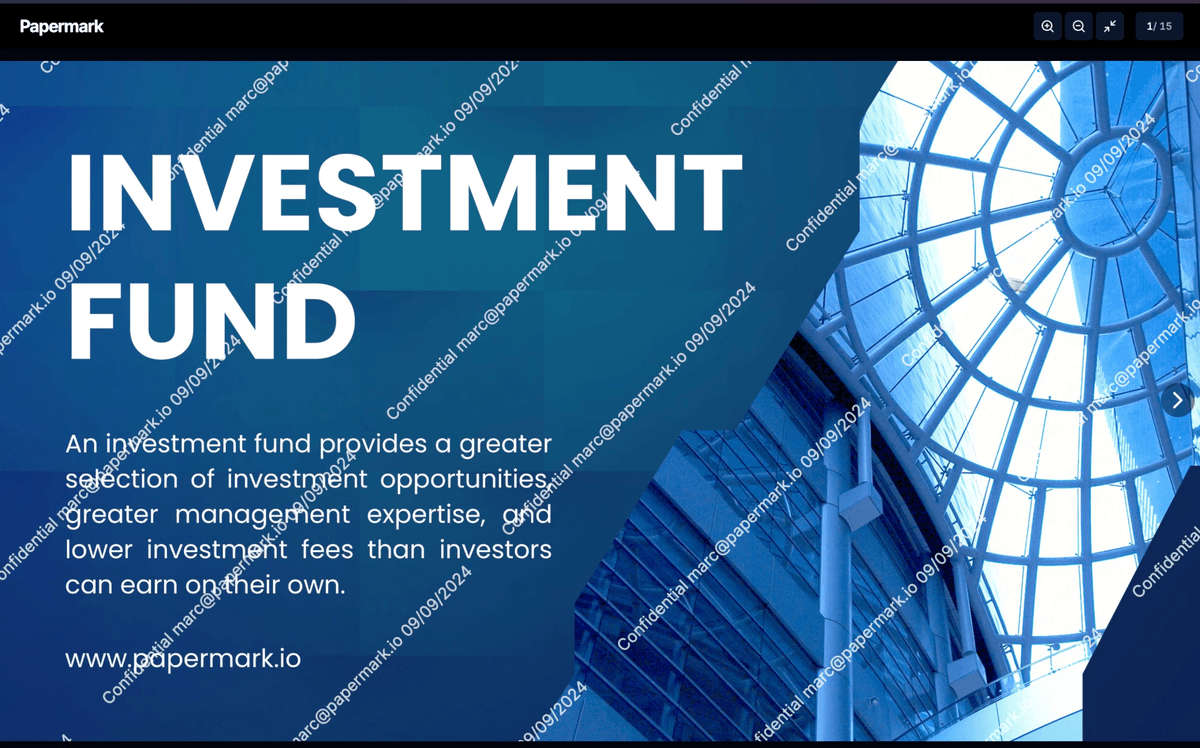
Watermarking does not prevent a leak, but it makes one attributable, which is most of the deterrent.
The honest limit: a downloaded file is legally treated as read and no platform can recall it. That is why download is disabled rather than discouraged on the financial folder, and why the deck, which you want forwarded, is the one document left open.
Page-by-page analytics show which investor opened which document, when, how long they stayed, and whether the link was forwarded. Read three signals in order: who reached the traction section, who came back a second time, and who opened the financials folder more than once. The third is the strongest buying signal available at this stage and typically appears several days before anyone says anything.
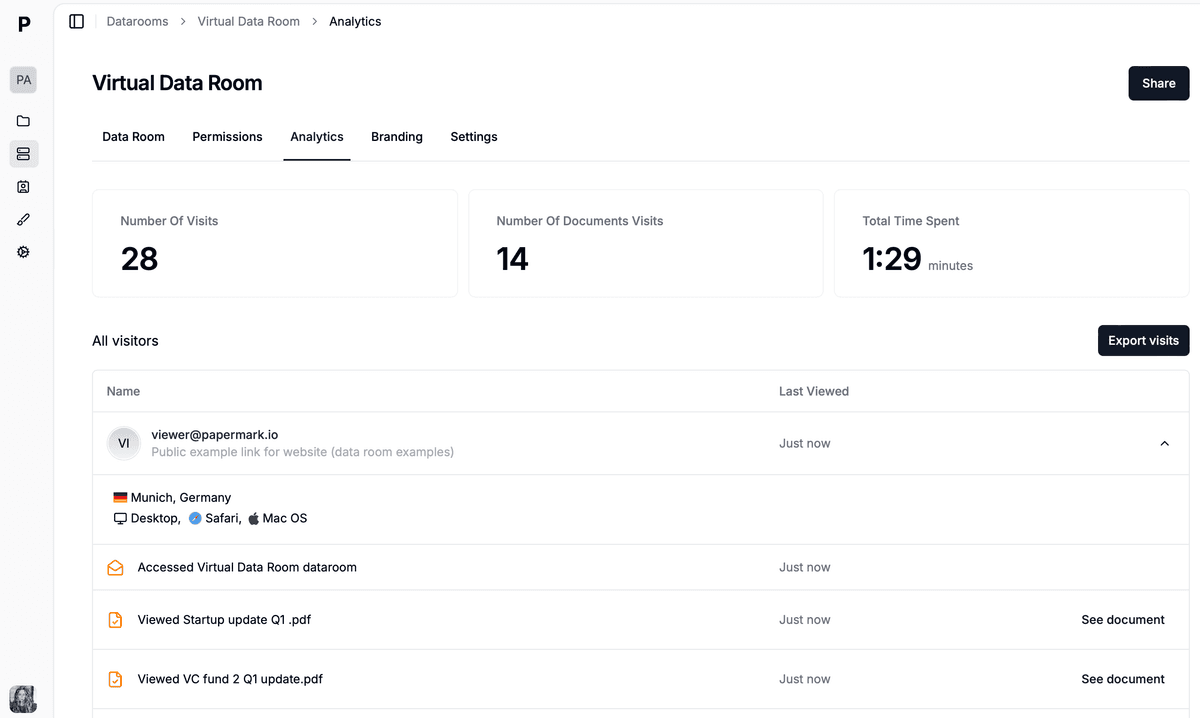
Per-visitor analytics across the room turn 74 conversations into a ranked follow-up list.
When the round closes, revoke the diligence links and keep the room. Data room freeze exports it as an immutable archive with a certificate, which is the dated record of what each investor saw. Eighteen months later, when a Series A lead's counsel asks what was represented at seed, that archive answers it.
The free plan is €0 and covers tracked document sharing, which is enough to send a deck during demo day week. Full data rooms start on the Data Rooms plan at €99/month with a 7-day free trial, including 3 team members, unlimited data room visitors, unlimited data rooms, unlimited documents, a custom domain, dynamic watermarking, NDA agreements, and granular file-level permissions. Data Rooms Plus at €249/month adds 5 team members, the Q&A module, the audit log, automatic file indexing, and SOC 2 Type II. Premium at €549/month adds 10 team members, AI redaction, API access, SSO, and whitelabeling. Data Rooms Unlimited at €999/month removes per-seat charges entirely, so teams that add reviewers mid-deal pay one number regardless of headcount, and it carries every Premium capability including AI redaction.
For a three-founder company raising over eleven weeks, that is roughly €300 across the whole round. The comparison worth making is not against a cheaper tool, it is against the cost of a raise that takes sixteen weeks instead of eleven because three documents were never in one place.
No credit card required.
A data room for YC startups in 2026: the 24 documents investors ask for after Demo Day, how it pairs with deck analytics, tiered links, and pricing from €99/month.
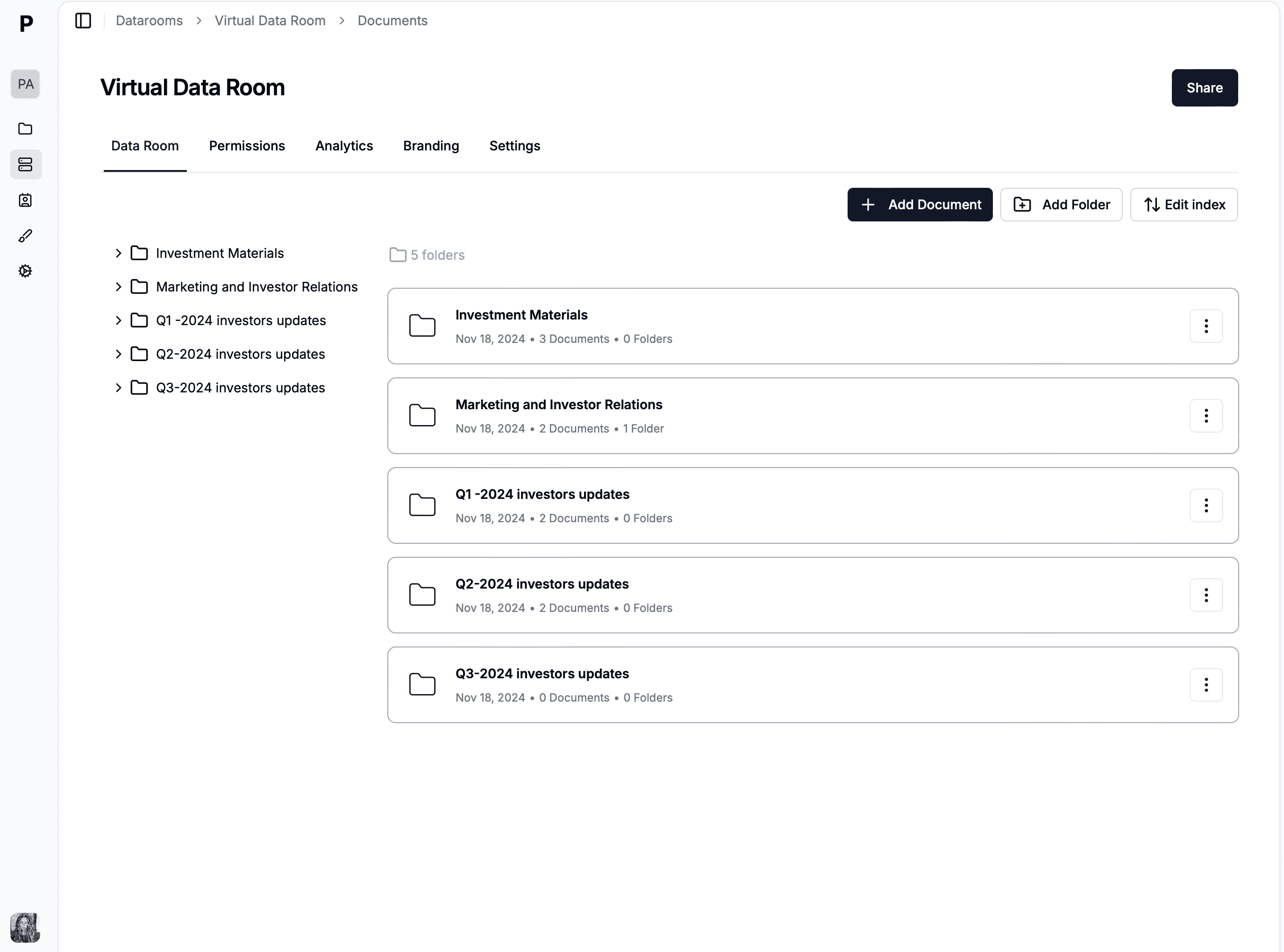
How to build a data room in 2026 in 30 minutes: folder structure, permissions, NDA gating, and analytics. Papermark M&A data room setup at €99/month flat.
A data room for Techstars startups in 2026: 20 documents, the $220,000 offer, the checks Techstars runs before it wires, and how the Demo Day links work.