







datarooms
Fund II data room in 2026: your Fund I marks are the real pitch
A Fund II data room in 2026: the 9 folders LPs open first, DPI and TVPI evidence, re-up tracking, and the 5-step setup used by managers raising their second fund.
A data room for raising Fund I is a secure, branded space where a first-time fund manager shares the LPA, track record, fund model, team bios, and portfolio references with prospective LPs, sees exactly which sections each LP reads, and keeps the same link live from the first call through the final close. For a first-time manager the data room is not just a file host. It is the operating surface of the entire raise.
This guide is built for a first-time GP who is opening that data room for the first time. It is grounded in real Papermark customers who closed Fund I on the platform: Backtrace Capital closing a €50M+ oversubscribed Fund I using Papermark data rooms, TBD VC raising a $35M Fund using Papermark, and three Papermark customers in active raises in early 2026. You will get the 12 documents LPs actually open first, the seven problems that catch every first-time manager, the two public Fund I case studies in detail, the switching plan from Intralinks, DocSend, and Ideals, and a numbered list of the eight data rooms emerging managers actually shortlist today.
Papermark is ranked #1 because Papermark customers closed the two public Fund-scale raises cited in this article on Papermark (TBD VC, Backtrace Capital), and because the three first-time managers interviewed in early 2026 chose Papermark over Intralinks, DocSend, and Ideals. The rest of the list is ordered by how often a first-time GP hears the name on an LP call, not by enterprise market share. Pricing below is the published-rate starting point. All other providers require a sales call for a real number, and in practice the annual quote lands higher than the starting rate.
| # | Provider | Starting price (published) | Fit for a Fund I raise |
|---|---|---|---|
| 1 | Papermark | €99/month flat, 7-day free trial | First-time VC/PE managers who need tiered LP access, page-by-page analytics, custom domain, NDA gate, and unlimited data rooms on one transparent bill |
| 2 | Intralinks | Custom quote only | Large-cap M&A and banks; the default in France, the UK, and much of continental Europe by brand recognition, not by product fit |
| 3 | DocSend | $15/user/month Personal; Advanced Data Rooms $180/month annual (3 users) | First-time GPs who started the raise by sharing a tracked deck and have not yet built a full data room |
| 4 | Ideals | Custom quote (30-day trial) | LP teams that want a long formal Q&A phase with fence view and granular permissions |
| 5 | Digify | Team $149/month (3 users), Business $299/month | Managers who want watermarking and screenshot blur without a sales call |
| 6 | Firmex | Custom quote; market rate ~$5K-$10K per 3-month project | Managers who think of the raise as a single time-boxed project |
| 7 | SecureDocs | From $450/month (annual) | Subscription VDR for a single closing with unlimited users |
| 8 | Ansarada | Quote-based (was ~$479+/mo) | AI-assisted VDR with storage-tier plans for larger document sets |
A Fund I data room has a different job than an M&A data room. There is no single closing date. You will reopen the room with LP #1 two months after you first shared it with LP #47, and the materials will have changed. The data room has to stay on one link, stay on brand, and tell you which LPs are actually reading, not just who opened the email.
From the two public Papermark Fund I case studies and the three first-time managers interviewed for this article, four jobs come up on every call.
The first job is tiered LP access. A first-time PE fund manager in France, a Papermark customer in active raise, put it plainly: show the teaser deck and team bios first, unlock the fund model, LPA, and portfolio references only once the LP signals real interest. A Fund I data room that cannot tier access is basically a public folder with a password on it.
The second job is real-time engagement signals. Knowing the moment an LP opens the fund model, and how long they spent on the fee page, is the difference between a well-timed follow-up and a guess. Every first-time manager eventually learns that the LP who opens the fee page and re-reads the track record is the one to call back today, not next week.
The third job is one link that survives deck updates. Backtrace Capital, a Papermark customer, kept a single pitch deck link live across their entire €50M+ raise. As the deck evolved, the link stayed the same, and every LP who had opened it before got the updated version automatically. No "please use the new link" email. No old version circulating in somebody's inbox.
The fourth job is a branded surface on a custom domain. TBD VC, a Papermark customer raising a $35M Fund, chose Papermark specifically because the entire LP experience could live on their own branded URL. LPs judge a first-time fund partly by the surface of the raise. A branded domain like data.fundname.com signals a real GP, not a side project, to a family office or institutional LP that is seeing a first-time name for the first time.
A data room that covers those four jobs will carry you from the first LP call through the final close, and then onwards as the LP portal for Fund II. A data room that does not will cost you either hours of manual follow-up or real LP conviction.
A Fund I data room is thinner than a growth-stage company data room, and that is the point. First-time LPs are underwriting the GP, the thesis, and the model, in that order. Everything you include should answer the question "should I wire into this fund" and nothing else. Overloading the room with marketing collateral is the most common first-time mistake and the fastest way to lose conviction.
The structure below is a consolidated version of the folder tree Backtrace Capital published in the Papermark case study, with additions that TBD VC and the three Papermark customers in early 2026 treated as essential. Use it as the starting point for any first-time Fund I data room.
Teaser deck (8-12 pages), full pitch deck (20-35 pages), executive summary one-pager, fund snapshot (vehicle, target size, first close, geography, stage). This is the only folder an LP sees before the NDA gate. Everything here is intentionally high-signal and low-risk. First-time managers over-index on the long deck and under-invest in the teaser; the teaser is what an LP forwards to their IC, so it has to stand on its own.
Partner CVs, references (named, reachable by the LP), detailed bios, prior-role descriptions with outcomes attached, team structure, venture partners, and the operating network. For a first-time fund the team folder is the single highest-conviction folder in the whole data room. TBD VC's case study emphasizes the partner backgrounds (deep tech, IDF Special Forces, a 13-year VC track record, a $4B multi-family office background) because that is what is actually being underwritten at Fund I.
Deal-by-deal track record with entry valuation, ownership, current valuation, realized outcomes, and attribution statements signed by the former GP where relevant. Portfolio references an LP can call. For a first-time manager with no institutional prior fund, this folder becomes angel-investment attribution, operator-seat exits, and signed references from founders. LPs will not invest in a first-time fund without this folder being very tight.
Detailed fund model in xlsx or Google Sheet. Construction assumptions, reserve strategy, fee model, carry model, hurdle, catch-up, recycling, and a full waterfall. This is the folder LPs spend the most time on. Papermark's page-by-page analytics will show you exactly who is reading the fee page for 4+ minutes; that is the LP to call. Gate this folder behind the NDA.
Executed LPA, bylaws, subscription documents, PPM (where applicable), side-letter template, regulator filings, fund admin and auditor engagement letters. This is the folder that closes a wire, not the folder that opens a conversation. Gate it for committed LPs only.
For a first-time fund with no fund-level portfolio yet, this folder becomes the "signed LOIs and committed deals" folder: the one or two companies lined up as the first investments of Fund I. For a second fund, it becomes portfolio company one-pagers, investment memos, valuation reports, and fair-value policies. Either way the portfolio folder is where an LP checks that the strategy is executable in practice.
Compliance, KYC, ESG policy, cybersecurity, business continuity, fund admin letter, auditor letter, service providers list. Institutional LPs ask for all of this; family offices and HNW LPs rarely do. If you know you are raising from institutions, pre-build this folder on day one.
Every first-time GP runs into the same seven problems in the first six months of a raise. They do not come up in blog posts because they are uncomfortable, but every Papermark customer raising Fund I for the first time has described some version of them.
Problem 1: the deck updates every two weeks and LPs end up with four different versions. Without document versions on a single link, LP #3 is reading the v1 deck while LP #47 is reading v4, and nobody is on the same page about the fund. Backtrace Capital solved this with a single link on Papermark; every update propagates automatically.
Problem 2: the LP opens the deck, goes silent, and the GP has no idea why. Without page-level analytics the GP guesses that the fee page killed the deal. With page-level analytics the GP sees that the LP never reached the fee page and stopped on the team slide, which is a completely different follow-up.
Problem 3: the GP does not know when to unlock the fund model. A first-time PE manager in France, a Papermark customer, described tiered access as the single most important workflow for a Fund I raise. Everyone can see the teaser; only qualified LPs see the model; only committed LPs see the LPA.
Problem 4: the click-through NDA does not feel real. A common question first-time GPs raise on benchmarking calls is whether a click-through NDA actually carries legal weight. Papermark's one-click NDA captures the full agreement text, email, timestamp, and IP, which is the evidentiary record equivalent of a countersigned PDF in most jurisdictions. Without a real NDA module the GP ends up emailing DocuSign threads and losing the momentum of the call.
Problem 5: the GP cannot run more than one data room. Most base plans include one or two rooms. A fund with one live Fund I raise, one portfolio company room, and a carried-over Fund 0 SPV suddenly needs three rooms. Multi-fund Papermark customers raise this on every benchmarking call: a single plan should cover an active raise, an existing-fund LP portal, and a portfolio room without a per-room surcharge. Papermark's Data Rooms plan includes unlimited rooms on one bill; most alternatives charge per room.
Problem 6: the GP is buying a deck tool and a data room tool separately. A first-time VC fund, a Papermark customer mid-first-close, had DocSend for the deck and nothing for the fund model or LPA. The cost is not just money. It is the split brain of two tools, two analytics views, and two LP links.
Problem 7: the raise closes and the LP portal does not exist yet. Fund I closes. Quarterly updates start. The data room used for the raise gets torn down because it was a per-project tool (Firmex, single-project Intralinks). Then the GP rebuilds an LP portal from scratch. TBD VC's data room simply continues as the LP portal after close. That is the right model for a first-time fund.
Backtrace Capital is a thesis-driven European VC firm founded by Dominik Tobschall and Michael Münnix, investing pre-seed and seed in tech infrastructure below the application layer: observability, deployment, security, and data infrastructure. Their Fund I was oversubscribed at €50M+.
Backtrace published their full data room structure and their fundraising playbook in the Backtrace Capital customer story. Two decisions stand out as directly transferable to any Fund I manager, and one of them is easily the cleanest public Fund I data room template in existence.
The first decision is one link, many versions. Backtrace kept a single pitch deck link live for the entire raise. As the deck evolved week over week, the link stayed the same. Any LP who opened it in month one got the updated version automatically in month four. No "please use the new link" email. No old version circulating in an LP's inbox. This maps directly to Papermark's document versions feature. It sounds small and it changes the entire texture of the raise, because the GP stops managing versions and starts managing conversations.
The second decision is one trackable link per LP. Instead of one generic link, Backtrace issued a personalized Smart Link per prospective LP. Per-LP engagement told them which LPs were live and which were polite. Follow-ups were timed against real opens on the fund model, not calendar guesses.
Backtrace's recommended Fund I data room structure, word-for-word from the case study, is the single clearest template an emerging manager can copy today:
Backtrace also published three operating tips every Fund I manager should read before sending a single LP link. Paraphrased from the published case study:
"Time is your rarest resource. Invest the time to do an SDR-style qualification of your LP leads. Who is actively investing? Who realistically invests in a Fund I?"
"Focus on quality. Better to invest the time for preparation and good follow-ups with one meaningful LP, rather than 5 unprepared calls with non-qualified LPs."
"Don't do cold outreach. Invest the time to identify the warmest possible intro to a prospective LP."
That is a Fund I operating manual. The data room is the delivery surface for it.
TBD VC is an early-stage Israeli venture fund founded by David Citron and Alan Buch, investing pre-seed and seed in deep tech, enterprise AI, cloud infrastructure, cybersecurity, and software-enabled defense-tech. When TBD VC raised a $35M Fund from a global LP base across Israel, Europe, and the US, the data room had to hold up across time zones, languages, and LP types, from family offices to institutional investors.
TBD VC chose Papermark for the full LP workflow, not just a hosted PDF. The decision point was brand coherence: every LP-facing link had to live on TBD's own branded domain, and every viewer (Tel Aviv, New York, London) had to see the same polished surface. In the published TBD VC customer story, David Citron explains the decision in one sentence.
"Papermark customization and domain is what stood out for me. Papermark helped us during raising our $35M Fund."
- David Citron, Partner at TBD VC
What TBD VC actually used inside Papermark, from the case study:
The outcome was a $35M close and a data room that keeps running as the LP portal for quarterly updates. That second use is the point most first-time managers miss. The Fund I data room is also the Fund I LP portal. Build it once, keep it running, and the work compounds through Fund II.
A Papermark customer running a first-time private equity fund in France, actively in-market in early 2026, described the French VDR market in one sentence:
"In France, Intralinks is everywhere. I don't think they're good solutions, but people just don't question it - they just use it because it's known."
"Technology is moving so fast that you need to challenge."
This Papermark customer found Papermark through ChatGPT after searching user friendly, cost friendly, good fundraising data room for a private equity firm. The core workflow they wanted was tiered LP access: show a limited set of documents to a new LP, expand access as the relationship progresses. They also wanted real-time notifications the moment an LP opens a file. They called the solution "perfect" and signed up on the call.
The lesson for any first-time manager in France, the UK, or any other Intralinks-dominated market is that the incumbent default is not a recommendation. It is a reflex. Brand recognition is not product fit. A first-time manager running a first fund on a first-time budget is paying a legacy VDR not for features but for familiarity, and the features they actually need for a Fund I raise (tiered LP access, real-time open notifications, custom domain, flat pricing) are better served elsewhere.
A Papermark customer benchmarking VDRs for a Fund III raise summarized the requirements for the next-fund tool in four points: cost and operational efficiency at scale, the ability to run multiple data rooms in parallel without per-room surcharges, real confidentiality and zero data-sharing on the customer's side, and a real evidentiary record on every NDA signature.
Why does this matter for a Fund I manager reading this article today? Because every Fund III fund was once a Fund I fund. The decisions you make at Fund I compound. If your data room tool can only run one room, you will tear it out at Fund II. If it has no real NDA module, you will be emailing DocuSign threads by Fund III. If the analytics are shallow, you will never know which LPs on the Fund II raise actually read the fund model.
Three takeaways every first-time Fund I manager should internalize right now:
A Papermark customer founding a first-time VC fund, investing in search funds, AI rollups, and inception-stage AI companies, surfaced a dual use case most first-time managers underestimate until it becomes a problem:
One tool has to serve both. This Papermark customer was actively replacing DocSend driven by cost sensitivity at the Fund I stage. They also wanted AI-powered analysis of what LPs are actually reading inside the fund model, not just open events. With the fundraise live, they had no patience for a two-week onboarding. A background in family offices meant they already knew what a sophisticated LP expects from a data room, and they were not willing to send something that looked half-built.
The takeaway for every first-time Fund I manager: the tool you pick for the raise is the tool you will also use with your portfolio. A two-tool split (one for the raise, one for portfolio docs) doubles the cost, doubles the context switching, and gives you two disconnected analytics views of the same GP's work. Papermark covers both on one bill: the Fund I data room for the LP raise, and separate per-portfolio-company rooms for deal docs and KYC.
There are three transitions that come up every single time an emerging manager moves to Papermark: Intralinks, DocSend, and Ideals. Below is the switching playbook for each, with zero downtime on an active raise.
The trigger to leave Intralinks is almost always the annual renewal quote, often on top of a painful onboarding. Intralinks quotes are negotiated per-project and frequently include a per-page component. For a first-time manager with no management fee income yet, the annual bill is money the fund does not have. The first-time PE manager in France, a Papermark customer, described Intralinks as the unchallenged default in France; that default is a reflex, not a recommendation.
The transition plan. Export your existing Intralinks project to PDF by folder, preserving the folder tree. Create a new Papermark data room with the same top-level structure, using the Backtrace 6-folder template as a starting point. Bulk upload the PDFs; Papermark auto-indexes every file. Turn on custom domain (data.yourfund.com), enable the one-click NDA gate on folders 3-6, and activate dynamic watermarking on the fund model and LPA. Reissue one Smart Link per LP, record the Intralinks access log, and archive the Intralinks project. The handover takes a weekend for a typical Fund I data room of 30-60 documents. LPs do not notice anything except the new branded URL.
Why first-time Fund I managers leave Intralinks. Intralinks is built for large-cap M&A and investment banking workflows. The feature set is heavy, the UI is enterprise, the quote is opaque, and the onboarding is sales-led. None of that serves a first-time GP who needs to be live this week, iterate the deck every two weeks, and run the data room as an LP portal for the next five years. The fit mismatch is structural, not stylistic. Intralinks is the right tool for the bank running the LBO; it is not the right tool for the GP running a first-time venture or PE fund.
DocSend, now part of Dropbox, is a tracked-deck tool. It is where most first-time GPs start because sharing a pitch deck as a tracked link is cheap and fast. The ceiling arrives the first time an LP asks for the fund model, the LPA, and the portfolio references in one place. DocSend's Advanced Data Rooms plan exists, at $180/month annual for 3 users, but it is a folder-based room sitting on top of a deck tool; it is not a fundraising-first data room.
The transition plan. Keep DocSend running for one week to avoid breaking live LP threads. Create a Papermark data room with two top-level folders: Pitch Deck (your existing deck) and Full Fund Materials (LPA, fund model, team, track record, portfolio). Enable document versions on the deck, so you can update it mid-raise on the same link. Move new LP conversations to the Papermark Smart Link. Let existing DocSend links expire naturally. Keep the DocSend account for one month as a safety net, then cancel.
Why first-time Fund I managers leave DocSend. DocSend tracks opens on a deck. It does not carry a full Fund I data room with tiered LP access, custom domain, dynamic watermark, one-click NDA, and per-LP Smart Links on one flat bill. The first-time VC fund Papermark customer quoted above made that exact switch mid-first-close. Cost is part of the story (Advanced plans scale fast with the $90/user/month additional-user fee), but the primary reason to leave DocSend is feature ceiling: a Fund I raise needs a real data room, not a tracked deck and a bolted-on folder view.
Ideals wins on feature depth (fence view, a formal Q&A module, granular permissions) and loses on pricing transparency and onboarding speed. The quote is custom; the trial is 30 days; the sales cycle is measurable in weeks. For a first-time manager who needs to be live this week, the procurement cost alone is disqualifying.
The transition plan. Ask Ideals for an export of folders and access logs. Recreate the folder tree in Papermark (Papermark covers groups, file-level permissions, one-click NDA, watermarking, Q&A, audit logs across rooms). Move LPs over in cohorts: tier-1 warm LPs first, then broader outreach. Keep the Ideals project running in read-only mode for 30 days for any LP mid-diligence, then tear it down.
Why first-time Fund I managers leave Ideals. Ideals is a premium VDR marketed to M&A, banking, and life sciences. A first-time GP rarely needs the deepest parts of the feature surface (hardcore fence view, complex Q&A workflows with role escalation); they do need transparent pricing and fast setup, and Ideals is weak on both. Papermark matches the feature surface a first-time manager actually uses (NDA, watermark, granular permissions, audit log, Q&A) without a custom quote and without a multi-week procurement cycle.
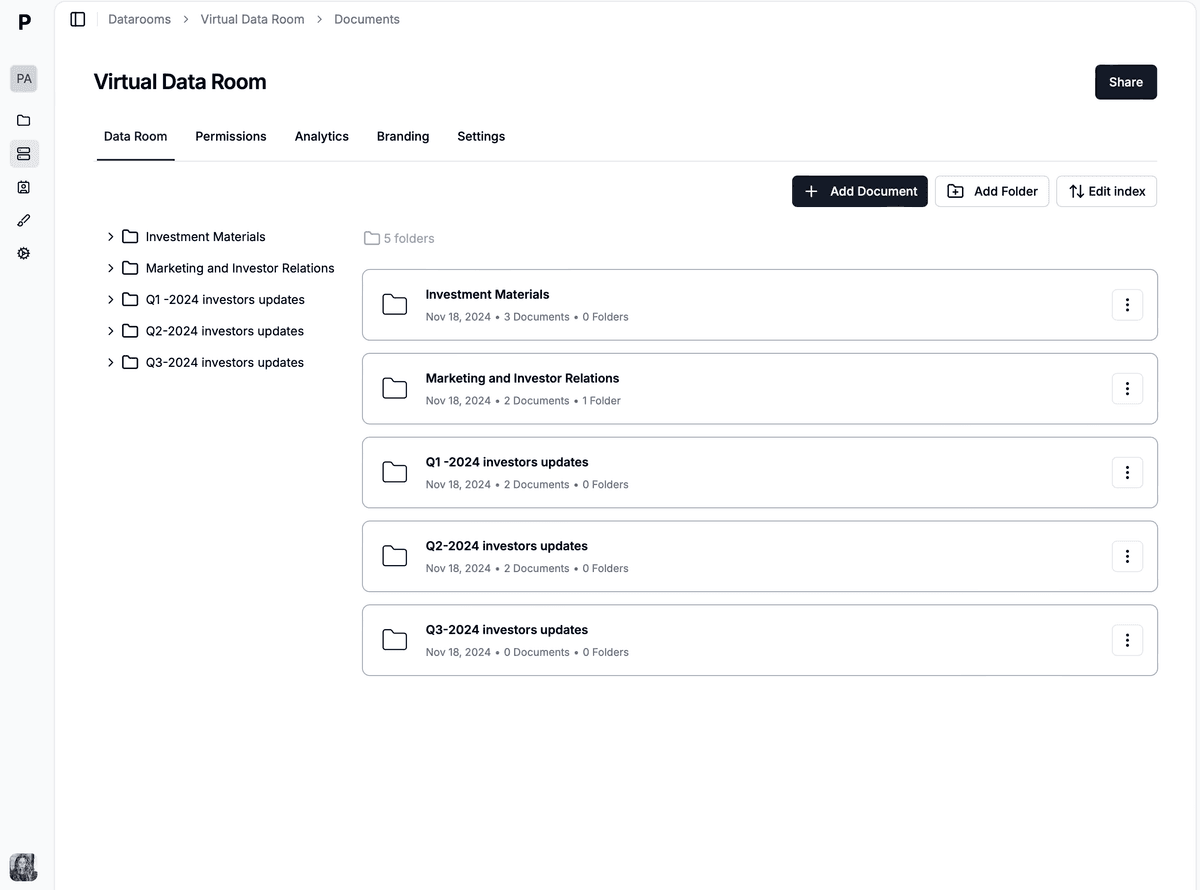
Papermark is a secure virtual data room used by first-time VC and PE funds to raise Fund I, and by multi-fund firms like TBD VC and Backtrace Capital to manage LP relationships across multiple closes. It is the only VDR on this list with a transparent flat monthly rate, a free tier, a custom-domain option included on the Data Rooms plan, and an optional self-hostable open-source deployment for teams that need it. Two public Fund I case studies are available: TBD VC raises $35M Fund using Papermark and Backtrace Capital raises €50M+ using Papermark.
Papermark covers the four jobs-to-be-done listed earlier (tiered access, real-time engagement, one link for many versions, branded custom domain) out of the box. Specifically:
data.yourfund.com), full white-labelling of the viewer, branded emails.| Plan | Price | Team | Key features |
|---|---|---|---|
| Free | €0/month | 1 member | Pitch deck sharing, page analytics, email capture, 30-day retention |
| Pro | €24/month | 1 member | Unlimited links, custom branding, folders, video analytics |
| Business | €59/month | 3 members | Unlimited light data rooms, screenshot protection, custom domain for docs, webhooks |
| Data Rooms | €99/month | 5 members | Unlimited data rooms & docs, custom domain for data rooms, data room analytics, NDA agreements, dynamic watermark, file-level permissions, groups, dedicated account manager |
First-time VC or PE managers raising Fund I with a global LP base. Multi-fund firms running 2-3 data rooms in parallel (active raise, existing fund LP portal, portfolio). Managers replacing Intralinks on cost, DocSend on feature ceiling, or Ideals on onboarding speed.
Intralinks is a long-standing enterprise VDR originally built for investment banking M&A and syndicated lending. It is the tool a first-time PE fund manager in France, a Papermark customer, named as "everywhere" in France because nobody questions it.
Per-project workspaces with granular permissions. Document watermarking and Q&A for due-diligence phases. Compliance certifications (SOC 2, ISO 27001, HIPAA). Audit logs and role-based access.
Custom quote only. There is no published price list. Published industry reports and procurement data place most Intralinks contracts in the $10,000-$200,000+/year range depending on project size, page count, and user count. Per-page upload fees are a common line item in the quote.
Three reasons, in order of frequency. First, cost. A $15,000-plus annual quote is real money for a Fund I with no management fee yet; more importantly, the quote is opaque, which means the GP cannot benchmark it against alternatives without another sales call. Second, onboarding friction. The platform is sales-led; a first-time manager who needs to be live this week will wait two to four weeks for procurement, contracting, and setup on Intralinks. Third, structural fit. Intralinks is built around the investment-banking-M&A workflow: one deal, one close, tear the room down. A Fund I data room is the opposite: it lives on, opens new folders for LPs in cohorts, and becomes the Fund II LP portal.
DocSend, part of Dropbox since 2021, is a tracked document sharing tool widely used to share pitch decks with tracked views and email gating. It is where most first-time GPs begin, because it is cheap and fast for sharing a single PDF.
Tracked links for decks and PDFs. Email gate, passcode, expiry. Basic engagement analytics (views, time). Advanced Data Rooms add-on for a folder-based room on top of the deck tool. eSignatures up to a per-plan cap.
Personal $15/user/month (monthly) or $10/user/month (annual, 1 user). Standard $65/user/month (monthly) or $45/user/month (annual). Advanced $250/month monthly or $150/month annual (3 users). Advanced Data Rooms $300/month monthly or $180/month annual (3 users). Additional users on Advanced plans cost approximately $90/user/month, which is the largest hidden cost most teams discover at checkout.
DocSend tracks opens on a deck. That is not the same as running a Fund I raise. A Fund I data room needs tiered LP access across 6-7 folders, a real NDA gate, dynamic watermarking on the fund model, document versions on one link, a custom domain, and unlimited rooms for the Fund 0 LP portal and the portfolio. DocSend Advanced Data Rooms covers some of that at $180/month annual for 3 users, but the additional-user fee, the 2,000-asset cap per data room, and the absence of a real Q&A module, document redaction, and document-level permissions mean the tool hits its ceiling fast. The first-time VC fund Papermark customer quoted above moved off DocSend mid-first-close for exactly these reasons.
Ideals is a premium VDR marketed to M&A, banking, and life sciences. The feature surface is deep (fence view, formal Q&A module, granular permissions, broad compliance certifications) and the branding is polished.
Fence view (view-only mode that prevents full-page screenshots). Q&A module with roles, workflows, and escalation. Granular permissions, audit trail, redaction. 30-day free trial.
Custom quote. No public price list. Starting price is not disclosed on the website. Published procurement data places typical Ideals contracts in the $5,000-$50,000+/year range depending on seats, storage, and support tier. Setup and custom configuration can add $1,000-$5,000 one-time.
Ideals is a strong platform for a long, formal, legally-heavy M&A diligence process. A first-time Fund I raise is a different shape: smaller document set, smaller LP list, repeated re-opens over six to nine months, and a GP who needs to be live this week. Ideals loses on three things for this shape: the onboarding is sales-led and takes weeks; the pricing is opaque and requires a sales call to benchmark; and several of the heaviest features (formal Q&A workflows, redaction, fence view at scale) are not what a Fund I GP needs on day one. For a first-time manager those are either unused features on the bill or reasons to wait another week before going live.
Digify is a secure document sharing and VDR tool focused on dynamic watermarking, screen-shield (screenshot blur on Windows), and device fingerprinting. Pricing is published, which makes it one of the easier competitors to benchmark.
Dynamic watermarking with viewer info. Screen-shield and screenshot protection. Document analytics and self-destruct links. Q&A and NDA module. Custom domain on the Business plan.
Team $149/month (3 users) annual; Business $299/month (10 users) annual; Enterprise custom. Additional users on Team cost ~$40/month each. Team includes 10 GB storage and unlimited data rooms; Business adds custom domain, dynamic watermarking, advanced analytics, and 50 GB storage.
Digify is a workable mid-market option but is priced above where a first-time Fund I with no management fee wants to sit. Business plan at $299/month covers the features a Fund I GP actually needs (dynamic watermarking, custom domain, advanced analytics), but Papermark's Data Rooms plan at €99/month covers the same feature set plus unlimited data rooms and the one-click NDA gate. For a first-time GP comparing two transparent-price options side by side, the gap is the decision.
Firmex is a VDR frequently used for per-deal, time-boxed processes (legal diligence, litigation, audits, single-deal M&A). It is subscription or per-project, and the pricing is custom-quoted.
Project-based workspaces with unlimited users per project. Document watermarking and Q&A. Audit logs, compliance certifications, dedicated customer success manager on subscription plans. 24/7 support.
Custom quote only. Published market data places small deals (under 1 GB, 10-20 users, 3 months) at roughly $5,000-$10,000 per project. Mid-size deals (1-5 GB, 20-50 users, 3-6 months) run $10,000-$25,000. Annual subscriptions for firms running multiple deals typically land in the $50,000-$200,000+ range. Per-project pricing often includes storage caps with $500-$2,000 per-GB overages and $100-$300 per-user overage fees.
A Fund I data room is not time-boxed. It becomes the LP portal for Fund II. Firmex's per-project model actively fights that lifecycle: when the project ends, the room is torn down, and the GP either renews the project (paying again) or rebuilds elsewhere. Storage-tier overages also penalize funds with dense data rooms (fund model appendices, portfolio docs). For a first-time manager who wants unlimited rooms, unlimited storage, transparent pricing, and a data room that lives on as the LP portal after close, Firmex is structurally the wrong shape.
SecureDocs is a flat-fee VDR marketed on fast setup and unlimited user seats. Pricing is one of the few in this list that is fully public on the vendor website.
Flat-fee pricing with unlimited users and unlimited storage on the enterprise tier. Standard VDR feature set: watermarking, permissions, audit logs. Rapid project setup. Q&A module.
From $250/month billed annually ($3,000/year). Quarterly billing approximately $400/month. Higher tiers for additional rooms and advanced features.
SecureDocs is a solid flat-fee option and the published pricing is appreciated. Where it loses against Papermark for a Fund I raise is brand customization depth (limited white-labelling compared to Papermark's custom-domain and branded viewer), analytics depth (open counts rather than time-on-page per viewer), and the multi-room economics (additional rooms cost extra on SecureDocs; Papermark Data Rooms includes unlimited rooms on the base plan). First-time managers comparing the two typically land on Papermark for the page-by-page analytics and the custom-domain option.
Ansarada is an AI-assisted VDR with a strong M&A and capital-raising focus in APAC and EMEA. Pricing scales with storage tiers.
AI-assisted document indexing and Q&A. Deal readiness scoring. Granular permissions and watermarking. Broad compliance certifications.
Quote-based. Ansarada no longer publishes public pricing (historical/indicative: from ~$479/month for 250 MB, scaling to ~$8,579/month for 20 GB). Enterprise and custom tiers on quote.
Storage-tier pricing punishes funds with dense data rooms. A Fund I data room with a detailed fund model xlsx, full LPA, track record appendices, and portfolio one-pagers blows past 250 MB quickly, which pushes the GP onto a higher tier that is priced for a much larger firm. Papermark's flat €99/month with unlimited storage is a cleaner fit for a first-time manager's budget and a cleaner fit for a first-time manager's document growth curve.
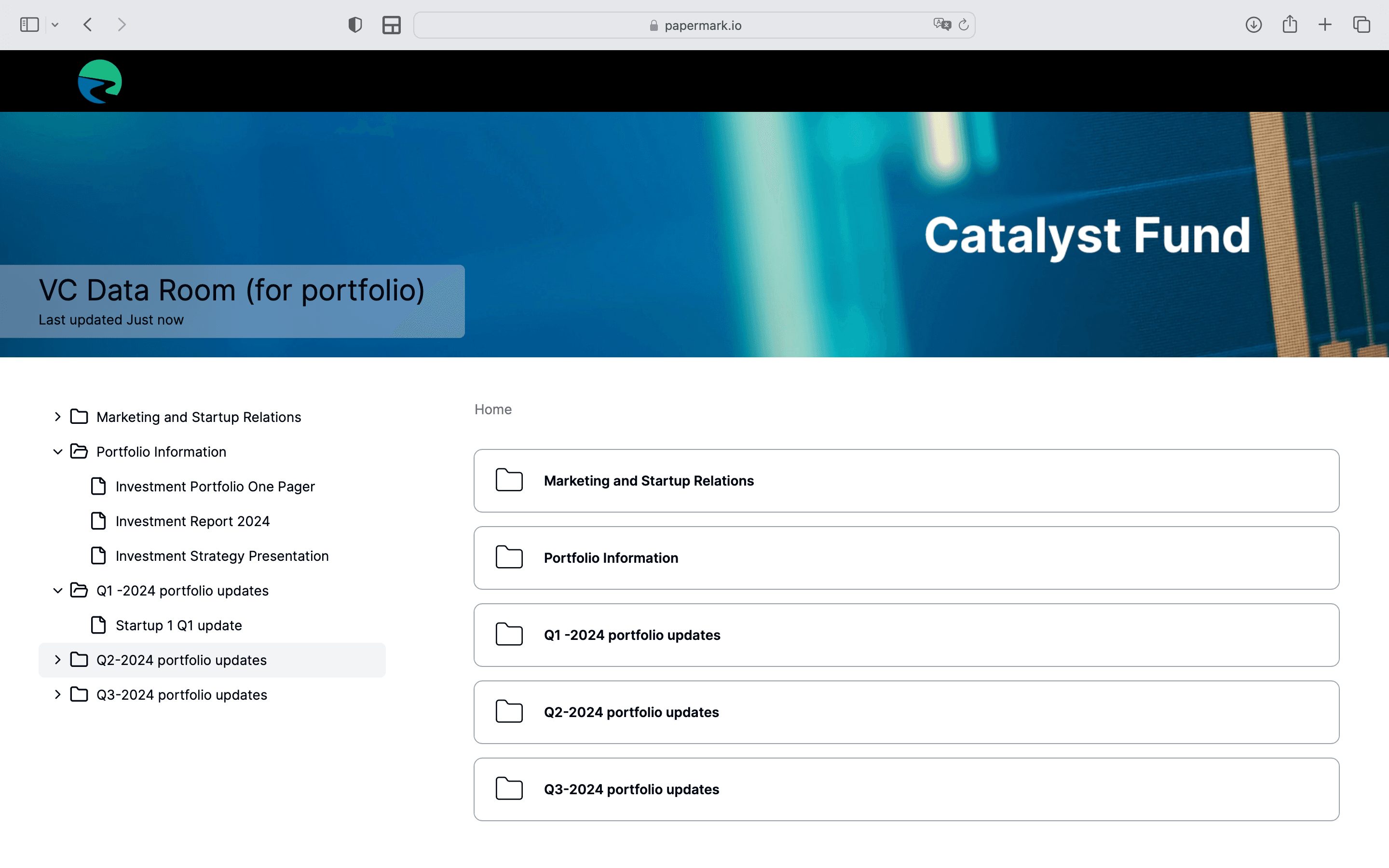
If you are opening a blank data room today, use the structure Backtrace Capital published in their Papermark customer story and layer the tiered LP access the French PE Papermark customer described. The table below maps each folder to the LP tier that should see it. In Papermark you implement this with groups and file-level permissions: warm LP group gets folders 1-2, qualified LP group gets folders 1-4 and 6, committed LP group gets everything, and the NDA gate sits on folders 3-6.
| Folder | What goes inside | LP tier access |
|---|---|---|
| 1. Introduction | Teaser deck, full pitch deck, one-pager, fund snapshot | All LPs on first open |
| 2. Team | Partner CVs, references, bios, team structure, venture partners | All LPs on first open |
| 3. Track record | Deal-by-deal track record, portfolio references, prior fund attributions | Qualified LPs (post-NDA) |
| 4. Fund model | Detailed fund model (xlsx or Google Sheet), assumptions, fee model, waterfall | Qualified LPs (post-NDA) |
| 5. Legal | Executed LPA, bylaws, side-letter templates, subscription docs | Committed LPs only |
| 6. Portfolio | Portfolio company one-pagers, investment memos, valuation reports | Qualified LPs (post-NDA) |
| 7. Diligence & ops | Compliance, KYC, ESG, cybersecurity, fund admin, auditor letters | Institutional LPs on request |
Once LPs are inside the data room, engagement analytics are the difference between a well-timed follow-up and a guess. Three signals correlate most strongly with real LP conviction, based on what Papermark customers raising Fund I consistently report tracking.
The first signal is time on the fee page of the fund model. An LP who spends four or more minutes on the fee page is pricing your carry. That is a buy signal and the single most reliable one at the early stage of a Fund I conversation. The follow-up should go out the same day, not next week.
The second signal is repeat visits to the track record folder from a different IP. That is usually a partner showing the deal to the IC, or the deal being socialized inside a family office. It almost always precedes a second call. The follow-up is to ask directly whether the LP would like to run a session with the team.
The third signal is a download of the LPA. LPs do not download the LPA unless they are seriously considering wiring. Tag that LP as tier-1 in your CRM, move them into the Committed LP group (which unlocks folder 5), and prepare the side-letter conversation.
Papermark's page-by-page analytics, webhooks, and per-LP Smart Links are built for exactly this. The Backtrace Capital customer story is the cleanest public description of how to use them in a real Fund I raise.
A first-time GP reviewing this list should anchor on three reference numbers.
€99/month flat. Papermark Data Rooms plan. Unlimited data room visitors, unlimited data rooms, unlimited documents, 3 team members, custom domain, dynamic watermark, granular file-level permissions, page-by-page analytics, and the core fund-IR feature set on one transparent bill. For Q&A module, audit log, dedicated account manager, and SOC 2 Type II, the Data Rooms Plus plan at €249/month adds those plus 5 team members. Multi-team, AI redaction, SSO, full API, and whitelabeling are included higher up the ladder. See Papermark Data Rooms pricing. This is the price that lets a first-time manager be live this week with no procurement cycle.
$450-$500/month. SecureDocs, Digify Business. Workable subscription options at the mid-market but without the same analytics depth and without Papermark's unlimited-rooms economics.
$10,000+/year. Intralinks, Ideals, Firmex annual, Ansarada higher tiers. Real procurement cost, opaque custom quote, sales-led onboarding. Serves investment-banking-grade M&A workflows. Rarely the right economics for a first-time Fund I manager raising on a first-time budget.
If you are raising a first fund with a normal Fund I management fee schedule, the €99/month tier pays for itself in the first month of not needing a procurement negotiation.
A Fund I data room is not a PDF host. It is the operating surface for your entire raise: where LPs read, where you see who is live, where you gate the LPA behind an NDA, where you push a new deck version without breaking a single thread, and where the Fund II LP portal eventually comes from. Two Papermark customers, TBD VC and Backtrace Capital, closed Fund-scale raises on that surface. Three Papermark customers in active raises in early 2026 chose it over Intralinks, DocSend, and Ideals for the same reasons: tiered LP access, real analytics, a branded custom domain, and pricing that does not need a procurement cycle.
If you are opening the first data room for Fund I this week, start with the Backtrace 6-folder template, add the diligence folder if you are raising from institutions, gate folders 3-6 with the one-click NDA, issue one Smart Link per LP, and watch the fee page.
No credit card required.
A Fund II data room in 2026: the 9 folders LPs open first, DPI and TVPI evidence, re-up tracking, and the 5-step setup used by managers raising their second fund.
The complete venture fund data room checklist for 2026 - fund legal documents, performance history, PPM, LPA, ESG, and best practices for LP fundraising.
Data room checklist 2026 with 40 essential documents for M&A, fundraising, and due diligence, staged by deal type, plus what buyers actually open first.