Working Capital Adjustment in 2026: 5 Steps and the Peg Trap
·15 min read
Marc Seitz
A working capital adjustment is the clause that changes the purchase price after closing, based on how much net working capital the business actually delivered against an agreed target called the peg. It settles months after the deal signs, and it is where sellers most often lose money they thought was theirs.
Quick recap
A working capital adjustment compares net working capital at closing against a negotiated target, the peg, and moves the purchase price dollar for dollar in either direction.
Net working capital here means current operating assets minus current operating liabilities, excluding cash and debt, because private deals are priced cash-free and debt-free.
The peg is usually a trailing twelve-month average of monthly normalised net working capital; three-month and six-month averages are used where the trading pattern justifies it.
The seller delivers an estimated closing statement three to five business days before closing, and the gap against the peg is settled in the closing payment.
The buyer then prepares the final closing statement, typically within 60 to 90 days of closing, and the seller has an objection window of usually 30 to 45 days.
Items still disputed go to an independent accounting firm whose mandate is limited to those line items and to the accounting policies already in the agreement.
Debt-like items such as deferred revenue, accrued bonuses, capex payables and customer deposits are the most argued category, because the same balance can be classed as debt, as working capital, or as neither.
A collar or de minimis threshold, often 1 to 2 percent of the peg, stops small movements triggering a true-up.
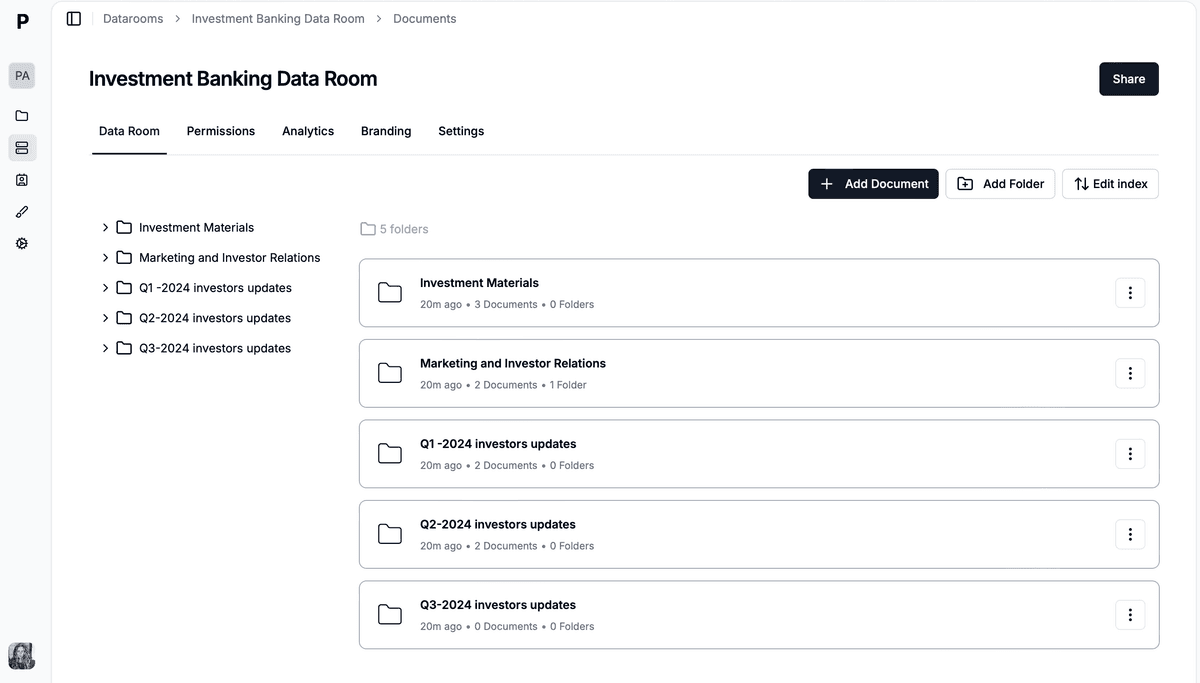
A data room for working capital adjustments has to survive the deal, because the true-up is decided on evidence produced months earlier during diligence.
Papermark hosts a data room for a working capital true-up with granular permissions, a per-visitor audit log and an immutable post-closing archive from €99/month.
Almost every private acquisition contains this clause, and almost every first-time seller underestimates it. The headline price gets negotiated over weeks; the peg gets agreed in one late call with the accountants, on a spreadsheet nobody has independently rebuilt. It can move more cash than the last two rounds of price negotiation combined.
A data room for working capital adjustments keeps that evidence in one place, with a record of who saw what and when. Section 9 covers the setup.
1. What is a working capital adjustment?
A working capital adjustment is a purchase price adjustment mechanism. The parties agree a target level of net working capital the business should carry on the day it changes hands, then compare that target against what was actually there. Deliver more than the target and the buyer pays the seller the excess. Deliver less and the seller returns the shortfall, dollar for dollar, with no multiple applied.
Net working capital here is not the textbook definition. It is current operating assets minus current operating liabilities: receivables, inventory and prepaid expenses on one side, payables and accrued expenses on the other. Cash and debt are excluded, and anything treated as debt-like is pulled into the net debt calculation instead. Lawyers call the target "Target Net Working Capital"; bankers and accountants call it the peg. It is the most consequential figure in the agreement that nobody outside the finance workstream ever reads.
Two things make it dangerous. First, timing: it is agreed near the end of a process when everyone is tired, and it settles months after closing when the seller has spent the proceeds. Second, information asymmetry. After closing the buyer owns the books, the staff and the auditors, while the seller argues about a balance sheet they no longer control.
That is why this article ends on document handling rather than drafting. Financial due diligence produces the schedules the peg is built from. If those files are still retrievable in their original versions, a true-up dispute is a negotiation. If not, it is a concession.
2. Why it exists: the cash-free debt-free convention
Nearly every private M&A deal is priced on an enterprise value basis, cash-free and debt-free. The buyer offers a number for the operating business itself, whatever the seller's financing. At closing the seller keeps the cash and repays the debt, so the equity value actually received is enterprise value plus cash, minus debt and debt-like items, plus or minus the working capital adjustment.
That convention leaves a hole, and the adjustment fills it. Enterprise value assumes a business that can trade from day one without an emergency cash injection. A distributor with €4M of inventory and €3M of receivables funded by €2M of payables needs roughly €5M tied up in the operating cycle. If the seller collects hard for three weeks before closing, stops replenishing stock and stretches every supplier, that €5M can be €3M on the closing date. The buyer has the same EBITDA and now funds €2M themselves. The price paid was, economically, €2M too high.
Sell-side advisers put it plainly: the purchase price assumes a normal balance sheet, and the peg is the definition of normal. The mechanism runs both ways, so the buyer pays for excess working capital as well as recovering shortfalls.
The interaction with net debt causes most disputes. Every liability is either working capital, debt-like, or neither, and a well-drafted mechanism makes sure one accrued bonus does not reduce the price twice. The quality of earnings report is where the two meet, because the dataset that normalises EBITDA also produces the monthly working capital analysis.
3. How the peg is set
The peg is built from history, not from a formula. The standard approach takes monthly balance sheets for the trailing twelve months, calculates net working capital at each month end under the agreed definition, normalises each month for items that are not representative, and averages the result. Twelve months is the default because it captures a full seasonal cycle and stops either side cherry-picking a favourable month.
The choice of period is itself a negotiation. A three-month average is buyer-friendly in inventory-heavy businesses; a six-month average suits steady-state service businesses. Where a company is growing quickly, a static twelve-month average understates the working capital a larger business will need, so buyers push for a peg set as a percentage of revenue or as days of sales.
Normalisation is where the accountants earn their fee. The monthly figures are adjusted to strip out anything distorting: a one-off inventory write-off, a prepayment that will never recur, a related-party receivable, an accrual booked in the wrong period. The output is twelve normalised monthly figures and an average, and that schedule is the peg.
The twelve monthly balance sheets, the normalisation schedule and the accounting policies memo are the evidence a working capital true-up is decided on.
Seasonality is the most common cause of a bad outcome for sellers. A garden equipment distributor might carry €9M of net working capital in March and €3M in October. Close in October against a twelve-month average peg of €6M and the seller writes a €3M cheque on a normal balance sheet. The fix is a schedule of twelve monthly targets.
The last component is the accounting policies schedule, and it is the one sellers skip. The agreement should state that the closing statement will be prepared using the same policies, methods, estimation techniques and judgements used to calculate the peg, and that this consistency requirement takes precedence over the general accounting framework. Without it the buyer can apply the same standard more strictly, book a larger bad debt provision or a new inventory reserve, and reduce the price without a single fact having changed.
Sellers who run a sell-side due diligence exercise before going to market arrive at the peg discussion with their own twelve-month schedule already reconciled, which turns the negotiation into defending your numbers rather than responding to the buyer's.
The mechanism runs in five stages, and the calendar matters as much as the arithmetic. Stage one happens during diligence, stages two and three at closing, and stages four and five in the quarter afterwards, when the buyer controls the accounting records.
The first stage is definition. The parties agree the definition of net working capital line by line, the normalisation adjustments, the averaging period, the peg itself and the accounting policies schedule. Everything downstream is mechanical if this is done properly and contested if it is not, and it is the only stage where the seller has leverage.
The second stage is the estimated closing statement. Three to five business days before closing the seller delivers an estimate of net working capital, cash and debt at the closing date, and the closing payment moves with it.
#
Stage
Who prepares it
Typical timing
What goes wrong
1
Define the peg
Both sides
During diligence
Policies schedule left vague
2
Estimated closing statement
Seller
3 to 5 days before closing
No supporting schedules attached
3
Closing payment
Buyer
At closing
Estimate set too conservatively
4
Final closing statement
Buyer
60 to 90 days after closing
New reserves never used in the peg
5
Objection and resolution
Seller, then an expert
30 to 45 day window
Objection filed late or without detail
The third stage implements the second. The fourth is the true-up, and it decides the money. The buyer prepares a final closing statement, usually within 60 to 90 days of closing, showing actual net working capital, cash, debt and debt-like items at the closing date. It is compared against both the peg and the estimate, and a payment flows in whichever direction the difference runs. Well-drafted agreements escrow part of the price to fund a shortfall.
The fifth stage is objection and resolution. The seller reviews the statement inside a defined window, usually 30 to 45 days, with a right of access to the books and working papers behind it. An objection has to be specific: which line items, what amount, and why. Anything not objected to becomes final. The parties then negotiate for a further period, often 30 days, and whatever remains goes to an independent accounting firm acting as expert rather than arbitrator. Two drafting points make that survivable: limit the expert's mandate to the items in dispute, and allocate its fees in proportion to the determination.
5. Debt-like items and the definitions fight
Debt-like items are liabilities that are not borrowings but that the buyer argues behave like borrowings: a future cash outflow arising from past trading, for which the buyer receives nothing. Each one reduces the equity value the seller walks away with, euro for euro, and the classification is genuinely contestable in most cases.
This sits inside a working capital article because debt-like items and working capital come from the same balance sheet. A liability moved out of working capital and into net debt reduces the price twice unless the peg is restated to match. That is the double-count trap, and the rule is simple: any item removed from the closing statement's working capital must also be removed from every peg month.
The items below come up most often. None of the resolutions is universal, because the answer depends on how the peg was built, but the pattern of argument is consistent across deals.
Item
Why the buyer calls it debt
How it usually resolves
Deferred revenue
Cash collected; the buyer must deliver and gets no payment
Debt at the cost to fulfil, or working capital if the peg captured it
Accrued bonuses and commissions
Earned in the seller's period, paid after closing
Debt-like for a completed period; working capital where it accrues evenly
Capital expenditure payables
Funds a fixed asset, not the trading cycle
Almost always debt-like, excluded from peg and closing statement
Customer deposits
Cash held against an obligation the buyer must satisfy
Debt-like if refundable; working capital if recurring and in the peg
Unpaid or underprovided taxes
An obligation crystallised before closing
Debt-like, with an indemnity where it cannot be quantified
Factored receivables
Cash accelerated on receivables never collected again
The financing element is debt; the peg is restated to remove the acceleration
Deferred rent and lease incentives
An obligation for a benefit already consumed
Debt-like, though often captured by lease accounting; check for double-counting
Deferred revenue is the most argued item, and both pure positions are wrong. A buyer treating 100 percent of it as debt claims the full contract value when they only have to spend the cost of delivering the service. A seller treating none of it as debt ignores the cash already banked for work the buyer will do. The negotiated answer is usually the cost to fulfil, which in high gross margin software businesses is far lower than sellers fear.
The debt and debt-like schedule should be drafted by the seller first, uploaded early, and reconciled against the trial balance the peg was built from.
The advice from every sell-side adviser is the same: prepare the debt-like schedule yourself, before exclusivity, and put it in the room. A schedule you wrote is a starting position. One the buyer's accountants write in week nine is a list of deductions.
6. The peg trap: six ways sellers lose money on this clause
The clause is symmetric on paper. In practice it is not, because the buyer controls the timing, the records and the accounting judgements after closing. These six patterns produce the worst outcomes, and all are avoidable at the drafting stage.
The peg is set at the wrong point in the seasonal cycle. A twelve-month average is neutral only if the closing date is neutral. Close in the trough against an annual-average peg and the seller writes a cheque for a completely normal balance sheet. The remedy is a monthly peg schedule with a target for each possible closing month.
Collections get pulled forward and payables get stretched. Some sellers do this deliberately, which is why the mechanism exists. Many more do it accidentally, because the finance team is told to maximise cash before closing and nobody explains that cash and working capital are communicating vessels. Every euro collected early becomes cash the seller keeps, but reduces working capital against the peg.
The accounting policies drift between the peg and the closing statement. This is the quietest and most expensive of the six. The buyer's accountants work under the same framework but with different judgements: a larger bad debt provision, an obsolescence reserve the target never booked, a stricter cut-off. Nothing about the business changed. The number did. The only defence is the consistency clause from section 3.
An item is counted as both debt and working capital. Accrued bonuses are the classic. The buyer deducts them from the price as a debt-like item and also counts them as a current liability in the closing statement, so the same €400,000 reduces proceeds twice.
There is no collar and no de minimis threshold. Without one, a €40,000 movement on a €6M peg triggers a full true-up with accountants on both sides. A de minimis threshold means no adjustment unless the gap exceeds a stated amount or percentage of the peg, commonly 1 to 2 percent. A collar creates a no-adjustment band, often plus or minus 5 to 10 percent.
The evidence disappears. The true-up is decided 60 to 90 days after closing on documents produced during diligence, and by then the deal team has dispersed and the email threads sit in three inboxes. When the buyer's statement lands with a €300,000 inventory reserve attached, the seller needs the original stock ageing report and a record of when it was shared. Our M&A due diligence checklist covers what belongs in the financial folder.
7. Worked scenario: the true-up at Halden Instruments
Halden Instruments is a hypothetical German maker of calibration equipment with €31M of revenue and €4.4M of EBITDA. A mid-market private equity fund acquires it for an enterprise value of €48M, cash-free and debt-free, against a peg of €6.2M. The peg is the trailing twelve-month average of monthly normalised net working capital, calculated by the buyer's diligence team and agreed by Halden's founder on the basis of a schedule he never rebuilt himself.
Three business days before closing, Halden delivers an estimated closing statement showing net working capital of €6.4M. Because that is €200,000 above the peg, the closing payment increases by €200,000 and the founder banks it.
Seventy-five days after closing, the buyer's final closing statement shows actual net working capital at the closing date of €5.1M, €1.1M below the peg. Combined with the €200,000 already paid on the estimate, the buyer claims €1.3M back from escrow. The founder objects inside the 30-day window on €1.06M of the claim.
Halden Instruments: composition of the €1.3M claimed shortfall
1.3€M claimed
Inventory obsolescence reserve470 · 36%
Never present in any peg month
Receivables over 90 days written down310 · 24%
A stricter bad debt policy than the target applied
Accrued bonus counted twice280 · 22%
Already deducted in the net debt schedule
Genuine timing movement in payables240 · 18%
The only component the seller concedes
Worked scenario. Only €240,000 of the claim reflects a real movement in the balance sheet. The other three are accounting judgements applied to the closing statement but never to the peg.
The objection succeeds on two of the three contested items. The accrued bonus double-count is conceded within a week once both schedules are put side by side. The inventory reserve fails because the agreement carries a consistency clause, and the founder can produce the stock ageing reports that sat in the data room during diligence, showing the same slow-moving lines with no reserve applied in any peg month. The receivables write-down is split, because two of the four accounts genuinely went bad after closing.
The final settlement is €510,000 against an opening claim of €1.3M. Drafting alone did not do that. What did was that Halden's adviser could retrieve the exact documents shared during diligence, with a log showing the buyer's accountants had opened the stock ageing report twice before the peg was agreed.
8. Locked box versus completion accounts
The mechanism described so far is what European practitioners call completion accounts. There is an alternative that removes the post-closing true-up altogether, and it now dominates competitive European processes: the locked box.
Under a locked box, the price is fixed at signing by reference to a historic balance sheet, the locked box date, usually the last reliable set of accounts. The buyer takes the economic risk and reward from that date forward, even though they do not own the business until closing. There is no closing statement, no peg comparison and no true-up. The only post-closing claim is for leakage, meaning value that left the business to the sellers after the locked box date, which the agreement defines exhaustively and prohibits.
Sellers like it for price certainty above all. The number agreed at signing is the number received at closing, with no quarter of exposure afterwards and no escrow held back. That is worth a great deal to a private equity seller who wants to distribute proceeds, and to a founder who does not want to argue about inventory reserves in retirement.
Dimension
Completion accounts
Locked box
When the price is fixed
After closing, once the closing statement is final
At signing, from a historic balance sheet
Economic risk passes
At closing
At the locked box date
Post-closing adjustment
Yes, dollar for dollar against the peg
None, except a leakage claim
Seller's certainty of proceeds
Unknown until the true-up completes
Known at signing
Where the diligence effort sits
After closing, on the closing statement
Before signing, on the locked box accounts
Main dispute risk
Accounting policies and reserves
Whether a payment counted as leakage
Typical use
US private deals, owner-managed businesses
European auctions, sponsor to sponsor
The trade-off is that a locked box moves the work forward rather than removing it. The buyer has to be confident in a historic balance sheet they did not prepare, which means more intensive diligence on the locked box accounts, tighter leakage definitions, and usually an interest charge from the locked box date to closing. Where the target's monthly accounts are unreliable, where the business is highly seasonal, or where the closing date is uncertain, completion accounts remain the safer structure. The choice belongs in the letter of intent, not in the sale agreement's first draft.
Manage due diligence with a virtual data room
No credit card required
Page by page analytics
Unlimited documents & folders
Permission management
Dynamic watermarks
NDA collection
Real-time alerts
Custom branding
Audit trail
9. Data room for your working capital adjustment
A data room for working capital adjustments has an unusual requirement compared with every other diligence workstream: it has to keep working after the deal is done. Legal and commercial diligence end at closing. The true-up is decided 60 to 90 days later on documents produced weeks before, and the seller who can still retrieve them in their original form negotiates from a very different position than one who cannot.
That makes it an evidence problem more than a security one: which version of the stock ageing report was shared, on what date, to which adviser, and did they open it before the peg was agreed. Those four facts decide inventory reserve arguments, and no email thread answers them.
Papermark is a secure, fully customizable, and developer-friendly data room built for modern dealmakers, with page-by-page analytics, dynamic watermarking, and transparent pricing (open-source and self-hosting available).
A data room for a working capital true-up keeps the peg schedule, the monthly balance sheets and the debt-like schedule in one folder that survives closing.
Why you need a data room for working capital adjustments
Most sellers run financial diligence through a shared drive and a long email thread, and it holds together right up until the closing statement arrives. Four concrete reasons make a dedicated room worth it. If you are still choosing a platform, our comparison of the best virtual data rooms covers pricing model, permissions and audit capability across the main providers.
The adjustment is decided on evidence, months after everyone stops paying attention. The closing statement lands 60 to 90 days after closing and the seller has 30 to 45 days to object with line-item specificity. A data room for working capital adjustments that stays intact after closing keeps the peg schedule, the monthly balance sheets and the ageing reports one login away, in the versions actually shared.
Versions matter more here than anywhere else in the deal. Schedules get revised repeatedly, sometimes daily. When the buyer's accountants apply a reserve that was never in the peg, the seller's case rests on showing which version underpinned the agreed number. Document versioning with notifications keeps every revision addressable rather than overwritten.
The buyer's own access record is part of the argument. In the Halden scenario above, the fact that the buyer's accountants had opened the stock ageing report twice before agreeing the peg is what ended the inventory argument. A per-visitor audit log turns that from an assertion into a record.
Different reviewers need different folders. The quality of earnings team, the tax advisers, the lender and legal counsel all want access, and none should see the same set. Payroll detail behind the bonus accrual is material the lender never needs.
The rest of this section is the setup: five steps to build a data room for a working capital true-up that is still useful the day the closing statement arrives.
Step 1: build the financial folder around the peg, not around the ledger
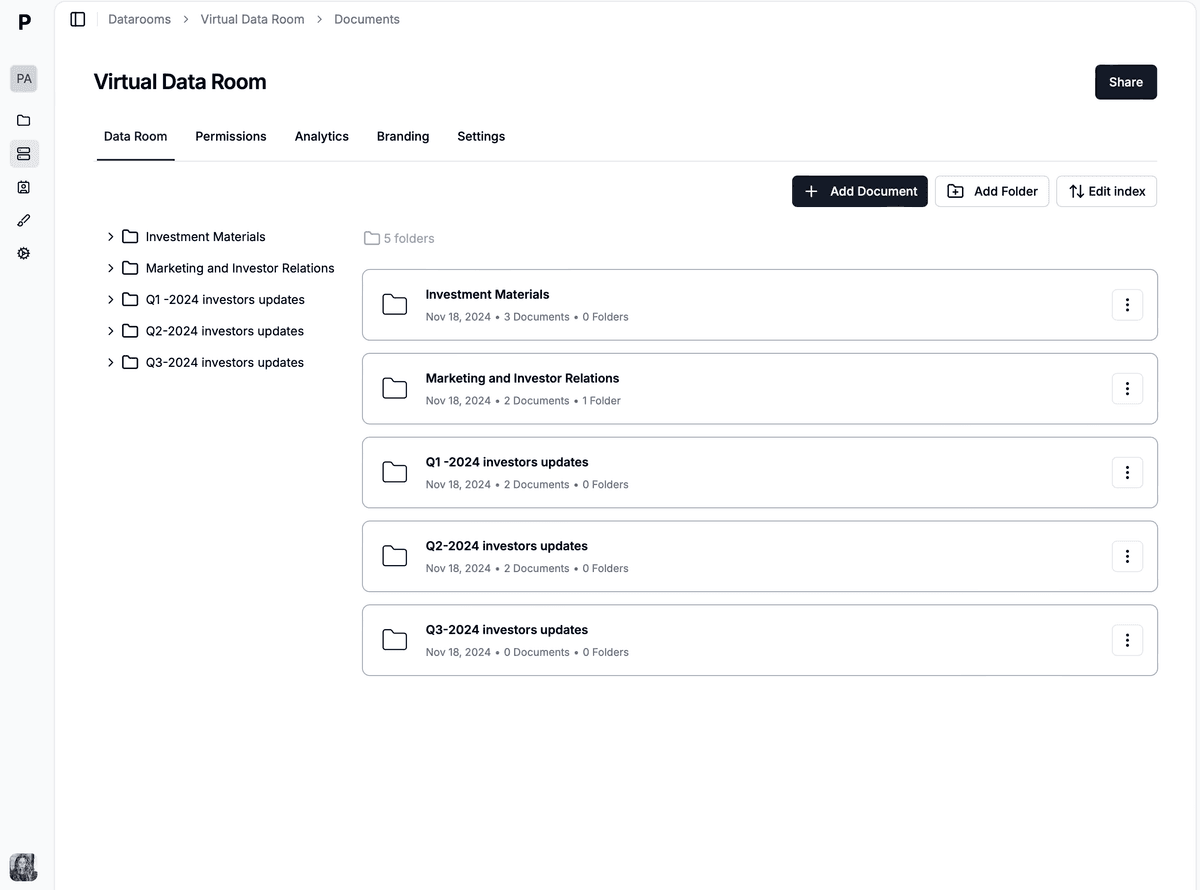
Create the structure the adjustment will be argued over: monthly balance sheets, the working capital calculation by month, the normalisation schedule, the accounting policies memo, the debt-like schedule, and the supporting detail behind each contested line. That last folder is the one sellers forget, and it holds the stock ageing report, the receivables ageing, the bonus accrual workings and the deferred revenue schedule.
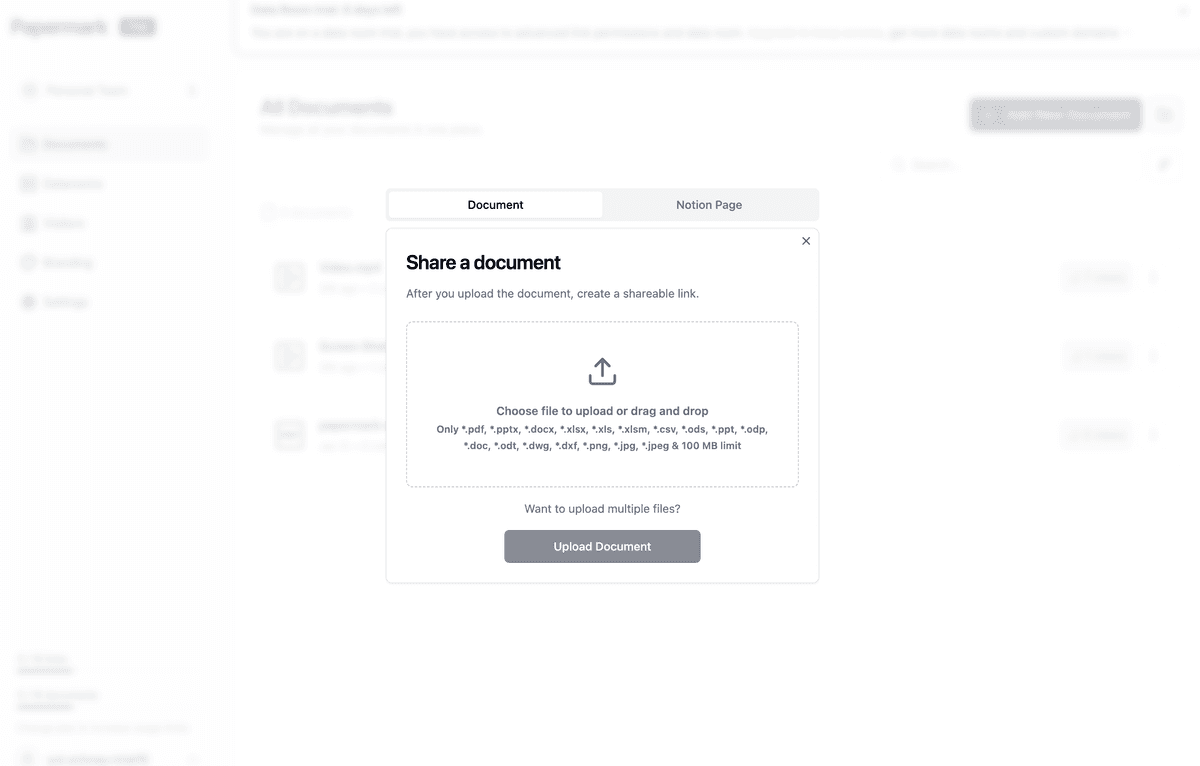
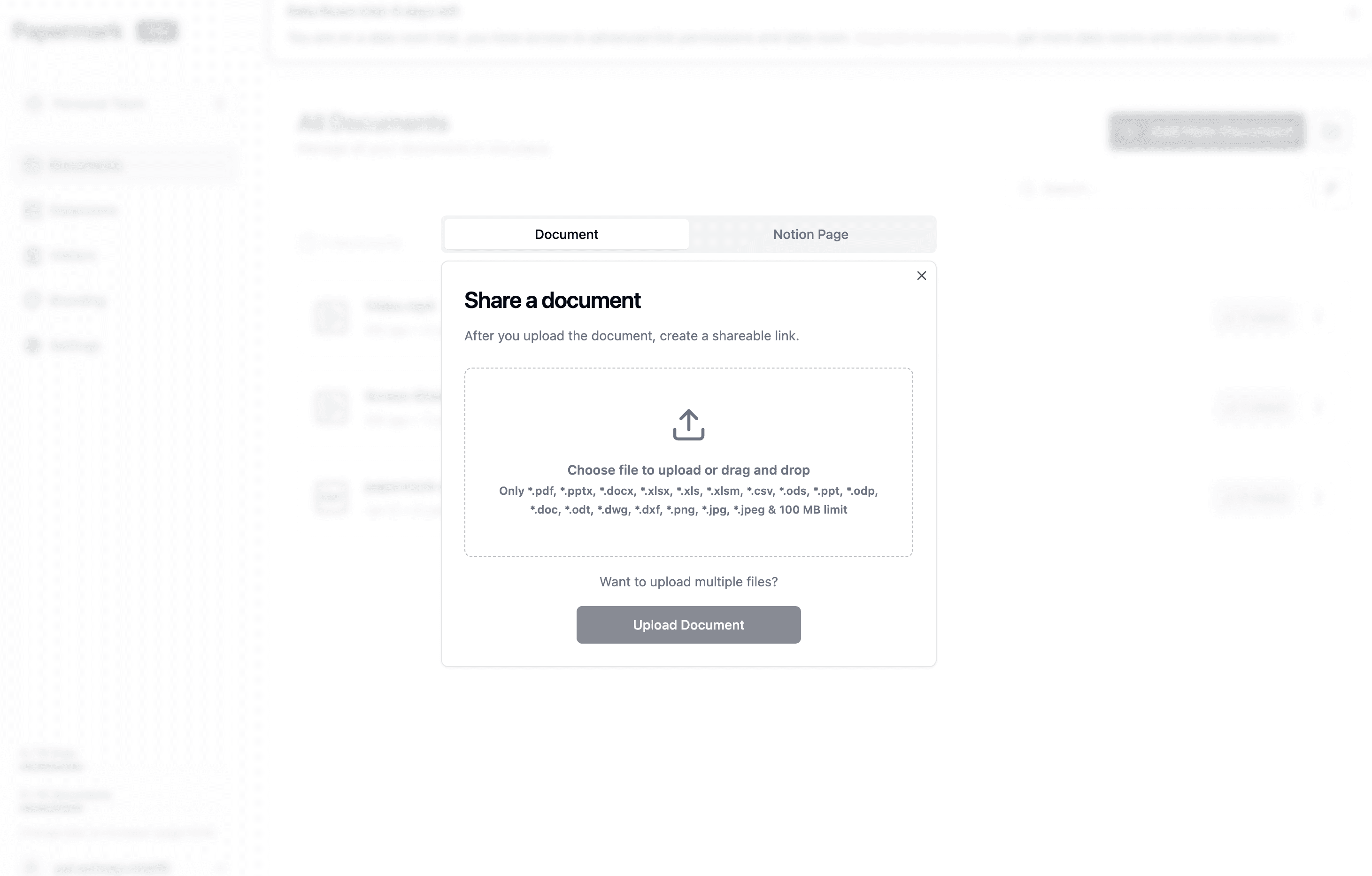
Upload the tree in bulk by dragging it straight in. Automatic file indexing on the Data Rooms Plus plan maintains the index as new schedules arrive, because requests come in waves.
Step 2: give each reviewer their own scope
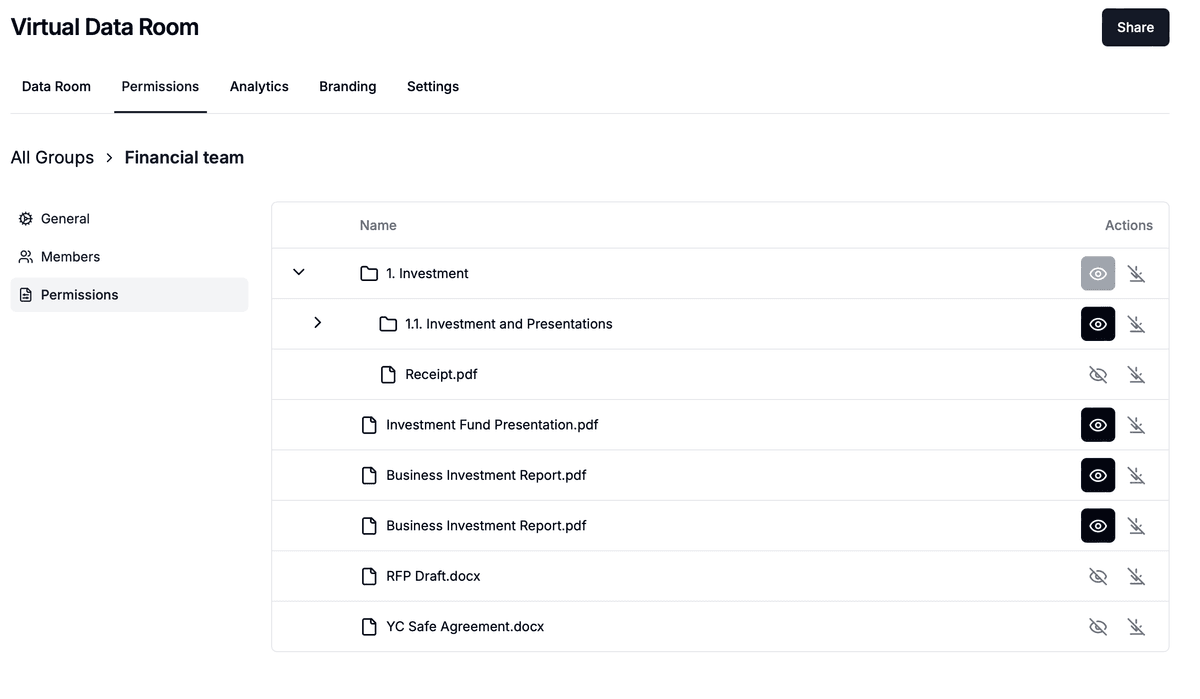
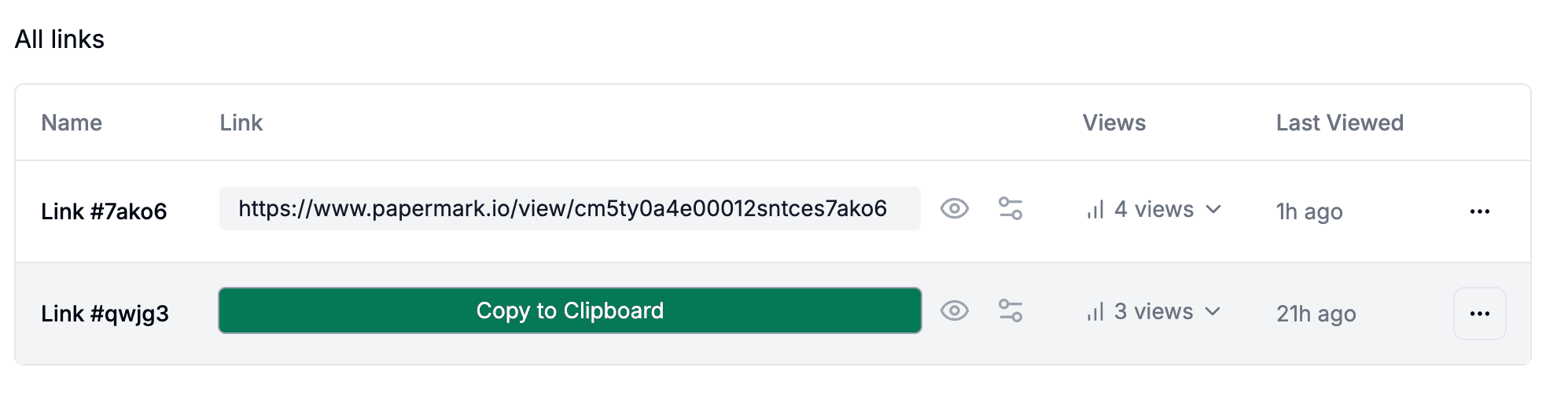
The parties working on a working capital adjustment do not need the same access. Granular file-level permissions are set per link rather than per user, so each party gets its own folder scope, email allowlist and download rule.
Access is link-based, so no reviewer has to create an account. That removes the most common source of friction with senior advisers, and it is one reason M&A teams leave systems that force account creation.
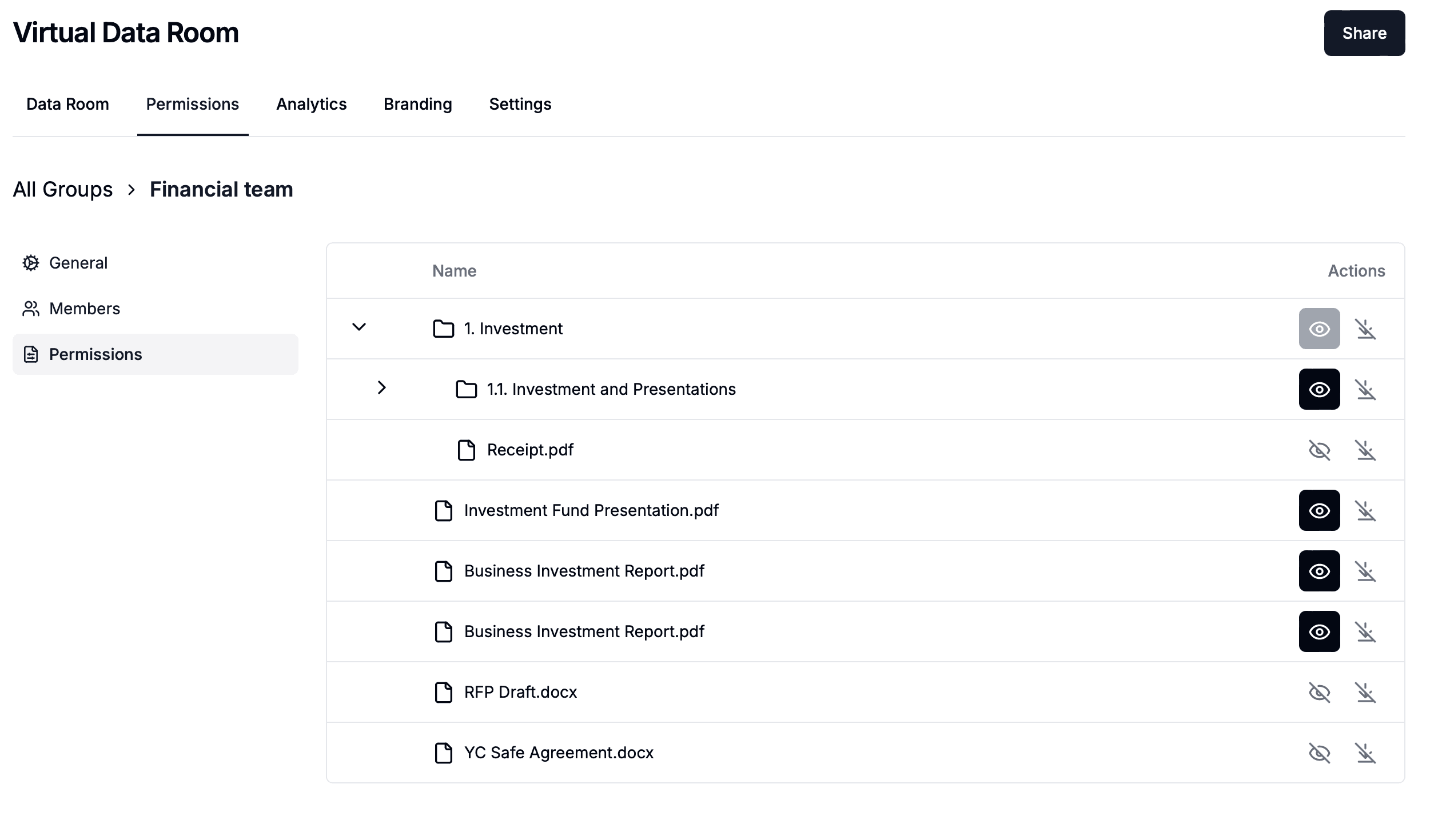
Permissions are set per link, so the lender and the earnings team see different folders of the same financial data set.
Step 3: version every schedule instead of overwriting it
Working capital schedules get revised more often than any other diligence document. Replace a file rather than uploading a second copy under a new name, and document versioning with notifications keeps the prior version addressable while alerting reviewers that the current one changed. When the closing statement applies an inventory reserve, the seller has to show which version of the ageing report the peg was built from. Overwritten files in a shared drive cannot answer that.
Step 4: read the analytics while diligence is still running
Page-level analytics show which reviewer opened which schedule, when, and for how long. During diligence that is a scoping signal: a team which has spent an hour in the inventory folder is building a position. After closing it becomes evidence, because the per-visitor audit log records that the buyer's accountants opened the stock ageing report twice before the peg was agreed, which defeats a reserve applied afterwards.
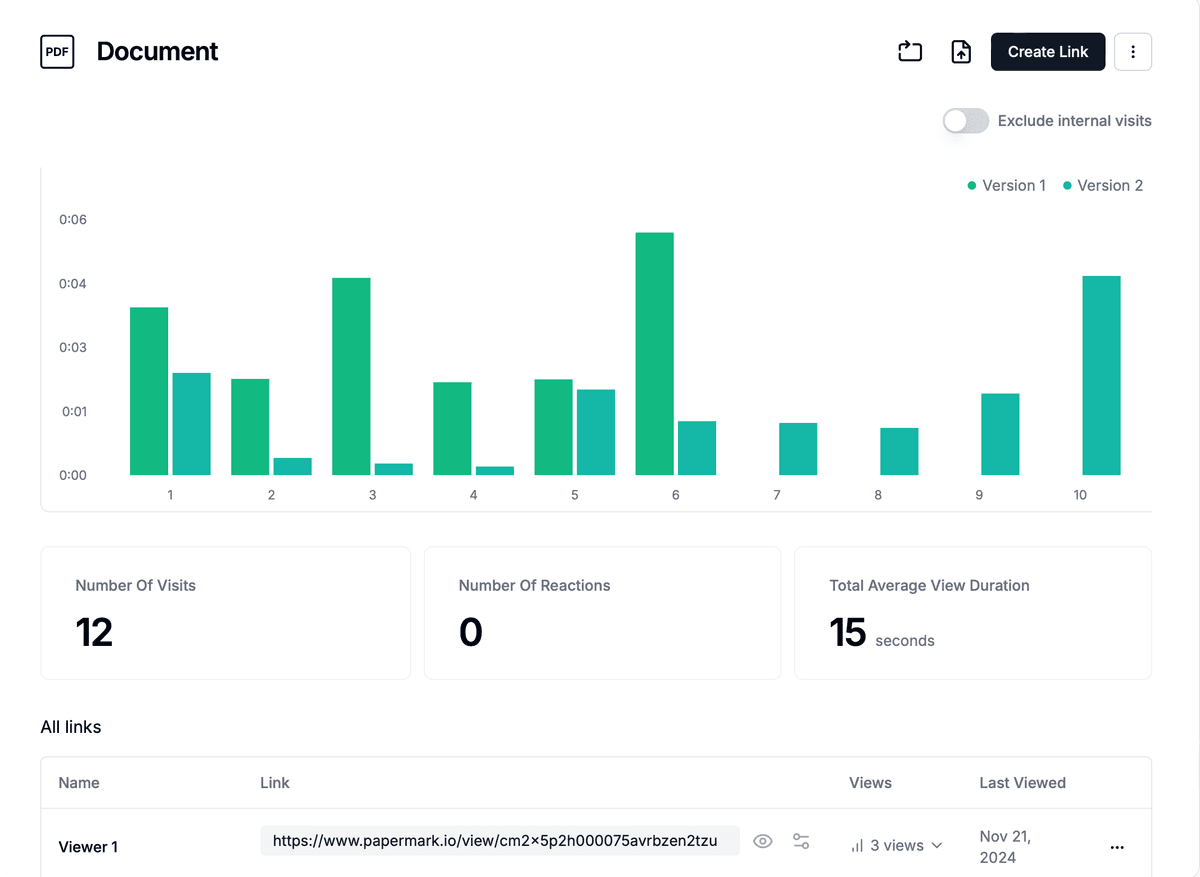
Page-level analytics show who opened the peg schedule and when, which is the record a working capital objection is built on.
Step 5: freeze the room at closing and keep it for the true-up window
At closing, data room freeze makes the room immutable and exports it as an archived ZIP with a certificate. Nothing can be added, removed or edited after that, which is what gives the archive its evidential value: neither side can argue the seller quietly changed a schedule once the closing statement arrived. Keep it accessible for the full cycle, roughly six months from closing.
Papermark is our #1 VDR provider for M&A transactions right now. In two deals we used custom branding, dynamic watermarking, and granular permissions.
The Data Rooms plan is €99/month with a 7-day free trial and includes 3 team members, unlimited data room visitors, unlimited data rooms, unlimited documents, custom domain, dynamic watermarking, NDA agreements, and granular file-level permissions. Data Rooms Plus at €249/month adds 5 team members, the Q&A module, the audit log, automatic file indexing, and SOC 2 Type II. The audit log matters most here, because it converts "we shared that schedule in March" into a dated per-visitor record. Premium at €549/month adds 10 team members, AI redaction, the REST API and SSO. Data Rooms Unlimited at €999/month removes per-seat charges entirely, so teams that add reviewers mid-deal pay one number regardless of headcount, and it carries every Premium capability including AI redaction.