
mergers-and-acquisitions
Entrepreneurship Through Acquisition 2026: 8 Steps and the Owner Trap
Entrepreneurship through acquisition in 2026: four search models, SBA financing up to $5M, an 8-step process, and the data room for an ETA acquisition.
An independent sponsor is a dealmaker who finds and signs an acquisition first, then raises the equity to close it, one deal at a time. There is no committed fund behind the signature. The economics are earned per transaction through a transaction fee, a management fee, and a negotiated promote.
The model has moved from a workaround into a recognised part of the lower middle market, because a sponsor with four repeat capital partners can fund a deal faster than a fund whose investment committee meets fortnightly. What has not become standard is the economics: every deal negotiates its own fee stack, and that negotiation happens after the letter of intent is signed, while exclusivity runs and the sponsor has already paid for lawyers and a quality of earnings report.
Running a deal-by-deal process means putting the same target documents in front of five competing capital partners while the lender and the diligence providers need something different again. A data room for independent sponsors handles that with one link per party. Section 9 covers the setup step by step.
An independent sponsor is an individual or small team that sources, negotiates, and leads the acquisition of a private company without a committed pool of investor capital behind them. They do what a private equity firm does, in the same order, except that the fundraising step moves into the middle of a live transaction. The older name, fundless sponsor, means the same thing and is still used by lenders and lower middle market intermediaries.
The distinction that matters is against the two adjacent models. A traditional private equity firm raises a blind-pool fund first, charges a fee on committed capital, and deploys it across ten or twelve platform investments. A search fund raises searcher capital to fund a full-time hunt for one company, with the searcher usually intending to run it. An independent sponsor sits between the two: transaction-led like private equity, deal-by-deal like a search fund, and typically not taking the chief executive seat.
That produces a specific profile. Most independent sponsors come out of private equity, investment banking, or an operating career in a defined sector, and they lead with a thesis they can prove rather than a fund they can point to. Sector knowledge is the differentiator, because a capital partner is underwriting the sponsor's judgement about one company, not a portfolio construction plan.
The trade-off is worth stating plainly. The sponsor keeps control of what they buy, but carries deal costs at risk, has no assured income between transactions, and negotiates economics from a weaker position than a fund manager whose terms were agreed before any deal existed.
The sequence defines the model. The sponsor sources a target, builds conviction, negotiates price and terms, and signs a letter of intent. Only then does the equity raise begin in earnest, and everything downstream is a race between three parallel workstreams: confirmatory diligence, debt financing, and the equity syndication.
Exclusivity is the constraint. A typical letter of intent grants 60 to 120 days, and the sponsor has to complete diligence, secure a debt commitment, and close the equity inside that window. The raise alone commonly adds 30 to 60 days without pre-existing capital relationships, which is why bankers ask about capital certainty before granting exclusivity at all.
Experienced sponsors solve this by pre-building the relationship rather than raising faster. A small group of capital partners who have already reviewed the thesis, agreed indicative terms, and diligenced the sponsor personally can turn a deal package around in one to two weeks. Three such relationships is the working minimum; five is comfortable. Presenting that group to the intermediary as capital certainty closes most of the speed gap against a funded buyer.
The other half of the process is proving the target. Capital partners underwrite the company, not the pitch, so the sponsor runs a miniature sell-side process on the buy side: the same financials, the same quality of earnings report, and the same customer analysis go to several competing investors at once. The M&A due diligence checklist is the right starting point for what that package contains. What those partners get in return for tolerating deal-by-deal economics is optionality: they see the company before committing and pay no fee on capital sitting uninvested, which is also why the promote is harder to defend than a fund's fixed carry.
Independent sponsor compensation is built in three layers, and confusing them is the fastest way to misread a term sheet. The transaction fee pays for work already done, the management fee funds overhead during the hold, and the promote is the only layer that rewards the outcome.
The transaction fee, sometimes called a closing fee, is expressed as a percentage of enterprise value. Convention runs roughly 1 to 4 percent, with most lower middle market deals settling around 2 to 3 percent and smaller transactions quoted as a fixed amount in the low hundreds of thousands. The shift in recent years is that capital partners now require a portion of that fee, sometimes a majority, to be rolled back into the deal as sponsor equity. The logic is alignment: an investor writing an eight-figure cheque does not want the sponsor's best day to be the closing day.
The management fee covers board work, reporting, add-on sourcing, and oversight. Unlike a fund, an independent sponsor ties it to the portfolio company's earnings: usually the greater of a floor amount and a percentage of EBITDA, with a cap. Lenders normally insist it be subordinated to debt service.
| Layer | When paid | Typical market range | What it is really for |
|---|---|---|---|
| Transaction fee | At closing | 1 to 4 percent of enterprise value, commonly 2 to 3 | Recovering sourcing and deal costs already spent |
| Fee roll | At closing | Often 40 to 80 percent of the transaction fee | Alignment; converts cash fee into sponsor equity |
| Management fee | Annually during the hold | Greater of a floor or 3 to 5 percent of EBITDA, capped | Funding sponsor overhead between transactions |
| Preferred return | At distribution | 8 percent cumulative is the common convention | The capital partner's hurdle before promote is paid |
| Promote | At exit or on distributions | 10 to 20 percent first-time, higher with track record | The only layer that pays for performance |
The promote, or carried interest, is where the negotiation actually happens. A fund's carry is fixed in its partnership agreement before any investment exists. An independent sponsor's promote is agreed on a live transaction, against a capital partner who knows exactly how much the sponsor has already spent and what happens to that money if the deal breaks.
The capital stack is assembled from sources that behave very differently, and part of the sponsor's craft is knowing which combination fits which target. An asset-light business with predictable cash flow carries more senior debt and needs less equity; a cyclical manufacturer with lumpy earnings gets a smaller debt commitment and a capital partner who wants more control.
Family offices are the most common equity partner in the segment. They commit quickly, they are not managing a deployment pace, they often have operating experience in a sector, and their hold horizons are longer than a fund's. The trade-off is variability: processes range from one decision-maker who answers in 48 hours to a committee that behaves like a fund.
Private equity funds also act as capital partners, particularly funds wanting exposure to deals below their normal size threshold. They bring institutional process and follow-on capital for add-ons, and they take the most aggressive stance on promote, because they are being asked to pay carry to someone else out of the same profit their own investors expect.
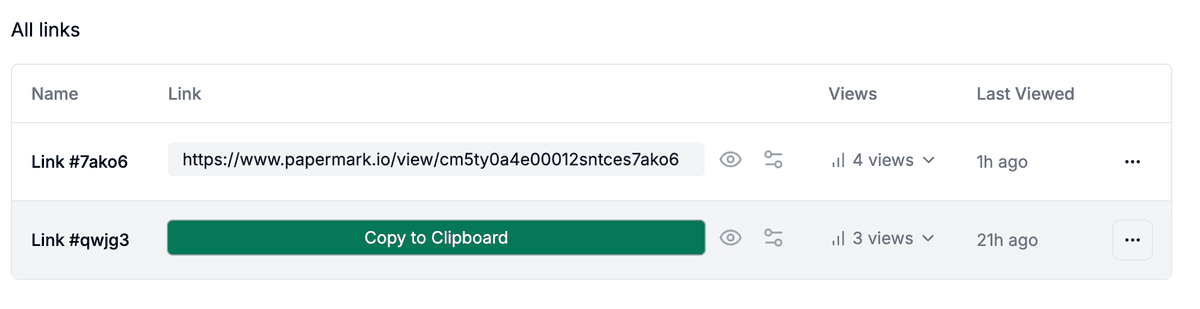
One link per capital partner keeps competing investors in the same data room without any of them seeing the others.
Debt sits underneath. Senior lenders include commercial banks with sponsor finance groups, lower middle market credit funds, and SBIC funds licensed by the Small Business Administration, which use SBA-guaranteed leverage to lend at a scale their own capital would not support. Mezzanine and private credit providers fill the gap between senior debt and equity, usually with a small warrant package, and some will also write the equity cheque. SBA 7(a) loans can finance smaller US acquisitions outright, though the personal guarantee makes them a different proposition entirely.
| Capital partner | Speed to commit | Control appetite | Stance on promote |
|---|---|---|---|
| Family office | 1 to 4 weeks | Low to medium; often a board seat only | Most flexible; will pay for sector expertise |
| PE fund as capital partner | 3 to 8 weeks | High; expects governance rights | Toughest; pushes tiers and a low base |
| Dedicated sponsor-equity provider | 1 to 3 weeks | Medium; standardised terms | Template driven, limited negotiation |
| Mezzanine or private credit | 2 to 6 weeks | Low; covenant driven | Not applicable, but warrants dilute equity |
| High-net-worth individuals | 2 to 8 weeks | Low each, high coordination cost | Flexible, but many small cheques to manage |
Speed and promote flexibility move together, and both track the depth of the relationship rather than the type of institution: a family office backing the sponsor for the third time moves in a week, while the same office meeting the sponsor for the first time behaves like anyone facing a stranger with a ticking clock.
The trap is not that promote percentages are low. It is that the headline percentage is the least important number in the waterfall, and first-time sponsors negotiate hard on the headline while conceding the structure that decides whether it is ever reached.
A distribution waterfall runs in four stages. Return of capital comes first: everyone gets their invested equity back pro rata. Then the preferred return, where the capital partner receives a cumulative annual return on that capital before the sponsor sees any profit share, with 8 percent the common convention. Then a catch-up, if one has been negotiated, where the sponsor takes a disproportionate share of the next dollars until the split reaches the agreed ratio. Then the residual split at the promote percentage.
The catch-up decides everything, and it is the clause most often traded away. Without it, a stated 20 percent promote applies only to profits above the hurdle. With a full catch-up, the sponsor eventually earns 20 percent of all profits, including those that funded the pref. On a five-year hold at a moderate return the difference can be a third or more of total promote, and it never appears in the headline number.
Tiered promotes are the second half of the trap. A structure reading "15 percent to 2.0x, 20 percent from 2.0x to 3.0x, 25 percent above 3.0x" sounds generous because the top number is big, but most lower middle market deals exit between 2.0x and 2.5x, so the sponsor spends the whole hold earning the bottom tier. A flat promote set at the multiple the deal is likely to reach is often worth more than a ladder whose upper rungs are decorative.
| Waterfall term | Sponsor-friendly version | Capital-partner-friendly version | Why it matters |
|---|---|---|---|
| Preferred return | 8 percent simple, non-compounding | 8 percent compounded annually | Compounding over a 5 year hold raises the hurdle materially |
| Catch-up | 100 percent catch-up to the promote ratio | No catch-up; promote applies above the pref only | Usually the single largest swing in sponsor economics |
| Tier structure | Flat promote at the realistic exit multiple | Low base tier with step-ups above 3x | Upper tiers rarely trigger in the lower middle market |
| Fee offset | None, or partial against management fee | Transaction and management fees credited against promote | Can turn a headline promote into a much smaller net |
Two other clauses deserve a careful read: a joint-and-several clawback across a two-person team is a genuine personal risk, and removal rights that let the capital partner replace the sponsor without cause decide whether the promote survives a disagreement in year three. The defence against all of it is to model the waterfall at three exit cases before agreeing anything, running the actual dollar promote at 1.3x, 2.0x, and 3.0x under each proposed structure. Sponsors who do this routinely find they would rather have a lower headline promote with a catch-up than a higher one without.
The operational reality is seven overlapping stages compressed into an exclusivity window that was never generous. The sponsor is simultaneously the buyer, the fundraiser, and the project manager of three diligence streams, and the failure mode is almost always coordination rather than analysis. Sourcing itself runs continuously, mostly through business brokers, lower middle market intermediaries, and networks built during a previous operating or banking career.
Once the letter of intent is signed, the capital raise and diligence run in parallel, and document control stops being administrative and becomes commercial. Five prospective capital partners are looking at the same model, quality of earnings report, and customer concentration analysis at once, and none of them should know who the others are. A data room for independent sponsors solves that with separate links over one document set, and the analytics show which investor has read the model rather than which one says they have.
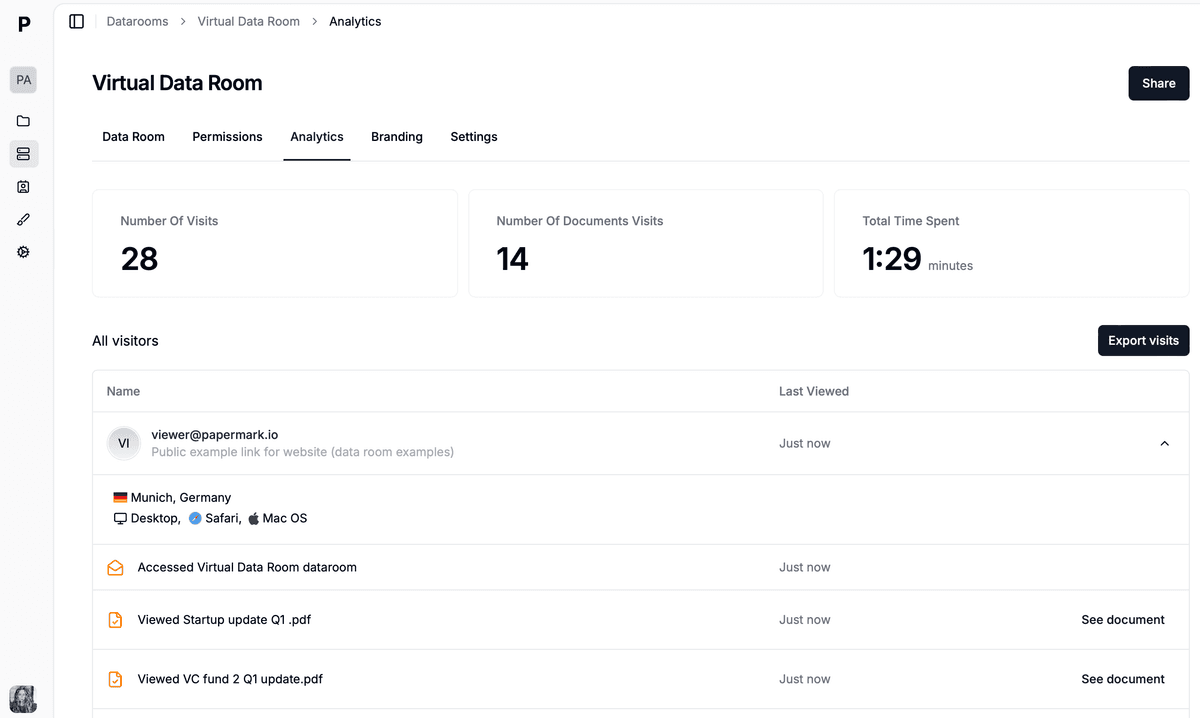
Page-level analytics show which prospective capital partner opened the model and how long they spent, weeks before they say anything.
Confirmatory diligence is the same workstream a funded buyer runs, and trimming it because the equity is not yet committed is a false economy. A quality of earnings report is effectively mandatory: the lender requires it, and it is the document capital partners read first. The sponsor pays for all of it before knowing whether the deal will fund.
| # | Stage | Typical duration | Where deals break |
|---|---|---|---|
| 1 | Sourcing and thesis | Continuous | No differentiated thesis to sell to capital later |
| 2 | LOI and exclusivity | 2 to 4 weeks to sign | Exclusivity too short for a deal-by-deal raise |
| 3 | Capital raise | 30 to 60 days | No pre-built relationships; terms renegotiated late |
| 4 | Confirmatory diligence | 45 to 75 days | Earnings quality findings reset the price |
| 5 | Debt financing | 45 to 90 days | Leverage commitment lands below the model |
| 6 | Documentation | 3 to 6 weeks | Waterfall terms reopened at the last minute |
| 7 | Closing and funding | 1 to 2 weeks | Working capital true-up disputes |
Two things separate sponsors who close from sponsors who do not: having the capital conversation before the letter of intent, and refusing to reopen economics late. A capital partner who renegotiates the promote in week nine of a twelve-week exclusivity is testing whether the sponsor has an alternative, and the sponsor who kept two other partners warm in the same room has one.
Marlow Ridge Partners is a hypothetical two-person independent sponsor focused on industrial distribution. The team signs a letter of intent to acquire Hallam Filtration Systems, a filtration components distributor with $4.1M of adjusted EBITDA, at 4.5x enterprise value, or $18.5M, with 90 days of exclusivity.
The capital stack comes together as $19.6M of total sources, covering the purchase price plus transaction expenses and closing working capital. A lower middle market credit fund commits $9.0M of senior debt at 3.3x EBITDA and a mezzanine provider adds $2.8M with warrants. A family office that has seen two previous Marlow Ridge deals writes the $7.0M equity cheque eleven days after receiving the package. Marlow Ridge invests $800K: $570K in cash and $230K from rolling half of its $460K transaction fee.
Worked scenario. The sponsor's $800K co-investment includes $230K of rolled transaction fee, which is the alignment term the family office required before committing.
Marlow Ridge takes a management fee set at the greater of $250K or 5 percent of EBITDA, capped and subordinated to debt service. The promote opens at 15 percent above an 8 percent cumulative preferred return, with a full catch-up, stepping to 20 percent above 2.5x invested capital.
The negotiation that mattered was not the 15 percent. The family office's first draft carried a 20 percent promote with no catch-up, and modelled at a 2.0x base case exit in year five that structure paid Marlow Ridge less than the 15 percent version with a full catch-up. The sponsor traded five headline points for the catch-up clause and gave up ground only above 3.0x, which this business was never likely to produce. Throughout, four prospective capital partners reviewed the same twelve core documents through four separate links, and none knew who the others were.
The most expensive mistake is signing a letter of intent before the capital conversation has happened. Every week spent finding a partner after exclusivity begins is a week not spent on diligence, and the sponsor reaches the economics negotiation with money already sunk and a deadline visible to everyone. The fix is unglamorous: build three to five capital relationships and agree indicative terms before there is a specific deal to argue about.
The second is negotiating the headline promote and ignoring the waterfall mechanics. A 20 percent promote with no catch-up, a compounding preferred return, and a full fee offset is worth less in most realistic exit cases than 15 percent without those features. Model the dollar outcome at 1.3x, 2.0x, and 3.0x, then negotiate the clause that moves the base case rather than the headline.
The third is underestimating personal capital. Between broken deal costs, quality of earnings work, and the co-investment capital partners now expect at closing, the cash needed before a first deal produces income routinely runs into the low hundreds of thousands.
The fourth is treating the capital raise as a pitch rather than a diligence process. Capital partners are underwriting a specific company, so they want the quality of earnings report, the customer concentration analysis, and the working capital history, not a deck. Emailing that material to five competing investors is how version confusion and accidental cross-disclosure happen. A data room for independent sponsors with per-link permissions removes both risks, and our data room checklist covers what belongs in it.
The fifth is neglecting the seller's view of capital certainty. Intermediaries screen for it, and a sponsor who cannot name their capital partners will lose competitive processes to funded buyers regardless of price. Owners on the other side of that table can use our guide on selling to private equity for what to ask about a buyer's funding.
A data room for independent sponsors carries a workload that neither a standard sell-side room nor a fundraising room handles alone. It has to sell one transaction to competing capital partners, host confirmatory diligence for lenders and advisors, and keep those audiences separated, all inside a single exclusivity window.
The complication is that the sponsor does not own the documents. Most of the material belongs to the seller under a confidentiality agreement limiting who it can be shown to, so emailing a financial model to five prospective investors is both a control problem and frequently a contractual one.
Papermark is a secure, fully customizable, and developer-friendly data room built for modern dealmakers, with page-by-page analytics, dynamic watermarking, and transparent pricing (open-source and self-hosting available).
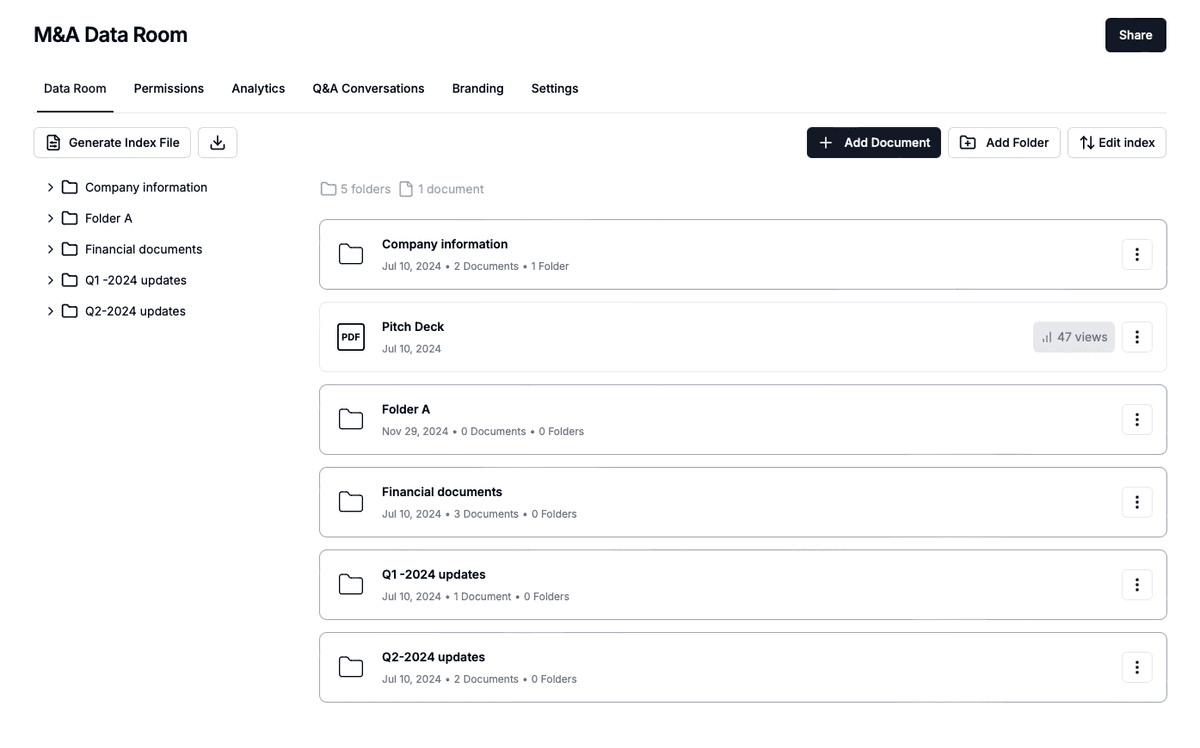
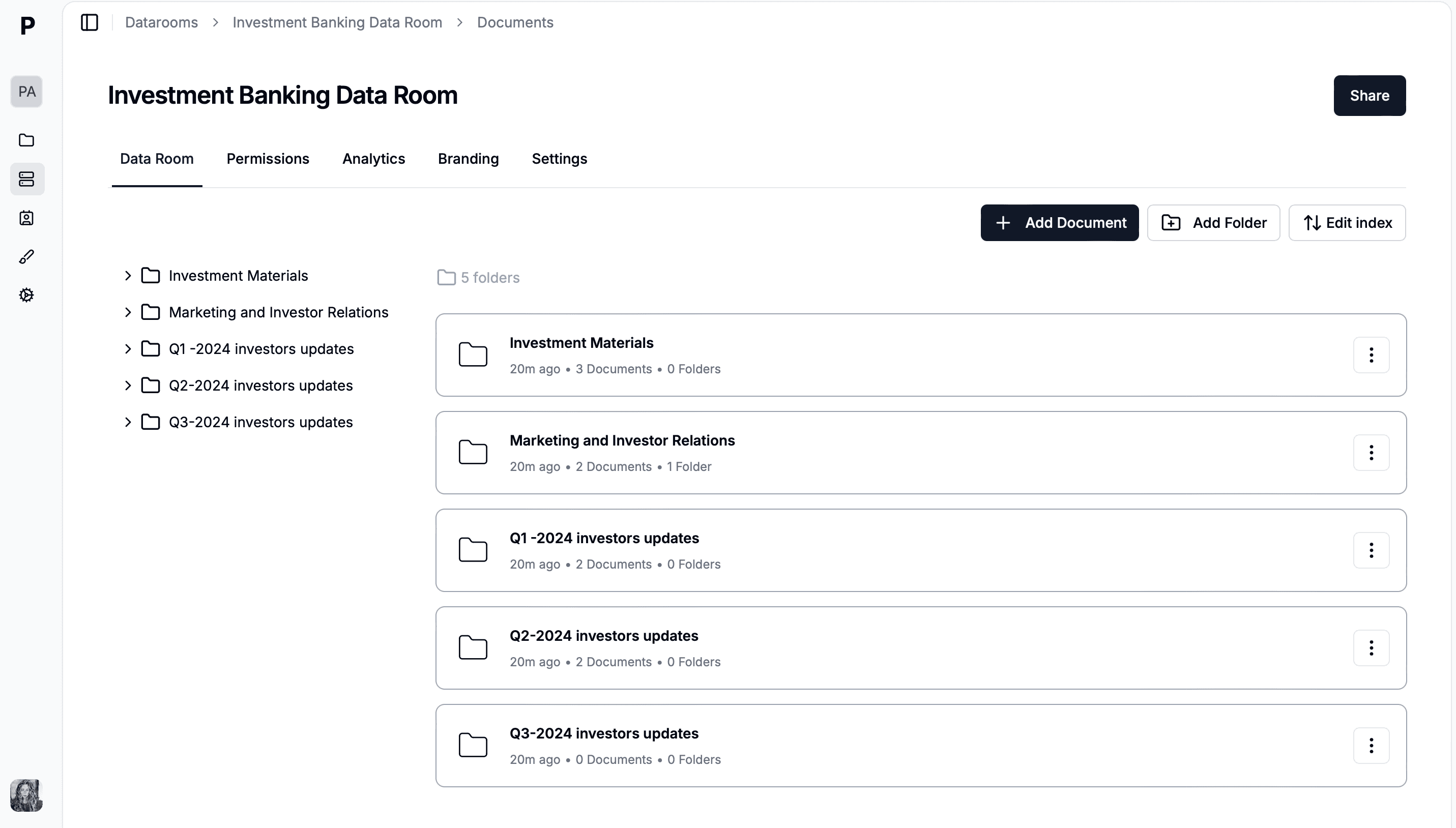
One room per deal, with folders split between the capital partner package and the confirmatory diligence set.
Deal-by-deal fundraising has a structural problem funded buyers do not have: the same confidential material goes to several parties competing with each other, at the same time, on someone else's documents. If you are still choosing a platform, our comparison of the best virtual data rooms covers pricing model, bidder management, and compliance across the main providers.
Competing capital partners must not see each other. Four investors reviewing the same model should have no visibility into who else is looking or how far along they are. Link-based access gives each one its own scoped entry over a single set of files, so there is no shared folder and no accidental disclosure that a rival is in the process.
The capital partner package and the diligence set are different documents. Prospective investors need the memorandum, the model, the quality of earnings summary, and the customer analysis. Lenders need the debt schedule, collateral detail, and historical financials. Advisors need the legal and tax folders. One room with folder-level permissions serves all three.
You are handling the seller's confidential information under someone else's agreement. A data room for independent sponsors with watermarking, download control, and a per-visitor audit log lets the sponsor show exactly who saw what and when, which is what the seller's counsel eventually asks.
Engagement data changes how you run the raise. Knowing that one family office spent forty minutes in the model and another never opened it is the difference between chasing the right investor and chasing all of them. That signal arrives weeks before anyone puts it in writing.
The rest of this section is the practical setup: five steps to build a data room for independent sponsors that handles all four.
Structure the top level by audience rather than document type: a capital partner package, a confirmatory diligence set, a debt financing folder, and a legal folder. That split makes differentiated access possible without duplicating files.
Upload by dragging the folder tree in whole. Automatic file indexing on Data Rooms Plus builds and maintains the index as documents arrive, which matters because seller material lands in waves.
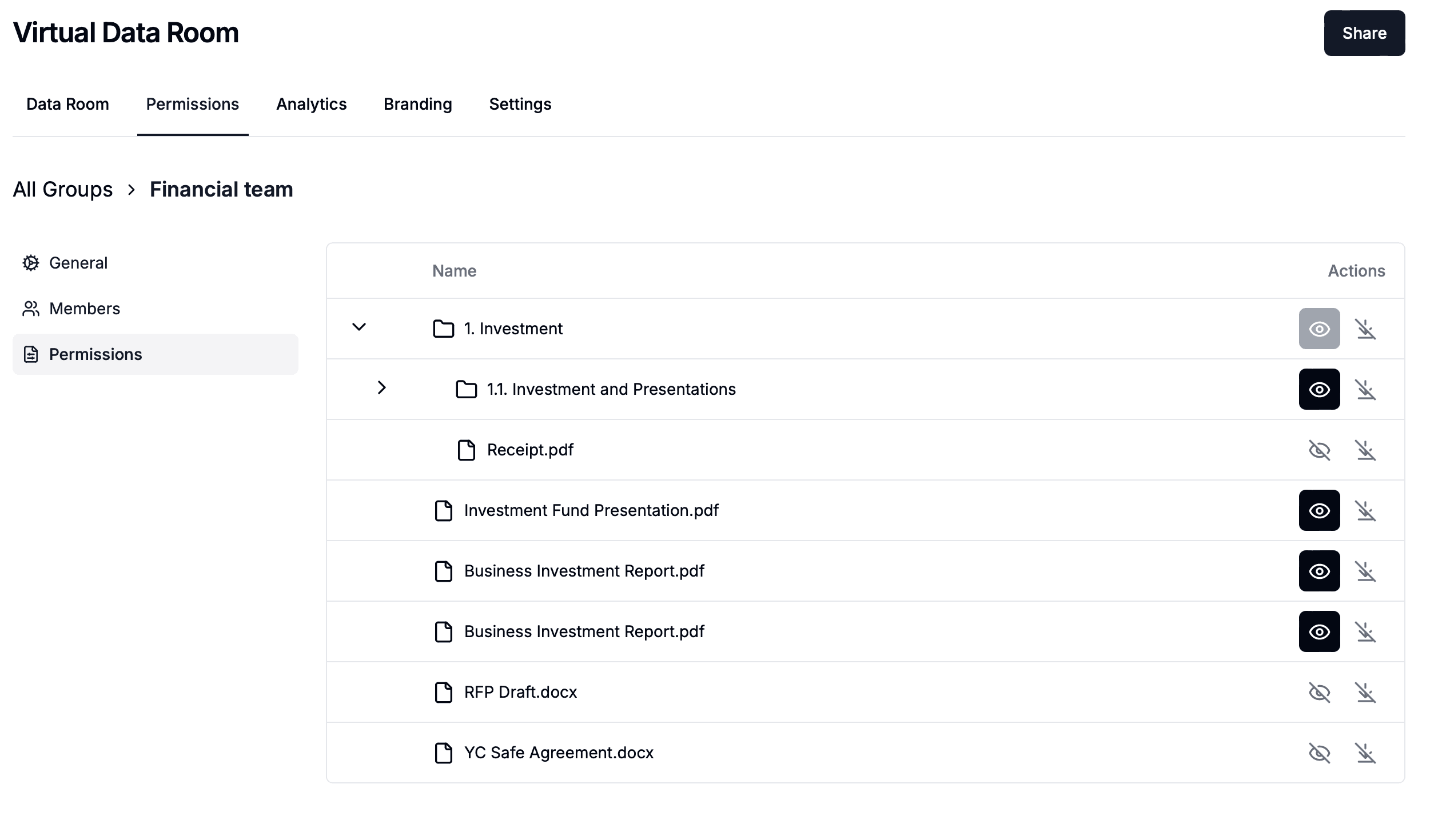
This is the step that defines a data room for independent sponsors. Each prospective investor, each lender, and each advisor gets a separate link carrying its own folder scope, email allowlist, and download rule. Prospective capital partners get the package only, view-only and watermarked; the committed partner gets the diligence set too; the lender gets financials, debt schedule, and collateral; the quality of earnings provider gets the financial folder; counsel gets everything.
Granular file-level permissions are set per link rather than per user, so revoking one investor after they pass costs a single click and affects nobody else. Access is link-based, so no capital partner has to create an account, which removes the friction that makes a busy family office principal put a deal aside.
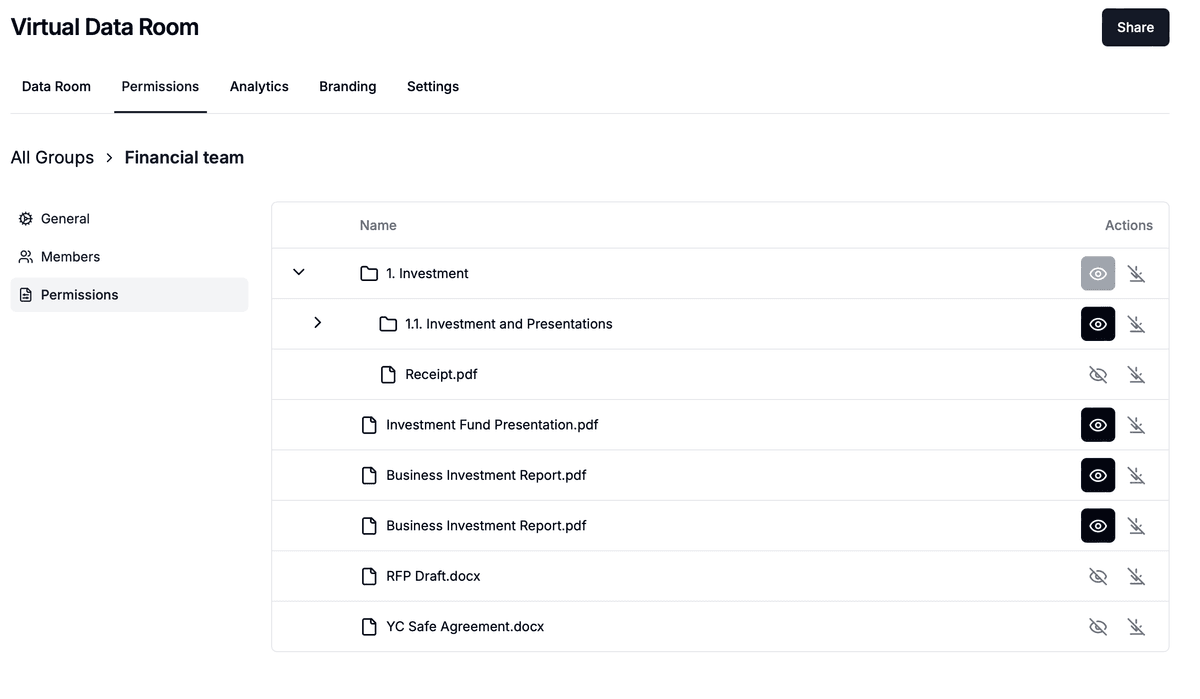
Permissions are set per link, so the lender and the prospective equity partner see different folders of the same room.
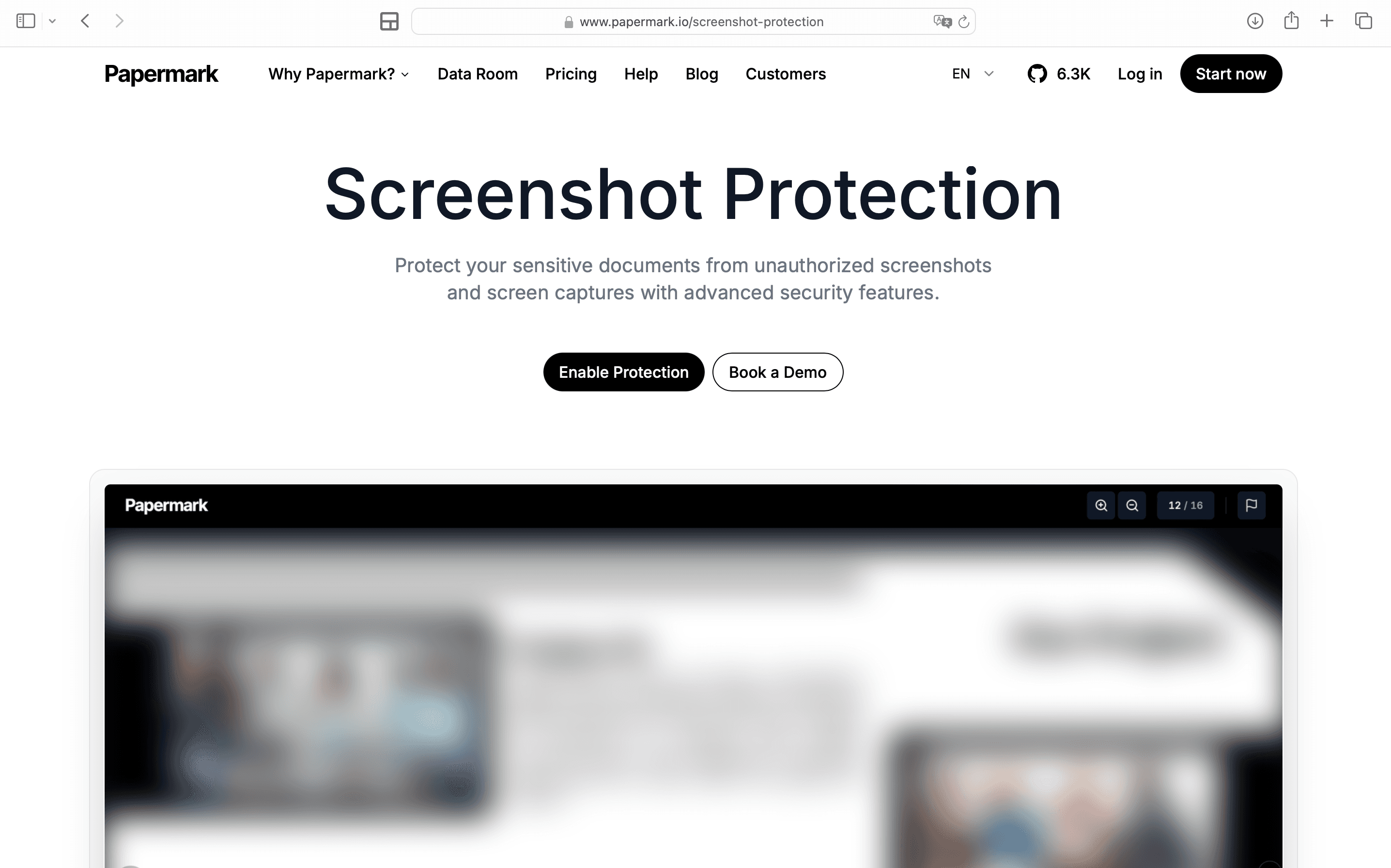
Turn on dynamic watermarking across the capital partner package, which stamps every page with the viewer's email, IP address, and timestamp as it renders. Set the pre-commitment folders to view-only, and add screenshot protection on the model and the customer concentration analysis.
Where the confidentiality agreement requires it, gate the room behind NDA agreements so each investor accepts terms before any file opens. A downloaded file is legally treated as read and no platform can recall it, which is exactly why download stays off until a partner is committed.
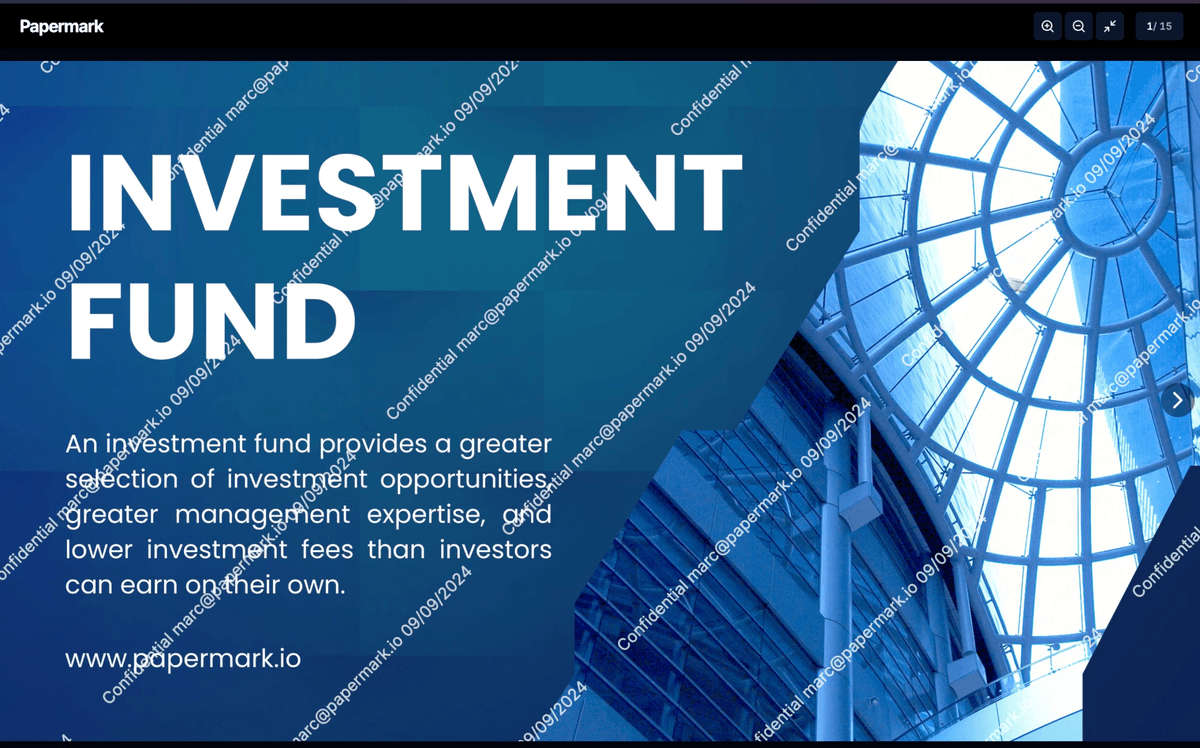
Dynamic watermarking renders viewer identity onto every page, which makes any leak traceable to a named capital partner.
Capital partner questions overlap heavily: three investors ask the same thing about customer concentration in three threads, and the sponsor answers it three times with slightly different wording. That inconsistency becomes a real risk when the answers later sit next to each other in a disclosure schedule.
The Q&A module attaches each question to the document that prompted it, with permissions controlling who sees which threads, so one investor never sees another's questions. Answers can be published to a single party or to everyone, and the whole log exports for the closing file.
Page-level analytics show which party opened which document, when, and for how long. That is the most useful signal available in a deal-by-deal raise: a family office that spent forty minutes in the quality of earnings report is close to a decision, whatever they said on the call.
After closing, data room freeze makes the room immutable and exports it as an archived ZIP with a certificate, and the audit log on Data Rooms Plus keeps the per-visitor session detail.
Papermark is our #1 VDR provider for M&A transactions right now. In two deals we used custom branding, dynamic watermarking, and granular permissions.
Tyler
The Data Rooms plan is €99/month with a 7-day free trial and includes 3 team members, unlimited data room visitors, unlimited data rooms, unlimited documents, custom domain, dynamic watermarking, NDA agreements, and granular file-level permissions. Data Rooms Plus at €249/month adds 5 team members, the Q&A module, the audit log, automatic file indexing, and SOC 2 Type II. Premium at €549/month adds 10 team members, AI redaction, the REST API, SSO, and whitelabeling. Data Rooms Unlimited at €999/month removes per-seat charges entirely, so teams that add reviewers mid-deal pay one number regardless of headcount, and it carries every Premium capability including AI redaction. For a sponsor running two or three live processes, unlimited data rooms means one room per deal with no per-project fee.
No credit card required.
Entrepreneurship through acquisition in 2026: four search models, SBA financing up to $5M, an 8-step process, and the data room for an ETA acquisition.
Working capital adjustment in 2026: how the peg is set, the 5-step true-up, debt-like items, the peg trap, and a data room for a working capital true-up.
HSR filing in 2026: the $133.9M threshold, fees from $35,000 to $2.46M, the 30-day wait, the Item 4(c) trap, and the data room for an HSR filing you run it from.