BlogData RoomsBest AI virtual data rooms for M&A due diligence in 2026 (agentic VDRs compared)
Best AI virtual data rooms for M&A due diligence in 2026 (agentic VDRs compared)
·15 min read
Marc Seitz
Hi, it is Marc, founder of Papermark. I build data room software, and over the last year the question I get most about M&A diligence has changed. It used to be "which VDR is most secure?" Now it is "which AI virtual data room can actually run diligence for me?"
The best AI virtual data rooms for M&A due diligence in 2026 are Papermark (agent-native via a public API, CLI, and MCP server, plus deal-level chat at €99/month), Datasite (enterprise AI diligence), Intralinks (cross-border M&A), Ansarada (predictive bidder signals), DealRoom (M&A playbooks), and V7 (buy-side AI copilot). This guide only covers agentic AI data rooms: platforms where an AI agent can take real actions across the deal, not just summarize a single file. Papermark leads because it is the only one an AI agent can fully operate through a documented public interface.
In an M&A process, the data room is where the deal is won or lost. Buyers, sellers, lawyers, and bankers all live inside it for weeks. An agentic AI data room compresses that work: it organizes the room, answers diligence questions across every contract with citations, and lets an AI agent handle the repetitive setup so your team focuses on judgment, not filing.
This list is deliberately short. I left out file-sharing tools and assistive-only VDRs (semantic search and single-file summaries are table stakes now) to focus on platforms with genuinely agentic capabilities for mergers and acquisitions due diligence.
What is an agentic AI data room for M&A due diligence?
An agentic AI virtual data room is an M&A data room where an AI agent can take actions on your behalf, not just read documents. Instead of only answering questions, the agent can create the room, build the folder structure, set granular permissions, upload and index files, generate share links, and run diligence queries across every contract, then report back with citations. The human stays in control and approves the work; the agent removes the manual filing and first-pass review that slows every deal.
This is the line that separates the platforms below from the rest of the market. Most "AI data rooms" are assistive: they add semantic search and per-file summaries on top of a traditional VDR. That helps, but a reviewer still drives every click. An agentic AI data room exposes its actions to an AI agent (through an API, a Model Context Protocol server, or a built-in workflow engine) so the agent can execute multi-step diligence tasks end to end.
For M&A specifically, agentic capability matters in three places. During prep, the agent stands up a best-practice folder structure and indexes a messy document dump in minutes. During diligence, deal-level chat answers buyer questions across hundreds of contracts at once, citing the exact clause. During management, the agent watches engagement and flags risk while your bankers and counsel make decisions. If you want the broader market view including assistive tools, see our full AI data rooms comparison and the best virtual data rooms for due diligence guide.
Quick recap of the best agentic AI data rooms for M&A
Papermark: the only agent-native AI data room with a public API, CLI, and MCP server, plus deal-level chat and AI folder generation; transparent €99/month pricing and an open-source self-host option.
Datasite: enterprise M&A VDR with AI diligence tooling: semantic search, summaries, bulk redaction, and 17+ language in-room translation.
Intralinks: DealCentre AI (the Link assistant) brings agent-assisted prep, marketing, and diligence to cross-border M&A.
Ansarada: deal-lifecycle platform with AI-Sort, AI-Redact, and AI-Predict bidder engagement signals for sell-side processes.
DealRoom: buyer-led M&A platform with AI deal playbooks and deal-level chat that extracts and cites terms across every contract.
V7: an AI copilot and agent framework that layers on top of your data room for buy-side analysis (not a standalone VDR).
#
Provider
Agent control (API/MCP/CLI)
Deal-level chat
Standout agentic capability
Pricing
1
Papermark
API + MCP + CLI
Agent creates and runs the room; AI folder generation
€99/month flat
2
Datasite
API only
AI redaction + 17-language translation at scale
Quote-based
3
Intralinks
API only
DealCentre AI assistant (Link) across deal phases
Quote-based
4
Ansarada
AI-Predict bidder dropout signals
Quote-based
5
DealRoom
AI deal playbook + contract chat with citations
Quote-based
6
V7 (copilot, not a VDR)
API only
Buy-side AI agents over your existing room
Quote-based
How we evaluated agentic AI data rooms for M&A
I ranked these six platforms against four criteria that decide whether AI actually moves an M&A deal forward, rather than just looking good in a demo.
Agent control, not just AI features. The real test of an agentic AI data room is whether an external AI agent can operate it. Can an agent create a room, set permissions, upload documents, and pull analytics through a documented interface? An API, a Model Context Protocol (MCP) server, and a command-line interface (CLI) are the infrastructure that make this possible. A platform with a chat box but no programmable surface is assistive, not agentic.
Diligence depth across documents. M&A diligence is a cross-document problem. The question is rarely "what does this one file say?" but "where, across 400 contracts, is there a change-of-control clause?" Deal-level chat that answers across the whole room with clause-level citations is worth far more than per-file summaries.
Security and compliance posture. Every platform here must ship AES-256 encryption, granular folder and file permissions, dynamic watermarking, append-only audit logs, and SOC 2. AI features cannot come at the cost of the controls that buyers' counsel relies on. Papermark adds dynamic watermarking and secure file sharing as baseline.
Pricing predictability. Flat-rate pricing (Papermark at €99/month) beats per-page and quote-based enterprise models for almost every deal under a few thousand documents. AI is often metered inside higher tiers, so the capability in a demo is not always in the base price.
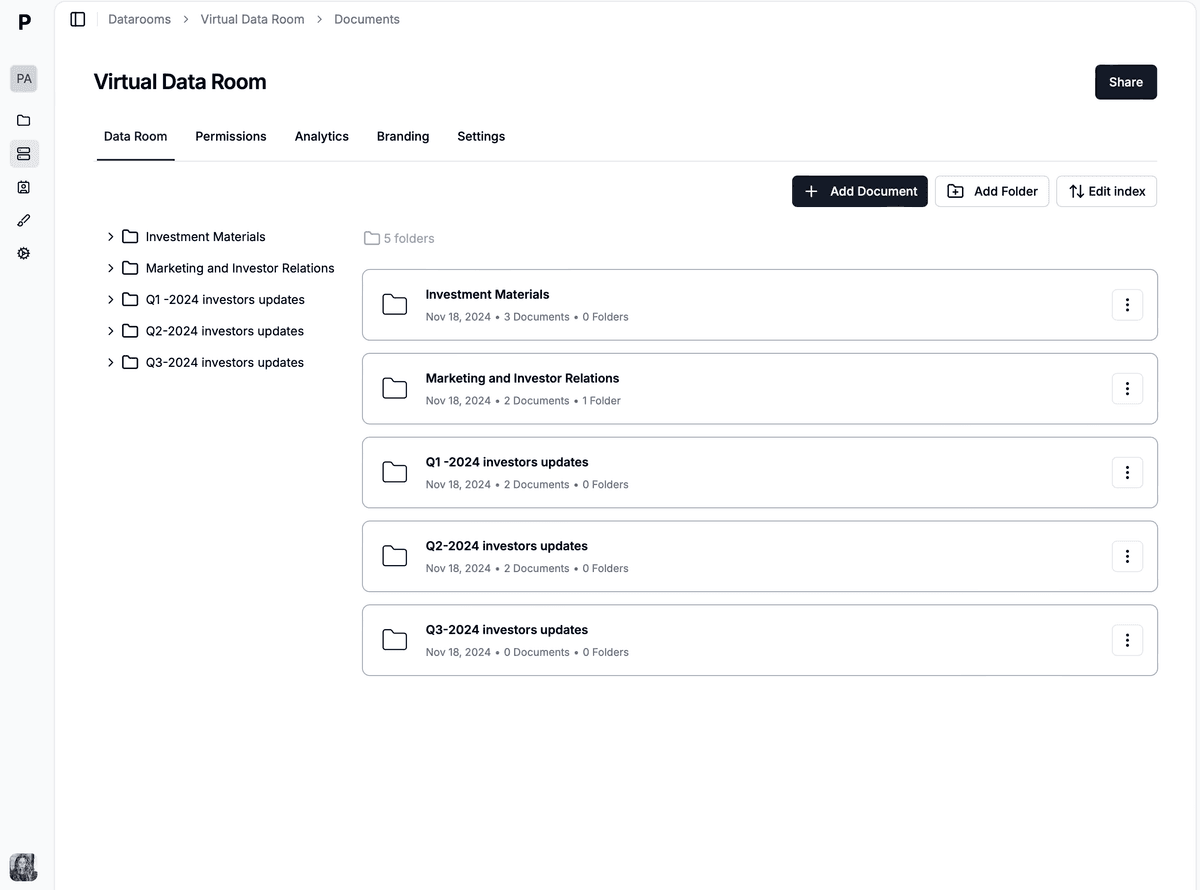
Papermark is a modern, open-source AI virtual data room priced at €99/month flat-rate, and the only platform on this list that an AI agent can fully operate through a documented public interface. It ships a public REST API, a CLI, and a Model Context Protocol (MCP) server, so agents like Claude and Cursor can create rooms, set permissions, upload diligence documents, and read analytics, not just answer questions about files inside one. For M&A teams, that means the repetitive setup and first-pass review can be delegated to an agent while your bankers and counsel keep control. Papermark is best for startups, mid-market M&A, and fundraising teams that want agent-native diligence without enterprise pricing, plus an optional self-hostable open-source deployment for full data sovereignty.
Agent-native by design: API, CLI, and MCP server
This is what makes Papermark genuinely agentic rather than AI-assisted. Every action a human takes in the dashboard is also available to a script or an AI agent through the same interface, all documented in the Papermark docs. There are three ways to integrate, and they share one token and one set of endpoints.
The REST API is the canonical surface. It exposes datarooms, documents, folders, links, viewers, and analytics over HTTP with Bearer-token auth, and the dashboard, CLI, and MCP server all call these same endpoints. Tokens are scoped (for example datarooms.write), and authentication supports an OAuth 2.1 device flow for CI patterns, so you can hand an agent a narrowly permissioned key for a single deal.
The MCP server (@papermark/mcp-server) drops Papermark into any MCP-compatible AI agent, including Claude Desktop, Claude Code, and ChatGPT Apps. The agent can create an M&A data room, upload the document dump, set per-bidder permissions, generate watermarked share links, and report engagement, all from a natural-language instruction. The CLI (papermark on npm) scripts the same workflows from your terminal or a CI pipeline.
Quickstart: give an AI agent control of your M&A data room in under a minute. Generate a PAPERMARK_TOKEN in settings, then pick the surface that fits your workflow:
# 1. MCP - give Claude or Cursor agent control of your data rooms
export PAPERMARK_TOKEN="pmk_..."
claude mcp add papermark -- npx -y @papermark/mcp-server
# the agent can now: "Create a data room 'Project Atlas M&A' and upload these files"

# 2. CLI - script the diligence room setup from your terminal
npm install -g papermark
papermark login
papermark datarooms create "Project Atlas M&A"

# 3. API - create the data room programmatically
curl -X POST https://api.papermark.com/v1/datarooms \
  -H "Authorization: Bearer $PAPERMARK_TOKEN" \
  -H "Content-Type: application/json" \
  -d '{"name": "Project Atlas M&A"}'
The same token and the same endpoints power all three surfaces, so an agent over MCP, a terminal script over the CLI, and your backend over the API stay perfectly in sync. Full setup, authentication, scopes, and the REST reference live in the Papermark docs.
Deal-level chat across every contract
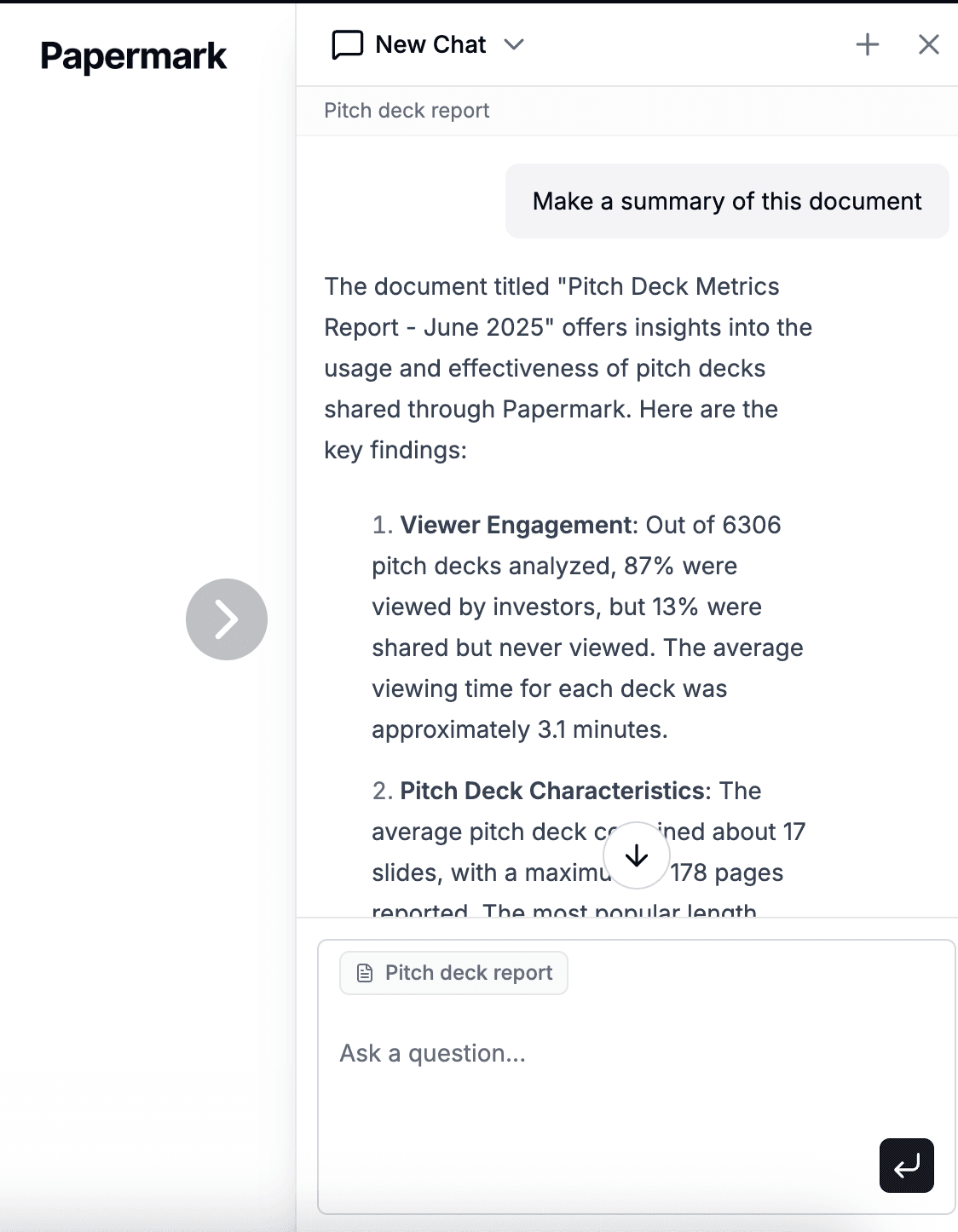
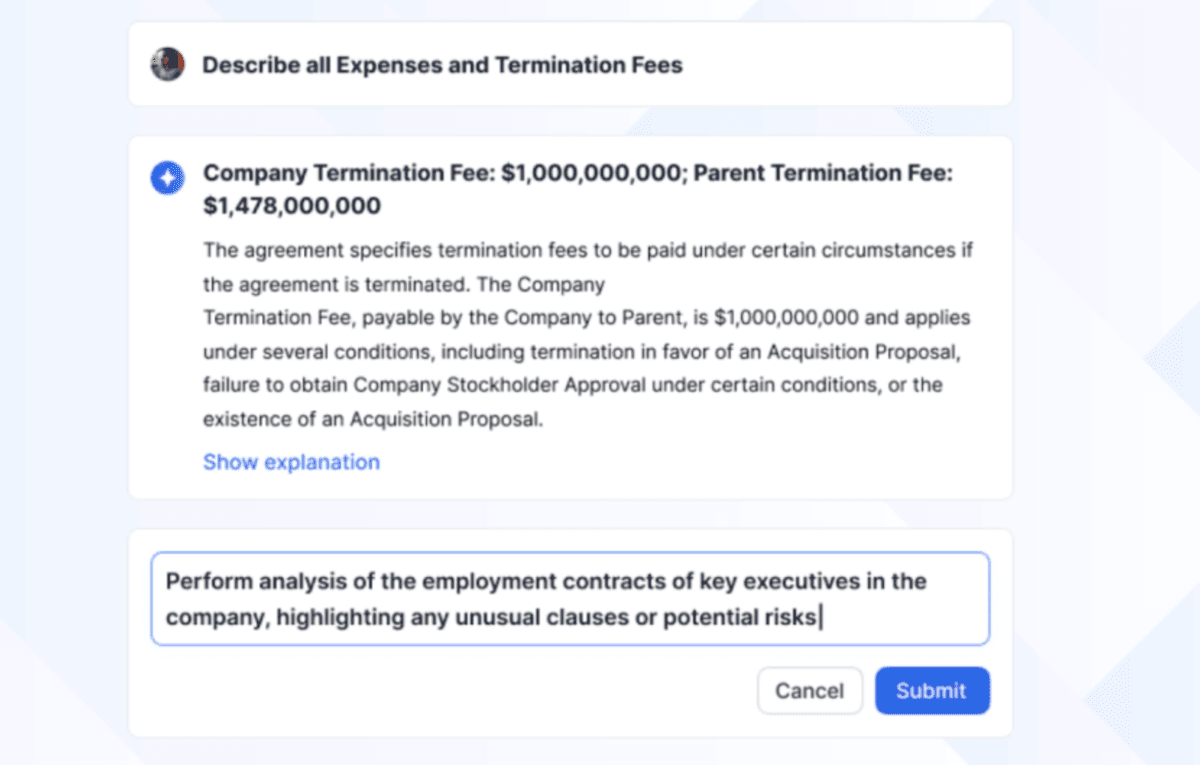
Papermark offers two AI agents: one for an individual document and one for the entire data room. The data room agent is the one that matters most for M&A. Instead of opening contracts one by one, you ask a question once and get an answer that spans every document and folder, with citations back to the exact page. You can build a due diligence summary, compare two versions of an agreement, or find every change-of-control clause across hundreds of files in seconds.
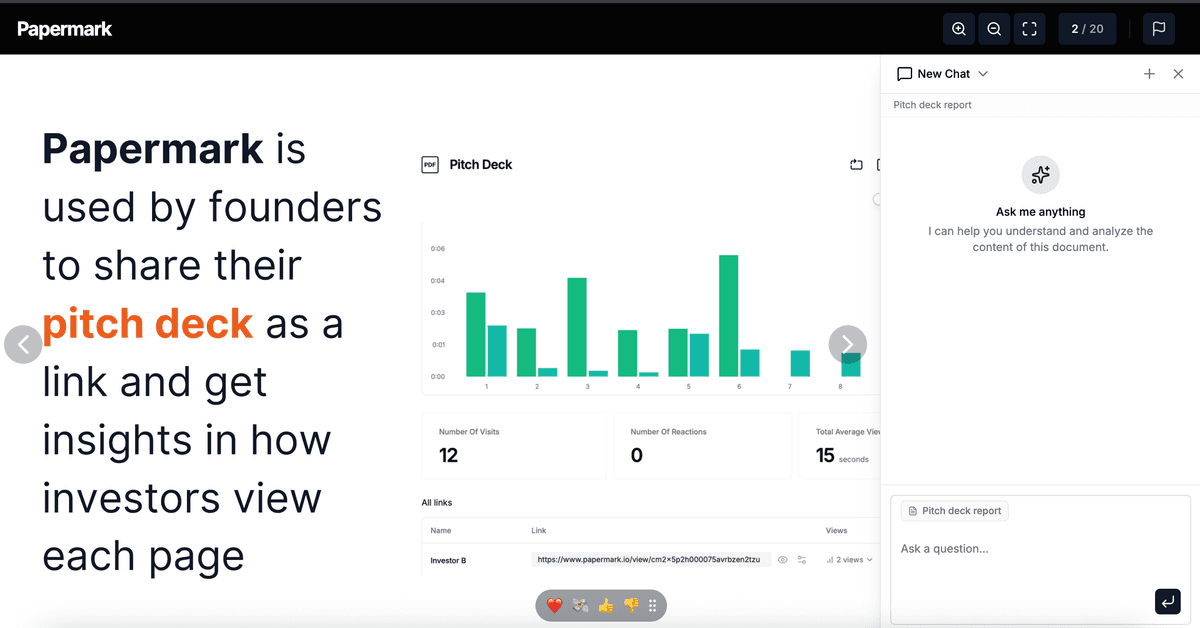
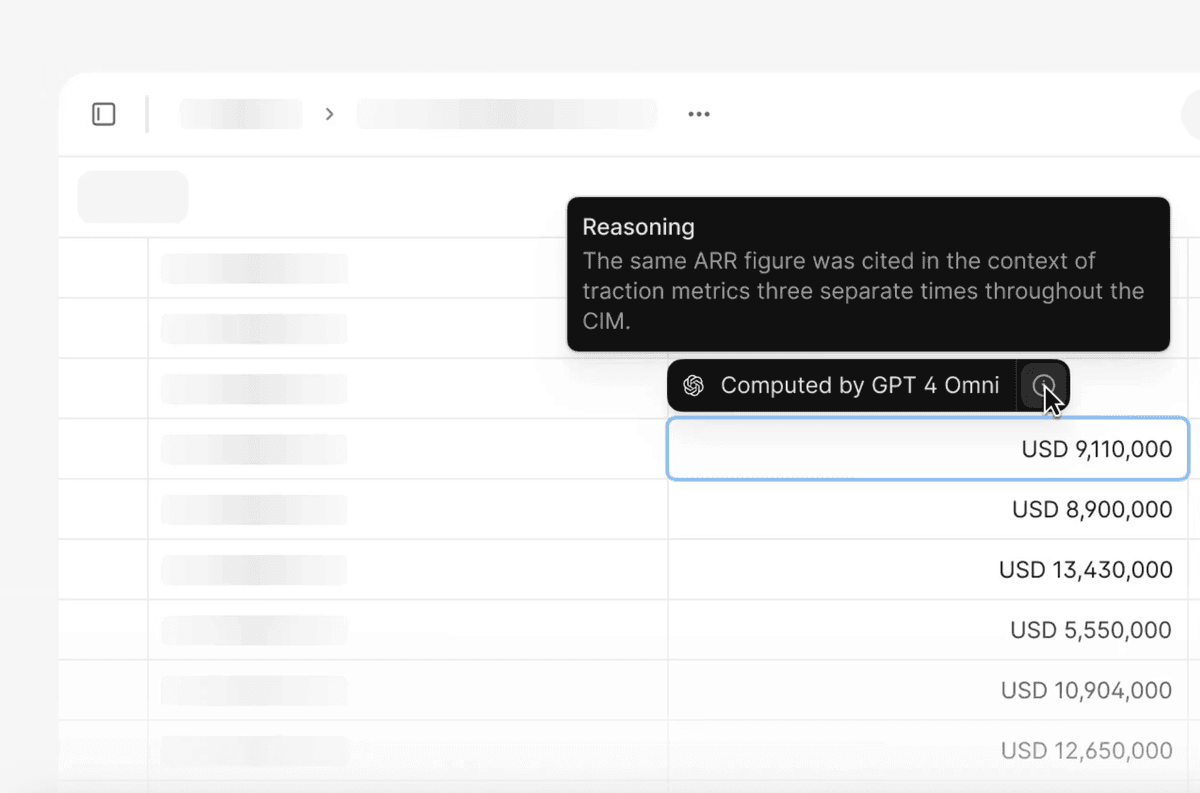
The single-document agent is a specialized assistant for one file you have shared or received. You can ask questions about that contract or CIM, request a summary, extract key terms, and convert it into a structured format like an investment memo or a diligence summary. Both agents cite their sources, so a reviewer can verify every answer rather than trusting a black box, which is what makes AI defensible in a regulated M&A process.
AI-generated folder structure for M&A diligence
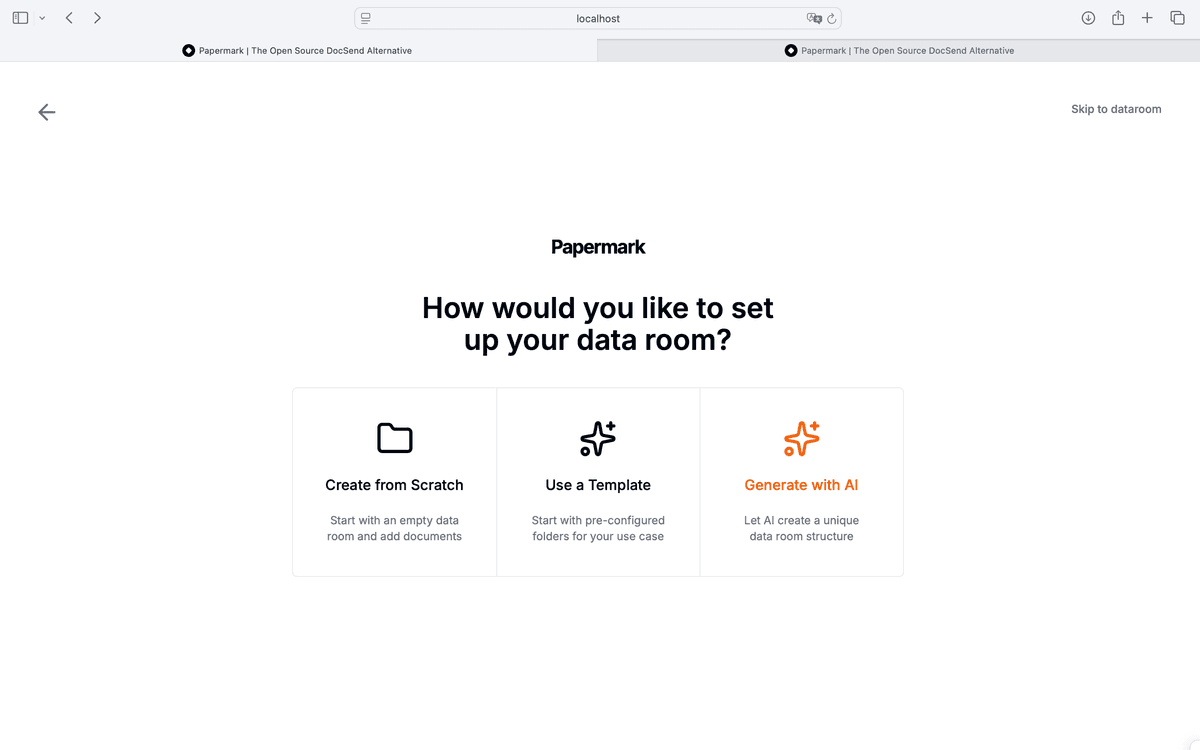
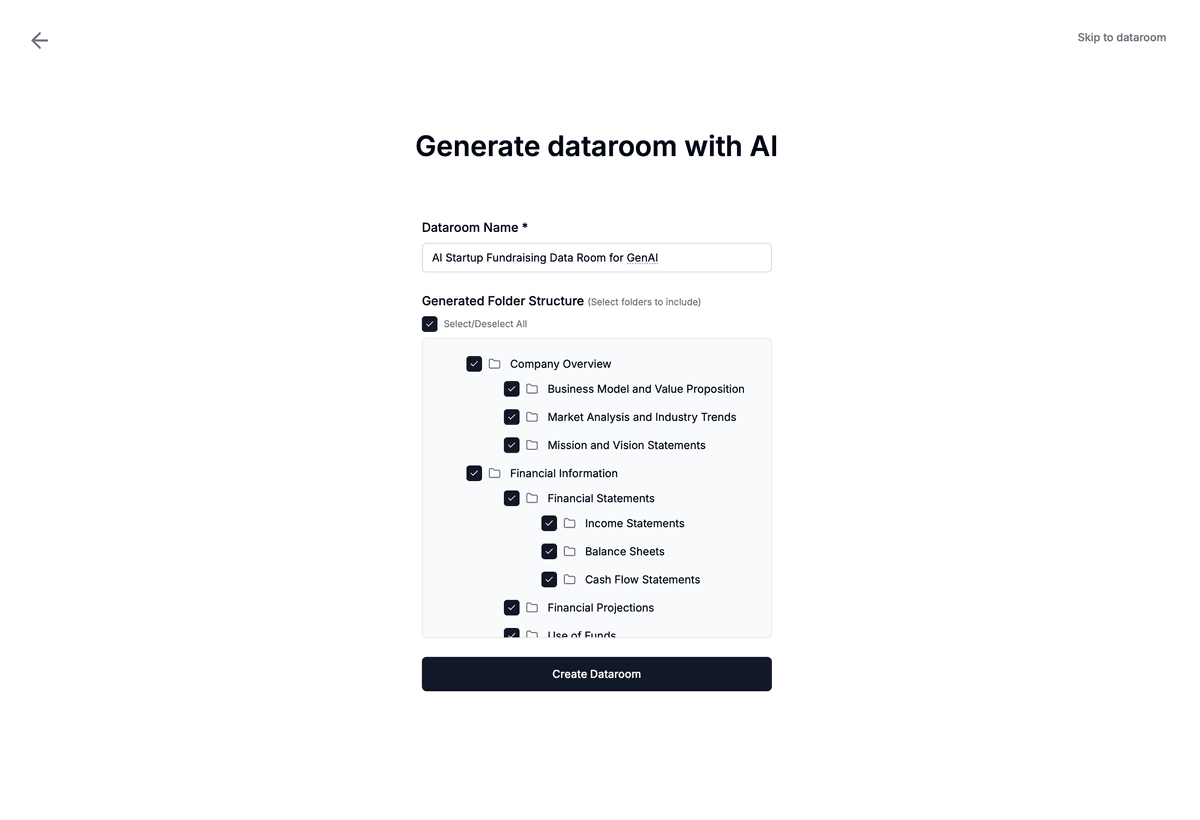
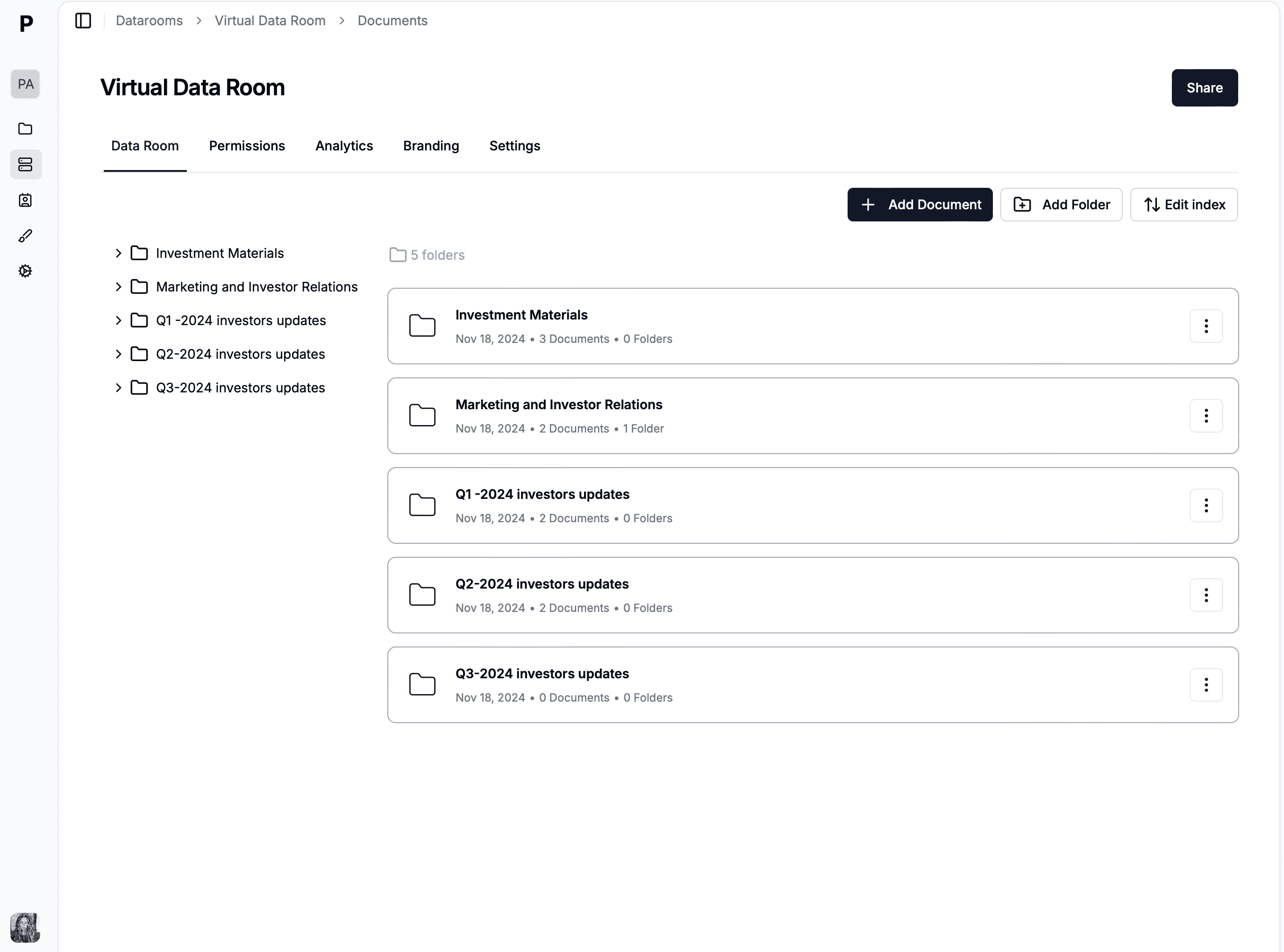
Papermark is the only platform on this list with AI-powered data room structure generation. Describe the deal (sell-side M&A, buy-side diligence, fundraising, portfolio management) and the AI builds a complete, best-practice folder hierarchy in seconds. You just drop in your documents, no more copying a folder tree from a past deal or planning the index by hand.
Combined with the agent, this is a full agentic loop: the agent creates the room, generates the M&A folder structure, uploads and indexes the documents, then answers diligence questions across all of them. For a recommended layout, see our data room folder structure guide.
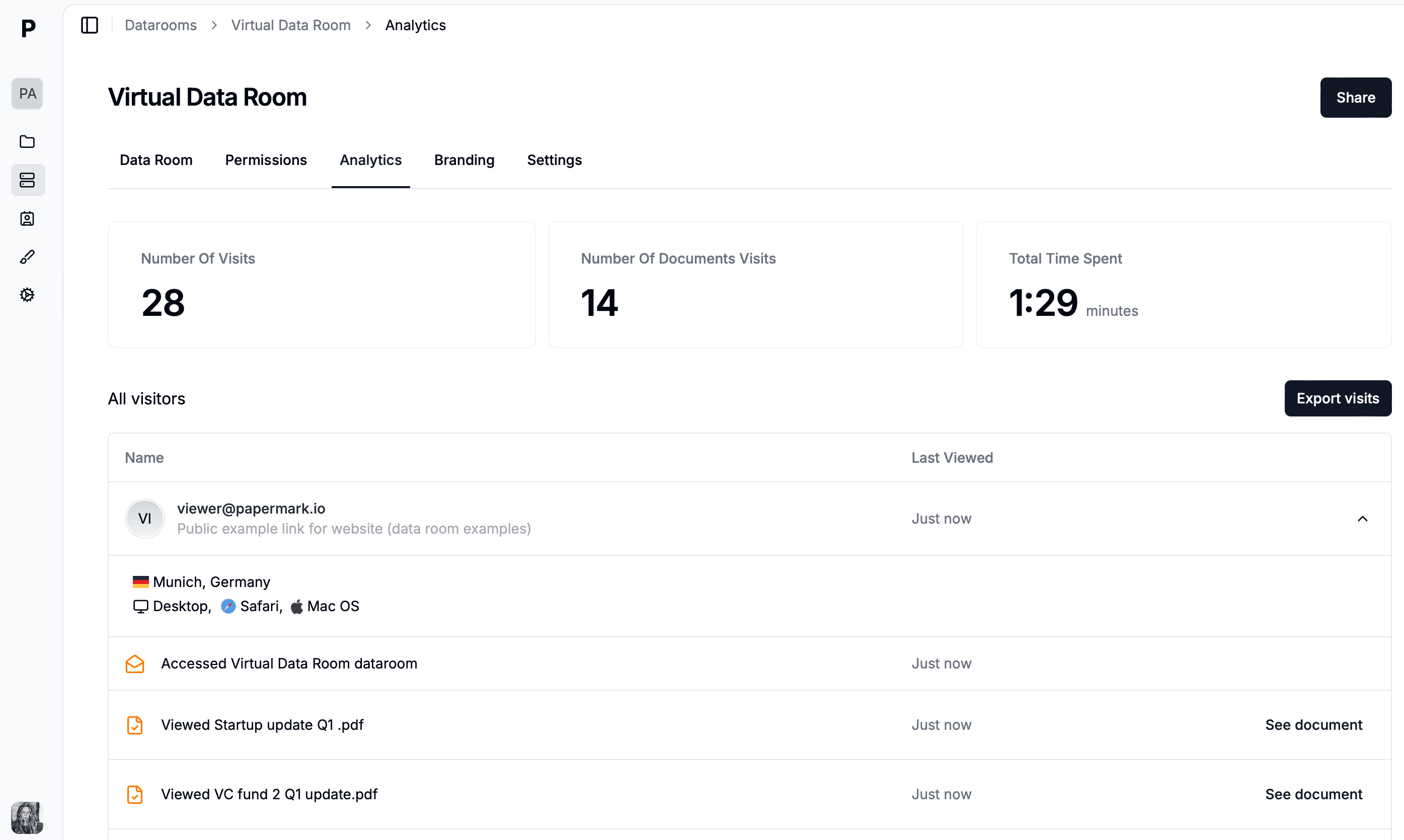
Beyond the AI, Papermark includes everything an M&A diligence room needs: page-by-page analytics, granular permissions, dynamic watermarking, a Q&A module, custom domains, and NDA enforcement. It is also the only open-source and self-hostable option here, which matters for teams with strict data-residency requirements. The Data Rooms plan is €99/month with a 7-day free trial, includes 5 team members, unlimited documents, and unlimited custom domains.
Datasite is an enterprise virtual data room widely used for large-cap M&A and due diligence, with comprehensive permissions, detailed audit trails, and workflow modules for Q&A and analytics. Its AI focuses on accelerating review across very large document sets, which is where enterprise sell-side processes spend most of their time. Pricing is quote-based and typically runs into five figures per year, and the platform has a steeper learning curve than lighter VDRs. See our Datasite VDR overview and Datasite pricing review for detail.
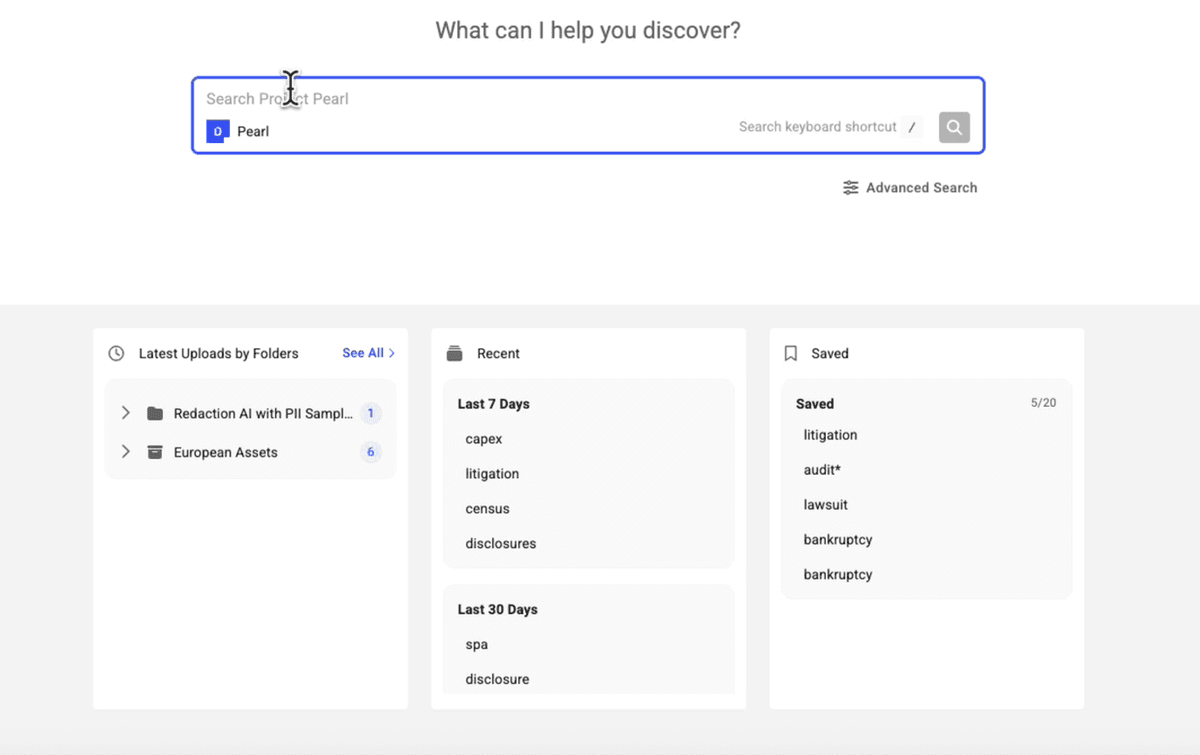
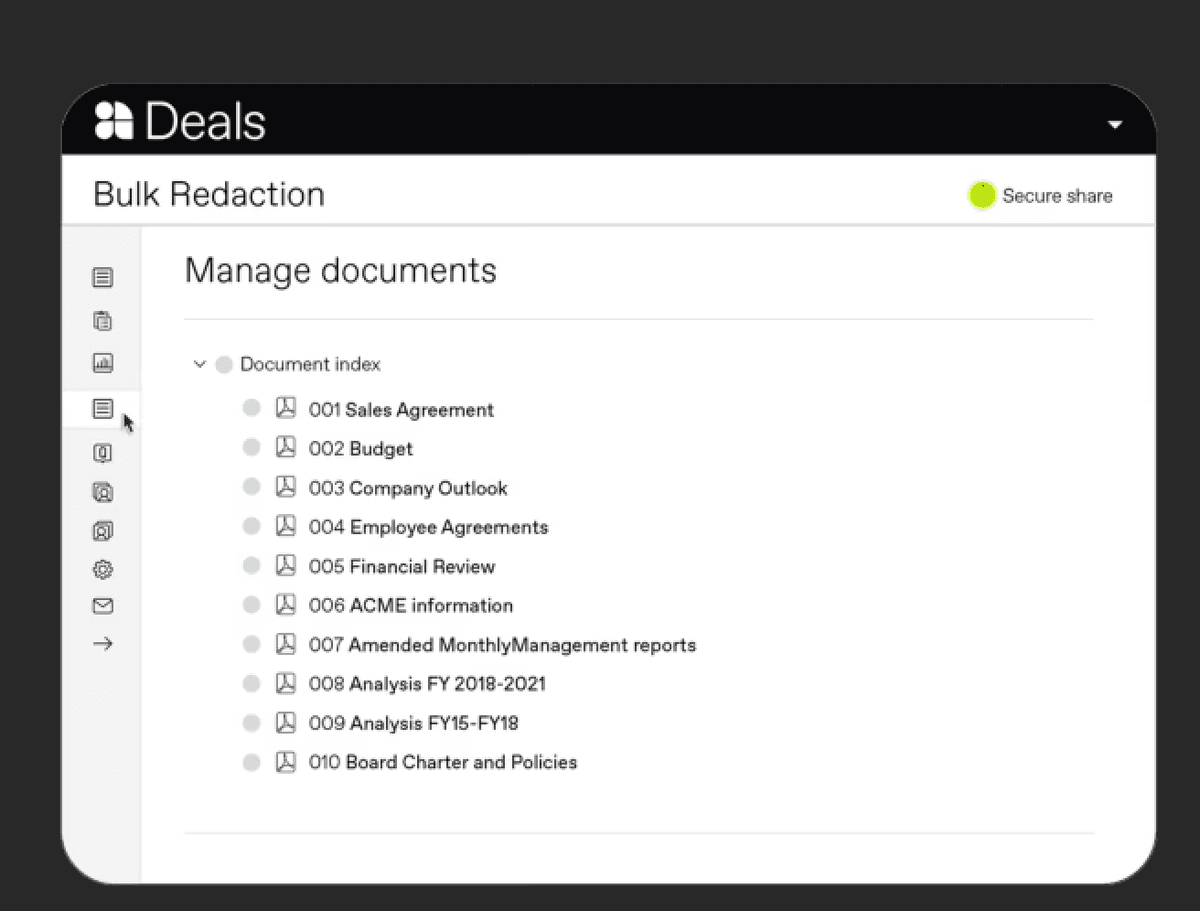
Datasite's agentic and AI capabilities cluster around diligence acceleration. Semantic search finds intent-level matches across the room rather than exact keywords. "Summarize and Explain This" generates concise, plain-English briefs of complex contracts. Automated and intelligent redaction detects and removes sensitive terms across hundreds of documents at once, and full-document translation across 17+ languages runs in the viewer for cross-border deals. AI categorization plus OCR makes scanned, unstructured uploads searchable. Datasite exposes a public API for integrations, but it does not ship an MCP server or a public CLI, so external AI agents cannot operate the room the way they can with Papermark.
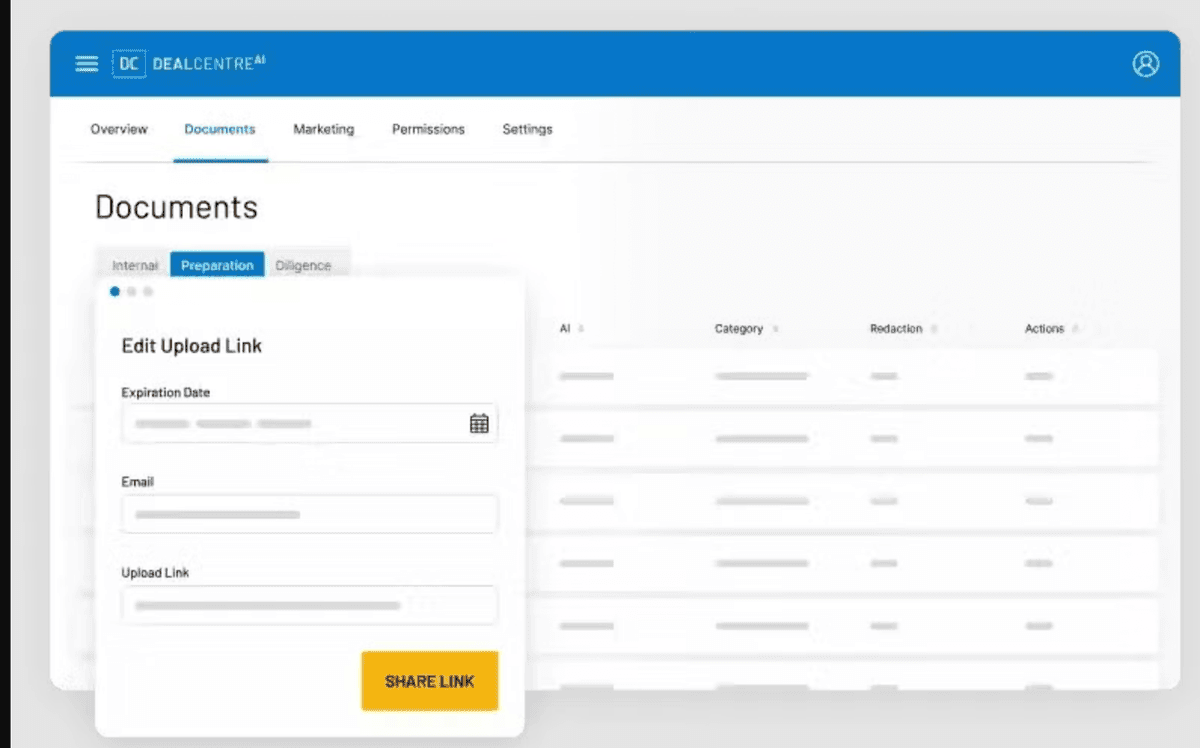
Intralinks is an enterprise data room and deal platform used across every M&A phase, built for complex, multi-party, cross-border processes where governance, scale, and dedicated services matter. Its AI layer is DealCentre AI, powered by an assistant called Link. Link summarizes documents, answers specific diligence questions, and extracts key data points on demand, while semantic discovery ("Ask Link") surfaces clauses and obligations beyond keyword matching. For a walkthrough, see our Intralinks VDR guide.
Where Intralinks earns its place on an agentic list is the spread of AI across the deal lifecycle, not just review. Preparation tools auto-organize, categorize, and validate files, and "view as" checks simplify permissioning before bidders arrive. Marketing-phase tooling tracks outreach and applies bulk watermarking, then hands off cleanly into diligence. Management dashboards spotlight bottlenecks and reuse insights from past deals. Intralinks offers a public API for enterprise integration, but like Datasite it has no MCP server or public CLI, so the assistant works inside the platform rather than letting an external agent drive the room. Pricing is custom and enterprise-oriented, which adds onboarding overhead for smaller teams.
Ansarada is a deal platform and VDR built around the full M&A transaction lifecycle, from prep and Q&A through bidder management and post-merger integration. Its AI is the most workflow-automation-heavy on this list, which is what gives it an agentic flavor on the sell side. AI-Sort auto-organizes uploads into the correct index in seconds, eliminating manual drag-and-drop. AI-Translate handles 14+ languages in-room, and AI-Redact applies bulk redaction with pattern recognition and custom terms across 500+ documents. See our Ansarada data room overview and Ansarada pricing review.
The standout is AI-Predict, which scores bidder engagement to forecast dropout risk and help sellers maintain competitive tension, with accuracy claims by day 7 of a process. That predictive signal is unique among the platforms here and genuinely useful for a banker running a competitive auction. The trade-offs: Ansarada's AI lives inside its own structured workflows rather than an open programmable surface (no API-driven agent control, no MCP server, no CLI), and advanced capabilities are quote-based. It is a strong fit for sell-side M&A teams that adopt the platform end to end.
DealRoom is a buyer-led M&A platform that blends a VDR with pipeline, diligence tracking, and integration workflows. Its AI is purpose-built for due diligence, and it is one of only two platforms here (alongside Papermark) with true deal-level chat across all contracts at once. Ask a question and DealRoom surfaces the relevant risks and obligations with citations back to the source excerpt, so findings stay defensible.
Its most agentic feature is the AI deal playbook builder. Describe the deal type, industry, and rationale, and DealRoom generates a tailored diligence tracker and folder structure, which saves hours of setup for teams starting from scratch. Bulk contract analysis auto-extracts key terms (change of control, pricing grids, renewal clauses) and generates summaries across many agreements, and verification links jump to the exact clause behind each extracted data point. The main trade-offs are an opinionated workflow geared specifically to Buyer-Led M&A, quote-based pricing, and no public API, MCP server, or CLI for external agent control. It is most valuable when your team fully adopts the platform.
V7 is not a data room. It is an AI copilot and agent framework that runs on top of your existing data room, so you still need a VDR (like Papermark) to host and share files. I include it because it is the most explicitly agentic product I tested: it is built by an AI company, not a VDR vendor, and it shows. V7 Go reads everything in your room, answers diligence questions in plain English, extracts KPIs, and triggers multi-step, no-code automations using a stack of large language models, computer vision, OCR, and an agent framework.
What stands out is how well V7 handles heterogeneous, messy content (contracts, scans, spreadsheets, decks) that trips up traditional VDRs, and how fast a buy-side team can prototype a workflow (days, not months). V7 exposes an API for integrations into your internal and external tools. The trade-off is structural: because it is a copilot layer, governance, permissions, watermarking, and audit trails still live in your underlying data room. The best fit is buy-side teams (VC, PE, corporate development) that value AI-accelerated analysis and want to pair an agent layer with a secure room like Papermark for the actual hosting and sharing.
How agentic AI changes the M&A due diligence workflow
An agentic AI data room compresses the three stages of an M&A process where teams lose the most time. Understanding where the agent helps (and where a human must stay in the loop) is the difference between a tool that saves weeks and one that just adds another login.
Prep and setup. This is the most automatable stage. An agent generates the M&A folder structure, ingests a disorganized document dump, runs OCR on scans, and indexes everything into the right place. With Papermark's MCP server, a single instruction like "create a sell-side data room and upload this folder" replaces a day of manual filing. The reviewer's job shrinks to approving the structure.
Diligence and review. Here deal-level chat carries the load. Instead of a junior associate reading 400 contracts to find every change-of-control or assignment clause, the agent answers across the whole room with citations, and the human verifies the flagged clauses. This is where teams report 60 to 80 percent time savings, and it is exactly the cross-document problem that per-file summaries cannot solve. Pair it with the M&A due diligence process checklist so nothing gets skipped.
Management and signaling. On the sell side, AI watches bidder engagement and flags risk (Ansarada's AI-Predict is the clearest example), so the banker keeps competitive tension without guessing. Decisions stay human; the AI just surfaces the signal earlier.
The constant across all three stages is verification. Every credible platform here cites its sources, because an answer a buyer's counsel cannot trace back to a document is worthless in a deal. Agentic does not mean unsupervised; it means the agent does the filing and the first pass, and your team does the judgment.
Why M&A teams choose Papermark for agentic diligence
Most agentic features on this list are locked inside one vendor's UI. Papermark is different because the agent control is open: a public API, an MCP server, and a CLI, all on the same token, documented in the Papermark docs. That is the practical reason teams switching from Intralinks, Datasite, or iDeals land on Papermark for AI-driven M&A diligence.
A clean transition looks like this. First, export your current data room's documents and recreate the structure with Papermark's AI folder generation, or let an agent do it over MCP in one instruction. Second, set per-bidder permissions and dynamic watermarking so the security posture matches what counsel expects. Third, point your AI agent (Claude, Cursor, or your own) at the MCP server and let it run first-pass diligence across the room while your team reviews the citations. You keep flat €99/month pricing instead of a five-figure enterprise quote, and you can self-host the open-source version if data residency demands it.
The alternative for document version control
No credit card required
Page by page analytics
Require email verification
Require password to view
Allow/Block specified viewers
Apply Watermark
Require NDA to view
Custom Welcome Message
How to choose an agentic AI data room for M&A in 2026
Choose based on deal side, deal size, and whether you need an AI agent to actually operate the room, not the longest feature list. For most startups and mid-market M&A, a transparent flat-rate platform with agent control and deal-level chat covers the real work. Large-cap sell-side processes with hundreds of bidders and strict procurement justify the quote-based enterprise platforms. The table below maps common situations to the best-fit platform.
If you...
Best-fit platform
Why
Want an AI agent to create and run the room
Papermark
Only platform with a public API, MCP server, and CLI on one token
Run mid-market M&A or fundraising on a budget
Papermark
Flat €99/month, AI folder generation, deal-level chat with citations
Need deal-level chat across every contract
Papermark or DealRoom
Only two platforms answer across all documents with citations
Run large-cap sell-side M&A with many bidders
Datasite or Intralinks
Enterprise governance, redaction, and translation at scale
Want predictive bidder engagement signals
Ansarada
AI-Predict scores dropout risk to maintain competitive tension
Are a buy-side VC/PE team analyzing portfolios
V7 (copilot, paired with a VDR)
Agent framework for messy documents, layered on your data room
Need full data control or self-hosting
Papermark
Only open-source, self-hostable option on this list
A common mistake is picking the platform with the most AI features instead of the one capability that fits your deal. Agent control, deal-level chat, predictive signals, and bulk redaction each solve a different problem, and few M&A teams need all of them on one transaction. Start from the single stage that costs you the most time, then choose the platform that does that one thing best.
Conclusion
Agentic AI is the real shift in M&A data rooms for 2026. Assistive search and per-file summaries are now baseline; the platforms that pull ahead are the ones where an AI agent can take action across the deal and cite its work. Of the six here, Papermark is the only one an agent can fully operate through a documented public API, MCP server, and CLI, and it does so at transparent €99/month pricing with an open-source self-host option. Datasite and Intralinks remain strong for enterprise sell-side scale, Ansarada for predictive bidder signals, DealRoom for buyer-led playbooks, and V7 as a copilot layer on top of your room.