

mergers-and-acquisitions
Business Brokers San Diego: 13 Top Firms to Sell a Business 2026
Compare 13 business brokers and M&A advisors in San Diego for 2026, with deal sizes, sectors, fee ranges, and how to pick the right firm to sell your business.
Pittsburgh supports roughly 13 to 20 active business brokers and M&A advisory firms that sell privately held companies, from $500K main street deals to nine-figure industrial carve-outs. This list covers the firms that actually close transactions in Allegheny and the surrounding counties, what size deals each takes, and what they charge in 2026.
Deal flow follows what the region builds. Specialty manufacturing and metals sit along the river valleys and out toward Southpointe in Canonsburg, energy services orbit the Marcellus and Utica plays, healthcare services cluster around UPMC and Allegheny Health Network, and robotics and software concentrate around Carnegie Mellon, Lawrenceville, and the Strip District. Family-owned contractors run through Cranberry Township, Monroeville, and Robinson, and anchors including PNC, PPG, Wabtec, Howmet Aerospace, EQT, and Dick's Sporting Goods keep a deep supplier base in play. The right advisor for a $3M mechanical contractor is never the right advisor for a $120M precision components maker, and picking the wrong tier is the most common mistake Pittsburgh sellers make.
The 13 firms below are the Pittsburgh shortlist. The full M&A advisors database adds every other adviser we have researched, so you can widen to a neighbouring metro or narrow to your own industry.
| # | Firm | Typical deal size | Sector focus |
|---|---|---|---|
| 1 | Confluence Advisors | $10M to $150M | Manufacturing, industrial services, chemicals, distribution |
| 2 | Stone Pier Capital Advisors | $5M to $75M | Lower middle market generalist |
| 3 | RedShift Advisors | $5M to $75M | Industrials, energy, materials, technology |
| 4 | Renaissance Partners | $5M to $100M | Heavy manufacturing, metals, industrial applications |
| 5 | Schneider Downs Capital | $10M to $150M | Energy, manufacturing, healthcare, distribution, IT |
| 6 | TobinLeff | $2M to $50M | Marketing, digital, PR, professional services, tech |
| 7 | Holsinger | $5M to $300M | Middle market generalist, family and fund owned |
| 8 | Capital Foundry | $2M to $50M | Small business and middle market, credit-led |
| 9 | Lower Middle Market Advisors | $2M to $30M | Owner-operated businesses, services, industrial |
| 10 | TM Business Brokers | $1M to $20M | Manufacturing, distribution, trades, machine shops |
| 11 | Murphy Business North Pittsburgh | $500K to $15M | Main street, trades, services, commercial real estate |
| 12 | First Choice Business Brokers | $500K to $10M | Main street, retail, food service, services |
| 13 | Sunbelt Business Brokers Pittsburgh | $500K to $10M | Main street, franchises, light manufacturing |
Sellers assume the broker is the one being chosen, but at the lower middle market level it runs both ways. A Pittsburgh advisor taking a $10M engagement invests six to nine months of senior time before seeing a success fee, so they screen hard for deals that can actually close.
The fastest way to get a yes is to arrive with three years of reconciled financials, a normalized EBITDA schedule with defensible add-backs, and a customer concentration table. Advisors shelve most inbound sellers because the numbers cannot be tied out, not because the business is weak. If one steel service center or one hospital system is 40% of your revenue, say so in the first meeting rather than letting a buyer find it in week nine.
The second signal is readiness for the diligence load. A Pittsburgh sell-side process generates 300 to 600 documents across financial, legal, HR, environmental, IP, and customer categories, and owners who already have those organized in a secure data room get taken seriously faster. Environmental files matter more here than in most metros, because so many local industrial sites carry historical remediation questions.
No credit card required.
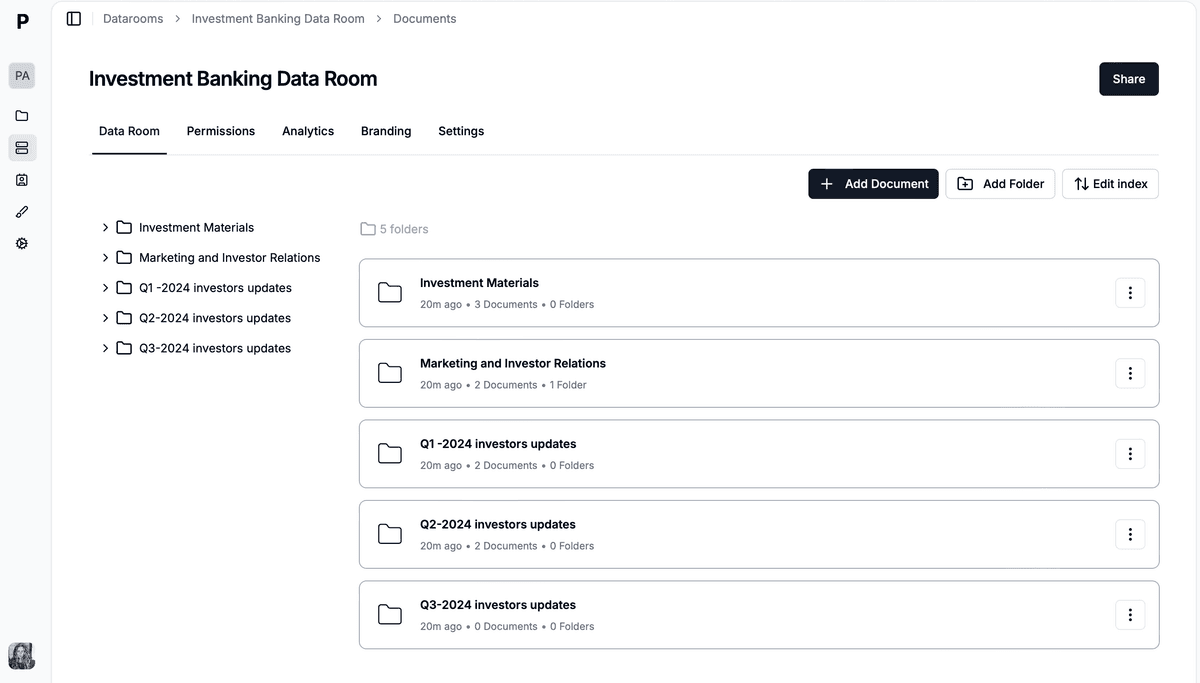
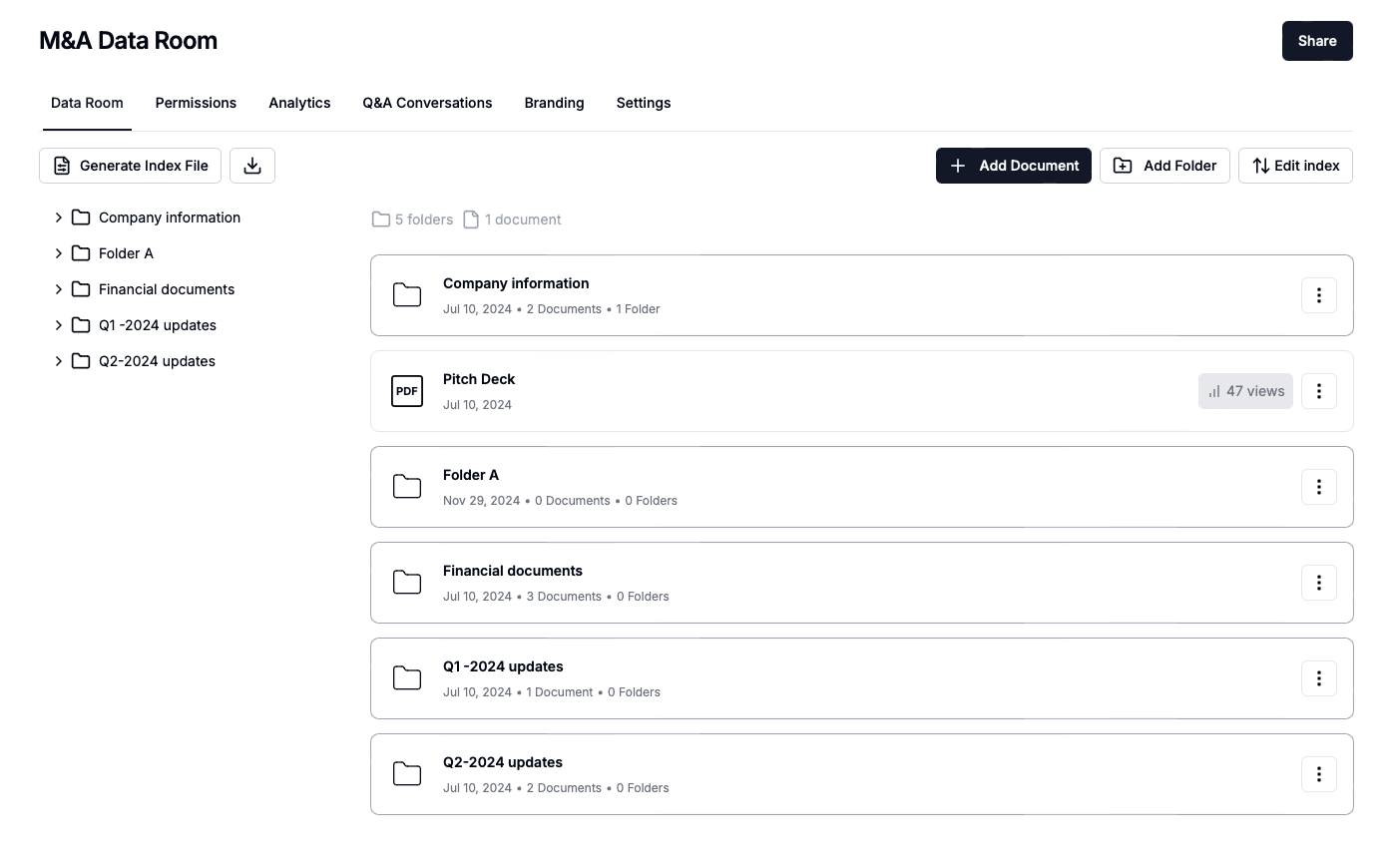
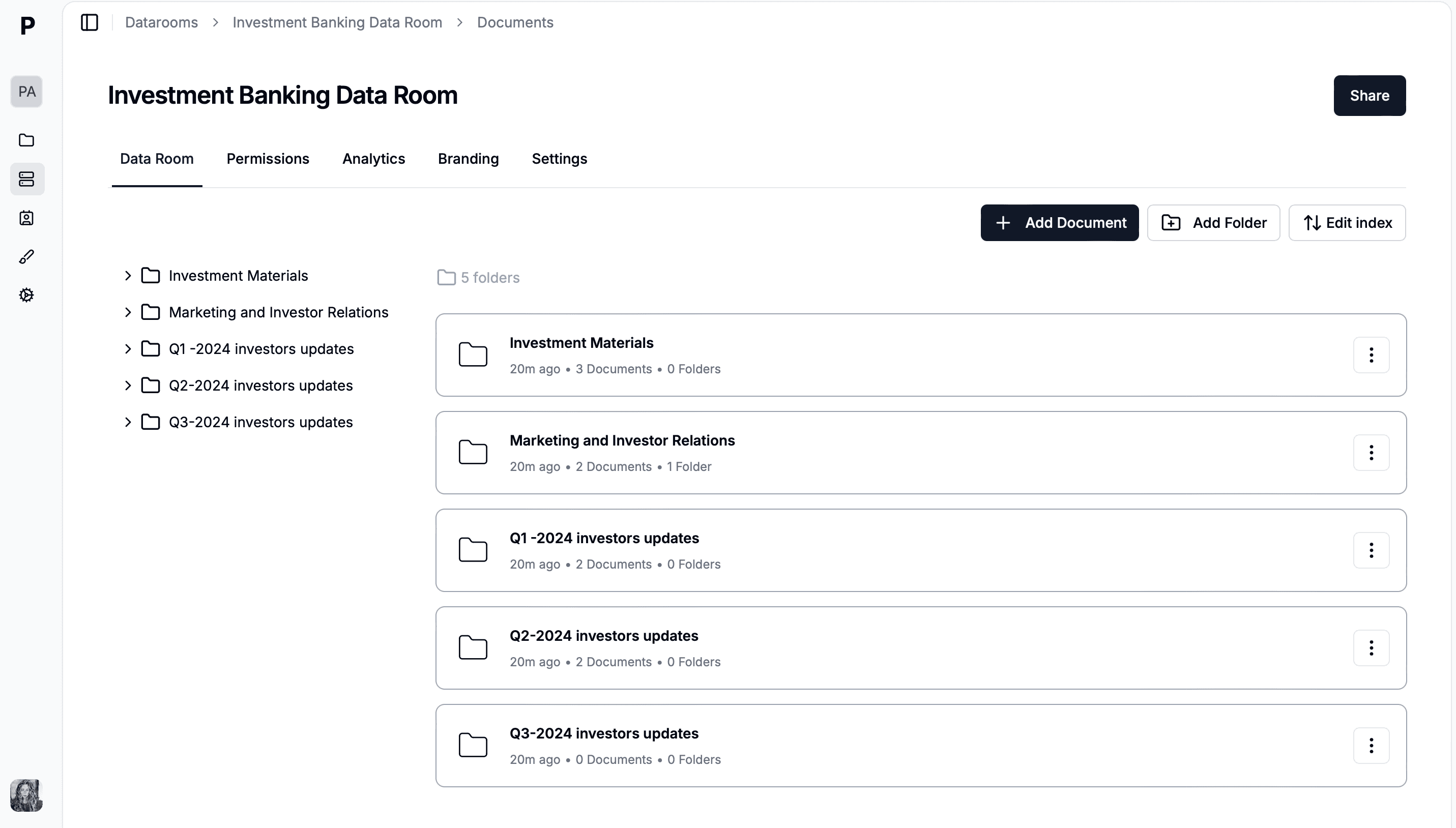
A structured deal document index, the format Pittsburgh business brokers expect before a sell-side engagement.
Papermark is our #1 VDR provider for M&A transactions right now. In two deals we used custom branding, dynamic watermarking, and granular permissions.
Tyler
Start with the transaction record, not the marketing site. The useful question is not how many deals a firm has closed in total, but how many closed in your revenue band and your industry in the last 24 months. An advisor whose last five deals were $80M healthcare services businesses will not run a $4M excavating contractor sale well, and the reverse is equally true.
Check credentials next. The M&A Source and the IBBA issue the M&AMI and CBI designations, the Alliance of M&A Advisors issues the CM&AA, and exit planners carry the CEPA. Pennsylvania does not issue a dedicated business broker licence, but under the Real Estate Licensing and Registration Act a broker handling real property inside the transaction needs an active state real estate licence. Since most Western Pennsylvania sales include a building or an assigned lease, the majority of credible local brokers carry one.
Then work the referral network. Pittsburgh deals travel through CPAs, transaction attorneys, and bank relationship managers far more than through any online directory, and the ACG Pittsburgh chapter puts the same 40 to 50 deal professionals in a room every month.
Approach three to five firms, not one. A competitive selection costs two weeks and routinely changes both the fee scale and the valuation range you are quoted. Send each firm the same package: a one-page business summary, three years of P&L and balance sheet, a trailing twelve month figure, and your add-back schedule.
Quoted valuation ranges for the same Pittsburgh business commonly vary by 1.5x to 2x between firms, mostly because of different assumptions about who the buyer is. A regional strategic acquirer and a national private equity platform will not pay the same multiple for the same fabrication shop.
Confluence Advisors is a middle market investment bank founded in 2009 and based in Wexford, north of the city. It concentrates on family and founder-owned industrial businesses, reports more than $2 billion in total transaction value, and runs three service lines: sell-side advisory, management buyouts, and capital advisory.
Stone Pier Capital Advisors is a boutique M&A investment banking firm at One Oxford Centre downtown. It describes work on hundreds of transactions with domestic and foreign buyers, and splits its practice between sell-side, buy-side, and strategic consulting for boards and ownership groups.
RedShift Advisors is an independent lower middle market investment bank founded in Pittsburgh in 2018 and based on Seventh Avenue downtown. It targets founder-owned companies making a first institutional transaction, and pairs M&A execution with succession and exit planning.
Founded in 1986 by Leo Keevican and James Bauerle, Renaissance Partners is one of the longest-operating advisory firms in the city. Its roots are in heavy manufacturing, metals, and industrial applications, the profile of many Western Pennsylvania sellers, and it also handles buyouts, restructurings, and technology commercialization.
Schneider Downs Capital is the investment banking and value advisory subsidiary of Schneider Downs & Co., one of the largest independent accounting firms in the region. It reports more than 100 transactions and runs sales, divestitures, recapitalizations, and acquisition advisory from One PPG Place.
TobinLeff was founded in Pittsburgh and now works from several US offices. It is a specialist, focused on marketing services firms, digital and PR agencies, professional services, and technology companies, and reports helping more than 250 owners with exit planning and M&A. Agency valuations turn on client concentration and recurring retainer mix, which generalist brokers misprice.
Holsinger P.C. is a Wexford accounting and advisory firm whose transaction practice, run with Strategic Advisors, covers middle market companies with enterprise values between $5 million and $300 million. It works across family, equity fund, and publicly owned structures, and suits sellers who want tax structuring and deal advice from one team.
Capital Foundry works from Smallman Street in the Strip District and combines commercial finance and capital markets with M&A advisory and outsourced CFO services. The credit-led model is useful when a sale needs a refinancing or a partial recapitalization rather than a clean exit.
Lower Middle Market Advisors is a Pittsburgh-area M&A and capital advisory firm built on a three-stage model: plan, transform, transact. Principal Anthony Ventura holds Series 7, 63, and 79 registrations plus the CEPA designation, so the firm suits owners two or three years out who need the business fixed before it is marketed.
TM Business Brokers is a certified Pittsburgh brokerage whose principals hold CPA, CBB, and Certified Business Intermediary credentials, including a Lifetime CBI distinction held by roughly 60 intermediaries worldwide. Recent listings have run from about $1.5 million to $17 million in asking price.
The North Pittsburgh office of Murphy Business Sales operates from Cranberry Township and serves Cranberry, Mars, the North Hills, and Beaver County. It handles confidential sales, valuations with equipment appraisals, exit planning, and commercial real estate, backed by a national network of more than 140 offices.
First Choice Business Brokers Pittsburgh is the local office of a national brokerage franchise, covering sales, acquisitions, and formal valuations. It sits at the entry tier of this list, where the buyer is usually an individual, an SBA-financed first-time owner, or a small search fund.
The Pittsburgh office of the Sunbelt network works from North Huntingdon and covers the eastern suburbs and Westmoreland County. The franchise model gives a local team access to one of the largest buyer databases in the industry, which matters most where buyer volume drives price.
The standard Lehman formula charges 5% on the first $1 million and steps down to 1% above $4 million, but most lower middle market Pittsburgh firms use a modified or double Lehman scale starting at 10% on the first $1 million. Retainers are almost always creditable against the success fee at close.
| Deal size | Success fee | Retainer | Minimum fee |
|---|---|---|---|
| Under $1M | 8% to 12% of sale price | $0 to $2,500 upfront | $15,000 to $25,000 |
| $1M to $5M | 6% to 10% blended | $3,000 to $7,500/month | $50,000 to $100,000 |
| $5M to $50M | Modified Lehman, 3% to 8% blended | $7,500 to $15,000/month | $100,000 to $150,000 |
| $50M+ | 1% to 3% blended | Negotiated, often credited | Negotiated |
Once an advisor is engaged, the sale becomes a document exercise. A Pittsburgh deal in the $5M to $50M band runs 300 to 600 files through diligence over four to six months, shared with five to thirty buyer groups, and industrial sellers carry an extra layer of environmental permits, Phase I reports, and union agreements. On top of that sit customer contracts and supplier pricing, backlog and job costing for a contractor, master service agreements with the energy operators, equipment and tooling schedules, payroll, and every lease on the yard or the plant.
Several of those buyer groups are competitors down the river valley. The likeliest strategic buyer for a specialty metals or precision components maker is another Western Pennsylvania manufacturer quoting the same parts, the acquirer of an energy services business is often a competitor already working the Marcellus and Utica plays, and a healthcare services company will find itself sending files to a group tied to the health system it competes with for staff. Supplier pricing, job costing and the named customer list are exactly what a competitor doing reconnaissance wants, and most of the parties who sign an NDA will never bid.
A leak costs you tradespeople and contracts. Skilled welders, machinists, field supervisors and project managers are scarce across Allegheny and the surrounding counties, and word that the company is for sale travels through job sites, suppliers and union halls within days, after which the shop in Canonsburg or Cranberry recruits them directly. Customers stall renewals and quietly qualify a second supplier, a surety tightens the bonding line, and a landlord or franchisor who learns of the sale from someone other than you gains leverage over the consent you need at closing. Email attachments cannot be recalled, cannot be watermarked, and tell you nothing about who actually opened them.
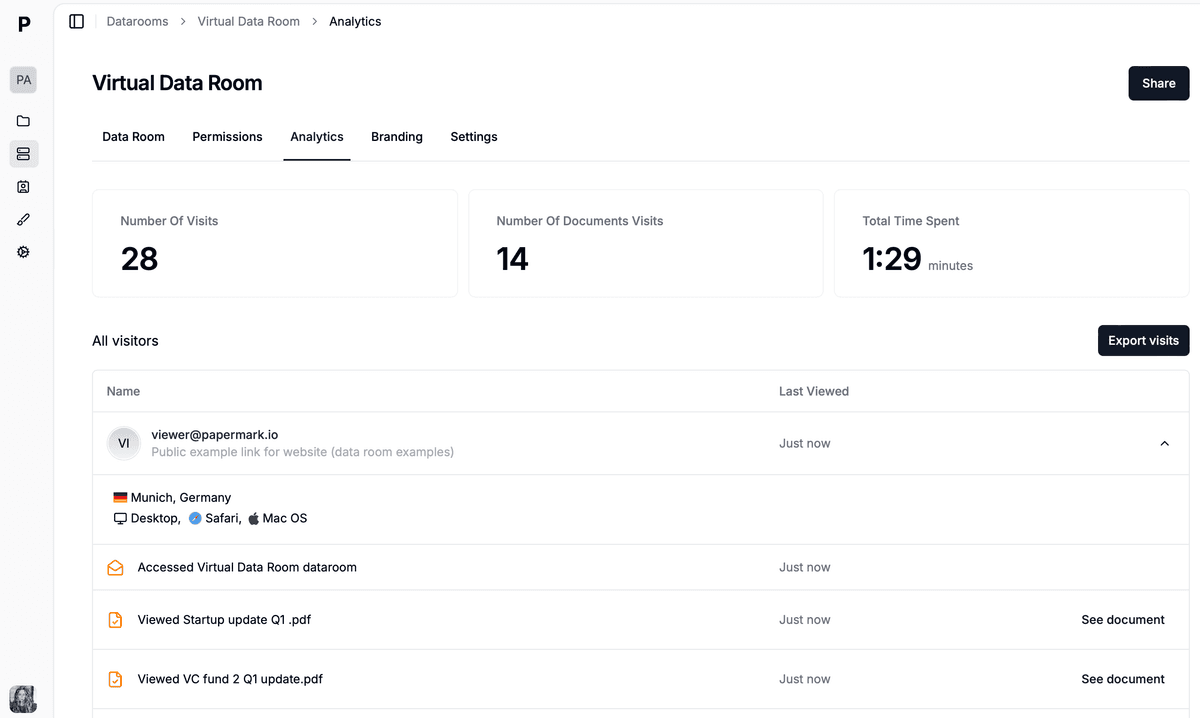
Page-by-page analytics show which Pittsburgh buyers actually read the financials and which only skimmed the teaser.
A data room for Pittsburgh M&A is the permissioned workspace where your advisor stages 300 to 600 diligence files and runs five to thirty buyer groups through them at once, without any of them seeing what the others see. This is what advisors mean when they ask whether your documents are ready.
Papermark is a secure, fully customizable, and developer-friendly data room built for modern dealmakers, and a secure data room is what keeps the sensitive parts of the file locked while the process runs. Granular permissions open the financial folder to a shortlisted buyer while customer contracts and supplier pricing stay closed until an LOI is signed. Dynamic watermarking stamps each viewer's email, IP, and timestamp on every page, so a leaked CIM traces back to a specific buyer. The audit log records every view down to the page and the second, which is how advisors separate a serious bidder from a competitor doing reconnaissance, and the built-in Q&A module keeps diligence questions in one thread instead of scattered across inboxes.
The Data Rooms plan is €149/month, or €99/month billed annually, with a 7-day free trial, and includes 3 team members, unlimited data rooms, unlimited documents, a custom domain, dynamic watermarking, NDA agreements, and granular file-level permissions. Our breakdown of the best virtual data rooms compares Papermark against Datasite, Intralinks, iDeals, and DocSend.
Most virtual data rooms were built for bankers and priced for them. Papermark is a secure data room for modern dealmakers, and it is more customizable and more branded than any other VDR on the market.
Fit is usually about band and sector rather than reputation. If none of the thirteen firms above match your revenue range, widen the search to Cleveland and Columbus, where several middle market banks actively cover Western Pennsylvania.
If none of the thirteen above fits, the M&A advisors database lists every firm we have researched by city and by industry, with deal sizes and sectors side by side. Filter to Pittsburgh to compare these against each other, or switch to Cleveland or Columbus if the local bench is thin in your sector.
Compare 13 business brokers and M&A advisors in San Diego for 2026, with deal sizes, sectors, fee ranges, and how to pick the right firm to sell your business.
Compare 13 business brokers and M&A advisors in Kansas City for 2026, with deal sizes, sectors, fee ranges, and how to choose the right firm to sell your business.
Compare 13 business brokers Minneapolis owners hire to sell a company in 2026, with deal sizes, sectors, fee ranges, and how to choose the right firm.