



datarooms
Best Data Rooms for Fundraising in 2026 (Seed to Series C Compared)
The 10 best data rooms for fundraising in 2026 compared on pricing, security, and best-fit round. Real customer stories from Backtrace Capital, TBD VC, and Two Inc.
A buy-side data room is the room the acquirer builds and controls, holding target research, diligence findings, adviser work product, financing materials, and investment committee papers. It is a different artifact from the seller's data room, which the buyer only ever visits as a guest.
Most writing about M&A data rooms assumes you are selling. Search for a data room checklist and you get the seller's index: financials, contracts, cap table, IP. The buyer's side of the same transaction is barely covered, even though a corporate development team or a private equity fund runs more rooms than any single seller ever will, keeps them open longer, and puts far more confidential material into them.
This guide covers what a buy-side data room holds, how it differs from the sell-side room, how to run intake from several targets at once without leaking one target's information into another's file, how investment committee materials should be handled, and what the setup costs. Section 9 is the practical build.
A buy-side data room is a secure repository controlled by the acquirer, holding everything the buy side generates and receives across a transaction: target research and screening notes, signed NDAs, information received from the seller, diligence findings from each adviser workstream, financing materials for lenders, valuation models, and the investment committee papers that authorise a bid.
The distinction from the sell-side room matters because the two have opposite security postures. In the seller's virtual data room, the buyer is a visitor whose every page view is logged by someone else. In the buy-side room, the acquirer is the host, and the material inside is more sensitive to the acquirer than anything the seller ever showed: the model, the walk-away price, the synergy case, the internal view on management, and the reason the last three targets were passed on.
Corporate development teams and private equity funds often start without one. Target files live in a shared drive, adviser reports arrive by email, and the diligence request list is a spreadsheet emailed back and forth. That works for one deal a year. It stops working the moment two live processes overlap, because the failure mode is not inefficiency but cross-contamination: the wrong target's financials attached to the wrong email, or a departing analyst who still has a downloaded copy of a competitor's management accounts.
The buy-side room is also the record. When a deal completes, the disclosure position, the adviser reports relied on, and the version of the model the committee approved are all facts a buyer may need to prove years later. A room with a per-visitor audit log answers those questions. A shared drive does not.
The sell-side room is built to be read. Its job is to present a curated, complete, and controlled version of a business to several bidders at once, in a way that moves the process along and keeps the auction competitive. Everything about its design follows from that: a numbered index, staged access, watermarking, and a Q&A module that answers many bidders without letting them see each other.
The buy-side room is built to be worked in. Its job is to accumulate, compare, and decide. Documents arrive from many directions rather than one, the population changes daily, and the most valuable files in it are the ones the buyer created rather than received. That changes the folder logic, the permission model, and above all the retention policy, because a buyer keeps material on targets it never bought.
| Dimension | Sell-side data room | Buy-side data room |
|---|---|---|
| Owner | Seller or the sell-side adviser | Acquirer or the corporate development team |
| Primary content | Company documents disclosed to bidders | Target research, adviser findings, IC papers, financing |
| Audience | Multiple bidders and their advisers | Internal deal team, IC, lenders, the buyer's advisers |
| Number of rooms | Usually one, sometimes staged | One per live target, plus standing internal rooms |
| Most sensitive file | Customer contracts and management accounts | The valuation model and walk-away price |
| Lifespan | Closes at signing or when the process ends | Runs across the pipeline, years in some cases |
| Retention driver | Deal archive and disclosure record | Passed targets, re-approaches, and audit trail |
| Q&A direction | Bidders ask, seller answers | Deal team asks, advisers and seller answer |
One consequence is worth stating plainly: material generated on the buy side should never be uploaded into the seller's room. A quality of earnings report commissioned by the buyer, a red-flag legal memo, or an integration cost estimate belongs to the buyer and reveals the buyer's thinking. Sellers occasionally ask for it, and there are cases in a bilateral process where sharing a specific finding is a deliberate negotiating move, but that should be a decision rather than an accident of where the file happened to be stored.
The second consequence is about counting. A seller runs one process. A serial acquirer might screen fifty targets in a year, sign NDAs with a dozen, run full diligence on four, and close one. If you are new to comparing platforms for this, our roundup of the best virtual data rooms covers pricing model, room limits, and permission depth across the main providers, and room limits are the number that matters most on the buy side.
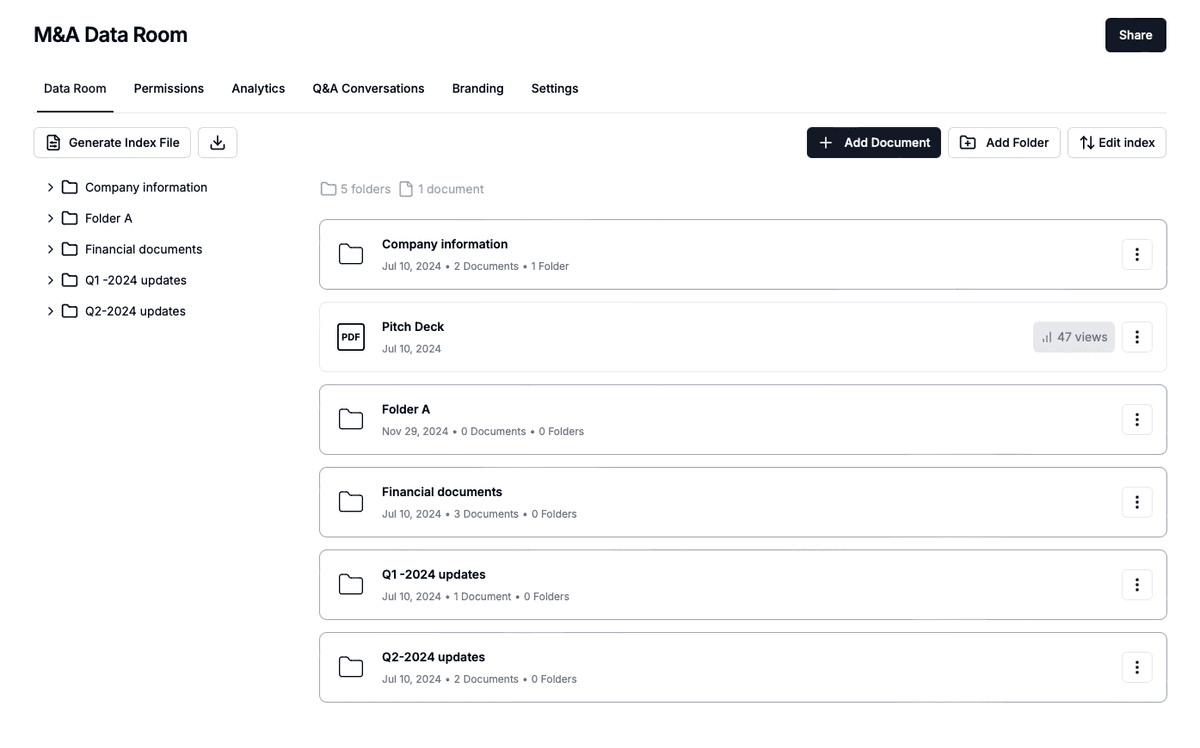
A buy-side M&A data room is organised by target and workstream, not by the seller's disclosure index.
Corporate development teams that do this well do not have one buy-side data room. They have a small set of rooms with different lifespans, different audiences, and different permission rules, all under one subscription. Collapsing them into a single folder tree is the mistake that creates most of the access problems later.
The pipeline room is permanent and internal. It holds the screening universe, market maps, banker teasers, and the notes on why each target was passed on. It is the room that gets consulted when a target that was too expensive in 2024 becomes affordable in 2026, and it is also the room most likely to contain material a competitor would pay for, which is why it stays internal.
The target intake rooms are temporary and numerous. One per live target, opened when an NDA is signed and closed when the target is either bought or dropped. This is where information received from the seller, findings from each adviser workstream, and the target-specific model live. The financing room and the investment committee room are the two that carry the most restrictive permissions, and the integration room is the one that outlives the deal.
| # | Room | What it holds | Who gets access | Lifespan |
|---|---|---|---|---|
| 1 | Pipeline | Screening universe, market maps, teasers, pass notes | Corp dev team only | Permanent |
| 2 | Target intake | NDA, seller material, adviser findings, target model | Deal team plus that target's advisers | Per target |
| 3 | Adviser work product | QoE, legal red flags, commercial, IT, tax, environmental | Deal team, IC on request | Per target, archived |
| 4 | Financing | Lender pack, model, structure, term sheets | Lenders and debt advisers, scoped per lender | Weeks 8 to 26 |
| 5 | Investment committee | IC memo, valuation, walk-away price, synergy case | IC members and deal lead only | Per approval cycle |
| 6 | Integration | Day-one plan, TSA schedules, workstream owners | Integration lead and function heads | Outlives the deal |
The reason to keep these separate is not tidiness. It is that a single room with a single permission set forces you to choose between over-sharing and hand-picking documents per person, and neither survives four live targets. When each room is its own object, a target that drops out gets its room frozen and archived in one action, and nobody has to audit a folder tree to work out what a departing analyst could still reach.
Most of a buy-side team's year happens before any diligence begins. Sourcing, screening, and relationship-building produce a large volume of low-sensitivity material and a small volume of extremely sensitive material, and the two are easy to mix up. A banker teaser is not confidential in any meaningful sense. The internal note explaining that a target's founder is close to retirement and would sell at a discount absolutely is.
A pipeline room handles this with one folder per target, opened at first contact, closed or archived when the target is passed on. The value is continuity. Acquirers re-approach targets constantly, and the question two years later is always the same: what did we know, what did we offer, and why did it not happen. That is a folder, not a memory.
Most corporate development teams work a six-stage funnel, and the transition that matters for the data room happens at stage three. A sourced target and a contacted target produce screening notes, teasers, and call logs, all of which can live in the pipeline room. The moment an NDA is executed, real information starts flowing and the target needs its own room.
Two habits pay for themselves here. The first is opening the target intake room at NDA signature rather than at LOI, because the material that arrives in that window is already confidential and usually ends up in an inbox otherwise. The second is writing the pass note when a target is dropped, in the room, dated. It costs ten minutes and it is the single most useful document in the pipeline two years later.
Confirmatory diligence is where the buy-side room earns its cost. Six or seven workstreams run in parallel, each producing findings, each asking the seller follow-up questions, and each needing access to a different slice of what the seller has disclosed. Running that through email across two live targets is where mistakes happen.
The structural answer is one room per target with one link per adviser. The quality of earnings provider gets the financial folder. The legal adviser gets contracts, corporate records, and litigation. The commercial adviser gets customer data and pipeline. The IT reviewer gets infrastructure and licensing. The lender gets a narrow slice: the model, the QoE summary, and the financing pack. Nobody gets a room-wide download.
Findings then need to flow back into one place. A workstream report that lands in the deal lead's inbox is a report that the IC never reads in full and that nobody can find eighteen months later. Uploading each adviser's draft and final report into the adviser work product room, with the date and version in the filename, means the IC memo can cite them and the closing archive contains them.
| Workstream | What the buyer commissions | Typical cost band | Folder access needed |
|---|---|---|---|
| Quality of earnings | Normalised EBITDA, working capital, net debt | $30,000 to $150,000 by target size | Financial, tax |
| Legal | Corporate, contracts, litigation, employment | $25,000 to $200,000 | Legal, corporate, HR |
| Commercial | Market, customers, churn, competitive position | $40,000 to $250,000 | Commercial, customer data |
| IT and technical | Estate, licensing, security, integration effort | $15,000 to $200,000 by size | IT, infrastructure, security |
| Tax | Structure, exposures, transfer pricing | $15,000 to $75,000 | Tax, corporate |
| Environmental | Site conditions, permits, remediation liability | $5,000 to $60,000 | Property, permits, HSE |
Those bands are indicative ranges rather than quotes, and they vary widely with target size and sector. The reason to keep them in the room is that a deal which dies in confirmatory diligence still costs real money, and the pass note is far more useful sitting next to the invoices and findings that justified it. Our guides to financial due diligence and quality of earnings cover what each report contains.
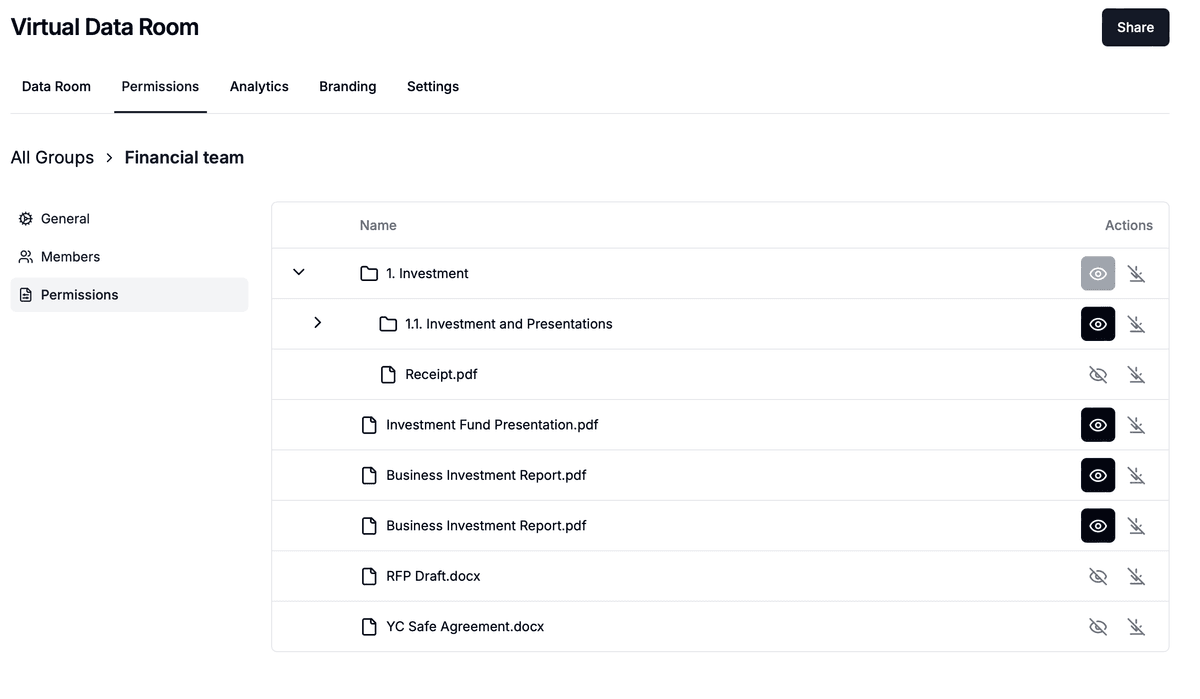
On the buy side, permissions are set per adviser link, so the lender never sees the legal red-flag memo.
The investment committee pack is the most sensitive document a buy-side team produces. It contains the valuation, the bid range, the walk-away price, the synergy assumptions, the honest assessment of management, and the risks the team is prepared to accept. If a single file from a buy-side data room must never leak, it is this one.
An IC pack usually contains the memo itself, the model, the summary of each diligence workstream, the financing plan, the proposed structure and price, the risks and mitigants, and the recommendation. The committee reads it, asks questions, and either approves a bid within a range or declines. What matters operationally is that the version approved is identifiable later, because the authority granted was to a specific price and structure, not to a deal in general.
Three controls make that work. Version discipline, so the approved pack is a fixed artifact rather than a rolling document. Restricted distribution, so the pack goes to committee members on their own links rather than as an email attachment forwarded onward. And an access record, so the buyer can show who read what and when, which matters in regulated acquirers and in funds with LP reporting duties.
Handling follows sensitivity. The memo, the workstream summaries, and above all the valuation model should be view-only, watermarked, and restricted to a named list, with download disabled outright on anything that states the approved bid range. The financing plan usually needs a separate link because the debt adviser sees it and the wider committee often does not. The post-approval minutes belong in the same archive as the pack, because they are the record of the authority actually granted rather than the authority requested.
The trap referenced in the title of this guide is simple and common. The IC memo is written in a document editor, circulated as an attachment, revised four times in reply-all, and then approved verbally in a meeting. Six months later, in a warranty dispute or an internal audit, nobody can say with confidence which version the committee saw or what price it authorised. The fix is not a heavier process; it is putting the pack in the room, sending links instead of attachments, and freezing the approved version.

Watermarking the IC pack does not stop a leak, but it makes one attributable to a named viewer.
Ardenfell Group is a mid-market industrial buyer running an active acquisition programme. In a single year the corporate development team of four screens 46 targets, signs NDAs with 14, runs confirmatory diligence on 4, and closes 1. The buy-side data room is what keeps those numbers from colliding.
The pipeline room holds all 46 targets, one folder each, with a screening note, public financials, and a dated pass note where relevant. Fourteen of those graduate into their own intake rooms at NDA signature. Two of the fourteen are direct competitors of each other, which is exactly why each has its own room rather than a folder: the commercial adviser working on one is not on the access list of the other, and the audit log proves it.
Worked scenario. The four targets in confirmatory diligence generated more documents between them than the other 42 combined, which is why each one gets its own room rather than a folder.
On the one deal that proceeds, a €48M components maker, the intake room ends the process holding 640 documents. Six adviser workstreams run in parallel over eleven weeks. The quality of earnings work reduces reported EBITDA by €1.1M through normalisation adjustments, the IT review finds a group licensing agreement that does not transfer on a change of control, and the environmental review identifies a remediation obligation at one of three sites.
Each of those findings reaches the investment committee as a summary in a single pack, with the underlying reports linked in the same room. The committee approves a bid range €2.4M below the indicative offer submitted at LOI stage, on the strength of the QoE adjustment and the licensing finding. The seller accepts €1.6M of the reduction, and the deal signs.
After closing, the intake room is frozen and exported as an immutable archive with a certificate. The nine targets that signed NDAs but never progressed have their rooms archived too, with retention set so that a re-approach in 2028 starts from the file rather than from scratch. The pipeline room carries on.
The most common mistake is running the buy side out of the seller's room. Because that is where the documents are, teams start storing there, or worse, upload their own analysis into a folder the seller controls. Everything a buyer creates belongs on the buyer's side of the line.
The second is one room for all targets. It feels simpler until a target drops out, an engagement ends, or an analyst leaves, and the question of what any of them can still reach has no clean answer. One room per target makes revocation a single action.
The third is treating the IC pack like an ordinary document. Attachments get forwarded, versions multiply, and the record of what was approved becomes a matter of recollection. Links, watermarks, and a frozen approved version fix it at almost no cost.
The fourth is neglecting retention on passed targets, when the file from a first attempt is worth more than the second attempt's first three meetings. The fifth is ignoring the security posture of what diligence produces: penetration test findings, network diagrams, and customer lists received under NDA are genuinely dangerous material. Our M&A due diligence checklist and IT due diligence guides cover which of those need view-only handling.
A buy-side data room has a different job from the seller's room, so it should be configured differently. The seller optimises for controlled disclosure to competing bidders. The buyer optimises for parallel intake from many sources, strict internal segregation, and a durable record of what was decided.
Papermark is a secure, fully customizable, and developer-friendly data room built for modern dealmakers, with page-by-page analytics, dynamic watermarking, and transparent pricing (open-source and self-hosting available). For a buy-side team, the feature that matters most is the one that sounds least exciting: unlimited data rooms under one subscription, so opening a room per target costs nothing extra.
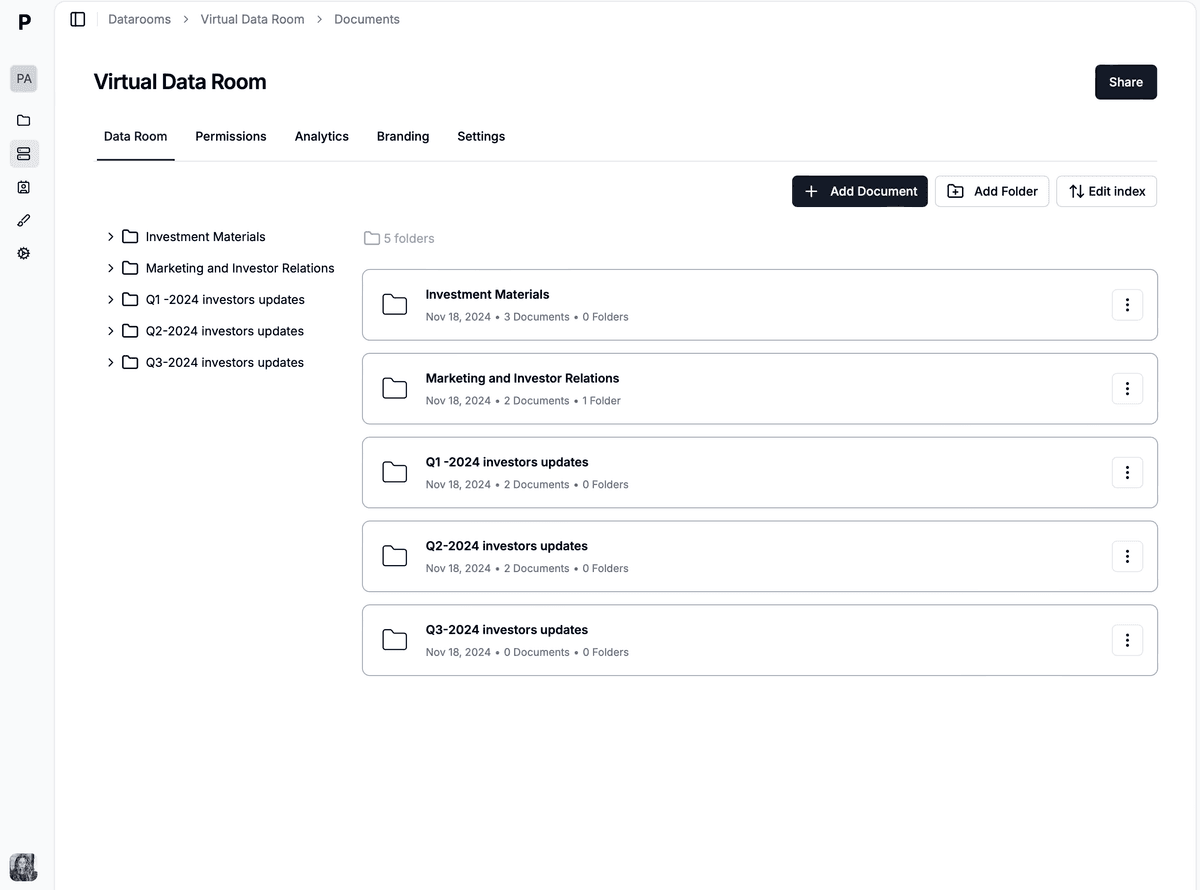
A buy-side data room with one room per live target keeps two competing targets' material genuinely separate.
Corporate development teams usually arrive at this after a near miss rather than before one. Four reasons come up repeatedly.
Two live targets must never touch. If you are looking at two companies in the same sector, and you often are, their material has to be separated at the room level rather than the folder level. Competing sellers have a legitimate expectation that their confidential information is not sitting one click away from a rival's, and an NDA usually says so in writing. One room per target makes that provable rather than merely intended.
Six advisers need six different views. The quality of earnings provider, the legal adviser, the commercial team, the IT reviewer, the tax adviser, and the lender each need a narrow slice, and none of them needs the IC pack. A shared drive gives you one permission set for everyone. Per-link permissions give you one per adviser over the same underlying documents.
The IC pack is the crown jewel. The buyer's model, bid range, and walk-away price are more damaging in the wrong hands than anything the seller disclosed. That file needs view-only access, watermarking, a named viewer list, and a version that can be frozen once approved.
Passed targets are an asset. Most screened targets do not transact this year. The value of the pipeline room compounds only if the material survives, dated and findable, long enough for the re-approach. That means retention and archiving are product decisions, not admin.
If you are still selecting a platform, the comparison of the best virtual data rooms sets out how the main providers price room count, because on the buy side that single line item usually decides the winner.
Open a room at NDA signature and name it for the target and the year. Inside, use the same folder skeleton every time: seller material, adviser work product, model, correspondence, and closing. Standardising the skeleton means an analyst joining the deal in week six knows where everything is, and it makes the archive comparable across deals.
Bulk upload works by dragging the folder tree straight in. Automatic file indexing on the Data Rooms Plus plan builds and maintains the index as documents arrive, which matters on the buy side because intake never arrives complete. Keep the pipeline room as a single permanent room alongside the per-target ones.
This is the step that makes the whole model work. Access in Papermark is granted per link rather than per user account, so each adviser gets a link carrying its own folder scope, its own email allowlist or domain restriction, and its own download rule. No adviser has to create an account, which removes the friction that makes busy professionals ignore a room entirely.
| Link holder | Folders granted | Rights |
|---|---|---|
| Deal team | All folders in that target's room | View, upload, download |
| QoE provider | Financial, tax | View and download |
| Legal adviser | Corporate, contracts, litigation, HR | View and download |
| Commercial adviser | Commercial, customer data | View only, watermarked |
| Lender | Model summary, QoE summary, financing pack | View only |
| IC members | IC room only | View only, watermarked, no download |
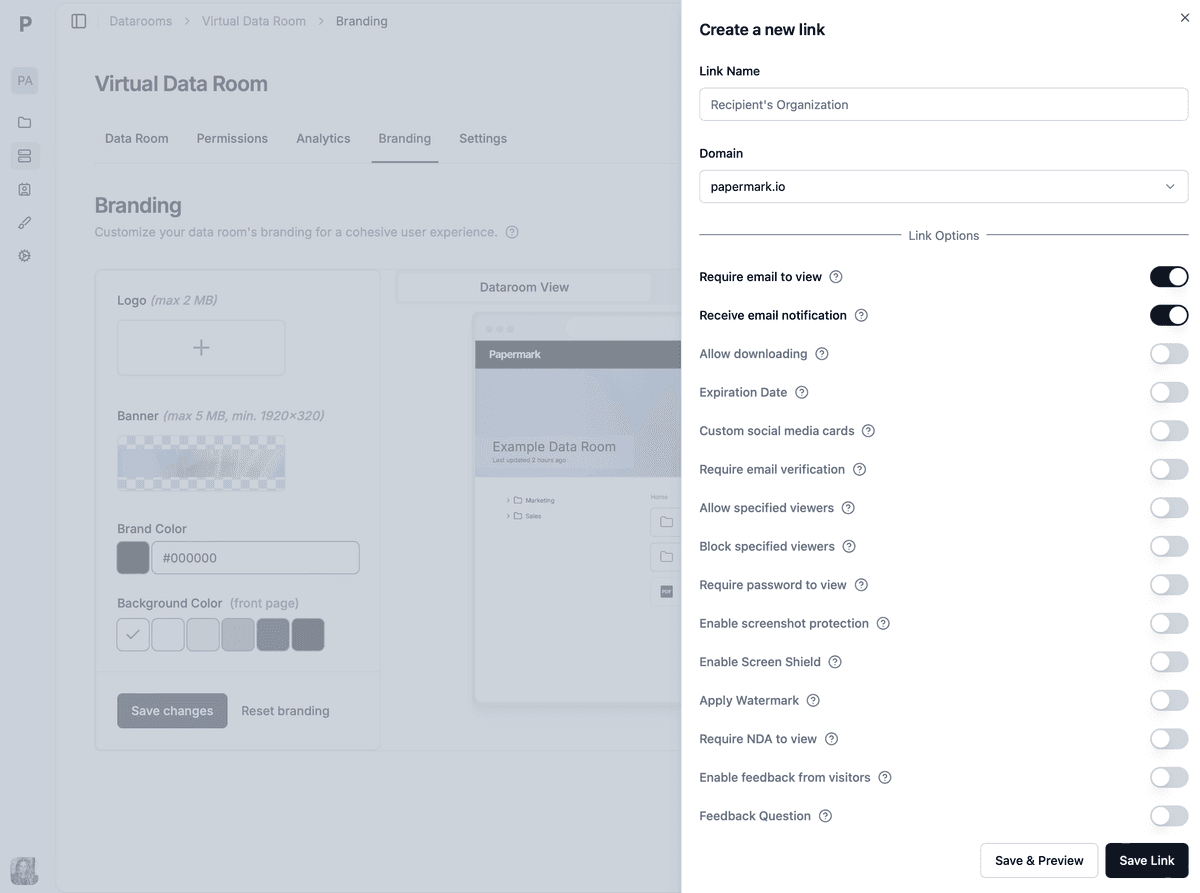
Each buy-side adviser link carries its own folder scope, allowlist, and download rule.
Put the IC pack in its own room, not a folder inside the target room. Set it to view-only, disable download, restrict the link to a named email allowlist, and turn on dynamic watermarking, which renders each viewer's email, IP address, and timestamp onto every page as it loads. Screenshot protection adds a further deterrent on the model and the bid range specifically.
The honest limit is worth stating: a file that has been downloaded is legally treated as read, and no platform can recall it. That is precisely why download is disabled rather than discouraged on the IC pack, and why watermarking exists. It makes a leak attributable to a named viewer rather than merely regrettable.
Diligence questions arrive in waves and from several directions. The Q&A module attaches each question to the document that prompted it, with permissions controlling which group sees which threads, so the lender never reads the legal adviser's red flags. Answers can be published to one group or to everyone, and the log exports for the closing file.
Request files from visitors turns the room into an intake channel rather than only an output channel. Advisers upload their draft and final reports directly into the adviser work product folder, and the seller can be given an upload-only link for late documents, which keeps material out of email entirely.
Page-level analytics show which adviser opened which document, when, and for how long. On the buy side this is a scoping signal rather than a buyer-intent signal: an adviser who has spent forty minutes in the licensing folder has found something, and you will usually hear about it a week before the report lands.
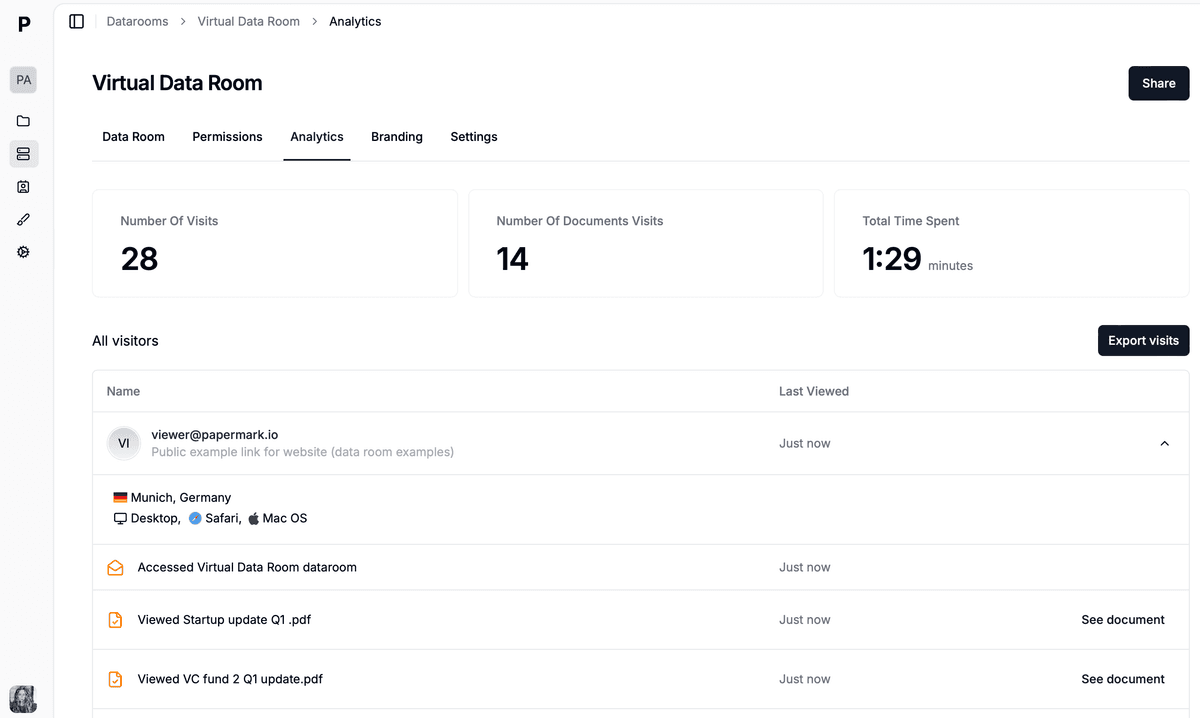
Per-visitor analytics on the buy side show adviser progress across each workstream in real time.
When a target closes or drops, data room freeze makes the room immutable and exports it as an archived ZIP with a certificate. That archive is what answers the question of what was disclosed, relied on, and approved, whether it comes up in a warranty claim two years later or in an LP audit.
The Data Rooms plan is €99/month with a 7-day free trial and includes 3 team members, unlimited data room visitors, unlimited data rooms, unlimited documents, custom domain, dynamic watermarking, NDA agreements, and granular file-level permissions. Data Rooms Plus at €249/month adds 5 team members, the Q&A module, the audit log, automatic file indexing, and SOC 2 Type II. Data Rooms Premium at €549/month adds 10 team members, AI redaction, API access, SSO, and full whitelabeling, which matters for corporate development teams that want target rooms on their own domain. Data Rooms Unlimited at €999/month removes per-seat charges entirely, so teams that add reviewers mid-deal pay one number regardless of headcount, and it carries every Premium capability including AI redaction. There is also a free plan at €0 for document sharing, which is fine for sending a teaser but not for running diligence.
For a buy-side team, the pricing shape matters more than the headline. Unlimited data rooms under one subscription means 14 target rooms cost the same as one, so the decision to open a room at NDA signature is never a budget decision. Enterprise VDRs that price per project or per page make the opposite trade, and buy-side teams feel it every time they open a room for a target that may not transact.
No credit card required.
The 10 best data rooms for fundraising in 2026 compared on pricing, security, and best-fit round. Real customer stories from Backtrace Capital, TBD VC, and Two Inc.
The 15 best virtual data room providers and software compared on real pricing, verified ratings, and best-fit deal type, re-verified September 2026. Plus 6 tools we ruled out.
Compare the 7 best data rooms for investors in 2026 (Papermark, DocSend, Intralinks, iDeals, Notion, FirmRoom, Digify). Features, pricing, analytics for VCs and PE.