



datarooms
Data room for Plug and Play fundraising in 2026: the pilot room
A data room for Plug and Play fundraising in 2026: one room for corporate pilots and another for investors, because the three-month batch takes no equity.
Hi, it's Marc, founder of Papermark. I've seen hundreds of companies raise using Papermark, and I raised for my previous company too. The pattern is consistent: founders who prepare a clean data room before the first investor meeting close faster than founders who scramble to assemble materials mid-process. This guide is everything I wish I had on day one of my own first raise.
A startup fundraising data room is a secure online repository where founders share confidential documents with prospective investors during a seed, Series A, Series B, or later-stage round. A well-prepared fundraising data room accelerates investor diligence, demonstrates operational maturity, and lets founders track investor engagement in real time. Papermark supports startup fundraising at €99/month flat with all investor-ready features bundled.
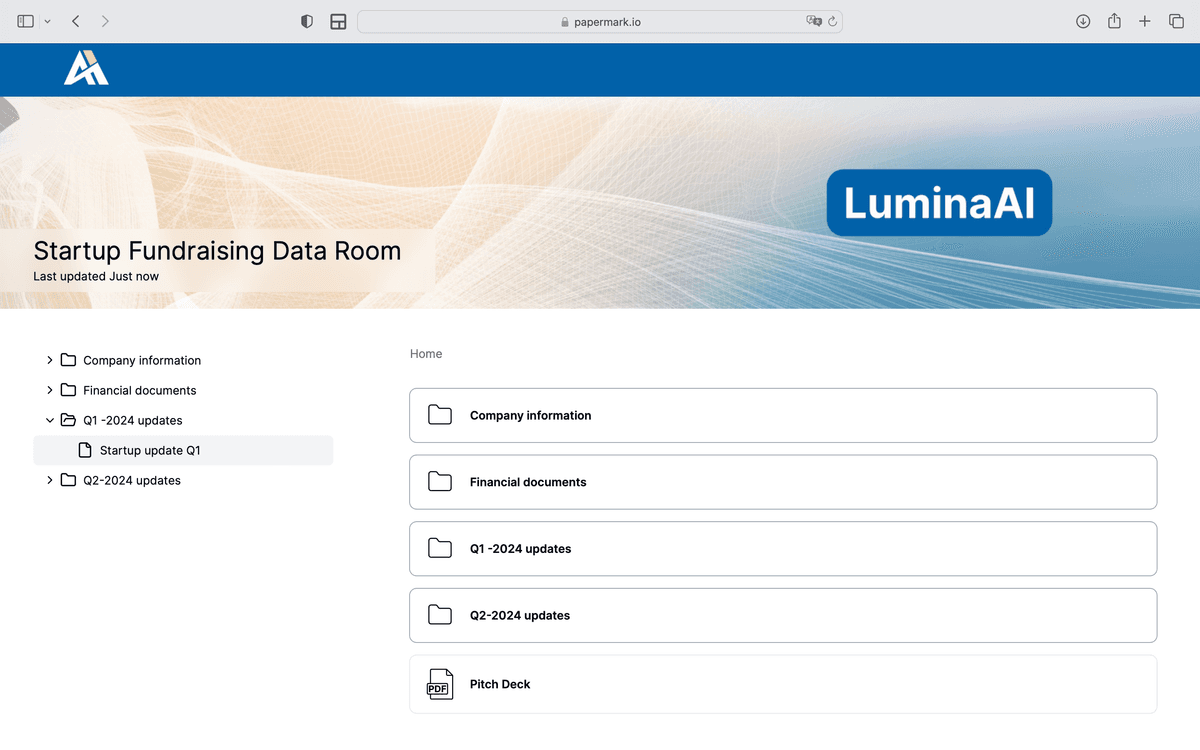
A startup fundraising data room is a secure online workspace where founders store and share confidential documents with prospective investors during a capital raise. It facilitates due diligence, signals operational maturity to institutional investors, and gives founders visibility into which partners are actively engaging with which materials through page-by-page analytics.
Unlike an email-and-shared-Drive approach, a purpose-built fundraising data room provides granular permissions (partners see the full diligence binder; their associates see a subset), dynamic watermarking (a leaked deck traces back to the specific investor who forwarded it), and NDA enforcement before any viewer opens a file. The audit trail that results is both a legal record and a signal-rich source of data on who is actually running the process versus who is going through the motions.
Raising capital without a proper data room is survivable at pre-seed, painful at seed, and a material disadvantage from Series A onward. Six reasons drive most founders to set one up before the first investor meeting.
Professionalism and preparedness. A well-organized data room signals that the founding team is serious, has anticipated investor diligence, and is ready to move quickly. Institutional investors, especially partners at top-tier funds, treat data room quality as a proxy for operational discipline.
Due diligence efficiency. A comprehensive data room compresses weeks of back-and-forth email requests into a single self-service workflow. Investors get what they need; founders stop doing the document-request admin and focus on the pitch.
Trust through transparency. Open access to clean financials, cap table, and customer data builds investor confidence. A disorganized or incomplete data room erodes it, even if the pitch is strong.
Highlighting startup strengths. Structured organization lets founders showcase traction, product roadmap, and team quality in a navigable format. Investors who self-serve through the materials arrive at partner meetings with substantive questions instead of scavenger-hunt complaints.
Facilitating investment decisions. Investors evaluate dozens of companies in parallel. Clean, organized information makes comparison easier and moves the startup up the decision queue.
Reading investor intent. Page-by-page analytics let founders see exactly which investors opened the financial model, how long they spent on the cap table page, and whether they came back for a second review. This is often more decisive than the pitch itself for timing follow-up conversations.
Different rounds need different data rooms. A pre-seed deck-and-traction setup is inappropriate for a Series B institutional raise; an enterprise-grade Series C data room is overkill for a seed angel round. The table below maps round to data room scope.
| Round | Round size | Documents | Viewer groups | Key features needed |
|---|---|---|---|---|
| Pre-seed | $100K-$1M | 10-15 | Angels, pre-seed funds | Pitch deck, analytics, NDA |
| Seed | $1M-$5M | 15-25 | Seed funds, angels | Deck, model, cap table, customer traction |
| Series A | $5M-$20M | 30-60 | Series A leads, syndicate | Full financial model, 12-24 month historicals, customer cohorts |
| Series B | $20M-$80M | 60-120 | Series B leads, existing investor follow-ons | Full diligence binder, board materials, KPIs, unit economics |
| Series C+ | $80M+ | 100-500+ | Growth funds, crossover investors | IPO-readiness materials, audited financials, governance |
A seed round data room is lean and optimized for speed. Partners at seed funds like Initialized, First Round, or Accel's seed program make decisions in weeks, not months. The data room needs to cover the essentials without bloat.
Minimum documents for a seed round data room:
Seed investors rarely dig beyond these 10 document categories at the seed stage. Over-preparing (full board minutes, 3-year audited financials, legal opinions) signals misplaced priorities.
A Series A data room is where startup fundraising starts to look like real due diligence. Series A leads (Sequoia, a16z, Accel, Index, Benchmark, Bessemer) run structured processes with partner meetings, partner-associate splits, and reference calls. The data room expands accordingly.
Series A data room adds to the seed list:
The Series A data room commonly runs 30-60 documents. Granular permissions matter here: the lead partner gets the full binder, their associate sees a subset focused on diligence-relevant items, and syndicate investors get a curated view.
A Series B data room mirrors light M&A diligence. Investors are valuing the company at $100M-$500M+ and writing checks that will survive multiple market cycles. The document set becomes comprehensive.
Series B data room adds:
Series B and later rounds commonly use the same granular permission model as M&A data rooms. Lead investors get full access; co-investors get scoped access; associates get subset access by diligence workstream.
Institutional investors (Sequoia, a16z, Accel, Index, Benchmark, Founders Fund, Bessemer, GV, Kleiner Perkins) have consistent expectations that founders should design the data room around.
Clean cap table. The cap table is the first document most partners open. Messy cap tables (misaligned share classes, un-vested founder shares, orphaned SAFEs, unresolved common-vs-preferred disputes) kill term sheets faster than weak financials.
Financial model with transparent assumptions. Partners want to see not just the numbers but the drivers: what is the assumed ARR growth rate, what conversion funnel, what pipeline coverage, what CAC payback. A model with opaque assumptions signals either incompetence or evasion.
Customer traction with evidence. Revenue numbers supported by customer-level detail (revenue per logo, NDA-permitted reference contacts, retention cohorts) carry far more weight than aggregate MRR.
NDA-gated access. Top-tier funds expect some form of NDA or confidentiality wrapper before opening materials. Not all partners sign NDAs (some firms categorically refuse), but the option should be available. For licensing, biotech, or regulated industries, NDA is mandatory.
Analytics visibility. Founders are increasingly expected to know which partners opened which documents, when, and for how long. Page-by-page analytics turn the data room from a static file share into an intent-reading tool.
Professional presentation. Custom domain (vdr.yourcompany.com), logo-branded interface, and email templates signal operational seriousness. Generic Google Drive folders do not.
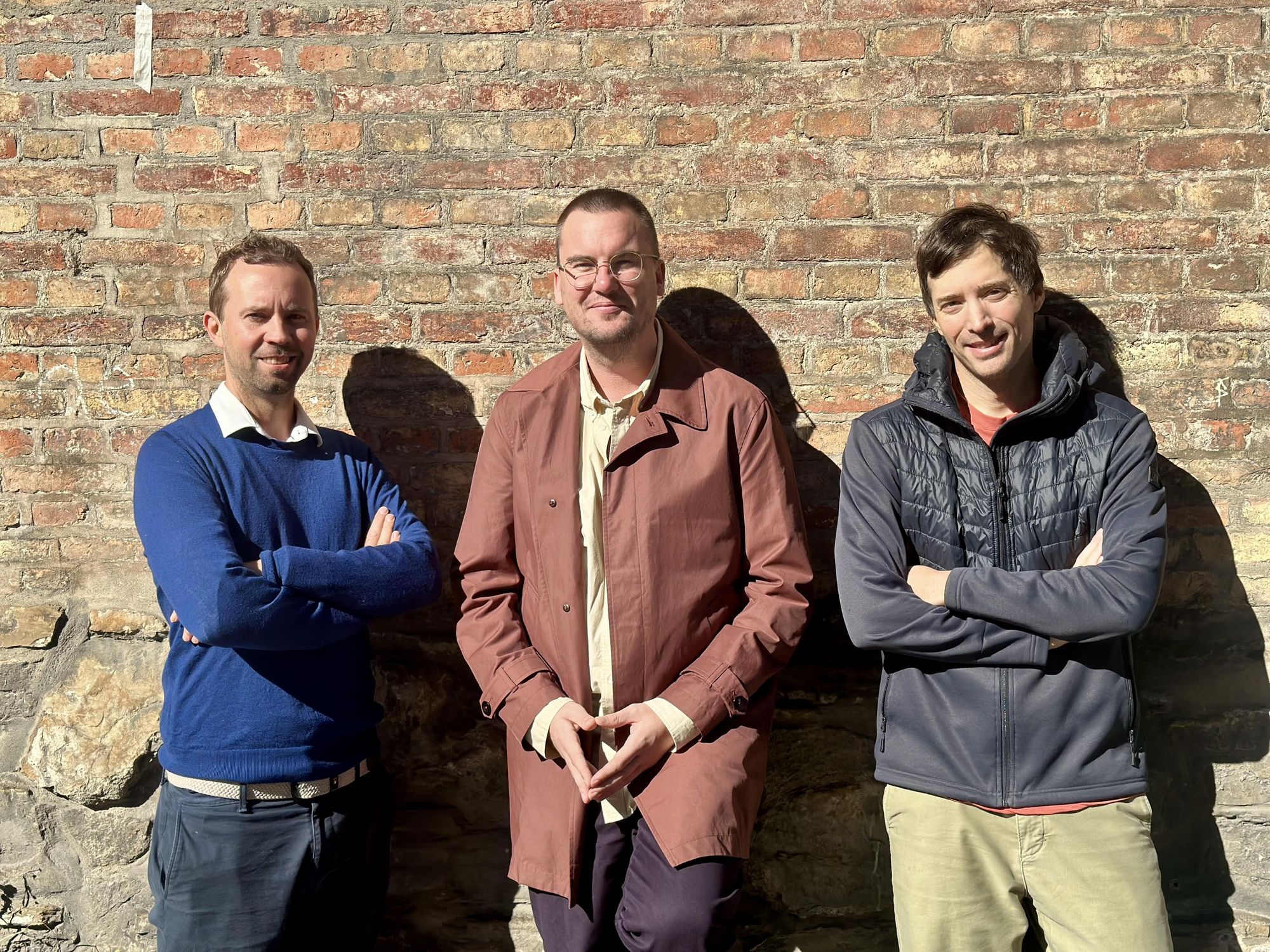
See how Two, a fintech startup, used Papermark to secure €13M in Series A funding:
Select a VDR designed for modern fundraising: page-by-page analytics, dynamic watermarking, NDA enforcement, granular permissions, custom branding, and flat-rate pricing. Avoid per-user tools that penalize you for inviting more investors. Compare options at best virtual data rooms 2026.
Create the standard fundraising folder structure (Company Overview, Financial, Product, Market, Legal, Team, KPIs). Use consistent file naming (YYYY-MM-DD_DocumentType). See the data room folder structure guide for conventions.
Gather the documents relevant to your round stage (see the round-specific lists above). Bulk upload to preserve folder hierarchy. Redact sensitive customer names or employee PII before upload.
Scope access per investor group. Lead partners get full access; associates and syndicate investors get curated views. Enable NDA gating, email verification, and dynamic watermarking by default.
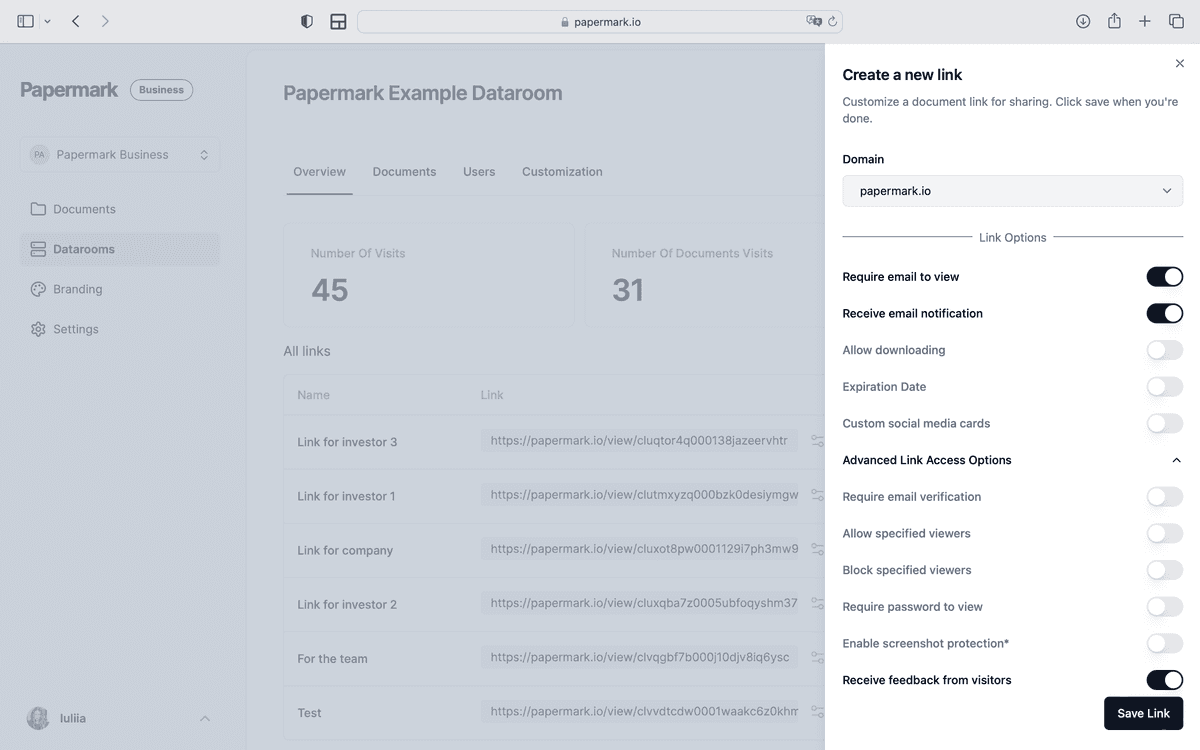
Update documents as the round progresses: new monthly financials, product updates, customer wins. Papermark's version control logs every change and notifies active viewers automatically.
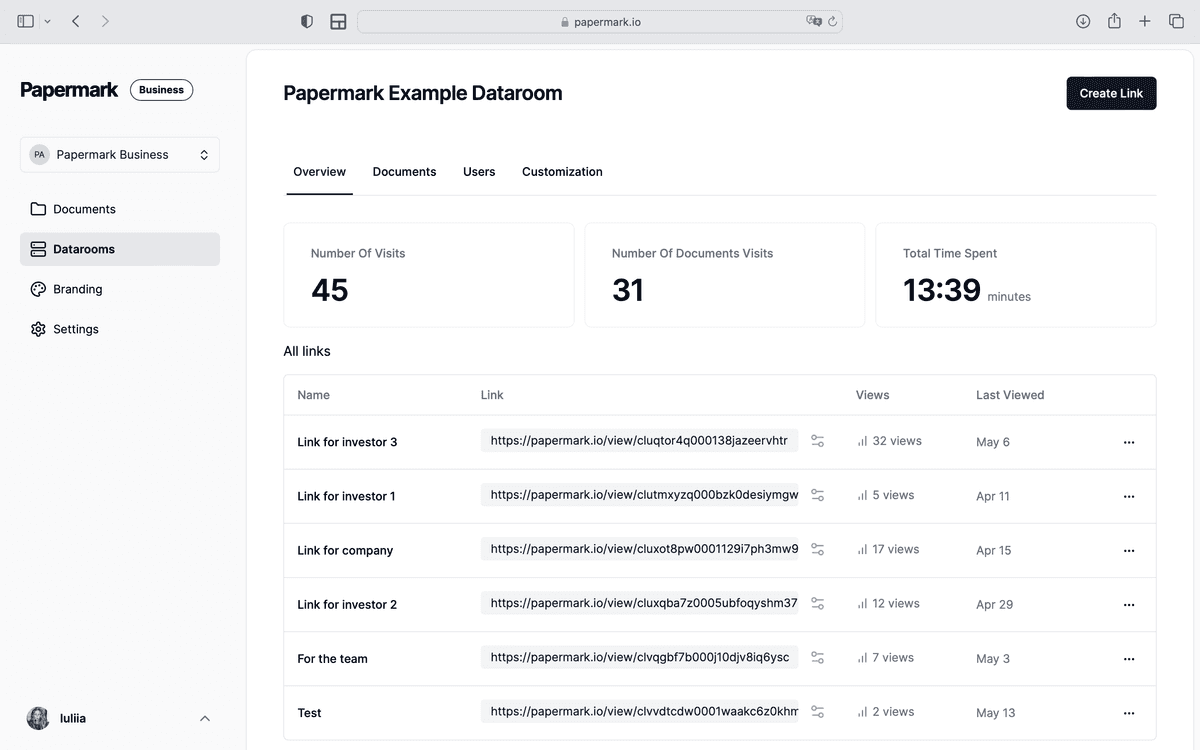
Use page-by-page analytics to see which partners are engaging. A partner who re-opens the financial model three times in week 2 is signaling active interest. A partner who has not returned in two weeks is usually out.
The table below lists the complete document set for a Series A / Series B-ready fundraising data room. Seed rounds use a subset focused on the Company Overview, Financial (cap table, model), and Team sections.
| Document | Necessary | Good to Have |
|---|---|---|
| Pitch Deck | ||
| Executive Summary | ||
| Detailed Business Plan | ||
| Market Research and Analysis | ||
| Product Roadmap | ||
| Technical Documentation | ||
| User Guides and Manuals | ||
| Historical Financials | ||
| Financial Projections | ||
| Cap Table | ||
| Funding History (SAFEs, convertibles, priced rounds) | ||
| Incorporation Documents | ||
| Shareholder Agreements | ||
| Intellectual Property Documentation | ||
| Contracts and Agreements | ||
| Founders' Bios and Resumes | ||
| Organizational Chart | ||
| Advisors and Board Members | ||
| Customer Traction and Metrics | ||
| Sales and Marketing Strategy | ||
| Customer Testimonials and Case Studies | ||
| Key Performance Indicators (KPIs) | ||
| Operational Processes | ||
| Technology Stack | ||
| Risk Factors | ||
| Use of Funds | ||
| Exit Strategy |
| Feature | Papermark | DocSend | Intralinks |
|---|---|---|---|
| Page-by-page analytics | ✔️ | ✔️ | Partial |
| Dynamic watermarking | ✔️ | Partial | ✔️ |
| NDA gating | ✔️ | ✔️ | ✔️ |
| Custom domain | ✔️ | Partial | ❌ |
| Self-hosted option | ✔️ | ❌ | ❌ |
| Flat-rate pricing | ✔️ | ❌ | ❌ |
| Starting price | €99/month | $15/user/month | $4,000+/year |
Papermark offers the strongest fundraising feature set at flat-rate pricing. DocSend is common for pitch-deck-only workflows but charges per user. Intralinks is typically overkill for seed or Series A. See Papermark vs DocSend and Papermark vs Intralinks for head-to-head.
Sharing too much too early reduces leverage; sharing too little too late kills momentum. The matrix below maps the five stages of investor engagement to the documents to share at each.
| Stage | Audience | Documents to share | Goal |
|---|---|---|---|
| Stage 0: Cold outreach | Partners, scouts | Pitch deck only (with view tracking) | Confirm interest; track who opens |
| Stage 1: First meeting | Lead partner, associate | Deck + executive summary | Generate next-meeting invitation |
| Stage 2: Partner pitch | Full partnership | Deck + financial model + customer cohorts | Get partnership conviction |
| Stage 3: Diligence | Lead investor + counsel | Full data room minus highly sensitive items | Pass technical and commercial review |
| Stage 4: Term sheet | Lead investor | Everything including IP, customer references | Close lead with signed term sheet |
| Stage 5: Confirmatory | Co-investors, syndicate | Full data room with scoped access per investor | Close round on time |
For the playbook by round, see pitch deck analytics and data room for raising Fund I.
Page-by-page analytics produce a stream of behavioral data. Five signals predict closing more reliably than any one-on-one conversation.
1. Partner returns to the financial model. A partner who re-opens the financial model 2-3 times across a week is running internal partnership conversations. Time the follow-up email when the model is still fresh.
2. Cap table dwell time. Time spent on the cap table page correlates with seriousness about ownership stake. Partners spending 5+ minutes are mentally calculating dilution scenarios.
3. Customer reference page opens. Investors who pull customer logos and reference materials are doing back-channel reference checks. Expect calls to your named customers within 1-2 weeks.
4. Repeated visits across the partnership. When the lead partner shares the data room with two more partners, that is partner-meeting prep. Probability of term sheet rises sharply.
5. Quiet sections. A partner who has not returned to the data room in 2 weeks is usually out. Re-engage explicitly with a "still interested?" email rather than waiting silently.
Six mistakes show up consistently in customer post-mortems on raises that took longer or closed lower than expected.
1. Launching with an incomplete cap table. Investors immediately notice missing rows or unclear ownership math. Solution: clean the cap table to 5-decimal precision before opening to investors.
2. Sharing the same set of documents to all investors at all stages. Stage-1 partners do not need to see customer concentration analysis or IP filings. Solution: use staged scoped access via investor groups.
3. No NDA gating on later-stage materials. Sensitive customer data, IP filings, and competitive analysis should be NDA-gated even when the deck is open. Solution: configure per-link NDA enforcement.
4. Dynamic watermarking turned off. A leaked deck without watermarks is impossible to trace. Solution: enable dynamic watermarking on every shared document, even the deck.
5. Tracking turned off "to seem polite." Investors expect founders to track engagement. It is professional, not invasive. Solution: keep page-by-page analytics on for every link.
6. No follow-up on quiet investors. A partner who stops engaging is usually out. Re-engage explicitly rather than waiting silently. Solution: set up engagement-trigger emails that prompt follow-up after 7 days of silence.
Backtrace Capital - Fund I €50M+ close. First-time European fund manager Backtrace used Papermark to centralize PPM, LPA, track record, and ESG documentation across 80+ LP prospects. Per-LP scoped access plus page-by-page analytics let the GP team see which LPs were progressing. See Backtrace customer story and data room for raising Fund I.
Medusa JS - Open-source startup investor relations. Medusa, an open-source e-commerce platform, uses Papermark to securely share marketing materials and investor diligence across distributed teams. Custom domain, dynamic watermarking, page analytics across the investor outreach process. See Medusa customer story.
HUO Family Office - LP allocations and direct co-investments. HUO uses Papermark to manage diligence on direct co-investments and PE GP allocations alongside the family's investment committee workflow..
| Round | Recommended VDR plan | Monthly cost | Why |
|---|---|---|---|
| Pre-seed | Papermark Free | €0 | Pitch deck only with view tracking |
| Seed (€500K-€3M) | Papermark Pro or Business | €24-€59/month | Custom domain, multi-file sharing |
| Series A (€3M-€15M) | Papermark Data Rooms | €99/month | Unlimited investor viewers, scoped access, NDA gating |
| Series B+ (€15M-€50M) | Papermark Plus | €249/month | Q&A module + audit log for institutional diligence |
| Growth / pre-IPO | Papermark Premium | €549/month | Multi-team workspaces, SSO, white-label for advisors |
For full pricing detail, see Papermark pricing and virtual data room cost in 2026.
A data room for Plug and Play fundraising in 2026: one room for corporate pilots and another for investors, because the three-month batch takes no equity.
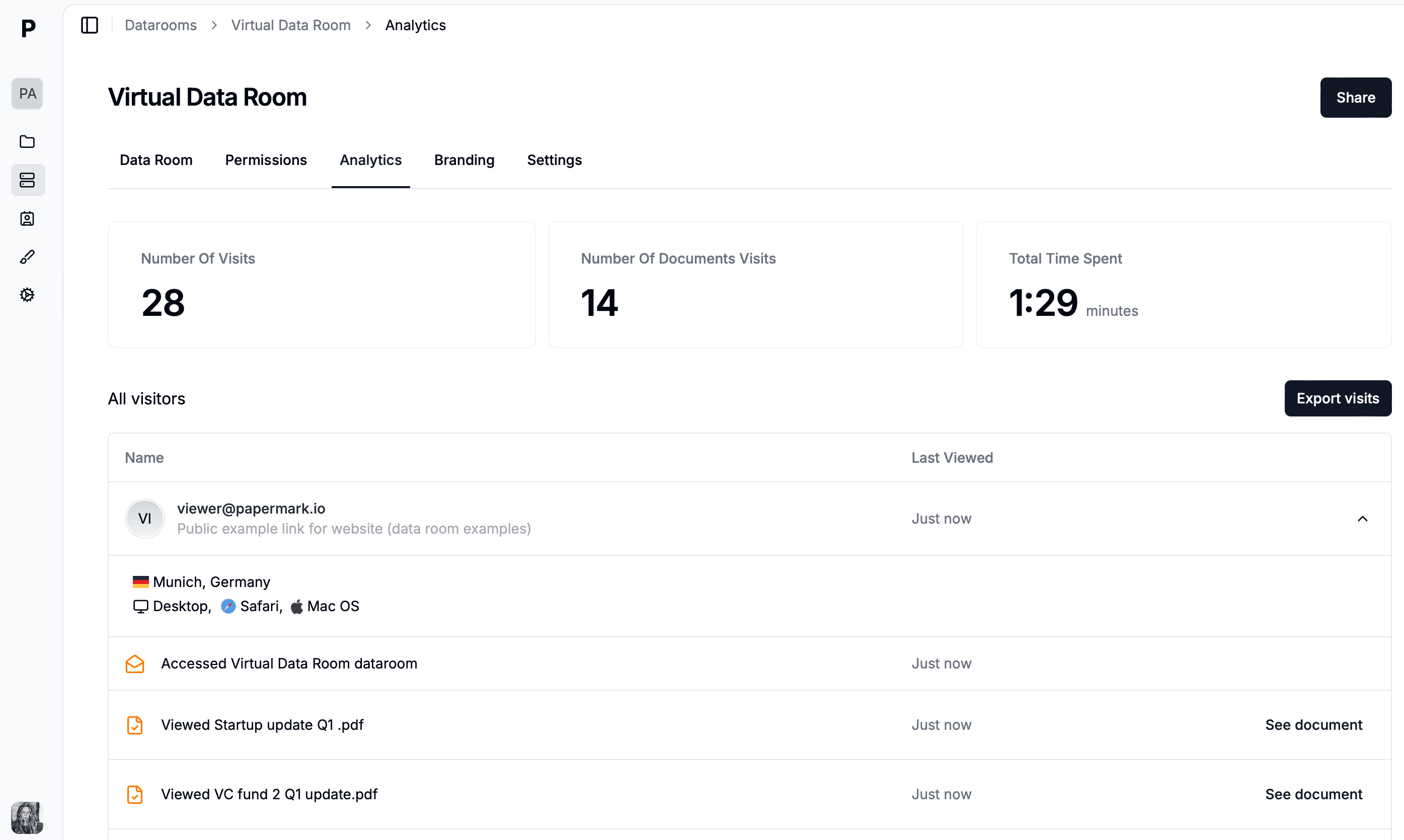
Data room checklist 2026 with 40 essential documents for M&A, fundraising, and due diligence, staged by deal type, plus what buyers actually open first.
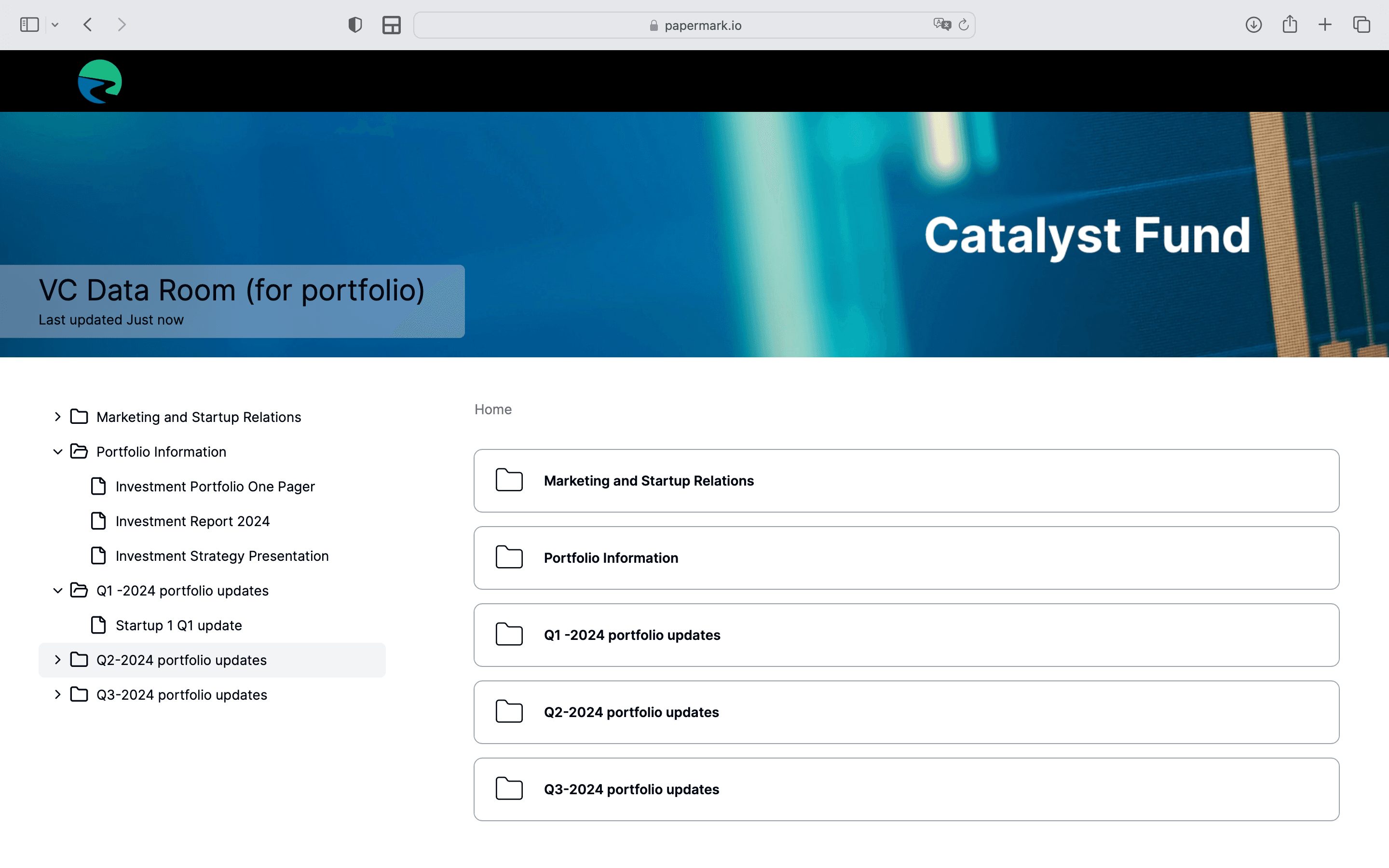
The complete venture fund data room checklist for 2026 - fund legal documents, performance history, PPM, LPA, ESG, and best practices for LP fundraising.