



datarooms
Fund I Data Room in 2026: 12 Documents LPs Open First (and the Playbook That Closed €50M)
The 12 documents LPs actually open first in a Fund I data room, and the playbook used to close $35M (TBD VC) and €50M+ (Backtrace Capital) in 2026.
A data room for raising Fund II is the secure, branded space where an existing manager proves what Fund I actually returned. Fund I was sold on a thesis. Fund II is sold on evidence, and the data room is where that evidence either holds up under LP diligence or falls apart.
The structural difference is evidence. A first-time manager builds a room that argues a case: this team, this thesis, this market, this differentiated access to deals. Everything in a Fund I room is forward-looking, because there is nothing else to show. A Fund II room inverts that. The manager now has three to five years of realised decisions, and the LP's job is to check whether the story told in Fund I matches what actually happened.
That inversion changes which folder gets opened first. In a Fund I raise, LPs open the team folder, because the team is the asset. In a Fund II raise they open the track record, and they open it before they read the deck. If the numbers hold up, they read the rest. If the numbers are confusing, inconsistent with prior quarterly reports, or presented without the methodology behind them, the raise stalls in the first week and no amount of narrative recovers it.
The second change is audience split. A Fund I raise talks to one audience: prospective LPs who have never given you money. A Fund II raise talks to two, and they need different rooms. Existing Fund I LPs already know the thesis and are deciding on performance and continuity, so they want deep portfolio detail and want it fast. New LPs need the full Fund I story rebuilt, including the reasoning behind the initial thesis, because they were not there for it. Serving both from a single link means one group is bored and the other is lost.
Third, the diligence itself gets harder. Fund I diligence is largely qualitative: reference calls, background checks, thesis interrogation. Fund II diligence is quantitative and adversarial. LPs will recalculate your IRR, question your marks, and compare your quarterly reporting cadence against what you promised in the Fund I LPA. A room built for that scrutiny is organised around verifiability, not around persuasion.
| Dimension | Fund I data room | Fund II data room |
|---|---|---|
| First folder opened | Team and track record of individuals | Fund I performance: DPI, TVPI, net IRR |
| Core question | Can this team execute the thesis? | Did they execute the thesis they sold? |
| Audience | One: prospective LPs | Two: Fund I re-ups and new LPs |
| Diligence style | Qualitative, reference-led | Quantitative, adversarial, recalculated |
| Hardest document | Credible fund model with no history | Valuation policy that survives challenge |
| Typical timeline | 12 to 24 months | 9 to 18 months |
| Fatal weakness | No proprietary deal flow evidence | Inconsistent Fund I reporting history |
The folder structure below is ordered by the sequence an LP actually reads, not by internal convenience. Put the track record first, because that is what gets opened first, and burying it under an introduction folder adds friction at exactly the moment you want none.
Folder 1: Fund I track record. The performance summary, net and gross IRR, DPI, TVPI, RVPI, and a clear statement of the as-of date. Include the methodology: how you calculate IRR, what fees are netted, and which cash flows are included. LPs recalculate these numbers, and a methodology note prevents a benign difference from reading as a discrepancy.
Folder 2: Portfolio company marks. Every company, current mark, cost basis, ownership, round history, and the valuation basis for the mark. This is the folder that draws the most pointed questions, and the one where a written valuation policy does the most work.
Folder 3: Fund II model and terms. Target size, deployment pace, reserve strategy, portfolio construction, and the fee and carry structure. Where Fund II differs from Fund I on terms, say so explicitly rather than letting an LP discover it in the LPA.
Folder 4: Team and continuity. Bios, but more importantly the continuity story: who is still here from Fund I, what has changed, how carry is split now, and what the key-person provision covers. Team turnover between funds is a standard LP concern and answering it preemptively is cheaper than answering it under pressure.
Folder 5: Legal. LPA, subscription documents, side letter policy, structure diagram, and the regulatory registrations that apply in your jurisdiction.
Folder 6: Fund I reporting history. Every quarterly report and annual letter you sent during Fund I, in order. This folder is unique to a Fund II raise and it is the one most managers underestimate. It is direct evidence of reporting discipline, and its absence is read as a warning.
Folder 7: References. Founder references, co-investor references, and existing LP references, with a note on who is available to speak and about what.
Folder 8: Operations and service providers. Fund administrator, auditor, legal counsel, banking, and your valuation process. Institutional LPs diligence your back office, not just your investing.
Folder 9: ESG, DEI, and regulatory. Policies, reporting commitments, and where applicable SFDR classification. For European institutional LPs this is a gating folder, not a nice-to-have.
Worked scenario based on a €120M Fund II raise. Track record and portfolio marks together take roughly two thirds of total reading time, which is why they belong at the top of the room rather than behind an introduction folder.
Icebreaker.vc is an early-stage firm investing across Finland, Sweden, and Estonia. They launched in 2017, have worked with nearly 400 founders, and are now investing from Fund III. That progression, from a first fund through to a third, is exactly the arc a Fund II raise sits in the middle of, and it is built on the reporting discipline accumulated in the funds before it.
The mechanics they rely on are the ones that matter for any later fund: a structured data room per audience, granular permissions so each LP group sees only what applies to it, individual trackable links per investor so engagement is visible at the LP level rather than in aggregate, and analytics that show which sections were actually read.
That per-investor visibility changes how a raise is run. When you can see that a prospective LP opened the track record three times and never reached the fund model, you know what the next call needs to cover. Aggregate download counts tell you nothing comparable.
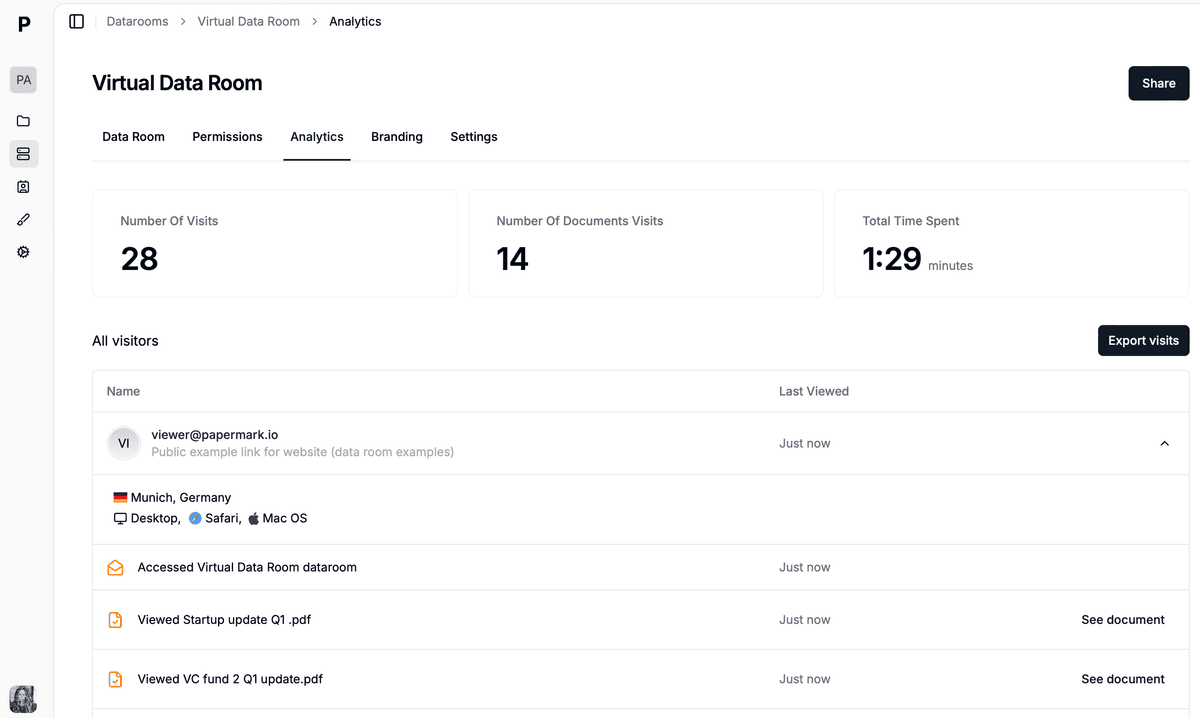 Per-investor analytics show which LPs opened the track record and how far into the fund model they read.
The single highest-leverage thing a manager can do for a Fund II raise happens years before the raise begins: report to Fund I LPs consistently, in a consistent format, through a consistent channel. Managers who do this arrive at Fund II with a complete, ordered reporting history that answers most diligence questions before they are asked. Managers who do not arrive with a folder of inconsistent PDFs and spend the first month of the raise reconstructing history.
DataPower VC illustrates the operational side of this. As their portfolio expanded they needed a structured way to organise portfolio company information, share sensitive financials with specific investors, track engagement, present a branded experience, and update information regularly while keeping a single access point. Those five needs are precisely the ones that compound into a Fund II track record.
Their approach was a dedicated data room per portfolio company, a custom branded domain so updates arrived under their own brand, individual trackable links per investor, and granular access control setting different permission levels for different investor groups. Run that for three years and the Fund II track record folder builds itself.
The version-control point deserves emphasis. Portfolio marks change quarterly. If each update goes out as a fresh email attachment, LPs accumulate a dozen inconsistent versions and any one of them can surface during diligence as a contradiction. A single live link that always resolves to the current version removes that failure mode entirely.
| Fund I habit | Cost at Fund II | What to do instead |
|---|---|---|
| Quarterly updates as email attachments | Conflicting versions surface during diligence | One live link per LP, versioned centrally |
| Inconsistent reporting format | LPs cannot compare periods, so they ask for rework | Fixed template from the first quarter of Fund I |
| No written valuation policy | Every mark becomes an argument | Write it in Fund I, apply it unchanged |
| Skipped quarters when nothing happened | Reads as a discipline gap, not a quiet quarter | Report every quarter, even briefly |
| One shared link for all LPs | No engagement signal, no per-LP insight | Individual trackable link per LP |
It is worth understanding how the room is used by the people you are sending it to. G.P. Loree & Co., a New York family office, runs its investment diligence in Papermark data rooms organised by deal or asset, with each room carrying specialised folders: historical financial statements, projections and forecasts, budgets, KPIs, and operating metrics.
Two things follow from that. First, your data room is not the only room the LP is in. It sits alongside other managers' rooms and other asset classes, and the one that is fastest to navigate gets diligenced first. Second, the LP is reorganising your material into their own structure regardless of how you present it. Documents that are clearly labelled, correctly dated, and consistently formatted transfer cleanly into that process. A folder called "final_v3_updated" does not.
The practical lesson is to name and date every document as though it will be read out of context, because it will be.
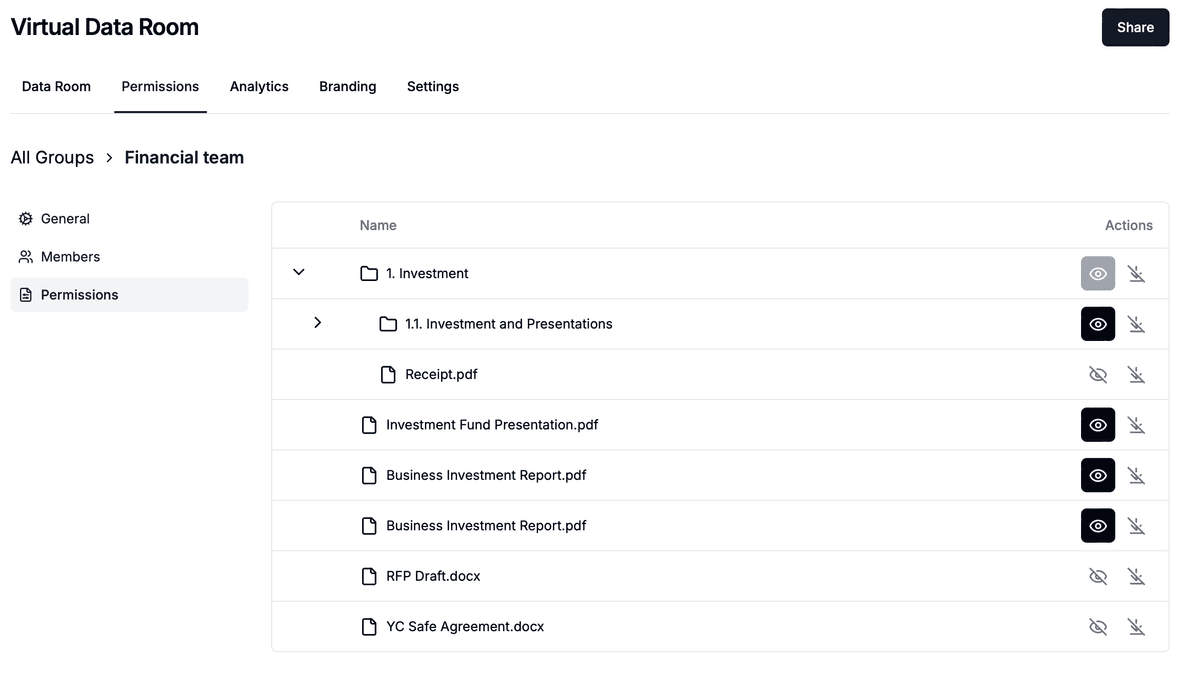 Folder-level permissions let existing Fund I LPs and prospective new LPs work from the same room with different access.
The re-up conversation and the new-LP conversation are different sales, and the room has to serve both without maintaining two sets of documents.
Existing Fund I LPs are deciding whether to re-up. They know the thesis, so the thesis material is noise to them. What they want is performance detail, the current mark on every company they are already exposed to, and a clear account of what changes in Fund II. They also want it quickly, because a re-up decision that drags is usually a re-up decision that turns into a no.
New LPs need everything. The Fund I story has to be rebuilt from the beginning, including why the original thesis was chosen and how it held up, because they are underwriting both the track record and the reasoning that produced it. They also tend to run longer, more formal diligence, often with a consultant involved.
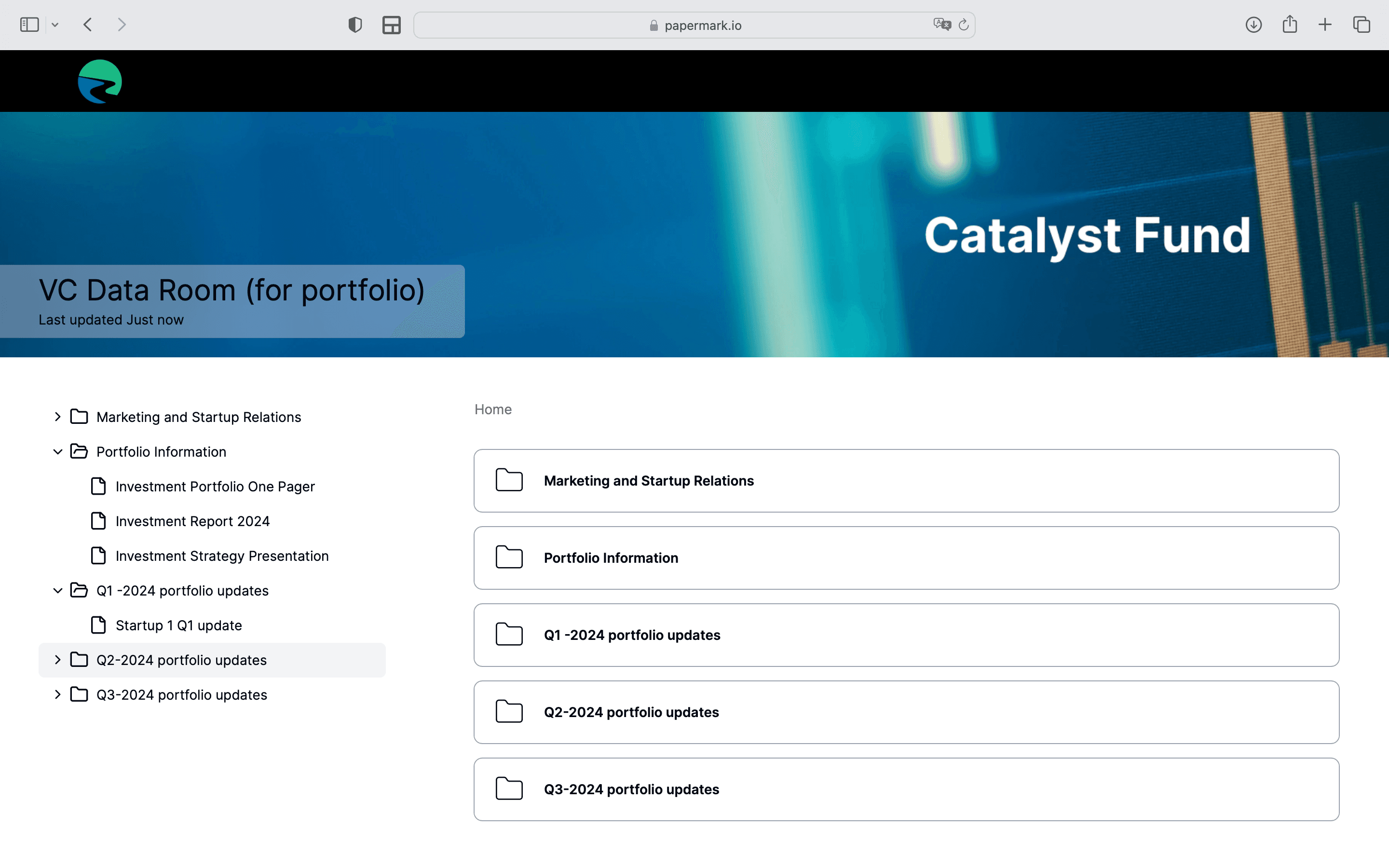
The clean solution is one document set with permissioned views. Build the room once, then create separate access groups: a re-up group that lands directly in track record and portfolio marks, and a new-LP group that gets the full room including thesis and background material. Both groups read the same underlying files, so there is no version drift, but each sees a room shaped to the decision it is making.
A third group is worth creating in advance: the consultant or gatekeeper view. Institutional LPs frequently delegate first-pass diligence, and consultants want the operational and regulatory folders far earlier than the LP does.
| Folder | Fund I re-up group | New LP group | Consultant / gatekeeper |
|---|---|---|---|
| 1. Fund I track record | Full, landing folder | Full | Full |
| 2. Portfolio company marks | Full, including per-company basis notes | Full | Full |
| 3. Fund II model and terms | Full, with terms-change rationale | Full | Full |
| 4. Team and continuity | Summary only | Full | Full |
| 5. Legal (LPA, subs, structure) | Full | On request, after first call | Full |
| 6. Fund I reporting history | Not needed, they received it | Full | Full, read closely |
| 7. References | Not needed | Full | Full |
| 8. Operations and service providers | Summary only | On request | Full, requested first |
| 9. ESG, DEI, regulatory | Summary only | Full | Full, gating check |
Two rows in that matrix are counter-intuitive and worth calling out. Existing LPs do not need the reporting-history folder, because they are the ones who received those reports, and surfacing it to them adds noise to a decision you want to be fast. Consultants, by contrast, often request the operations and ESG folders in week one, before their LP has opened the room at all, so building those folders late is a common way to stall an institutional commitment before the conversation has properly started.
The questions below recur across Fund II raises. Each one is answerable in advance with a document in the room, and answering it in advance is worth more than answering it well later.
Notice that most of these are answerable from folders 1, 2, and 6. That is the case for building the room around evidence rather than narrative.
Papermark is a secure, fully customizable, and developer-friendly data room for modern dealmakers, with page-level analytics, dynamic watermarking, unlimited data room visitors on every plan, and transparent pricing from €99/month. For a Fund II raise the relevant capabilities are the ones that let one document set serve two LP audiences while producing a per-investor engagement signal you can actually run the raise from.
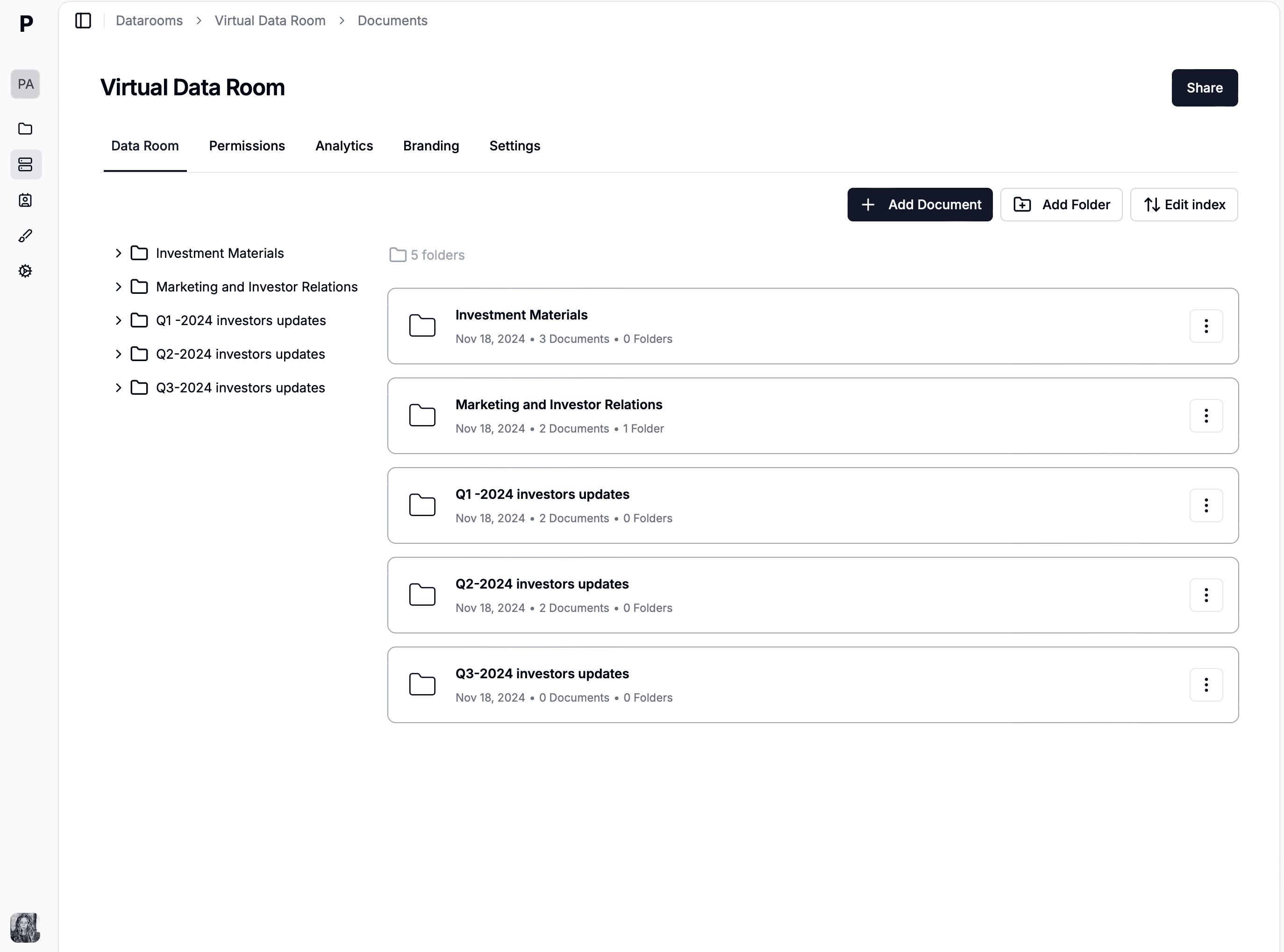
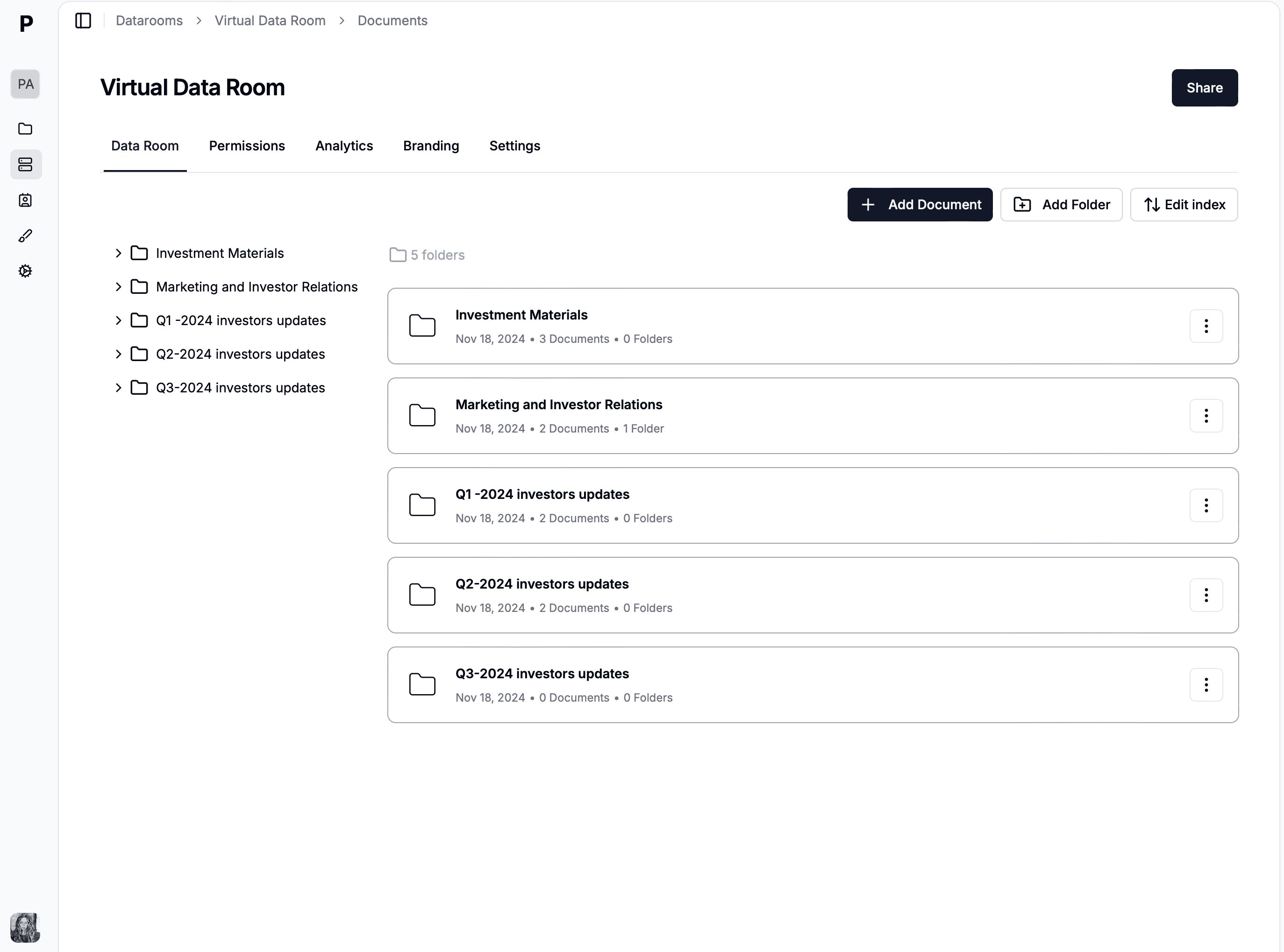
Create the nine folders in reading order, with Fund I track record first. Papermark's folder structure carries granular, file-level permissions, so ordering the room for the LP costs nothing in access control.
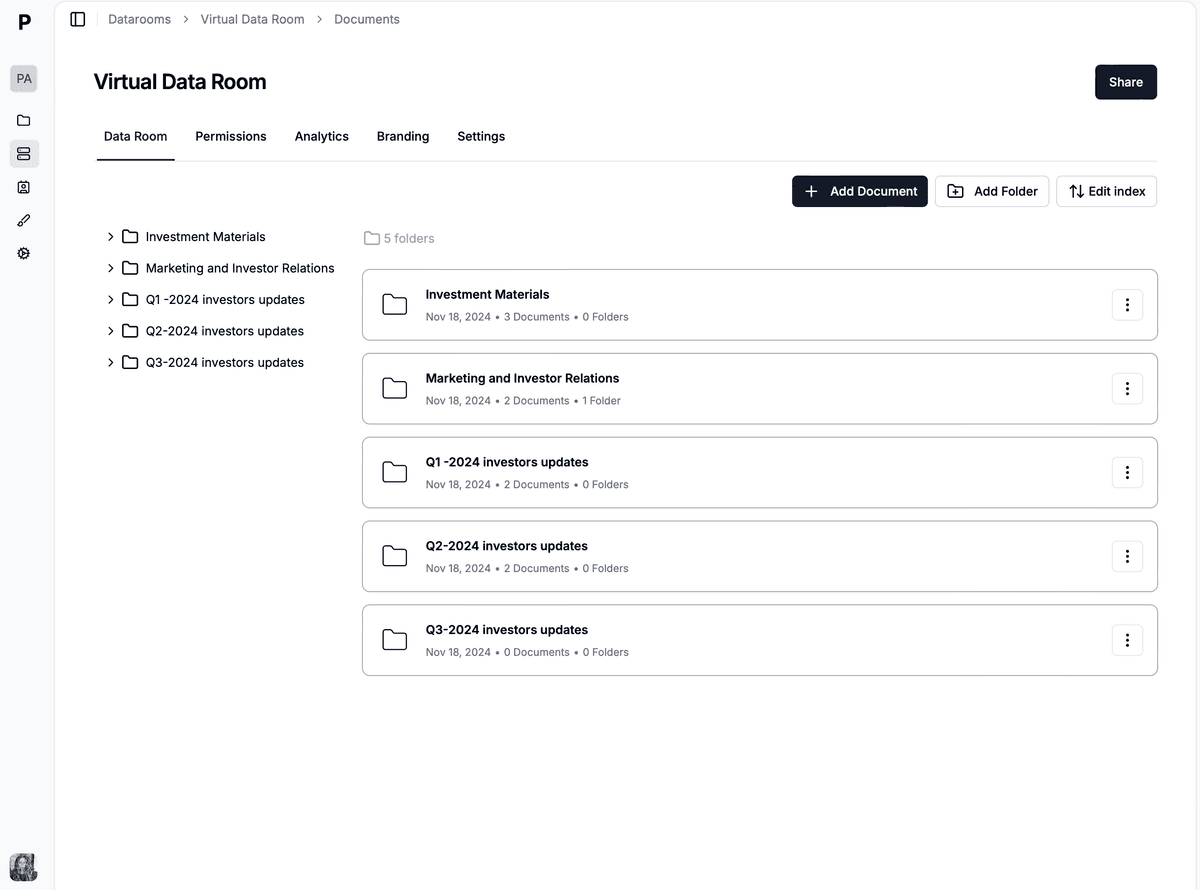 A Fund II data room built in reading order, with track record and portfolio marks above the fold.
Use granular file permissions to create a re-up group scoped to track record, marks, and Fund II terms, and a new-LP group with the full room. One underlying document set, two experiences, no version drift.
Create a separate link per LP rather than one shared URL. Page-by-page analytics then tell you which LP read the fund model to the end and which stopped at the marks, which is the difference between a follow-up call that lands and one that guesses.
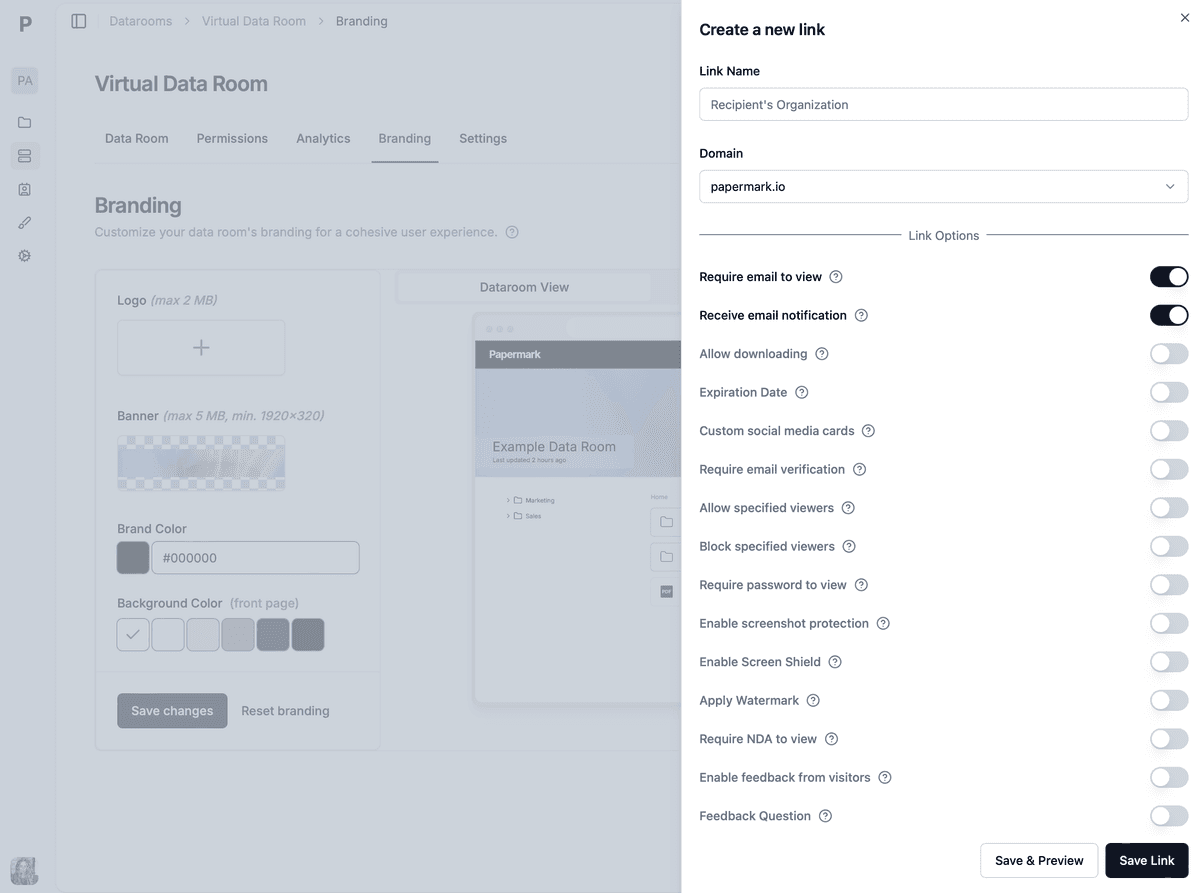 Individual links per LP make engagement visible at the investor level rather than in aggregate.
Portfolio marks and the fund model are the documents most likely to circulate beyond the intended reader. Dynamic watermarking stamps each page with the viewer's email and a timestamp at view time, so a leaked mark sheet is traceable to a session.
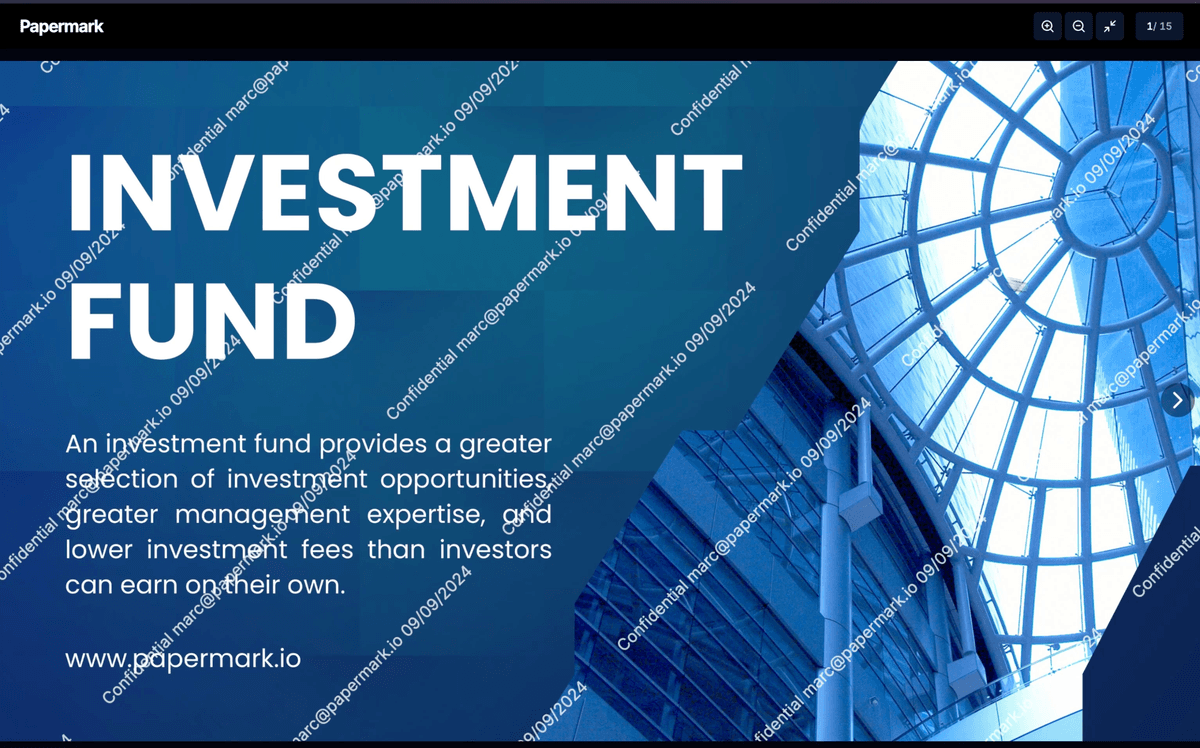 Dynamic watermarking makes portfolio marks traceable to the specific viewer and session.
Serve the room from a custom domain so LP-facing material arrives under your brand rather than a vendor's. Where you want the quarterly cycle automated, the public API, CLI, and MCP server let you create rooms, set permissions, and pull engagement data programmatically, which is how a reporting cadence survives three years without becoming a manual chore.
The reason is verifiability under pressure. A Fund II raise is decided on whether an LP can confirm your numbers quickly and reconcile them against what you reported during Fund I. Email attachments and shared drives fail that test in three specific ways: they produce version conflicts that read as discrepancies, they give you no signal about who read what, and they offer no access control when a prospective LP turns out to be a competitor's anchor.
A purpose-built room fixes all three. It also does something subtler that matters at Fund II specifically: it demonstrates operational discipline. An LP diligencing your back office is forming a view on whether you will report properly for the next ten years, and the room they are sitting in is the first evidence they see. If you are still choosing a provider, the best virtual data rooms comparison covers how the main options price and what they include.
The Data Rooms plan is €99/month billed annually (€149 monthly) with a 7-day free trial, and includes 3 team members, unlimited data room visitors, unlimited storage, dynamic watermarking, granular file permissions, and a custom domain. Data Rooms Plus at €249/month adds Q&A, an audit log, and SOC 2 Type II. Data Rooms Premium at €549/month adds AI redaction, full API access, and SSO. Data Rooms Unlimited at €999/month removes per-seat charges entirely.
For most Fund II raises the €99 tier carries the whole process. A manager running a 12-month raise pays under €1,200 for the data room across the entire fund, against legacy VDRs that quote per page or per gigabyte and reach five figures on a document set of this size.
Consider Halvard Partners, a European seed manager raising a €120M Fund II after a €45M Fund I deployed across 24 companies. Three years in, Fund I shows a 1.7x TVPI, 0.3x DPI from two partial exits, and a net IRR of 19 percent. Two companies are marked below cost, one is written off, and three carry marks above their last priced round.
They open the room ten weeks before the first LP meeting. The track record folder goes in first, with a one-page methodology note stating that IRR is net of fees and carry, cash flows are as of 30 September, and marks follow a written policy applied since Fund I quarter one. The three above-round marks each carry a basis note explaining the comparable used, because they know those three will draw questions.
They build two access groups. The 14 existing Fund I LPs land directly in track record, marks, and Fund II terms. The 60 prospective new LPs get the full room including the original Fund I thesis memo and a note on how it held up. Each LP gets an individual link.
By week four the analytics tell them something they did not expect. Existing LPs are reading the Fund II terms section far more closely than the marks, which turns out to be about the change in carry structure rather than any doubt about performance. They add a one-page terms rationale to the room and address it directly in re-up calls. Nine of the 14 re-up, covering €38M.
Among new LPs, the pattern is the opposite: heavy reading in portfolio marks, light reading in the fund model. Three consultants request the operations folder in week two, before their LPs have opened the room at all. The first close lands at €71M in month seven; the final close reaches €118M in month fourteen.
The detail worth extracting is that none of the analytics changed the underlying facts of the raise. What they changed was where the team spent its time.
| Month | Milestone | What the data room is doing |
|---|---|---|
| -10 weeks | Room built, methodology note written | Track record and marks loaded first, basis notes attached to the three above-round marks |
| 1 | Existing LP re-up calls open | Re-up group live, scoped to track record, marks, and terms |
| 2 | First consultants request access | Operations and ESG folders opened to gatekeeper group |
| 4 | Terms rationale added | Analytics show re-ups reading terms harder than marks |
| 5 | Re-ups confirmed: 9 of 14, €38M | Per-LP engagement drives call prioritisation |
| 7 | First close at €71M | New-LP group reading marks heavily, model lightly |
| 14 | Final close at €118M | Room stays live as the reporting surface for Fund II |
The shape of that timeline is typical. Re-ups resolve in the first half of the raise and set the credibility of the first close, while new institutional LPs and their consultants determine when the final close actually lands.
The 12 documents LPs actually open first in a Fund I data room, and the playbook used to close $35M (TBD VC) and €50M+ (Backtrace Capital) in 2026.
Private equity data room guide for 2026: PE fund vs portfolio data rooms, LP reporting, 30-document deal index, pricing from €99/month, and 5 real PE customer setups.
The complete venture fund data room checklist for 2026 - fund legal documents, performance history, PPM, LPA, ESG, and best practices for LP fundraising.