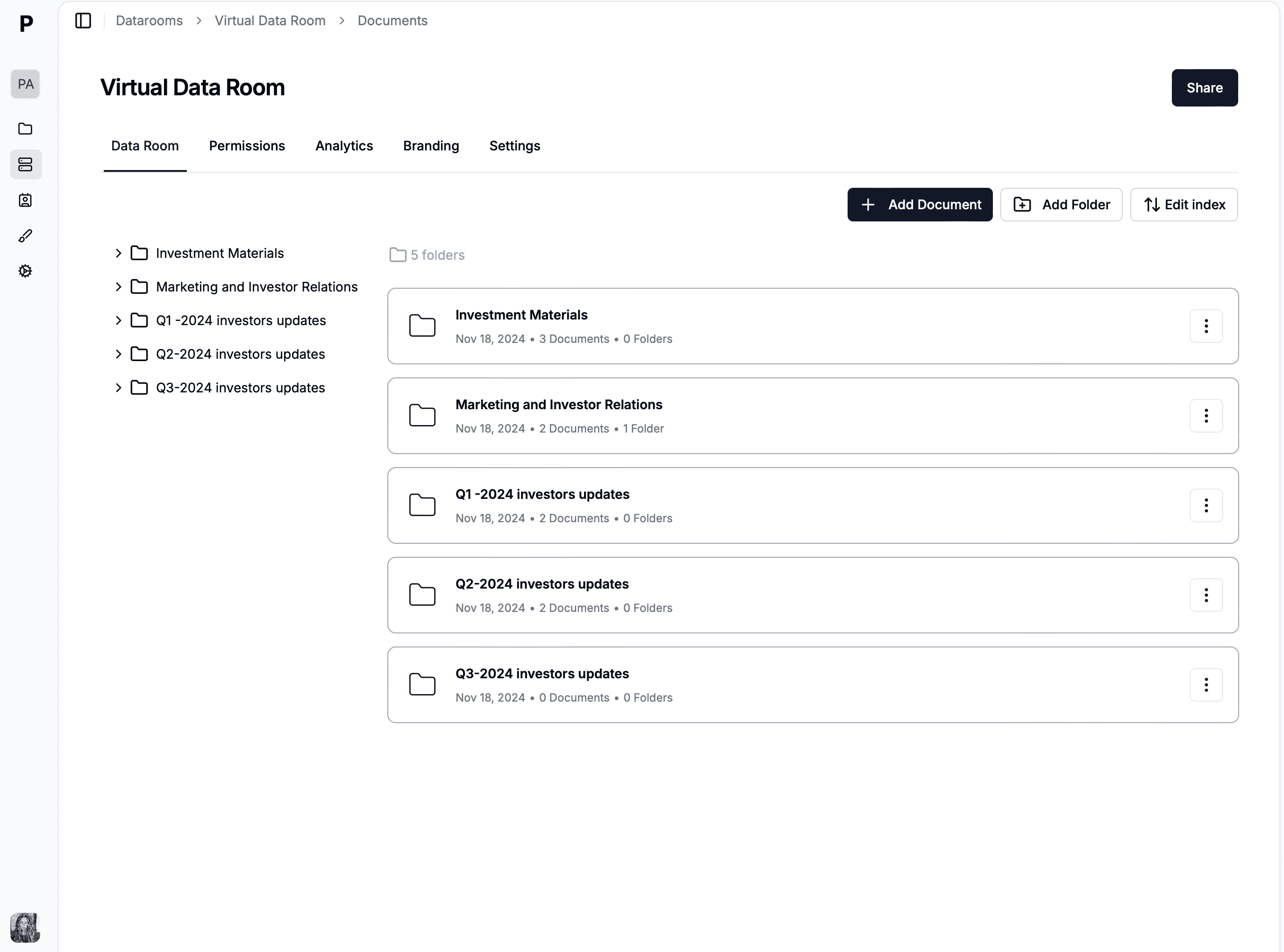
Virtual data rooms serve far more purposes than their original use case of M&A document management. Today, organizations across industries rely on VDRs for any process that involves secure document sharing, controlled access, and auditable activity tracking. From fundraising and IPO preparation to clinical trials and bankruptcy proceedings, data rooms provide the security infrastructure that sensitive transactions demand.
This guide covers 12 distinct virtual data room use cases, explaining how each one leverages VDR capabilities to improve security, efficiency, and outcomes.
1. M&A Due Diligence
Mergers and acquisitions remain the most established use case for virtual data rooms. During M&A transactions, buyers must review thousands of documents covering the target company's financials, legal standing, operations, intellectual property, customer contracts, and employee agreements. A VDR provides a centralized, secure environment where sell-side teams organize these documents and buy-side teams conduct their review.
The VDR's permission controls allow sell-side advisors to manage multiple bidders simultaneously, ensuring that each potential buyer accesses only the documents appropriate for their stage in the process. Engagement analytics reveal which bidders are most active, helping sellers prioritize negotiations. Q&A modules facilitate structured communication between parties without exposing questions to competing bidders. For complex transactions, the data room becomes the operational backbone of the entire due diligence process, housing tens of thousands of documents organized across standardized folder structures.
2. Fundraising
Startups and growth-stage companies use data rooms to share confidential materials with prospective investors during fundraising rounds. A fundraising data room typically contains the cap table, financial statements and projections, pitch deck, legal incorporation documents, key customer contracts, and team information. The VDR allows founders to share these materials securely while tracking which investors are actively engaged.
Document analytics provide strategic intelligence: founders can see which investors reviewed the financial model, how long they spent on specific sections, and whether they returned for a second review. This data helps founders prioritize follow-up conversations and tailor their pitch based on each investor's demonstrated interests. Unlike email-based document sharing, a VDR ensures that outdated versions are automatically replaced and that access can be revoked instantly if an investor exits the process. Read more about data room features for fundraising. That is the core of virtual fundraising software: the raise runs remotely, and the data tells you who to call.
3. IPO Preparation
Companies preparing for an initial public offering use virtual data rooms to manage the extensive documentation required by regulators, underwriters, and legal counsel. IPO data rooms house prospectus drafts, audited financial statements, corporate governance documents, material contracts, intellectual property portfolios, and regulatory filings. The data room facilitates collaboration among the company's internal team, investment bankers, auditors, and legal advisors.
The sheer volume of stakeholders involved in an IPO makes access control critical. Different work streams (legal, financial, operational) require access to different document sets, and the underwriter's counsel may need different access than the company's outside counsel. A VDR manages these overlapping permission requirements while maintaining a complete audit trail that can be referenced during SEC review or in the event of post-IPO litigation. The structured Q&A feature enables efficient resolution of comments across multiple work streams without the confusion of email chains.
4. Real Estate Transactions
Commercial and residential real estate transactions generate substantial documentation: purchase agreements, title reports, environmental assessments, zoning approvals, tenant leases, property surveys, inspection reports, and financing documents. Real estate data rooms organize these materials for buyers, sellers, lenders, title companies, and legal counsel involved in the transaction.
In portfolio transactions involving multiple properties, data rooms are particularly valuable. Each property has its own document set, and buyers need to review materials across the entire portfolio efficiently. A VDR with strong search capabilities allows buyers to locate specific lease terms, environmental conditions, or zoning restrictions across hundreds of properties simultaneously. For real estate investment trusts (REITs) and institutional investors conducting regular acquisitions, a persistent data room that evolves across multiple transactions reduces setup time and ensures consistency in document organization. Sponsors raising capital for a property fund or syndication use the same setup as real estate fundraising software.
5. Clinical Trials
Pharmaceutical companies, biotech firms, and contract research organizations (CROs) use virtual data rooms to manage the documentation associated with clinical trials. Regulatory submissions (IND applications, NDA filings), clinical study reports, informed consent forms, site agreements, investigator brochures, and safety data all require secure storage and controlled sharing with regulators, ethics committees, and research partners.
Clinical trial data rooms must comply with FDA 21 CFR Part 11 requirements for electronic records and signatures, including audit trail capabilities, access controls, and system validation documentation. Life science data rooms also support the collaborative nature of multi-site trials, where clinical data and regulatory documents must be accessible to investigators, monitors, and sponsors across different institutions and geographies. The ability to track document access at the user level supports compliance with Good Clinical Practice (GCP) guidelines.
6. Board Communications
Corporate boards of directors use virtual data rooms as secure portals for distributing board materials, storing governance documents, and facilitating communication between board meetings. Board packs containing financial reports, strategic plans, committee reports, and proposed resolutions are uploaded before each meeting, and directors access them through the VDR on their preferred devices.
Security is paramount for board communications. Board materials contain non-public information about corporate strategy, financial performance, executive compensation, and potential transactions that could constitute material non-public information under securities regulations. A VDR with dynamic watermarking, download restrictions, and access expiration ensures that board materials remain confidential. The audit trail provides a record of director engagement that supports corporate governance best practices and can demonstrate board diligence in the event of shareholder litigation.
7. Bankruptcy Proceedings
Bankruptcy cases, particularly Chapter 11 reorganizations, involve massive volumes of documents shared among debtors, creditors, creditor committees, bankruptcy trustees, and the court. Schedules of assets and liabilities, financial statements, executory contracts, claims documentation, and reorganization plans all require organized, accessible storage with controlled access.
A bankruptcy data room supports the transparency requirements of bankruptcy proceedings while protecting commercially sensitive information. Certain documents may be filed under seal or subject to protective orders, requiring different access levels for different parties. The creditor committee may have access to documents that individual creditors cannot see. A VDR manages these complex, court-ordered access structures while maintaining the audit trail that courts require. The ability to manage large document sets with full-text search helps parties navigate the voluminous filings typical of complex bankruptcy cases.
8. Joint Ventures
When two or more organizations form a joint venture, they must share confidential information about their respective businesses to structure the arrangement, conduct mutual due diligence, and manage the ongoing relationship. A VDR provides a neutral, secure environment where joint venture partners share business plans, financial projections, intellectual property documentation, and operational details.
The symmetry of a joint venture, where both parties are simultaneously sharing and reviewing confidential information, makes robust access controls especially important. Each party's documents must be segregated and accessible only to authorized reviewers from the other party. The VDR's audit trail creates a record of information exchange that can be referenced if disputes arise about what information was shared and when. After formation, the joint venture data room can transition into an operational document management platform for the new entity, providing continuity from negotiation through execution.
9. Audit Management
Internal and external audits require organized access to financial records, policies, procedures, and supporting documentation. A virtual data room streamlines the audit process by centralizing requested documents, tracking auditor access, and managing the information request lifecycle. Audit teams submit document requests through the data room, and the audited organization uploads responsive materials into designated folders.
For organizations undergoing multiple concurrent audits (financial audit, regulatory examination, SOX compliance review), a VDR prevents duplication of effort by maintaining a single document repository that serves multiple audit engagements. Access controls ensure that each audit team sees only the documents relevant to their engagement. The audit trail within the VDR itself serves as evidence of the organization's cooperation and responsiveness, which can influence audit outcomes and regulatory relationships.
10. IP Licensing
Intellectual property licensing transactions require controlled sharing of patent portfolios, technical documentation, licensing agreements, valuation analyses, and royalty calculations. Licensors use data rooms to present their IP assets to potential licensees while protecting the confidential details of the technology and existing licensing arrangements.
Patent portfolios may include hundreds or thousands of individual patents across multiple jurisdictions, each with its own prosecution history, claims analysis, and freedom-to-operate assessment. A VDR with strong document organization and search capabilities helps potential licensees evaluate the portfolio efficiently. Dynamic watermarking and download restrictions protect against unauthorized use of technical documentation during the evaluation period. For cross-licensing negotiations, where both parties are simultaneously evaluating each other's IP, the data room's access controls manage the bidirectional flow of sensitive technical information.
11. Regulatory Compliance
Organizations in regulated industries use virtual data rooms to manage ongoing regulatory compliance documentation. Banks maintain data rooms for regulatory examination readiness, pharmaceutical companies store regulatory submissions and correspondence, and energy companies manage environmental compliance records. These compliance data rooms serve as permanent repositories that are continuously maintained rather than created for a single transaction.
The value of a compliance data room lies in its readiness. When regulators request documentation, whether during a routine examination or an enforcement action, the organization can grant controlled access to the relevant materials within hours rather than spending weeks assembling documents from disparate systems. The audit trail demonstrates when documents were created, modified, and accessed, which supports the organization's compliance narrative. For multi-jurisdictional organizations, separate data room sections for each regulatory regime keep compliance documentation organized and accessible.
12. Litigation Support
Law firms and corporate legal departments use virtual data rooms to manage documents in litigation proceedings. Litigation data rooms house pleadings, discovery materials, deposition transcripts, expert reports, and trial exhibits. The VDR supports document review workflows, privilege management, and secure sharing with co-counsel, experts, and the court.
In multi-party litigation, access controls manage the complex web of who can see what. Protective orders may designate certain documents as "Attorneys' Eyes Only," requiring the VDR to enforce viewing restrictions that prevent client-side access. Privilege logs can be generated from documents tagged during review, streamlining the production process. For various use cases in litigation and beyond, the VDR's combination of security, organization, and audit capabilities makes it indispensable for managing the document-intensive nature of modern legal proceedings.
Choosing a VDR for Your Use Case
The diversity of VDR use cases means that no single platform is optimal for every scenario. When selecting a VDR, consider the specific requirements of your primary use case:
Transaction-based use cases (M&A, fundraising, IPO) prioritize engagement analytics, Q&A management, and the ability to manage multiple counterparties with different access levels. Speed of setup and ease of use for external parties are critical differentiators.
Compliance-based use cases (regulatory compliance, audit management, clinical trials) prioritize long-term document management, regulatory certifications, and the ability to demonstrate compliance through audit trails and access logs. Integration with existing compliance workflows matters more than deal-specific features.
Litigation use cases prioritize privilege management, document review workflows, and production capabilities. Forensic-grade audit trails and the ability to enforce court-ordered access restrictions are essential.
Collaborative use cases (joint ventures, board communications, IP licensing) prioritize balanced access controls, ease of use for all parties, and the ability to manage bidirectional document sharing securely.
Conclusion: Papermark for Every VDR Use Case
Virtual data rooms have evolved from specialized M&A tools into essential infrastructure for any process requiring secure, auditable document sharing. The 12 use cases covered in this guide represent the most common applications, but organizations continue to find new ways to leverage VDR capabilities.
Papermark is a modern, open-source virtual data room that supports the full range of VDR use cases. With granular permissions, comprehensive audit trails, dynamic watermarking, document analytics, and an intuitive interface, Papermark provides the flexibility to serve transaction, compliance, litigation, and collaborative use cases equally well.
Whether you are preparing for an M&A transaction, managing a fundraising process, conducting due diligence, or organizing documents for a life science data room, Papermark delivers the security and usability that modern organizations require. Explore Papermark's virtual data room features to get started.
Related resources