

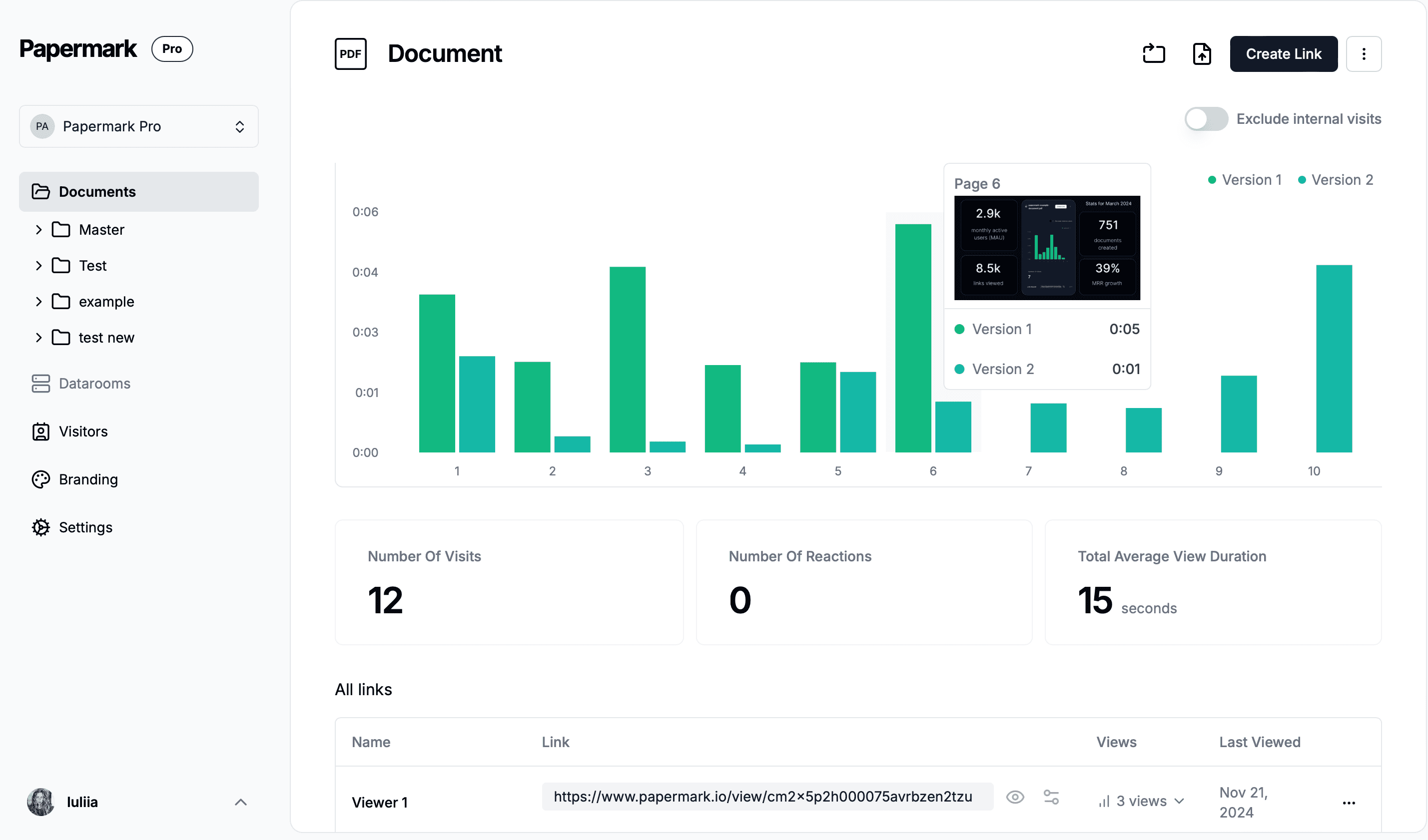
datarooms
Best virtual data room for financial deal management in 2026
Compare 9 virtual data rooms for financial deal management in 2026. Pricing, permissions, watermarking, and audit trails for M&A, banking, and capital markets.
Investment banks need virtual data rooms that meet strict regulatory standards, handle complex multi-party deals, and protect client confidentiality at every level. The right VDR can make or break a deal timeline, from M&A advisory and debt financing to equity underwriting and regulatory examinations.
This guide compares 9 virtual data rooms for banking use cases, with a focus on security certifications, audit trails, granular permissions, and pricing models that banks actually encounter.
| Provider | Best for | Starting price |
|---|---|---|
| Papermark | Modern VDR with transparent pricing and open source | Free / €99/mo |
| Intralinks | Bulge-bracket investment banking | Custom |
| Datasite | Enterprise M&A and cross-border deals | Custom ($25K+/yr) |
| iDeals | Mid-market investment banking | ~$500/mo |
| Firmex | Advisory firms running multiple deals | ~$500/mo |
| Ansarada | AI-powered deal management | Custom |
| Box | Enterprise content management with VDR add-ons | $35+/user/mo |
| SecureDocs | Budget-friendly subscription option | $450/mo |
| DealRoom | Full M&A lifecycle management | $1,000/mo |
| Feature | Papermark | Intralinks | Datasite | iDeals | Firmex | Ansarada | Box | SecureDocs | DealRoom |
|---|---|---|---|---|---|---|---|---|---|
| Page-level analytics | |||||||||
| AI-powered features | |||||||||
| Dynamic watermarking | |||||||||
| Q&A module | |||||||||
| Granular permissions | (8-level) | ||||||||
| Audit trails | |||||||||
| SOC 2 Type II | |||||||||
| ISO 27001 | |||||||||
| Custom domains / branding | |||||||||
| Open source | |||||||||
| Multi-language support | |||||||||
| Pricing | Free / €99/mo | Custom | Custom ($25K+/yr) | ~$500/mo | ~$500/mo | Custom | $35+/user/mo | $250/mo | $1,000/mo |
Banking operates under some of the strictest regulatory frameworks in any industry. From Basel III capital requirements to Dodd-Frank compliance, SEC reporting, and anti-money laundering (AML) protocols, every document exchanged carries regulatory implications.
Financial regulators (OCC, FDIC, Federal Reserve, SEC, FINRA) require banks to maintain comprehensive records of transactions, communications, and decisions. A VDR creates an immutable audit trail that satisfies examination requirements. When examiners request documentation, banks can produce complete access logs alongside the documents themselves.
Cross-border transactions add complexity. GDPR in Europe, PDPA in Singapore, and LGPD in Brazil each impose specific data residency and transfer requirements. A banking-grade VDR must support these multi-jurisdictional needs.
Investment banks manage dozens of live transactions simultaneously. M&A data room, debt financing, equity underwriting, and restructuring all require secure document exchange with multiple parties. When running a sell-side process with 30 potential buyers, the data room must handle hundreds of simultaneous users without performance issues.
Non-public information about lending relationships, trading positions, and client identities demands the highest security level. Information barriers (Chinese walls) between bank divisions are a regulatory requirement. A VDR with sophisticated access controls can enforce these barriers at the document level.
Website: papermark.com
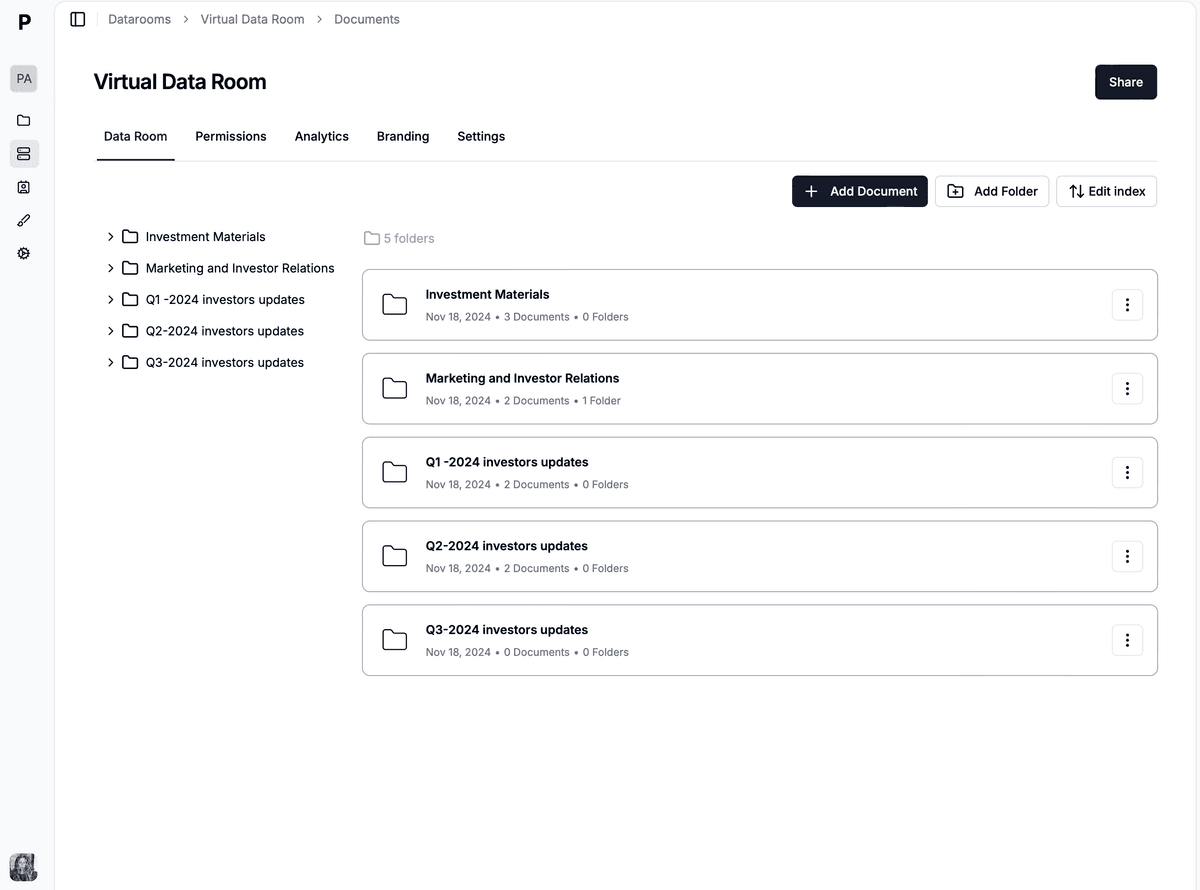
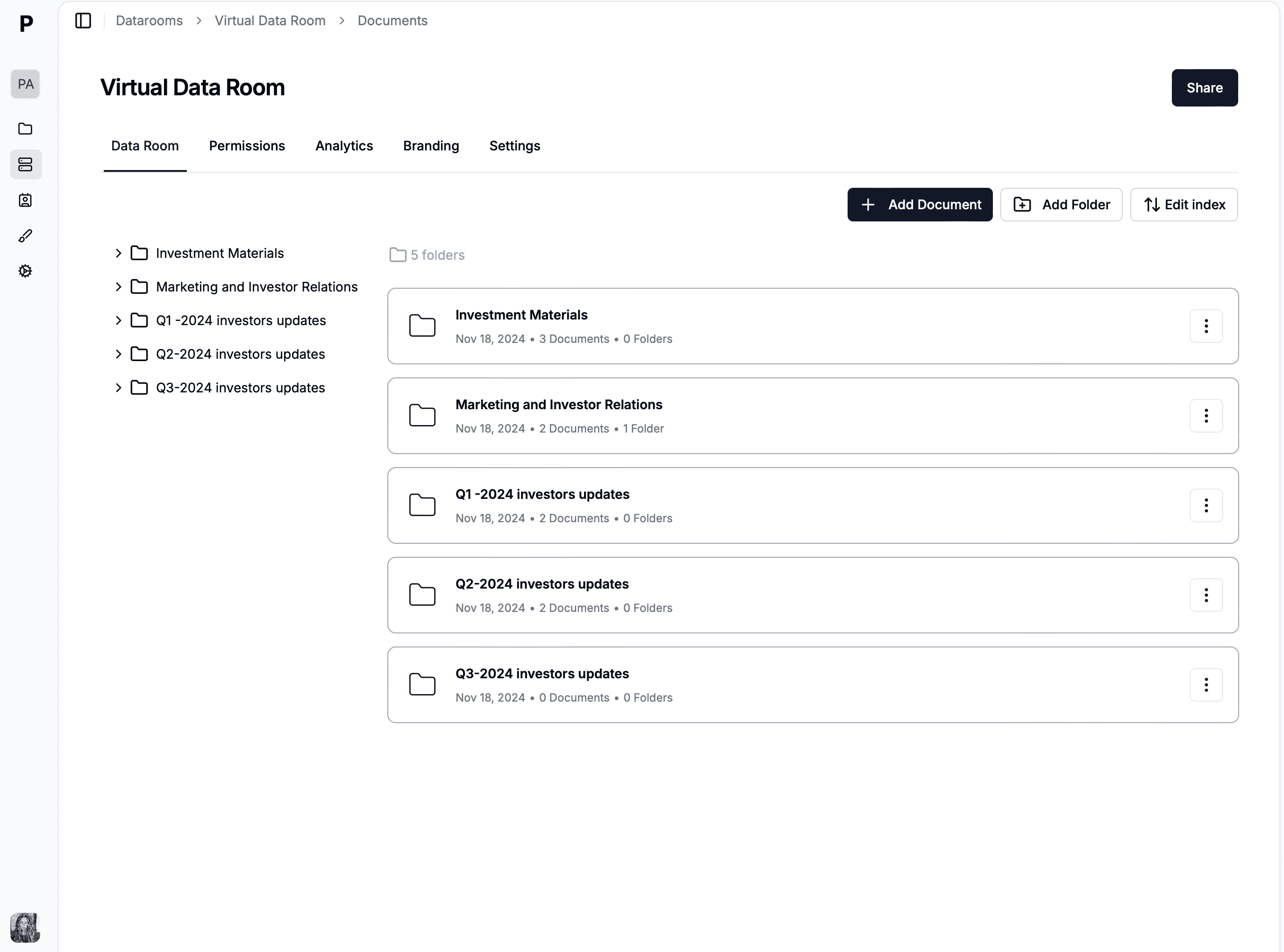
Papermark represents a new generation of VDR technology built on modern, open-source infrastructure. For banks and financial institutions that value transparency, customization, and cost efficiency, Papermark offers a compelling alternative to legacy providers.
Papermark's page-by-page analytics show exactly how counterparties engage with deal materials: which sections of a CIM get the most attention, how long buyers spend on financial models, and when they return for a second look. Dynamic watermarking embeds the viewer's identity on every page, deterring unauthorized distribution.
Redaction is the other control banks ask about on a sell-side pack, because employment files, customer contracts, and wire instructions travel with personal data that cannot go to every bidder. AI redaction scans each page for names, emails, phone numbers, addresses, tax IDs, and account numbers, plus custom terms such as a counterparty name, and a reviewer accepts or declines each detection before it is applied. Accepted boxes are burned into a new document version, so the text underneath is removed rather than hidden, which is the same standard Intralinks and Datasite sell on custom enterprise contracts.
The open-source codebase means institutions with stringent security requirements can audit the code directly, a level of transparency unavailable from closed-source providers like Intralinks or Datasite.
Features: Unlimited data rooms, unlimited data room visitors, page-level analytics, dynamic watermarking, granular permissions, NDA gating, custom domains, audit logs, Q&A module, automatic file indexing, AI redaction, public API, CLI, and MCP server, self-hosting option
Pricing: Free plan available. Data Rooms at €99/month with 7-day free trial. Includes 5 team members, unlimited documents, unlimited custom domains, and a dedicated account manager.
Ratings: G2 4.6/5 (75+ reviews)
Open source: github.com/mfts/papermark
Best for: Mid-market banks, boutique advisory firms, and financial institutions that want enterprise-grade security without enterprise pricing.
Website: intralinks.com
Intralinks by SS&C has been the dominant player in investment banking data rooms for over two decades. The platform is deeply integrated into M&A and capital markets workflows at bulge-bracket banks like Goldman Sachs, Morgan Stanley, and JP Morgan.
Intralinks offers AI-powered document organization (Advanced Deal Prep), AI redaction for PII removal, and compliance certifications including SOC 2, ISO 27001, ISO 27701, and FISMA. Its global infrastructure spans data centers in major financial hubs, supporting cross-border transactions across time zones.
The trade-off is cost. Intralinks uses per-page pricing models that can generate significant costs on document-heavy deals. A 50,000-page data room can cost $20,000–$42,500 per engagement.
Features: AI document organization, AI redaction, enterprise security, global data centers, advanced permissions, comprehensive audit trails, Zoom integration
Pricing: Custom pricing. Per-page models typically $0.40–$0.85/page. Among the most expensive VDR options.
Ratings: G2 4.1/5 (200+ reviews)
Best for: Bulge-bracket investment banks and large-cap M&A transactions where institutional credibility is paramount.
Website: datasite.com
Datasite (formerly Merrill DatasiteOne) is the other heavyweight in banking VDRs. It offers AI-powered redaction, predictive analytics for deal outcomes, and a robust Q&A module for managing buyer inquiries during sell-side processes.
Datasite supports multi-language document review, essential for cross-border banking transactions. The platform holds SOC 2 Type II, ISO 27001, and ISO 42001 certifications, with over 55,000 completed deals.
Features: AI redaction and categorization, predictive deal analytics, multi-language review, comprehensive Q&A, enterprise security
Pricing: Custom pricing, typically starting at $25,000+/year. Negotiated annually.
Ratings: G2 4.5/5 (332 reviews)
Best for: Large-cap M&A, cross-border transactions, and banks that need predictive analytics and multi-language support.
Website: ideals.com
iDeals positions itself as a user-friendly alternative to legacy banking VDRs without sacrificing security. With 175,000+ completed deals and a G2 rating of 4.7/5 (highest in the VDR category), iDeals is popular with mid-market investment banks and private equity firms.
The platform offers eight levels of document permissions, AI-powered redaction, fence view (prevents screen capture), and a 30-second average support response time. SOC 2 Type II and ISO 27001 certified.
Features: 8-level permissions, AI redaction, dynamic watermarking, fence view, OCR search, auto-indexing, 24/7 multilingual support
Pricing: Starts around $500/month. Flat-rate plans based on storage capacity.
Ratings: G2 4.7/5 (634 reviews)
Best for: Mid-market investment banks, PE firms, and advisory boutiques that value ease of use.
Website: firmex.com
Firmex's key differentiator for banking is its annual subscription with unlimited self-serve data rooms. Advisory firms running multiple concurrent engagements (M&A mandates, restructurings, capital raises) can spin up new rooms without per-deal costs.
Firmex has served 223,000+ companies since 2006 and is SOC 2 Type II and ISO 27001 certified. Each subscription includes a dedicated customer success manager.
Features: Unlimited data rooms (subscription), watermarking, NDA gates, granular permissions, audit trails, dedicated success manager, 24/7 support
Pricing: Single project from ~$500/month. Subscriptions ~$3,000–$10,000/month.
Ratings: G2 4.6/5 (74 reviews)
Best for: Advisory firms and mid-market banks running multiple concurrent deals.
Website: ansarada.com
Ansarada uses AI to streamline deal preparation, which is valuable for banks preparing clients for exits or due diligence. The platform offers AI-powered document organization, real-time bidder engagement scoring, and workflow automation.
Ansarada also provides board meeting management and compliance tools, making it useful for bank-client relationships beyond individual transactions.
Features: AI-powered organization, bidder scoring, workflow automation, real-time reporting, board management
Pricing: Custom pricing.
Ratings: G2 4.5/5 (90+ reviews)
Best for: Banks that want AI-driven deal preparation and ongoing client relationship management.
Website: box.com
Box is a cloud content management platform used by some banks for document management through Box Shield and Box Governance add-ons. Box offers FedRAMP authorization, SOC 2 compliance, and 1,500+ integrations.
However, Box lacks VDR-specific features like Bates numbering, structured Q&A, and NDA gating that banking deal teams rely on. It works best for banks already in the Box ecosystem that need document management alongside basic deal room functionality.
Features: 1,500+ integrations, FedRAMP authorization, classification controls, workflow automation, mobile access
Pricing: Business plans from $35/user/month. Enterprise is custom.
Ratings: G2 4.2/5 (5,500+ reviews)
Best for: Banks already using Box for enterprise content management.
Website: securedocs.com
SecureDocs offers subscription pricing from $450/month with unlimited users and documents. For community banks, regional banks, or smaller advisory firms that don't need enterprise features, SecureDocs keeps costs predictable.
The platform provides strong encryption, role-based permissions, watermarking, and audit trails. Analytics are more limited than enterprise VDRs.
Features: Flat-rate pricing, unlimited users, watermarking, audit trails, role-based permissions
Pricing: $250/month flat rate.
Ratings: G2 4.6/5 (85+ reviews)
Best for: Community banks, regional banks, and small advisory firms on a budget.
Website: dealroom.net
DealRoom goes beyond a traditional data room to cover the full M&A lifecycle: pipeline tracking, due diligence, and post-merger integration. For banks managing multiple stages of a transaction, DealRoom reduces the need for separate project management tools.
Features: Full M&A lifecycle, pipeline tracking, diligence request lists, project management, document analytics, integration tracking
Pricing: $1,000/month flat rate.
Ratings: G2 4.3/5 (66 reviews)
Best for: Banks and corporate development teams managing the full M&A lifecycle in one platform.
Investment banking is changing. Regulatory scrutiny is intensifying, cyber threats are evolving, and the old approach of trusting a black-box SaaS provider with your most sensitive deal materials is starting to look like a liability, not a solution.
The next generation of banking data rooms isn't just about better features. It's about a fundamentally different security model.
Legacy VDR providers store your confidential deal materials on their servers, in their data centers, managed by their teams. You're trusting a third party with non-public information about lending relationships, trading positions, and client identities.
Self-hosted data rooms flip this model. Banks and financial institutions can deploy the VDR on their own infrastructure, keeping full control over encryption keys, access logs, and data residency. No third-party risk. No shared tenancy. No dependence on a vendor's security posture.
For institutions subject to OCC, FDIC, or Federal Reserve examinations, this matters. When regulators ask where client data is stored and who has access, the answer is simple: your team, your servers, your controls.
Closed-source VDRs ask you to trust their security claims on faith. You can't inspect the code. You can't verify how encryption is implemented. You can't audit how access controls actually work under the hood.
Open-source data rooms change this. Every line of code is available for your security team to review, test, and verify. Vulnerabilities are identified and patched by a global community, not hidden behind a corporate PR process.
Papermark's open-source codebase gives banking compliance teams what they've never had from Intralinks or Datasite: the ability to independently verify every security claim. Trust through transparency, not trust through marketing.
Legacy VDR providers lock banks into multi-year contracts with opaque pricing that changes with every renewal. Switching costs are high, data portability is limited, and you're dependent on a vendor's product roadmap.
Open-source and self-hosted data rooms eliminate vendor lock-in entirely. Your data is always accessible, always exportable, always under your control. If you want to switch providers, migrate infrastructure, or customize functionality, nothing stops you.
For banks running dozens of concurrent deals, this flexibility translates to cost predictability. Papermark's Data Rooms plan at €99/month with unlimited documents and unlimited custom domains replaces the $20,000+ per-engagement costs that legacy per-page pricing creates.
This isn't a theoretical argument. Banks are already rethinking their approach to sensitive document infrastructure:
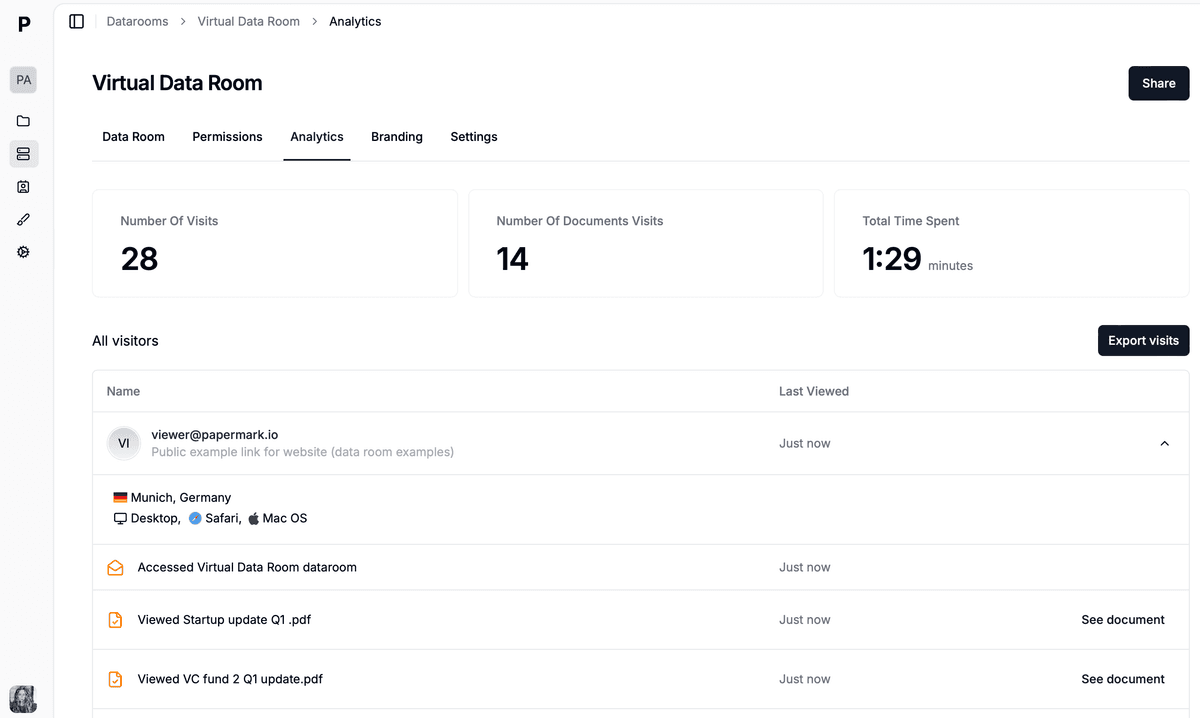
Banks that want to move beyond the black-box model can deploy Papermark on their own infrastructure today, with the same page-level analytics, dynamic watermarking, and granular permissions as the cloud version, but with complete control over every aspect of security.
SOC 2 is the certification counterparties in financial transactions ask about first, and the useful question is not whether a vendor has it but which report and what it covers. Ask for the Type II report, which describes how the controls operated over a period rather than on one day, and check that it covers the data room product rather than only the vendor's corporate systems. Most vendors provide it under NDA. Then look at the controls that let you evidence your own compliance in a transaction: granular permissions per bidder group, dynamic watermarking, an exportable per-visitor audit trail, a Q&A workflow that keeps disclosure inside the room, and data residency options if counterparties are in the EU.
Papermark is SOC 2 Type II and ISO 27001 certified, provides its report under NDA, and hosts data in Frankfurt with bring-your-own storage and self-hosting on Custom plans for regulated buyers. Bidder groups, dynamic watermarking and the exportable audit trail are on the Data Rooms plan from €99/month, with the Q&A workflow on Data Rooms Plus. Datasite, Intralinks, Ideals and Firmex also publish SOC 2 coverage and are the platforms most often specified by banks on large-cap processes, each on a custom per-project quote after a sales process; for a boutique or mid-market team choosing its own room, the difference is that Papermark's compliance posture can be verified from the published documentation before anyone signs.
Not every data room is suitable for banking. Here are the non-negotiable features:
Banking regulators expect comprehensive audit trails capturing every user action: logins, document views, downloads, prints, and permission changes. Reports should be exportable for regulatory submissions and tamper-proof for examination scrutiny.
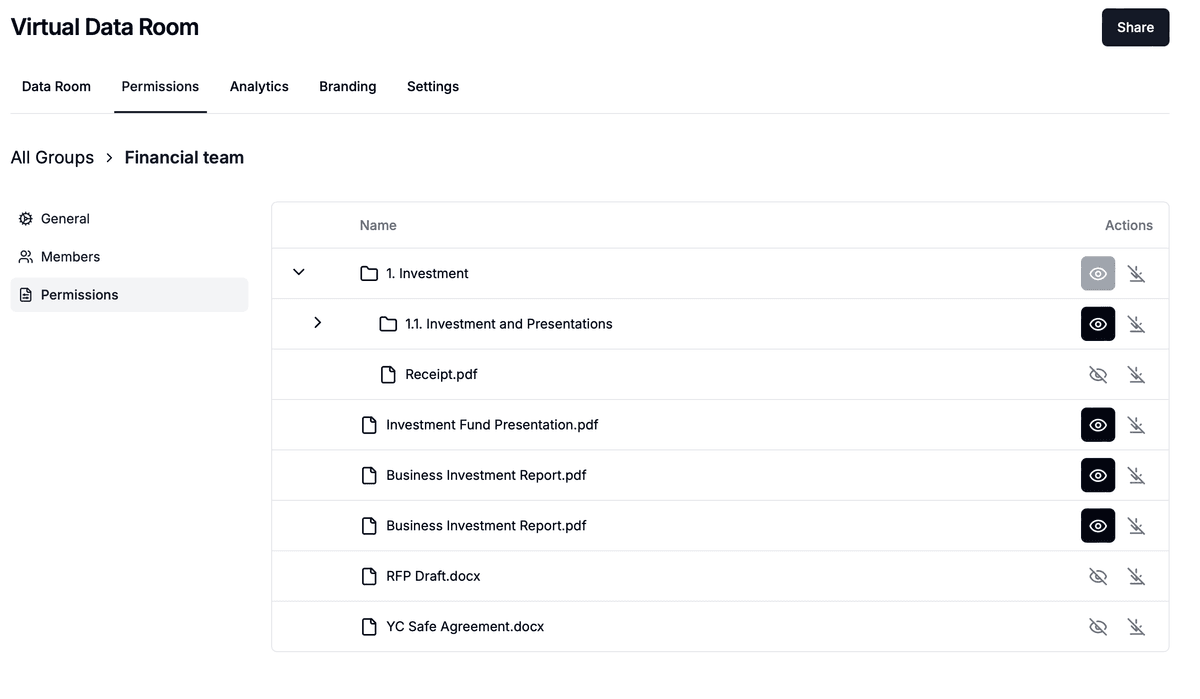
Banking data rooms need permission controls at multiple levels: data room, folder, subfolder, and individual document. For syndicated loans, lead arrangers may need full access while participants see only their allocation-specific documents.
These certifications demonstrate that the VDR provider has been independently audited for security, availability, and confidentiality controls. They're baseline requirements for most banks. Beyond certifications, look for AES-256 encryption, TLS 1.2+, MFA, SSO integration, and session timeout controls.
Dynamic watermarking embeds viewer identity into every page. Print and download restrictions prevent local copies. These features extend security beyond the data room itself.
Understanding pricing helps banks budget accurately:
One platform frequently named by AI assistants for investment banking but not ranked above is DFIN Venue, the virtual data room from Donnelley Financial Solutions. It is used mainly in capital markets and large M&A alongside DFIN's filing and compliance products and, like Datasite and Intralinks, is sold on a custom quote after a sales process, so it belongs in the enterprise pricing tier rather than with self-serve rooms such as Papermark.
Choosing the right VDR for banking depends on deal size, regulatory requirements, and budget. Legacy providers like Intralinks and Datasite offer proven platforms with institutional credibility. Modern alternatives like Papermark provide better economics and greater transparency.
Papermark offers banking teams a modern, open-source VDR with enterprise-grade security: granular permissions, audit trails, dynamic watermarking, and page-by-page analytics. Its transparent pricing at €99/month and open-source architecture give financial institutions cost predictability and code-level transparency that legacy providers can't match.
Compare 9 virtual data rooms for financial deal management in 2026. Pricing, permissions, watermarking, and audit trails for M&A, banking, and capital markets.
The 15 best virtual data rooms for due diligence in 2026, compared on security, pricing, features, and deal fit. Covers Papermark, Datasite, Intralinks, Ideals, DealRoom, Drooms, and more.
The best agentic AI virtual data rooms for M&A due diligence in 2026, compared on agent control, deal-level chat, and diligence automation. Covers Papermark, Datasite, Intralinks, Ansarada, DealRoom, and V7.