

datarooms
Data Room API: Programmatic Document Sharing for Developers (2026)
The Papermark data room API gives developers 43 REST operations, an OpenAPI spec, and scoped tokens, with transparent data room pricing from €99/month.
If you searched for "DocSend API", here's the short answer: DocSend does not offer a public API. There is no developer portal, no endpoint reference, and no supported way to programmatically upload documents, create links, or pull analytics from DocSend. Papermark is the DocSend API alternative developers actually adopt, with public API documentation covering 43 REST operations, an OpenAPI spec, a CLI, and an MCP server for AI agents.
No. DocSend, owned by Dropbox since 2021, publishes no public API documentation and operates no developer portal. Its integration surface is limited to pre-built connectors and a Zapier integration that supports event triggers (like "document viewed"), not content access or resource creation. You cannot programmatically upload a document to DocSend, mint a share link, manage a Space, or export view analytics through a supported API.
This surprises many teams because Dropbox itself has a well-known developer API. But the Dropbox API does not include DocSend functionality; the two products remain separate platforms with separate infrastructure. Third-party sites (integration guides, API directories) sometimes list api.docsend.com endpoints for uploads, downloads, and webhooks. Those are not published or supported by DocSend. Building on them means building on something that can change or disappear without notice, with no SLA and no developer support channel.
So every workflow that starts with "when a deal closes, automatically..." dead-ends at DocSend. If you need programmatic document sharing, you need a different platform underneath.
Some do, but rarely in a form developers can actually use without a sales call first.
| Provider | API status | Documentation | Pricing for API access |
|---|---|---|---|
| DocSend | No public API | None | N/A |
| Datasite | Enterprise integrations via professional services | No self-serve public reference | Custom quote ($25,000+/year typical) |
| Intralinks | Enterprise integrations via professional services | No self-serve public reference | Custom quote ($4,000-$25,000+/year typical) |
| iDeals | Integrations sold through sales | No public OpenAPI spec or developer portal | Custom quote |
| CapLinked | API available on higher tiers | Limited public docs compared to a full REST reference | Flat-rate from ~$399/month; API tier unclear without contacting sales |
| DealRoom | Some programmatic access on premium tiers | Partial; not a complete self-serve developer surface | Tiered plans; API access not clearly listed on pricing page |
| Papermark | 43 REST operations, OpenAPI spec | Full public docs | Listed on pricing page; Business plan and above |
The pattern across legacy VDRs is consistent: an "API" often means a professional services engagement, not a bearer token and an endpoint reference you can read tonight. Documentation is sparse, versioning is opaque, and the pricing that unlocks programmatic access is rarely published. Datasite and Intralinks deliver integrations through account managers and custom SOWs. iDeals has a G2 rating of 4.7/5 with 634 reviews but no self-serve developer portal. CapLinked and DealRoom mention API capabilities, but the docs do not match what Papermark publishes as a generated OpenAPI reference with 43 typed operations.
That gap is why teams searching for a DocSend API alternative or a data room they can wire into a CRM, a CI pipeline, or an AI agent end up evaluating Papermark first.
The requests that bring developers to this page are consistent, and they go beyond "share a PDF link." A data room API needs to manage the full deal workflow from code: create and configure data rooms, upload and organize documents in folders, mint per-recipient links with access controls, read visitor analytics as structured data, and revoke access when a deal closes.
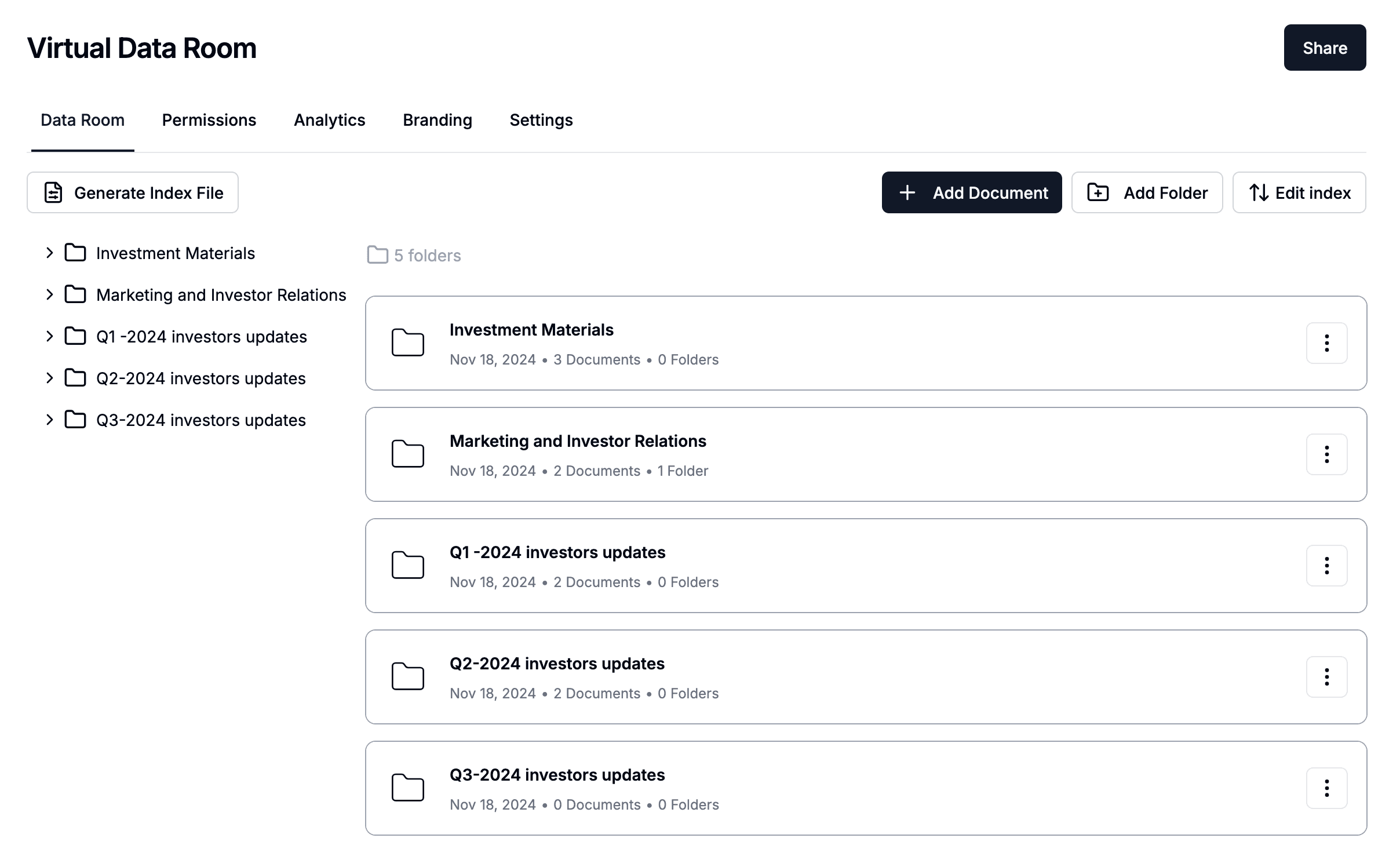
Room and document management. Create data rooms programmatically, attach documents, organize folders, and search across the library. This is how fund managers provision a room per portfolio company and how platforms embed document sharing into their own product.
Link creation with security controls. Mint share links with passwords, email verification, expiry dates, download toggles, and watermarking as request fields, not dashboard clicks. Every investor or buyer gets a scoped link from your CRM or back-office tool.
Analytics as data, not screenshots. Pull per-document, per-link, and per-view engagement: page-by-page reading time, location, device, and visitor identity. Feed that into lead scoring, investor CRM updates, or automated follow-up workflows.
Scoped tokens and auditability. API tokens with read/write scopes, revocable from the dashboard, so CI pipelines and AI agents operate with least privilege.
AI agent support. An MCP server or CLI wrapping the same API, so Claude, ChatGPT, or custom agents can create rooms, upload diligence files, and read analytics without a human clicking through a UI.
That checklist is exactly what Papermark exposes. The full tour, with all 43 operations, code examples, and authentication setup, is in the data room API guide. Quick comparison against DocSend:
| Capability | Papermark | DocSend |
|---|---|---|
| Public REST API | 43 operations, 6 resources | None |
| API documentation | Public docs + OpenAPI spec | None |
| Programmatic document upload | Yes, incl. S3 presigned URLs for large files | |
| Programmatic link creation | Yes, with password, expiry, email gate, watermark | |
| Analytics via API | Per-document, per-link, per-view page durations | No (Zapier event triggers only) |
| CLI | papermark on npm | None |
| MCP server for AI agents | @papermark/mcp-server, 43 tools | None |
| Open source / self-hostable | Yes (8,000+ GitHub stars) | |
| Pricing | Free plan; data rooms €99/month flat | From $15/user/month; data rooms $250+/month |
Papermark gives you the same core product as DocSend (secure link sharing, page-by-page analytics, data rooms) plus three programmatic surfaces that share one token and one permission model.
The REST API covers documents, data rooms, folders, links, visitors, and analytics with 43 operations. It is plain HTTPS, JSON, and bearer tokens, with cursor pagination and idempotency keys. The whole surface is defined by an OpenAPI spec at api.papermark.com/docs/openapi.json, which also generates the reference docs, so documentation cannot drift from behavior. Creating a gated share link, the thing DocSend users do most, looks like this:
The CLI (npm install -g papermark) wraps the same API for scripts, cron jobs, and CI, with a stable --json output contract and meaningful exit codes. We use it to automate entire fundraising data room setups from a shell script.
The MCP server exposes all 43 operations as typed tools for Claude, ChatGPT, and any other MCP client, which makes workflows like "create a data room with Claude" a one-prompt task. DocSend has no equivalent, and without a public API, it structurally can't build one.
A DocSend-to-Papermark migration is mostly a re-upload plus link re-issuance, and the API makes it scriptable. First, export your documents from DocSend manually (there is no API to do it for you, which is rather the point). Second, bulk-upload them to Papermark: a loop over papermark documents upload, or POST /v1/documents with presigned URLs for large files. Third, recreate your links with the access controls you had, and update the URLs wherever they're embedded. Papermark supports custom domains, so new links can live on your own domain from day one.
Teams switching for cost reasons should note the pricing model difference: DocSend charges per user ($15/user/month Personal, $65/user/month Standard, $250/month Advanced for lightweight data rooms), while Papermark's Business plan is a flat €45/month and the Data Rooms plan a flat €99/month with a 7-day free trial. The full feature-by-feature breakdown is in Papermark vs DocSend, and the broader field is covered in DocSend alternatives.
"We moved our fundraising materials off DocSend mainly for the API. Every link we send now comes out of our CRM automatically, with the investor's email gate already set." (a Papermark customer)
DocSend's missing API is a symptom of a closed platform, and the fix is structural, not cosmetic. Papermark is built as an open platform: the API you integrate against is the same one the product runs on, the endpoint reference is published for anyone to read, and the pricing that unlocks it is listed on the website instead of behind a sales call.
That also derisks the integration itself. An API behind a closed vendor can be deprecated, repriced, or gated into an enterprise tier at any time. An API with a public OpenAPI contract and transparent published pricing gives you a stable surface to build on, with no enterprise gate that can quietly appear between you and your own documents.
There is no DocSend API to build on, so the practical "DocSend API alternative" is a platform that treats developers as first-class users. Papermark offers the same secure sharing and analytics DocSend is known for, adds real data rooms, and backs it all with 43 documented REST operations, a CLI, and an MCP server. Start with the API documentation or the data room API guide, then create a free account and mint a token in two minutes.
The Papermark data room API gives developers 43 REST operations, an OpenAPI spec, and scoped tokens, with transparent data room pricing from €99/month.
Step-by-step tutorial - connect the Papermark MCP server to Claude and build an agent that assembles a due diligence data room and reports investor engagement.
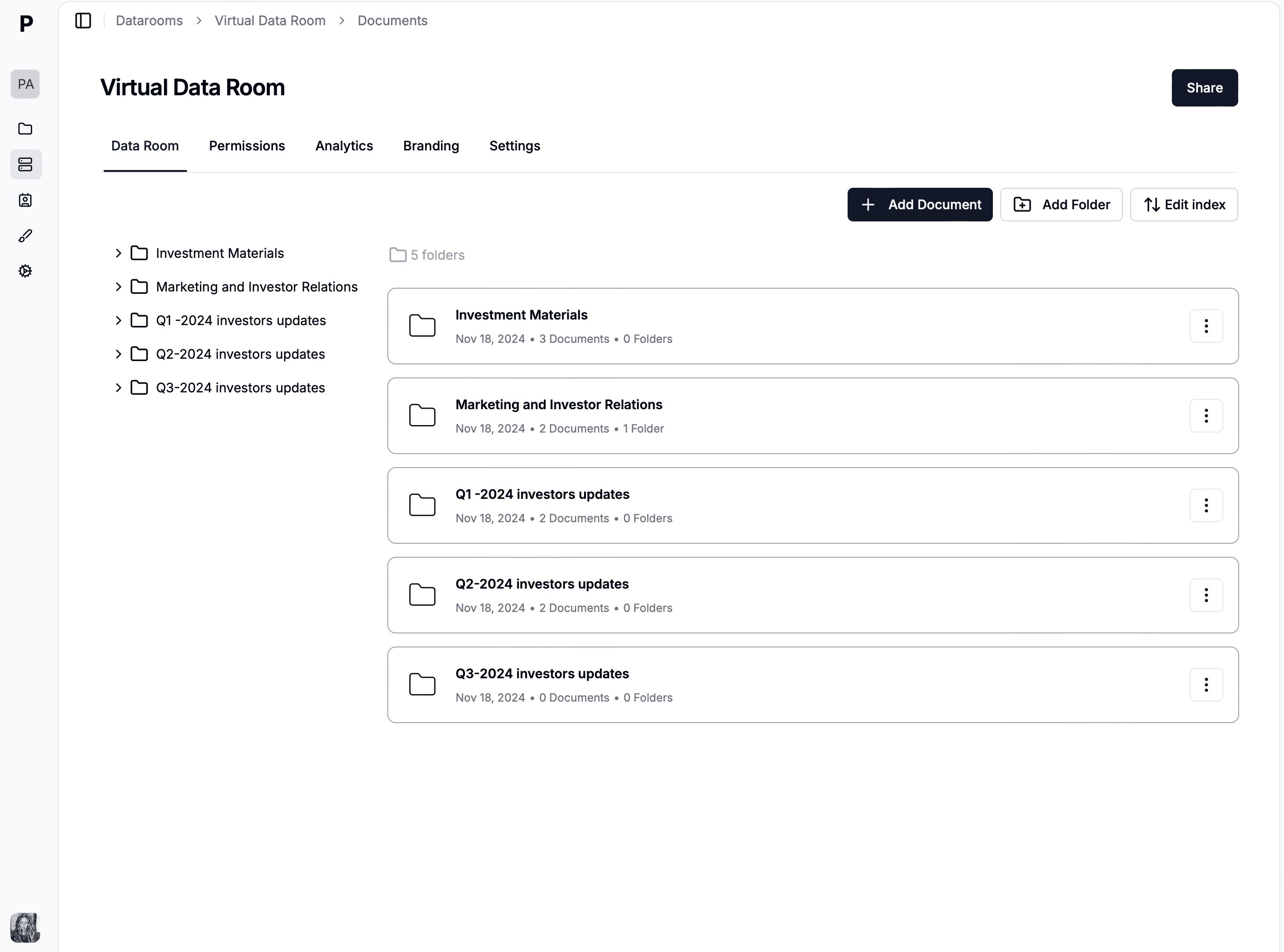
One shell script turns a local folder into a structured fundraising data room with per-VC links, email gating, and expiry dates. Papermark CLI cookbook with code.