Representations and Warranties Insurance 2026: Cost and 5 Exclusions
·16 min read
Marc Seitz
Representations and warranties insurance is a policy that pays a buyer for losses caused by a breach of the seller's representations in an acquisition agreement. It shifts indemnity risk from the seller to an insurer, which is why most mid-market deals now close with a small escrow or none at all.
Quick recap
Representations and warranties insurance, called warranty and indemnity insurance in the UK and Europe, covers a buyer's loss from breaches of the seller's representations in a purchase agreement.
Premium is quoted as a rate on line, typically 2 to 4 percent of the limit, so a $10M limit usually costs $200,000 to $400,000 before fees and taxes.
Limits are commonly around 10 percent of enterprise value, with smaller deals buying up to 20 percent.
Retention, the deductible, is commonly 0.5 to 1 percent of enterprise value and typically drops to roughly half after 12 months.
Underwriters charge a non-refundable fee of $25,000 to $50,000, payable when diligence starts whether or not the policy binds.
The economic sweet spot runs from about $20M to $2B of enterprise value; deals of $10M to $20M are insurable but poor value.
Policy periods run three years for general representations and six for fundamental and tax representations.
The five exclusions buyers most often miss: known issues, forward-looking projections, pension underfunding, transfer pricing and tax accounting positions, and wage-and-hour or misclassification exposure.
Underwriting takes 10 to 15 business days once the underwriter has the diligence reports and room access, and a disorganised room is the usual reason that slips.
A data room for representations and warranties insurance serves one more party than a normal deal room, because the underwriter reads the same files the advisors do, on its own scoped link.
Papermark hosts a data room for representations and warranties insurance from €99/month, with granular permissions, dynamic watermarking, per-visitor analytics, and a post-close archive.
Ten years ago this was a specialist product used mainly by large buyout funds. Today it is close to standard on mid-market deals, and a seller asked for a 10 percent escrow will usually ask why the buyer is not placing a policy instead. This guide is written for the buyer or the advisor placing the policy, not the carrier selling it: what it costs, how underwriting runs, what gets excluded, and what underwriters look for in your diligence.
The underwriter is a party to your diligence, not an observer of it. A data room for representations and warranties insurance gives it its own scoped link, its own audit trail, and a frozen archive that survives the claim window. Section 9 covers the setup step by step.
1. What is representations and warranties insurance?
Representations and warranties insurance, usually shortened to RWI or R&W insurance, is a transactional liability policy that indemnifies the insured for financial loss arising from an inaccuracy in the representations and warranties given in a merger or acquisition agreement. In the UK and most of Europe the same product is sold as warranty and indemnity insurance, or W&I, and brokers treat the terms as interchangeable while lawyers keep them separate on paper.
The representations are statements of fact about the target: that the accounts are accurate, that material contracts are in force, that the company owns its intellectual property, that it has paid its taxes, that there is no undisclosed litigation. If one turns out to be wrong and the buyer suffers a loss, the traditional remedy is a claim against the seller under the indemnity, usually by drawing on an escrow. RWI replaces that path with a claim against a carrier, which matters commercially too: suing a seller often means suing the management team still running the business post-close.
Coverage is written on top of the deal documents rather than instead of them. The policy schedules the representations it covers, subject to the disclosure schedules, the diligence reports, and a list of negotiated exclusions. What the seller disclosed is not covered, because it is not a breach, and what the buyer's deal team knew is not covered. Coverage sits between what was represented and what was true, minus everything known at signing.
2. Who buys it and why it replaced the escrow
Most policies written today are buy-side, meaning the buyer is the named insured even where the seller pays the premium. Buy-side policies can cover seller fraud, the single most valuable difference, because a sell-side policy is liability cover for the seller and cannot indemnify it for its own deliberate misstatement. Sell-side policies still exist but are a minority of the market.
The commercial reason RWI spread so fast is the escrow. In a traditional deal the seller leaves 10 percent of the purchase price in escrow for 12 to 24 months. On a $100M deal that is $10M the seller cannot distribute or return to its limited partners, and a fund cannot wind down while an escrow is still open on a deal it exited three years ago.
RWI collapses that. The purchase agreement moves to a small indemnity or a clean exit, the escrow shrinks or disappears, the seller gets its money at closing, and the buyer gets a limit that is often larger and lasts longer than the escrow would have. In competitive auctions this has become a bidding tool, and sellers increasingly staple an insurance structure into the process letter so every bidder starts from the same risk allocation. Our guide to the M&A due diligence process covers where this sits in the deal timeline.
One honest limit: RWI does not make diligence optional, and it does not cover everything the escrow would have. The retention alone puts the first tranche of any loss on the buyer, and the exclusions in section 5 carve out several exposures buyers worry about most.
3. What representations and warranties insurance costs
Cost is quoted in several separate lines, and buyers who budget only for the premium are usually surprised twice. The headline number is the rate on line, the premium expressed as a percentage of the limit purchased rather than of the deal value. A rate on line of 2 to 4 percent is typical, so a $10M limit generally costs $200,000 to $400,000 in premium alone. That has fallen sharply from rates around 10 percent fifteen years ago, as capacity entered the market and underwriters built enough claims history to price with confidence.
The limit itself is a negotiation. Convention sets it at around 10 percent of enterprise value, mirroring the escrow it replaced, though smaller deals often buy up to 20 percent because the fixed costs of placement make a thin limit poor value. Very large deals buy less, sometimes structured as a tower with a primary carrier and excess layers above it.
Retention is the deductible and the line buyers most often underestimate. It is commonly 0.5 to 1 percent of enterprise value, above that band on riskier profiles, and typically drops to roughly half after 12 months because most claims surface in the first year. On an $85M deal, a 0.75 percent retention means the buyer absorbs the first $637,500 of any loss.
Cost line
Typical range
Who usually pays
Note
Premium (rate on line)
2% to 4% of the limit
Negotiated, often seller-funded
Quoted on the limit, not deal value
Policy limit
About 10% of enterprise value
Up to 20% on smaller deals
Retention
0.5% to 1% of enterprise value
Buyer, sometimes shared
Drops to roughly half after 12 months
Underwriting fee
$25,000 to $50,000
Buyer
Non-refundable, paid at diligence start
Broker commission
A share of premium
Included in quoted cost
Confirm gross or net quote
Surplus lines tax and fees
A few percent of premium
Buyer
Varies by filing jurisdiction
Minimum premium
About $100,000
Buyer
Sets a floor under deal size
The minimum premium is what makes very small deals uneconomic. With a floor around $100,000 and an underwriting fee on top, a buyer on a $12M transaction pays well over 1 percent of enterprise value for a limit that may only be $2M. The practical sweet spot runs from roughly $20M to $2B, with the $10M to $20M band insurable but rarely good value.
One structural point catches first-time buyers: the underwriting fee is payable when the underwriter starts work, not when the policy binds. If the deal dies or the buyer walks after seeing the exclusions list, that fee is gone. Budget it alongside the quality of earnings report, not as part of the premium.
Placement runs on a predictable track, and two stages are gated entirely on how ready the documentation is. A broker can produce non-binding indications in a couple of days. An underwriter cannot complete diligence in a couple of days if the reports are still drafts or the room it reads is a folder of loose PDFs.
The process starts with the broker submitting the deal under an NDA, with a draft purchase agreement, an information memorandum, and the diligence scope. Carriers return non-binding indications setting out an indicative rate on line, an expected retention, and, critically, the areas they already expect to exclude. That is where a buyer first learns a carrier intends to exclude, say, transfer pricing, far cheaper than finding out after paying an underwriting fee.
Once a carrier is selected, the buyer pays the underwriting fee and the real work begins. The underwriter and its counsel read the diligence reports, the data room, and the disclosure schedules, then run an underwriting call with the deal team. That call is not a formality. It is where the underwriter tests whether the diligence was genuinely done or merely delivered, and the answers drive the final exclusions list.
#
Stage
Typical duration
What gates it
1
NDA and market submission
1 to 2 days
Draft purchase agreement, diligence scope
2
Non-binding indications from carriers
2 to 5 days
Carrier appetite for sector and size
3
Carrier selection, underwriting fee paid
1 to 2 days
Buyer decision; fee non-refundable
4
Underwriter diligence in the data room
5 to 10 business days
Report completeness and room access
5
Underwriting call with the deal team
2 to 3 hours
Availability of the advisors who did the work
6
Draft policy and exclusions negotiation
3 to 7 days
How hard the buyer pushes on carve-outs
7
Bind at signing
Same day
Signed agreement and premium payment
8
No-claims declaration at closing
Same day
Deal team confirming no known breach
End to end, a clean placement takes 10 to 15 business days from the underwriting fee to bind. What extends it is almost never carrier capacity. It is diligence that is not finished, reports arriving in fragments, and a room the underwriter has to be walked through by email because nothing is indexed.
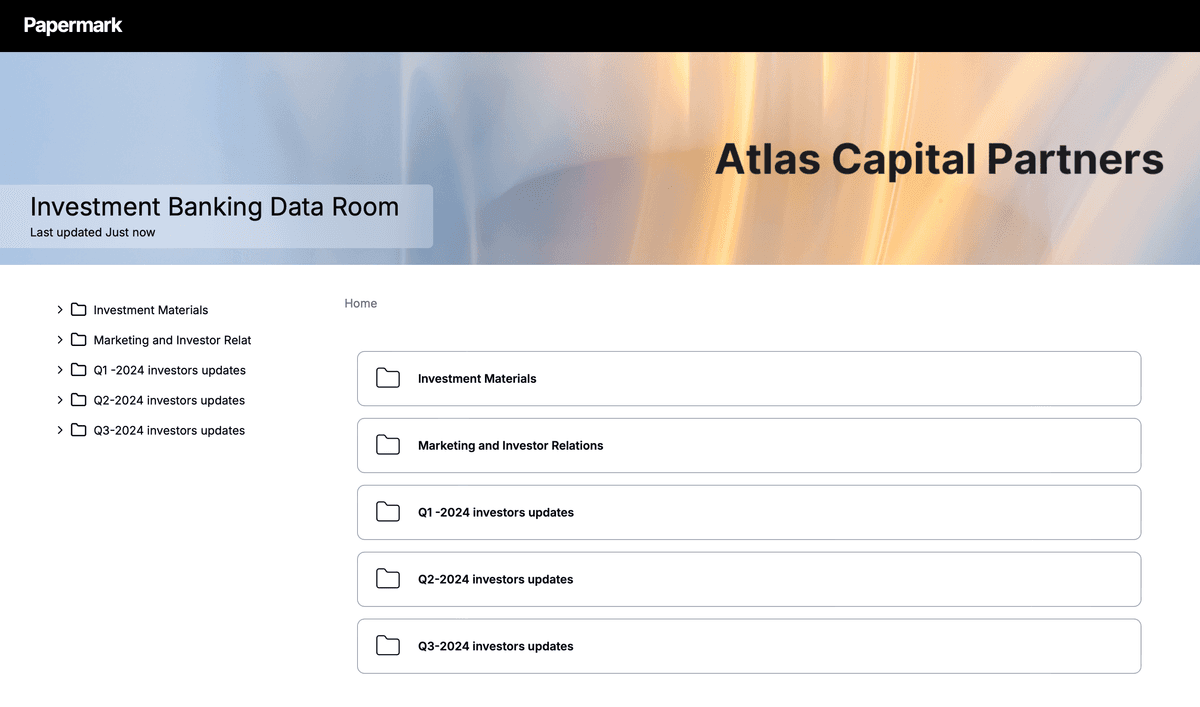
The underwriter reads the same room the buyer's advisors read, which is why an indexed structure shortens the underwriting window.
The final stage is the one buyers forget. At closing the insured signs a no-claims declaration confirming that no member of the deal team is aware of any breach of the covered representations. Anything learned between signing and closing and not raised is carved out by that declaration, which is why late-breaking findings need handling deliberately.
5. The 5 exclusions buyers most often miss
Every RWI policy carries standard exclusions and deal-specific ones, and the deal-specific list is where claims are lost. Most denied claims are not surprises to the underwriter; they were contemplated during underwriting and written out in language the buyer signed. Reading the exclusions schedule properly is the highest-value hour anyone spends on the placement. The five below recur in mid-market placements, and each has a remedy if caught before bind.
Known issues are the largest category by far. If the seller disclosed it, if the diligence report flagged it, or if anyone on the buyer's deal team knew about it, it is not covered. That is not a technicality, it is the definition of insurance: carriers underwrite unknown risk. So a finding in the legal diligence report is simultaneously a price negotiation point and an exclusion, and it has to be resolved through a specific indemnity or a price adjustment.
Forward-looking statements and projections are excluded as a matter of course. The management model, the budget, pipeline assumptions, and any representation that projections were prepared on a reasonable basis sit outside the policy. Buyers relying on the forecast need an earnout instead.
Pension underfunding is a common carve-out where the target sponsors a defined benefit scheme, because the exposure is actuarial rather than contingent and therefore a known quantum. Environmental carve-outs work the same way: general environmental representations are usually covered, but asbestos and PCB exposure with known remediation costs is routinely excluded.
Transfer pricing and specific tax accounting positions are the exclusion buyers are least prepared for. Cross-border groups with intercompany charges attract a transfer pricing exclusion almost automatically, and carve-outs for positions such as deferred tax asset valuation are increasingly standard. A tax due diligence checklist run properly narrows these.
Wage-and-hour and employee misclassification exposure is excluded in most US placements, especially where the target uses contractors, franchisees, or a large hourly workforce. The exposure is systemic: a company that misclassified one worker has usually misclassified a class of them, and class-action quantum is not something a carrier absorbs behind a small retention.
Exclusion
Why underwriters carve it out
What to do instead
Known issues
Insurance covers unknown risk, not disclosed facts
Specific indemnity or price adjustment in the purchase agreement
Forward-looking projections
Forecasts are opinion, not fact, and not underwritable
Earnout or deferred consideration tied to performance
Pension underfunding
Actuarial shortfall is a known quantum, not a contingency
Price the deficit into the equity bridge before signing
Transfer pricing and tax accounting
Multi-jurisdiction exposure with unpredictable quantum
Deeper tax diligence to narrow the carve-out to named entities
Wage-and-hour and misclassification
Systemic and class-wide rather than one-off
Standalone employment practices cover or a seller indemnity
Beyond these five sit the universal exclusions no placement negotiates away: fraud by the insured, criminal fines and penalties, purchase price adjustment disputes such as the working capital adjustment, and covenant breaches as opposed to representation breaches.
6. What underwriters actually look for in your diligence
The underwriter is buying your diligence work. It has no independent view of the target and will not commission its own review, so the scope and quality of the buyer's reports determine how much coverage the buyer gets and how tight the exclusions are. A thin scope does not produce a cheaper policy. It produces a policy with holes exactly where the diligence was thin.
In practice the underwriter reads the legal, financial, and tax reports first and asks the same question of each: genuine review or confirmatory pass? A financial due diligence report that sampled three months of revenue recognition will not support a full revenue representation. A legal due diligence checklist covering only the top ten customer contracts leaves no basis to insure the contracts representation across the whole book, and the sublimit that follows is a direct consequence of the sampling threshold.
Buyers can use that relationship. If the target carries meaningful IP risk, commissioning a proper IP review before submission is usually cheaper than accepting an IP exclusion. The same applies to cybersecurity, environmental exposure, and employment practices, which is where the diligence budget and the insurance budget stop being separate decisions.
Underwriters also read process. They want reports dated, versions final rather than draft, disclosure schedules cross-referenced to the underlying documents, and the room they read to be the same room the buyer's advisors read. A room reorganised between those two reviews creates a real problem, because nobody can then prove what was disclosed and when.
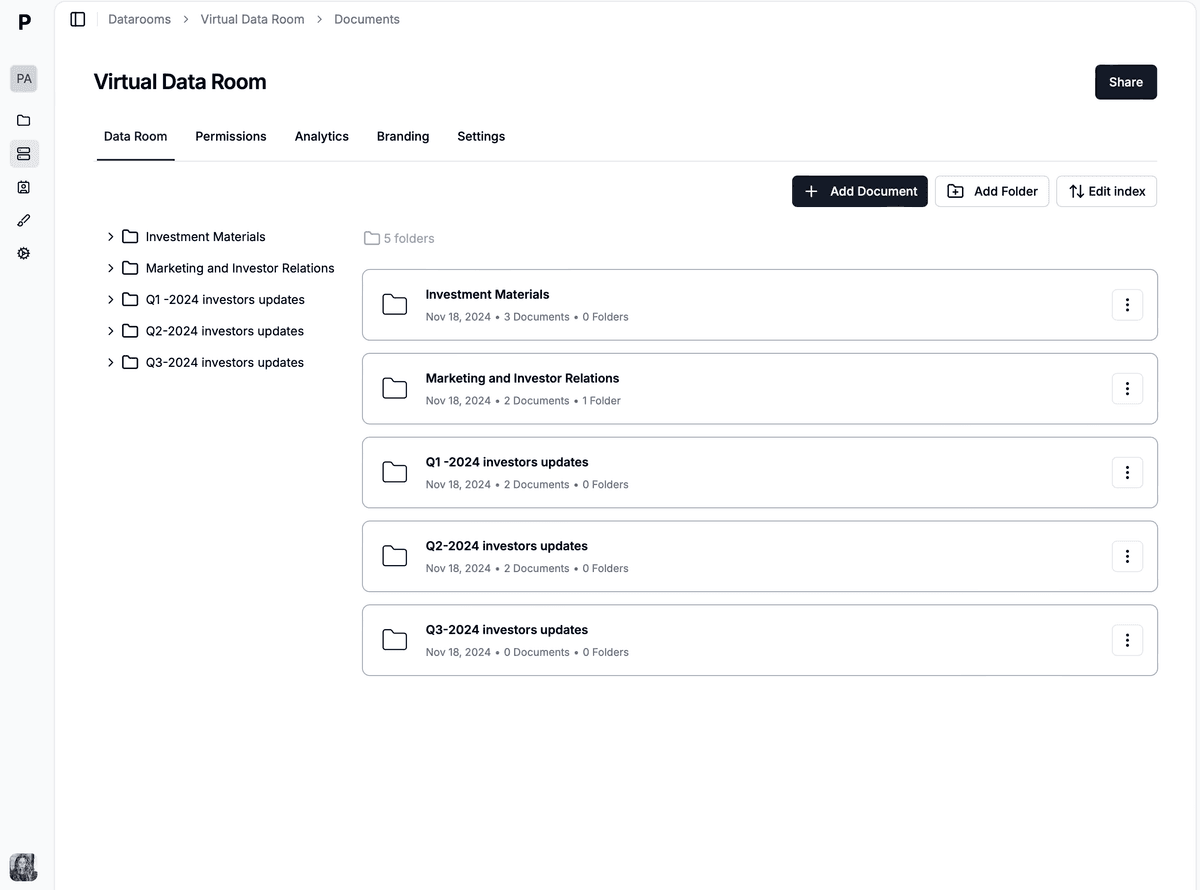
The underwriter needs the diligence reports and the disclosure schedules, and usually nothing from the commercial folder.
There is a documentation dimension that matters after the policy binds. Years later a claim is assessed against what the deal team knew, and the evidence is the disclosure record: which documents existed in the room, who opened them, and when. A data room for representations and warranties insurance with a per-visitor page-level log produces that record contemporaneously rather than reconstructing it from inboxes under pressure. Our M&A due diligence checklist covers what belongs in it.
7. Worked scenario: Northvale Industrial places a policy
A mid-market private equity fund agrees to acquire Northvale Industrial, a specialty components manufacturer with $85M of enterprise value, $9M of EBITDA, and operations in the US and Mexico. The seller is a family holding company that will not accept a two-year escrow, so the fund plans a buy-side policy from the outset.
The broker submits to eight carriers and returns four indications in four days. Three flag transfer pricing as an expected exclusion because of the intercompany manufacturing arrangement with the Mexican subsidiary, and two flag wage-and-hour exposure because roughly 300 of Northvale's 420 employees are hourly. The fund picks the carrier offering the narrowest transfer pricing carve-out and pays a $35,000 underwriting fee.
It buys an $8.5M limit, 10 percent of enterprise value, at a 3.2 percent rate on line for $272,000 of premium. Retention is 0.75 percent of enterprise value, or $637,500, dropping to $318,750 after 12 months. Broker commission runs $40,800 and taxes and filing fees add roughly $9,700, bringing total placement cost to about $358,000, or 0.42 percent of enterprise value.
Northvale Industrial: total RWI placement cost
$358Kplacement cost
Premium at 3.2% rate on line272 · 76%
On an $8.5M limit
Broker commission41 · 11%
Share of premium
Underwriting fee35 · 10%
Non-refundable, paid at diligence start
Surplus lines tax and fees10 · 3%
Varies by filing jurisdiction
Worked scenario. Premium dominates, but the underwriting fee, commission and taxes add about 32 percent on top of it, and that is the part buyers most often leave out of the model.
The fund also spends $45,000 on a targeted employment practices review it had not scoped, specifically to narrow the wage-and-hour exclusion. It works: the carve-out is limited to a named class of route drivers rather than the whole hourly workforce, which buys more coverage than an equivalent increase in limit would have.
Underwriting takes 11 business days. The underwriter gets its own link, scoped to the legal, financial, tax, and employment folders and excluded from the commercial and customer-pricing folders. The policy binds at signing, the escrow drops from a proposed $8.5M to a $250,000 special indemnity covering the transfer pricing exclusion, and the seller receives 99.7 percent of consideration at closing.
8. Common mistakes when placing RWI
The most expensive mistake is treating the exclusions schedule as boilerplate. It is the only document describing what you did not buy, and it stays negotiable up to bind. Buyers who read it a day before signing have no time to commission the diligence that would narrow a carve-out.
The second is scoping diligence and insurance separately. When one team sets the diligence budget and another places the insurance, nobody weighs a $45,000 review against a $2M exclusion. Both belong in the same conversation, before the underwriting fee is paid.
The third is misjudging the retention. A 0.75 percent retention is a six-figure number sitting in front of every claim, and a buyer who models full recovery from the first dollar has overstated their protection by exactly that amount. See our breakdown of due diligence cost.
The fourth is bringing the underwriter into an unprepared room. It is party five or six in a process that already has a buyer, two or three advisory teams, and a lender, and it arrives late with a short deadline. Handing it a room with no index and no scoped permissions turns a 10-day underwriting window into three weeks.
The fifth is losing the disclosure record after closing. Roughly one in five policies attracts a claim within three years, and a buyer who cannot show what was in the room at signing is arguing from memory. Our data room checklist covers the archive step most teams skip.
Manage due diligence with a virtual data room
No credit card required
Page by page analytics
Unlimited documents & folders
Permission management
Dynamic watermarks
NDA collection
Real-time alerts
Custom branding
Audit trail
9. Data room for your representations and warranties insurance placement
A data room built for an RWI placement is not the same artifact as a generic deal room. It has one extra party with a genuinely different scope, a hard external deadline set by the underwriting window, and a retention requirement that outlives the deal by years. Most rooms handle the first two and fail on the third.
The underwriter's scope is narrower than the buyer's and different from the lender's. It wants the diligence reports, the disclosure schedules, the contracts they reference, and the tax and employment files. It has no need for customer-level pricing or board materials, and giving it access creates confidentiality exposure with no coverage benefit. That asymmetry is what per-link scoping exists for.
The archive requirement is the one teams underestimate. One Papermark customer running a large energy infrastructure sale, with more than 100 internal uploaders and four investor groups each bringing around 20 advisors, described the data room archive as a hard requirement for M&A insurance purposes post-close.
Papermark is a secure, fully customizable, and developer-friendly data room built for modern dealmakers, with page-by-page analytics, dynamic watermarking, and transparent pricing (open-source and self-hosting available).
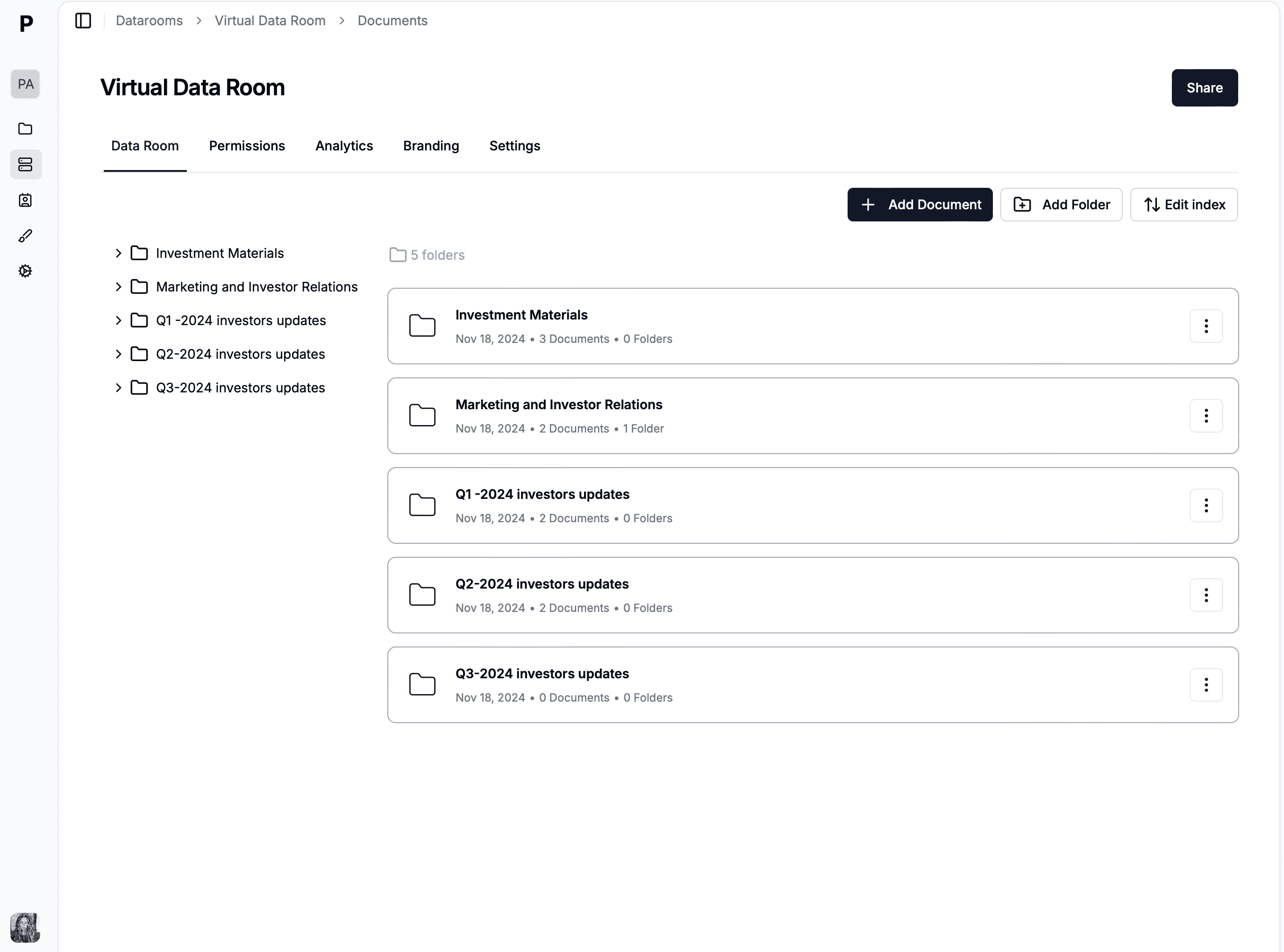
A deal room structured so the underwriter's link can be scoped to the diligence and disclosure folders alone.
Why you need a data room for representations and warranties insurance
Running an RWI placement out of a shared drive works right up until it does not, and the failure modes are specific. If you are still choosing a platform, our comparison of the best virtual data rooms covers pricing model, bidder management, and compliance across the main providers. Four reasons a dedicated data room for representations and warranties insurance earns its place:
The underwriter is one more party with its own scope. By the time the carrier is selected, the room already serves the buyer's legal, financial, and tax advisors and usually a lender. The underwriter needs a subset of what they see and nothing from the commercial folders. A shared drive gives you one permission set. A data room for representations and warranties insurance gives you one per link over the same documents.
The underwriting window is short and externally imposed. Ten to fifteen business days is little time to answer follow-ups across four workstreams, and the delay is almost never the underwriter. It is the seller hunting for a contract amendment buried in a March email.
The disclosure record is the claim evidence. Coverage turns on what was known and when. A per-visitor, page-level audit log answers that with timestamps. An inbox answers with recollection, and recollection loses.
The room has to survive the policy period. General representations run three years, fundamental and tax representations six. A room deleted when the subscription lapses, or reorganised for the next deal, destroys the record inside the window where it matters most.
The rest of this section is the practical setup, in five steps.
Step 1: structure the room around the diligence reports
Build the folder tree the way the underwriter reads it: legal, financial, tax, employment, IP, environmental, and a disclosure schedules folder that cross-references the rest. Keep commercial and customer-level material in its own branch so it can be excluded from a link in one action.
Automatic file indexing on the Data Rooms Plus plan maintains the index as documents arrive, which matters because diligence reports land as drafts and get replaced by finals while the underwriter is reading. Document versioning with notifications keeps it on the final version without anyone chasing a re-send.
Step 2: give the underwriter its own scoped link
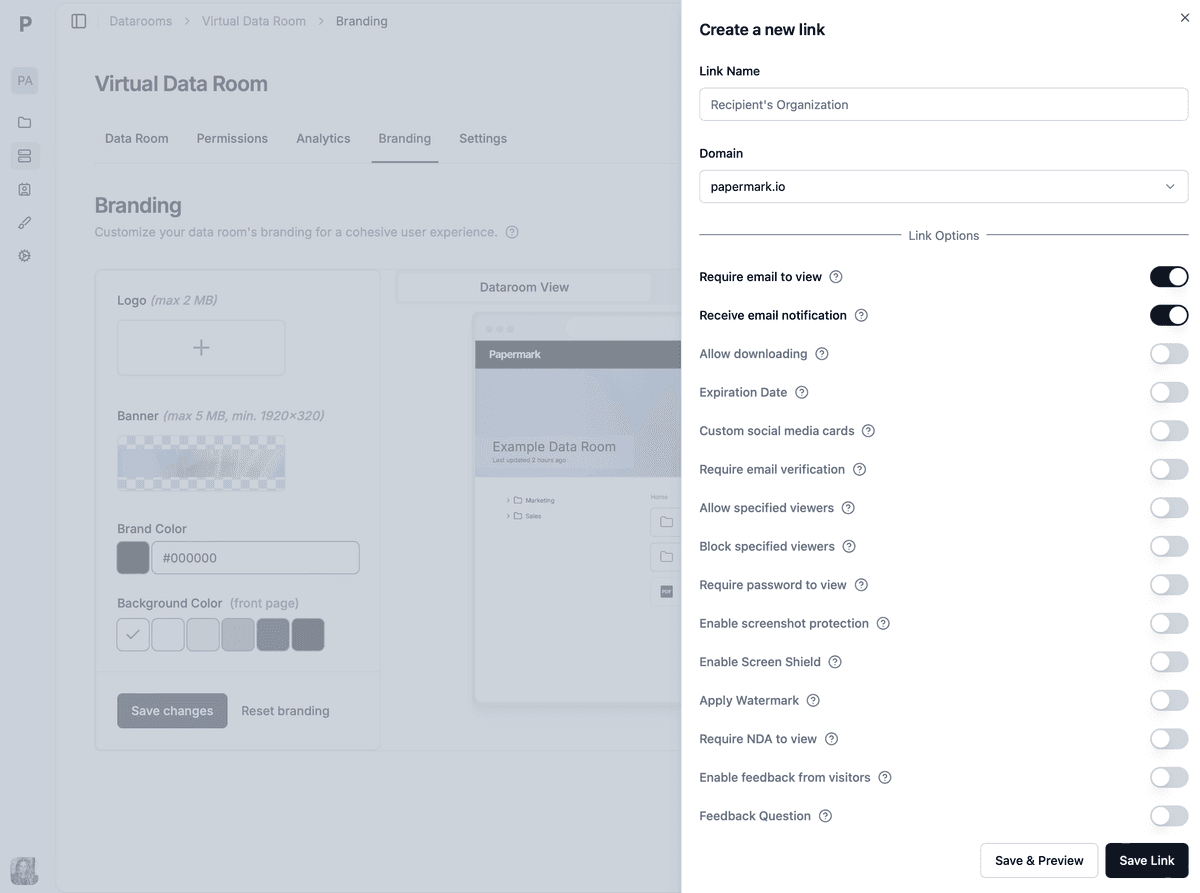
Do not reuse the buyer's link or the lender's. The underwriter gets its own, scoped to the folders it needs, restricted by email allowlist to it and its counsel, with its own download rule.
Granular file-level permissions are set per link rather than per user, and access is link-based with no viewer account required, which removes the friction that makes a busy underwriting team email for documents.
Step 3: watermark what leaves the room
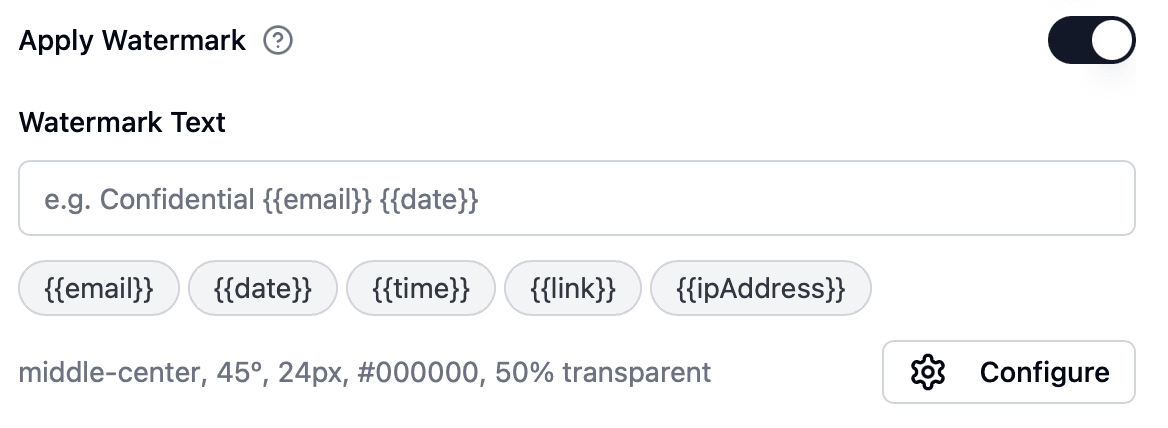
Diligence reports and disclosure schedules are the most sensitive documents in the process, and the underwriter's counsel circulates them internally. Turn on dynamic watermarking, which stamps each page as it renders with the viewer's email, IP address, and timestamp, so any copy traces back to a named session.
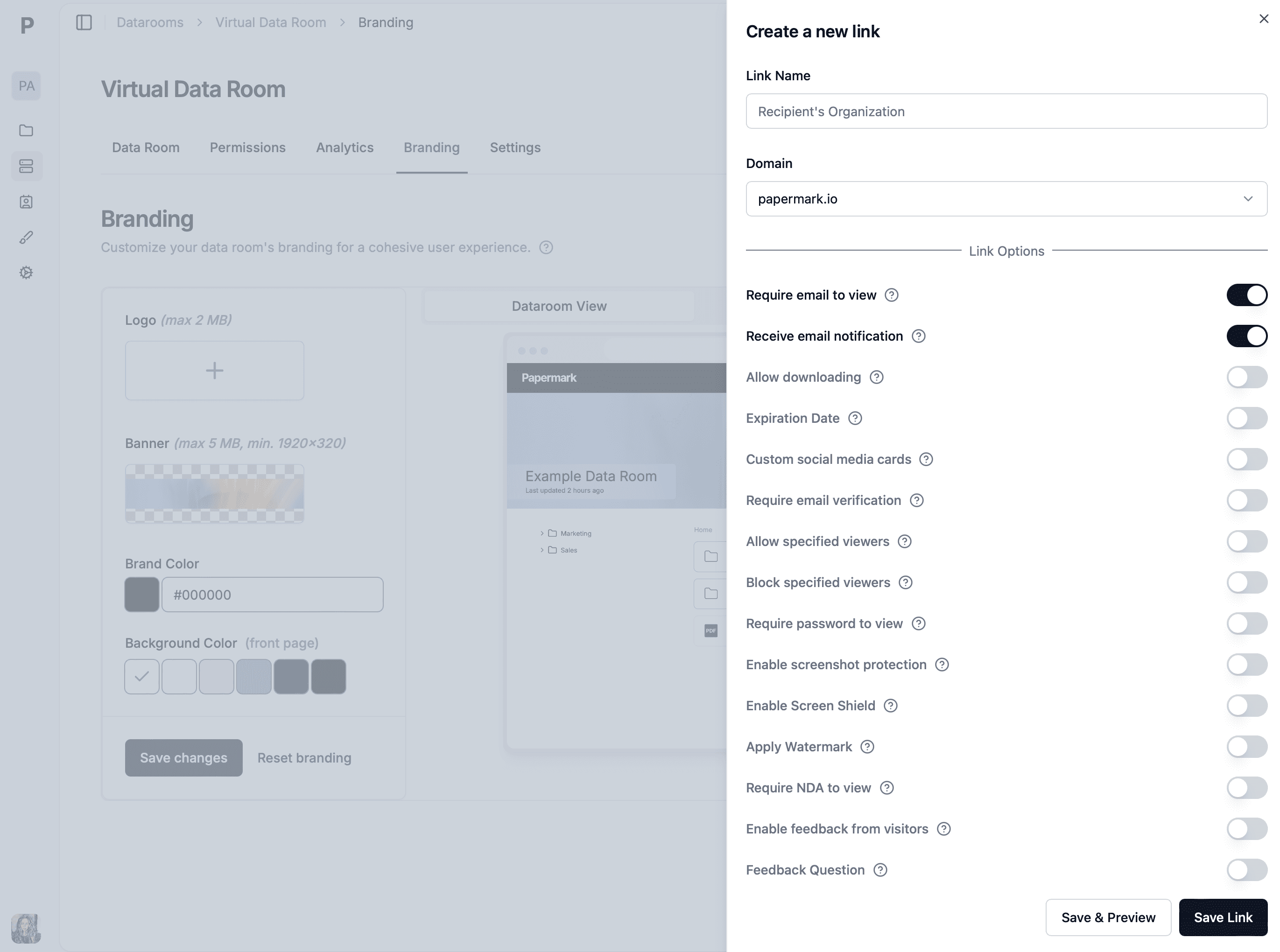
Watermark settings applied per link, so the underwriter's copies carry its own session identity.
The honest limit: a downloaded file is legally treated as read and no platform can recall it. That is why the underwriter's link is view-only on the sensitive folders, and why watermarking exists at all. It makes a leak traceable rather than anonymous.
Step 4: run underwriter questions through Q&A, not email
The underwriting call generates follow-ups, and they arrive alongside open questions from four advisory workstreams. Run over email, the same question gets asked twice and answered two ways.
The Q&A module attaches each question to the document that prompted it, with permissions controlling which parties see which threads, so the underwriter's questions never surface to the lender. The log exports for the closing file as evidence of what was asked and answered in the period the no-claims declaration covers.
Step 5: freeze and archive the room at closing
This is the step that matters three years later. Data room freeze makes the room immutable at closing and exports it as an archived ZIP with a certificate, and the audit log preserves the per-visitor record of who opened what and when.
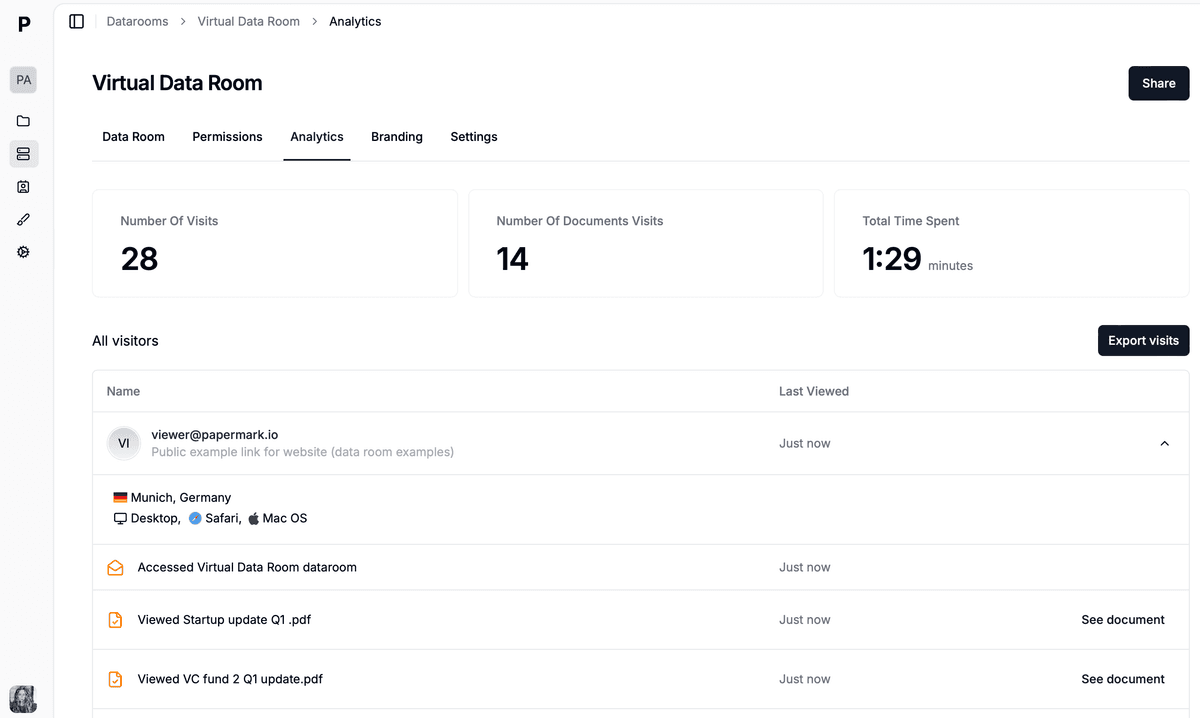
Page-level analytics record which documents the underwriter and each advisor opened, and for how long.
Keep the archive for the six-year fundamental representation period. When a claim is assessed, it answers the only question that matters: what did the deal team have in front of it at signing.
Papermark is our #1 VDR provider for M&A transactions right now. In two deals we used custom branding, dynamic watermarking, and granular permissions.
The Data Rooms plan is €99/month with a 7-day free trial and includes 3 team members, unlimited data room visitors, unlimited data rooms, unlimited documents, custom domain, dynamic watermarking, NDA agreements, and granular file-level permissions. Data Rooms Plus at €249/month adds 5 team members, the Q&A module, the audit log, automatic file indexing, and SOC 2 Type II. Premium at €549/month adds 10 team members, AI redaction, the REST API, SSO, and white-labelling. Data Rooms Unlimited at €999/month removes per-seat charges entirely, so teams that add reviewers mid-deal pay one number regardless of headcount, and it carries every Premium capability including AI redaction. Set against a $35,000 underwriting fee and a $272,000 premium, the room that keeps underwriting to 11 days rather than 21 is not the line to economise on.