

mergers-and-acquisitions
13 Best Real Estate Investment Banks and M&A Advisors in 2026
Compare 13 verified real estate investment banks by mandate type, asset class and deal size, plus how owners and sponsors run a sale or recapitalisation in 2026.
Healthcare is the most specialised M&A market in the United States, and a generalist banker will misprice it. This guide profiles 14 verified healthcare investment banks and M&A advisors, with the subsectors each one actually covers, typical deal bands and who their buyers are.
Specialisation matters here because of regulation. A behavioural health group, a dental service organisation, a home infusion pharmacy and a hospital system are four different transactions, with different licensing exposure, different payer risk and four separate buyer pools. An advisor who ran a distribution deal last quarter will not know which of your Medicaid contracts survives a change of control.
Capital is also concentrated. Private equity has spent fifteen years building physician platforms in dermatology, ophthalmology, dental, veterinary and behavioural health, and those platforms are still buying add-ons. The result is wide valuation dispersion: two home care agencies with identical revenue can trade three turns apart on payer mix alone. Hiring one of the healthcare investment banks below is how you find out which of those two you are before a buyer tells you.
Working across more than one sector? The M&A advisors database holds every firm we have researched and opens filtered to Healthcare, so you can line these 14 up against each other on deal size and coverage.
Healthcare bankers turn work down more often than they take it, because a failed provider deal burns six months and damages their standing with sponsors they will call again next quarter. Getting an engagement letter is about proving your business is sellable before you ask.
Payer mix is the first screen. A banker will want the split between commercial, Medicare, Medicaid and self-pay, by revenue and by volume, for three years. A group at 60% commercial reimbursement gets a different buyer list from one at 70% Medicaid. Bring the contract schedule too, with rates and renewal dates, because buyers price the contracts rather than the revenue.
Second is clinician retention. Sponsors underwrite provider deals on whether the physicians, therapists or nurses stay, and turnover above roughly 25% a year will surface in diligence anyway. Put it in front of the banker first, with the plan you have to fix it.
Third is document readiness. Healthcare diligence lists run longer than any other sector because of licensing, credentialing, billing compliance and HIPAA. Staging everything in a permissioned workspace before you go to market is the fix, and our review of the best virtual data rooms covers what each tier costs.
Bring these to a first banker meeting:
No credit card required.
Papermark is our #1 VDR provider for M&A transactions right now. In two deals we used custom branding, dynamic watermarking, and granular permissions.
Tyler
Start from your subsector rather than a league table. The firms below overlap very little: the bank that sells hospices does not sell medtech, and the one advising a non-profit system on a merger has never run a sponsor auction.
Approach a healthcare bank in stages, releasing information against interest rather than all at once. Confidentiality is unusually fragile here because referral networks and clinician communities are small: a rumour that a group is selling reaches competing practices and recruiters within days, and the recruiters move first.
| # | Firm | Typical deal size | Healthcare focus |
|---|---|---|---|
| 1 | Leerink Partners | Upper middle market and public | Biopharma, medtech, life science tools, health services |
| 2 | Cain Brothers | Middle market and above | Health systems, senior living, services, healthcare IT |
| 3 | TripleTree | Middle market | Healthcare services, healthcare technology, pharma services |
| 4 | Provident Healthcare Partners | Lower middle to middle market | Physician practices, provider recapitalisations |
| 5 | Ziegler | Middle market financings | Senior living, hospitals, healthcare capital markets |
| 6 | Edgemont Partners | Middle market | Provider services, healthcare technology, growth capital |
| 7 | Cross Keys Capital | Middle market | Healthcare services and diversified middle market |
| 8 | VERTESS | $5M to $100M+ value | Behavioural health, home care, IDD, pharmacy, health IT |
| 9 | Juniper Advisory | Hospital and system scale | Non-profit hospital mergers and partnerships |
| 10 | Bourne Partners | Middle market | Pharma, pharma services, healthcare services |
| 11 | VMG Health | All sizes, advisory and valuation | Providers, health systems, physician transactions |
| 12 | The Braff Group | $5M to $500M+ value | Home health, hospice, behavioural health, HME, pharma services |
| 13 | Mertz Taggart | Lower middle market | Home-based care, behavioural health, hospice, infusion |
| 14 | Kaufman Hall | Health system scale | Hospital strategy, partnerships, affiliations |
Leerink is the reference point for anything touching biopharma, medical devices or life science tools. It runs both M&A and public capital markets, so a private company with an IPO option gets both paths priced by the same team.
Cain Brothers has advised healthcare and only healthcare since 1982, and since 2017 has operated as a division of KeyBanc Capital Markets, which puts balance sheet and debt capital markets behind the advisory work.
TripleTree has been a healthcare specialist since 1997 and became the healthcare investment bank of Capital One after its acquisition, which pairs a boutique advisory team with a large lender.
Provident is one of the better known sell-side advisors for physician practice management, and has spent two decades running recapitalisations that put a sponsor alongside the founding physicians rather than cashing them out.
Ziegler is a specialty investment bank rather than a pure M&A shop, and a dominant name in senior living and non-profit healthcare finance. If your transaction involves tax-exempt bonds or a senior living portfolio, it belongs on the list.
Edgemont is a New York boutique that does healthcare M&A advisory and growth capital raising exclusively, which keeps its senior bankers on a small number of processes at a time.
Cross Keys is a Florida middle market investment bank with a dedicated healthcare group alongside a generalist corporate team, which suits owners whose business straddles healthcare and business services.
VERTESS works the lower middle market end that larger healthcare banks decline, and its advisors are typically former operators from the same service lines they now sell.
Juniper is the specialist option for non-profit hospitals. It works only on partnerships, mergers and affiliations for non-profit systems, a market where the board process matters more than the price.
Bourne is the Charlotte boutique that pharma and pharma services owners call. It combines M&A advisory with its own investment activity, so it sees deal flow from both sides.
VMG is best known for healthcare valuation, and that is exactly why it appears on sell-side lists. Boards and physician groups use it for fair market value opinions and transaction advisory where compliance scrutiny is heavy.
Braff is a pure sell-side shop and among the most active advisors in home health and hospice by deal count. Its comparables database is why owners in those niches call it first.
Mertz Taggart concentrates almost entirely on home-based care and behavioural health, and publishes quarterly deal reports for those niches, so its market read is easy to verify before you engage.
Kaufman Hall sits on the other side of the table from most firms here, advising hospitals and health systems on strategy, partnerships and affiliations, backed by benchmarking data most bankers lack.
Healthcare processes generate the longest diligence lists in the middle market. A behavioural health group selling to a sponsor can expect several hundred requests covering licences, credentialing files, payer contracts, billing audits and HIPAA policies, with several bidders working through them at once.
The people asking for those files are frequently your competitors. Private equity backed platforms buy add-ons in markets where their existing practices already operate, and the strategic operator running diligence on your agency may be the same group bidding on the referral contracts you both serve. Sending payer contracts and provider compensation schedules by email to twenty parties, most of whom will never sign, hands your contracted rates and your physician pay bands to the organisation trying to recruit from you.
A confidentiality leak in healthcare costs you the two assets a buyer is actually paying for: your clinicians and your referral sources. Physicians and nurses who hear the practice is for sale start fielding calls from the platform down the road, referring providers slow their volume while they wait to see who ends up owning you, and a payer that learns your rates are being circulated has no incentive to be generous at the next renewal. Files containing protected health information carry a separate regulatory problem: an untracked email attachment is not a defensible disclosure record.
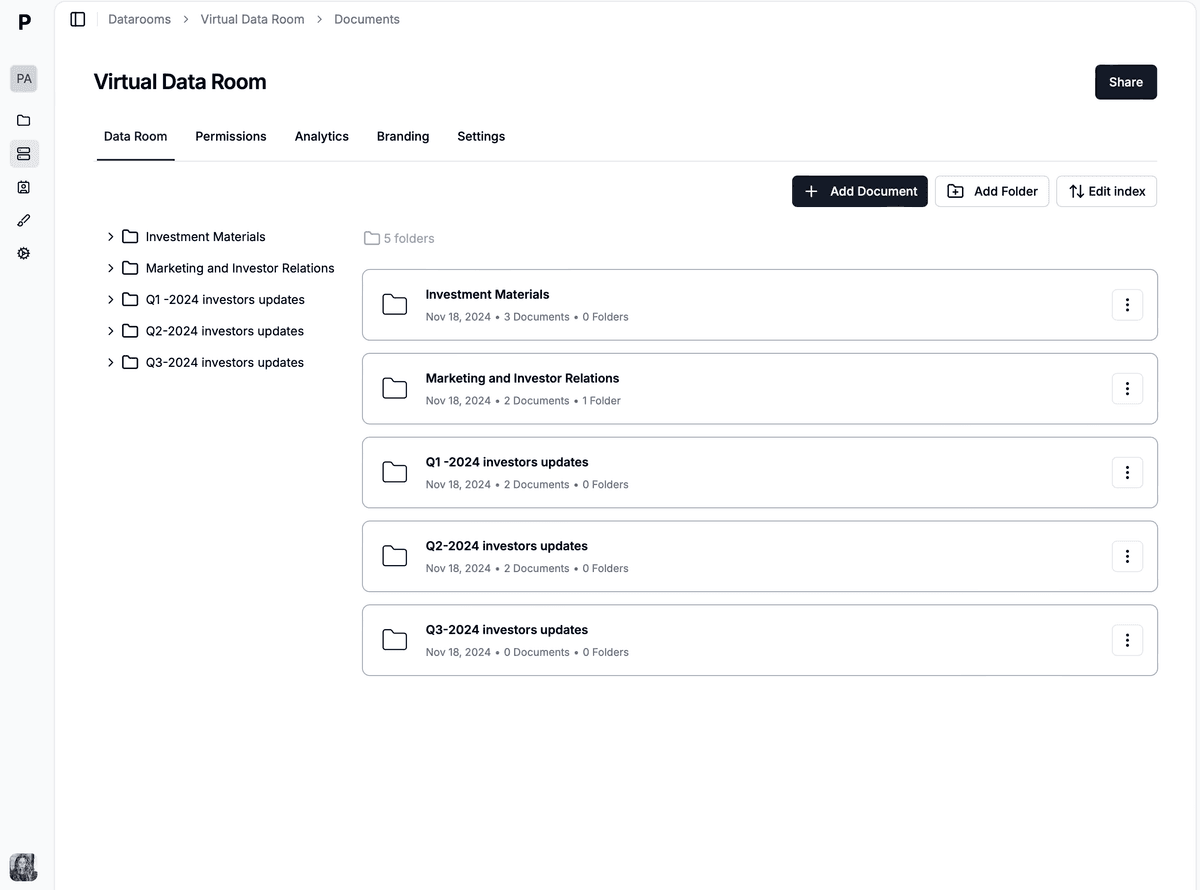
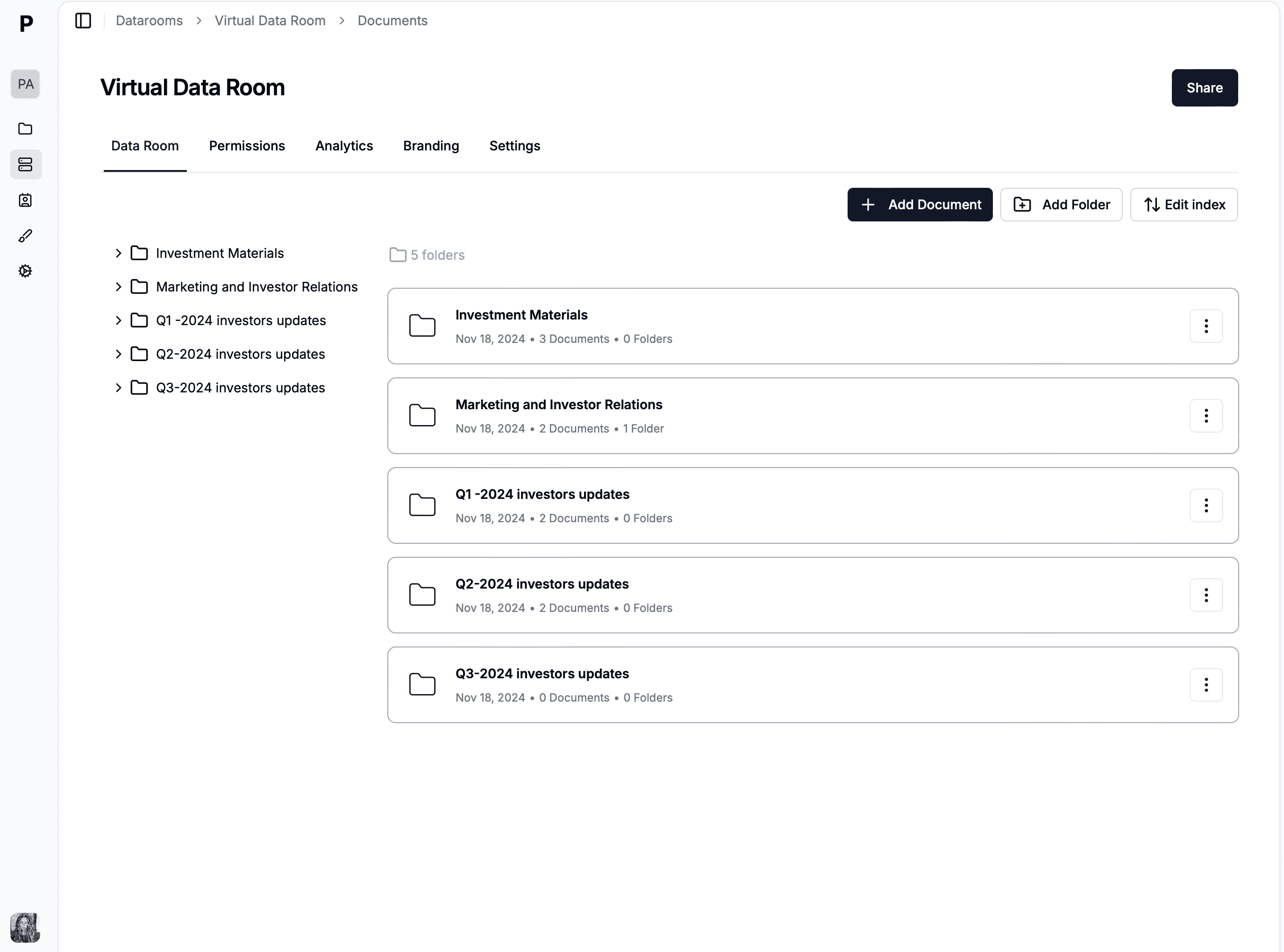
Folder-level permissions let a banker open the general file to twenty buyers and payer contracts to two.
A data room for healthcare M&A is the permissioned workspace where your banker stages the diligence file and runs several buyers through it at once, without any of them seeing what the others see. It is what advisers mean when they ask whether your documents are ready before they take the mandate.
Papermark is a secure, fully customizable, and developer-friendly data room built for exactly this: a secure data room for your healthcare M&A process that keeps the sensitive parts of the file locked while the process runs. NDA agreements sit on the link itself, so a competing operator signs before the confidential information memorandum renders. Dynamic watermarking burns each viewer's email and the timestamp onto every page, the practical deterrent when your CIM contains payer rates. Granular file-level permissions let your banker open the general folder to twenty parties while payer contracts and provider compensation stay locked to the last two bidders.
Page-by-page analytics tell your banker where to push. When one platform spends twenty minutes on the payer concentration exhibit and another has not opened the room since day three, the follow-up list writes itself. The audit log records every view and download, which matters when files hold protected health information.
The Data Rooms plan is €149/month, or €99/month billed annually, with a 7-day free trial, and includes 3 team members, unlimited data rooms, unlimited documents, a custom domain, dynamic watermarking, NDA agreements, and granular file-level permissions. Open a secure data room before the teaser goes out and reuse it through diligence.
Most virtual data rooms were built for bankers and priced for them. Papermark is a secure data room for modern dealmakers, and it is more customizable and more branded than any other VDR on the market.
If your business sits below these firms' bands, or you want to test valuation before signing an exclusive, the alternative is approaching platform buyers directly with healthcare counsel supporting you.
If none of the fourteen above fits, the M&A advisors database lists every firm we have researched by city and by industry, with deal sizes and sectors side by side. Filter to healthcare to compare these fourteen against each other, or check your metro if you would rather work with an adviser locally.
Compare 13 verified real estate investment banks by mandate type, asset class and deal size, plus how owners and sponsors run a sale or recapitalisation in 2026.
Compare 13 verified retail M&A advisory firms by deal size, channel focus and mandate type, plus what retail and e-commerce owners prepare before a sale in 2026.
Compare 12 verified technology M&A advisors by deal size, sub-sector and mandate type, plus what software and internet founders prepare before a sale in 2026.