13 Best Business Brokers in Boston: Fees and Deal Sizes 2026
·12 min read
Marc Seitz
This guide profiles 13 business brokers in Boston and the surrounding Massachusetts suburbs, from Main Street intermediaries handling sub-$1M deals to FINRA-registered banks running competitive auctions. For each firm you get the deal size band, the sectors they close in, and their site.
Boston's owner-operated economy looks nothing like its venture headlines. The businesses that change hands here are home health and behavioral health agencies, dental and veterinary groups, machine shops along Route 128, HVAC and electrical contractors, IT managed service providers, and engineering practices whose founders are nearing retirement. Almost none ever raised a round.
Two things push Boston owners to sell. Demographics come first: many Massachusetts manufacturers and professional services firms are led by founders in their sixties with no internal successor. Buyer appetite comes second, with private equity add-on programmes buying healthcare services, HVAC and MSP businesses across New England, and search funds out of Harvard and MIT Sloan looking locally first. The right advisor depends less on geography than on which buyers they can reach.
If you would rather scan the field before reading the profiles, the M&A advisors database lists all 13 Boston firms below alongside every other adviser we have researched, filterable by city, industry and deal size.
Quick list of business brokers in Boston
Capstone Partners: Boston-headquartered middle market bank with a dozen industry groups.
Mirus Capital Advisors: Burlington bank, 35 years of New England sell-side work.
Covington Associates: Boston boutique known for healthcare and business services deals.
Consilium Partners: Downtown Boston bank for engineered products and healthcare services.
BellMark Partners: Independent Boston bank serving lower middle market owners.
Beacon Equity Advisors: Norwood firm transferring closely held New England businesses since 1985.
BayState Business Brokers: Needham brokerage covering MA, NH, CT and RI.
Inbar Group: Dedham office of a Northeast brokerage with no upfront fees.
Sunbelt Business Brokers of Boston: Main Street and lower middle market listings.
Transworld Business Advisors of Boston: North-of-Boston franchise and business sales.
First Choice Business Brokers Boston Metro: Metro Boston office of a national network.
Murphy Business Greater Boston North: Valuations and confidential listings north of the city.
MedWorld Advisors: Massachusetts boutique for medical device and life sciences deals.
How to get yes from business brokers in Boston
Good Boston advisors turn away more sellers than they take on. A firm running a proper process invests months of unpaid work before a fee arrives, so it screens for businesses that will close. Clean, accrual-based financials matter more than headline revenue; if your books are cash-basis with personal expenses mixed in, expect a broker to decline or to ask for a quarter of cleanup first.
The second filter is customer concentration. A $3M services business where one hospital system is 45% of sales is harder to sell than a $2M business with 200 accounts, because buyers price that risk into the multiple. The third is whether the business runs without you. Owners who are the top salesperson, the estimator and the licensed tradesperson are selling a job, not a company.
Document your add-backs rather than remembering them. Every personal vehicle, family salary and above-market rent needs a line item and a receipt, because a quality of earnings review will test each one. It is worth comparing the best virtual data rooms before you start collecting files.
Three years of financial statements plus a year-to-date profit and loss
Three years of tax returns that reconcile to those statements
A written add-back and owner compensation schedule
A customer list by revenue with concentration percentages
Equipment schedule, leases, licences and permits
Key contracts, including anything with change-of-control language
Send that package as a permissioned link, not a 60MB attachment. A link lets you revoke access when a conversation ends, see whether the financials were actually opened, and keep version control when your accountant restates a number.
No credit card required.
Papermark is our #1 VDR provider for M&A transactions right now. In two deals we used custom branding, dynamic watermarking, and granular permissions.
Start from your deal size, not from a Google ranking. The Boston market splits at roughly $1M of seller's discretionary earnings, and firms on either side of that line run different processes, reach different buyers and price their fees differently.
Deal size band: Ask what the firm's smallest and largest closed deal was in the last two years. A bank used to $25M processes will under-resource a $2M listing.
Credentials: The CBI from the IBBA and the M&AMI from M&A Source require coursework and closed-deal experience.
Association membership: IBBA, M&A Source and the New England Business Brokers Association are the bodies that matter in Massachusetts.
Sector specialisation: A firm that has closed six behavioural health agencies knows which regional buyers pay up. A generalist starts cold.
FINRA registration: For a stock sale, the advisor taking a success fee should sit under a registered broker-dealer.
Buyer network: Ask how many of their last ten closings went to private equity, to strategics and to individuals.
Fee structure: Confirm the retainer, whether it credits against the success fee, the commission formula and the tail period.
References: Ask for two owners who closed and one who did not.
Bandwidth: Find out how many live engagements your named advisor carries.
How to approach business brokers in Boston
Treat the first meeting as a two-way interview. You are buying eight to twelve months of someone's attention, and the person who signs your engagement letter is not always the one who runs your deal. Ask who makes the buyer calls, who writes the CIM and who sits in the room at closing.
Shortlist three firms whose closed deals resemble your business in size and sector.
Send a one-page anonymised summary: industry, revenue, EBITDA or SDE, location, reason for selling.
Ask for a written opinion of value with the comparable transactions behind it, not a single number.
Compare marketing plans. A confidential process with 40 curated buyers is not a marketplace listing.
Read the exclusivity period, tail clause and expense terms before negotiating the fee.
Confirm the NDA workflow and how buyer identities get approved before the CIM goes out.
Agree how diligence materials are shared and what happens if a buyer walks.
Comparison of business brokers in Boston
#
Firm
Typical deal size
Focus sectors
1
Capstone Partners
Middle market
Industrials, healthcare, business services
2
Mirus Capital Advisors
Middle market
Industrial, consumer, healthcare, technology
3
Covington Associates
$10M and above
Healthcare, business services, industrial
4
Consilium Partners
$15M to $50M
Engineered products, healthcare services
5
BellMark Partners
Lower middle market
Business and technology services
6
Beacon Equity Advisors
Closely held companies
Manufacturing, distribution, services
7
BayState Business Brokers
$1M to $50M revenue
Services, manufacturing, healthcare
8
Inbar Group
$500K to $250M revenue
Distribution, healthcare, manufacturing
9
Sunbelt Boston
$1M to $30M value
Main Street, franchise resales
10
Transworld Boston
Main Street to lower mid
Retail, services, franchise
11
First Choice Boston Metro
Main Street to mid market
Generalist local businesses
12
Murphy Business Boston North
Main Street to lower mid
Services, retail, light manufacturing
13
MedWorld Advisors
Small to mid-size medtech
Medical device, biotech, life sciences
1. Capstone Partners
Capstone Partners is headquartered in Boston and runs one of the region's larger middle market M&A platforms, organised into a dozen industry groups. It handles sales, recapitalisations and management buyouts, and as a subsidiary of Huntington Bancshares it pairs advisory with a bank balance sheet.
Deal size: Middle market
Sectors: Industrials, healthcare, business services, technology
Notable: Founded 2001, more than 175 professionals
2. Mirus Capital Advisors
Mirus Capital Advisors works out of Burlington and has advised New England owners for more than 35 years. The team runs sell-side M&A and capital raises through Mirus Securities, a FINRA and SIPC member, and is a common choice for founder-owned industrial and technology companies.
Covington Associates is a Boston boutique founded in 1991 with an unusually deep healthcare practice alongside business services, consumer and industrial coverage. Senior bankers stay on the deal rather than handing it to juniors.
Deal size: $10M and above
Sectors: Healthcare, business services, industrial, technology
Notable: Founded 1991, more than 300 completed transactions
4. Consilium Partners
Consilium Partners operates from Franklin Street in downtown Boston and concentrates on lower middle market sell-side mandates in the $15M to $50M range. Its focus is engineered products, industrial technology and healthcare services.
BellMark Partners is an independent boutique bank with offices in Boston and Cleveland, working almost exclusively in the lower middle market. It sells to strategic acquirers, family offices and private equity groups, and publishes closed transactions so you can check whether your sector appears.
Deal size: Lower middle market
Sectors: Business and technology services, industrials
Beacon Equity Advisors has worked from Norwood since 1985 on the transfer of closely held New England businesses. It targets companies too complex for a Main Street brokerage but too small for a national bank, and its advisors are former operators.
BayState Business Brokers works from Kendrick Street in Needham and covers Massachusetts, New Hampshire, Connecticut and Rhode Island. It handles companies at roughly $1M to $50M in revenue and under $5M of cash flow, marketing to individual, strategic and private equity buyers.
Notable: Established 2004, principal Sarah Grossman holds the CBI
8. Inbar Group
Inbar Group serves Greater Boston from Legacy Place in Dedham and operates across ten Northeast states. It covers businesses from roughly $500K to $250M in revenue, and its stated policy is no upfront fees, with payment only on a completed sale.
The Boston office of Sunbelt covers Main Street listings and lower middle market deals with enterprise values roughly between $1M and $30M, a band larger banks often skip. Services include valuations, financing support and transition consulting.
Deal size: $1M to $30M enterprise value
Sectors: Main Street businesses, franchise resales
Notable: Part of the Sunbelt Network, operating since 1978
10. Transworld Business Advisors of Boston
Transworld's Boston operation runs from north of the city and offers full-service brokerage plus franchise consulting. It suits owners of multi-unit franchise operations as well as independent retail and service businesses.
Deal size: Main Street to lower middle market
Sectors: Retail, food service, personal services, franchise
Notable: Part of the Transworld Business Advisors network
11. First Choice Business Brokers Boston Metro
The Boston Metro office of First Choice provides market analysis, valuation, confidential marketing and closing support. It is a generalist practice, suited to owners who want a conventional listing rather than a curated auction.
Deal size: Main Street to middle market
Sectors: Generalist across local operating businesses
Murphy Business covers the communities north of Boston with a Main Street and lower middle market practice, offering valuation and confidential listings. Its national network brings in buyer inquiries generated outside Massachusetts.
Notable: Part of the Murphy Business national network
13. MedWorld Advisors
MedWorld Advisors is a Massachusetts boutique working only in healthcare technology: medical device, medtech, biotech, dental and life sciences companies, plus medical and dental practices. It runs sell-side and buy-side mandates.
Deal size: Small to mid-size medtech companies
Sectors: Medical device, biotech, dental, life sciences
Common mistakes when hiring a business broker in Boston
The most expensive mistake is hiring on valuation. If three firms quote $4.2M, $4.5M and $7M, the $7M number is usually a pitch rather than an opinion, and the listing sits for a year before the price is cut. Ask every firm to show its comparables and the multiple applied.
Consider a Woburn machining business with $6M of revenue and $900K of adjusted EBITDA. The owner signed with the firm quoting the highest number, went to market at 7x and got no offers in five months. A sector-focused advisor then repositioned the business around its aerospace certifications, took it to 30 targeted strategic and private equity buyers, and closed at roughly 5.5x with an earnout bridging part of the gap. Same company, same numbers, different process. Businesses in the $5M to $50M range trade near 6.5x EBITDA, and pricing far outside that band needs a reason buyers accept.
The other recurring errors are cheaper to fix. Do not sign an exclusivity longer than twelve months without a performance out, do not agree a tail clause you have not read, and do not release detailed financials before an NDA is signed.
Why you need secure document sharing in a Boston business sale
A broker-run sale in Boston means twenty to fifty parties touching your information, each needing a different level of access. The teaser goes out unbranded, the memorandum only to signed NDAs, and payroll and supplier pricing only to the two or three parties in confirmatory diligence. In between sit the files that carry the real risk: customer contracts and concentration, quality and industry certifications, licensing and clinical records for a healthcare services business, and the equipment and lease schedules.
Several of the parties reading that file compete with you. Private equity add-on programmes buying HVAC, healthcare services and managed IT across New England are buying on behalf of a platform that already trades in your postcode, and the "strategic buyer" looking at a Route 128 machine shop is usually another shop bidding for the same aerospace and medical device work. A competitor that signs the NDA, reads the memorandum and walks away has learned your certifications, your top accounts and your labour rates at no cost.
The cost of a leak in this market lands on people and referrals. Machinists, technicians and clinicians are the constraint in almost every Massachusetts business on this list, and one who hears the company is for sale will take the call from the buyer who lost the auction. Home health and behavioural health sellers have a second exposure: referring physicians and case managers move volume elsewhere while they wait to see who ends up owning the agency, and that shows up in the numbers a buyer is about to re-diligence. Email attachments cannot be recalled, cannot be watermarked, and tell you nothing about who actually opened them.
Data room for Boston M&A
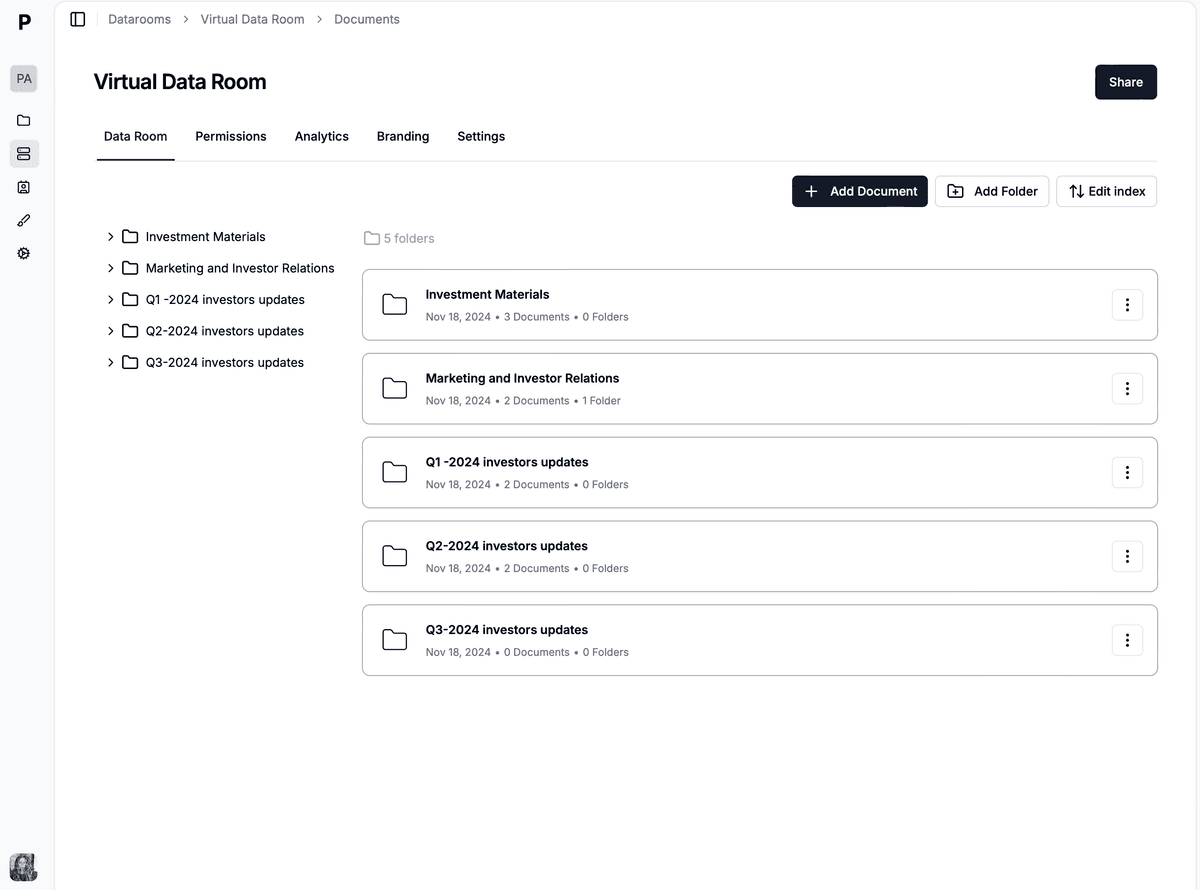
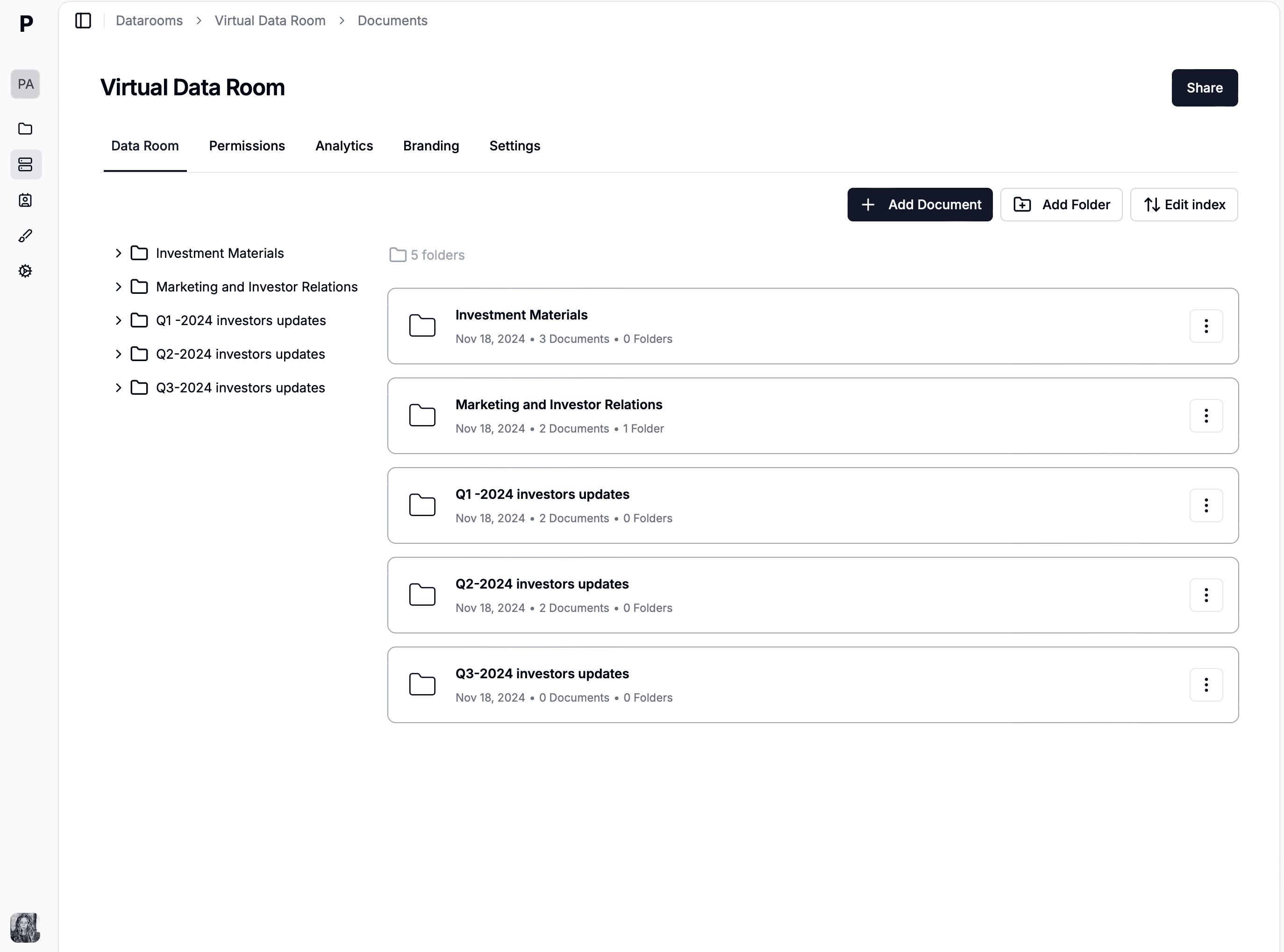
A structured data room keeps the CIM, financials and contracts on separate permission levels.
A data room for Boston M&A is the permissioned workspace where your broker stages the diligence file and runs several buyers through it at once, without any of them seeing what the others see. It is what advisers mean when they ask whether your documents are ready before they take the mandate.
Papermark is a secure, fully customizable, and developer-friendly data room built for exactly this: a secure data room for your Boston sale process that keeps the sensitive parts of the file locked while the process runs.
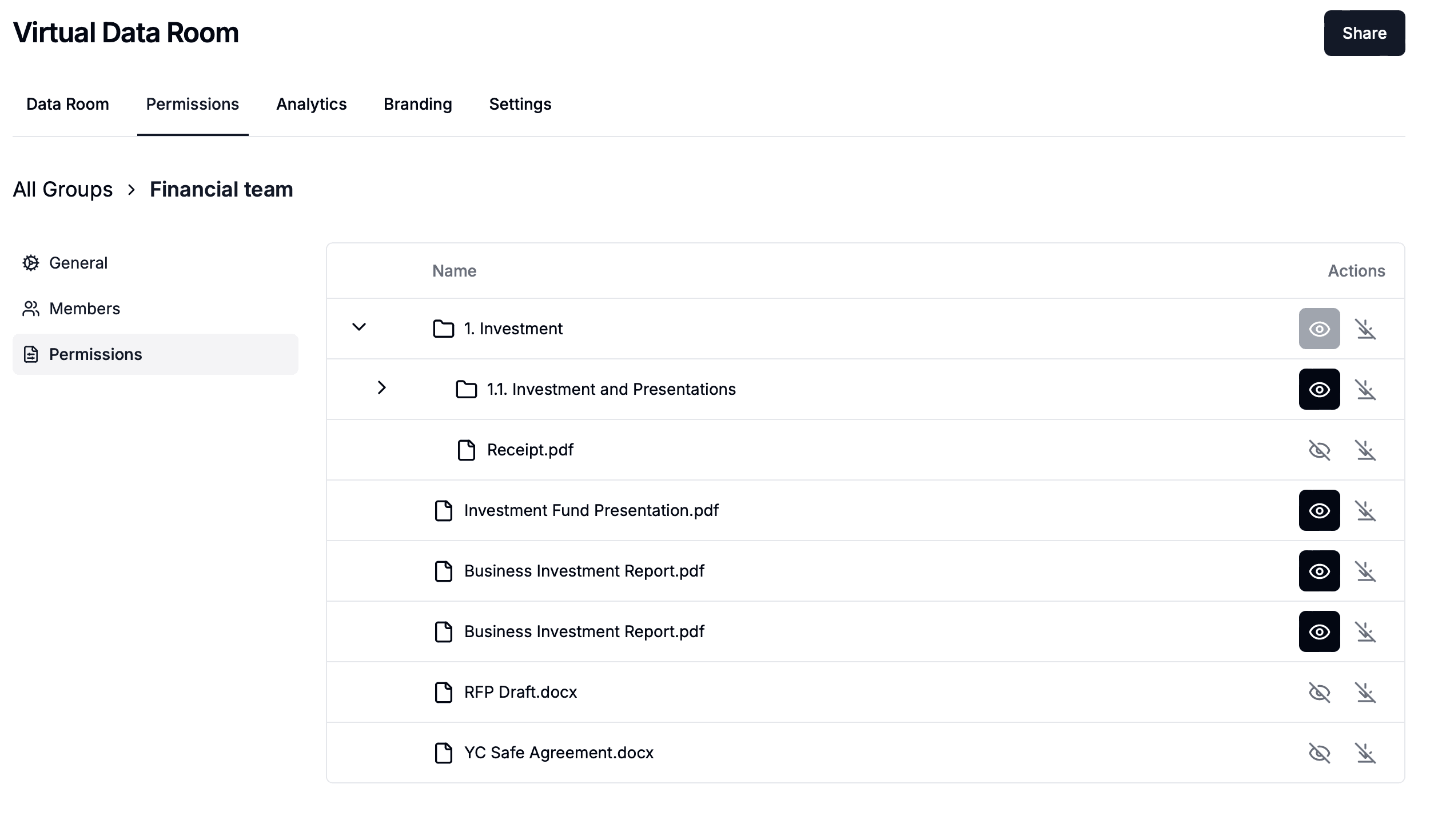
Gating matters most at the CIM stage. A Papermark data room can require an NDA click-through before a document opens, so no buyer sees the memorandum without a recorded acceptance. Dynamic watermarking stamps each viewer's email and access time across every page, making a leaked copy traceable, and granular file-level permissions let your broker open the financial folder to one bidder without opening it to the rest.
Page-by-page analytics separate real buyers from tyre kickers. A prospect who spends eleven minutes on the customer concentration section and returns twice behaves differently from one who opened the CIM for forty seconds, and brokers use that to time the offer deadline. The audit log records every view, download and permission change.
The Data Rooms plan is €149/month, or €99/month billed annually, with a 7-day free trial, and includes 3 team members, unlimited data rooms, unlimited documents, a custom domain, dynamic watermarking, NDA agreements, and granular file-level permissions.
Why Papermark as a data room provider for Boston M&A
Most virtual data rooms were built for bankers and priced for them. Papermark is a secure data room for modern dealmakers, and it is more customizable and more branded than any other VDR on the market.
Security first. SOC 2 Type II, granular file-level permissions, dynamic watermarking on every page, and NDA agreements that sit on the link itself.
Open source and self-hostable. The codebase is public, and Enterprise can run it in your own environment, which matters when a buyer's IT team asks where the documents actually live.
Branded and white-labelled. Custom domain and full white-labelling, so the room carries your firm's name rather than a vendor's.
AI and MCP. 57 typed MCP tools over the Model Context Protocol let Claude, Cursor, ChatGPT or your own code drive the room, plus a REST API for everything else.
Chat with your data room. Papermark AI answers questions across the room and the documents in it, so you are not scrolling a folder tree to find one clause.
Built for Boston deals. Permissions are set per file, so the sensitive parts of the file can stay locked to final bidders while the general file stays open.
Did not find the right business broker in Boston?
If none of these firms fit, the other route is to approach buyers directly. Plenty of Massachusetts owners sell to a competitor, a supplier, a family office or a search fund without running a public process.
If none of the thirteen above fits, the M&A advisors database lists every firm we have researched by city and by industry, with deal sizes and sectors side by side. Filter to Boston to compare these thirteen against each other, or check your industry if you would rather work with a sector specialist.