



datarooms
Data room for Antler fundraising in 2026: 12 files for the IC
A data room for Antler fundraising in 2026: 12 documents for the investment committee, why terms change by city, and the published UK structure of up to £500k.
A data room for Entrepreneur First fundraising is the file set for a company that was two people a few weeks ago. Papermark is a secure, fully customizable, and developer-friendly data room for modern dealmakers. This guide covers the published offer of up to $250,000, the 10 documents that matter, and how to share them when you raise after the program.
Entrepreneur First starts with individuals, not companies. Fundraising starts when a company exists. The data room is the bridge: proof of who the founders are, what they own, and what 8% already means.
A data room for Entrepreneur First fundraising is a small room for a first outside raise. The reader is not buying a track record. They are checking that the company is real, that both founders assigned their work, and that the EF SAFE is described the way the documents describe it.
A full virtual data room assumes years of contracts. You do not have those. Sending a template folder with empty "financials" and "customers" directories makes the company look like it is hiding the emptiness. Ten files, all real, is the better signal.
Build it when the company is formed, which on the London path is around the investment committee, and on the US day-one path is at the start. Outside investors usually appear after that, when you are ready to raise beyond EF.
EF publishes two cheques that founders mix up. The first is $125,000 from EF on a post-money SAFE for 8%. On the London FAQ, that SAFE converts immediately before a priced round where preferred shares are issued, and it is diluted by that round, not by option pools or other convertibles. Read your offer. The point for the data room is that 8% is a known number, not a cap to be negotiated later.
The second is $125,000 from EF and Transpose Platform on an uncapped MFN SAFE. It is optional. The London and US FAQs both say it is available if you relocate to San Francisco and incorporate as a Delaware C-Corp. The MFN takes the best cap or discount you give any other SAFE. If you take it, it is a line on the cap table. If you do not, do not let a deck imply you did.
The path depends on the city. In the US, founders who are ready now can take up to $250,000 on day one and spend the first 3 months in San Francisco. In London, the investment committee sits at the end of FORM, the first 12 weeks, and the optional MFN cheque is tied to LAUNCH, the second 12 weeks, if you move. People who are earlier can take an equity-free grant instead. The US FAQ puts that grant at $10,000. It does not buy shares.
| Piece | Amount | Condition |
|---|---|---|
| EF post-money SAFE | $125,000 for 8% | Company formed, committee or day-one path |
| MFN SAFE | $125,000, optional | San Francisco and a Delaware C-Corp |
| Talent grant | $10,000 in the US FAQ | Equity-free, not on the cap table |
Confirm the FAQ for your site before you send a number. EF tells founders the full documents arrive with the offer. The data room should contain that offer, not a summary from a blog.
Cofounders. The agreement between the two people who decided to start the company, including equity between them and what happens if one leaves. EF companies are new relationships. Investors read this page because the risk is the partnership, not a churn cohort you do not have.
IP. An assignment from each founder to the company, covering work done before incorporation and during the program. If either founder had an employer, a short note on whether that employer has a claim belongs here. Silence reads as a gap. A clean "no claim, here is the assignment" closes it.
Company. Incorporation documents and a cap table with the 8% SAFE and, if taken, the MFN. One page of text that says which path you are on, London or US, so a reader does not assume both cheques landed.
Story. The deck, a roadmap for the next 2 quarters, and a one-pager on what you will raise next and why. If a customer conversation happened, put the notes in. If it did not, do not invent a pipeline.
| Folder | Documents | Count |
|---|---|---|
| 01 Cofounders | Agreement, split, leaver terms | 2 |
| 02 IP | Assignments, prior-employer note | 3 |
| 03 Company | Incorporation, cap table, signed EF terms | 3 |
| 04 Story | Deck, roadmap, next-raise note | 2 |
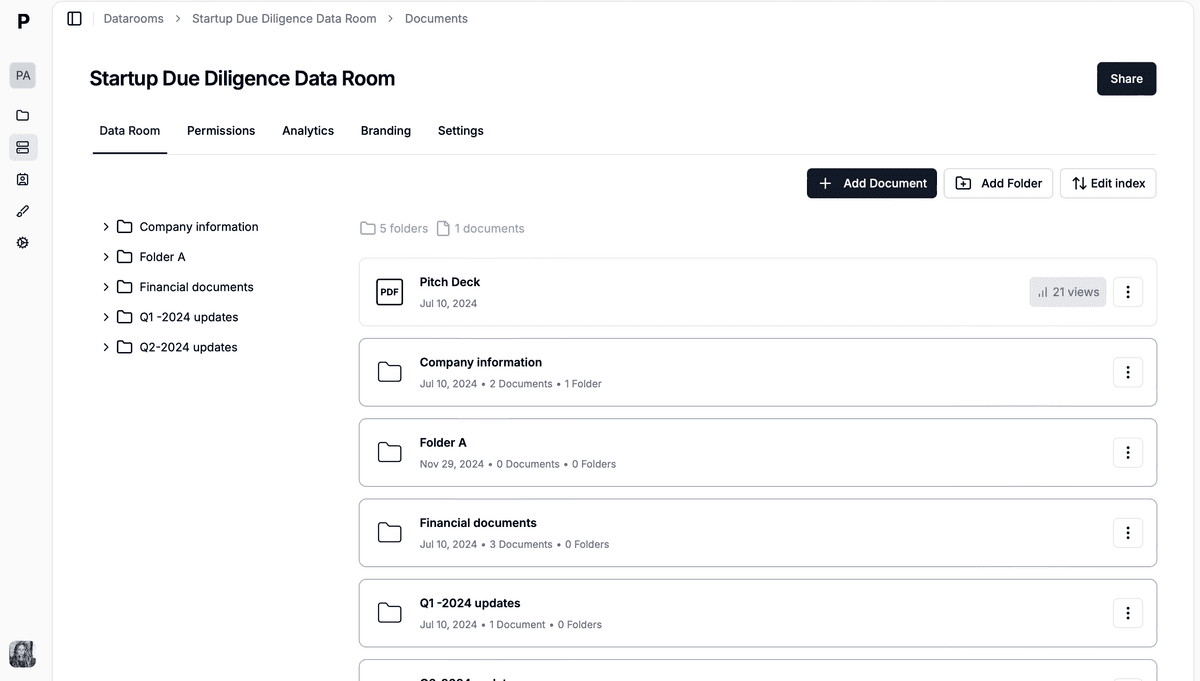
Ten files. The cofounder agreement and the IP assignments are the ones that get read.
A data room for Antler fundraising is similar in stage and different in structure: Antler's UK cheque includes a service fee and a match on the outside round. EF's published shape is 8% plus an optional MFN tied to San Francisco. The startup data room checklist is what you add once customers exist.
EF already has the investment documents. The data room is for the investors you meet after the company exists: angels, seed funds, and anyone EF introduces. They get the deck on the first email. They get the 10 files after a conversation, watermarked, with the cap table download off.
Do not send the room to everyone in the cohort. Cofounder terms are not a community document.
| Link | Contains | Who |
|---|---|---|
| Deck | Story folder only | Intros and first meetings |
| Raise | All 10 files | Investors after a real conversation |
Lumen is a hypothetical pair who met in a London FORM cohort. They incorporate at week 10. The committee invests $125,000 for 8%. They do not take the MFN, because they are not moving to San Francisco yet. The cap table says that in one line, so nobody assumes a second $125,000.
The data room is the 10 files. The prior-employer note says one founder was a researcher and the university has confirmed it has no claim. That single page is what a US angel asks for first.
They send the deck to 18 investors. Seven come back to the product slide. Five get the raise link. Reading time sits on the cofounder agreement and the cap table, which is the right outcome for a company with no revenue. One investor asks for a financial model. They add a one-page spend plan for 12 months, not a five-year forecast, and the other four never ask.
Worked scenario. Share of reading time across the 5 investors who received the full link.
A three-year financial model. You do not have the history EF's investors would check it against. A fake customer list. Cohort charts with one user. Board minutes for a board that has not met. Market-sizing slides as a substitute for a point of view, which belongs in the deck in a few lines, not in a 15-page appendix.
The talent grant does not belong on the cap table. It is not equity. Putting it next to the 8% confuses the only number in the room that is precise.
A data room for your Entrepreneur First fundraise is 10 files and two links. Papermark is a secure, fully customizable, and developer-friendly data room for modern dealmakers, with page-by-page analytics, dynamic watermarking, unlimited data room visitors, and transparent pricing (open-source and self-hosting available). If you are still choosing a platform, our comparison of the best virtual data rooms covers pricing, visitor limits, and analytics across the main providers.
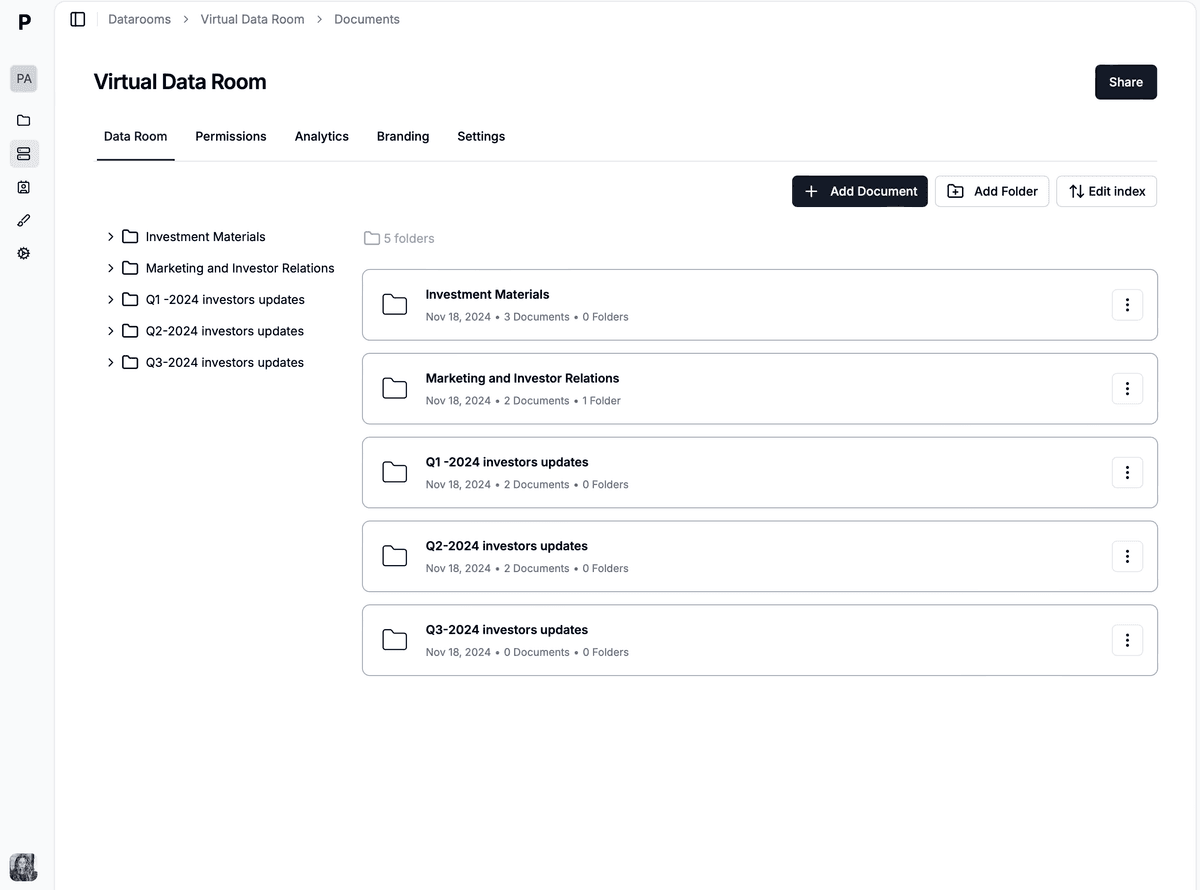
Cofounders, IP, the company, and the deck. That is the whole room.
There is no operating history. Investors are underwriting the two people and the 8%. Extra folders look like padding.
The second cheque is conditional. San Francisco and a Delaware C-Corp are the gate on the MFN. The cap table has to say whether you walked through it.
IP is the whole legal question. Assignments and a prior-employer note are the files that stop a week of email. Page-by-page analytics show whether an investor opened them.
You will add files later. When a customer exists, add a folder. Do not add it now to look further along than you are.
Put the signed SAFE next to the cap table. Name the IP files with each founder's name. Automatic file indexing on Plus is optional at 10 files and useful the moment the room grows.
Dynamic watermarking on the raise link, email verification on, download off on the cap table and the cofounder agreement. Granular permissions do this per link. The deck link stays open and light.
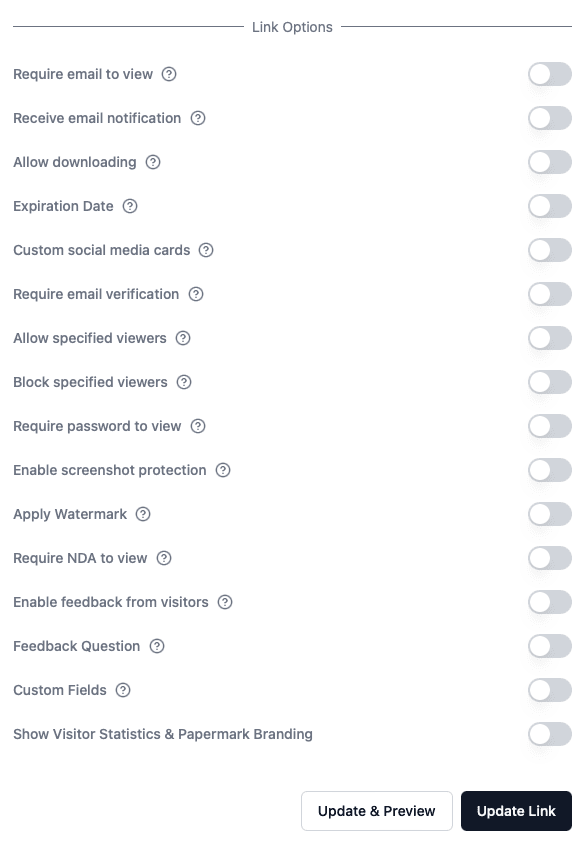
The deck can travel. The cofounder agreement should not.
You are a new company. A generic link makes you look even newer. Custom domains are on the Data Rooms plan. The steps are on custom branding.
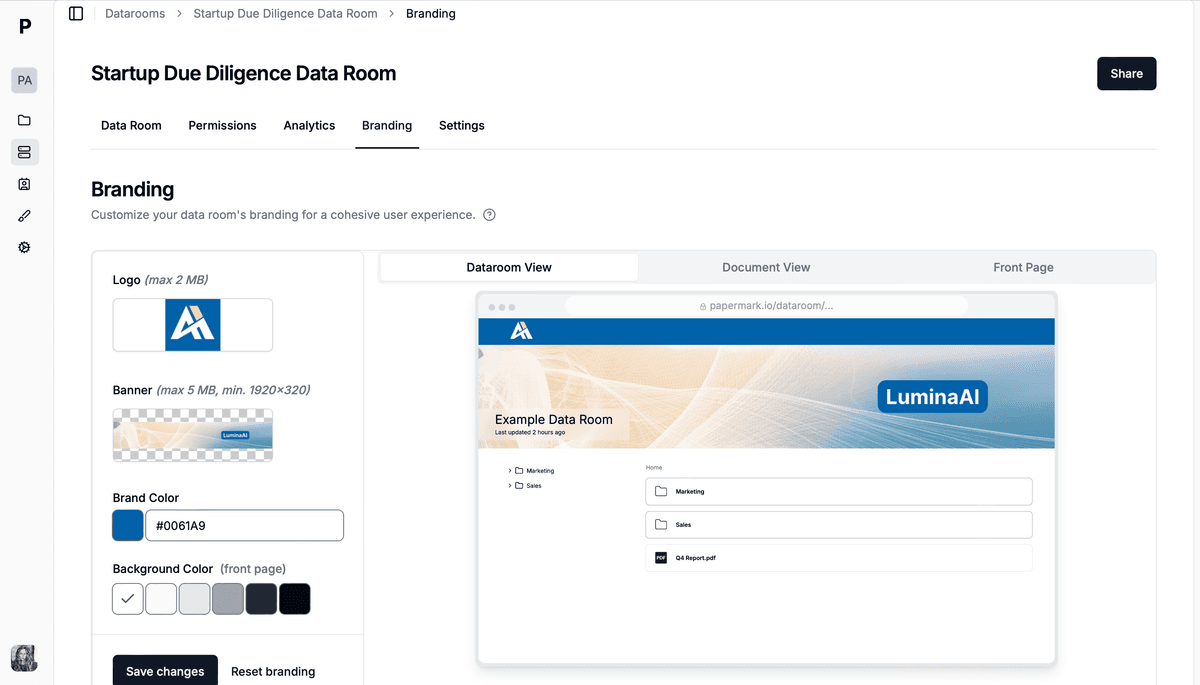
A company domain is part of looking incorporated.
Revoke the raise link. Keep the files. Data room freeze stores what those 5 investors saw, which is the record you will want when the next round asks what you disclosed at pre-seed.
The deck is free to send. The room is €99/month on the Data Rooms plan with a 7-day trial, 3 seats, unlimited data room visitors, and the public API, CLI, and MCP server. Plus is €249/month and adds the audit log. AI redaction is Premium at €549/month and Unlimited at €999/month only.
No credit card required.
A data room for Antler fundraising in 2026: 12 documents for the investment committee, why terms change by city, and the published UK structure of up to £500k.
A data room for Techstars startups in 2026: 20 documents, the $220,000 offer, the checks Techstars runs before it wires, and how the Demo Day links work.
A data room for Seedcamp fundraising in 2026: 18 documents for a process that aims to finish in two weeks, and a first cheque usually between $350k and $1.25M.