





datarooms
Data Room for YC Startups 2026: 24 Documents and the Week You Save
A data room for YC startups in 2026: the 24 documents investors ask for after Demo Day, how it pairs with deck analytics, tiered links, and pricing from €99/month.
A data room for Techstars startups is the file set you need twice: once so Techstars can wire its money, and again so Demo Day investors can confirm the company in a few days. Papermark is a secure, fully customizable, and developer-friendly data room for modern dealmakers. This guide covers the $220,000 offer, the 20 documents, and the two links that keep the raise from leaking.
A Techstars company has two deadlines that look similar and are not. The wire depends on a clean company. The raise depends on a clean story. One data room does both, if you build the legal folder first and the traction folder second.
A data room for Techstars startups is a small, link-shared set of files that answers two readers. Techstars' investment team wants proof the company exists, owns its code, and has a bank account. A Demo Day investor wants proof the numbers in the deck are the numbers in the model.
It is not a virtual data room of the kind a buyer uses to acquire a company. Those rooms run for months and hold hundreds of files. Yours will be open for a program that lasts about 3 months, and most of the outside reading happens in the last 2 weeks. Twenty current documents beat a drive full of drafts.
The order matters. Founders who start with a polished deck and leave IP assignments for later are the ones waiting on the $20,000. Techstars says it signs and wires that amount once the checks are done. The data room is how you hand them over without a week of email.
Techstars publishes the offer on its investment terms page. $220,000 in total for the vast majority of accelerator programs. $20,000 buys 5% common stock through a post-money convertible equity agreement. $200,000 sits in an uncapped MFN SAFE with no valuation cap and no discount. A side letter sets out rights Techstars wants later, including the ability to participate in a future round.
The MFN is the line founders miss. It converts when you raise a priced round of at least $1 million, and it adopts the most favorable SAFE you issued between the start of that MFN and the priced round. A small angel SAFE with a low cap, signed in month two of the program, becomes Techstars' conversion price too. The cap table in the data room has to show every one of those SAFEs, with cap and discount, or the Demo Day conversation starts with arithmetic.
At a $20 million pre-money priced round, Techstars' own example puts the $200,000 MFN at about 1% of additional ownership, on top of the 5% from the convertible equity agreement. Model that before you promise an angel a number you cannot live with.
| Piece | Amount | What it becomes |
|---|---|---|
| Convertible equity agreement | $20,000 | 5% common stock, post-money |
| Uncapped MFN SAFE | $200,000 | Best SAFE terms you issue before a priced round |
| Priced-round trigger | At least $1 million | Both instruments convert in that round |
| Worked example from Techstars | $20 million pre-money | The $200,000 SAFE is about 1% more |
Regional programs are not all on this offer. If your accelerator page shows a different total, use that page. Do not paste the $220,000 line into a deck until you have checked.
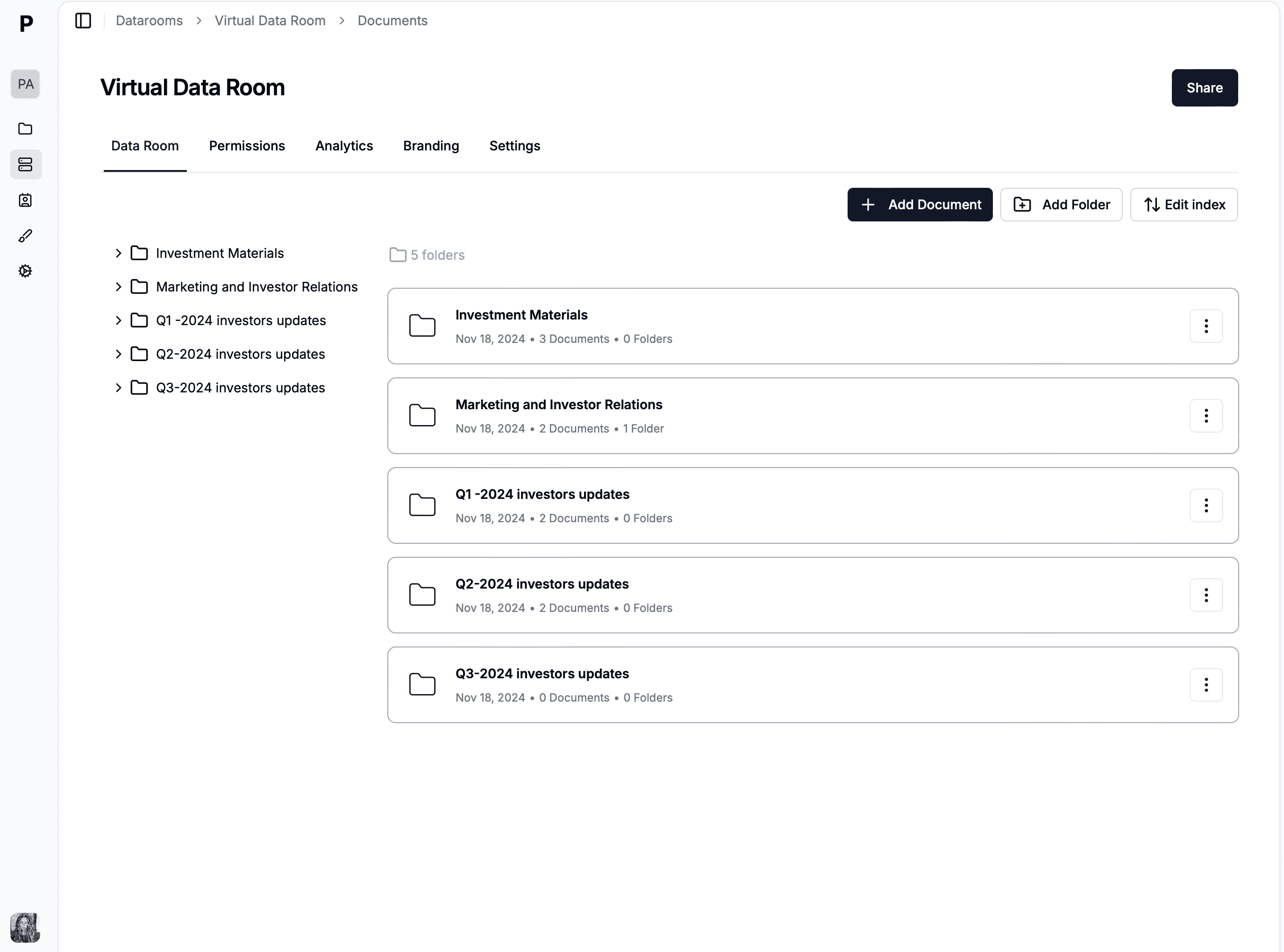
Six folders. The first three are what Techstars needs before it wires. The last three are what investors need after Demo Day. Build them in that order.
01 Company. Certificate of incorporation, charter or bylaws, and a cap table that already includes the 5% and the MFN SAFE, even if the wire has not landed. An investor who builds the table themselves will not include the MFN the way you do.
02 IP and people. A signed assignment from every founder, employee, and contractor, including the friend who wrote the first prototype. This is the check Techstars names. It is also the finding that stalls a seed lead nine months later. An org chart with open roles can sit here. Bios can be one page.
03 Bank and wire. The company account, not a personal one, plus a voided letter or statement that shows the legal name matches the incorporation documents. Mismatched names are a common reason a wire waits.
04 Deck and round. The current deck, a one-pager, and a short note on how much you are raising around Demo Day and on what instrument. The deck in this folder must be the same file as the tracked link you send out. Two versions is how a metric changes between Monday and Thursday.
05 Traction. Monthly revenue if you have it, a cohort or usage export, a customer or design-partner list, and a pipeline snapshot. If you are pre-revenue, say so in a one-page note and put the pilot evidence here instead of an empty spreadsheet.
06 Financials. A monthly burn since the company opened the account, 3 to 6 months of statements once they exist, and a simple runway view through the next 12 months. A five-year model does not help a mentor in week 6.
| Folder | Documents | Count |
|---|---|---|
| 01 Company | Charter, incorporation, cap table with the 5% and the MFN | 3 |
| 02 IP and people | Assignments, contractor agreements, org chart, bios | 4 |
| 03 Bank | Company account proof, name match, wire details | 3 |
| 04 Deck and round | Deck, one-pager, round terms | 3 |
| 05 Traction | Metrics, cohorts or pilots, customer list, pipeline | 4 |
| 06 Financials | Burn, statements, 12-month runway | 3 |
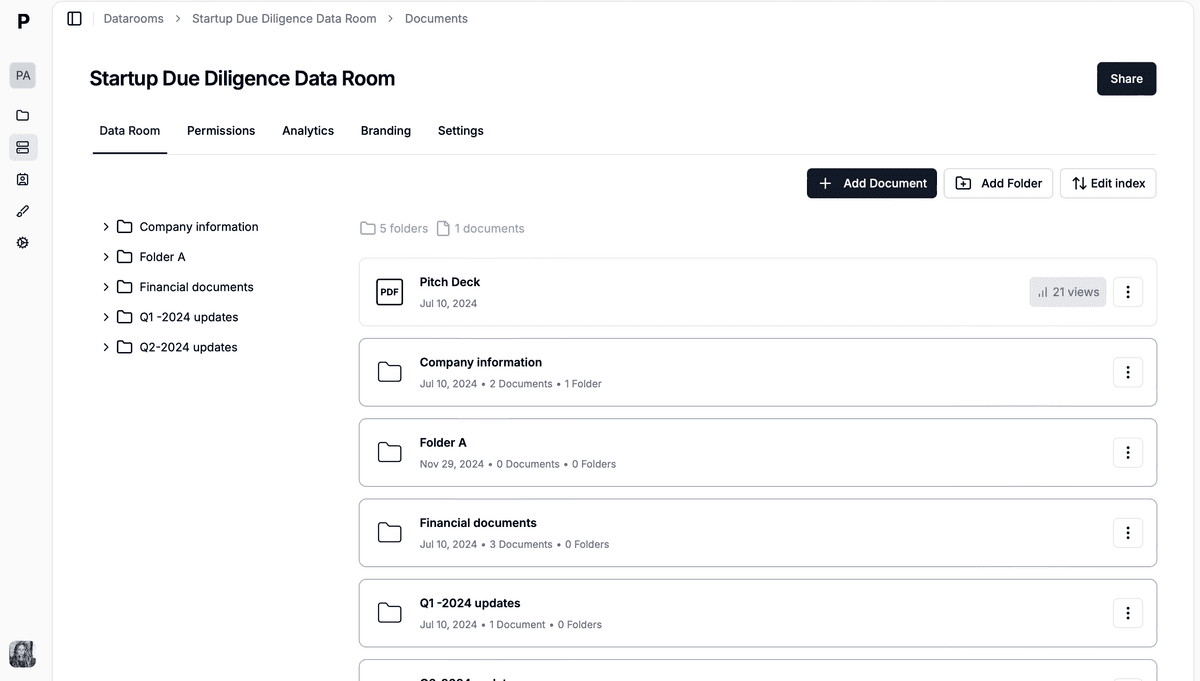
Twenty documents. The first three folders are for the wire. The last three are for Demo Day.
Our startup data room checklist is the version for companies that are not in a program. A data room for YC startups is the closest cousin: same stage, a different standard deal, and a shorter spike around Demo Day. A 500 Global data room is the other close match, with a four-month program and investors spread across more countries.
During the program you will send the deck to mentors, corporate partners, and people who asked for it in a hallway. None of them need the bank folder. After a real investor meeting, the full room is appropriate, with email verification on and download off for financials.
Keep the Techstars investment team on a named link that includes folders 01 to 03 from the day you are accepted. That link is not your Demo Day link. Mixing them means a mentor can forward your wire details.
| Link | Who | Folders |
|---|---|---|
| Program | Techstars investment checks | Company, IP, bank |
| Teaser | Mentors, cold intros, scouts | Deck and one-pager only |
| Investor | After a real meeting | All 6 folders, watermarked |
Set the investor link to expire at the end of the month after Demo Day. Links that stay open get forwarded to a company you will compete with next year.
Harbor Labs is a hypothetical two-founder developer tool, accepted to a Techstars program on the $220,000 offer. They have $9,000 in monthly revenue and one contractor who wrote the billing integration on a handshake.
Week one, the data room has the charter and a cap table that does not yet show Techstars. The IP folder is missing the contractor. Techstars asks for the assignment before the $20,000 wire. The founders get it signed in 4 days and drop it in folder 02. The wire follows the checks, which is the process, not a surprise.
They do not build a 40-file room. They add a monthly cohort export in week 5, when a mentor asks why retention dipped. The same file is still there at Demo Day, so investors are not looking at a new version invented the night before.
Demo Day week, the deck link is opened by 80 people. Nineteen reach the metrics slide and come back. Those nineteen get the investor link. Two ask for the cap table to be updated with an angel SAFE signed in week 8. Because that SAFE has a cap, it is also the terms the MFN can adopt. The founders put the SAFE in the company folder the same day and update the one-pager so the dilution story matches.
Worked scenario, not a Techstars statistic. Share of reading time across the 19 people who received the investor link.
The round they raise around the program is small and on SAFEs. The room's job was to make the 5% and the MFN visible before anyone modeled ownership from the deck alone.
The first is treating the investment checks as paperwork for later. Incorporation, IP, ownership, and the company bank account are the gate on the $20,000. A deck does not open that gate.
The second is a cap table that hides the MFN. Founders show the 5% and forget that a cheap SAFE signed during the program sets Techstars' conversion as well.
The third is one Google Drive folder shared with the mentor list and the investor list. Bank details and customer names do not belong in that distribution. There is no watermark and no way to see who actually read the metrics.
The fourth is rebuilding the room the week of Demo Day. The cohort file you add in week 5 is the one investors trust. A file exported the night before, with a different revenue definition, is the one they challenge.
A data room for your Techstars startup should be up in the first week, with the legal folders complete and the deck on its own link. Papermark is a secure, fully customizable, and developer-friendly data room for modern dealmakers, with page-by-page analytics, dynamic watermarking, unlimited data room visitors, and transparent pricing (open-source and self-hosting available). The program link and the Demo Day link are two doors on one room. The Papermark page for Techstars startups covers the setup for program companies.
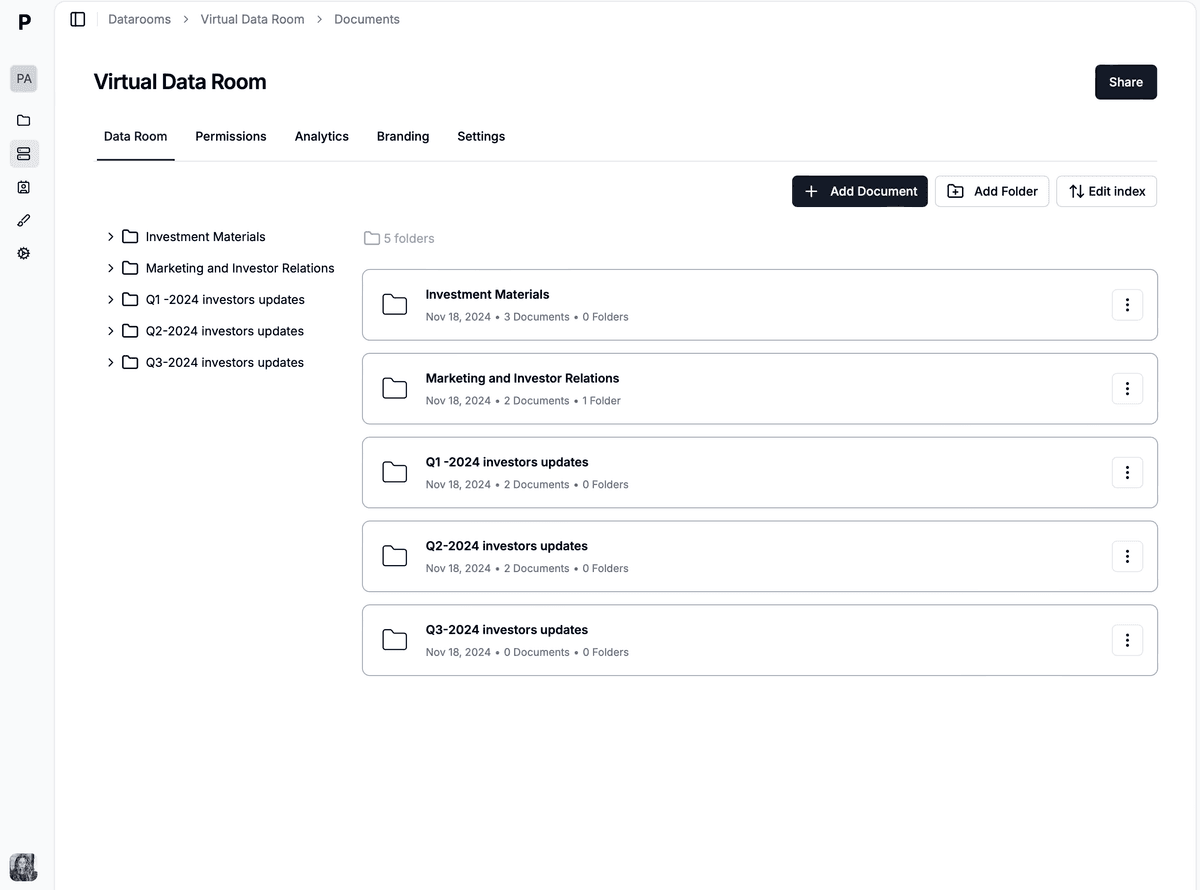
Six numbered folders. The Techstars team and Demo Day investors do not use the same link.
The wire has a checklist. Background, incorporation, ownership, IP, and a company account are documents, not vibes. A folder Techstars can open beats a zip file named "final".
Demo Day is a spike, not the whole program. You will have sent the deck to mentors for weeks. Those opens should not include financials. A teaser link and an investor link are the split.
The MFN makes versions dangerous. If the cap table changes in week 8, every investor still holding an old link is looking at the wrong company. One room, updated once, is the fix.
You can see who to follow up. Page-by-page analytics show who reached the metrics slide. In a week with dozens of conversations, that list is the follow-up list.
Number them so they sort. Upload the company, IP, and bank folders first, even if traction is thin. Name files with the company and the date. Automatic file indexing on Data Rooms Plus keeps the index current when you add the angel SAFE later.
The program link is a named allowlist for folders 01 to 03. The teaser is the deck only. The investor link is all six folders, with dynamic watermarking and email verification on, and download off on financials. Granular permissions are per link, so nobody creates an account to open a PDF.
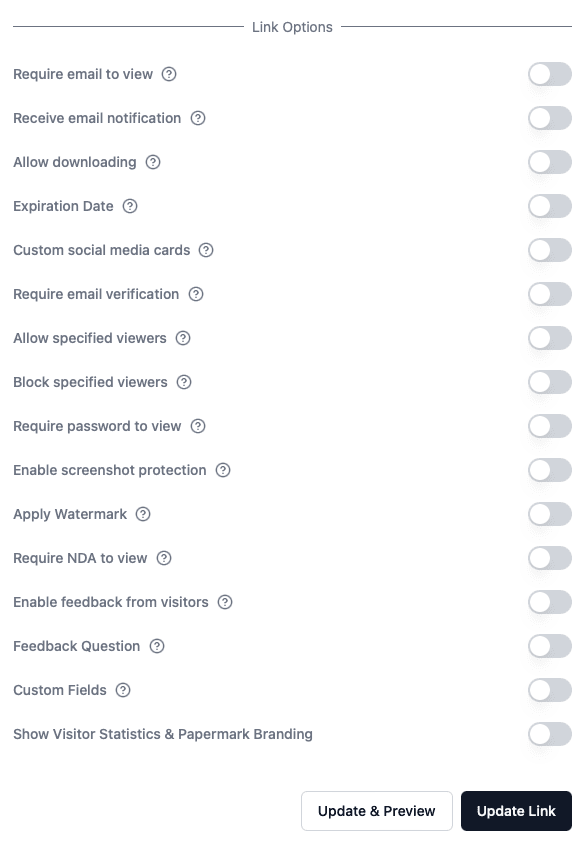
Three links, one room. Bank details stay on the program link.
Put the room on your domain. Custom branding is on the Data Rooms plan, and the setup is covered on custom branding. Share the deck from the same account so you can see who came back to the metrics slide before you send the investor link. How to track activity on your pitch deck is the longer note on reading those numbers.
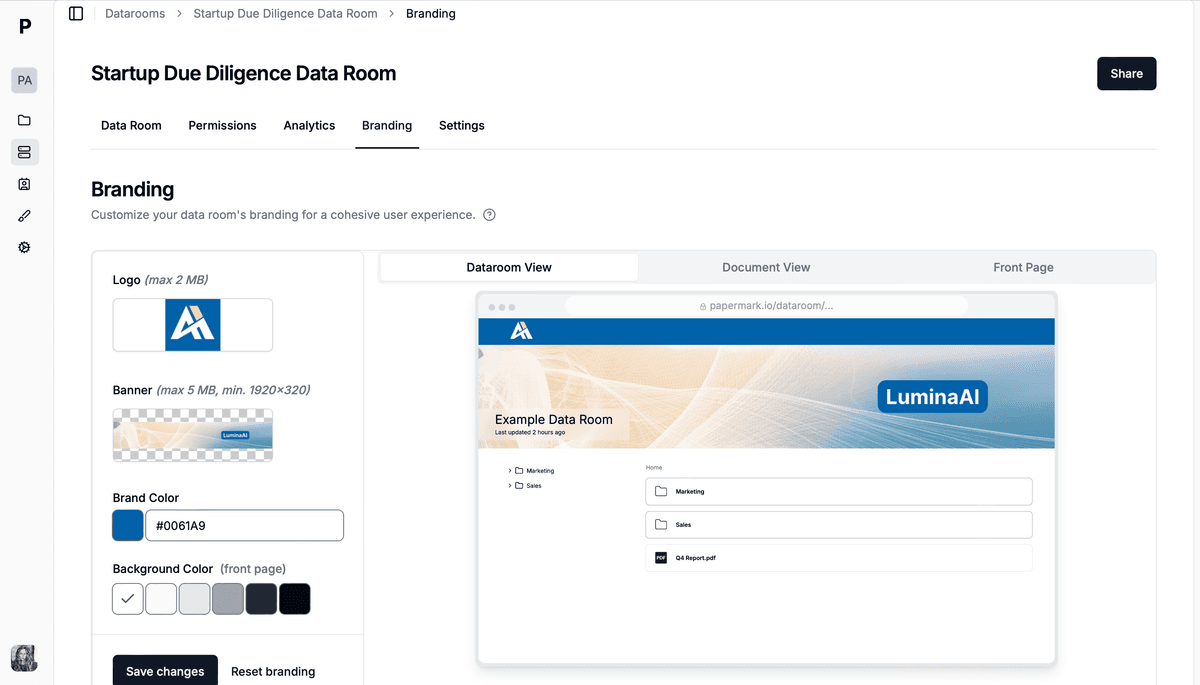
The first screen an investor sees should be your company, not a generic file host.
Revoke it when the round is done. Keep the room. Data room freeze archives what each investor saw, which is the record you want when a later lead asks what you showed at Demo Day.
The free plan is €0 and is enough for a tracked deck. Full data rooms start on the Data Rooms plan at €99/month with a 7-day trial: 3 team members, unlimited data room visitors, unlimited storage, a custom domain, dynamic watermarking, NDA agreements, granular permissions, and the public API, CLI, and MCP server. Data Rooms Plus at €249/month adds Q&A, the audit log, automatic file indexing, and SOC 2 Type II. Premium at €549/month adds AI redaction. Data Rooms Unlimited at €999/month drops per-seat charges and includes AI redaction. AI redaction is not on the €99 or €249 plan.
No credit card required.
A data room for YC startups in 2026: the 24 documents investors ask for after Demo Day, how it pairs with deck analytics, tiered links, and pricing from €99/month.
A data room for Entrepreneur First fundraising in 2026: 10 documents for a brand-new company, the offer of up to $250,000, and the 8% post-money SAFE.
A 500 Startups data room in 2026: the 22 documents accelerator founders need, cross-border diligence, tiered investor links, and setup from €99/month.