



datarooms
DealRoom VDR Review 2026: Features, Pricing, and 4 Alternatives
An honest 2026 review of DealRoom VDR: real features, custom pricing from $2,000 per deal, strengths, weaknesses, and 4 alternatives for M&A and fundraising.
Datasite is an enterprise virtual data room built for investment banking and large-cap M&A, sold on a custom quote rather than a published price. This Datasite review covers what the platform does well, what the per-page pricing model actually costs on a real document set, and how seven alternatives compare.
| # | Provider | Starting price | Pricing published? | Best for |
|---|---|---|---|---|
| 1 | Papermark | From €99/month (7-day trial) | Mid-market M&A, fundraising, advisors who want a fixed monthly number | |
| 2 | Datasite | Custom quote (~$0.40 to $0.85 per page, $25,000+/year typical) | Large-cap sell-side M&A run by a bank | |
| 3 | Intralinks | Custom quote (~$10,000 to $200,000+/year) | Regulated, syndicated and cross-border transactions | |
| 4 | iDeals | Custom quote (30-day free trial) | Mid-market deals wanting fence view and Q&A | |
| 5 | Firmex | Custom quote (entry subscriptions reported at $625 to $995/month) | Advisory firms running several rooms a year | |
| 6 | Ansarada | Custom quote | Deal-readiness scoring before a sale process | |
| 7 | SecureDocs | From $450/month | Single transactions with a short timeline | |
| 8 | DocSend | From $250/month (Advanced, 3 users) | Pitch deck tracking rather than full diligence |
No credit card required.
How this review was built. Datasite does not publish a price list, so the cost figures here come from vendor-verified industry reporting and buyer accounts rather than from a Datasite rate card, and they are labelled as such throughout. Ratings are taken from G2 with review counts, verified in 2026. Competitors are described neutrally and factually, with at least one honest limitation each.
Datasite is the virtual data room formerly known as Merrill DataSite, part of Merrill Corporation before the company rebranded in 2020. It sits at the enterprise end of the market: the rooms it hosts are typically large sell-side M&A processes, carve-outs, and capital markets transactions run by an investment bank or a corporate development team, not by a founder raising a seed round.
The product line is broader than a single data room. Datasite Diligence is the VDR itself, the piece most people mean when they say Datasite. Around it sit Datasite Prepare for organising documents before a process opens, Datasite Acquire for buy-side pipeline work, and Datasite Outreach for managing the marketing phase of a sale. Buying the suite is part of the pitch, and part of the price.
The typical buyer is an M&A team that runs several processes a year and has a procurement function that is comfortable with a sales cycle. Datasite is not a self-serve product. There is no signup page that ends in a working data room; every engagement starts with a call, a scoping exercise around page counts and duration, and a quote. That model suits a bank running a $500M sale and suits almost nobody running a $15M one.
On G2, Datasite Diligence holds 4.5 out of 5 from 399 reviews as of 2026. Reviewers consistently praise the bulk upload and indexing tooling and the responsiveness of the project support team. The recurring criticisms are equally consistent: cost, the opacity of the quote, and an interface that carries a learning curve for occasional users.
Datasite does not publish pricing. The model that circulates in vendor comparisons and buyer accounts is a per-page one inherited from the physical data room era, where a room was quoted on the volume of paper it held. Reported rates sit in the $0.40 to $0.85 per page range depending on file type, total volume, and negotiated terms, with roughly $0.60 the figure quoted most often.
That model has one consequence worth understanding before a quote lands. The cost of the room is driven by how many pages the seller uploads, and the seller does not control that number well. A 12,000-page diligence set is not unusual for a mid-market industrial business once you include contracts, HR files, permits, and five years of statements. At $0.60 a page, that is $7,200 in upload charges before a single bidder opens a document.
Alongside per-page charges, engagements are commonly structured as subscriptions with a defined duration. Industry reporting puts a typical Datasite deal room at $25,000 or more per year, with large processes reaching $50,000 to $100,000 and above. Extensions past the contracted duration, additional storage, and additional administrative users are the three line items that most often push a final invoice above the quoted one.
| Cost element | How it is charged | What buyers report |
|---|---|---|
| Page volume | Per page uploaded, by file type | $0.40 to $0.85 per page, commonly around $0.60 |
| Room subscription | Per project, for a fixed duration | $25,000+/year typical, $50,000 to $100,000+ on large processes |
| Duration extension | Per additional month or quarter | Negotiated separately, rarely priced in the original quote |
| Storage overage | Per GB above the contracted tier | A common source of variance on document-heavy deals |
| Professional services | Per engagement | Project management and onboarding, bundled or itemised by quote |
The comparison that matters is not Datasite against a cheaper enterprise VDR. It is the per-page model against a flat monthly one. A flat subscription prices the room, not the paper, so a 12,000-page set and a 2,000-page set cost the same. On a document-heavy process that difference is usually larger than any feature gap.
Pricing transparency splits this market almost down the middle, and it correlates closely with which end of the market a provider sells into. The chart below maps every provider in this guide to whether its pricing is published or reachable only through a sales conversation.
Based on each vendor's own pricing page, checked in 2026. Custom-quote providers publish no rate card; the figures quoted for them in this guide come from industry reporting and buyer accounts.
Three of the eight let a buyer size a budget without talking to anyone. The other five require a discovery call, which is fine when you are a bank with a procurement team and expensive when you are a founder trying to work out whether a data room fits in this quarter.
Two capabilities genuinely distinguish Datasite from a general file-sharing tool, and both address the part of a sale process that consumes the most junior banker hours.
The first is AI-assisted redaction. Diligence sets are full of documents that cannot be shown as they stand: employment contracts with salaries, customer agreements with named counterparties, supplier terms with pricing. Datasite applies machine learning to find and mask those elements across a document set rather than requiring a person to work page by page. On a large room this is the single feature that changes how long preparation takes.
The second is automated indexing and categorisation. Uploaded documents are classified, OCR-processed, and slotted into an index structure, which matters when a seller dumps 12,000 pages into a room three weeks before a management presentation. Around those two sit the features every enterprise VDR carries: granular permissions, dynamic watermarking, Q&A with role-based routing, full-text search, and group-level activity reporting.
The honest limitation is that none of this is available to evaluate before you buy. There is no trial that ends in a working room, so the decision to adopt Datasite is made on a demo and a reference call rather than on your own document set.
Northline Partners is a hypothetical boutique advisory firm in Manchester running the sale of a €40M revenue packaging business. The diligence set, once the seller has finished scanning, runs to about 11,400 pages across 620 documents: statutory accounts, management packs, 140 customer contracts, employment files for 210 staff, environmental permits, and a property portfolio.
The process is expected to run seven months from teaser to completion, with an initial round of nine bidders narrowing to three for confirmatory diligence. Northline needs one room, three access tiers, watermarking on everything, and a Q&A log it can hand to counsel at signing.
Priced on the reported Datasite model at $0.60 a page, the 11,400-page set carries roughly $6,840 in upload charges alone. Add a room subscription in the range industry reporting associates with a mid-market process and a seven-month duration rather than a three-month one, and Northline is budgeting five figures before it has decided whether the seller will add a second tranche of contracts in month four. If the seller does add them, and sellers usually do, the number moves again.
Priced on a flat monthly subscription, the same room is a fixed line. Papermark's Data Rooms plan is €99 a month with unlimited documents and no per-page charge, so seven months is €693 regardless of whether the page count is 11,400 or 22,000. Northline's decision then turns on features rather than on arithmetic: does it need AI redaction badly enough to pay for it, and does the buy side expect a bank-standard room.
For this deal the firm chose the flat plan and redacted the 140 customer contracts manually over four days of paralegal time. On a $500M process with 90,000 pages, the same firm would reach the opposite conclusion, and that is the real dividing line in this category.
Website: papermark.com
Pricing: From €99/month on the Data Rooms plan, with a 7-day free trial. Free plan available.
Papermark is a secure, fully customizable, and developer-friendly data room built for modern dealmakers, with page-by-page analytics, dynamic watermarking, and transparent pricing from €99/month. It is the direct structural opposite of the Datasite model: the price is on the website, the room is running in minutes, and the number does not move when the seller uploads another 4,000 pages. It is also open-source and self-hostable for teams that need full data sovereignty.
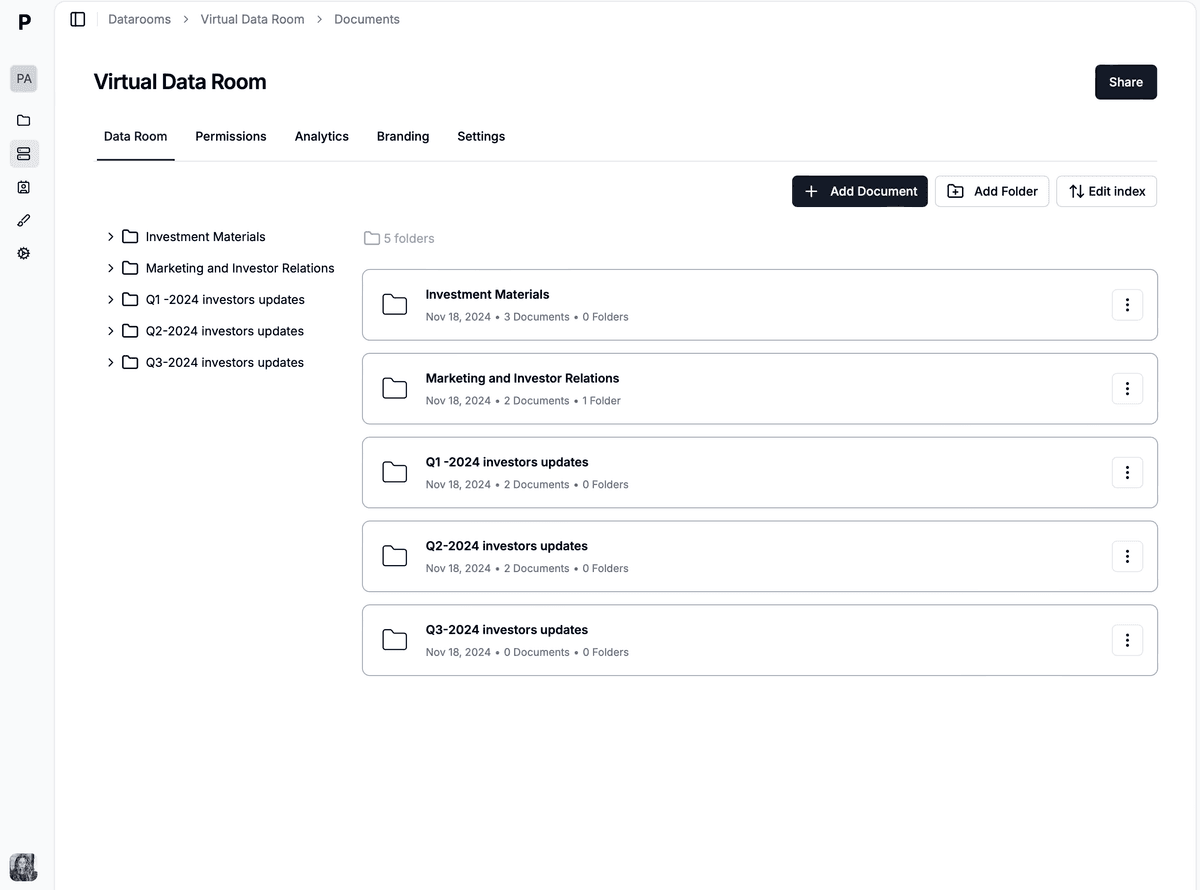
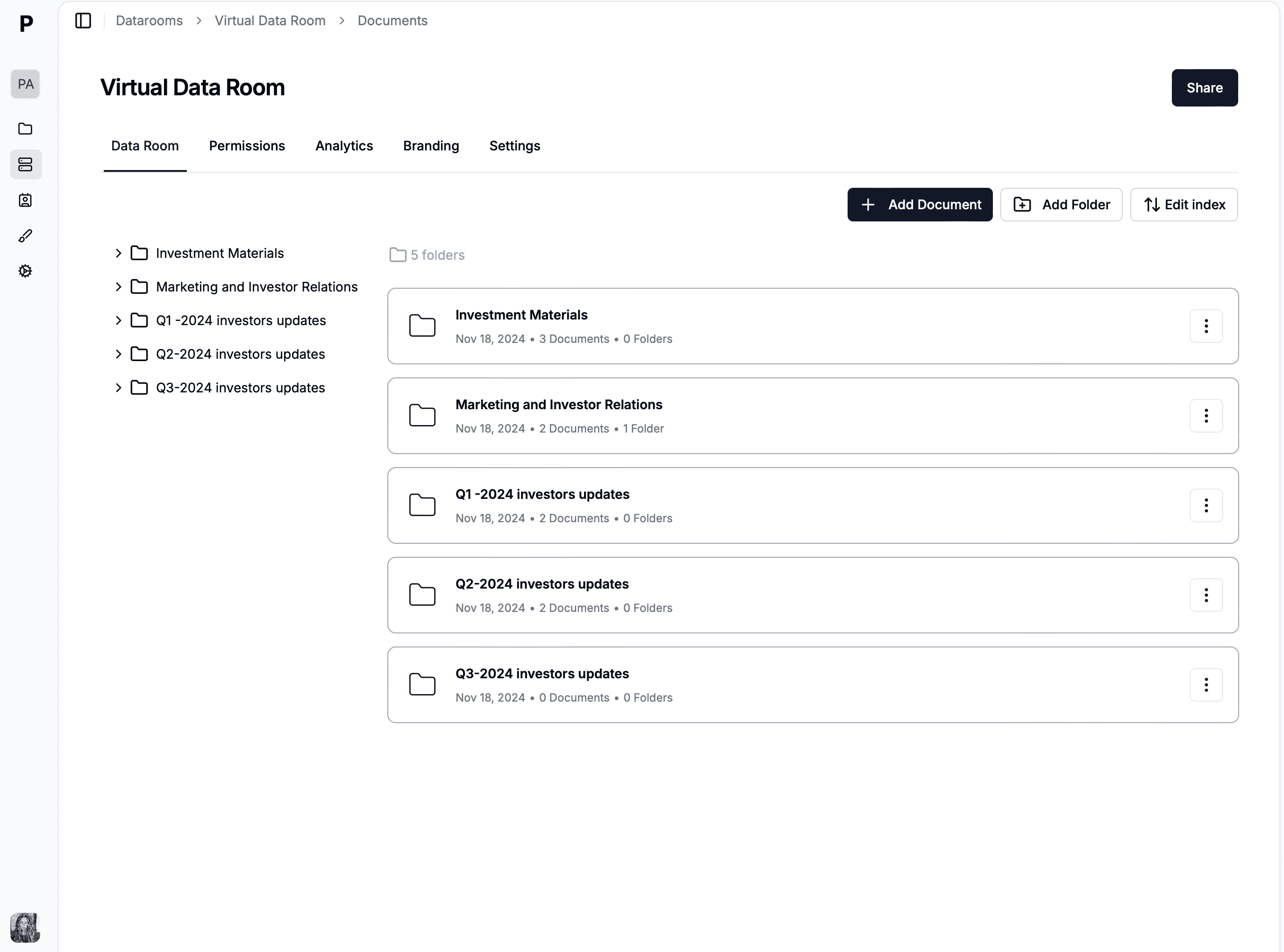
A Papermark data room organised by diligence workstream, with permissions set per link rather than per user.
Analytics is the feature most Datasite buyers are surprised to find at this price point. Papermark shows which viewer opened the room, which document and which page they spent time on, how long they lingered, and whether the link was forwarded. On a sell-side process that is a live read on bidder intent: the party spending forty minutes in the customer contracts folder is the one whose questions arrive next week.
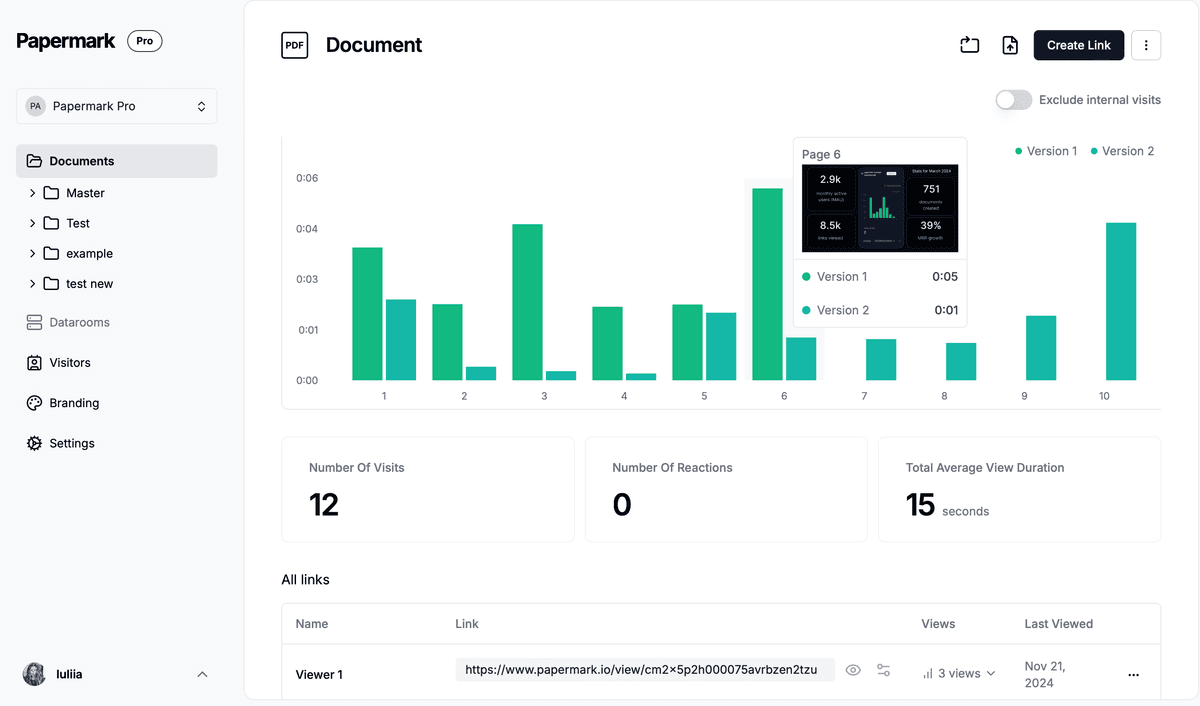
Page-level analytics are native to every plan rather than an enterprise reporting add-on.
Papermark covers the controls diligence counterparties ask about: dynamic watermarking that stamps each viewer's email, IP address, and timestamp onto every page as it renders, view-only mode with screenshot protection, one-click NDA gating before access, granular file and folder permissions per viewer group, password protection, email verification, and instant link revocation. Encryption is AES-256 at rest and TLS in transit, EU hosting in Frankfurt is available, and every view, download, and NDA acceptance lands in an exportable audit log. SOC 2 Type II sits on the Data Rooms Plus plan and above; GDPR, HIPAA, and CCPA compliance apply across the platform. The full list is on the security page.
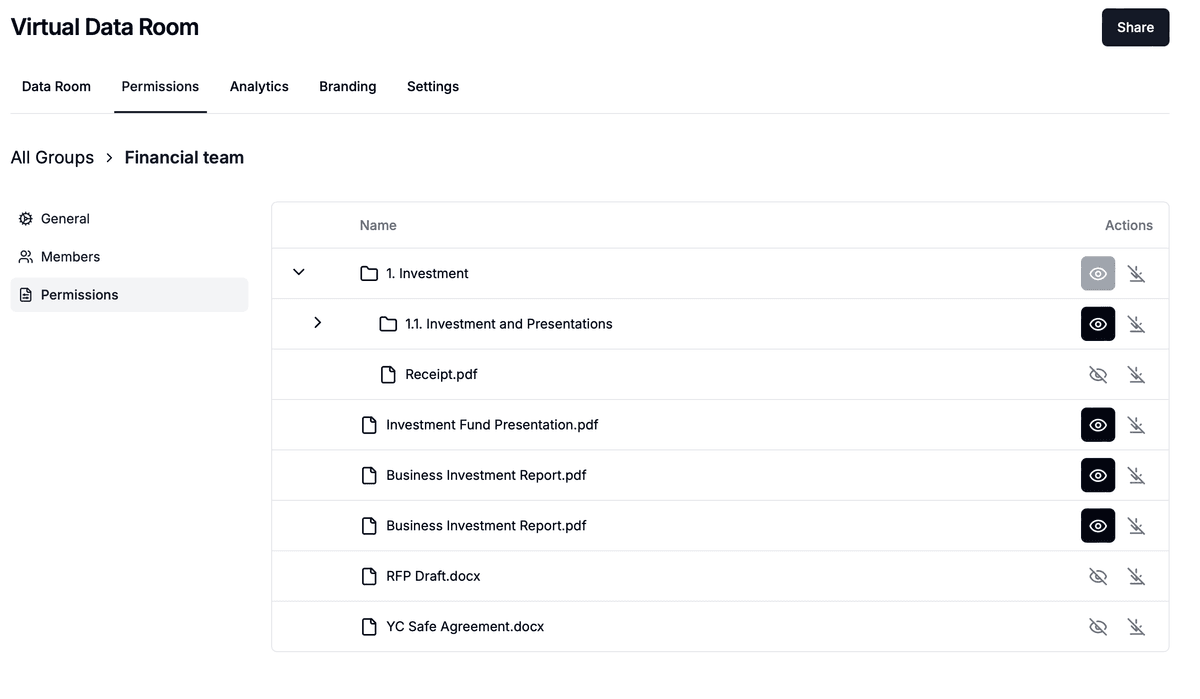
Permissions are set per link, so nine first-round bidders and three confirmatory ones see different folders of the same room.
Every room can run on your own custom domain with your logo, colours, and layout, and with Papermark branding removed entirely. Advisory firms use this to give each client a room that carries the client's brand rather than a vendor's, which is the same thing enterprise VDRs charge a white-label uplift for.
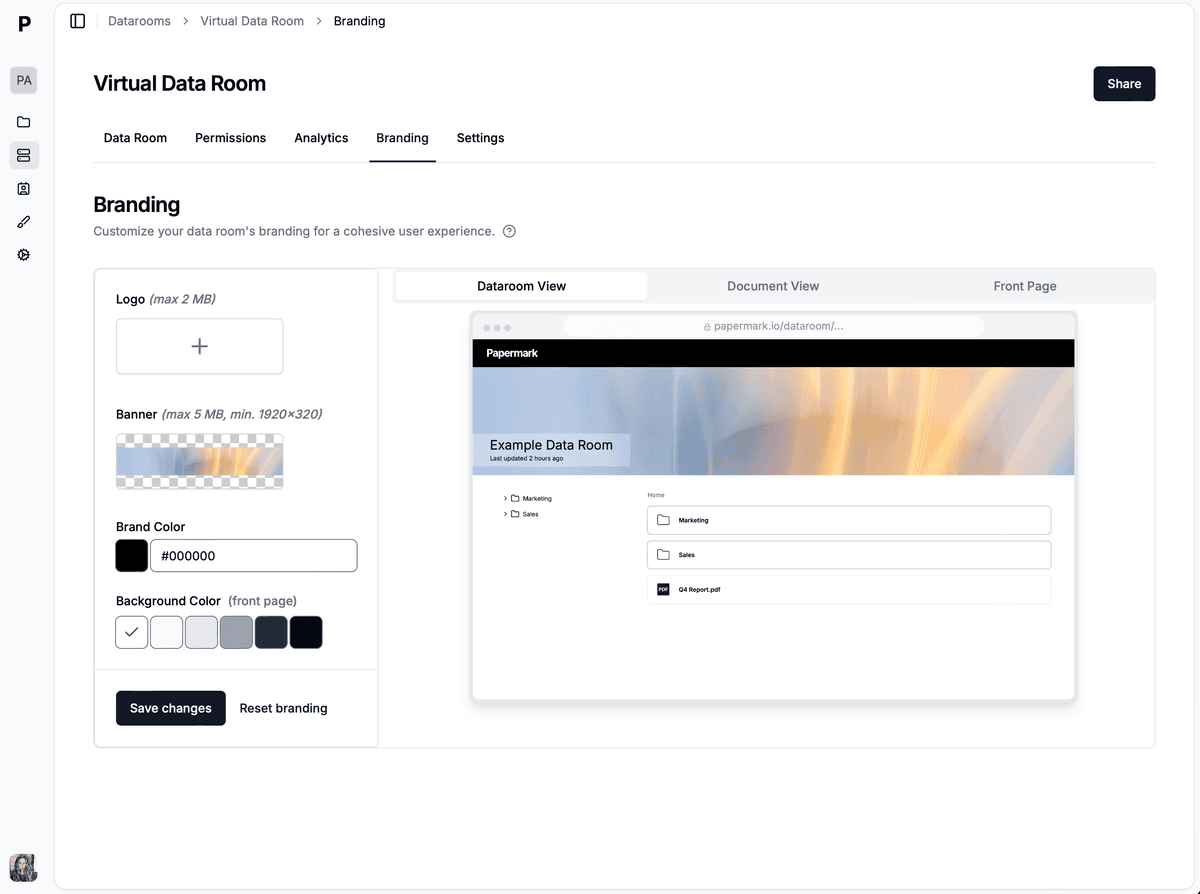
White-labelling and custom domains for data rooms are included from the €99/month plan.
The Data Rooms plan is €99/month with a 7-day free trial and includes 3 team members, unlimited data room visitors, unlimited data rooms, unlimited documents, a custom domain, dynamic watermarking, NDA agreements, and granular file-level permissions. Data Rooms Plus at €249/month adds 5 team members, the Q&A module with permissions, the visitor audit log, automatic file indexing, and SOC 2 Type II. Data Rooms Premium at €549/month covers 10 team members plus AI redaction, full API access, SSO, whitelabeling, and advanced security controls. Data Rooms Unlimited at €999/month removes per-seat charges entirely for unlimited team members, and adds self-hosted deployment and a bring-your-own AWS bucket.
Papermark rates 4.9/5 across 171 reviews on G2, Product Hunt, and community feedback, verified in 2026, and is used by 70,000+ companies. The honest limitation against Datasite: there is no AI-assisted redaction engine, so a room with hundreds of contracts that need masking is manual work, and Papermark does not carry the brand recognition that a bulge-bracket buy side sometimes expects on a nine-figure process.
Website: datasite.com
Pricing: Custom quote. Reported per-page rates of $0.40 to $0.85, with typical deal rooms at $25,000+/year.
Datasite Diligence is the enterprise VDR covered in detail earlier in this review. The strengths are AI-assisted redaction, automated indexing and OCR across large uploads, mature Q&A routing, and a project support team that works alongside the deal team. It rates 4.5/5 from 399 G2 reviews.
Limitations: pricing is quote-only and page-driven, so document-heavy sellers carry the cost of their own thoroughness; there is no self-serve trial; duration extensions and storage overages are frequent sources of invoice variance; and reviewers describe a learning curve for occasional users. For an itemised cost breakdown see our Datasite pricing review, and for switching mechanics see transitioning from Datasite to Papermark.
Website: intralinks.com
Pricing: Custom quote. Industry estimates range from $10,000 to $200,000+ per year.
Intralinks is a long-established VDR used on regulated, syndicated, and cross-border transactions, with AI-assisted redaction, automated indexing, Q&A workflow, granular permissions, and group-level activity reporting. It is a common default where counsel has used it before.
Limitations: no published pricing, onboarding that typically takes two to three days with a representative, limited custom branding relative to modern tools, and additional fees for storage overages, extra users, and duration extensions. See Intralinks alternatives for the comparison set.
Website: idealsvdr.com
Pricing: Custom quote across three tiers, with a 30-day free trial.
iDeals is a mid-market VDR with granular permissions, fence view, multi-factor authentication, dynamic watermarking, an integrated Q&A module, and mobile apps. The 30-day trial is longer than most and does let a team test on its own documents.
Limitations: pricing is quote-only with no public rates, advanced features sit on higher tiers, and lower tiers carry upload limits that document-heavy diligence sets hit quickly. Our iDeals pricing guide covers what buyers report.
Website: firmex.com
Pricing: Custom quote. Entry subscriptions are reported at $625 to $995/month; unlimited-room plans are quoted individually.
Firmex sells both per-transaction rooms and unlimited-room subscriptions, which suits advisory firms running several processes a year. Features include dynamic watermarking, document-level permissions, Q&A, and project management tooling.
Limitations: Firmex publishes plan tiers but not the numbers underneath them, so every budget starts with a discovery call, and the reported entry rates are buyer accounts rather than a vendor rate card. Detail is in our Firmex pricing breakdown.
Website: ansarada.com
Pricing: Custom quote.
Ansarada pairs a VDR with deal-readiness scoring, which grades how prepared a seller is before a process opens. That is genuinely useful for a company preparing for a sale twelve months out rather than one already in market.
Limitations: pricing moved to quote-only, historic plans were tiered by storage in gigabytes rather than by users, and the readiness tooling is of little value to a buyer who only needs a room for a live transaction. See our Ansarada pricing overview.
Website: securedocs.com
Pricing: From $450/month, a subscription fee with unlimited users and storage. 14-day free trial.
SecureDocs publishes a price, which puts it in the minority here, and includes unlimited users and storage in the subscription. Rooms can be stood up quickly, which suits a single transaction on a short timeline.
Limitations: the feature set is deliberately narrow compared with enterprise VDRs, with lighter analytics and branding, and the entry price is roughly four and a half times the cheapest published mid-market plan for a comparable single room. Detail is in our SecureDocs pricing review.
Website: docsend.com
Pricing: From $250/month on the Advanced plan for 3 users, with additional users at $90/month.
DocSend, owned by Dropbox, is a document-tracking product rather than a diligence VDR. The Advanced plan adds watermarking, viewer verification, one-click NDAs, unlimited deal rooms, and eSignature, and it is a reasonable fit for pitch deck distribution.
Limitations: per-user pricing escalates quickly on a deal team, the data room features are lighter than a purpose-built VDR on permissions and Q&A, and the $90 per additional user charge is the line item most teams underestimate. See Papermark vs DocSend for the feature-by-feature comparison.
The decision comes down to three questions, and only the first one is really about features.
How many pages will the room hold, and who pays for them? If the answer is tens of thousands of pages and the fee is being passed to a client or absorbed into a transaction fee, per-page pricing is survivable. If the answer is a five-figure page count on a mid-market deal funded from your own P&L, a flat monthly plan removes the variable entirely.
Does the buy side expect a specific room? On large-cap processes, buy-side counsel occasionally has a house preference, and there is no point fighting it. Below roughly $100M in enterprise value that expectation largely disappears, and the seller picks. If you are still deciding, our comparison of the best virtual data rooms covers pricing model, bidder management, and compliance across the wider provider set.
How much preparation work do you actually have? AI-assisted redaction is worth real money when hundreds of contracts need masking. It is worth nothing when the seller has forty documents. Buyers routinely pay for enterprise preparation tooling they never use, then discover the analytics they wanted were the thing they should have shopped for.
| If this is true | Lean towards |
|---|---|
| Large-cap sell-side, bank-run, 50,000+ pages | Datasite or Intralinks |
| Mid-market M&A, predictable monthly cost matters | Papermark |
| Hundreds of contracts need redacting before launch | Datasite |
| You want to test on your own documents before paying | Papermark or iDeals |
| Several rooms a year across a small advisory firm | Papermark or Firmex |
| One deal, short timeline, no branding requirement | SecureDocs |
| Pitch deck distribution rather than diligence | DocSend or Papermark |
| You need self-hosting or EU data residency | Papermark |
Papermark gives you a working secure data room on your own documents inside a 7-day trial, which is the fastest way to answer the third question without a procurement cycle.
An honest 2026 review of DealRoom VDR: real features, custom pricing from $2,000 per deal, strengths, weaknesses, and 4 alternatives for M&A and fundraising.
Honest Merrill VDR review for 2026: features, pricing, pros and cons of Merrill DataSite (now Datasite), and 5 modern alternatives led by Papermark at €99/mo.
HighQ Dataroom review for 2026: features, real pricing estimates, honest pros and cons, and 5 legal VDR alternatives including a data room from €99/month.